#oneaday Day 636: Esoteric Ebb and Flow

Well, my original plan was to play at least one of the bonus episodes of Resident Evil Revelations this evening, but then I was distracted by some screenshots of a game that apparently came out recently, and which I hadn't previously heard of: Esoteric Ebb by Christoffer Bodegård, published by the "indie publisher to watch" of the moment, Raw Fury.

Here's one of the screenshots that convinced me to buy and play this game:

If you're looking at that and thinking something along the lines of "cor blimey guvnor, that sure does look like Disco Elysium and no mistake", you'd be absolutely right. The game isn't trying to hide its inspiration. But the other thing you may well notice from this screenshot is that this is Disco Elysium, But Fantasy.

In Esoteric Ebb, you play the role of The Cleric, an ostensible agent of the government who has been sent in to investigate an explosion in a local teahouse. As befits a CRPG hero, whether or not you actually get stuck right in to this "main quest" is entirely up to you, because the small but well-crafted world of Esoteric Ebb certainly has lots of distractions. You do have a time limit, though; the setting is having its first ever democratic election in five days' time, and the current sitting government would really rather all this unpleasantness was quietly dealt with before that happens.

If you've never played Disco Elysium (or, indeed, games like it, since they appear to be Becoming a Thing right now) the simple pitch is this: they're a cross between classic "Infinity Engine" RPGs like Baldur's Gate, Planescape Torment and the like, with almost all of the combat removed, and a strong emphasis on the game responding to you a bit more like a human dungeon master during a tabletop gaming session would. That means all of your stats get a workout, with most sequences in the game involving either passive skill checks (which you will just automatically pass or fail based on your current stats) or active skill checks (where you roll a die and your stats can potentially boost or penalise the score).

Crucially, failure is not necessarily a bad thing, because it can lead to amusing situations or alternative solutions — much as real tabletop sessions are often at their best when things get a little improvisatory.

Skill checks are only half the story, though. The other defining feature of a game following the Disco Elysium mould is that your stats "talk" to you, reflecting your character's often conflicted inner monologues about the situations in which they find themselves. Exactly how helpful you will find these "Chimes", as Esoteric Ebb calls them, depends on those aforementioned passive skill checks; failure often means you misinterpret a situation, fail to notice something or do something clumsy, depending on the context, while success can mean anything positive: performing a complicated physical task correctly, finding just the right words to say in an awkward situation, feeling empathy for the person you're talking to.

Esoteric Ebb adds a few additional features atop this, too. One of the most notable is that you can examine any of the interactable characters, and a skill check of variable difficulty (with the exact stat being tested depending on the character you're examining) will determine how much information you can tell about them just from looking at them. Failing to pass the check at all means you just about notice their basic appearance; passing higher difficulty level checks will let you know their level, class, stats and even pieces of information they would rather remain hidden — you might recognise someone who is trying to conceal their identity, for example. These pieces of information can often be used in conversation.

Other interesting features are the interconnected web of quests in place of the usual quest journal; this indicates how various happenings around the city relate to one another, and upon successfully finishing one of the major quests, you then get to reflect on the situation and allow your stats to "debate" one another, with the eventual result being a nice chunk of experience and a new feat based on the eventual conclusion you came to. In this way, there's a real sense you're building your character just by playing the game; you do "level up" in a conventional RPG style, and you can increase one of your stats when you do so, but it's not just about gaining experience — and, indeed, given that it's a game where it's impossible to grind, you're best off just exploring the world and seeing what happens.

This can, of course, sometimes have fatal consequences in unusual ways. Thus far I have died from attempting to retrieve a shiny object that was stuck in a set of gears, which caused me to get crushed and then fall to my death just to make sure, and from being eaten by a "Roper" enemy hiding in the rocks. I also narrowly escaped death in the very first scene of the game, where I felt an uncontrollable urge to try and eat a path through a room-filling pile of apples, but thankfully my sense of self-preservation kicked in early enough to allow me to survive.

It's a really fun game, so long as you're on board with a slow pace. There are combat encounters in the game, but rather than being a matter of lining up and attacking or quasi-strategic combat, these instead unfold much like all the other encounters in the game: through skill checks, dialogue and choosing actions to take that are always more interesting than just pressing "attack".

I played for a good few hours this evening, and I'm looking forward to exploring it further. The full thing is apparently about 10-15 hours or so, so it's not a game that outstays its welcome. This, to me, is a selling point. It also means it's potentially replayable, and in a choice-heavy game like this, that's always a good thing.

So yeah. A confident thumbs-up from me on this one from my few hours with it this evening, then. Grab it on Steam (don't think there's any news of console or alternative PC storefront releases as yet) — it's 10% off until the 14th.


Want to read my thoughts on various video games, visual novels and other popular culture things? Stop by MoeGamer.net, my site for all things fun where I am generally a lot more cheerful. And if you fancy watching some vids on classic games, drop by my YouTube channel.

If you want this nonsense in your inbox every day, please feel free to subscribe via email. Your email address won't be used for anything else.

#oneaday Day 571: Some stuff I've written this year - MoeGamer edition (Part 2)

Continuing on from yesterday, let's continue recapping the stuff I posted over on MoeGamer this year, shall we? Yes, we shall.

Cyclopean: The Great Abyss – Ultima meets Lovecraft

In this piece, I explore a game that an independent developer sent me a copy of. Inspired heavily by both classic computer role-playing games such as the Ultima series and the works of H.P. Lovecraft, this is a lovely, atmospheric retro-style RPG that is easy to pick up and play, but tricky to master. The developer is currently working on a sequel.

Payment processors' control over the arts has to stop

A story broke this year that Visa and Mastercard are seemingly trying to prevent consenting adults from choosing what they spend their money on. Specifically, both companies have been making it very hard for anyone with the slightest connection to sexually explicit (or, in some cases, provocative) entertainment to make a living. It's crazy to think that I posted this back in July, and the situation is still ongoing, with seemingly no resolution in sight.

Old Skies: Wadjet Eye in top form

This is one of the best games I played this year, and the game that caused me to think that, once and for all, the point-and-click adventure sector is in an even better space today than it was back in its supposed LucasArts and Sierra-led "golden age" of the late '90s.

No Sleep for Kaname Date: A meeting of the minds

I adore the first two AI: The Somnium Files games, so I was excited that a third one was coming. I ended up not loving this one quite as much as the first two, but it's still pretty solid, and the new mechanical elements in the escape room sequences are a great addition to the overall formula. It just didn't come together quite as well as the prior two — perhaps because series creator Uchikoshi was a little more hands-off with this one.

Arzette: The Jewel of Faramore – more than just a mockery

I was immediately intrigued by Arzette: The Jewel of Faramore and the fact it was paying homage to two notoriously not-very-good games. I was even more surprised that it was actually a very good game in its own right. Poking gentle fun at its source material while correcting all their annoyances, this was a real pleasure to play through.

Ara Fell: elves vs vampires

I've had a double-pack of this game and its spiritual successor Rise of the Third Power on my shelf for ages, so I decided while we were away on holiday, I was finally going to play them. And I had a really lovely time! Ara Fell adopts an interesting quasi-open world approach and is an immensely rewarding, engaging experience.

Rise of the Third Power: like FFVI never left

Rise of the Third Power, spiritual successor (but not "sequel") to Ara Fell, is one of the best story-centric RPGs I've played for a long time. Brilliant characterisation, stirring music — all the more remarkable considering it was drawn from royalty-free libraries rather than specifically composed — and a wonderfully engaging story make this a highly memorable game that I highly, highly recommend.

Master Detective Archives: Rain Code – what price justice?

Although it gets a little bogged down in itself over the course of its complete runtime, this murder mystery adventure from the Danganronpa creator was nonetheless a compelling, entertaining thrill ride, set in a thoroughly fascinating setting and, in true Danganronpa tradition, presenting some immensely stylish, abstracted takes on the "mechanics" of investigation and deduction.

Lumines Arise, the art of sincerity and creating meaning without explicit narrative

It's easy to assume that the only games with real "meaning" are those that tell an explicit story. But sit down with Lumines Arise, a new take on a classic puzzle game developed by the same folks who did the incredible Tetris Effect, and you will feel very differently. This is a game that is designed to make you feel things while you play. And it's enormously successful at doing that. A truly wonderful experience.

Zelda's organic adventures

I started playing Tears of the Kingdom a little while back, and I am reminded of one of the things I liked so much about Breath of the Wild: the fact that the whole game is a series of little mini-adventures that you stumble across pretty much at random as you explore the world. This is a markedly distinct approach from the "hoover all the icons up off the minimap" structure that many other open-world games take, and it makes for a much more enjoyable game.

HORSES: much ado about nothing?

Notoriously banned from release on Steam, HORSES from Italian developer Santa Ragione is really not worth all the fuss there's been over it. It was an interesting experience, for sure, but you'll see more upsetting material on late-night TV.

Return to Castle Wolfenstein and my history with Nazi-blastin'

As I've noted a few times recently, I love Wolfenstein 3-D and its follow-up Spear of Destiny, but I've never played any of the Wolfenstein games that followed. I am now in the process of correcting this, so I wrote this after beating Return to Castle Wolfenstein: Tides of War on original Xbox. I had fun, though the game shows its age in a few places — in both good and bad ways.


And that's your lot for now. Tomorrow I will review my Evercade blog posts for the year… and then it will be 2026! Hurrah. Possibly. Here's hoping the new year is better than the old one… but I'm not holding out much hope at the moment. At least I have plenty of things to distract me, apparently!


Want to read my thoughts on various video games, visual novels and other popular culture things? Stop by MoeGamer.net, my site for all things fun where I am generally a lot more cheerful. And if you fancy watching some vids on classic games, drop by my YouTube channel.

If you want this nonsense in your inbox every day, please feel free to subscribe via email. Your email address won't be used for anything else.
#oneaday Day 293: Nintendo Direct immediate reactions

There was a Nintendo Direct today, almost certainly the last one we'll ever see devoted to the original Nintendo Switch. So it seems fitting to go through the stuff that was announced and discussed and provide my own personal feelings about them.

Note: my own personal feelings. If you feel differently about any of these things, great! You have an opinion and a personality. You are not wrong for feeling differently to me, just as I am not wrong for feeling differently to you.

Standard procedure Internet of 2025 disclaimer over, let's get to it, shall we?

Dragon Quest I & II HD-2D Remake

Brilliant news. I haven't bought III yet, let alone played it, but I'm thrilled we finally have a modern way to play early Dragon Quest games that isn't those fucking awful mobile phone ports with the horrible visuals. Here's hoping they give IV, V and VI similar treatment, because while I'm lucky enough to own the Nintendo DS versions, I certainly wouldn't complain at the opportunity to play them on the big screen.

To date, the only Dragon Quest I've played to completion is IV. I got right to the end of V, but was underpowered for the final boss and couldn't be arsed to grind, so I never got around to beating it. I loved it up until that point, though. Bianca was my waifu.

No Sleep for Kaname Date

HELL YES. I love Kotaro Uchikoshi's work, and the two AI: The Somnium Files games are absolute masterpieces. I'm thrilled that we're getting another one. If you're yet to play the first two, I highly recommend setting some time aside for them (they're both pretty chunky by adventure game standards) and playing them fully. Can't wait to get back into that world with those wonderful characters.

Raidou Remastered

I never played the Raidou Kuzonoha games back on PS2, and they're super-expensive to collect today. I remember several folks whose opinions I trust enthusing greatly about them 15-20 years ago though, so I'm excited that I'll finally have the opportunity to check one of these games out. And that Shoji Meguro soundtrack sounds great.

I know absolutely nothing about the game other than it's supposed to be a pretty good time, so I'll likely be going in fairly blind to this. But I will be going in!

Shadow Labyrinth

Pac-Man-themed exploratory platformer? Interesting, and I can see the potential there. The "dark and edgy" thing is a bit of a turnoff, to be honest, but if the game's decent I can live with it. Not something I'm on the edge of my seat waiting to play, but I will follow with interest.

Patapon 1+2 Replay

Yes! Never really played the PSP versions much beyond trying them out at a friends house a very long time ago, but I liked their vibe and their music. Plus me and my wife often tease our cat Patti by going "pon, pon, Patti-pon", so it will be nice to finally educate my wife on where that actually came from.

Story of Seasons: Grand Bazaar

I've played a few Story of Seasons/Harvest Moon games in my time and quite enjoyed them, but my trouble is I've got it in my head that they sort of never end. I don't think that's actually true, and that my opinion is probably largely based on the number of people who have been playing Stardew Valley for approximately 300 years, but it's kind of put me off jumping into any of the more recent ones. I think the last one I played was the one on Gamecube?

Certainly not against this, but not rushing out of my way to pick it up, either.

Metroid Prime 4: Beyond

Cool that it actually exists and seems to be a decent way along. I've still never played a Metroid Prime game, though, so my excitement for this is somewhat tempered compared to many other folks. I do like Metroid from my relatively limited contact with the series to date (mostly Super Metroid) — I just haven't made the time for other entries in the series so far.

Disney Villains Cursed Café

I quite like the concept of this, as the "make drinks for patrons who have their own stories to tell" thing has been done well previously by VA-11 HALL-A and Coffee Talk. I just wonder if the Disney Villains thing won't end up holding it back rather than making it interesting. After all, I suspect there's fairly strict writers' guidelines in place on what these characters are and are not allowed to "do" in narrative terms.

Witchbrook

Well this looks adorable! I have a lot of time for school-themed games, and throw in a bit of magic that isn't the work of a raging transphobe and you have a winner, so far as I'm concerned. Will it beat Mana Khemia? It'll probably be a rather different experience, but I'm very much up for this, particularly with its lush pixel art.

The Eternal Life of Goldman

I must confess, I couldn't remember what this was just from the title as I think I tuned it out a bit when I was watching the show (no shade on the game, I was working at the time) but looking back at it now, it looks kind of neat. The animation on the characters is lovely, but the backdrops look a bit drab. If this has a decent story or some more varied environments, I might give it a look.

Gradius Origins

Yes please. The other Konami collections are excellent, so I will be happy to add this one to the mix.

Rift of the Necrodancer

I like Crypt of the Necrodancer, but my first impression of this is that it loses a bit of its charm by being a more conventional rhythm game rather than a combination of rhythm game and RPG. The visuals are nice, though, and it looks like it plays well enough. I was a bit concerned about the number of times they mentioned DLC, though. Perhaps one to wait for a "Complete" physical release of.

Tamagotchi Plaza

Do not care. Never had a Tamagotchi, have no attachment to them whatsoever, and the dentistry bit looked like one of those spam mobile games. No thank you.

Pokémon Legends: Z-A

I've never been a big Pokémon fan, though I moderately enjoyed Sword/Shield a while back. Another one I'll keep a bit of an eye on, but probably won't rush out to buy.

Rhythm Paradise Groove

I feel the exact opposite about this as I do about Pokémon. A new Rhythm Paradise/Rhythm Heaven/whatever you call it in your neck of the woods is an insta-purchase for me after loving the DS and Wii versions.

Virtual Game Cards

Seems like a decent solution to sharing digital games. A little more cumbersome than it perhaps needs to be, but that's Nintendo for you. I do like that you can "lend" digital games to family members, though; I've been hoping for a way to do that so my wife can play the Atelier Arland series for a very long time.

SaGa Frontier 2 Remastered

I bounced off this hard on PS1 but I'm much more open to it these days. The art is kind of weird though; the heavily pixelated characters on the upscaled backdrops just look a bit odd. Not "ew, I'm never buying this" odd, just a bit odd. Which would be firmly in keeping with SaGa in general.

Monument Valley

Hooray! A mobile game breaking free of its mobile prison! I was always curious about this but had absolutely no desire to play it on a mobile device. Now I don't have to!

Everybody's Golf: Hot Shots

Yes please! Arcadey golf games are very much my jam, and while the Mario sports games are insistent on getting a bit too experimental with their more recent installments, this looks like it will be a good old-fashioned silly golf game. I am definitely there for this.

Marvel Cosmic Invasion

I have zero stakes in the Marvel race, but Tribute Games is always a good time. As someone else pointed out earlier, I hope they don't just get stuck doing licensed stuff until the end of time, though.

Tomodachi Life: Living the Dream

I had zero contact with (and, really, interest in) the original Tomodachi Life, but I know it's responsible for some funny moments. I also remember having some funny times with… what was it called, Miitomo? So I'll have a look and see what this is, but not one I'll be rushing out to buy or anything

Nintendo Today

Sure, Nintendo. Another app just for your news. I'm fine with this.


On the whole, I think it was a pretty good presentation! As some folks pointed out, this can be looked on as the Switch's last desperate gasp before Switch 2 shows up, and thus there's a lot of "niche interest" stuff here. But that's good! I like niche interest! I am the niche! So I say bring it on.


Want to read my thoughts on various video games, visual novels and other popular culture things? Stop by MoeGamer.net, my site for all things fun where I am generally a lot more cheerful. And if you fancy watching some vids on classic games, drop by my YouTube channel.

If you want this nonsense in your inbox every day, please feel free to subscribe via email. Your email address won't be used for anything else.
#oneaday Day 285: On that thing what Gareth Southgate said

Former England manager and renowned penalty whiffer Sir Gareth Southgate recently delivered the prestigious Richard Dimbleby lecture, as reported by The Guardian (and doubtless some other places, but The Guardian is where I saw it).

The thrust of Southgate's speech was the plight of young men, and how they are, I quote, "feeling isolated, grappling with their masculinity and with their broader place in society".

I agree with this part, though I'd probably broaden it to "most men" rather than just "young men". We are encountering a problem I could have predicted a decade ago: that strides forward in progressive attitudes are leaving some men feeling somewhat cast adrift.

This isn't to say that the broad shifts in progressive attitudes are in any way wrong, I hasten to add, whatever the current United States administration might be attempting to do right now. No, on the contrary, it's good that, on the whole, we have much less sexism, racism, homophobia and transphobia than we used to have. We haven't eliminated any of these problems, unfortunately, but progress has been made.

As part of all that happening, though, there was a certain amount of demonisation of privileged groups in society. Not universally, by any means, and again, I'm not saying that white men deserve to be "better" than anyone else. But for a good decade or more, men have been facing something of an existential crisis as society attempted to "make up" for their historical position of privilege. And this, in turn, has led to things like the loneliness epidemic among young men, the alt-right pipeline and all that business. That's a thing that has happened. The question is why.

Southgate argued that these men "spend more time online searching for direction and are falling into unhealthy alternatives like gaming, gambling and pornography". This quote, unsurprisingly, is the one that has been largely taken out of context and objected to. And I don't disagree with the people who did that. While gambling is hard to defend, I firmly believe there's a place in society for both gaming and pornography, and that neither of them are inherently evil things. The problem, as with so many things, is the groups that spring up around those things.

Which, as it happens, is what Southgate's speech went on to criticise.

"This void is filled by a new kind of role model who do not have their best interests at heart," he said. "These are callous, manipulative and toxic influencers, whose sole drive is for their own gain. They willingly trick young men into believing success is measured by money or dominance, never showing emotion, and that the world — including women — is against them. They are as far away as you could possibly get from the role models our young men need in their lives."

The key nuance that Southgate is missing here is that while some "influencers" (ugh, I hate that word, but I'll use it for the sake of quotations in this instance) in the gaming, gambling and pornography spaces are having a harmful effect on young men's wellbeing, this is not a universal thing by any means. (Again, I'd make the argument that gambling is the hardest to defend here, but even that's by no means a universal negative — look at things like The National Lottery and the charitable organisations attached to them.) I hate to be all "not all [x]", because people seem to take that as you having lost an argument, but it really is the case in this instance.

What he's getting at is exactly what I described above (and back in this post) — disenfranchised young men are finding what they believe to be "role models" in figures like Andrew Tate and Jordan Peterson, who are saying the things they want to hear, and reinforcing harmful attitudes. And these figures "recruit" from fields that young men are interested in — like gaming, gambling and pornography.

The nuance is that gaming, gambling and pornography aren't themselves to blame for the existence of Tate, Peterson and others like them, but rather they just happen to be where figures like that found their most fertile markets. Being into gaming, gambling or pornography doesn't mean you're immediately going to get sucked down the alt-right pipeline into a life of perpetual fury at the world — but I can see how that happens, as I've described elsewhere.

I think it's important to highlight the positives of these things. Gaming, in particular, is probably the fastest growing creative medium in the world, and is a truly democratised form of art. Anyone from a solo independent developer to a huge multinational corporation can make a game, and the market will support that. Granted, it's harder for a solo independent developer to make as much of a splash as a huge multinational corporation with an army of marketing specialists, but it's not impossible — look at stuff like Vampire Survivors and even Minecraft's origins.

Gambling, as I say, is harder to defend, but not impossible. While a gambling addiction can be utterly devastating to individuals and families alike, I don't see the harm in an occasional flutter on the National Lottery, particularly when the money is going to Good Causes™. Sports betting, I'm not even going to try and defend. But you hopefully see my point.

And pornography. While there has always been exploitation and suffering surrounding the production of pornography, today we have a society where sex workers aren't treated as something shameful to be swept under the rug, but where they have meaningful contributions to online discourse, and where the most prolific, uh, performers can make a surprising amount of money, often for just posting videos online. We have artists who focus on drawing pornography as a means of self-expression, or to cater to the tastes of their audience. And that audience gets to explore their fantasies and learn about their tastes in a safe environment.

All of these fields have their negative, toxic ends. "Gamer" discourse surrounding the recently released Assassin's Creed Shadows, for example, shows that we still have a lot of work to do with regard to racism. I don't know anything about the gambling influencer sphere, but it doesn't seem like… something I want to get involved with. And, of course, pornography still has the exploitation element, even in seemingly democratised scenarios such as OnlyFans.

But then… doesn't anything have its toxic element? Southgate's own field of football has its own problems with racism, homophobia, xenophobia, hooliganism and violence, but I don't see him acknowledging that. It feels just a little disingenuous to specifically pick out the things he did in his speech; it's approaching "moral panic" territory, and while there are things we can work on with regard to all of those fields, I don't think it's justified to make blanket statements like "gaming is an unhealthy alternative to having a father figure".

Toxic influencers are a different issue to the games industry in general. The games industry has its own problems that it still needs to grapple with, but it is not a direct, straight line from gaming to Andrew Tate. Southgate argues that "success is about much more than the final score; it isn't a straight line, and it's not a single moment". The same is true for negative cycles, too; you can't point to one single thing and go "that is the cause of all my woes".

For my part, I believe the increasingly abusive practices of algorithm-driven social media are more harmful than anything else when it comes to the situation men find themselves in these days. Because social media is how those harmful messages get out and how they are spread — often with the full approval of the platform holders, because they know the most toxic waste of the Internet is that which gets the most "engagement". But social media is just part of a much more complicated picture, and one we could do well with trying to zoom out and see the entirety of.

Men are suffering. Men are feeling isolated. Men are grappling with their masculinity and with their broader place in society. Gaming and pornography, like anything else, within reason, can be a comfort for those men when engaged with in moderation. They are not the enemy. It is, however, correct to say that toxic "influencers" are a real problem, so that is what we should perhaps be looking at more closely.


Want to read my thoughts on various video games, visual novels and other popular culture things? Stop by MoeGamer.net, my site for all things fun where I am generally a lot more cheerful. And if you fancy watching some vids on classic games, drop by my YouTube channel.

If you want this nonsense in your inbox every day, please feel free to subscribe via email. Your email address won't be used for anything else.

1679: Countdown

Tomorrow is a bank holiday here in the UK — a public holiday to you Americans; I'm not entirely sure why we place so much emphasis on the "bank" part, aside from the fact that it means the banks are usually shut — and also my last day of "freedom" before I become a cog in the corporate machine.

I've mentioned before that I'm actually quite looking forward to starting my new job. It's a daunting prospect, of course — it's a new place of work, new people to work alongside, a new role and a whole new industry to be a part of — but it's something that I'm eagerly anticipating, rather than dreading. Why? Well, partly because it's something new to do, and something that will help me feel like I'm leading a more "normal" existence — as pleasant as the freedom of working from home can be, it's a lonely existence that can become surprisingly stressful and trying after a while, particularly when you have no-one around you to bounce ideas off or just vent a bit of stress — and actually building a career rather than just constantly treading water.

The other reason is something that's become readily apparent since I stepped back from the games industry. In fact, it was already becoming apparent when I was still involved with it. And that "something" is the confrontation that seems to be at the heart of the various parts of the industry's interactions with one another on a daily basis.

Frankly I don't want to get into a discussion of what's been going on recently because it's all been done to death elsewhere, and it tends to lead to frayed tempers on all sides. If you're that curious, I'll point out that it started here, passed through here and will hopefully end here and leave you to make your own mind up, perhaps with some of your own research filling in the blanks. If you're shocked at what you read — if indeed you can be bothered to read all of it, since there's a whole lot there — then good, you should be; there are plenty of things under discussion that need examining without one side complaining about "social justice warriors" and the other complaining about "neckbeards". But unfortunately that's never going to happen because the games industry has a collective mental age of about 14 — and yes, I count all sides of the debacle in this group in this instance — and is thus unable to discuss anything reasonably or rationally without immediately jumping to the most extreme viewpoints possible.

I'm happy to be out of it, frankly. My new job may be in a somewhat more stereotypically "boring" sector — utilities — but I can pretty much guarantee that said "boringness" (and I use that term relative to the dynamism of the games industry) will bring with it a lovely atmosphere of calm in which people don't feel the need to aggressively state and restate their views on a daily basis; in which Internet hate mobs aren't dispatched to harass and belittle other people; in which I can just get on with my work, come home in the evening, switch off and just enjoy some video games.

Two more days to go then. Hopefully my posts towards the end of this week will continue with a positive outlook!


#oneaday Day 791: Give Me More J

20120320-013144.jpg

The Squadron of Shame recently tackled the subject of Japanese role-playing games in the first of a new format show that we're experimenting with. You can check out the show here, or if you're on something Flash-enabled, you can use the fancy-pants player below. (If you're not, you'll simply see a white space, for which I apologise.)

If I had to pick a favourite genre of interactive entertainment, it would, without doubt, be the Japanese role-playing game. I came to the genre relatively late (yes, I was one of those people who discovered RPGs in general through Final Fantasy VII) so I didn't really have the NES-era epiphany of realising that RPGs were the only genre of games that were attempting to tell a story — for a while, at least. I also didn't discover the earlier Final Fantasy games until much later, though I have, to date, played every one of them (except XIV) and have finished most of them. I still have V and VI outstanding. Shameful, I know.

There's something about the JRPG genre that has resonated with me ever since I first got off that train in Midgar and that awesome music started up, though. For one, I find the sort of over-the-top wackiness and melodrama that typifies the genre to many people to be entertaining and fun to get invested in. For another, I have absolutely no objection to a bit of moe in my games, and generally find anime characters of this type very appealing despite the fact that in many ways they're just as generic and widespread as the bald space marine with no neck. And for yet another, I enjoy the creativity frequently on display in the genre, both from an artistic and a narrative perspective.

It's a cliché to say that Japanese RPGs are clichéd, and a lot of people who accuse the genre of that probably haven't played one for a while. Sure, there are certain thematic elements and tropes which many of them have in common, but all are unique in some way. I can remember pretty much every JRPG I've played over the years in great detail — contrast this with the fact that there are a whole bunch of shooters I struggle to distinguish from one another, and it's pretty rare than I can even remember characters' names from Western RPGs like The Elder Scrolls. Each JRPG has its own unique cast of characters who are (in most cases) well-developed and display plenty of growth and change over the course of the story. Sure, some of them start their journeys as unlikable arseholes (Squall from FFVIII and Neku from The World Ends With You spring immediately to mind) but having a strong emotional reaction to a character — "I really don't like this guy" — is surely a sign that the writers have done their job well. It's sometimes a difficult experience to play a game with a seemingly dislikable protagonist, but often this is a sign that he's going to go through some experiences to soften that stony heart of his, and I'm a big fan of that particular narrative trope.

Leaving narrative aside, I've always been a fan of the often abstract, creative battle systems that populate Japanese role-playing games. This is perhaps best exemplified by the Final Fantasy series, which significantly shakes up its core mechanics with every single instalment. Don't believe me? Here's how the battle system and related mechanics differ from game to game:

  • Final Fantasy — Traditional D&D-style turn-based combat without movement. Spells split into levels, like D&D, and characters have a limited number of casts per level that increases with their character level. Characters have set classes and, later in the game, may promote these to "prestige" classes.
  • Final Fantasy II — Turn-based combat, but progression is tied to an Elder Scrolls-like system whereby using something makes it improve. Whack things with a sword and your sword skill will increase. Take a lot of damage and your hit points will increase. Use a lot of magic and your magic points will increase. This system proved rather divisive at the time, and predated Bethesda's implementation of a very similar levelling system into its flagship Western RPG series by six years.
  • Final Fantasy III — Turn-based combat, with progression tied to a "Job" system where characters could switch classes almost at will, allowing players to dynamically build a party to fit the situation at hand.
  • Final Fantasy IV — The first appearance of "Active Time Battle", the almost-real-time-but-not-quite system which has been present in most of the subsequent titles. Progression and skill unlocks were static and unique for each character.
  • Final Fantasy V — The Job system returns in a much more well-implemented fashion. Players may develop Jobs at will, and may also equip certain skills that they have learned from another Job to build multi-purpose characters.
  • Final Fantasy VI — Each character has unique special abilities but everyone has the opportunity to learn the same spells by fighting with "Espers" equipped.
  • Final Fantasy VII — The Materia system allowed for deep customisation of characters with a slightly puzzly element — how best to fill the available slots in a character's weapon and armour?
  • Final Fantasy VIII — By drawing magic out of enemies and "junctioning" these spells to statistics, players could create powerhouses that made their character level practically irrelevant. A bizarre and abstract system that didn't quite work.
  • Final Fantasy IX — Characters learned skills from their equipment. Once they had learned the skill, they could use it any time, otherwise they had to keep the equipment in question in use to perform the action.
  • Final Fantasy X — A brief break from the Active Time Battle system brought a clever turn-based system where certain actions could rearrange the turn order. Also saw the first appearance of a non-traditional levelling system in the form of the "Sphere Grid"
  • Final Fantasy X-2 — A return to the Active Time Battle system and a variation on the Job system came with X-2's Dressphere setup, whereby each of the game's three playable characters could equip several Jobs and switch between them mid-battle.
  • Final Fantasy XI — The first MMO entry in the series had another variation on the Job system whereby a single character had levels in every Job, but could only have one active at a time, with a "Sub-Job" becoming available after some progression had been made and allowing characters to use skills from this second Job.
  • Final Fantasy XII — Taking the combat of XI and applying it to a single-player game allowed XII to have a real-time feel while still feeling strategic, as players were able to pause the game to issue commands to characters while battling without being sent to a separate screen. Progression was split between a traditional levelling system and the "License Grid", whereby characters had to purchase licenses to use specific pieces of equipment and abilities, then purchase the equipment and abilities separately.
  • Final Fantasy XIII — Active Time Battle on a separate combat screen returns, this time with players taking control of a single character in fights that focus more on carefully-timed Paradigm Shifts (effectively Job changes by another name) rather than using specific abilities. Had a distinctly unconventional levelling system whereby characters could gain levels and abilities from six different classes independently.
  • Final Fantasy XIII-2 — Similar to XIII, but with only two characters available. Players could catch various monsters to fill the third party slot. Characters could once again develop down the six different paths, though monsters had a fixed class which could also be developed. Unlike XIII, where you were stuck playing as the party leader, in XIII-2 you could switch between the two characters at will, and one of them getting knocked out did not mean failure.

As you can see, Final Fantasy is a series which has evolved significantly over the years, and yet many accuse Square Enix of letting it stagnate. Sure, they've arguably made a few missteps over the years — XII, XIII and XIII-2 have all proven somewhat divisive in particular (though I enjoyed all three of them) — but one thing that the Final Fantasy team really can't be accused of is sitting on their laurels and churning out the same old thing year after year. The same is true for many other JRPG developers. It's one of the richest, most creative genres out there.

So why has it fallen from grace? A combination of factors. With the increasingly-busy lives people lead today, a 100-hour game is no longer necessarily seen as a good thing. Budgets for high-definition games spiral out of control, making the production of an HD JRPG an impractical prospect for many studios, particularly when they can't necessarily count on huge sales numbers to recoup their expenditure. (This is perhaps why MonolithSoft and Mistwalker chose to release the gobsmackingly brilliant Xenoblade Chronicles and The Last Story on the Wii rather than the more popular/"hardcore" Xbox 360 and PS3.) And the eye of "the average gamer", whoever that might be, has drifted towards the West these days for the majority of their gaming fixes, rather than the East as once was.

There's still a rich back catalogue of excellent titles out there to explore in this deep genre, however — even more so if you learn Japanese. I'm making a point to go back and revisit some titles I missed the first time around at the moment — having recently played Shadow Hearts I'm now on to its excellent sequel, for example — and I'm having a great time. For the vast majority of these games, they're a reminder of a simpler time — no "Your friend is online!" notifications, no party chat invites, no DLC, no controversy over endings even when they sucked — and they're great.

So while the rest of the Internet yells and screams about each other about Mass Effect 3 (still!) I'm more than happy to immerse myself in a world of HP, MP, Attack, Magic, Item, Escape.

#oneaday Day 783: Prepare for Moxibustion: Shadow Hearts First Impressions

20120311-235149.jpg

[I am not at all sorry for the above image.]

I recently acquired copies of Shadow Hearts and Shadow Hearts: Covenant for PlayStation 2. My good friend and podcasting buddy Mark has been extolling the virtues of this series (well, its first two entries anyway) for a considerable amount of time now, and given my current aversion to recently-released triple-A titles, I figured it was about time to give it a shot.

For those unfamiliar with this particular little gem, Shadow Hearts is a Japanese roleplaying game from 2001 developed by a company known as Sacnoth (later Nautilus) and published by Midway in Europe. It's the sequel to an unusual PlayStation 1 roleplaying game called Koudelka, which blended survival horror and tactical RPG elements to create a game that had a rather mixed reception upon its original release. Shadow Hearts, unlike its predecessor, is a much more traditional Japanese roleplaying game, with a great deal in common with the PS1-era Final Fantasy games. Players control a 3D character on a flat, prerendered backdrop and are thrown regularly into random battles against enemies which are otherwise invisible on the field.

Aside from these basic mechanical and technical similarities, however, Shadow Hearts is a very different beast to Square Enix's franchise, for a wide variety of reasons.

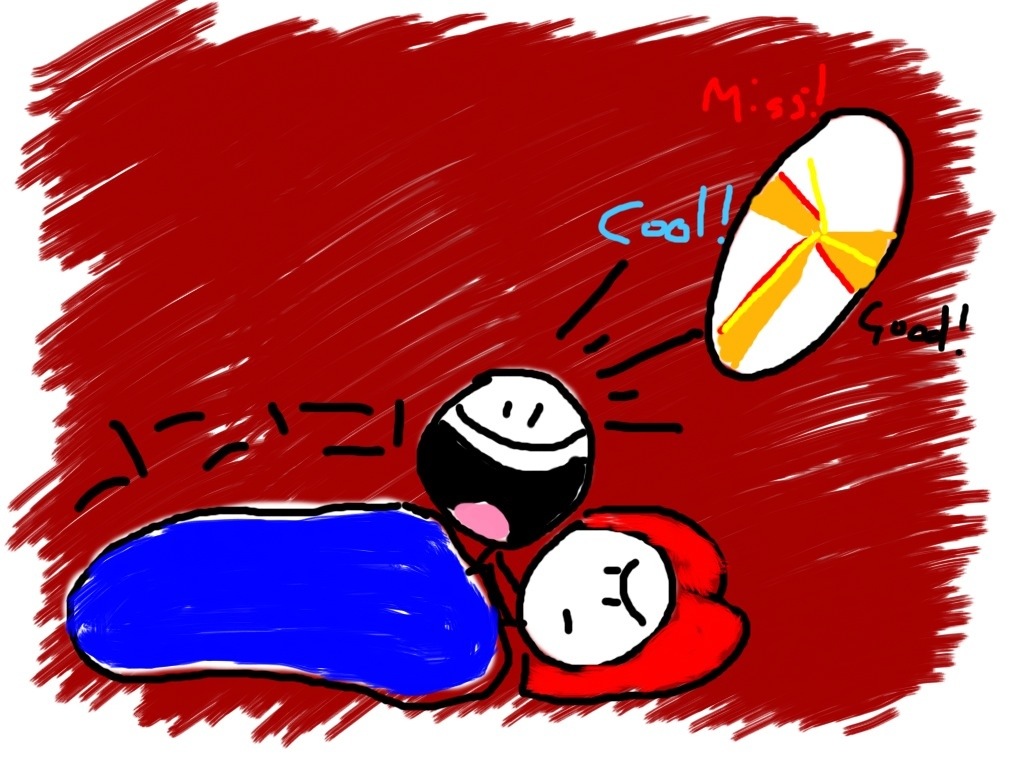
Mechanically, an innovative feature in the game was the "Judgement Ring" system, whereby any action which would be resolved in a tabletop roleplaying game by a throw of the dice is instead left up to the player's reflexes and sense of timing. The titular Ring appears on screen with markers placed on it to show where the player needs to press the button. An indicator sweeps round it, and the player must tap the button as the indicator passes through the various areas. There are variations on the theme, but this is used throughout the game whenever there is an element of chance — both in and out of combat. For example, the Judgement Ring is seen when attacking an enemy, attempting to cast a spell or use an item in combat (outside combat, magic and item use automatically succeeds, thankfully) or attempting to haggle for a better price in shops. It's a simple system that through its inclusion lends a much greater feeling of interactivity and involvement to a genre known for making the player sit back and tap the X button 300 times before getting to do anything. Its timing-based nature means that combat can't simply be resolved by strapping a rubber band to the X button and walking away — the player must learn the various characters' "rhythms" for their attacks and stay on their toes to tap the button appropriately.

It's not just in mechanics that Shadow Hearts differs somewhat from the norm, however. In a typical Japanese RPG, the party tends to be made up of a group of idealistic teenagers (with optional "old man" character who is actually simply in his late 20s), at least two of whom will be childhood friends; at least two of whom will fall in love with one another; at least one of whom will be a moody bastard who grows to understand human kindness and friendship by the end of the story; and at least one of whom will be a demure, shy girl while another will be a borderline-inappropriately sexy girl in a teeny-tiny skirt. This kind of ensemble works well, which is why we see it so often, particularly in popular franchises such as Final Fantasy.

Not so in Shadow Hearts. In Yuri, we have a moody protagonist, sure, but he's angsty because he can turn into monsters. Also he's half Russian, which explains why he hails from Japan but has a name which is commonly used to refer to lesbian-themed content in Japanese. (His name also means "lily" in Japanese, which might explain why he's so upset and surly. Although if we take "Yuri" to be the Russian half of his name, then that means "farmer", which is a bit more manly.) Then in Alice we have the shy, demure girl, but she's clad in what can only be described as an incredibly impractical outfit which precludes her from ever volunteering to bend over and pick anything up ever. She's also English. I've never met any English girls who dress like that. But then I wasn't alive in 1913, either.

Aside: not only does Shadow Hearts take place in the "real world" (albeit a real world with magic and demons and vampires and whatnot), it also takes place in recognisably "recent" (relatively) history, meaning we get a pleasing blend of low-tech fantasy-style stuff with the trenchcoats and Mauser pistols of the World War I-ish era.

But back to the cast. We also have a crotchety old Chinese oracle who calls people "son of a bitch" all the time and a friendly vampire called Keith (Keith?) who woke up from a 200 year slumber only to find himself bored stiff with nothing to do in his monster-infested castle. There may be more, but I haven't got that far yet. Already it's a memorable, bizarre cast, though the game nails the whole "suspension of disbelief" thing so well that it seems perfectly natural for this oddball group to be hanging out together while discussing the movements of the Japanese army.

Shadow Hearts is a slow burn that takes a while to get going. If you've been playing more recent Japanese roleplaying games that tend to be a bit pacier or have battle systems that veer a little closer to "action" (see: Final Fantasy XIII and its sequel, The Last Story and Xenoblade Chronicles to a certain extent) then there's a bit of an adjustment period to get back into random battles and completely turn-based combat. It's also a bit of a culture shock to go back to a game where the dialogue is pretty much all text — though this rekindles the once-common love for renaming your characters; a joy which the age of voice acting has rendered obsolete.

I'm guessing I'm about halfway through at the moment. Further thoughts to follow when I've beaten it.

#oneaday Day 568: iOS Gaming Not Proper Gaming? To That I Say "Balls!"

There's a degree of at least partly-justifiable snobbery surrounding iOS devices such as the iPhone and iPod touch — an assumption that they're not "proper" game platforms because they don't have the words "Nintendo", "Sony" or "Microsoft" emblazoned anywhere upon them, and that software for them is much cheaper than for aforementioned devices with "Nintendo", "Sony" or "Microsoft" emblazoned upon them.
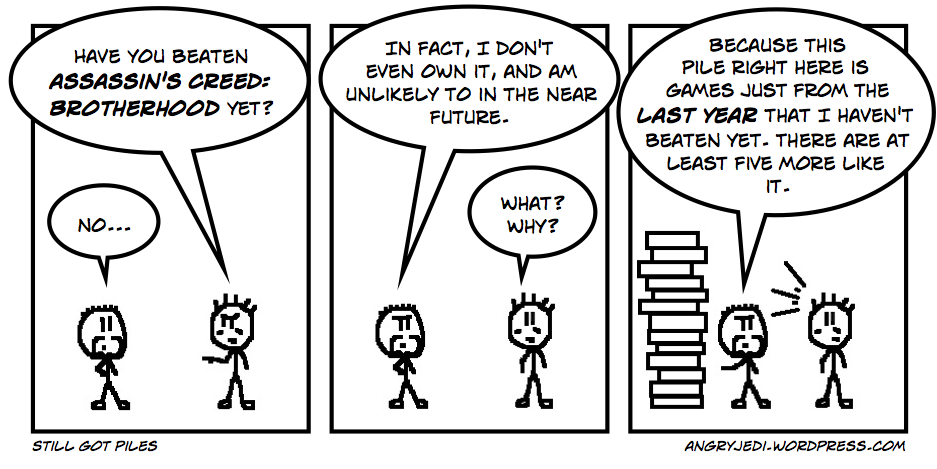
This is a flawed assumption. However, as I say, it is at least partly understandable given the meteoric popularity of titles such as the ubiquitous Angry Birds and all manner of other casual-friendly games. In many ways, iOS devices are the Wii of the handheld world, featuring a lot of casual games, a lot of shovelware and a surprising number of diamonds in the rough which it's entirely possible that self-professed "hardcore" gamers will gloss over on the grounds that they're "just mobile phone games".

That in itself isn't a negative thing, though; if you're waiting for a bus/train/poo to fall out/tardy date/kettle to boil then these quick-fire, quick-play games are ideal. You can load up Bejeweled Blitz, play a game and post your score to Facebook in the amount of time it takes to make a cup of coffee. You can play a level of Angry Birds in the time it takes your toast to be toasted. If you're as bad at Flight Control as I am you'll have caused a hideous air traffic accident by the time you've finished a poo.

But here's the key thing: iOS gaming isn't just about this kind of game, but that's where the flawed perception of it comes from. Take Square's recently-released Final Fantasy Tactics: The War of the Lions, for example. This has attracted widespread bewilderment and criticism for its "unreasonable" £10.99 price point — but this is a game for which I paid £50 for an import version upon its original release 14 years ago (Christ, that makes me feel old — that game's nearly half as old as I am), and whose PSP version released at £35. Okay, sure, you can grab it for less than a tenner from PSN now, but for a couple of extra quid you can get a version with new touchscreen controls — touchscreen controls that work extremely well with the game, I might add (yes, I caved and bought it — I love me some FFT) along with a ridiculous number of hours of gameplay. Final Fantasy Tactics is not a short game — so consider its £10.99 price point in terms of "price per hour" and you'll find it a bit more reasonable.

At the other end of the pricing spectrum is the excellent (if poorly-translated) Zenonia series of action-JRPGs, the latest entry of which is completely free with a few optional microtransaction items available for those happy to pay some money or watch some ads. Zenonia is an excellent 16-bit style RPG that is simple to play yet deep and very addictive. And again, it's not a small game. The touchscreen controls are a bit fiddly — any game that attempts to incorporate a traditional control scheme usually is — but once you get used to them and customize them to your liking there's a lengthy RPG that will keep you occupied for many commutes there. The kind of lengthy RPG that you'd pay at least £20 for on DS. For free. And despite featuring microtransactions and premium items, the game never hassles you to spend money on it — it's just an option that's there if you want it, but I haven't paid a penny and it still feels like a proper game.

The list goes on: Kairosoft's series of management/sim games have provided a resurgence in popularity of a genre which has laid fairly stagnant for some time. Virtual renditions of well-established boardgames allow multiplayer action at times convenient to both players — even if that's not at the same time. And some of the finest roguelikes in existence (100 Rogues, Sword of Fargoal) are to be found on the platform.

iOS is here to stay as a gaming platform, and the sooner people wake up and stop seeing it as some sort of bastard offspring to the "mainstream" gaming industry, the better. Sure, there's a ton of amateurish shovelware out there — but that doesn't by any means diminish the significance of the some the games which are available for the platform — a platform which is growing more and more likely to give both Nintendo and Sony in particular cause for concern as the months roll by.

#oneaday, Day 35: In Praise of Last Gen

An oft-had discussion in gaming is what constitutes the "golden age" of gaming, or indeed if there has even been one.

For some, it's the age of the arcade, when games were designed for pure fun and nothing else—besides emptying your pocket of quarters/local equivalents, of course. For others, it's the home consoles of the NES era; others still, the 16-bit wonderment of the SNES and Genesis/Mega Drive. For yet others… You get where this is going, I'm sure.

For me, the golden age will forever be the PS2 era. I didn't always think this was going to be the case; I remember playing PS2 games for the first time and thinking they were graphically impressive, but somehow lacking the "magic" of my favourite PS1-era games, particularly when it came to JRPGs. It took time, but the PS2 gradually proved itself as a force to be reckoned with, with a gigantic library of excellent titles (and an even bigger library of fucking awful ones) and the kind of backing from the public that Microsoft and Nintendo could only have dreamed of in those days. Funny how things change.

The thing is, being unemployed and skint as I am at the moment, I'm finally getting around to attempting to beat some of the PS2 titles that have sat, under-loved, on my shelf for years now. Final Fantasy XII is my current project: I'm now over 60 hours into it and still loving every minute. It's struck me while playing FFXII that it seems to be a much more infrequent occurrence that a current-gen (360, PS3 or Wii) game will grab me in quite the same way as numerous titles from the PS2 era did… and indeed still are.

I wonder how much of this is down to graphics. Naughty Dog aren't far from the truth with their jokey "next-gen filter" option in Uncharted; an increasing number of games in the current generation are looking increasingly interchangeable, with "gritty", "realistic" graphics often winning out over vibrant colours. There are exceptions, of course, and I discussed a number of these the other day.

I don't think it's just visual character, though; I think the way games are designed and consumed has changed considerably since the PS2 days, too. Look at the number of people who Achievement-whore these days. More often than not, this takes place not through a desire to see everything the game has to offer, but instead to line up their shiny virtual trophies on their virtual shelf and brag to their friends. The social side of gaming is cool, sure, but what happened to gaming just purely for the sake of fun?

There's no reason for these people to want to 100% Final Fantasy XII, for example. There's no public way of recognising your achievement besides actually telling people. But I think that's kind of a good thing, personally—if you want to be a hardcore insane idiot and complete every insanely difficult hunt, clear out every unnecessarily difficult area just for the satisfaction of knowing you have, that's great. But there's no feeling of "obligation" to do so—the person who storms straight through FFXII's main quest without exploring the side content is getting their money's worth just as much as the hardcore insane idiot.

But in games with Achievements these days, many people feel that they haven't got their money's worth unless they 1000G/Platinum Trophy the game. And in many cases, some of those Achievements and Trophies are enormously tedious collectathons (Assassin's Creed), forced replays of lengthy games (Mass Effect, Dragon Age) or encouragement to completely remove any "meaning" and sense of consequence from moral choices in games (any game that has separate Achievements for completing quests/levels in multiple different ways, thereby encouraging saving before "important" bits, then reloading and replaying just to get said Achievements).

Screw that; I'm just as guilty as the next man or woman of Achievement-whoring at times. But spending such a protracted period of time in the company of a last-gen game without all that bollocks to think about is giving me pause for thought. Are things really moving in the right direction?

It makes me a little sad to think that there's a generation of gamers now who have no idea what gaming life pre-Achievements was like—and with Sony's ditching of PS2 support on the PS3 and Microsoft's woeful "backward compatibility" (I use the term loosely) on the Xbox 360, it's becoming more and more unlikely that newer gamers will have the opportunity to explore that side of gaming—and then even if they do, they'll probably be put off by "ugly" SD graphics. Look at how much snobbery people have towards the Wii's graphics now.

Do I have rose-tinted specs when it comes to looking at last-gen gaming? Perhaps. But I'm more than happy to live in the past, if so.

#oneaday, Day 332: Fire The Canon... He's Not Pulling His Weight

What are those games you have to play?

The answer, of course, is none at all, but there are plenty of people out there who believe that you can't call yourself a "true gamer" (whatever that means) unless you've played this game or that game. And for sure, at one point that was true, simply because the volume of games being released was such that it was easy enough to keep up to speed on at least all the big releases, if not absolutely everything that was available.

Nowadays, though, gaming is such big business that it's impossible to keep up with triple-A releases, let alone delve into the increasingly-awesome pool of independent and/or smaller titles out there.

Rather than this being a frustrating thing, though, this is a very positive sign. Speak to someone who's a film snob and they will probably turn their nose up at the prospect of a Michael Bay film, yet there are plenty of people out there who go and watch various childhood-raping movies that ensure you can never look at Transformers in quite the same way ever again.

And it's the same with gaming. There is no one set "canon" of games that you absolutely must play. I've come around to this idea, having had it first mooted by my good buddy and fine, upstanding gentleman Calin. There are games that are important to the history of gaming, sure. But they're not things that everyone has to play. If everyone plays all of the stuff from history that is supposedly "important", they'll never get to anything from today. It's a balancing act.

What I've been wondering is if it's possible for someone who is a full-on gaming enthusiast to spend their time playing nothing but non-triple A titles. Surely there are enough indie and "cheap-fu" titles out there now to enable someone to have an enjoyable experience without having to spend $60 a time for the privilege? And yes, I'm using dollars to illustrate my point because I'm in the States. When in Rome and all that.

This approach isn't for every gamer, just like watching only foreign and/or arthouse movies isn't for everyone who purports to "like movies". I love ASCII-based roguelike Angband, for example, and have sent any number of heroic @-signs to their death now, but I don't expect everyone to find that sort of experience palatable. I can certainly play that game and find it enjoyable, however, and there are times when I'd pick playing that over something like, say, Halo. I'd certainly always pick it over Call of Duty.

But there are people who feel the opposite too. And it's pretty cool that we've reached a stage where we can say that about the gaming industry. The only difficulty that comes with this territory is the fact that the gaming press is not able to cover everything that is out there, meaning some spectacular stuff can get completely overlooked, or sell poorly, or be unfairly judged.

This is where word of mouth comes in. You found something awesome you think friends might enjoy too? Tell them. Don't keep it to yourself. I know that I've convinced at least a few people to play Recettear: An Item Shop's Tale since I started banging on about it a few weeks back, and I'm sure there are others out there who might be interested in trying other things I've mentioned. Similarly, my obsession with Persona 3 and 4 can be entirely attributed to a blog post my friend Mark wrote extolling the virtues of Persona 3, a post which was enough to make me think "I have to play this game."

We're in an age of active involvement and active socialisation. The gaming press still certainly has a place—I should hope so, anyway, since I'm involved in it—but there's just as much importance, if not more, on word-of-mouth recommendations and discussion.

Think about the last game you played. Was it something you played because reviews were good? Because people were talking about it? Or something you took a chance on and then felt like telling everyone how good/bad it was?

In my case, the last two games I played (Recettear and DEADLY PREMONITION) were the latter two. I took a chance on Recettear and adored it. And I couldn't not play DEADLY PREMONITION after hearing some of my closest friends discussing it in appropriately reverent tones. I actually can't remember the last time I bought a game purely on the strength of a review.