#oneaday Day 561: A world of misinformation

We mock Donny Trump's obsession with "fake news" because he always busts that out whenever someone criticises him, but it's an unfortunate fact of life that we are living in a world that is riddled with misinformation right now — particularly if you're the sort of person who primarily gets their information from social media. And, distressingly, that is quite a lot of people these days.

Not all bits of misinformation are dangerous, of course, but they're no less frustrating to see. The other day, for example, I saw a post on Bluesky where someone commented that someone waxing nostalgic over the original Quake for being "from the days before you needed to spend thousands on graphics cards" or suchlike was "the funniest game they could have picked to comment this on". Funny! Except Quake didn't need a 3D accelerator card, as it ran entirely in software, meaning that while a decent non-3D graphics card would help in unlocking graphics modes, it was primarily dependent on how good your CPU was. Its 3D-accelerated version was never officially supported, despite being developed by id Software, and was primarily put out as a test for what they were planning to do with Quake II, which was 3D-accelerated by default.

Likewise, when a near-complete version of Resident Evil for Game Boy Color was unearthed and released to the public the other day, there were people talking about how it "included" the pre-rendered backgrounds of the PS1 version (it doesn't, they are low-resolution pixel art recreations) and how it "used the same isometric perspective" as the PS1 version (neither the PS1 nor the GBC versions are depicted from an isometric perspective).

I didn't comment on either of these at the time because that would have made me an "Um Actually" guy, and no-one wants to be one of those. But as someone who cares about this stuff — particularly about game history, and modern folks appreciating the many varied and wonderful things that classic games were doing — it was frustrating to see these statements go completely unchallenged.

The problem, as I've already alluded to, is people seeing someone saying something on social media and then immediately taking that as gospel truth without verifying it for themselves. In cases such as the above, perhaps younger people might not know what they would need to search for in order to verify those things — or indeed even if they needed verifying in the first place. Neither of those cases particularly matter in the grand scheme of things, but they're a microcosm of times when more serious misinformation — misinformation that could, say, seriously damage someone's reputation — has found itself spreading in one way or another.

They say "the Internet never forgets" — and with the sterling work the Internet Archive does, that's mostly true. Unfortunately, this sometimes means that the Internet never forgets something that was wrong in the first place. And once that misinformation takes root among enough people as being "the truth" — or, perhaps more accurately, "good enough" to sound like the truth — it's very hard to dig it out again to correct things, because not only does no-one like an "Um Actually" guy, even when they're correct, people are simply very resistant to having their assumptions challenged and corrected.

That feels like it might be a problem we should deal with sooner rather than later. But how…?


Want to read my thoughts on various video games, visual novels and other popular culture things? Stop by MoeGamer.net, my site for all things fun where I am generally a lot more cheerful. And if you fancy watching some vids on classic games, drop by my YouTube channel.

If you want this nonsense in your inbox every day, please feel free to subscribe via email. Your email address won't be used for anything else.

#oneaday Day 453: The Generation Game

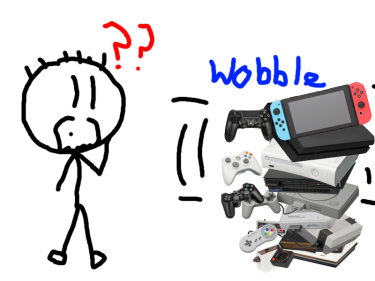
There's been some resurrected discussion today on the subject of "video game console generations", primarily based on a month-old Bluesky post from a member of the Video Game History Foundation describing them as largely unhelpful, and something that serious video game historians don't rely on at all. He posited that "generations" were made up by a Wikipedia editor in the early 2000s, and people have just sort of accepted them as "gospel" ever since.

As another part of the discussion, others have objected to descriptors like "8-bit", "16-bit" and suchlike for similar reasons.

My feelings on the subject are relatively straightforward. I agree that the "generation" thing isn't necessarily helpful — if someone uses it, I always have to look them up and check which one is which, particularly when people like EA attempt to redefine what the "generations" were, as they did around the start of the PS4 era — but I don't have a problem with "8-bit", "16-bit", "32-bit" and the like — up to a point. Dreamcast was the last console that people really referred to in terms of its "bits" ("128-bit") and that didn't really catch on; after that people just sort of… gave up, perhaps because console architecture became a bit more complicated. I don't actually know why we stopped talking "bits", but we did.

Anyway, one area where I do disagree a little with what appeared to be emerging as the popular consensus is that I think it is helpful to stratify computer and video gaming technology in terms of rough contemporaries, because while numbering generations isn't necessarily helpful, saying that the Atari 8-bit, ZX Spectrum, Commodore 64, Apple II, Amstrad CPC and numerous others all coexisted at the same point in history — though some endured longer than others — is useful.

If you consider rough contemporaries, you get into some interesting overlapping territories, too, such as where the Commodore 64 and Spectrum were happily coexisting with the Atari ST and Amiga, or where the Super NES was still holding its own against early PlayStation games. Those are interesting periods of history to talk about, not least because the "outgoing" hardware tends to have thoroughly fascinating (and often quite hard-to-come-by) games released during those curious times of overlap. And this is to say nothing of the fact that the "generations" of home computers work a bit differently to those of the consoles, especially since it pretty much went "8-bit, 16-bit, PC" and then sort of stopped when "PC" became a thing unto itself.

I think it is also helpful to distinguish distinct groups of computer and gaming hardware by their capabilities, also. Again using the home computers as an example, there is an obvious technological leap between the ZX Spectrum and the Amiga. There's another massive difference between the NES and Super NES. Those differences aren't all down to the "bits" of course — in most cases, it's more about the custom hardware and its capabilities, hence how the "8-bit" PC Engine is more commonly considered as a contemporary and rival of something like the Mega Drive rather than the NES — but there are clear moments when the industry has gone "we're releasing something new now, and it's going to be way more impressive than anything you've ever seen before".

I actually think it's somewhat easy to forget quite how fast things moved in the '80s and '90s, since today's technological advancements, particularly in terms of visual fidelity, have slowed to a crawl. There was another good post recently about how you could have released a game from ten years ago (like Metal Gear Solid V) today, completely unchanged, and no-one would know it wasn't a brand new game. That certainly wasn't the case ten years ago, and not at any point prior to that, either. Things were moving just so quickly that it was kind of mindblowing to see.

And it's easy to forget how surprisingly early some of these advancements happened, too. The Atari ST and Amiga came out in 1985, when the 8-bit home computers were still thriving — hence the considerable years of crossover. The PlayStation came out (late in) the same year as Super Metroid, Sonic the Hedgehog 3, Earthbound and Donkey Kong Country, all games that most would probably agree were released while the SNES and Mega Drive were in their absolute prime.

So yes. Numbered generations are kind of stupid. But I do think there's value in looking at the things that were coexisting at a given moment — and at the notable leaps forward computer and gaming technology was taking throughout the 1980s and 1990s in particular.

I guess, as with everything, the real value is in just saying what you actually mean rather than trying to find a catch-all shorthand — if only because that catch-all shorthand often assumes knowledge that not everyone has. Same reason I don't like using "Metroidvania" or "JRPG"; much better to be specific about these things and say what you really mean. In an age of attention-deficit "short-form content", being verbose and detailed can actually make you stand out quite a bit. In a good way.

At least I hope so, because I'm not changing.


Want to read my thoughts on various video games, visual novels and other popular culture things? Stop by MoeGamer.net, my site for all things fun where I am generally a lot more cheerful. And if you fancy watching some vids on classic games, drop by my YouTube channel.

If you want this nonsense in your inbox every day, please feel free to subscribe via email. Your email address won't be used for anything else.

#oneaday Day 287: European video game history discourse is happening again

As the title says, European video game history discourse is happening again. I'm not going to link to the post in question, because I like the chap who inadvertently kicked this off and I don't want him to have to put up with any more angry Europeans than he already is contending with. But I will comment on the whole subject, because it's a topic worth discussing with some commonly held assumptions that need challenging.

So here we go.

"The Great Video Game Crash" didn't happen in Europe

This point is one that, I think, is finally getting through to a lot of people. The notorious "crash" of 1983 following the absolutely flooded market of third-party Atari 2600 games was a purely North American phenomenon, and it only affected the console market.

It was a bad thing, to be sure, putting a lot of developers and publishers out of business, and it can probably be pointed at as the main reason that platforms like the ColecoVision and Intellivision didn't survive. And it's definitely true that the arrival of the NES on the scene marked a renaissance for the console games market in North America.

But it just didn't happen in Europe. I didn't even know it was a thing until the Internet came about. The reason? Because most of us in Europe were happily making use of home computers at the time, and we continued to do so throughout most of the '80s and early '90s.

Europe's console game sales are a miniscule fraction of those seen in the States

The same reasoning can be applied to this. Yes, I entirely believe that considerably fewer console games were sold in Europe than in North America. This is because consoles weren't nearly as widespread as home computers were. Growing up, I didn't know anyone who had a console for many years. I didn't even know for sure if the ColecoVision came out in Europe until quite recently when I found an ad in an old home computer magazine.

But I did know people who had home computers. We had Atari 8-bits. My best friend in primary school and a girl I moderately fancied both had BBC Micros. Another friend had a Spectrum. Another still had a Commodore 64. One even had an Electron.

There are a few considerations here. One, home computer games were often much cheaper than console games — though this wasn't always the case, particularly for games distributed on ROM cartridge. Cassette-based games were very cheap, though, particularly on the Spectrum and C64, and disk-based games weren't crazy expensive for the most part — though disk drives were, since back then they essentially had a whole other computer inside them to control the damn things!

However, what you also have to consider is that many games had considerably wider reach than their commercial, officially recorded sales figures might suggest due to piracy. Piracy was absolutely rife in the early home computer sector, and while this probably wasn't good for the overall health of the industry, it somehow never caused a "crash". Piracy has also, long term, been amazing for preservation purposes, because pirated disks (pretty much always disks) often had pre-release or beta versions of games on them, and in many cases these particular versions of these games were not preserved by their original developers and publishers.

Thirdly, home computers were programmable. And, outside of dedicated games magazines, which were in a minority compared to "general computing" magazines for quite a few years, most publications encouraged computer users to get involved in programming their machines themselves. Magazines published type-in listings each month, allowing you to get "free" software in exchange for the cover price of the magazine, a bit of your time and some blank media to save it on. Public domain libraries appeared and thrived. And many folks simply wrote their own software to do something their computer couldn't already do. With BASIC built-in to pretty much every 8-bit machine, anyone could become a programmer just by turning the damn thing on.

Home computers continued to thrive even with the advent of consoles

The NES didn't "save" gaming in Europe in the same way that it did in the States. It was present, sure, but the only person I know who had one was my Uncle Peter (or perhaps more accurately, his daughter Gemma). We certainly didn't have one. I knew one guy who had a Master System, but I think he only had one game for it and he certainly didn't consider himself a gaming nerd.

Console gaming really started to pick up in Europe — or at least in the UK, from my experience — with the advent of the 16-bit era. That's when we really started to get a glut of specialist gaming magazines focusing on individual platforms, and that's when I knew more people who started to get Mega Drives and SNESeses.

But those consoles never replaced home computers. My best friend in high school, Edd, had a Mega Drive, but he spent much more time on his Amiga 500. I had a SNES, but I still spent much more time on the Atari ST and even the Atari 8-bit, which we still kept out and in use for many years. And the press reflected this, also: multiformat magazines tended to prioritise Amiga and Atari ST, with console games often relegated to their own little section, like they were a curiosity. And just as there were specialist gaming magazines for platforms like the SNES and Mega Drive, there were also individual mags for the ST and Amiga, too. And in many cases, those mags were more substantial than their console counterparts — often aimed at a slightly more mature audience, too.

Not only that, but the "free software" sector continued to thrive, too. While the ST and Amiga didn't ship with built-in BASIC like their 8-bit predecessors, there were still plenty of easily accessible packages for both that allowed anyone to get programming. Public domain software, likewise, continued to thrive, with public domain titles distributed through magazine coverdisks, through public domain libraries and through early online services such as bulletin boards.

Particularly notable from this era are STOS and AMOS, flavours of BASIC for Atari ST and Amiga respectively, which featured game-centric features such as sprites, sound generation, interrupt-based music and all manner of other good stuff. Both, as you might expect, were widely used to make both public domain and commercial titles by enthusiast developers. STOS and AMOS were made by Francois Lionet and Constantin Sotiropoulous, the former of whom founded Clickteam. Clickteam made Klik and Play, which saw several follow-ups, the latter of which, Multimedia Fusion (or just Clickteam Fusion now), is still in use to this day to make commercial games. Played Freedom Planet? You've played a game whose lineage can indirectly be traced back to STOS.

Things only really shifted firmly in favour of consoles when the PlayStation showed up, but even then, MS-DOS PC gaming had already hit its stride with the advent of 256-colour VGA graphics and sound card support.

Without the European home computer scene, there's a lot of today's developers that wouldn't exist

This is the most important thing to bear in mind, I think. So many of today's developers and publishers can be traced directly back to '80s home computer labels.

Codemasters? They used to specialise in budget-priced cassette games made by teenagers in their bedrooms. Rare? They started out making Spectrum games. Sumo Digital? They can be traced back to Gremlin Graphics, who were there from the very early days of 8-bit home computer games. And there are countless more; if you were to go through everyone Of A Certain Age in today's European games industry, you will almost certainly find a significant portion of them who cut their teeth working on home computer games.

Hell, this is even the case in the States, too. Folks who were making home computer games in North America, in many cases, continued on into careers in the later console sectors. I learned the other day that Cathryn Mataga, maker of the excellent Shamus and Zeppelin on Atari 8-bit, also made the frankly incredible port of Dragon's Lair to Game Boy Color, to name just one example.

Revenue isn't the whole story, not by a long shot

It keeps coming back to this. Sure, the money numbers might look smaller for the European games industry throughout the '80s. But in terms of the usage of these systems, the passion, the things that are harder to track through anything other than anecdotal evidence and the lived experiences of folks who were there? Absolutely nothing beat the home computer scene of the 8-bit and 16-bit era in Europe.

Hell, our favourite Atari computer magazine ran from 1982 until 1998. That's an astonishing achievement for a publication that covered the Atari 8-bit platform from its very first issue right up until its sad finale. And Atari 8-bits were a niche platform; the Spectrum, Commodore 64 and Amstrad all did way better in the market.

Look, I'm not saying American video game history isn't important. It is. It's where video games as we know them today were born, after all. But we've gotta get over this assumption that anything that happened outside of North America or Japan was somehow not important. '80s home computing was — is — much more than just a fad or a scene. For many folks, it was video games. For many folks, it was life. And acknowledging that doesn't make Pong, the Magnavox Odyssey, the Atari 2600 or the NES any less cool or revolutionary.


Want to read my thoughts on various video games, visual novels and other popular culture things? Stop by MoeGamer.net, my site for all things fun where I am generally a lot more cheerful. And if you fancy watching some vids on classic games, drop by my YouTube channel.

If you want this nonsense in your inbox every day, please feel free to subscribe via email. Your email address won't be used for anything else.

#oneaday Day 237: The library is open

A number of things occurred today that I could potentially talk about: some positive, some not so positive. In the interests of… (gesticulates at all this) everything I'll focus on probably the most positive one, because it's something I'm really excited and happy to see.

Those of you interested in video games as a medium may be aware of the work of the Video Game History Foundation. They've been working as a charitable organisation chronicling the history of the medium for some time now, and they're responsible for the figure you may have seen bandied around that "87% of classic games are not available".

Something they've been working on for a while is providing a means of public access to their library of materials, which includes not only old computer and gaming magazines, but also development and marketing materials as well as some thoroughly fascinating bits of miscellanea, such as a gamer's hand-drawn maps of two early Zelda games that found themselves among a donation of other bits and pieces.

Today, the organisation launched the library for "early access", presumably meaning that there might be some kinks to work out and that it will expand over time, but already it's clear that it's going to be both a valuable resource and something that is just interesting to explore.

There are two main components to the library. First of all is the main catalogue at library.gamehistory.org, which is a catalogue of the materials that the organisation holds. This is interesting to browse through and see what's in their collection, but isn't of that much use when researching things. For most, the real attraction will be the digital archives at archive.gamehistory.org, which include digitally preserved material — scans and other digitised content, in other words.

At present the archives only contain a fraction of what is listed in the main catalogue, and the organisation notes that there is some material that may never be digitised for public access via the Internet for one reason or another. But what's there already is plenty to get stuck into. There's a library of magazines, for example, including 33 publications at the time of writing, including complete or near-complete runs of well-known mags such as Game Informer, Electronic Gaming Monthly and GamePro, plus early attempts at gaming media like Electronic Games, a spinoff of Video magazine's Arcade Alley column.

Right now there is, unsurprisingly, a bit of a US bias to things (and as I type this, the site has crashed under the weight of day-one demand so I can't check what non-American stuff they have, if any!) but there's a significant chunk of gaming media history to explore here; the aforementioned publications all played an important part in shaping video game fandom at one point or another, and the digitally available collection will only continue to expand over time. I'm particularly excited to see the archive of Electronic Games there, as this is an incredible resource to see how early consoles (like the Atari 2600, Intellivision and suchlike) and 8-bit home computers were covered by a fledgling enthusiast press.

But it's not just about magazines. There's also stuff like an archive of the CDs GamePro had that contained press materials, from the days before press assets being distributed via the Internet. There's production materials from games, some of which never made it to market, like SimPeople (what would subsequently become The Sims). There's development materials from a wide variety of sources. And tons more.

I'm really looking forward to exploring this library of stuff and seeing how it expands over time. It's going to be an absolute boon to anyone researching the history of video games and how they were covered by the media of the day, and I can't wait to make use of all this material when composing videos and articles.


Want to read my thoughts on various video games, visual novels and other popular culture things? Stop by MoeGamer.net, my site for all things fun where I am generally a lot more cheerful. And if you fancy watching some vids on classic games, drop by my YouTube channel.

If you want this nonsense in your inbox every day, please feel free to subscribe via email. Your email address won't be used for anything else.