#oneaday Day 624: Revisionist gaming history

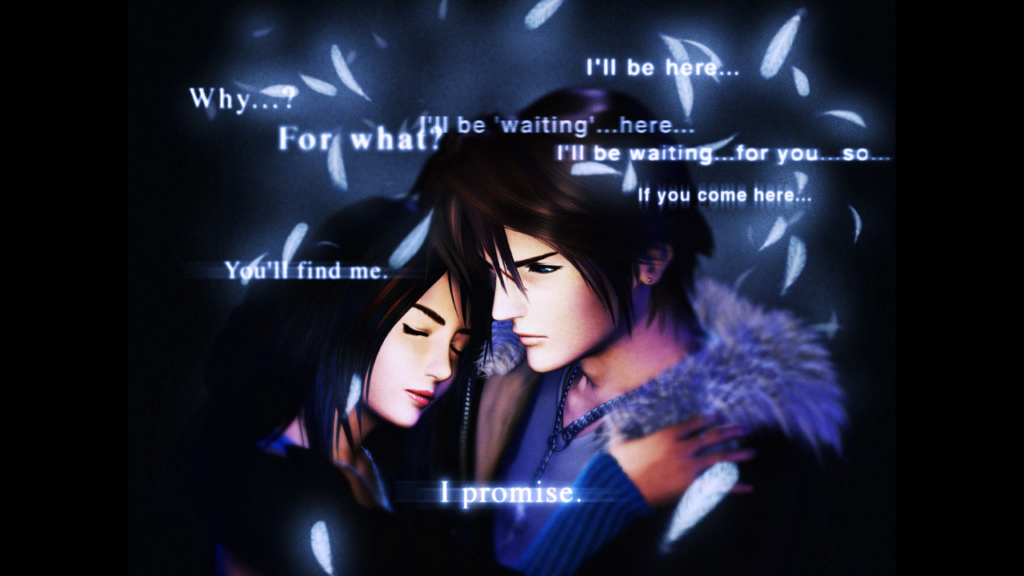
A few weeks back, someone started an argument with me about Final Fantasy VIII. They asserted that everyone had always hated Final Fantasy VIII, and that I was somehow wrong for remembering that my friends and I were super-hyped for it, enjoyed it immensely when it came out, and that reviews of the time were also very kind to it. Review scores aren't the be-all and end-all, of course, but they do act as a pretty good barometer of roughly how positive the critical reception for a given title was.

I bowed out of the conversation early on because it was pretty clear from the outset that the person attempting to start this argument was not going to listen to any viewpoint other than their own, even when it was coming from someone who lived through the experience of that game coming out, and they just wanted to hate on something that had, in recent years, become fashionable to bash.

Now, I'm not going to attempt to convince you one way or the other about Final Fantasy VIII at this point. It's one of those games that you either "get" or you don't, and I don't blame anyone who doesn't "get" it. But to extend "I don't get this" out to "everyone everywhere always hated this" is ridiculous. It's absolute revisionist history, and it's something that drives me absolutely bonkers about online discourse over video games these days.

It happens with more recent games, too. Take Mario Kart World, a game which does some really interesting things with the Mario Kart formula, and one which is designed with so much polish that I really can't take anyone who says it is a "bad" game seriously. And yet to some folks it is "the worst Mario Kart there has ever been" and, again, "everyone hated it". No, no they did not.

Or another example: I saw a post just this evening that implied that The Legend of Zelda: Echoes of Wisdom was a bad game, primarily due to the fact that none of the original team who worked on the first ever The Legend of Zelda game (which is celebrating an anniversary milestone right now) worked on it. I take two issues with this: one, that everyone who worked on the original The Legend of Zelda is probably either an old man or dead at this point, and thus should be left to get on with their life in peace, and two, Echoes of Wisdom wasn't a bad game! Not even a little bit!


EDIT: The account in question has since clarified that they meant it was "sad" that Echoes of Wisdom was the first game without any of the original team that was involved, not that they thought it was a "sad" game due to it not being any good. I have left the preceding paragraph as-is to take ownership of my own misunderstanding — and to acknowledge that I wasn't alone in it, hence the account's clarification of what they said.


And don't even get me started on Final Fantasy XIII.

There is one thing that all these examples have in common, though, and that is the fact that all of them do something different to what is expected as "the norm" in their respective series. For Final Fantasy VIII and XIII, this should be no surprise to anyone who has ever paid attention to the series and its core philosophy of "if it's not new, it's not Final Fantasy" (as I wrote about nearly ten years ago right here), but, to this day, people are confused by the fact that Final Fantasy VIII and XIII are very unconventional in a lot of ways. (Interestingly, very few people seem to have a problem with Final Fantasy XII these days, despite, in many ways, it being a way more significant disruption from the series "usual format" than many other entries.)

For Mario Kart World and Echoes of Wisdom, those two games were always in a bit of a no-win situation. Do something the same as previous games and they would be regarded as pointless and unambitious. Do something a bit different, as they both did, and people complain that they're not like all the other games in the series! Seriously daft.

The most annoying thing about this constant revisionist history is that it makes it impossible to have sensible discussions about these games. Pretty much as soon as it became clear someone was spoiling for a fight over having the "correct" opinion about Final Fantasy VIII (and what "everybody" thought of it, apparently), the entire thread derailed and became impossible to have a reasonable discussion in. Anyone who attempted to highlight the things that they, in fact, liked about it was shouted down, and it just became pointless to even try. I've seen enough threads like that in my time to know that it really wasn't worth trying in the first place, which is why I bowed out of it early.

When it comes to Final Fantasy VIII, I'll just leave you with one little story from my past. In the period between Final Fantasy VII and Final Fantasy VIII coming out, our friendship group had a perpetually running joke with the local computer shop owner, in which literally every time we went in there (and we went in there a lot), we would ask him if he knew when Final Fantasy VIII was coming out, to which he would reply by mumbling something mostly incoherent about "stocks". This became such a notorious exchange among our friendship group that during our obsession with the Klik and Play games-making software, one of our number immortalised the discussion in his project Resident Evil EX, by incorporating a fully-voiced scene in which the protagonist, Agent Wesley Wilson, would walk into a computer store in the in-game mall, ask if the shopkeeper knew when Final Fantasy VIII was coming out, to which he would reply "asfhgblaskbkljblkl stocks".

That's how excited we were for Final Fantasy VIII to come out. And when it eventually did come out, I had people in my university room almost every night to come watch and see what would happen next.

So don't fuckin' tell me that "everyone always hated" something. Because, inevitably, it isn't true. In pretty much every instance like this, what the person saying that "everyone always hated" something means is "I didn't really like this" and "I'm unwilling to entertain the possibility that anyone else did".


Want to read my thoughts on various video games, visual novels and other popular culture things? Stop by MoeGamer.net, my site for all things fun where I am generally a lot more cheerful. And if you fancy watching some vids on classic games, drop by my YouTube channel.

If you want this nonsense in your inbox every day, please feel free to subscribe via email. Your email address won't be used for anything else.

1418: Eight and Thirteen

Final Fantasy, once one of the biggest names in gaming, is now something of a laughingstock to many people.

To a lot of these detractors, it was the Final Fantasy XIII sub-series that triggered this feeling. (Many of said detractors have not played Final Fantasy XIV, incidentally, refusing to even try it because it's an MMO. Fair enough, but it's also the best Final Fantasy in years.)

To others, though, Final Fantasy VIII is an object of ridicule — and the recent rerelease of the game on Steam has caused all these people to come out of the woodwork once again.

It will undoubtedly prove somewhat unsurprising to you to hear that I played and enjoyed both, and feel that they both get an undeservedly bad rap.

Let's start with Final Fantasy VIII. After my friends and I discovered JRPGs with Final Fantasy VII and promptly played it through a good seven or eight times, Final Fantasy VIII shot straight to the top of our most-anticipated lists. And it looked amazing; gone were Final Fantasy VII's weird super-deformed polygonal models, to be replaced with much more realistically-proportioned character models along the lines of what we now recognise as the "Final Fantasy look" today. Gone was the "magical disaster threatening to destroy the planet" plotline, to be replaced with something that was, above all else, a love story.

Final Fantasy VIII did a bunch of weird, unconventional things, and I loved it for it. Its character-driven story was much more intimate and personal than my limited experience with the genre at the time — hell, it was much more intimate and personal than a lot of games I'd played up until that point, period. It was one of the few times I'd encountered a convincing love story in the context of a video game; Squall and Rinoa were both interesting, flawed characters and I felt myself rooting for them throughout the game.

The battle system was enjoyable, too. The Junction system was really, really odd, but made sense once you got your head around its extremely abstract nature. The reflex-based actions, where you had to pull the trigger on Squall's gunblade for additional damage, or hammer in button combinations while performing Limit Breaks, or repeatedly bash the Square button while summoning a "Guardian Force", gave the battles a feeling of "action game" intensity when they were essentially still sort-of turn-based.

And the final boss? Easily one of the most spectacular final confrontations of the PS1 era, even if the plot in the immediate run-up to it started veering into seriously odd plot-related territory. "Time kompression" was a bit weird, yeah, but it certainly didn't undo all the good work for the many hours beforehand, and damn, those last battles were genuinely exciting.

Fast forward a whole bunch of years (I'd work it out, but I can't be arsed right now) and we have Final Fantasy XIII. Again — I've covered this before — this did things markedly differently to past Final Fantasies, replacing the open-world MMO-style gameplay of Final Fantasy XII with more linear progression that opened up into an interesting, enjoyable open world towards the end.

People hated Final Fantasy XIII for its linearity, but in practice it really wasn't all that much more linear than previous Final Fantasies — it was just more obvious about it. Previous Final Fantasies had provided the illusion of freedom through their world maps, you see, but your progression was still railroaded by being unable to cross certain types of terrain until the story dictated that you got your hands on a particular vehicle. And, like Final Fantasy XIII, these games would tend to open up towards the end, giving you freedom to explore.

There's always been a reason for that linearity in Final Fantasy games, however, and that's to push the story along. Because you didn't get a lot of opportunity to stray from the path set out in front of you, the story was kept pacy and snappy, and maintained its momentum — something which many more open RPGs, and not just those of the J-variety, really struggle with. By the time you reached the more open part, you had an extremely firm grounding in the game's mechanics — more than enough to take on some of the extremely tough challenges that said open world presented you with.

As for the characters? I liked them a lot. Sazh was an interesting character in that he was an older, black character who didn't resort to Mr. T stereotypes like Barret in FFVII. Vanille was cute and adorable. Fang was badass. Lightning was enigmatic, intriguing and all-business; Snow was her perfect foil with his laid-back attitude. And Hope, whom many people accuse of being "whiny", watched his parents die towards the beginning of the game. I think being a little emotional is perhaps understandable in this instance, no?

Ultimately I know that if you've made up your mind about Final Fantasy VIII and XIII I'm probably not going to change your mind, and that's fine; this post simply outlines what I feel about these much-maligned installments in the long-running series. The thing that annoys me, I think, is how people feel the need to declare them unequivocally "crap" when what they really mean is that they didn't personally like them.

But then this is nothing new to the games biz, and I've spent the best part of the last couple of years playing and adoring games that many people think are "crap" if you believe Metacritic scores and the like. Each to their own, I say, and if you can eke out enjoyment from something that isn't popular, I say good on you. And if you can't, maybe try not to make other people feel bad about liking it?