1868: A Relic Reborn, Again (and Again)

I am finally on the final step of one of Final Fantasy XIV's most lengthy, gruelling challenges: the "Relic" quest, which can begin the moment you hit level 50 and will keep you going right up into top-tier endgame play. It was designed as an alternative for more "casual" players to be able to get better weapons over time without having to jump into super-difficult raids — a process which requires organisation and commitment from people in order to make any meaningful progress. The intention was to give these "casual" players something that would take about as long to complete as it would for a raider to be able to master top-level content and score the sweetest possible loot from them, but somewhere along the line the Relic questline became all but obligatory for everyone to complete, if only as a matter of pride.

As previously noted, it's a long and gruelling — though not especially difficult — process.

First you have the quest to acquire the weapon in the first place. This is an involved, multi-part affair that involves tracking its timeworn and weathered form down — usually from the depths of a monster-infested area — and then setting about finding the materials that master weaponsmith Gerolt needs to restore it to its former glory. Rather inconveniently, these materials can only be found in the somewhat uninviting lairs of Eorzea's Primals Ifrit, Garuda and Titan, so having already floored these massive enemies once during the course of the main story, you're now tasked with killing them again. This used to be a genuinely challenging task, back when the base Relic was pretty much the best weapon you could get in the game, but it's become almost trivial now thanks to how well-geared the vast majority of the level 50 population is now. There's also a dungeon to run (Amdapor Keep, which was the hardest four-player dungeon in the game when it launched, but which again has now become somewhat trivial) and two more boss fights against a Chimera and a Hydra that are new to the Relic questline.

After all this — and a bit of testing out the unfinished form of the weapon on unsuspecting members of Eorzea's beast tribes — you're finally blessed with an item level 80 weapon, which can be upgraded to item level 90 and made to glow in a rather fetching "this is special!" manner through the judicious application of Thavnairian Mist, a rare concoction that can only be acquired by exchanging Allagan Tomestones with collectors of rarities. Tomestones are a special currency rewarded for completing content at level 50 — since you no longer get experience points at this level, having reached the level cap, they form the basis for progression beyond this point. Pretty much anything that involves other people will reward you with Tomestones, be it four-player dungeons, eight-player Trials, twenty-four player raids or the extremely tough challenges of the Binding Coils of Bahamut.

This form of the weapon, known as Zenith, used to be pretty much the best weapon you could get outside of downing Turn 5 of the Binding Coil of Bahamut — a tall order even for well-geared players even today — and acquiring one of the Allagan weapons. But as time went on and the game gradually expanded with each new patch, so too did the Relic quest.

It began with Atmas, a step which, for many, proves an insurmountable obstacle, but which sets the pace for the amount of commitment required to finish this lengthy process. Atmas are small crystals containing the souls of fallen warriors, and can be acquired randomly by participating in FATEs — public events that occur every so often in each of the game's zones — and completing them successfully. There are twelve Atma in total to collect, meaning you'll have to visit twelve different zones to participate in FATEs. In game terms, this step was designed to get level 50 players helping out with low-level FATEs, since a tweak to how experience points were awarded in the game's early days saw people turning to instanced dungeons for quick experience points rather than wandering around out in the open world helping one another.

The cruel twist in the Atma step was that once you'd acquired all twelve Atma, all that happened when you "upgraded" your weapon was that it lost its cool glow from the Zenith step. Its stats didn't change at all. But it was still an important step, because it made your weapon ready for the gradual upgrade process that came next.

By exchanging further Allagan Tomestones with a collector in Mor Dhona, you could acquire books telling tales of the "Zodiac Braves", and you're told that by recreating these tales of derring-do using your Atma Relic, you can improve it considerably. What this boils down to is a set of objectives — 100 specific monsters to kill, three specific dungeons to complete (or, more accurately, three specific bosses to beat), three specific FATEs to participate in and three specific levequests (short, repeatable quests) to complete. You had to do this nine times in total; each completed book rewarded you with a small increase to the stats on your Atma weapon, so it gradually improved over time. When all the books were completed, your Atma weapon regained its glow — a more substantial one this time — and became its Animus form.

Next up, you're told that you can improve the weapon further — and, crucially for this step, customise it — by infusing materia into a "sphere scroll". In order to do this, you need the sphere scroll itself (which costs yet more Tomestones), seventy-five pieces of Alexandrite as a catalyst to infuse the materia into the scroll, and at least seventy-five pieces of materia of the appropriate types to give your weapon the stats you want. Alexandrite can be acquired by participating in FATEs, bought with Allied Seals acquired by beating the giant monsters of The Hunt, or by digging it up using Mysterious Maps acquired from a strange old lady in Mor Dhona who appears to have been using them to clean her kitchen. The more materia you attach to the scroll, the higher the chance that the infusion will fail; fortunately, you only lose the materia if this happens, while the Alexandrite remains in your possession. Your reward for successfully infusing seventy-five points' worth of stats into the sphere scroll? Your Relic's Novus form, which has a somewhat more imposing glow.

For a while, again, Novus was the pinnacle of what you could have in terms of weaponry, and it was particularly powerful due to the fact that you could customise it. The materia to do this — particularly for popular stats like Determination (which increases damage) and Critical Hit Rate (which increases the likelihood an attack will deal considerably more damage than usual) — didn't come cheap, and the only other alternative was to "Spiritbond" equipment by using it to defeat monsters either in the world or in dungeons, then turn this equipment into materia, with random chance determining whether you'd get the kind of materia you wanted or a useless alternative. Thus, Novus was a long, difficult and expensive process for many, but taking the time to complete it would give you a strong weapon that would see you through pretty much anything the game could throw at you.

Then came another step. By "soulglazing" your relic and using it to collect soul energy — known colloquially as "light" owing to the fact your weapon glows with varying levels of intensity when it acquires this energy — you could make it more powerful still, improving the stats you'd infused into the Novus by a set amount according to the combinations and amounts you put in. In order to acquire light, you simply had to do pretty much anything that involved other people — dungeons, trials, even FATEs. Light was acquired at a very slow rate, however, and many resorted to running the same things over and over again for hours at a time in order to gain light most effectively. In practice, however, you could gain light at a good rate simply by playing the game as you normally would, attempting to acquire Tomestones to gear up your armour to match your increasingly powerful weapon. Upon filling your Novus with light, you'd be able to turn it into its Nexus form, the ultimate incarnation of the Relic you found all that time ago, and a weapon that you've truly helped to make your own.

But your efforts don't end there. Through this whole process, you've been developing a relationship with both a scholar of these ancient weapons and a local master blacksmith, and it eventually becomes clear that it's possible to recreate the legendary weapons of the Zodiac Braves themselves — but in order to do so there is, unsurprisingly, a somewhat convoluted process involved that requires you to do the dirty work of four separate individuals who have what you need to complete the weapon, but who aren't about to give their prizes up quickly.

By far the most gruelling part of this phase is acquiring specific items from specific dungeons. These are drops similar to the Atma in that there's only a random chance of you acquiring them when you complete a dungeon, and no guarantees. Consequently, you may find yourself running one dungeon lots and lots of times in order to acquire one specific item; at the other end of the spectrum, however, sometimes you get lucky and acquire it straight away. It's unpredictable and, at times, infuriating, but oh so satisfying when you get what you need.

After completing this epic slog, you're rewarded with a brand new weapon, recreating the form of one of the Zodiac Braves' weapons and infused with the soul energy you collected using your Relic. (These Zodiac weapons take the form of iconic weapons from past Final Fantasy games such as Excalibur for a Paladin, Kaiser Knuckles for a Monk, Yoichi Bow for a Bard and so on.) This is the stage I got to tonight: I now have Excalibur and its companion Aegis Shield.

But there's one final step to go: embracing the weapon's apparent sentience and sense of will, and forging an unbreakable bond between the two of you. In order to do this, it's another light grind similar to that for the Nexus, but this time instead of having to collect it all in one weapon, you gradually fill up twelve "mahatma" with soul energy, and the process is considerably quicker than before. This is the final step of a quest that's been in the game since launch, and your reward is a weapon that is likely to be the absolute best piece of equipment you can get until the expansion Heavensward arrives later this year and makes all this work irrelevant. (Actually, that's not quite true; producer Naoki Yoshida has said that those who put in the work to complete this questline will have a leg-up on whatever comes next come Heavensward time. Thankfully.)

It's a slog, to be sure, and it's even something that a lot of players will find offputting and want nothing to do with — thankfully, there are numerous alternative means of acquiring weapons, so even if you're playing multiple classes you don't have to go through this epic grind for all of them — but by God it's satisfying to reach a milestone in. I've likened it before to the idea of "building your own lightsaber" in a Star Wars game — something which has never been given the gravity it deserves, even in the Star Wars MMO The Old Republic — and it's true. By the end of this process, your weapon, even though it's just a collection of numbers, is part of you and your play style, and an important part of your character as a whole; the unbreakable bond between character and weapon isn't just for lore reasons — you'll feel it yourself as a player, too.

So wish me luck as I proceed on the final chapter of the Relic quest; I'm hoping to have Excalibur's "Zeta" form before I head off to PAX later this week. We'll see if I'm successful!
1861: Raid Night

It was Raid Night this evening, and the assembled forces of LoCoBomb (sans Andie, who was not feeling too hot earlier) once again took on Final Fantasy XIV's The Second Coil of Bahamut, Turn 4, aka Turn 9.

This is, as I've noted in previous posts, one of the toughest fights in all of Final Fantasy XIV. Up until the Final Coil of Bahamut launched with patch 2.4 a while back, this battle was effectively the "true final boss" of the game, demanding that all eight party members know their jobs well, can learn mechanics and know what to do when. Since Final Coil became a thing, it's been gradually made a bit easier, but it will still absolutely obliterate any party who goes in there unprepared thanks to more than a few instant-kill mechanics, plus some seriously hard hits from both the boss and the additional enemies that show up over the course of the fight.

It's been a strong test for our assembled group, but it's brought us together and helped us understand how we all play. I've been developing some strong tanking skills — they're demanded in this fight, particularly if you take it on, as we are, with just one tank — and that's been helping me play better elsewhere in the game.

It's been an interesting personal journey so far. When I first started playing FFXIV, I had a ready-made group of acquaintances to play with thanks to the fact that someone I knew from 1up.com and Twitter invited me to come along. I was still somewhat anxious about playing with people I didn't know, though, particularly if it was in content that was new to me. I chose a DPS class (Black Mage) because they're perceived as having the least responsibility, at least in the early stages of the game — in late endgame encounters, they have a lot more to do — and they're less likely to get everyone killed. I didn't like running things without at least one person I knew, and I was nervous about asking for help.

There are still times today when I don't like running with strangers — usually if they're the aggressive, unpleasant, rude, elitist type — but I'm much more confident about it. I'm also happy to jump in on the healer or tank roles — roles which have direct responsibility for ensuring the rest of the group doesn't get killed. Black Mage will always have a space in my heart, of course, but I'm spending a lot of my time tanking on Paladin at the moment, and really enjoying it; I don't know if it's my "main" as such — my Black Mage is technically further advanced thanks to its progress in the lengthy Relic weapon quest — but it tends to be my default choice when given the option these days.

Anyway. Exciting times are ahead, since on Tuesday patch 2.51 is released, and coming with it is the long-awaited arrival of Gold Saucer and Triple Triad. I'm looking forward to it a lot; after that, it won't be all that long until PAX East!

In the meantime, I guess it's back to jobhunting, though…

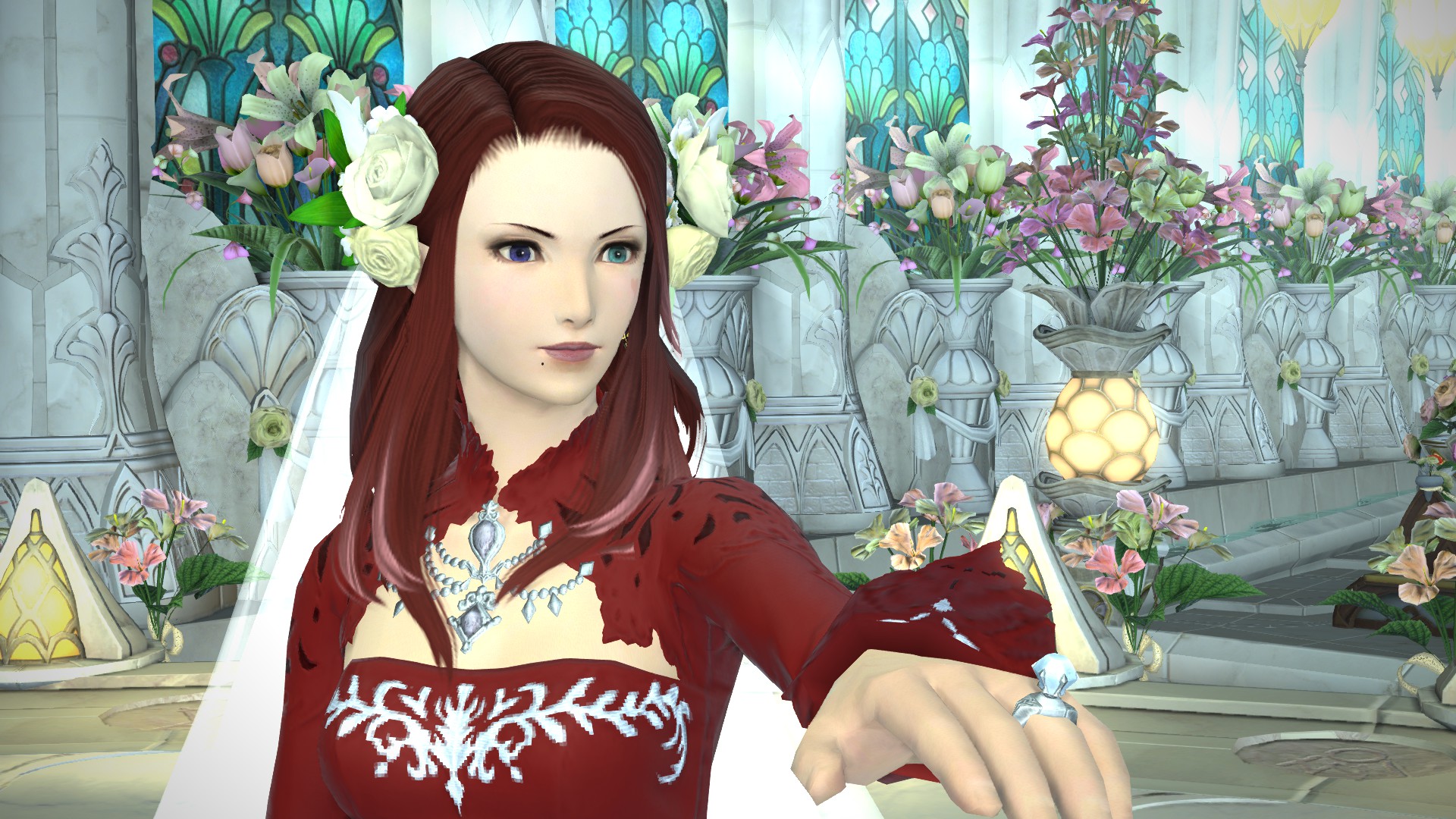
1825: The Happy Couple (or: How I Proposed For Real in #FFXIV)

It occurs to me that a Big Life Event happened during the period when I was doing creative writing on this blog, and thus those of you who only keep tabs on what I'm up to through this site won't be aware of it. So now seems like as good a time as any to share the happy news that Andie and I got engaged, and we're getting married in June of this year.

You probably want an engagement story, don't you? Well, all right, then. Settle down and I'll tell you one.

2015-01-03_00001

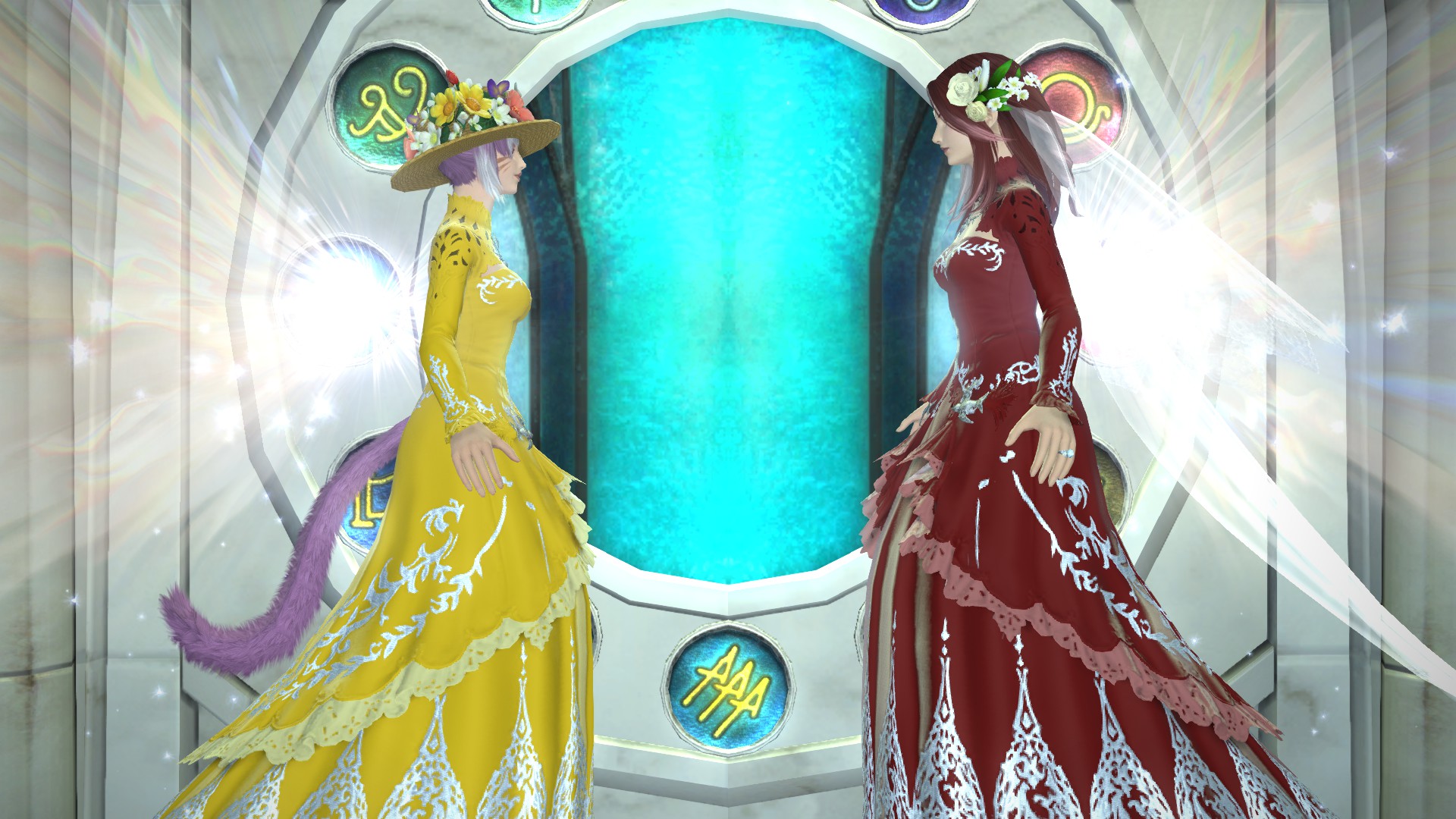
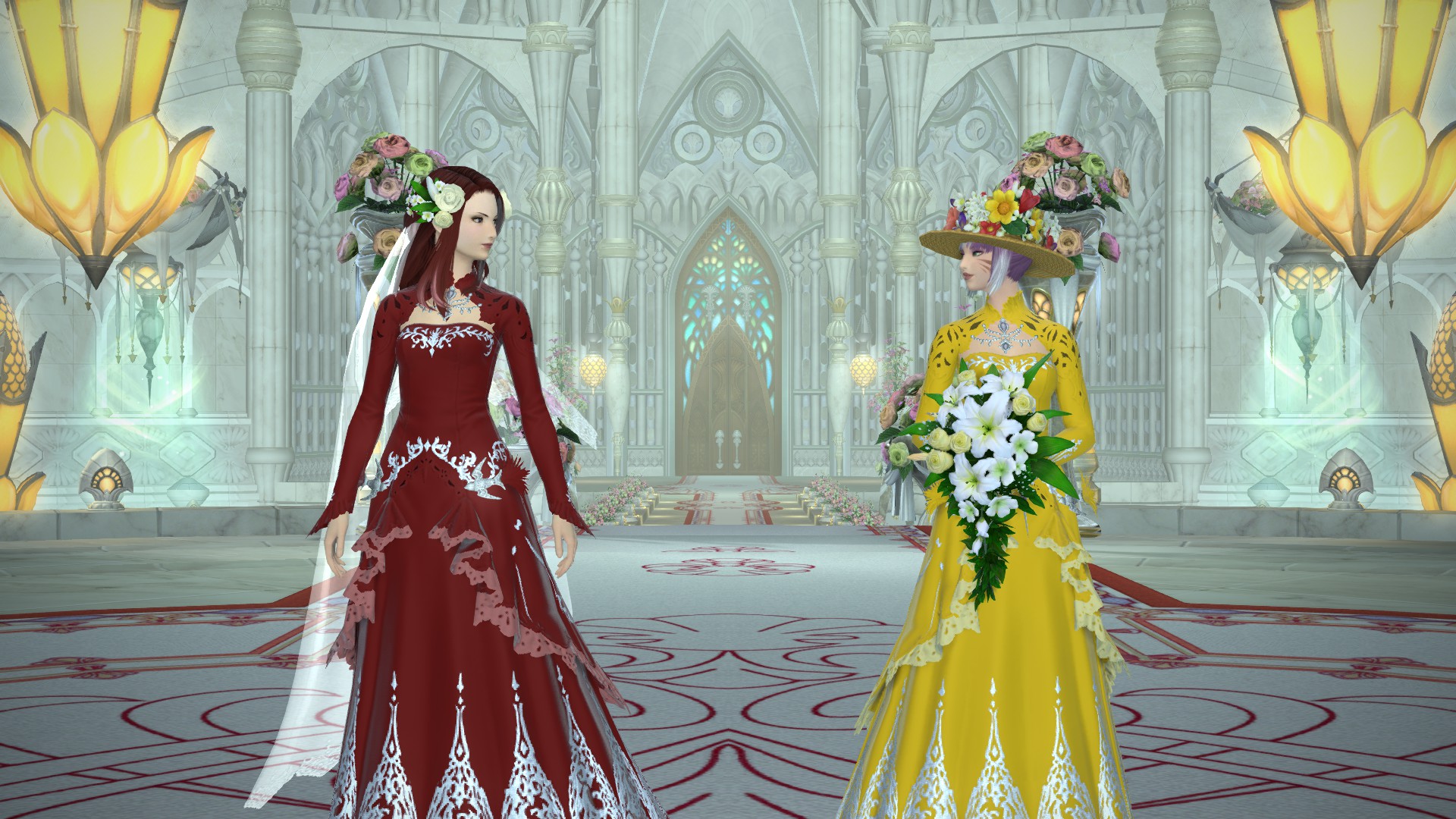
As regular readers will know, Andie and I are both regular players of the massively multiplayer online RPG Final Fantasy XIV: A Realm Reborn. In a recent patch, developer Square Enix added the facility to perform a "Ceremony of Eternal Bonding" with a partner in the game — getting married, in other words. Any character can marry any other character, no matter their gender or race, making it a wonderfully inclusive part of a game that was already extremely inclusive to begin with. I mention this latter fact because Andie and I both play female characters: mine is Amarysse the Hyur Midlander (essentially a relatively normal-looking — albeit "Final Fantasy attractive" — human-type female), while Andie's is W'khebica the Miqo'te (a race of people with cat ears and tails).

As soon as the Eternal Bond stuff launched, Andie and I knew that we wanted to indulge in it. It's ultimately a silly thing that doesn't have a huge amount of relevance to the game as a whole — your main benefits for getting married are that you get a ring that allows you to teleport to your spouse's side once every 30 minutes and, depending on which package you signed up for, some of which cost real money, a selection of goodies including wedding attire, a two-seater chocobo mount and a minion to give to all your guests when they attend your ceremony — but we still wanted to do it. I also think it's quite a nice way to acknowledge a real-world relationship in the game itself — though, of course, there are plenty of people who are getting married just for fun.

Anyway. Andie and I got up early on Boxing Day to book our ceremony. Yes, you actually have to book; ceremonies occur at specific times on specific dates, so we had to get in early in order to get a practical slot. Given that we play alongside a lot of Americans, we wanted to book it for an America-friendly time that was also not in the middle of the night for us, so we eventually settled on Saturday January 3 in the evening our time, since you have to book at least a week in advance.

2015-01-03_00009

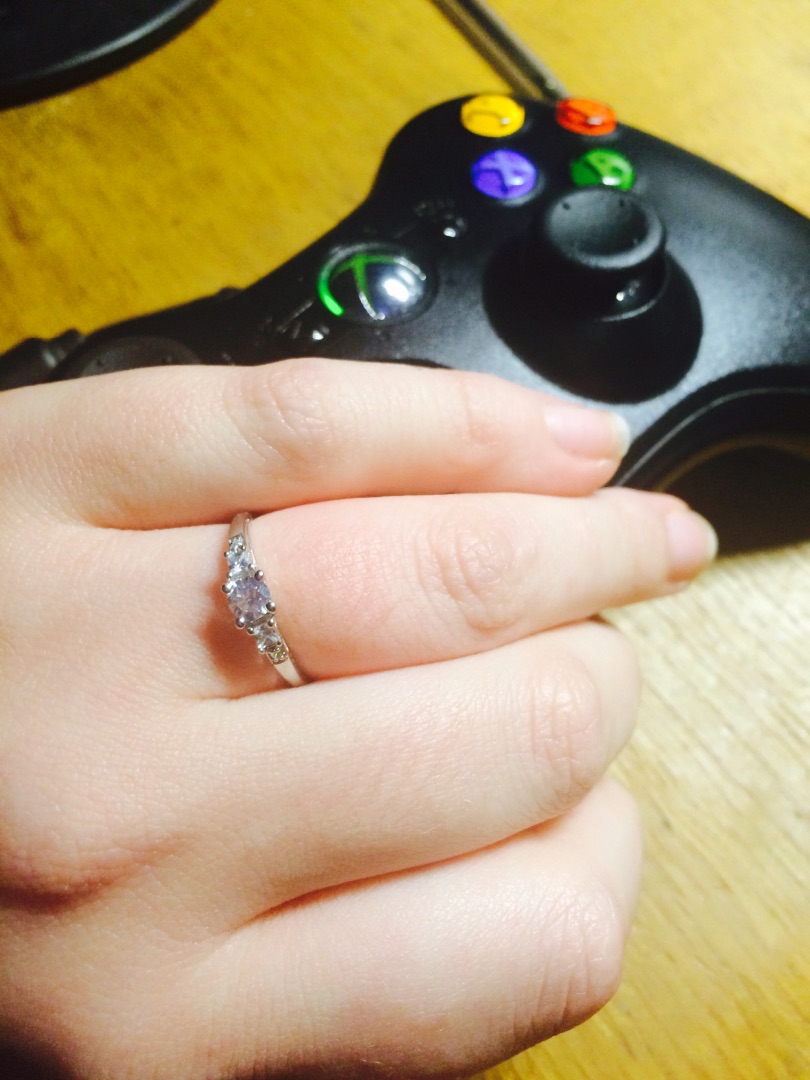
Now, since we'd been talking about getting in-game married ever since the possibility was launched, I'd been pondering secret plans in the run-up to this, and decided that yes, I wanted to put those plans into motion. I had not-particularly-subtly hinted to Andie that I might be interested in buying her a shiny ring, and invited her to indicate a selection of acceptable choices that would not cause me to be thrown out on the street or anything. I did some research, shopped around and eventually settled on one that she'd indicated she particularly liked. I finished work early on New Year's Eve and snuck into town to see if they had one in stock. They did, but not in the right size; I bought it anyway, as it was more that I wanted to have it as a symbol to go with the proposal than something I could put on her finger right away. (It transpired that she put it on anyway, got it stuck and we eventually had to go to A&E to get the damn thing off again! We now have one in the correct size.)

That was that; the plan was in motion, and there wasn't really any turning back now. Well, sure, I could bottle it and save the ring for another occasion, but really, honestly, our in-game ceremony felt like an ideal time to do it.

I set to work determining how I was going to do it, including worrying rather more than I probably needed to about whether I should actually ask the question in the game's text chat function, or just disappear from my keyboard for a few moments and ask her in person. (When we're both playing, she's on her computer upstairs while I'm downstairs in the living room, so it's not as if I could have just turned to her and asked her.) Eventually, I wrote a speech that I felt expressed what I was feeling adequately (albeit perhaps overdramatically) and resolved to deliver it during the twenty-minute period of the in-game ceremony where you are invited to exchange your vows with your partner. Most players who are doing the wedding thing for fun skip over this part or just allow their friends to set off some fireworks, cheer, whoop and holler, but it seemed like the ideal moment to me. So that was what I decided to do.

2015-01-03_00013

The day came, and we both logged on to play as normal. While it was tempting to surprise everyone with what I was up to, I decided that it would be prudent to share my plans with at least a couple of people so that I could ensure we had a decent turnout to our ceremony, and that people knew they had to behave themselves appropriately. I sent a "whisper" (private message) to my friend Cyra (aka Phil; we actually met him in the real world a while back when he happened to be in London the same day we went down to see the Distant Worlds concert) and informed him of my plans. He squee'd a bit (well, in a sort of manly way) and then told me to leave it with him; he'd inform some of the other regulars in our Free Company (guild) and between them they'd make sure people were 1) at the ceremony and 2) behaving themselves.

The appointed hour came, and Andie and I rode to the Sanctum of the Twelve in the East Shroud. Our friends were already gathered outside, and one had been crafting multiple copies of a hat that Andie's character habitually wears, then handing them out to the guests, so we were confronted with a crowd of people all wearing flowery hats. Then it was time to go in; Andie and I were escorted to our separate rooms to get ready, while the guests were taken to their separate waiting room to wait for us both to indicate that we were ready. We both changed into our wedding dresses, rang our Eternity Bells to indicate that we were ready, and then the ceremony began.

Conveniently, Cyra/Phil recorded the whole thing. You can watch it on his Twitch page, because WordPress doesn't want to embed the video for some reason. 🙂

And, well, this happened.

ring

1798: Starlight Vigil

Today I participated in something that I had only previously heard about: an entire online community coming together to pay its respects to someone.

That "someone" was a person whom I only knew as Codex Vahlda, a Final Fantasy XIV player on the Gilgamesh server whom I became aware of this morning after a casual browse of Twitter.

I didn't know Codex at all. I don't even play on his server, so it's unlikely I would have come into contact with him unless he randomly showed up in a Duty Finder group for running a dungeon, since those pull players from several servers to make complete groups.

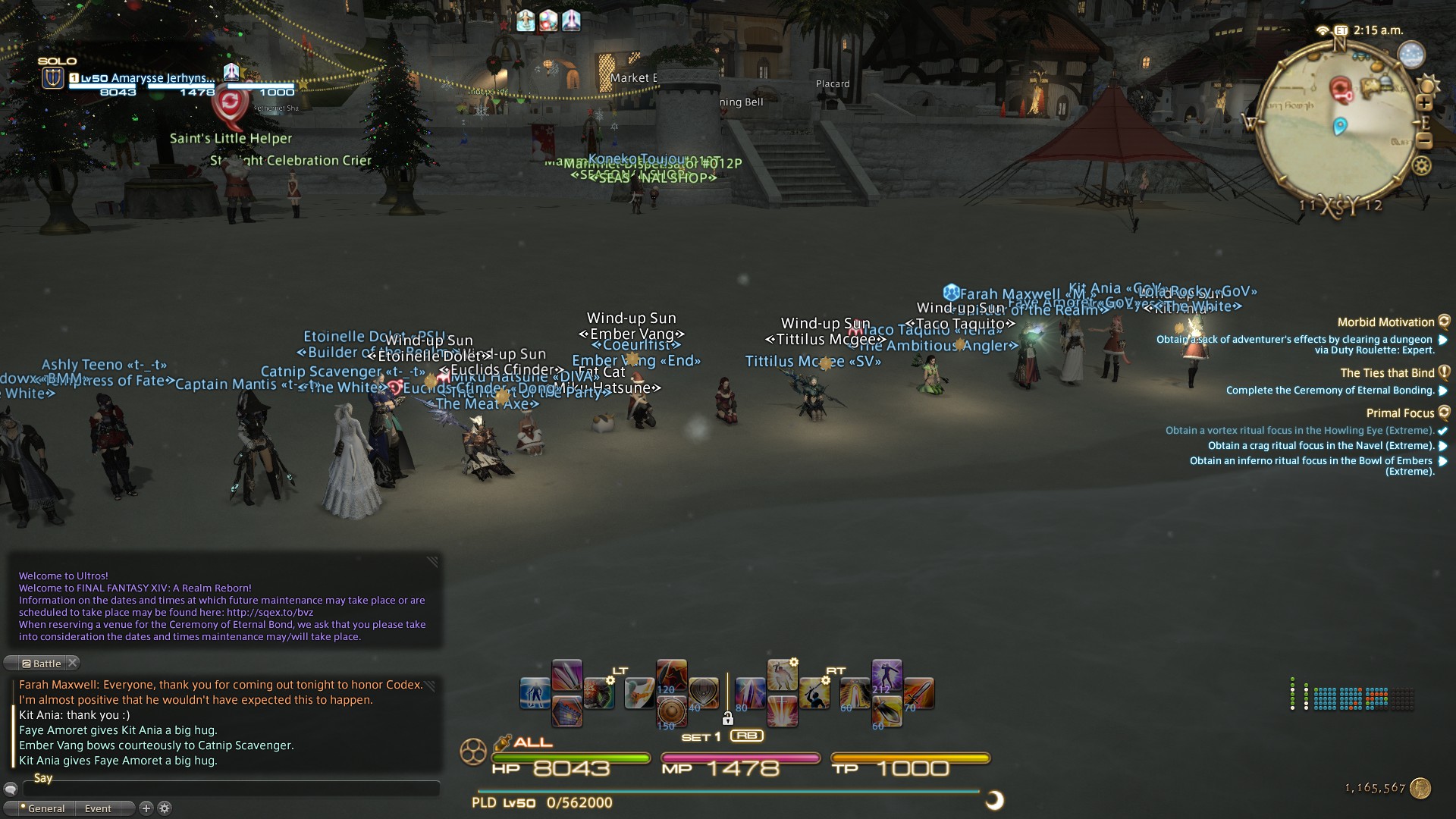
Sadly, I'll never have the opportunity to know Codex, as he passed away recently due to complications from renal failure. Both he and his family and friends seemingly knew that he was going to pass on, and it was as he lay on what was to become his deathbed that Final Fantasy XIV players from around the world, and from several different servers, all gathered in the same place — the beach in Ward 1 of the player housing district Mist — and held their own vigil for our fallen adventuring comrade.

Normally, this sort of thing is an event that you tend to hear about after the fact, but I happened to be online just as someone on Twitter was posting about the vigil taking place on Ultros, the Final Fantasy XIV server which I call home. Largely out of curiosity, I logged in to take a look at what was happening, ran down to the beach and, sure enough, found a line of players facing out to sea, "wind-up sun" minions out, bathing the group in a soft light, contemplating whatever they chose to be contemplating as they paid their respects to Codex. I joined them.

17754480252836380672_screenshots_2014-12-21_00001

After a moment of quiet reflection, people spontaneously began letting off fireworks and balloons — these are items you can acquire in the game and are intended for use upon celebratory occasions such as seasonal events or the newly added "Eternal Bond" wedding system. It was a celebration not only of Codex's life, but also of how one stranger could bring all these disparate people from all over the world together in one place to do the same thing. It was a really, really beautiful moment, and extremely moving.

It's easy to think of the Internet at large, social media and online games in particular, as utterly "toxic" (that's a favourite word of critics at the moment) environments in which everyone is constantly at one another's throats. But every so often something happens that reminds you that an awful lot of human beings are fundamentally decent people, and that regardless of where you're from or what — if anything — you happen to believe in spiritually, the cycle of life and death is, pretty much without fail, something that will always bring us closer together with one another.

Rest in peace, Codex; I never knew you, but I hope wherever you are now, you feel the love of all the strangers who came together to celebrate your life today. May you forever walk in the light of the crystal.

1632: Defenders of Eorzea

Final Fantasy XIV patch day today, and I told myself that today was going to be a day off from stress, anxiety and worrying about things, and that I was just going to enjoy myself. So I did. I logged on at about 11:30 this morning — or yesterday morning, if we're being truly accurate — and now, at 2:52am, I am logging off, with only a few short breaks throughout the day for food and drink.

Suffice to say, patch 2.3 is excellent. I, along with many of my Free Company-mates, took today to work through the new episode of the main scenario quest, which included a spectacular battle against Ramuh, Lord of Levin (aka "the old man who flings lightning everywhere") as well as a ton of other story content. I also completed the new Hildibrand questline — a comedic questline that, for many, has proven a highlight of Final Fantasy XIV's ongoing updates — as well as trying out all three of the new 4-player dungeons.

And I've barely scratched the surface. I've bought a room in our Free Company's house for my character, but I'm yet to fill it with furniture — there's just a bed, a couple of chairs and a table in there for now. I haven't even touched the new 24-player Crystal Tower raid, which promises to be an enjoyable clusterfuck, just like the previous 24-player Crystal Tower raid. And there's a ton of other stuff I'm yet to fiddle around with, too — not to mention returning to the tasks I was already working on prior to the patch, which will now be somewhat easier thanks to improved rewards from a bunch of game content.

So far there have been numerous highlights. Although some disliked the amount of dialogue and cutscenes in the main scenario quest, I enjoyed what was offered, as if you stopped to read it and see what was going on, it proved to be a nice "here's what's been happening elsewhere in the realm since last you saw these people" affair. There was also some neat — if rather obvious — foreshadowing of who the next "big fight" is going to be against.

The new dungeons are great, too. Tam-Tara Hard is particularly fun — as one of the low-level dungeons that comes up most frequently in Low-Level Roulette, Tam-Tara is a dungeon that many people were growing sick of, but its Hard incarnation successfully reimagines it into one of the best — if not the best — dungeon in the game. Featuring a creepy atmosphere, some brilliant boss fights and a narrative twist that is sure to please those who were paying attention earlier in the game, Tam-Tara Hard was a real highlight of today's session.

Stone Vigil Hard has proven more divisive, but it's certainly an interesting, challenging experience. The regular enemies are more than a match for even a well-geared party, and the bosses all make use of interesting mechanics that require far more than a simple "tank and spank" approach. This is nothing unusual for Final Fantasy XIV, which features some very involved boss battles throughout, but Stone Vigil Hard features some particularly interesting mechanics.

Finally, the all-new dungeon Hullbreaker Isle was great. Unfolding mostly outdoors, the "dungeon" sees you attempting to track down the treasure of the pirate Mistbeard. Along the way, you have to contend with various groups of angry wildlife, some unpleasant traps left behind to deter unwanted visitors, and, at the end, a rather annoyed kraken who wants nothing more than to pick you up, fling you around and splatter you with ink.

Final Fantasy XIV continues to go from strength to strength. It remains, as it has done since it launched last August, one of my favourite games, and if the strength of this new content is anything to go by, it has a significant amount of life in it. I'm genuinely intrigued to see where the main story is going, and in the meantime I'm really enjoying the other tasks and challenges the game faces me with. And there's some stuff — like the super-challenging endgame raid The Binding Coil of Bahamut — that I'm still barely touching. There is so much to do, and I'm having an absolute blast doing it — not to mention making some good friends in the progress.

Now, my brain is fried, so I should probably go and get some sleep. It's back to the doldrums of hunting for work tomorrow, though I don't doubt I shall reward myself with an hour or two in Eorzea as the day progresses!

1626: Quest for the Animus

We're counting down the days until Final Fantasy XIV's third major patch, Defenders of Eorzea — and in the meantime, a lot of us are trying to get as much of the previous time-consuming stuff done as possible.

For a lot of people — those who have reached the endgame, anyway — this is the long and convoluted process of acquiring and subsequently upgrading your "Relic" weapon. It's a questline that was originally available in Final Fantasy XIV's 1.0 incarnation which was then rejigged, tweaked and revamped for when A Realm Reborn launched. Over the course of the last few patches, it's continued to expand — and in the process, it's created a highly memorable gaming experience, albeit one that will drive some people to madness.

Here's how it works. After beating the game's main scenario (as it existed in the base game when it launched), you can visit a smith named Gerolt in the North Shroud. Gerolt was once a master weaponsmith, but in the years since the Calamity it seems like he is now more frequently to be found at the bottom of a bottle than hammering out a masterwork. Until you show up, that is, having heard rumours of a legendary weapon.

Through a somewhat convoluted series of events that see you finally tracking down the relic — which is broken, naturally — and then defeating a series of increasingly ridiculous opponents in order to acquire the ingredients necessary to repair it, you find yourself with a new incarnation of one of the legendary weapons of yore.

But that's not where it ends. Acquire enough of the mysterious elixir Thavnairian Mist, and you can infuse your relic with additional power, turning it into its Zenith incarnation and giving it a rather fetching glowy effect in the process.

This used to be where the questline ended, leaving you with a level 90 weapon — one of the most powerful in the game at the time it launched. But then came the Zodiac Braves questline, during which you hear tell of the exploits of a band of legendary warriors and hope to use the information to upgrade your weapon further.

The first step in this process is to acquire twelve Atma, strange crystals that very rarely drop in all places around the realm of Eorzea. In gameplay terms, in order to acquire these, you'll need to complete the public quests (known as FATEs) in specific locations. Each FATE you complete with your Zenith relic equipped has a low chance of dropping the Atma for that location, and there are twelve in total. There are all manner of conspiracy theories about whether or not there's a way to game the system or if you really are at the mercy of the random number generator, but you'll get there eventually.

Once you've collected twelve Atma, they're infused into your Zenith weapon, turning it into an Atma. It loses its shiny glow, but changes appearance slightly in the process — in the case of my Black Mage's Stardust Rod, for example, the orb on the end which used to glow purple now glows in rainbow colours. It's not any more powerful, though — it's the next step in the process that makes the Atma weapon unique.

Continuing your research into the Zodiac Braves, it transpires that a number of books detailing the exploits of these legendary warriors are available, but the one who holds them isn't going to let them go cheap. Specifically, she's charging 1,500 Allagan Tomestones of Mythology — mysterious items left over by the 5,000-year old Allagan civilisation that are used as currency in certain parts of Eorzea — per book. And there are nine books to look into, each of which tasks you with a series of Trials of the Braves to follow in the footsteps of the legendary warriors. In gameplay terms, this means there are a number of tasks for you to complete, ranging from defeating specific monsters around the world to discovering and completing specific FATEs and other quests. Once one book is completed, your Atma weapon receives a small upgrade. When all are completed, the combined knowledge from the books  turns your weapon into its Animus form.

This is what I'm working towards at the moment. It's a long and time-consuming process and, frankly, a massive pain in the arse — Mythology Tomestones are acquired at quite a slow rate, so don't expect to be blasting out all those books in a weekend, unless you weren't planning on sleeping at all.

But at the same time, it's really quite satisfying. The upgrades you receive from completing a book are small but noticeable, and the prospect of an even more powerful weapon at the end of the process is a strong incentive to continue. Plus it helps give a feeling of "attachment" to this weapon you've put so much work into — it's something special that you've worked on, and it's become "your" weapon rather than just another item. This feeling further continues during the next phase of the process — upgrading the Animus weapon into a Novus — during which you have a strong degree of customisation over how your finished (for now, anyway) weapon will end up.

And, importantly, it's optional. If you don't think you'll be able to deal with the grind, you don't have to. There are plenty of other means of acquiring powerful weapons in the game — though expect to be challenging some of the game's toughest encounters in order to do so. Many people, even knowing how much work goes in to one of these weapons, are still voluntarily starting down the long road, though — and, as painful as the process can seem at times, it's something which you and your friends can bond over and swap war stories about.

Despite its negative aspects, then, I rather like it; it gives a feeling of investment in your character's development even after the experience points and levels have stopped flowing. It gives you a feeling of attachment to your weapon, much like characters in fantasy epics, or indeed the Zodiac Braves whose trials you're pursuing. And when you finally reach one of the important milestones in the process, good Lord is it satisfying.

Will I reach Novus or even Animus before patch 2.3 arrives — possibly bringing with it another step in the upgrade process? I have no idea, but I'm working on it, with my in-game friends cheering me on every step of the way.

1623: Attack on Twintania, Part 1

Further to yesterday's post, I had the good fortune to spend a bit of time in Turn 5 of the Binding Coil of Bahamut in Final Fantasy XIV this evening, courtesy of my good friends in my Free Company — the "guild" of other people I play with on a regular basis. Although Coil goes beyond Turn 5 now, there are still a number of people who are yet to clear it, and I'm one of them — so part of this evening was set aside as some training time to get to know the encounter a bit better. We didn't clear it, but we made some good progress.

What follows, then, is an account of how the fight went, written (hopefully) in a means through which a non-MMO player can understand what is going on. I found it an exciting experience — and if you've never tried it, you learn something about what high-level play in a massively multiplayer game like Final Fantasy XIV is all about.

Turn 5 of the Binding Coil of Bahamut focuses entirely on one encounter: eight comrades-in-arms against an ancient dragon named Twintania, put there by the ancient Allagan civilisation to do their bidding. Actually, to be exact, it's eight comrades-in-arms against an ancient dragon named Twintania and her three friends, but said three friends aren't nearly as much of a threat.

The fight began with our de facto leader the paladin — a strong defensive fighter whose strengths lie not in doing a lot of damage, but instead in keeping the attention of enemies off the more fragile members of the party — charging in and provoking Twintania and her allies. The remainder of the group then followed — at a safe distance for those members such as myself, who were able to inflict damage from a distance — and concentrated on dealing with Twintania's three friends. Meanwhile, we were fending off attacks from Twintania and her companions — fiery rings that dropped on the floor and hurt a lot if you didn't get out of them as quickly as possible when they fell on you.

Once the three smaller dragons were down, the group turned its attention to Twintania proper, gathering around her with a strong defensive fighter at the front and another defensive fighter at the side, accompanied by our Scholar's fairy companion Eos. The group aggressively attacked Twintania until one of the three Neurolink devices around her neck dropped to the floor, at which point the real fun was about to begin.

A curious "blip-blip" sound — perhaps from the Neurolink? — heralded the imminent arrival of a fireball attack from Twintania on a member of the party. No-one knew who these attacks were going to target, but as soon as the telltale signs appeared, they ran to the defensive fighter and fairy standing to one side of Twintania and shared the damage with their two companions — a direct hit without the support of others would have meant instant death.

As the healers frantically worked to help those hit by the fireball recover, the rest of the group prepared for another troublesome ability Twintania had up her sleeve: the ability to summon a terrible conflagration and trap a combatant within. The telltale "blip-blip!" sound came again, but this time with a different marker; its appearance signalled that the victim was about to become caught in a fiery prison, and would need their companions to break them free before it exploded.

Sometimes, despite our best efforts, it was impossible to break through the Conflagration before the next fireball attack came, but here it was possible to take advantage of a curious property of the Conflagrations: while those caught within were completely immobilised, it was possible to break in from without, and despite the temporary incapacitation, a Conflagration provided surprisingly good shelter and respite from the relentless fireballs.

After successfully dealing with this tense situation for some time, Twintania took to the skies and flew off. Had we driven her away? Of course not; this was just the beginning.

A second Neurolink fell from Twintania's neck; the signal that we had to move into a recessed part of the platform upon which we were standing — actually the right hand of the dormant dragon god Bahamut, who wreaked havoc on the realm of Eorzea five years previously. Keeping a careful eye on the dragon revealed when she was likely to swoop across our battleground, attempting to kill us off with her "divebomb" attack. Fortunately, staying nimble on our feet meant it was eminently possible to stay out of the way of these deadly swoops, and instead focus our attention on some new friends: three snake-like creatures, one of which was known as Asclepius and the other two of which were known as Hygieia.

Although terrifying and against the principles of everything we'd trained for up until this point, the party stood firm directly in front of these three new opponents, eyes occasionally darting to the sky in case Twintania decided to swoop in once more. We weakened the two Hygieia without killing them, then set to work on the Asclepius — and then Twintania resumed her assault. Once again, some nimble footwork saw us dodge all but one of the deadly swoops — the last of which knocked me clean across Bahamut's palm, but thankfully didn't finish me off — and it was time to deal with two more Hygieia that had appeared to join the fray.

Muttering an incantation under my breath, I summoned all my willpower and unleashed my Limit Break skill, calling down a shower of meteorites to pelt Asclepius and its four children with devastating, fiery projectiles. The two weakened Hygieia fell to the assault, enfeebling Asclepius, the two remaining Hygieia and the brave frontline paladins in the process. It wasn't long before the other two Hygieia fell, weakening Asclepius further in the process, and shortly after the larger snake was also defeated.

By this point, Twintania was obviously furious and preparing for some sort of last-ditch "ultimate" attack. We had but moments to dart for the safety of the fallen Neurolinks on the ground — and then to hope and pray as the room was filled with the brilliant white light of an aetheric explosion.

Not all of us survived the blast, and it wasn't long after this that Twintania's summoning of deadly whirlwinds finished the rest of us off. We collapsed to the ground — beaten for now, but determined to return once we had gathered our strength and prepared once again for the deadly conflict — and Twintania lived to fight another day.

1622: Another Turn in the Coil

The Binding Coil of Bahamut is — or at least was — the most daunting challenge in Final Fantasy XIV. Originally designed as an 8-player multi-part raid to challenge the very best of the best players, Coil, as it tends to be known by the denizens of Eorzea, is now something of a shadow of its former self, with the toughest challenge now being posed by the imaginatively named The Second Coil of Bahamut.

The reason why it's a shadow of its former self is twofold: firstly, the average equipment level of most endgame players in Final Fantasy XIV is now considerably higher than it was when it first launched and Coil was the hardest thing in the game; secondly, you're now provided with a buff called "The Echo" upon entering, which boosts your HP, damage, healing and a few other bits and pieces by 15%. Second Coil has no such buff, but it will have one in the future, when Third Coil, or whatever comes next, is released — and so on as the game gradually ups the stakes time and time again.

This is a clever and sensible move on the part of producer Naoki Yoshida and his team. The Binding Coil of Bahamut, despite still being a very challenging set of mini-dungeons and boss fights even with the Echo buff, is part of Final Fantasy XIV's overarching story. Working your way through it provides you with information about the ancient Allagan civilisation, whom you keep discovering artifacts of throughout your travels, and also what the main recurring villains of the piece — the Ascians — are up to. It also provides a tantalising glimpse at what really happened to the dragon-like god Bahamut as part of the Calamity — the in-game, in-lore justification for the shutdown of Final Fantasy XIV's version 1.0 incarnation in 2012 — and what the artificial moon Dalamud was actually hiding inside itself besides Bahamut.

All interesting stuff, I'm sure you'll agree — well, you might not, but humour me. To put it another way, it's all stuff that people who are interested in the detailed lore and worldbuilding of Final Fantasy XIV will probably want to experience. And through the gradual "nerfing" of it as new content arrives, eventually everyone will be able to make it through Coil and see what's what — just some people will do it sooner than others.

Anyway, the reason I bring this up tonight is that I've been doing a bit of Coil myself this evening. This is something of a big step for me, as I've previously only ever set foot inside that place in the company of my comrades from my Free Company. With a lot of high-level content in any MMO — not just Final Fantasy XIV — it's assumed that you know what you're doing when you step inside, and that you won't mess things up, because in many cases one mistake can bring an entire eight-person team crashing to its knees.

This is, I'm sure you'll appreciate, an enormously daunting prospect, particularly for someone like me, who sometimes lacks confidence in himself. But tonight I not only voluntarily went into Coil "solo" (to be automatically matched up with seven other random players), I also did so on White Mage, a healer class, rather than my "comfort zone" (and main) class Black Mage. And while there were a couple of aborted attempts — largely due to poor party makeup rather than anyone making any horrendous mistakes — there was none of the rage, none of the aggression, none of the elitism that can make playing through difficult content even more daunting than it already is. On the whole, it was actually quite a pleasant experience, despite being challenging — and I was rewarded for my efforts, too, with a new ring for my Paladin and some new boots for my White Mage. Score!

I'm always secretly pleased with myself when I overcome a fear like that. Because although Final Fantasy XIV is just a game, and I understand that, the anxiety and fear I feel from social situations is as real online as it is when I'm getting tongue-tied trying to make small talk with someone I don't really know. My ticking that box in Duty Finder, queueing up and then repeatedly going back into Coil this evening might not sound like much, but believe me when I say it was actually quite a big step for me in terms of self-confidence.

And who says games can't do any good?

1610: Titan Falls

Just wanted to share my enthusiasm for what I felt was a significant (gaming) achievement this evening: finally successfully toppling Titan's Hard Mode incarnation in Final Fantasy XIV without dying, without being blown up by bombs, without getting hit by Weight of the Land (too many times) and without doing anything stupid. The secret? Zoom out the camera.

For those unfamiliar with Final Fantasy XIV's endgame, Titan Hard Mode was formerly one of the hardest encounters in the game, taking the form of an 8-player variation on one of the main story's 4-player bosses. Mastering (or at least clearing) the fight is an important part of endgame play, since acquiring your class's "Relic" weapon requires you to beat him along with the other two Hard Mode primal fights and two original bosses Dhorme Chimera and Hydra.

The actual battle against Titan bears some resemblance to its story mode counterpart in that Titan makes use of many of the same abilities throughout. The main difference is that the fight is overall a lot longer and incorporates a few new mechanics — most notably the addition of "Bomb Boulders" that drop down from the sky in set patterns and then explode in sequence, requiring the party to quickly and carefully manoeuvre from position to position in order to avoid damage — and while avoiding Titan's other abilities such as Landslide, which can knock you off the arena and out of the fight completely if you're not sharp enough.

Like the other Hard and Extreme mode Primal fights in Final Fantasy XIV, Titan Hard is quite a "choreographed" fight that requires the party be in the right place at the right time, and respond quickly to prompts on the screen. Titan always uses the same abilities in the same order, so there's very much a sequence and timing you can learn, though there will be slight variations on exactly what you need to do each time you play owing to people standing in different places.

It may sound odd to say, but it's a strangely beautiful sight to see a party pulling off a fight like Titan Hard efficiently and effectively. The group moving as one from place to place in response to the incoming threats is a very satisfying thing to watch, particularly when you're part of it. It's a hard thing to convey to anyone who hasn't experienced it for themselves, but in many ways it's like pulling off an impressive "dance" as a group — eight people working as one (for the most part… there's usually at least one person who falls off remarkably quickly, and up until tonight it's usually been me) to achieve a common goal.

I must confess to feeling pumped up and happy about my victory this evening — and, now, much more willing to jump into the Trials Roulette mode of the Duty Finder, which I'd previously been extremely hesitant about making use of despite the helpful rewards on offer. The Extreme Mode primals may still be a while off before I can confidently tackle them — same for Twintania, the notorious boss that guards the end of the first super-tough endgame dungeon The Binding Coil of Bahamut — but for now, I feel I have conquered Titan Hard and can move on to stiffer challenges.

Oh, and I should give a shout-out to Andie, too, who has been playing Final Fantasy XIV and has just got her first character to level 50, putting my friend James — who has been playing a lot longer — to shame. Nice job, W'khebica (an authentic Miqo'te name, apparently) — I look forward to enduring the endless Myth grind with you at my side.