2311: I Finished My First Ys

0311_001

It's something of a novelty these games to start and beat a game over the course of a couple of days — particularly an RPG — but with Dungeon Travelers 2 being considerable in both length and difficulty, I felt that a palate cleanser of some sort was in order before I tackled the remaining 15+ floors of that game's final dungeon. I considered picking up the new Doom, but I couldn't quite bring myself to spend that much on it, so instead, as I noted yesterday, I turned to the Ys series.

This evening, I beat Ys I. Here are some things I thought about it.

Things I liked

  • That music! The PC version I was playing has three mixes of the soundtrack available: the original FM version, a remastered MIDI version from a later incarnation and a full-on rock the fuck out version from Falcom's in-house band. I must confess I didn't try the two earlier versions, as Falcom's band is pretty damn amazing. Wailing guitars and pounding drumbeats complemented the action perfectly, and brought a pleasantly nostalgic feeling over me, making me think of both Castlevania: Symphony of the Night (which had plenty of widdly-diddly guitars) and my brother (who was always very good at widdly-diddly guitars when I was growing up).
  • Levelling up is meaningful. There are ten experience levels in Ys I. Each one is a significant jump in power. From level 1 to level 2 is the difference between taking 4 or 5 hits to kill an enemy and being able to splatter it in a single hit. Your power continues to increase hugely as the game progresses.
  • You have an HP bar that gets bigger. I don't know why I like this, I just do. I liked it in Metal Gear Solid, I liked it in Kingdom Hearts and I like it here. It's a satisfying visual representation of your growth in power.
  • Your HP bar shows how much damage the last hit you took chipped off. This is really nice. Similar to how fighting game health gauges work, your HP bar in Ys highlights the amount of damage the last hit gave you in a brighter shade of red so you can estimate roughly how many more individual hits you can take before needing to worry about healing.
  • Tactical health regeneration. Healing items are few and far between in Ys I, so it's fortunate that you regenerate health by standing still… though only when you're in a place where you can see the sky. Later in the game, you acquire a healing ring that allows you to regenerate in dungeons, too, but for the majority of the time, finding an open-air "clearing" in a dungeon makes a nice checkpoint.
  • Cute girls. My goodness. I want to cuddle Feena forever.
  • The sense of place and character. I mentioned this yesterday, but Ys I's world feels remarkably coherent, even with its relatively tiny size compared to some other RPGs. By the end of the game, you recognise every character, and the character notebook feature in the game suggests that the writers thought long and hard about each and every NPC in the game, regardless of their importance (or lack thereof) to the plot.
  • The interesting structure. Ys I is broadly split into two parts: the first half sees you charging around the overworld completing various quests, and this will probably bring you up to the level cap of 10. Once you've done everything out in the world, you then enter the 25-floor final dungeon Darm Tower, where you'll need to use everything you've learned (and a few other things besides) to make it to the top and kick the last boss' face in.
  • The last boss is the hardest thing in the game. I've lost count of the number of RPGs I've played where the final boss is an underwhelming battle thanks to the ability to overlevel yourself for it by doing all manner of side activities beforehand. In narrative terms, the final boss should really be your most significant challenge, so it's always a little disappointing when you can mash it in a couple of turns. Not so in Ys I; this asshole puts up a fight.

Things I liked a little less

  • The bosses are a bit primitive. This is perhaps understandable, given the game's heritage — despite this being a modern remake, the original Ys I came out in 1987 and the bosses in particular make this abundantly clear, with very simple attack patterns that have no "intelligence" whatsoever — simply either randomised or predictable path-based movement.
  • The last boss is the hardest thing in the game… but for all the wrong reasons. The final boss is all kinds of bullshit. He bounces around the screen, frequently going out of reach. When you hit him, the floor falls away underneath where he was, and this can either kill you instantly or trap you in a corner if you're not careful. He shoots fireballs that split into so many bullets it's literally impossible to dodge them all. Fighting him is more a matter of being able to inflict enough damage on him before he kills you than any real skill at recognising and dealing with his patterns.
  • Inconsistent item behaviour is a little unfair. You can't use items or change your equipment in boss battles. This means you can't use that healing potion you've been saving, or the magic mirror to freeze your opponent in place. Worse, the various rings you acquire throughout the game — which vary in effect from doubling your damage dealt to halving your damage taken via allowing you to slowly regenerate when standing still — have no effect whatsoever in boss battles, either.
  • There are a number of instances where the game kind of forgets to tell you what to do next. This happens for the first time right at the very beginning of the game, where no-one tells you that in order to trigger an important event you first have to speak to each and every NPC in the starting town. There are a number of other such incidents later in the game, too, but again, this is perhaps a remnant of the game's 1987 heritage, when games were a lot less hand-holdy.

Ultimately, none of the things I liked a bit less about Ys I distracted me from playing it through from start to finish and really enjoying the experience. I'm not sure whether I'll go back and play it on the notorious Nightmare difficulty — I'm not sure I can face some of those bosses again! — but it's a definite possibility. For the immediate "now", though, I think I'm going to move straight on to Ys II to see how Adol's adventure continues.

Yep. I'm 100% on board with this series, and I look forward to exploring the rest of it.
2310: My First Ys

0310_001

I've been meaning to check out the Ys series for quite some time — my Steam library informs me that I have owned a number of the PC versions for several years, and I also have a number of the PSP versions loaded on my Vita, too. For some reason, though, I've never got around to it.

I decided that it was time to change all that, so I booted up Ys I to start at the beginning. And, well, I kind of wish I'd done this sooner.

Ys is a series I've been dimly aware of for many years. I remember some seriously random things from my childhood, and one of the things that is still stored in my memory for some inexplicable reason was seeing a review of Ys III: Wanderers from Ys in the SNES magazine my brother's girlfriend at the time was working on, Control. Something struck me as very interesting about this side-scrolling hack and slash adventure, and I often found myself wondering what it would be like to play. For one reason or another, though, I never did check it out, but the Ys series had always been at the back of my mind ever since.

Ys I is a rather different affair from Ys III, which took a distinctly Zelda II-esque approach of attempting to reinvent the series as a side-scrolling platform action RPG rather than the more traditional top-down perspective of other installments. But Ys I isn't like any other RPG I've played, either. It's not like Zelda because of its use of the rather peculiar (but fun and satisfying) "bump" combat, wherein you attack enemies just by walking into them, and whether or not they do damage to you depends on the angle you hit them at. It's not like Final Fantasy or Dragon Quest because it's not a turn-based RPG, nor is it a globetrotting adventure. Instead, it's something that very much has its own identity.

Ys I — and, indeed, most of the subsequent Ys games — casts you in the role of one Adol Christin, a redheaded adventurer lad who washes up on the shores of the land of Esteria against all odds after surviving a strange phenomenon surrounding the island called the Stormwall. After a brief convalescence — and specifically against the recommendations of his doctor and nurse — he heads out into the world to explore and figure out what is going on, and before long, oh, wouldn't you know it, he's some sort of Chosen One at the centre of all sorts of mystical happenings that appear to converge on Darm Tower, a hulking, sinister structure on Esteria that seems to be the source of everyone's troubles and woes.

Where Ys shines is in its small scale. In this sense, it's rather similar to the only other Falcom game I've played to date, The Legend of Heroes: Trails in the SkyTrails in the Sky featured a fairly hefty journey for its main cast, but its real appeal was in how much character and personality it gave each and every party member, shopkeeper, NPC on the streets and distinct region of the world. Ys I is the same, only in more concentrated form; the island is a very small place that you quickly learn to find your way around, even with the game's total lack of any sort of map function, and it's not long before you feel like you've got to know pretty much all of the 88 characters who are scattered around the game world, some of whom have something interesting to say, others of whom are simply background colour.

What's fascinating about Ys is that even the incidental, "useless" NPCs are full of personality and have clearly been written with a greater context in mind. They each have their own little stories to tell, and over the course of Adol's adventure, the things they say change subtly, giving you a good feeling of the sort of person they are and what they think about everything that's been going on. And the game sometimes surprises you by making what appeared to be an incidental character rather more important than they first appeared.

Couple all this with some really lovely pixel art in the field, some gorgeous visual novel-style illustrations when speaking with the more important characters, and an absolutely rockin' soundtrack, and, well, you have a game that is really rather good: unconventional, memorable, interesting and, most of all, fun.

If Ys I, the oldest and most primitive title in the series, is this appealing to me, I can only imagine how enjoyable the most well-regarded entries like Oath in Felghana and its ilk are. I'm looking forward to investigating the rest of the series in detail, and anticipate that I may well become a bit of a Falcom fanboy by the time I'm done with them.

1963: Cold Steel

XSEED Games, localisation specialists extraordinaire, made a number of delightful announcements for fans of Japanese games earlier today. Firstly was the entirely expected but now thankfully confirmed news that Senran Kagura Estival Versus is coming to Western PS4s and Vitas later in the year — I'm supremely happy about this, as Senran Kagura is a fantastic series with some of the best characterisation out there.

Secondly, the more "major" news for many was the announcement that Trails of Cold Steel — known to Japanese fans as Sen no Kiseki or its previous unofficial English moniker Trails in the Flash — is also coming West. Not only that, the first of its two chapters is pretty much finished and almost ready to go.

For the unfamiliar, Trails of Cold Steel is part of the Legend of Heroes series by Falcom, a long-running and deeply, deeply respected series of role-playing games. We haven't had a lot of them over here in the West, but PSP (and later PC) installmentTrails in the Sky First Chapter came out a few years back to critical acclaim — I wrote some words about it here — and its own Second Chapter is coming shortly having nearly killed poor Andrew Dice of Carpe Fulgur, who worked on the mammoth job of translating its extremely substantial script.

After the initial joy at the announcement came some concern from long-standing series fans who had played Trails in the Sky's follow-up games Zero no Kiseki, Ao no Kiseki and Trails in the Sky Third Chapter. Unlike many of the previous Legend of Heroes games, the Kiseki games have a deep relationship with one another, with each of the three "groups" of games (Trails in the Sky, Zero/Ao no Kiseki and Trails of Cold Steel) unfolding on a different part of the same continent. The games all refer to one another and act as "prequels" to one another, so some fans were concerned that newcomers to Trails of Cold Steel would be thrown in at the deep end having missed three whole games' worth of lore and background. And the Kiseki series is not what you'd call light on lore; in fact, it features some of the most well-realised worldbuilding of any RPG I've played.

Brittany "Hatsuu" Avery of Xseed, one of my absolute favourite people in the games industry, took to the Xseed blog to address some of these concerns. And she's certainly set my mind at rest.

To summarise, the reasons why we're not getting Zero and Ao — yet, anyway, since there's a strong suggestion that they will come at a later date, probably on PC — is partly due to technological and marketing concerns. Zero and Ao are PSP games, you see, and while there are still a few PSP games trickling out here and there due to their Vita compatibility — Trails in the Sky Second Chapter will be one — the PSP as a platform has technically been "dead" for some time. As such, it makes sense to push out Trails of Cold Steel for PS3 and Vita, since both of those platforms are still relevant at this time — PS3 is on the decline somewhat, but while developers such as Idea Factory/Compile Heart, Nippon Ichi and Square Enix have made the transition to PS4, there are still a number of PS3 titles incoming for the next year or two at least. Vita, meanwhile, for all the press' attempts to declare it "dead" every few weeks, is enjoying a small-scale but successful existence as the go-to platform for fans of role-playing games and other Japanese fare.

Hatsuu also notes that Xseed took this decision with the full approval of the games' original developers Falcom, whose original intention was always that the three sub-series of the overarching Kiseki storyline could stand on their own and be played in any order. In fact, what you'd get from playing them "out of order" would be an experience and perspective on the overall story unique to Western players and different to what Japan had. Kind of like the difference between watching the Star Wars films in chronological order of release or watching them in "canonical" order from I-VI.

Trails in the Sky First Chapter was a stunning game that I enjoyed very much, and I'm glad to see the rest of this highly regarded series is coming West. It may not be in the "right" order and that may have a few snooty fans being a bit salty, but I'm more than happy to support Xseed taking on ambitious projects of this magnitude and delivering them with aplomb. Xseed are one of my favourite developer-publisher-localisation outfits right now, and they deserve the support of anyone who loves Japanese games.

#oneaday Day 942: Trails in the Sky

[Aside: This is the one-thousandth post on this blog. Hooray! Another 58 days until I've completed a thousand days of daily blogging, however.]

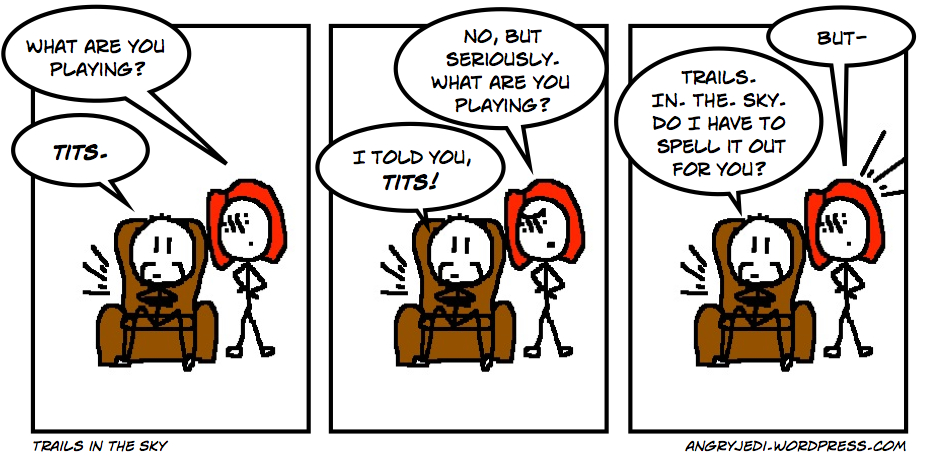
My current gaming "jam", as I believe the kids are saying nowadays, is Legend of Heroes: Trails in the Sky, just Trails in the Sky or its immensely entertaining acronym TitS for short. It's a Vita-compatible PSP game from Falcom, published by Xseed in the States and Ghostlight in the UK, and it was originally available for Windows PCs in Japan, though in the West I believe we've only seen the PSP release.

It's good. Real good. And, like recent RPGs that I've had a particular blast with — Xenoblade Chronicles, The Last Story, Pandora's Tower — it is good due to its willingness to dispense with the conventions of the JRPG genre and to incorporate good ideas from both Western RPGs and the more specialist strategy/tactical RPG subgenre. This exhibits itself in two main ways: its battle system and its game structure.

Battles in Trails in the Sky are a slightly more involved affair than your stereotypical "line up in front of each other and take it in turns to slap one another" JRPG combat system. Instead, battles take place on a grid, and characters have to actually move around as well as use their skills. Certain skills can affect areas, too, meaning that positioning is more than just a gimmick. This system is combined with a mechanic similar to the "Conditional Turn-Based Battle" system seen in Final Fantasy X, whereby the turn order for the next few rounds is displayed at the side of the screen and can be affected by various factors.

The game's "Craft" special ability system also allows player characters to "jump the queue" in the turn order at times if their "Craft Points" bar is full, allowing the player to manipulate the turn order to their advantage. This is an important aspect to gameplay, as certain turns are marked with symbols that denote various bonuses to the active character — a guaranteed critical hit, increased damage, a small amount of healing.

Structurally, the game is somewhere between a traditional JRPG and a more freeform Western title. The game's main plot is rigidly linear and leads the party through various locales which then become their "base" for a while. But while they are there, they have the opportunity to take on a bunch of optional quests which range from defeating tough monsters to delivering packages or locating ingredients. They're generally pretty simple stuff, but each is bookended by a short story sequence for context, giving the player a greater feeling of immersion in the game world by allowing them to get to know some of the incidental characters a bit better. It also makes the game feel less linear, as these optional quests can be tackled in any order — though some will expire if too much progress is made on the main plot before completing them.

There's another reason to do these quests: they're one of the few ways to make money. Rather than monsters inexplicably dropping fountains of gold when they expire, they instead drop crystals that can be used to synthesise new special abilities at a special location in towns, or sold for a profit. Questing is a much more reliable source of income, however, as it's better to save up the crystals for upgrading characters.

Mechanically, then, Trails in the Sky is interesting if not quite "revolutionary" — it's certainly enjoyable to play. But the highlight for me so far has been the excellent localisation. Characters are well-defined and have a strong sense of personality even though there's no speech or any real animation. Through a simple combination of well-written text and mood portraits, you get a real feel for who these people are and how they relate to one another. Particular praise should be given to the interplay between the two main protagonists Estelle and Joshua, who have clearly been set up to have a ridiculous amount of sexual tension between them for the duration of the game despite being polar opposites in terms of personality. It's also surprising to see an openly bisexual character making an appearance, though he is treated somewhat less than respectfully by Estelle, as she refers to him as a "pervert" within minutes of finding out about his preferences. (To be fair to her, though, he kind of is a bit of a pervert, though not because of his sexuality. His stalkerish lusting after Joshua seconds after meeting him for the first time is a bit creepy.)

I'm only about 10 hours in to the game so far but it claims to be about 50 hours in total. That's a decent size for a handheld RPG — hell, it's a decent size for an RPG generally. Any more than that and it can become a bit of a slog. I hope the excellent characterisation and fun battles continue throughout, as it's been a blast so far — so if you have a PSP or Vita and are looking for some top-quality questing, give it a shot.