If you're anything like me, when you encounter a period of great uncertainty or emotional turmoil in your life, it can feel like your brain has pressed a big old "pause" button, making it near-impossible to even contemplate going about your life as normal. Your job feels like the least important thing in the world, you feel like interacting with people in the way you usually would is the most tiring and difficult thing imaginable, and it somehow feels "wrong" to simply continue on with the things that you were doing prior to the aforementioned period of great uncertainty or emotional turmoil.
This is, inevitably, not particularly convenient or helpful, either for yourself or for people who are, for one reason or another, depending on you and your input into various aspects of their own lives, be it personal, professional or a bit of both. I unfortunately do not have a good answer for how to just "get over it" at times like this, since, as you have probably noticed from recent posts, I am slap bang in the middle of one such period right now. And I will doubtless continue to be so for quite some time. I apologise in advance to anyone I don't reply to, am rude to, have no patience for or for whom I am unable to complete a requested task. It's not you, it's very much me, but I do at least hope you have some understanding for what I am contending with.
One of the things I find most difficult about times like this is, as I talked about the other day, getting other people to understand the sheer depth of the things you are feeling, and how all-encompassing they can feel. I feel like not everyone's brain presses that big tempting "pause" button when something like this happens; some folks can, I suspect, handle things a lot better than I can. Or, no, that's perhaps not fair to myself. Some folks, I suspect, handle things differently to how I do. Regardless of self-deprecation, I envy them somewhat; the way in which they can allow their life to continue moving forward during times of great uncertainty and emotional turmoil.
Or perhaps they're just better at hiding it than I am. Perhaps they're feeling exactly the same as I do in private, but are better at "masking" the way they feel when they are around others. Putting on a brave face, stiff upper lip, that sort of thing — but breaking down in tears when they're off the clock, staring into space, feeling despair at simply not knowing what to do or how to feel.
At times like this, as I say, it can be difficult to engage with the things that would normally bring you joy, because sometimes it can feel like taking hold of a feeling of transient joy is somehow "wrong" or "disrespectful" to the thing you are uncertain, upset, sad or angry about — even if you know that it's a momentary distraction that you probably need for the sake of your own mental health. The other side of this is that when you're experiencing those feelings of great uncertainty and emotional turmoil, it can simply be difficult to focus on something that, under normal circumstances, would bring you joy, but requires a certain amount of concentration and engagement.
This is an exceedingly long-winded way of saying that I have not gone back to Final Fantasy XI since Oliver's disappearance, despite the fact that it was bringing me great joy, and would probably be an excellent distraction right now. But it just doesn't feel quite right to be going back to that just yet, which is what led me to reach for something from my shelf this evening that does not particularly require continuous concentration, focus and engagement — or, perhaps more accurately, demands a different kind of continuous concentration, focus and engagement; a kind that, when your brain is all a-churnin' with great uncertainty and emotional turmoil, you can still get along with.
For me, this is where video games that are entirely mechanics-focused come in. I am generally someone who prefers playing things with strong stories, but there are times when something that is pure mechanics is exactly what the doctor ordered. These types of experiences demand a different kind of focus to works that want you to concentrate on narrative, themes and characterisation, and they can make excellent distractions from periods of great uncertainty and emotional turmoil.
The absolute ideal form of this type of experience is something that, when you reach a "fail" state, you can jump right back into with minimal fuss, ad infinitum if necessary. In technical video game terms, the best implementation of this is a game where, when you hit a "Game Over" or equivalent, you can just press a button and be immediately playing again, ideally without any waiting around for load times or anything like that.
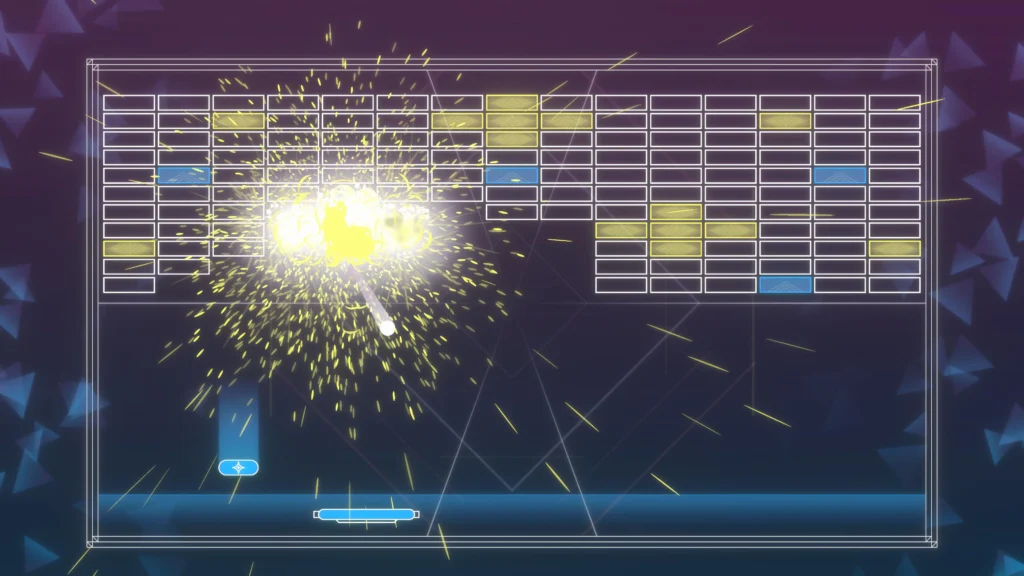
This evening, I have been playing some of the Atari Recharged games, which fit the bill perfectly for this sort of thing. I've had lovely boxed versions of these on my shelves for ages, but still haven't yet got around to exploring all of them fully. This evening, I have been playing Asteroids Recharged and Breakout Recharged, and they have very much been having the desired effect.
For the unfamiliar, the Atari Recharged games are modern reimaginings of classic Atari arcade games. The ones I have played all have the same structure: they have an infinite "arcade" mode, where you simply play to survive as long as possible and attain a high score, and a "challenge" mode, which consists of a large number of predefined, standalone, self-contained levels, each of which challenges you to accomplish a particular objective, often under difficult circumstances.
Both of these are excellent for calming the storm of a turbulent mind, as both function as I describe above: they demand concentration and focus without having to engage the part of your brain that deals with pesky things like words, subtext, narrative themes and characterisation, and they allow you to quickly and easily try again if you mess up. And you will mess up a lot more than you win — particularly in the arcade mode, where there is literally no way to win other than beating your own high scores, or those of people you have set your sights on from the online leaderboards.
In a way, they are "mindless", but I don't mean that in a denigratory way. There's something primal and instinctual that happens to you when you play games like this, and it leaves no room for abstract emotions. You'll feel enjoyment, satisfaction, frustration and even anger, but allow yourself to become one with the experience and you will, at least for an hour or two, forget about those feelings of great uncertainty and emotional turmoil.
It is important to give yourself an escape hatch; a lifeline. When your brain decides to put your life on pause, it often isn't healthy. It might cause you to not take as good care of yourself as you should. You might not eat properly. You might find yourself pushing away people who want to help — or at the very least want you to open up about what's wrong. It can be easy to immerse yourself in those feelings of great uncertainty and emotional turmoil; an all-encompassing, opaque black bubble of misery from which it can be very difficult to escape if you allow it to form completely.
So take those moments, as little and fleeting as they might be, and step out of that darkness for a moment. It's not a betrayal of the things you are upset about; it is allowing yourself a moment's peace, preventing you from being consumed completely, and perhaps giving you the strength to be able to pull yourself out of the mire, little by little.
Want to read my thoughts on various video games, visual novels and other popular culture things? Stop by MoeGamer.net, my site for all things fun where I am generally a lot more cheerful. And if you fancy watching some vids on classic games, drop by my YouTube channel.
If you want this nonsense in your inbox every day, please feel free to subscribe via email. Your email address won't be used for anything else.