#oneaday Day 803: Why Teaching Sucks Redux

20120331-233543.jpg

I've been trawling through my blog's top search terms recently and besides this post, which has been a permanent fixture on that list for somewhere around two years now, one of the most consistent things that people find me through is the simple, clear phrase "teaching sucks".

I have touched on this subject before — hence the presence of the search term — but perhaps haven't described the extent to which I suffered in particularly great detail. This was for several reasons, chief among which was the fact that I wasn't sure if I ever wanted to go back into that particular career path. I spent a year of my life earning a professional qualification to prove that I'm allowed to stand up in front of children and tell them things, after all, so I didn't want to rule it out entirely.

Having found myself doing things that I actually enjoy now, however, I'm pretty certain that I won't ever be jumping back on that train. So here, then, are just some of the many reasons Why Teaching Sucks.

My first teaching position was at a comprehensive secondary school somewhere near the Surrey/Hampshire border. I was hired as a music teacher, though had also agreed to take on some additional responsibilities because I'd been advised that making yourself out to be somewhat flexible was The Thing to Do. Specifically, I'd said that I'd also be happy to take on some English and ICT teaching as appropriate, though with the proviso that I'd not been specifically trained in those subject areas.

I was offered the job, and it was something of a relief as it was getting rather late to be applying for positions. I had been feeling a growing sense of unease — was I doing something terribly wrong at interview? Was I not cut out for this career? Was I a bad person? Some of these thoughts were unreasonable and irrational, of course, but it's the way my brain works. So when the headteacher offered me the position, his only criticism of my interview and observed lesson being the fact that my tie was a little bit creased, I accepted with haste. (As a matter of fact, in most cases you don't have any option but to accept with haste when being interviewed for a position at a school — most seem to expect you to give an answer there and then.)

The time came to start. My heart was in my mouth as the fateful day in September approached, though I was pleased there were a few days to plan and prepare before the kids actually showed up. I took the time to get to know my colleague in the Music department, and also discovered that I'd been signed up to teach "Key Skills" lessons. The exact nature of these lessons wasn't entirely clear, but I was promised that all lesson plans and relevant material would be prepared for me.

By the time the kids arrived, I was starting to feel reasonably positive. I could do this. I was trying desperately to ignore the things some of my new colleagues had said about the local squaddies' families having semi-regular violent altercations with local traveller families, and felt pretty much prepared for what faced me.

Things got underway, and to cut a long story short, it wasn't exactly plain sailing. Year 7 classes were mostly manageable, as the kids were generally fairly bright-eyed and fresh from primary school. Above that, though, and things got difficult. There was the kid whose mum said he didn't have to attend detentions, making all punishments effectively worthless. There was the kid who liked to climb bookshelves. There was the kid who threatened to knife me when I politely asked him to be quiet.

It wasn't all bad times, of course. My GCSE Music class were a joy to spend time with, and while some of them weren't the most gifted musicians in the world, they were fun to hang out with and always tried their best because they liked what they were doing, and they liked me. There were other students who brought a bit of light into the darkness, too, some of whom I've discussed on this very blog. And the school production of Seven Brides for Seven Brothers is a particular highlight that I doubt I'll ever forget — even if it meant me staying up until 3 in the morning arranging music on several occasions. And my colleagues were consistently super-awesome — what I discovered in that school was that people tend to stick together in adversity to support and help each other. I made some good friends, and without them I probably wouldn't have made it as far as I did.

It wasn't to last. The previous headteacher retired and a new head came in — oddly enough, he was an ex-teacher of my housemate at the time, though that's somewhat beside the point. The new head had been brought in to "fix" things — the school was about half a million in the red, behaviour was awful and clearly Things Needed To Be Done. So he did — he immediately expelled a selection of the worst kids in the school (and expelling kids is not an easy process these days), which made him look like he meant business. And he then set about tackling the budgetary problems.

Unfortunately, this meant redundancies. And it became abundantly apparent that the Music department was going to be on the chopping block. As I was the last in, I was also highly likely to be the first out, and sure enough, I was informed that my job would likely no longer be there after the end of the year.

Although I regularly went home cursing the names of the students I taught for the stress they caused me, I sort of enjoyed the job, and very much enjoyed the financial security of having regular income. I didn't want that to go away, and broke down in tears in the Music department staffroom one lunchtime. It was not a pleasant feeling, though it was somewhat cathartic to let out the pent-up emotions while surrounded by sympathetic ears. It didn't help that I was then invited to effectively go and plead for my job to the board of governors, a soul-destroyingly humiliating experience which I hope I never have to go through again.

By the time the end of term came, however, I'd secured a new position at a nearby school and was feeling a little more positive about things. My first impression of the new school had been a positive one, and I felt better about the whole "security" thing. I even managed to give a memorable leaving speech, during which I was able to slip in a saucy joke at the deputy headmistress' expense, offer some earnest thanks to the colleagues who had made my time at that school bearable, and wish them luck for the undoubtedly tough times ahead.

The summer holidays came and went, and I found myself at the new school. This was in a more affluent area, but it was still "the shit school" in the town in question. Once again I went in, got to know my colleagues and prepared for the coming storm.

And once again, all was well to begin with. In most schools, new teachers can enjoy a few weeks of relative calm as the students acclimatise to the new regime, occasionally push the boundaries but mostly seem to want to get on with things. As time passed, however, things declined somewhat. It became more and more difficult to control the classes as the children became more and more confident — overconfident, some might say. I had several pieces of expensive equipment stolen from my (locked) classroom, I was verbally abused on a regular basis, the equipment in the department hadn't been refreshed for a good ten years and there was no money to buy any more, and I was starting to feel the "cracks" from stress.

In the case of this school, there was no sense of camaraderie — at least, I didn't encounter any. No-one talked to me in the staffroom. Even my own departmental colleague preferred to hang out with her friend from Maths than talk to me. I found myself feeling unsupported, unliked and unappreciated. When things went well, I felt like I didn't receive recognition for them. And when things went badly, I felt like I didn't get the help I so desperately needed. I ended up taking quite a few days off sick when I felt I couldn't cope or face the day ahead — and still had to send in work for my classes to complete when that happened.

One particular day I was teaching a class, and had just set them off on an activity to compose some music. I had divided them into groups, I had set clear expectations as to what I wanted them to do and when I expected it to be done by, and I had the equipment set up ready to record their work at the end of the session. In short, there wasn't much else I could have done in order to make that lesson run any smoother.

Unfortunately, it was that day that several groups of students decided to kick off. No-one was concentrating on the task, despite my going around and helping them. Group members were arguing, disagreeing and in some cases threatening to get violent with one another. And they would not respond to me at all.

I could feel the pressure building in my brain like a pot slowly coming to the boil. I knew that something was going to give. I felt it happen as I was standing out in the main hall trying to convince the children who were using the piano to get on with their work rather than thump each other with percussion instruments. Nothing was happening. Nothing was working. I couldn't cope. I wanted out. I couldn't escape, and right at that point, there was nothing I wanted more than to be somewhere else.

I ran off and broke down in tears, thankfully out of sight of the students. It's a blur as to what exactly happened — I think I hid in the equipment cupboard. Somehow someone found me — either my departmental colleague or the Drama teacher — and gently escorted me into our office, away from prying eyes.

I was sobbing uncontrollably by this point. "I can't do this," I remember saying. "This isn't me. This isn't me." Over and over. At the back of my mind the mostly-dominated rational part of my brain was thinking "so this is what a nervous breakdown feels like", and my body was certainly providing an apt demonstration. It took a long time for me to calm down, by which time someone had gone and placated my class, or removed them to somewhere else — I didn't know. I didn't care by this point, either.

I escaped the premises as soon as I could, went home and cried again. I had got myself into this situation, and I didn't know how to get out. I was scared. I was sad. I was angry. I didn't know what to do — but I knew what I didn't want to do.

I made an appointment with my doctor. The time came to see her and, voice shaking, I explained how terrible I was feeling and how I had suffered my embarrassing emotional breakdown. I was terrified that the doctor would judge me, tell me I was being stupid, refuse to do anything and force me back into that hell. But she didn't. She gave me a sympathetic look and asked me what I wanted her to do for me.

"I can't go back there," I said. "I just can't."

She nodded, clearly understanding, and wrote me a sick note signing me off for "work-related stress". I couldn't face handing it to someone in person, so the next day, I wrote a brief letter to the headteacher apologising for my absence, attached the sick note and took it into the school one afternoon when I knew all the staff would be in a meeting. I left it there, swearing I would never set foot in that place again.

The next day, the headteacher's personal assistant phoned me, saying that the head was concerned about me and wanted to come over to my house and talk later that week. Panicking and not knowing what to do, I said that would be all right and immediately regretted it the moment after I put the phone down. I took to a teachers' forum I frequented and picked the brains of the community — was this normal, I wanted to know? Was it something I should be allowing?

It was recommended that I contact my union representative, and I did so. They told me that it would probably be a bad idea to have that meeting, so, not being able to face any more phone calls — telephobia, remember — I sent an email to the head's assistant saying that I was sorry, but I didn't think the meeting would be a good idea. I then closed my email program and promptly became terrified and paranoid about what the response would be. I was too afraid to look at it for most of the rest of the day, but when I did, I found that I had actually received a rather understanding response. I realised that in my mind, I was building up a feeling that everyone was out to get me, that I wasn't safe, that I couldn't escape. But it transpired that people were just worried about me.

This story has already gone on a long time — longer than I perhaps intended — so I'll just say at this point that I, unsurprisingly, resigned from my post while I was signed off sick. I sent a lengthy letter explaining exactly why I was resigning, taking the opportunity to share a number of concerns that both my colleagues and I had. I received a response from the head thanking me for the time I had served at the school, and noting that my concerns were valid, warranted and shared by many other members of staff, including him. That made me feel a bit better.

Since that time, I haven't really looked back. I spent a short time working in a primary school as an experiment to see if working with younger kids was any easier, but no — all the same stressors were still there. Behaviour, threats of violence, government interference, endless bureaucracy and the constant feeling that you're doing a Bad Job even when you're not. It didn't help, of course, that I was working at a school that was failing so hard it was in "Special Measures", meaning that government interference was even higher than it usually was. But that's a story for another time — in fact, the way that particular sorry episode made me feel is chronicled extensively at the start of my "oneaday" entries.

Fortunately, in that case, I was on a temporary contract rather than a full-time permanent position. As such, I was free to walk away — even though at the time I didn't have anything to go to. To date, I sometimes wonder if I made the right decision, as it proved to be the catalyst for a fairly cataclysmic Heroic BSOD in my own personal story.

But looking at where I am now… I'm in a better place. (No, not dead. Though it's not an exaggeration to say that was, at a number of points during the story above, a very real concern.) I'm doing a job I enjoy, living with a person I love and leading a life which may not be perfect, but it's certainly pretty good. Had I stayed in teaching, I'm not sure I'd be able to say the same thing.

If you read all that, thanks for listening.

TL;DR: Don't go into teaching. It'll fry your brain.

#oneaday Day 759: I Said Byte, Byte, Mrs Raspberry Pi

20120217-014019.jpg

The Raspberry Pi is here!

If you have no idea what I'm talking about, here's the official website.

Still no clue? It's a little computer (and I mean little — it's about the size of a credit card) that costs approximately £16 and is capable of outputting 1080p video via HDMI. David "I Made Elite, No Not the Call of Duty thing" Braben was involved in its development and has been a vocal spokesperson in the run-up to its release, but the device itself is the brainchild of one Eben Upton, a former lecturer at Cambridge University.

You're probably thinking that £16 is pretty cheap for a fully-functional computer, and that there must be some sort of catch. Well, it's not a "catch" as such, but don't expect to be playing The Old Republic on this little beast. Boasting 128MB or 256MB of RAM and a 700MHz ARM processor similar to that found in a low-end smartphone, it's not going to set the world alight with its performance, but that really isn't the point of it.

Instead, Upton, Braben and the other industry luminaries who have worked on the project are hoping that the device will inspire a quiet revolution in computer science teaching. Due to the system's low cost, it will be a simple matter for schools to outfit themselves with a veritable arsenal of Raspberry Pis, allowing large numbers of kids the opportunity to get hands-on time with a real computer and learn some useful skills.

This is a hot-button issue in the UK at the moment, as the Livingstone-Hope Next Gen Skills report published last year found that computer science teaching in the UK was, to put it politely, somewhat lacking. The National Curriculum prescribes that children should be equipped with certain information and communication technology skills by the end of their school career, but the goals are distinctly unambitious and, more to the point, have not exactly moved with the times. There's a strong focus on Microsoft Office and little else — no exploration of web design, website administration, database management, programming, and certainly very little in the way of creative design work such as Photoshop.

Part of this is a cost issue, of course — even at educational pricing, Photoshop is still pretty frickin' expensive — but that doesn't diminish the fact that kids aren't leaving school with the computer skills that they'd need to find jobs in the tech industries. They're maybe leaving with enough knowledge to allow them to fulfil a secretarial role, but that's about it. They certainly wouldn't be building a website, looking after a CRM or even inputting data into a CMS. Any knowledge of social networking and blogging is done on their own time — and all credit to the kids of today, they take to it like a duck to water.

What the Raspberry Pi team hopes to achieve with the little computer that could is to provide kids with a piece of kit that is built for tinkering with. Many pieces of consumer electronics in the home these days are locked down tightly to prevent modification and experimentation — in the case of games consoles, users are even punished for unauthorised system modifications in many cases. There's also a high barrier for entry to development in many cases — expensive software packages, development kits, membership in "developer programmes" all build up costs to a level unfeasible for the hobbyist to contemplate, especially if they're not sure whether or not they'll be able to develop the skills necessary to enjoy success.

The Raspberry Pi, running on Fedora Linux and designed to be expandable with all manner of external hardware, is a low-cost step that will allow a much greater number of people access to some truly open hardware with which they can experiment, tinker and learn all manner of exciting things. And even if they find that their brain is completely incapable of wrapping itself around complex computer-related concepts, they're only out of pocket by £16 when all's said and done. (Plus the cost of monitor, keyboard and other bits and bobs, but that's beside the point.)

Hopefully the Raspberry Pi will convince schools to throw out the abject tedium of the National Curriculum's ICT programme and start exploring more relevant, exciting topics surrounding computing. It might also convince schools to hire ICT teachers who actually know something about computers, rather than treating it as a second-class subject to be handled by teachers of completely unrelated disciplines as a means of filling up some of their free periods. What a brave new world that would be.

Will it be a success? Impossible to say at this juncture, as the simple existence of the product doesn't necessarily mean that there will be buy-in from the people who it is aimed at. But we'll see.

To find out more, check out the official site. You'll be able to order one for yourself at the end of this month, and educational packages including additional equipment, documentation and all manner of other goodies are on track for a September-ish release from the sounds of things.

#oneaday Day 691: Satisfactory is Unacceptable

It's been a while since I had a teaching-related rant, but this article helpfully reminded me why I'm in no hurry to go back, despite being currently out of a job.

Any profession where it's considered unacceptable to be graded "satisfactory" is not a profession I want to work in. And I'd argue it's a profession that's in need of a good shakeup.

Where do these rankings come from? OfSTED, or the Office for Standards in Education if you're unfamiliar and/or foreign. Every so often, a school gets a bunch of inspectors descend upon the place to nose around everything it's up to. As part of this process, inspectors drop in to a number of lessons for 15-20 minutes and then assign an arbitrary grade to the lesson, branding it anywhere between "Inadequate" (4) and "Outstanding" (1). These grades are also applied to other areas in the school, such as behaviour, "value for money" (i.e. how well the school is budgeting and spending what money it gets from the local authority) and numerous other factors.

Fine. I get the need to inspect places and ensure they're doing their job. What I don't get is the inconsistency in OfSTED's approach. 15-20 minutes observation of one lesson is not enough to understand how well a teacher teaches. That teacher might have the worst class in the world, and may have scored a major victory on that day simply by having them sat down and listening for once. But if the children aren't deemed to be "learning anything", then BAM! That's an "inadequate" mark right there.

Or it might not be — it may well be a "satisfactory" grade, depending on what else happens.

Now, the word "satisfactory" carries certain assumptions with it. Namely, it implies that the person declaring something to be "satisfactory" is somehow satisfied with the thing in question. While something that is "satisfactory" is not the best thing in the world, it's certainly acceptable and does what it is supposed to.

Not in teaching. "Satisfactory" is somehow seen as a bad thing, despite the standards for branding lessons as "good" or "outstanding" being 1) completely arbitrary and largely down to the opinion of the inspector rather than specific, measurable criteria and 2) extremely difficult to attain, even for the most talented teachers. And if you're in a difficult school teaching a difficult class, God help you.

New head of OfSTED Sir Michael Wilshaw is aiming to do away with the "satisfactory" branding and replacing it with "grade 3". Not only that, he's proposing that automatic pay rises for teachers whose work is considered "satisfactory" should cease, instead being reserved for those graded "good" or better.

This would be fine if the grading of a teacher was based on more than a short, not necessarily representative observation of part of a lesson. Actually, would it? If you're doing your job, wouldn't you expect a pay rise every so often? It's been that way in teaching for some time now, with yearly pay rises for your first few years on the job before you have to go through a procedure known as "Threshold" to get on to the upper pay scale. The demands for meeting Threshold are pretty stringent, so some teachers won't get through anyway — surely that's enough control on pay rises?

(Note: I haven't been teaching for a while, so pay systems may have changed since then. The above is how I understood it when I was employed by the system.)

Perhaps most obnoxious, however, is Sir Michael's quote where he noted that "if anyone says to you that ‘staff morale is at an all-time low’ you will know you are doing something right."

Sorry, Sir Michael, but this is where you lost any credibility with me whatsoever. You should not be actively trying to sap morale — an OfSTED inspection is already an incredibly stressful experience. I know — I've been through two, including one whose result caused the school to go in to Special Measures (essentially meaning that it gets re-inspected on a much more regular basis than normal, and is at serious risk of closure). They weren't pleasant experiences, so to imply that your staff should be encouraging a lack of morale among struggling teachers is pretty shameful.

Teaching is the most stressful job I've ever had. It drove me to a nervous breakdown, such was the stress of everything I had to think about at once coupled with torrents of abuse from hormonal, uncooperative teenagers. Sometimes you can use all the "strategies" in the book and nothing works with a difficult class or a particularly uncooperative child. Sometimes the behaviour of a pupil does disrupt the flow of a lesson. Should that be blamed on the teacher if the teacher in question does everything they're allowed to do to prevent the situation from escalating further? If the teacher in question is having difficulty dealing with particular pupils, should that teacher be supported or vilified?

I think you know the answer to that one.

So in short, then, I'm not sorry I left teaching. And if this is the way that the regulatory body for teaching is going, then I want absolutely no part of it whatsoever. Teaching should be about inspiring children to do great things; to teach them about the world; to encourage them to try new things, and to expand their knowledge of the things they know. It shouldn't be about meeting arbitrary criteria and being judged by people with no sense of context. And it certainly shouldn't be about being deliberately demoralised by the people supposedly regulating the profession.

Good luck to anyone entering the educational system at the moment. You're going to need it, from the sound of things.

#oneaday Day 623: Crime and Punishment

It's been a while since I told a story from my past life at the chalkface, so I feel it's about time we fixed that with another real-life tale of What Teaching is Really Like.
I worked in three schools (not counting those I did supply teaching in) during the course of my teaching career — two secondary and one primary. One of the secondaries and the primary were in what could politely be termed "somewhat deprived areas" while the other secondary was right on the border of an aforementioned "somewhat deprived area" and a very middle-class town — the sort of place that has shops that sell nothing but fabric, and tearooms rather than branches of Starbucks, that sort of thing.

All three of them, regardless of location, and regardless of age group, had Problem Children. You could often preemptively tell a Problem Child from the names on the register — generally speaking, if a child was male and called Jordan, female and had some obscure misspelling of a relatively normal name (Kaylee, Abbygale, Rooth) or of either sex and in possession of a completely made-up stupid name (Peaches, Infographia, Cubblers) they were likely to be a Problem Child. Sometimes you were pleasantly surprised — girls named Jordan often ended up being quite nice, and when you got your hands on a new class you often didn't know the sexes of the pupils, particularly if they had stupid names — but more often than not you'd run into a Problem Child sooner or later.

One particular Problem Child I encountered in the primary school in which I taught had a relatively normal name and, ironically, was one of the brighter kids in the class. But my God he was an asshole. He'd answer back, he'd yell at the teacher, the teaching assistant and his peers, and he'd frequently storm out of the room if he was pulled up on any sort of inappropriate behaviour. When parents' evening came around, I spoke to his parents about his behaviour — particularly the violent side of things — and I was told that they had simply told him to react to anything he saw as "unfair treatment" by striking back. "If someone hits you," said the dad, "you hit them back."

There's not much you can say to that, really, even with all the Anti-Bullying Policies and Zero Tolerance Initiatives in the world.

Then there was a Problem Child I came into regular contact with during my time at the first secondary school at which I taught. He, too, was an asshole, and this time with no redeeming features whatsoever — i.e. he was a dimwit as well. Again, he'd be aggressive, sweary, belligerent and completely resistant to authority. And again, there was no support from the parents.

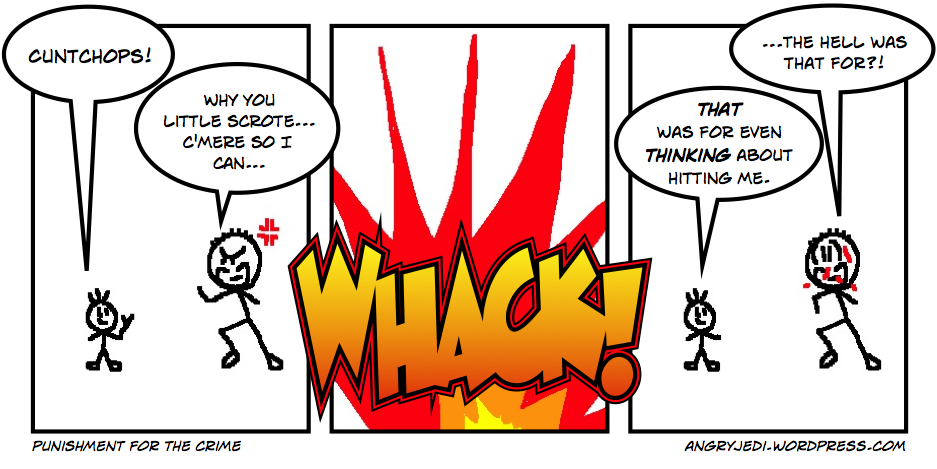
"My mum says I don't have to come to detentions," he told me upon receiving a detention for being a cunt (obviously not the exact wording I used on the form recording said inappropriate behaviour). "So I'm not coming."

He didn't come.

With many of these children — particularly in cases there was no parental support for whatever reason — it was pretty much impossible to instill any sort of discipline in them. There was nothing that they feared. They didn't fear detentions because they just wouldn't turn up. They didn't fear the wrath of the teachers or senior staff members. And they didn't fear exclusion because that just meant time away from the school they hated so much. There was little to nothing that could be done to discourage these little grotbags from acting like complete bellends.

The teacher training guides would say that punishment is not the way to go — that positive reinforcement is, in fact, the way in which they best learn what behaviours are appropriate and which are not. The trouble is, taken to the extreme, you end up with the ridiculous sight that many schools indulge in — primary schools in particular — which is the weekly Celebration Assembly. Here, the whole school gathers and a selection of children from each tutor group are called up one by one to come to the front and receive a certificate. These certificates aren't necessarily for academic achievement — and, indeed, usually aren't. No, these certificates are frequently awarded for "playing nicely with the other children" and "sitting in a chair for over half of the lesson" and "not hurting anyone". All of those are genuine examples, by the way, unlike the names I gave earlier, most of which were made up.

Now, while it's nice to celebrate the fact that little Cockbag, who never sits in his chair for more than 5 seconds and loves punching everyone in the neck, actually sat down and completed two maths questions in the last week, it completely devalues the entire concept of "rewards" for everyone — teacher and pupil. When I was at primary school in the late 80s and early 90s, we were rewarded for good work in class or special achievements. Go and colour in a square on your rocket. Have a gold star. Show the class what you've done. No-one got a square on their rocket, a gold star or the opportunity to show the class what they'd done for successfully sitting in their chair for more than fifteen seconds at once.

I wonder what on Earth the solution could be. It's pretty clear from what I saw that the one and only thing that the Problem Children feared was humiliation in front of their friends and peers — something that undermined their "authority", for want of a better word. So perhaps some sort of Inverse Celebration Assembly would be warranted, where the headmaster solemnly called out the names of the worst offenders each week, brought them onto the stage and forced them to do the Dance of Shame while everyone else pointed and laughed. Anyone who refused to do the Dance of Shame would be fed to the goldfish kept by Class 2, who had developed a taste for human flesh ever since Barry Jenkins kept his hand in there for an entire period for a bet.

But then that's probably some sort of human rights violation, isn't it?

#oneaday Day 127: You Checked In

Gamification pervades our mobile, Internet-connected society. The concept has been around a lot longer than the buzzword, of course, but it's in recent years that it's really taken off thanks to all manner of applications that while in practice are mostly pointless, somehow manage to be fun. I guess that's part of the point.

Take Foursquare, for example, primarily a service to do two things: to tell people where you are, and to find things that are nearby. But add in points, leaderboards and collectible badges and somehow it becomes an incentive to get out and about and explore places. Same with rival app Gowalla, which has a whole other set of things to collect.

When the whole "check-in" craze first started, it looked like it was primarily going to be a location-based service. But no — services like GetGlue popped up, allowing people to check in to the entertainment they were enjoying as well as discuss it with others and find out new things that they like.

Whatever you think about the applications and their uses themselves, all of them contribute to building up a large, mostly user-generated database of Interesting Things, whether those things are places, pieces of entertainment, beers or whatever else you can check in to these days. Would people take the time to put these collaborative databases together if they didn't feel like they were being "rewarded" for it?

Well, perhaps. Look at Wikipedia — that represents a repository of a considerable amount of human knowledge on topics both important and utterly asinine. There's no experience levels, badges or anything else there, just the contributors' knowledge that they have helped with a worldwide effort to collect humanity's knowledge.

What the "gamification" side of things adds, though, is enough incentive for lazy people to take part. People who write and edit Wikipedia entries are, in all likelihood, interested in their topic enough to be able to write at length about it — not to mention putting up with the seemingly-endless community criticism. Someone who checks into a Foursquare venue and leaves a tip saying "try the beef curry, it's fantastic and only costs four quid on Tuesdays" is helping out other people who may be stopping by the same beef curry-selling establishment and also feels like they're having a bit of fun while doing it.

Perhaps the education sector should take note. There's already an element of gamification in schools, what with marks and grades and so on, but perhaps children would be more engaged with things like reading if there was more of a game-like "incentive" for them to get on with it? Perhaps schools should set up their own GetGlue-style social network to allow kids to check in to what they are doing and earn "rewards" for things like reading books, completing homework and the like.

Okay. You shouldn't need that sort of thing to get kids engaged — but having worked as a teacher, it's clear that something should be done to get kids interested rather than apathetic. Perhaps gamification is the way forward for education?

#oneaday, Day 120: Education, Edducaytion, Eddyukayshun

Schools are "failing our children". So say various government watchdogs, quangos, hypocrites, rhinoceroses and jabberwockies. But aforementioned bodies (some of which I may have made up a little bit) don't take into account that it's their fault in the first place that schools are "failing our children". Not to mention the fact that there's also a lot of blame to lay at the feet of both the parents and the kids themselves before you start pointing the Finger of Justice™ at the hard-working teachers and other school staff who are trying very much to make the best of a bad lot.

I quit being a full-time teacher. Twice, in fact. I'm not going to make that mistake a third time. Fool me once and all that. Currently, to pay the bills, I am enjoying the life of a supply teacher. This means that I can choose whether or not to sleep in every morning or maybe be woken at the crack of dawn by a phone call saying some festering scumhole school in the very armpit of Southampton is short of a teacher for today and could I possibly go along with a chair, a whip and a net and see if I can do anything with them? There are two very simple equations to bear in mind here.

1. sb = 0(£) + 100(j) where sb is "staying in bed", £ is money and j is joy.

2. nsbapcdtvfssvas = muchos(£) – 5000(j) where nsbapcdtvfssvas is "not staying in bed, answering phone at crack of dawn, visiting festering scumhole school in very armpit of Southampton", £ is money and j is joy.

So while equation 1 leads to a gain in joy, it does not lead to a gain in money. Indirectly, in fact, it tends to lead to a decrease in money, as staying at home often leads to wandering out in search of coffee. However, while equation 2 leads to an increase in money it leads to a substantial hit in the joy department. And no, that's not a euphemism for your dangly parts.

But I digress in talk of made-up maths. I was about to tell you what is so very wrong with education. Particularly primary-level education, as that's where I've been spending most of my time recently. So let's do another list, shall we? Good. I know how you like lists, particularly if they're illustrated.

1. Overcomplicating everything.

I remember when I was at primary school. A tick meant "correct" and a cross meant "wrong". If you were lucky, you got a brief comment, like "Good." or "Lazy work." depending on whether you'd done good or lazy work.

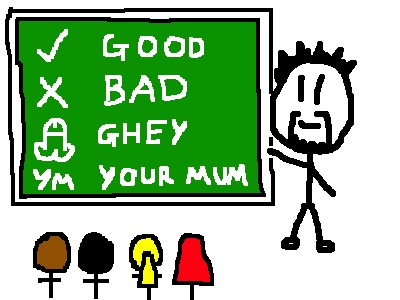
In the school I was working in today, they had a "marking key" on the wall. A squiggly line meant "look at this". A straight line with a "sp" meant "spelling mistake". A circled letter meant "you should have used a capital letter". A circled empty space meant "you have missed some punctuation". A caret meant "you've missed a word out". And then and only then did the key reveal that, yes, tick means "correct" and cross (or dot, now) means "wrong".

Seriously? These are eight- and nine-year olds we're dealing with here. Some of them can barely read, and you expect them to decipher that babble? Not only that, but then every book is expected to have a comment in there which, at the very least, says something inane like "Well done! You have shown me you are able to use connectives to join sentences together!" or "Congratulations! You successfully subtracted two things using the written method!" or "Super! You were able to recreate the entire Nutcracker Suite through the medium of rectal flatulence!"

Which brings us nicely on to…

2. Using unnecessarily high-level language.

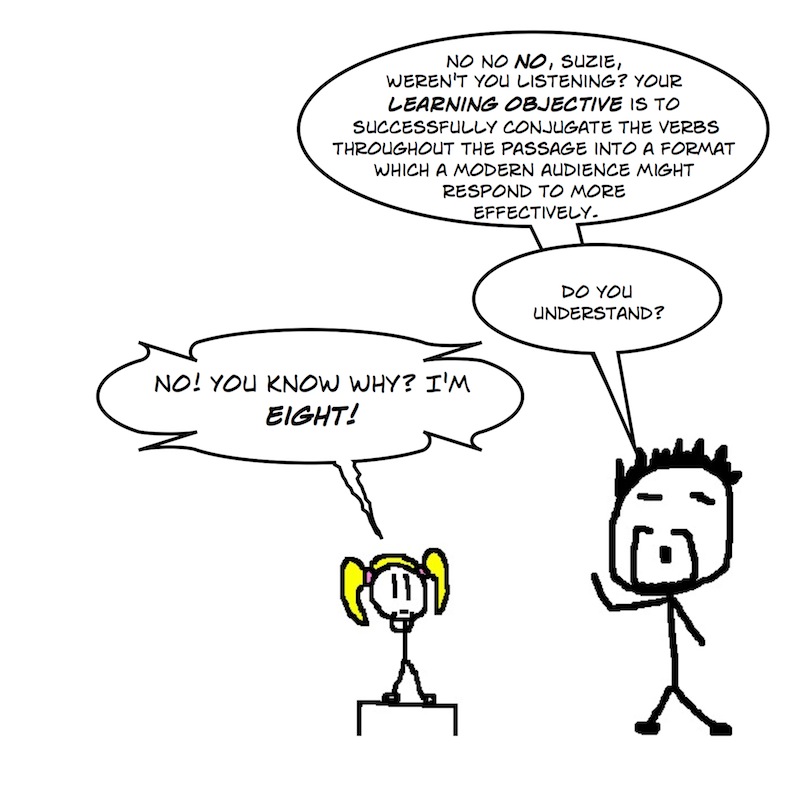
Remember: eight- and nine-year olds. Do they really need to know terminology like "learning objective" and "success criteria"? I am yet to meet a child who actually knows why they write down the learning objective and success criteria other than "it's the stuff we copy at the start of the work, innit". The sole purpose for it is so when the inspectors come to play that the teachers can point proudly at the various learning objectives and say "Look! They've done this!".
Bollocks.

3. Making unnecessary work.

Oh silly me. I made a mistake. The children shouldn't be copying the learning objective and success criteria. The teacher should have prepared them all in advance, trimmed them to size and stuck them in the children's books for them. Bear in mind at this point that a typical class has about 30 kids in it, each with at least five books (literacy, numeracy, "topic", science, art) and each day typically has four or five different things going on throughout the course of it. So hey, with all that to plan, what's a little extra cutting and sticking into ninety different books?

4. Dumb-ass theories that make no sense.

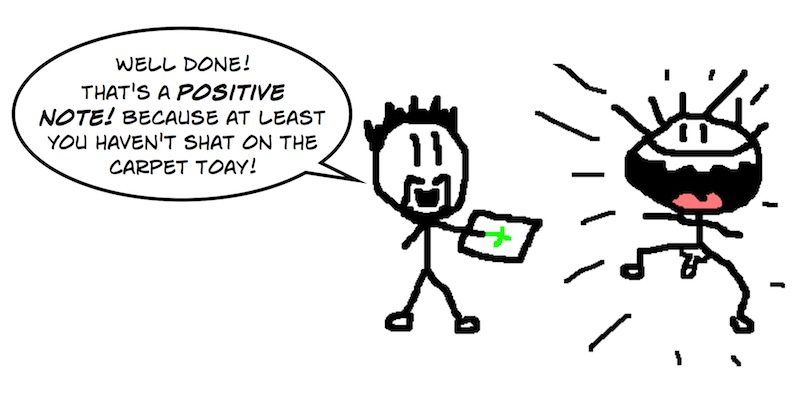
There are too many of these to count. Phonics is one. Anything involving behaviour management is another. Take a quick detour and go and watch this, including the stupid interactive part. The first shot of the class and the obnoxious children in it is the most accurate depiction of what it's actually like to be in a classroom. However, the supposed "strategies" for dealing with the class are complete bollocks. Giving the teen who thinks talking about fucking his classmate's mother a "positive note" if he sits down and gets on with his work? Don't make me laugh.

5. Pressure, pressure, pressure!

I was talking to someone the other day – I think it may have been Rhiarti – and talking about how the imagination of young people is stifled these days. UPDATE: Yes, it was definitely Rhiarti, right here, in fact. So yes – the imagination of young people is stifled by the fact that they're expected to learn all these million-and-one different techniques which there's no way in hell are going to stay in their tiny heads. I remember "writing" at primary school being all about writing stories. Now, they're expected to write Reports, Explanation Texts, Instruction Texts, Recounts, Narratives and all manner of other things (all inevitably capitalised, too) rather than, you know, just being able to sit down and write to express themselves. Even when they do get the rare opportunity to write a story, it's inevitably got such a long list of completely arbitrary success criteria for them to fulfil that any semblance of creativity has been battered out of them by the end of their school career. Which is sad.

All this is the tip of the iceberg. Don't even get me started on the "three stage lesson", on "thinking skills", "thinking hats", Bloom's Taxonomy, starters, plenaries and all manner of other shit.

So, in summary, a lot needs to change. But unfortunately, all of the things above, which are quite obviously and clearly dumb and stupid, are the sorts of things which men in suits with clipboards think "get results" and "show progress". Well hooray for progress. Somehow we managed without it for a long time. Why can't we go back to those days, for the kids' sake and for the sake of the poor, anxious teachers constantly on the verge of nervous breakdowns?

#oneaday Day 61: Call me Gordon

I'm a free man! Yes, my contract finished today so as of right this moment I am unemployed. At least as far as that pesky full-time work goes. I'll tell you one thing I won't miss, and that's the 40-mile commute with the immensely predictable traffic around Winchester. I don't know what it is about that place, but the M3 slows to a crawl and all of the roads in and out of the city also slow to a crawl, so it's impossible to win whichever way you choose to go. I let fly with quite a few obscenities on the way home tonight as all I wanted to do was get home.

I'm not going to be sitting on my ass doing nothing, though. I have plenty of things lined up. I have some music pupils starting this week (and, of course, if you know anyone in the Southampton area who is looking for a music teacher, kindly point them in the direction of http://www.pjedmusic.co.uk) and I am shortly to put up a site advertising IT tuition services. Then I'll be doing some writing, too, for a couple of different sites: Kombo.com and DailyJoypad.co.uk, both of which are going to be a great way to get some exposure for my writing, along with the stuff I've done for Good Old Games and WhatTheyPlay in the past.

Right now, it's late, there are drunken morons shouting incoherently outside my window and I've just finished recording an episode of the Exploding Barrel Podcast with the ever-awesome Minotti brothers. Just looked out of the window and the noise was being made by two… I hesitate to call them "men" because they were acting like the kids I've been teaching. Two of them. It sounded like a bloody football crowd. And this after Southampton was (apparently) voted "most welcoming and friendly city in the UK". (I call bullshit on that, by the way, in case you hadn't guessed).

Tomorrow is the first day of a new beginning, or something. I'm meeting one of my (potential) new pupils, I'm getting some stuff sorted ready to do my website writing and I'll have the chance to kick back and actually relax a bit for what feels like the first time in months. It's like a big weight has gone from my shoulders.

I feel bad for my colleagues I left behind as they are without exception awesome people that I will miss a great deal, and they're in a tough situation that is going to be hard work to get through. What I won't miss, however, is the stress of that job, the (8-year old) kids who climb walls and get brought in by the police, the reams and reams of ultimately fairly meaningless paperwork, the finger-wagging "official" people telling us that we don't know what we're doing and… well, you get the idea. Here's to a more positive future, but I will spare a thought for those great people I worked with regularly.

I'm just rambling now, clearly. I think it's time to go to bed. Up and at 'em tomorrow morning… and PAX is creeping ever closer. I can't wait.

One A Day, Day 24: Any Other Day

There goes another day. There are now two days remaining until the half-term vacation and a well-earned week off for me. I can't wait. I wish I didn't have to go back after said holiday, but at least there isn't that long to survive after it – and then the joy of PAX.

Naturally, since I'm nearing the end of one of the more unpleasant chapters of my life, now is the time for the shit to hit the fan. The school is expecting a "progress inspection" from the inspectors who judged it "shit" in the first place (I'm paraphrasing, of course) and that will inevitably involve yet more lesson observations. I'm half tempted to not even try, and let them get a real look at what the kids in that school are like. Why should I put myself out preparing a full-on fancy lesson plan when it only gets judged as "inadequate" by the local authority anyway?

I forgot to mention about the previous one – the super-ironic thing about that "inadequate" lesson (which my colleague also taught and got judged similarly, remember) is that we were following the guidelines on the National Strategy Framework Bollocks Primary Policy Full Of Shit site, or whatever it's called, to the letter. The lesson we delivered was straight out of the National Framework. And it was "inadequate".

Stupid.

On a side note, I have absolutely no idea why that site gives you the opportunity to 1) comment on 2) rate and 3) share its contents on Facebook. It's a huge pile of shit all round, so I urge you all to go there forthwith and troll the comments sections for each page as only the Internet can.

So what else is going to happen? Well, there's assessments to give in (which I've nearly finished, but not quite – late evening tomorrow… gah) and then there's a parents' evening to look forward to at the beginning of March, at which point I will be counting down the days until I escape so I really have little to no interest in talking to those who spawned the mini-chavs in my care. Actually, there's the potential opportunity for some fun there. There are plenty of kids in that class who need a good bollocking and don't listen when I give it to them, so hopefully the parents will sort them out.

Or perhaps not; since I've only had four reply slips back so far (and inevitably, all of them want to come in the latest possible time slot, meaning I have to sit twiddling my thumbs for about four hours) there might not be much opportunity to discuss it, particularly as all the parents who have signed up so far are the parents of the few actually nice children in the class.

Boo! Rubbish.

One day I'll stop ranting about this. Hopefully it will be the day I leave (or shortly thereafter).

For now, it's survival. Nearly there, though it was touch and go today for a while – though I did apply for another job that I actually want (as opposed to when I applied for the job I'm currently stuck in, which I applied for because I had to – at the time, I thought I wanted to do this, and there wasn't much else available) so hopefully that will come to something. I currently have three applications pending for different jobs, all of which I very much want. Hopefully one or more of them will find me sufficiently intriguing to interview and/or hire me. Time will tell.

Now I'm off to play some video games. Ta-ta.

One A Day, Day 22: Haven't Thought This Through

See title. It's 11:26pm and I haven't thought of something to write about. I did write a lengthy post extolling the virtues of Star Trek Online over at BitMob earlier, so at least I have written something. Still, not thinking things through sometimes leads to some entertaining ramblings of the nonsensical variety. Or sometimes not.

Let's start by talking about today. That's always a good opening.

Well, today was another day at work. Same old moans. Stupid children behaving in an annoying manner. Not wanting to be there. And, because it's Monday, that means Meeting Day! Hooray!

Today's meeting was about special needs provision. Specifically, and hold tight here, it was about IEPs, IBMPs, SA children, SA+ children and all manner of other nonsense that would cause your brain to melt if I explained it. The one thing that struck me, though, as I was sitting bored stiff in this meeting was this: why is one person expected to do all this shit?

I mean seriously. Think about it for a minute. A teacher is in charge of thirty kids. Their primary role is to teach them. That should be their role. But instead, they also find themselves keeping extensive and boring records of every single little mark, every single little bit of behaviour, every single time the kid looks at them funny – all to use for "evidence". Exactly what it is to be used as "evidence" for is never made explicit. Perhaps there's a global conspiracy involving children, and the UK's teachers are actually secret agents attempting to get to the bottom of it. But somehow I doubt it.

To get back on the point – yes, a teacher is in charge of thirty kids. But compare this to someone who's in charge of a team of people at work – it tends not to be just one person who is in charge of everything. Say what you like about overmanagement, at least delegating responsibility between several people means that there isn't one person constantly on the verge of a nervous breakdown because they discover they forgot to fill out a form PQX-65-A which was due in yesterday.

It's bollocks, is what it is. I'm glad I'm leaving.

What else? Hmm. I took a bunch of photos from my little trip to the forest the other day and finally stuck them on my computer. I'm currently booted into Windows, though, and they're stored on the Mac side. I'll upload them tomorrow if I remember. There are lots of pictures of wild ponies, which look like a cross between a pony and a yak.

Anything else? Err… I downloaded an iPhone app that purports to analyse your sleep patterns and wake you up when you're in "light sleep". I tried it out this morning and I certainly did wake up gently, though actually getting out of bed was somewhat difficult. I don't think that was anything to do with how I woke up though – more to do with the fact that I knew as soon as I got out of bed, I would be on the way to another horrible day at work. Boo.

Still, tomorrow is my quiet day at work. Oh! That reminds me. More observations coming up. YAY. Not until the start of March (i.e. just before I finish, making them utterly useless to me) but they're there, waiting on the peripheries of my awareness like a fetid old tramp. That and parent's evening coming up soon, which I really can't be bothered with. "Your child acts like a dick on a daily basis. Next!"

I think that'll do for now. I'll try and write something more interesting tomorrow. For now, I bid you good night.

One A Day, Day 19: The Worst Week

After midnight again… But I haven't gone to sleep yet. Although I will be very shortly.

This week has been utterly terrible. Not just for me, but for, it seems, most people. Both my wife and I noticed an alarmingly high number of despairing status updates from our respective Facebook and Twitter friends this week, yesterday in particular.

February's always bad. I don't know what it is about it. But it's always shit. And no-one ever does anything about it.

Of course, that's a stupid statement. What CAN anyone do about it? Nothing. Except maybe declare the whole month a national holiday.

They should declare the whole month a national holiday!

All this aside, the week is now effectively over, so I am looking forward to a quiet and pointless weekend.

What about today? After my inadequacy was made official yesterday, the headteacher came to see me after school. To – get this – "check I'm still on board". Well, no, I resigned, remember? I had to bite my tongue a bit, otherwise I would have exploded at her. I'm in two minds as to whether or not I should have given her a piece of my mind about the utter meaninglessness of those stupid judgements. I'm coming down on the "don't rock the boat" side of things at the moment. Maybe I can tear shit up a bit a little closer to the end.

One thing I do want to do, though, is write up all the things that I've said are dumb about education as an article and send it somewhere like <a href="TES or even a full-on newspaper. People need to hear about the plight of teachers as so many of them – including myself – suffer in silence and don't stand up to what is effectively bullying from people who have as much value to education as a lump of steaming turd. Actually, the turd is more valuable, as at least it could be discussed in a rather unpleasant Science lesson.

Anyway. Enough of that for now. It's the weekend. I'm off for some well-earned sleep. Next week is the last week before the week-long half term vacation, then it's the home straight from there.

G'night.