#oneaday Day 398: I just want to buy the game

Yesterday, I happened to watch the Giant Bomb folks playing through the new Tony Hawk's Pro Skater 3+4, and thought it looked like fun, so I thought I might actually buy it.

So I looked on Amazon to track down physical copies, and every single version available was marked with a bit "INTERNET REQUIRED. CONTENT DOWNLOAD NEEDED". The Nintendo Switch 2 version didn't even have a game cartridge — yes, they eschewed even the odious Game-Key Card system in favour of the even more pointless Code in a Box format.

This is frustrating, because we're seeing this happening more and more, and it concerns me greatly. While I've bought a fair amount of digital stuff on PC largely because it's the only option to buy pretty much anything now, I'm still very wary of consoles going digital-only or at least digital-centric, because it, of course, raises the question of how long those games are actually going to last.

I'm not talking about online servers remaining up so people can play multiplayer or check their rankings on leaderboards. I'm talking about the game just being straight-up playable. Like, if I were to buy Tony Hawk's Pro Skater 3+4 on PS5 or Switch 2 digitally, sure, I could keep it on my storage device theoretically indefinitely, but at some point with the size of today's games, I'd likely need to uninstall it to make room for something else. If, then, I decide maybe 10 or 20 years down the line that I'd actually quite like to play it again… will I still be able to download it and reinstall it?

You may think that sounds silly, but considering that there are 40+ year old games that I still play on a regular basis, I don't think that's especially ridiculous.

Thus far, Sony, Microsoft and Nintendo have kept digital downloads available for "dead" platforms, even when they've closed the actual storefronts. You can still download things you bought on PlayStation 3, PlayStation Vita, Wii, Wii U, 3DS and Xbox 360 — you just can't buy things any more. (Though there is a kind of sort of loophole with PS3 and Vita — if you add credit via the Web, you can actually still buy things; you just can't pay on your console any more.)

This is vaguely encouraging, but how long will it really last? At some point, presumably, Sony, Microsoft and Nintendo are going to want to turn off the servers that maybe double- or triple-digit numbers of people are using each year, and that'll be that; those games will just be gone. At that point, one would hope, the pirates will have likely "preserved" them in an unofficial capacity, but when it comes to that, you start getting into a territory where games aren't exactly "plug and play" any more. I can still pop in anything from the Atari 2600 to PlayStation 2 era and, assuming the media itself is still in working order, play the game contained therein. For the PlayStation 3 and Xbox 360 era onwards, things start to get a little more dicey; from the PS4/Xbox One era they get a lot dicey.

I guess there comes a point where one has to consider whether they are buying games to enjoy now — in which case whether or not they're still playable in 10, 20 or more years doesn't really matter all that much — or if they're building a library that can continue to be enjoyed for many years to come. I have, up until now, very much fallen into the latter category, and old habits die hard. But from the moment I preordered the Switch 2 I found myself wondering if I'm going to be forced into changing the way I think about things.

I don't know if I'm going to buy Tony Hawk's Pro Skater 3+4 as yet. If I do, it'll be a digital version, because there's absolutely no point purchasing a physical version which doesn't actually contain the game. I guess the only question I need to reconcile in my head is if I care enough about this to take a principled stand and "vote with my wallet", as it were, or just to suck it up and enjoy the game while I can.

Oh well, Donkey Kong Bananza is out in a week, and that is on a proper physical cart, so that's something, at least.


Want to read my thoughts on various video games, visual novels and other popular culture things? Stop by MoeGamer.net, my site for all things fun where I am generally a lot more cheerful. And if you fancy watching some vids on classic games, drop by my YouTube channel.

If you want this nonsense in your inbox every day, please feel free to subscribe via email. Your email address won't be used for anything else.
2340: The Rise of GOG

0340_001

I remember when GOG.com — or Good Old Games, as it was originally known — first launched. It was an exciting moment, because it promised to be a storefront absolutely filled with PC games from my childhood. PC games that it had previously been near-impossible to 1) acquire in the modern era and 2) get running on modern computers. (Okay, 2 was less of an issue because DOSBox was already a thing by then, but 1 was a problem, at least, and not everyone knew how to set up DOSBox properly.)

I've kept my GOG.com account since launch, and just recently I find myself starting to drift more and more towards them and away from Steam. I'm not going to abandon my Steam account, obviously, since there are several hundred games in there, but GOG is starting to prove itself to be a real contender in the online digital storefront battlefield.

The GOG.com of today is a little different from when it launched, as its change in name will attest. Rather than focusing entirely on retro PC games, GOG.com now provides a mix of both retro and modern titles, and has recently even started doing "Early Access"-style games, though not to the same degree as Steam.

In fact, "not to the same degree as Steam" is a running pattern when it comes to GOG, and the platform is benefiting from it. While Steam is presently suffering from a deluge of low-quality titles released on a seemingly daily basis — the mobile app store problem, now for your home computer! — GOG.com's marketplace is considerably more curated than Steam, and the few Early Access titles that are up on GOG are already decent quality rather than shovelware thrown out with an Early Access tag in an attempt to excuse shittiness.

In other words, discovering new games on GOG.com is a lot less of an issue than on the Steam of 2016 because you don't have to pick through pages and pages of shitty Eastern European games with "Simulator" in the title, or perpetually Early Access Minecraft knockoffs, or games by people who don't understand what the fundamentally appealing elements of pixel art are, or… you get the idea. This isn't to say that there isn't some shit on GOG, of course, but it's far from the flood of effluent that Steam has been suffering from for a while.

And then there's GOG's new client, Galaxy. While still lacking a few features to put it on parity with Steam's well-established client — most notably an in-game overlay for chat, achievements and web browsing — it's a very good start, offering a well organised, nicely presented game library and features like playtime recording and a datestamp for the last time you played a particular title. Perhaps most notably — and most understandably, given GOG.com's original pledge, which still holds true today, to remain a DRM-free digital storefront — is the opportunity to both automatically install games through the client a la steam and download DRM-free standalone installers for each and every game on the platform for backing up onto physical media or other hard drives. Coupled with the fact that GOG games often come with a variety of digital extras including manuals, soundtracks, artwork and all manner of other goodies, this is the next best thing to a physical copy — and if you feel strongly enough, you can even burn these installers to a CD or DVD and make your own physical copy using the materials provided. (I'm probably going to do this for the Ys games; I like them enough to want them on my actual shelves.)

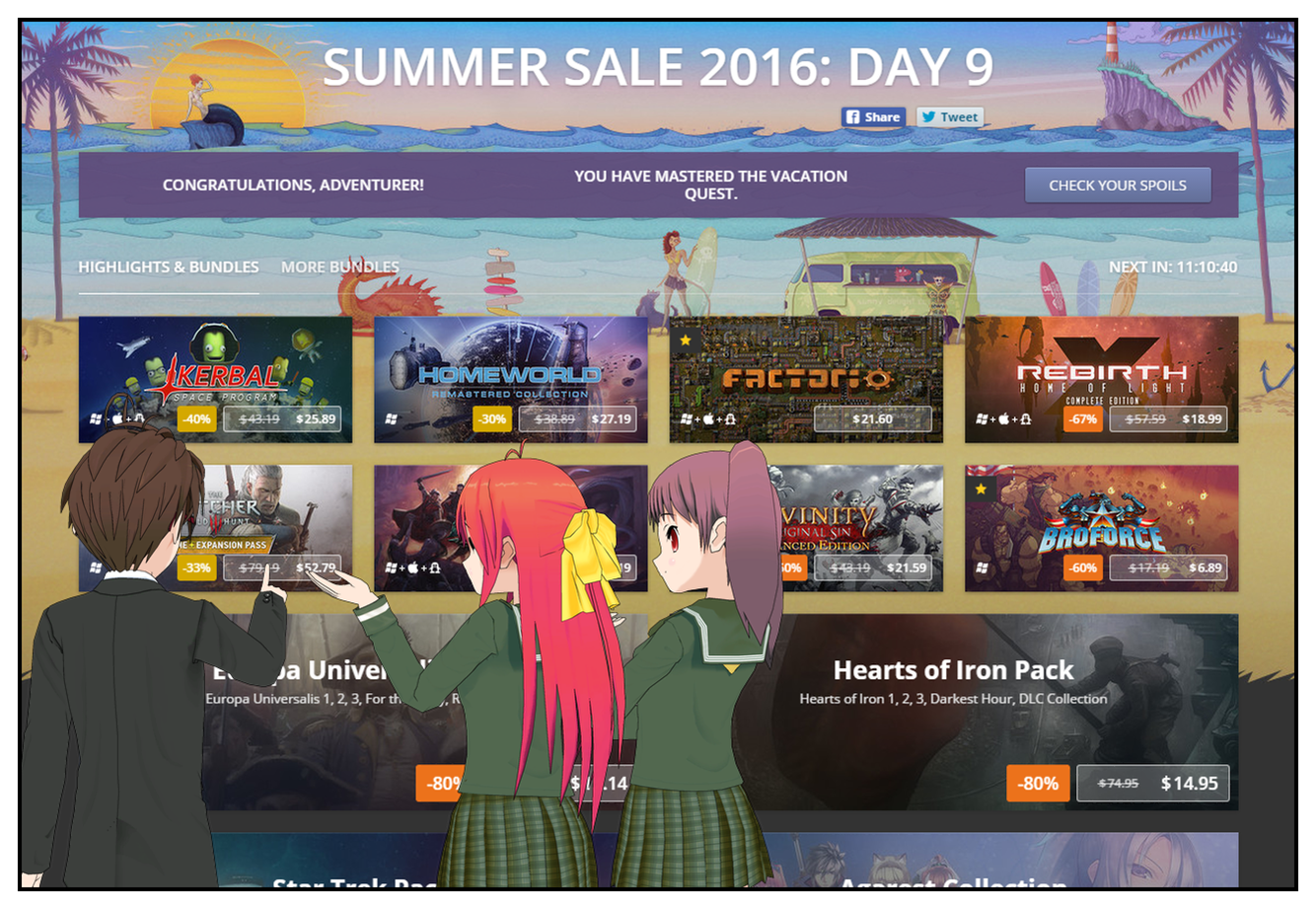
GOG's summer sale has also been excellent, with deep, generous discounts on a variety of games as well as a fun metagame that was very generous with its prizes. Rather than providing useless shit like emojis, profile backgrounds and trading cards like Steam, GOG's summer sale metagame sees you earning experience points with each purchase and action performed on the site, with three free games on offer at various XP milestones. And they're good games, too — specifically, Spelunky, Gabriel Knight Anniversary Edition and Dreamfall Chapters.

I anticipate I'm going to be using GOG.com a lot more in the near future; there's still work to be done — some games promise achievements but they haven't been implemented yet, for example — but the future looks bright for this growing storefront that refuses to compromise its principles.

Keep it up, GOG; you've got a loyal customer in me.

1589: The Digital Future

I was a bit surprised to read this piece from GamesRadar today. For those of you who can't be bothered to click the link, it's a piece decrying the fact that 73% of UK-based console gamers still exclusively buy boxed copies of games on disc, without ever purchasing any digital download titles. The article then goes on to pontificate as to how this can be "fixed".

My immediate response was "why does this need to be fixed"?

The piece does make some good points. Digital distribution cuts down on a considerable number of overheads and organisational considerations when compared with physical distribution — particularly on console platforms, where the platform holders still have very tight control over what can and cannot be released and sold in a box. Digital distribution allows smaller developers to release games to the public without having to worry about these overheads and organisational consideration — or even working with a publisher in some cases. It is ideally suited to the indie movement, in other words, though the article appears to espouse a philosophy of "all digital, all the time" being the way forward for interactive entertainment.

I'm not resistant to the idea of digitally distributed titles being available. The vast majority of my PC game collection is digital, and in fact I threw out a whole bunch of physical PC games when we moved this time — largely because they were old copies of games that no longer run on modern systems, and in most cases there are downloadable modernised versions that will happily run on newer hardware and operating systems. Similarly, if the only way to acquire a particular game on console or handheld is to download it, I will happily hand over my money and download it.

Here's the thing the article is missing, though: some people are collectors. I consider myself a collector of games, and I display my shelf of PC, PS1, PS2, PS3, Xbox 360, GameCube, Wii, Wii U, PSP, Vita, DS and 3DS games with a great deal of pride. I like being able to look at that shelf, think "oh, I used to enjoy that game", pull it down, pop it into a console and be playing it again a moment later. With the increasing speed of broadband these days — particularly if you're lucky enough to have fibre-optic like us — it doesn't take very long to download an older game, but there's still something very pleasant about seeing that box art, holding the box in your hands and putting the disc into the device. And for newer games — particularly with the excruciatingly slow speeds the PS3 downloads from PSN — I'd much rather just put in a disc and play than wait for 10GB or more to download.

The other consideration, of course, is that console online stores are closed ecosystems that theoretically could close down at any time, denying you access to content you've purchased a license to. Note: purchased a license to, not purchased. That license can be revoked at any time, meaning that there's always the risk that, having deleted a game to make space on your hard drive at some point in the past, you might not be able to get it back ever again at some point in the future. This issue is hopefully a way off for now, but it will become a problem in a few years, I imagine.

The newer consoles, the Xbox One and the PlayStation 4, have another problem, and that is the size of the downloads for newer games. Many new "next-gen" games are weighing in at 40 or 50 GB each, and with both consoles only coming with a 500GB hard drive as standard, that's only ten games you can have installed before you have to start deleting things. Granted, most gamers will probably only have one or two games on the go at once, but then there's that old concern again: what if, for some reason, you're suddenly no longer able to download something you paid £40 for? That sucks, and it does happen, even well before the whole store closes — recently, Europe saw the removal of Persona 4 Arena from the PlayStation 3's PSN without explanation.

Ultimately what is needed in this regard is not someone slamming down a gavel and saying "The Digital Future begins now!" — what is needed is the acknowledgement that consumers like choice. Collectors like myself who value games as cultural artifacts to be displayed with as much pride as books should continue to have the opportunity to add to their collection, while those who prefer to declutter and have their digital entertainment on tap — or who perhaps see games as a more "disposable" form of entertainment — should also have the opportunity to enjoy their games without acquiring things to find a home for in their house. Small developers should continue to have the opportunity to release their games as digital-only releases, with the most successful ones — see titles like Journey and its ilk — eventually making it to a physical release if the demand is there.

In other words, so far as I can see, pretty much the ideal situation is what we've got now. So why is that a problem that needs "fixing"?