I finished a rewatch of Peep Show the other day, confirming for myself that I had indeed never watched it right to the end. Now I have, and I came away from it with some thoughts that I wanted to share, so that's what I'm going to do today.
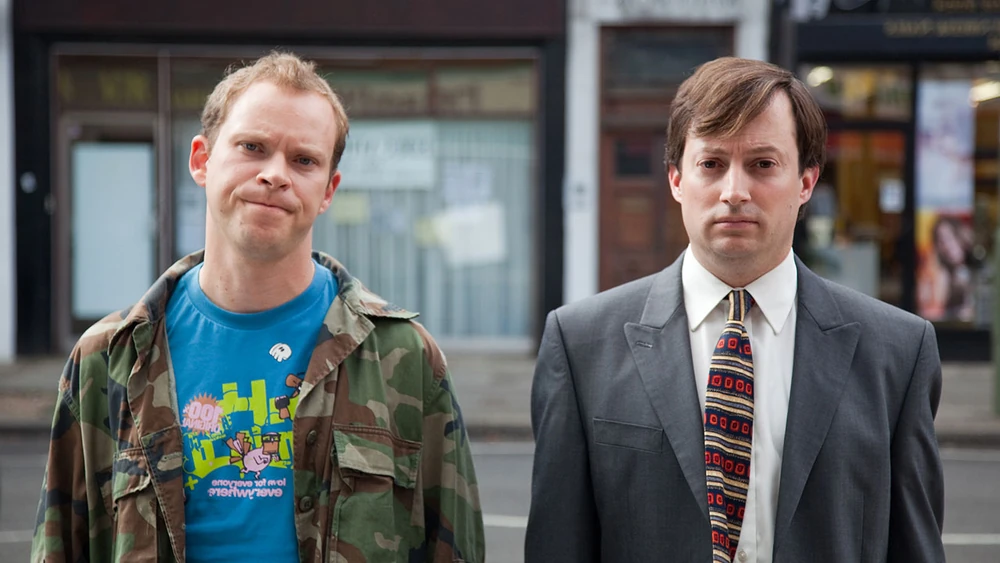
Peep Show, for the unfamiliar, is a Channel 4 comedy show starring David Mitchell and Robert Webb, written by Sam Bain, Jesse Armstrong and Andrew O'Connor, with occasional contributions from Mitchell and Webb themselves. It's the show that put Mitchell and Webb on the comedy map for many people, and is noteworthy for its main gimmick of being shot entirely in "first-person" from the perspective of the various characters, including the occasional ability to hear their thoughts — hence the name. We're getting to "peep" into the most intimate parts of their lives, including their private thoughts, in a way that simply isn't possible in "reality".
From the beginning, Peep Show sets itself up as a show where its two main characters are heavily, heavily flawed. Mitchell's Mark Corrigan character is stuffy, socially anxious, nerdy and, at times, rather arrogant, while Webb's Jeremy Usborne is also arrogant, albeit in a different way, self-obsessed, selfish, unambitious and, at times, borderline deluded about the possible directions his life could go in.
Early in the series, one could argue that Mark is somewhat set up to be the "protagonist" of sorts, since much of the ongoing storylines follow his attempts to woo his work colleague, Sophie. As time goes on, though, the show becomes more generally about how both Mark and Jeremy find themselves on their own separate pathways towards self-destruction, each coming at the concept from a different direction. Mark approaches it from the angle of repeatedly fucking up the genuinely good things that happen in his life, while Jeremy's obsession with drugs, alcohol and sex to the almost complete exclusion of building a "normal" adult life makes his trajectory clear pretty early on.
In many ways, Mark and Jeremy are polar opposites, but they are also a lot more similar than they would care to admit. And, as the show progresses, one comes to realise that perhaps the "El Dude Brothers" perhaps aren't as close friends as they thought they were; indeed, the very last line of the show comes from Mark, looking at Jeremy, reflecting on the many trials and tribulations they have both faced — and inflicted on one another — and thinking "I simply must get rid of him". The implication, of course, is that Mark will never be able to get rid of Jeremy — not because the pair of them are incredibly close friends, but because they're stuck with one another, thanks to each other's most awful tendencies having rubbed off on each other to an exceedingly unhealthy degree.
Thus one could probably say that Peep Show is about toxic masculinity. And indeed there are plenty of examples of that throughout the show, with the main ones being Mark's erstwhile boss, Alan Johnson, who is an obnoxious "alpha male" business leader type — although later shown to have enjoyed success primarily through luck and charisma rather than actual talent — and Jeremy's friend "Super Hans", who in many ways is far more fucked up than Mark or Jeremy will ever be — though at times he does seem to have his shit together a lot more than the pair of them.
Interestingly, though, neither Mark or Jeremy are examples of toxic masculinity in quite the same way. Jeremy likes to talk a big game and make out that he's always getting women, but we see repeatedly throughout the show that he is completely incompetent in developing close interpersonal relationships. Mark, meanwhile, has aspirations for a while of being a big balls businessman like Johnson, but over time comes to accept that he is, at heart, a fairly unremarkable person — and that that is not necessarily a bad thing.
To be sure, the pair of them do engage in behaviour that is plenty toxic, often in the name of pursuing masculinity. But a lot of the time they do this for the sake of living up to a misguided sense of "ideals" rather than because they actually feel that way. Neither of them have a clue how to navigate the challenges that life repeatedly confronts them with, and neither of them really know how to be a stereotypical "man", in terms of the unattainable ideal they both have in their minds. And this leads them both down destructive paths that ultimately bring them both to their own downfall — multiple times.
But Peep Show isn't a bleak tragedy. While I'm sure many people watching the show do feel a bit bad for Mark and Jeremy, particularly by the time the final episode rolls around, the central duo are, at their core, figures to laugh at. The show is a comedy because the situations they keep getting into are so ridiculous, but I think a lot of the humour lands because it's plausible. You can picture people you know going down some of the roads that both Mark and Jeremy fling themselves headlong down. You might even have broken off friendships with similar degrees of toxicity that the pair of them demonstrate.
It's a cautionary tale in many ways, then. Neither Mark or Jeremy are "villains" as such, nor are either of them fundamentally "bad people". But one thing Peep Show demonstrates more than anything else is that it is very easy to find yourself circling the drain if you don't make at least a bit of an effort to get your life under control — and that, as you grow older, if you don't find a good balance between "things that make your life better" and "things that make you feel good in the short term", where those two things are seemingly in conflict with one another, you will almost certainly find yourself bitter, twisted, and if not alone, then certainly stuck with someone who is bad for you, and that you will never, ever be able to get rid of.
A downer ending? Perhaps. But it was perfect for the story the show was telling. It would have been easy to give everyone on the show a "happy" ending for the final episode, but as harsh as it sounds, I'm glad they didn't get it. They got the ending that they deserved — and that has pretty much ensured I will remember the way things concluded a lot more vividly than if everything was all neatly resolved and tied up with a little bow.
Want to read my thoughts on various video games, visual novels and other popular culture things? Stop by MoeGamer.net, my site for all things fun where I am generally a lot more cheerful. And if you fancy watching some vids on classic games, drop by my YouTube channel.
If you want this nonsense in your inbox every day, please feel free to subscribe via email. Your email address won't be used for anything else.
