
Today I went out! All by myself and everything. Specifically, I went to Retrofest 2025, a new event held in sunny Swindon that promised a room full of sweaty old men and their peculiar computers, and delivered on that promise in spades. While the event was short on things to actually buy and come home with, it was thoroughly interesting to see some of the things people (and a few organisations) had chosen to exhibit from their personal collections.
I took a few photos from throughout the day. This isn't a comprehensive rundown of everything by any means, but I'll attempt to remember what everything was and tell you a bit about it. In no particular order:

Those who know me well will know that I have a major soft spot for Philips G7000 "Videopac Computer", a games console with a membrane keyboard. This is the "PS5 Pro" equivalent of that system: the G7400, which only came out in France to my knowledge. It runs all the G7000 games, including enhanced visuals for some of them, as well as more advanced titles specifically designed for it. That big grey lump on the back of it is a module that attempts to turn it into more of an actual computer, featuring additional RAM and Microsoft BASIC for programming.
Sadly, this wasn't up and running to play with, but it was a pleasure to actually see one.

Here's an Atari XE Games System, colloquially known as the XEGS. I've never actually seen one of these in the flesh. This was an attempt by Atari post-ST to revitalise the flagging 8-bit range by rejigging the 65XE computer into a games console with a detachable keyboard. Unlike the 5200 from several years earlier, the internals of the XEGS were identical to the Atari 8-bit home computers, so you could use pretty much any software and peripherals with it.
If this all sounds a bit like Atari didn't really know what they were doing at the time… you would be absolutely right. This thing is still cool, though. I like how the function keys look like those flying saucer sherbet sweeties.
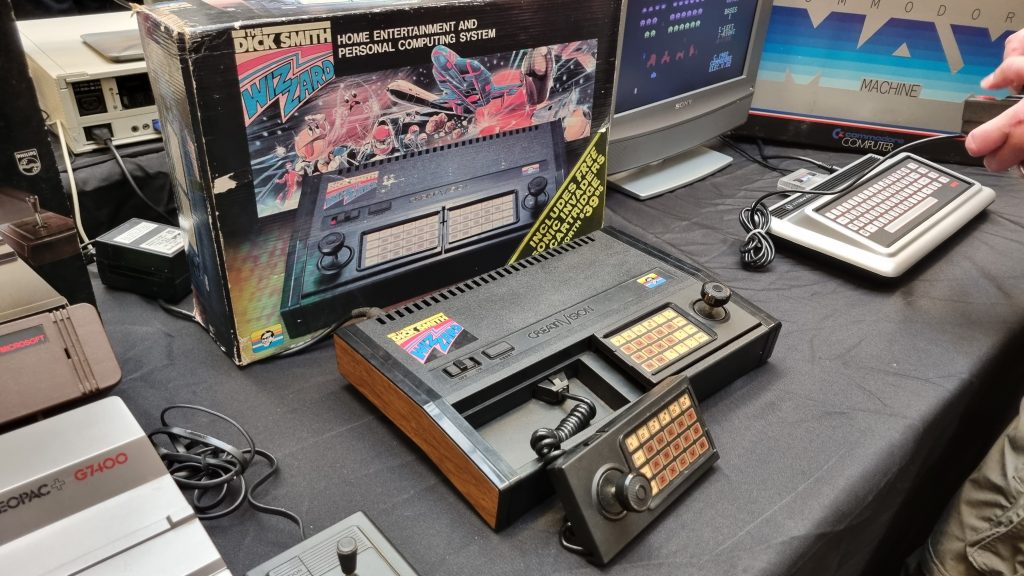
I was really interested to see this, a device known as both the CreatiVision and the Dick Smith Wizzard. Those who follow my videos may recall I saw this device advertised in an early issue of Page 6 magazine and had never heard of it. I asked the owner, Quang from Asobi Tech, about it. Apparently it's an Italian system from a roughly similar era to the ColecoVision (as one might expect from the design). Its capabilities are also roughly similar — which in turn means that it has similar capabilities to the MSX standard — but it's not cross-compatible with either the ColecoVision or the MSX itself.
Its notable feature is the full keyboard that spans the two controllers. These can either be used as an individual set of buttons for two players (presumably with overlays available) or "docked" into the system for a full-width keyboard of sorts.
The system wasn't a success, but it somehow made it to Australia, which is where the Dick Smith branding came from. Dick Smith was basically Australia's Alan Sugar, and he loved putting his mug on everything he sold, and the "Wizzard" was no exception.

Here's a fully working Asteroids Deluxe cabinet, the middle-sized one that lacks the "floating" backdrop of its larger counterpart. I spent quite a lot of time playing this today, and it turns out I don't dislike Asteroids as much as I thought I did.
Part of it was down to playing with those lovely leaf-switched arcade buttons and hearing the sound booming out from the internal speakers. But I just found myself enjoying the game in general a lot more than I have in the past.

The owner of the Asteroids Deluxe cabinet, streamer Rage Against The Retro, also brought a selection of other systems, all playing Asteroids. On the left there is a Vectrex, and situated next to it is an Apple Macintosh Plus. There's an Amiga A600 just to the right, also.
It occurred to me when playing both the Asteroids Deluxe cabinet and the Vectrex that I'd never actually played games on an authentic vector monitor before. The effect (which absolutely does not come through on either photos or video) is stunning, particularly the piercing brightness of your shots. This is one thing that emulation absolutely cannot do complete justice to.

Here's two very tiny TVs, both hooked up to games systems. The bigger one was hooked up to the A600 from the previous image, while the teeny one was attached to a Spectrum. Both were playing variants of Asteroids; the Amiga had follow-up Blasteroids, while the Speccy was playing a decent recreation of the arcade original.

More Asteroids! This time we've got an Atari 7800 playing a recent(ish) port, plus there's the Spectrum running one of the tiny TVs. Note the custom arcade controls Rage had set up to mimic the arcade version's control panel.

Here's some interesting rarities. On the left, we have two variations of the COMX-35 computer, which was designed to be low-cost, but which seemingly failed to leave any impression on the industry whatsoever. At least part of that may be down to the fact that it used the distinctly non-standard RCA 1802 processor while most other home computers of the era were using either the Zilog Z80 or the MOS 6502. It also had a peculiar 35K of memory. But it did have a built-in joystick, making it a nice little games machine.
On the right, we have Bandai's RX-78 "Gundam" home computer. And yes, it was named after the giant robots in an attempt to make it more appealing. This completely failed, however, as the system disappeared quickly with only about 20 pieces of software available in total. It looks neat though!

Here's a closer look at the COMX-35, with its chiclet keys and its fun quasi-industrial design. The more I look at this thing, the more I like its overall aesthetic.

And the RX-78 up close, too. Note the BASIC cartridge plugged into the back, ready for 10 PRINT "FARTS" 20 GOTO 10 shenanigans, and the matching joystick to the right.

This beauty is a Commodore RX-64, a "luggable" version of the Commodore 64 with integrated keyboard, floppy disk drive and monitor. Unsurprisingly, this beast of a thing completely failed on the market due to the fact it weighs ten and a half kilos and cost over a thousand dollars in the mid '80s, when the C64 itself was less than half that price.
It is a lovely thing though, and Commodore enthusiasts seem to enjoy it a lot. I can see why — it's fun to have everything integrated, and despite a few differences in the OS ROMs, it's mostly fully compatible with disk-based Commodore 64 software. It can't load tapes, though, as it has no tape controller at all.

This may look out of place, but the show was at Swindon's "STEAM" railway museum, and this little display was part of a display on train sets run by digital controllers from the 1970s. I didn't look into this too closely, but as someone who occasionally had the opportunity to play with Hornby trains when I was little (my family had a nice collection stuffed up in the loft that occasionally came down for an outing), it was nice to see this.

Here's some prototype Acorn machines. Without these, you might not have a smartphone! Yes, that's right, the "A" in "ARM" was originally for "Acorn", though now it is for "Advanced". ARM processors first appeared in Acorn Archimedes machines, which were a generation beyond these initial prototypes; these things would have ultimately become the BBC Micro and the Electron.
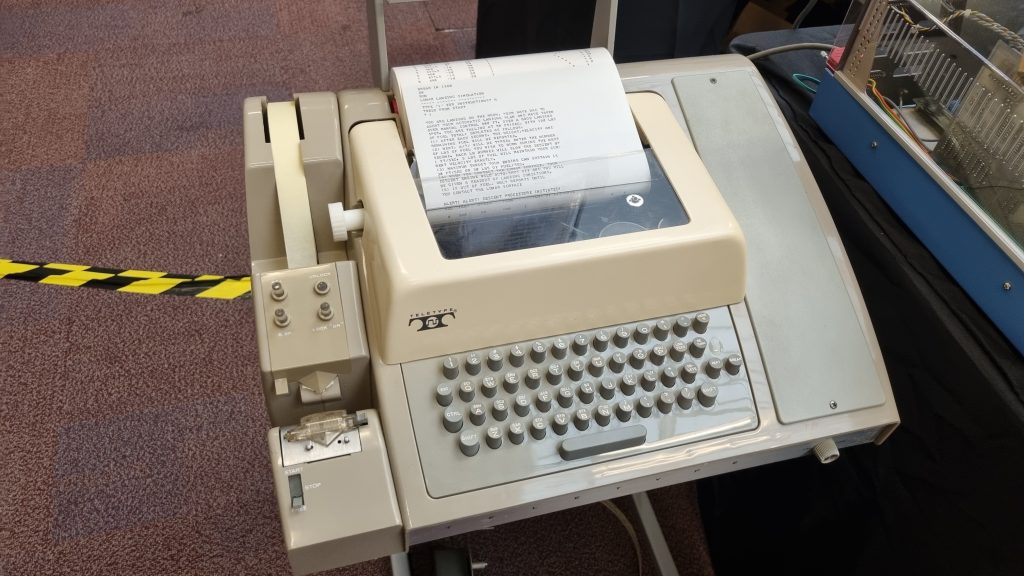
This is a teletype machine! This was an incredible amount of tactile fun to type stuff on, and unlike a regular typewriter it would type things back at you! You could also run a program on it that would punch out a message on the roll of paper tape to the side. I don't really know what this was "for", as such, but it was very cool!

Here's a pre-production prototype of the Dragon 32, the computer that Americans know as the TRS-80. Well, there are a few differences, but they're pretty similar internally. I don't know much about this machine but it certainly has its fans on both sides of the pond.

This is a Commodore MAX. I don't really know what this is! Apparently this was a cousin to the Commodore 64 that was mostly sold in Japan. It has similar capabilities to the C64, but a lot less RAM and a really horrible membrane keyboard. It also lacks much of an internal OS on ROM at all, making it more of a games machine that can do a few computery things than a full-on home computer.

This is a Spectravideo device that allows you to program in BASIC on the Atari 2600. At least, it does if you can figure out how on Earth to actually type things on it, because it uses a weird keyword-based system where pressing a single key inputs a full command, similar to Sinclair's BASIC. This is another thing that I'd seen in a magazine in a video I'd made, but had no idea even existed until quite recently. A thoroughly interesting little thing, though!

Finally, here's probably the rarest thing at the show: a Mattel Aquarius II home computer. The Aquarius range was such a flop for Mattel that it was cancelled mere months after its release, and as such very few Aquarius II units made it out into the wild. We're talking like maybe 25 out there — and this is supposedly the only one known to be in full working order. It's owned by a chap who has been developing games for the system for a while — at this point, he has now made more games for the Aquarius range than were released for it in its original lifespan.
And that's that! It was a really fun day out, and I enjoyed it a lot. It was good to see some YouTuber friends, set a few high scores, have a play with some intriguing rarities and see what the retro enthusiast community in general was up to. Particular shout-out to this guy, who is doing near-arcade perfect ports to the BBC Micro, of all things. His Missile Command and Frogger were particularly stunning.
Anyway, now I am very tired so I am going to go and lie down. If you're in the Swindon area tomorrow, first of all, I'm sorry, and second of all, maybe try and pop in to Retrofest — I'm pretty sure there's still a few tickets available. You can find out more here.
Want to read my thoughts on various video games, visual novels and other popular culture things? Stop by MoeGamer.net, my site for all things fun where I am generally a lot more cheerful. And if you fancy watching some vids on classic games, drop by my YouTube channel.
If you want this nonsense in your inbox every day, please feel free to subscribe via email. Your email address won't be used for anything else.

 PAX East is happening tomorrow, and I'm not there. This makes me inordinately sad for a number of reasons. Firstly, PAX East last year was the last time I could legitimately say that I was 100% completely, totally and utterly happy. For those few days, I had left all my growing troubles behind in the UK and was able to immerse myself in the culture that I loved so much. I was able to be an unabashed nerd and surround myself with thousands of other people like myself.