#oneaday Day 339: Eras

I remember when I was growing up, and I'd hear about life when my parents were young, and thinking "gosh, that was all jolly primitive, how on Earth did people get by without televisions and computers and the Internet?" Sitting here in 2025, thinking back to my own childhood, I feel like we've gone through shifts almost as big once again.

I grew up surrounded by computers. My Dad worked for IBM, and I'm pretty sure we had at least one Atari computer in the house from the moment I was born. I learned how to use computers from an early age — not just playing games, but also using them for productivity, programming and creativity. And my enjoyment of computing helped me make some friends, too.

But by modern standards, those computers were limited. They could run one program at a time, and you had to do everything using removable physical media. Want to play a game? Put in a disk, tape or cartridge and load it up. Want to do something creative? Put in a disk, tape or cartridge and load it up, then make sure you have another separate disk or tape handy to save your work onto. Hard disks existed, but they were something like £700 in '80s money for 20MB, and thus very few people had them — more to the point, not much software supported them, either, at least until the 16-bit era, when they became a little more commonplace.

"Going online" was something you could do from quite early on if you had the necessary hardware, and it was a very different experience to what using the Internet (really the Web) is today. To even get logged on you'd have to enter a cryptic string of commands to the modem, and sometimes it felt like a bit of a roll of the dice as to whether or not it would actually work at all. When you did get online, it was pages and pages of text, no pictures, and an understanding that you had a limited amount of time to do what you had to do before either 1) your family kicked you off for tying up the phone line for too long or 2) the SysOp kicked you off remotely for spending too long, preventing others from using the service.

When "online" spaces other than bulletin board systems came along — accompanied by computers that could do more than one thing at once — it was a revelation. I have immensely fond memories of exploring CompuServe on my Dad's account, spending time on the GAMERS forum, reading and replying to messages, and, on one memorable occasion, making $200 from some custom Wolfenstein 3-D levels. But it was still very different to today; CompuServe was a walled garden of curated stuff to explore, and access to the broader Web didn't come about until later. I remember us having great difficulty setting up the Mosaic browser to view simple websites, and how exciting it was when we finally got to look at, say, pictures from NASA for the first time.

I don't think anything tech-wise has changed things as much as the rise and growth of the mobile phone, though. Getting a mobile phone when I was in my late teens made me feel like I had a whole new degree of independence, free to communicate with my friends on my own terms when and how I felt like it (Pay as you Go credit permitting). I recall long, drunken text conversations with people important to me at university; there was even a time when I'd voluntarily phone people up for a chat. I used to have long phone conversations with my perpetually absent university housemate, for example; she was a good friend, but I didn't see her all that much for a variety of reasons.

Then, when smartphones arrived, everything changed. It didn't seem like it at first, because the earliest implementation of the iPhone was very limited. There were no installable apps; you had to do everything via the Web. But sites were starting to get savvy to the rise of this exciting new technology, and were starting to serve up "responsive" pages that looked nice on the small screen of an iPhone.

I was working at an Apple Store when the iPhone launched. It was an exciting time, for sure, and it only got more exciting when the App Store launched. Suddenly, there was this brave new frontier for software, and we'd all download and experiment with all manner of different apps; not just games, but productivity tools, creativity tools and silly joke apps — who can forget the "drinking a beer" one?

When in-app purchases were announced, my heart sank. We were already starting to see some nickel-and-diming in the console gaming space, and it was about to get much worse in mobile. Free-to-play became the default, and aggressive monetisation came along with it. And there were people who would make excuses for this. People who are still making excuses for it to this day, to such a degree that we're never going to get rid of free-to-play and microtransactions at this point.

But I think the biggest change was how addicted people became to those black plastic slabs. And I'm not excluding myself from that description, either; I could feel myself being compelled to fiddle with it constantly, and I didn't like it. I still don't like it. I'm better at controlling it today, but I still feel the "urges" near-constantly.

Things only got worse with the rise of content designed to be deliberately addictive, such as short-form videos. For quite some time now, I've found a lot of tech to be scary and unpleasant; definitely a far cry from the excitement I'd feel every day when I booted up the Atari 130XE to do some BASIC programming.

It's not all bad, of course. It's great having satellite navigation in your pocket when you're trying to find things. It's great being able to stay in touch with people via a whole host of different means. And it's great being able to quickly snap a photo or video of anything without kicking yourself for not bringing your camera with you.

But there have been some big changes. Whether or not they're as big as the differences between my parents' childhood and my childhood, I don't know. But I suspect the realisation that you've lived through some huge changes in the world and society is an important part of progressing through life; you often don't notice these changes while they're in the middle of happening, but when you look back on them you realise that they were pretty massive. And not always for the better.

Would I like to go back to earlier, less technologically advanced, less convenient days? Some days, I honestly do think that yes, I would. There are a lot of great things about our modern, connected society — and a lot of terrible things, too — but sometimes I just miss the simplicity of life as it was back then.

I find myself wondering exactly what I mean by "back then"; if it was possible to go back, exactly what point would be the optimal one? I think, for me, it would probably be the early 2000s. Mobile phones would exist but wouldn't be the life-consuming soul suckers they are today; computer and video game technology would be at a good point; and we might all see a bit more of one another in the real world.

I might not have this blog, though. Or maybe I would. Perhaps it wouldn't be in quite this form. Perhaps I'd be a trailblazer in the blogging space.

Who knows? You can't go back, more's the pity. So we're stuck with what we have, regrettably, constructed for ourselves. At least for the moment.


Want to read my thoughts on various video games, visual novels and other popular culture things? Stop by MoeGamer.net, my site for all things fun where I am generally a lot more cheerful. And if you fancy watching some vids on classic games, drop by my YouTube channel.

If you want this nonsense in your inbox every day, please feel free to subscribe via email. Your email address won't be used for anything else.
2306: Happy Birthday, Discord

0306_001

Back in the early days of "going online" — after the days of Bulletin Board Systems but before the widespread Internet we know today — our family used CompuServe to get at information online.

For a teenager like I was at the time, it was very exciting. For the first time, I was able to "meet" and communicate with people from all over the world, discuss common interests and even exchange files.

One of my favourite features of CompuServe was an area it rather grandiosely referred to as the "CB Simulator", after the units used by ham radio operators to communicate with other enthusiasts over the radio waves. In reality, it was simply what we now know today as a chatroom, but it was a revelation to the young me, who had always had a bit of difficulty finding new people to talk to, particularly those who were into the same things.

In the CB Simulator, I could talk to people without fear of them, say, judging me for my appearance, or my mannerisms that clearly indicated I was uncomfortable with talking to strangers, or how I tended to go the colour of beetroot when talking to girls I liked. No; in the CB Simulator, I was able to communicate in the way I had always felt most comfortable: through the written word.

A few years later, when "the Internet" started to become more of a thing and self-contained, fenced-off communities like CompuServe and AOL were starting to become less of a thing, I looked into Internet Relay Chat, or IRC. There, I found a similar experience to that which I'd had in CompuServe's CB Simulator: the ability to communicate and express myself through text to people from all over the world. And now, I could "emote" too, which in turn led to my first experiences with online roleplaying through a group that "simulated" Star Trek missions through text chat.

I was kind of sad when chatrooms fell out of favour with the rise of what we now know as social media, but for those of you, like me, who always used to enjoy the real-time nature of talking in chatrooms, may I introduce you to the wonderful service that is Discord, which is now celebrating its first birthday.

Originally designed as a free, lightweight alternative to Skype and Teamspeak, Discord has been actively developed over the last year to become one of the best — arguably the best — real-time chat application out there, particularly if you're a gamer.

For the unfamiliar, it works in a slightly different way to instant messaging services such as Skype and its earlier counterparts AIM, MSN and Yahoo Messenger. Instead of focusing on private chats with individuals on your friends list, Discord is instead server-based, much like IRC was. Within that server — again like IRC — there are channels for whatever purposes the server admins desire. Anyone who is a member of that server — and servers can be public or private — can hop in to a channel and text chat. There's voice chat facilities, too, which have very good, reliable, clear voice quality and connections, making it an ideal solution for "party chat" on PC, or even using alongside games that don't normally offer voice communication: the Splatoon community, for example, use it quite a bit, since that game has no means of direct communication whatsoever.

Mostly the thing that excites me about Discord is how much it feels like those old IRC servers, only with a more modern coat of paint. Inline image posts, markdown formatting, animated GIFs and link previews are all a natural evolution of the purely text-based chat that IRC offered, and Discord's cross-platform nature — it works via the Web, on PC or Mac desktop clients or even on mobile — makes it an ideal means for keeping in touch with groups of friends or specialised communities.

I'm very happy that Discord has been such a success since it originally launched, and hope it continues to be A Thing for many years to come yet. It's been a great way for me to interact with friends from elsewhere on the Internet in new, more immediate ways than services like Twitter offer, and, depending on the server, it can be a nice quiet safe haven away from the noise of more public social media channels.

I'm a member of several different Discord servers, but the one on which I'm most active is probably the one I'm an admin of. If you'd like to stop by and say hi — the server is largely focused on video games, anime, lewds and general shitposting, but everyone there is just happy to have a good chinwag — then you can do so by following this link.

Happy birthday, Discord, and happy chatting to those of you who choose to come and join us!

1631: GO GAMERS

The Squadron of Shame forums are coming along nicely — they're pretty much ready for the public to show up and start posting in now, so if you're at all interested in computer and video games and find that places like NeoGAF and its ilk aren't quite fitting your needs — in other words, you like to use paragraphs and write posts that include more than ten words at a time — then do feel free to come on over, sign up and start mingling with the rest of the community, who are slowly trickling over.

Forums are the spiritual home of the Squad, since it's where we, as a group, first came together. But they're also one of the most long-standing parts of the Internet — one aspect of the ever-changing digital world that has actually managed to remain reasonably constant over the course of the last 15-20 years or so.

I recall my first experience with forums fairly vividly. Our first Internet service provider was CompuServe, one of several providers that, at least initially, didn't offer "true" Internet access, instead opting to provide its users with a gated set of online services exclusively for subscribers. (Full Internet access eventually came later, initially in the form of the ability to send email messages to Internet addresses instead of just CompuServe IDs, and later full-on Web access.) As part of this "gated community", CompuServe offered a swathe of forums on a whole host of specialist subjects. Unsurprisingly, I quickly found an online home in the GAMERS forum — you clicked the "GO" button and typed "GAMERS" to get there — and had my first experience of mingling with the online community.

The term "online community" these days has a certain number of negative connotations, due in part to the perpetuation of the narrative that the majority of people who post things online are somehow "toxic", and the fact that indeed, some people who post things online are somehow "toxic". But back in its early days, it was a different matter. "Flaming" and "trolling" were established terms, but they tended to be seen fairly rarely. There were extensive glossaries of the then-new emoticons and acronyms that started to creep into everyday usage, and new terms like "netiquette" were coined to describe how you should interact with other people online.

I honestly can't remember a whole lot about the sort of things I posted and discussed on the Gamers' Forum on CompuServe, but I do remember one thing vividly: I was into Wolfenstein 3-D at the time, and had been experimenting with a variety of mod tools for it, at least partly because I'd been helping a local shareware dealer write his catalogues that included a selection of Wolfenstein add-ons and editors.

Anyway, yes; I was into Wolfenstein 3-D and had spent quite some time working on a selection of new levels — ten of them, in fact. I uploaded them to the Gamers' Forum's download area for others to have a go at, but didn't think anything more of it and certainly wasn't expecting any feedback or anything.

Imagine my surprise, then, when I was contacted by a gentleman named Carlton, who claimed to represent Apogee, the publisher of Wolfenstein, and also claimed to be interested in including my levels in an official expansion pack for the game. I'd be paid, he promised, and appropriately credited.

Frankly, I was at a loss as to what to do at this stage, but after some deliberation and discussion I took a chance and got in touch with Carlton, who took my contact details and promised to be in touch in short order.

Not a lot happened for a while, but then one day a package showed up. Inside it was a cheque for $200 and three floppy disks — one containing a full, registered version of Wolfenstein 3-D, and two containing the official expansion pack, the Super Upgrades pack. I installed the disks, browsed through the directory containing the game — and sure enough, there were my levels, credited to me. I was a professional game designer.

And all because of a forum. Pretty neat, huh?

#oneaday Day 90: You'll Never Win

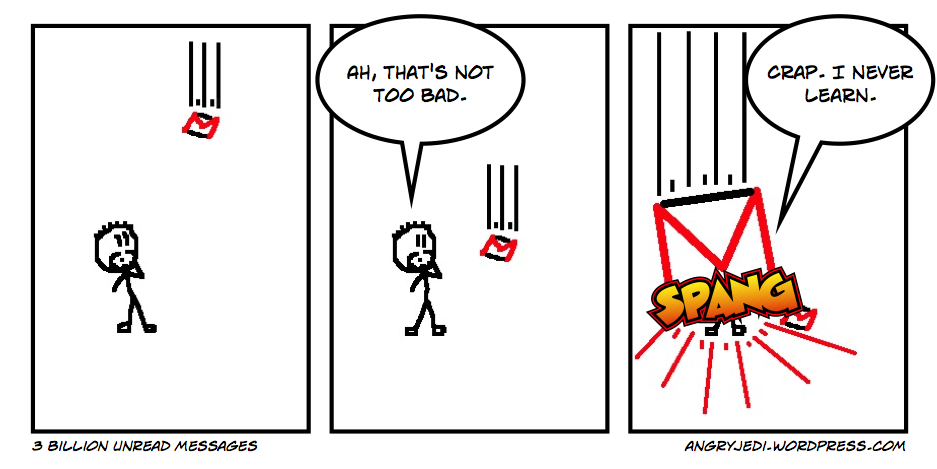
Got an iPhone or some sort of portable telecommunications device which supports push notifications? Take a look at its home screen and count how many notifications you've got. Not counting emails, I have 39, and I know the second I go through all those apps and "clear" them, they'll be back with a vengeance.

The same is true with emails. My inbox count on my iPhone has been hovering at somewhere around the 650-700 mark for a long time now, and there seems to be absolutely no way to shrink it down. My GMail button in Chrome claims I have 948 messages, but I think that's the total in my inbox, not unread. And like the notifications, I know that as soon as I batter the shit out of my inbox and get that number down to something approaching zero (it can never be zero, because there's always at least one message you find that you think "I'll just leave that in my inbox, I might want to refer to that later", conveniently forgetting the fact you have labels, folders and a search facility) those messages will be back to haunt me. Well, not those same messages, but some new ones.

It's the age of Web 2.0 that has done this to us, of course. The fact that we get bombarded with messages from various social networks on a minute-by-minute basis, everything vying for our attention (when in fact most of these emails are asinine, vapid crap that we really don't need — who gives a fuck if someone just commented on a photo you were tagged in? Check it later.) and, in many cases, causing the important stuff to get lost.

I remember back in the CompuServe days, receiving an email was A Big Deal (particularly if it was from Julia, at least until The Incident) because it didn't necessarily happen every day. Largely because not everyone Had The Internet, because some people didn't have a modem, or others were concerned about phone bills, or whatever. But at that time — oh, that golden time — you were lucky to get five emails a week, and certainly none inviting you to extend your penis with Biblical quotes (and no, sadly I'm not making that up).

I guess the solution would be, of course, to turn off notifications and to stop Twitter, Facebook and whatever else from emailing me every time someone in my network does ANYTHING… but then how will I know that someone just tagged me in 300 photos? (With an email for every photo, obv.)

In other news, it's probably about time I cleaned out my aforementioned GMail inbox. I'm going in… if you don't hear from me in 3 hours I've probably died.

#oneaday, Day 30: Julia

The Internet is a curious thing, as we all know. It's given us LOLcats, cakefarts, puddingfarts (so I'm told… I haven't dared look that one up yet), Twitter, Rickrolling, gayrolling, that kid throwing a WoW-related (fake) strop and jamming a controller up his arse, porn, dancing chicken man, leekspinning and all manner of other things besides.

The other thing it gives you is people.

As a kid at school, I often wondered what it would be like to meet people outside the local community where I lived. I grew up in a small village in the countryside that had a pretty close-knit community. You could probably name most of the local "characters" off the top of your head if you had a good think… largely because pretty much everyone got involved with everything. And, just to add to every country stereotype ever, there was even a semi-regular "village show" which was inevitably filled with middle-aged men and women making jokes that were smutty and/or at the local vicar's expense. It's pretty neat to see a close-knit community like that, actually, though I question how much it actually happens these days. It probably does, though I doubt to the same degree.

I remember when the Internet came to town, though. Or, more specifically, in the form of CompuServe, which wasn't the "proper" Internet—that was a mysterious and difficult thing that no-one quite understood at the time. CompuServe was a window onto the rest of the world; people who were potentially far away that we all had access to for the first time.

CompuServe had one of the earliest chatrooms around—this was so long ago that the term "chat" hadn't taken on the widespread meaning it had today. No, in keeping with the times (or possibly not), CompuServe elected to call their chatroom facility the "CB Simulator". You know, because it was like CB radio in that you could talk to random strangers. Only it was completely different because you were just typing things.

I remember "meeting" a few people through this facility, with one in particular springing to mind. Her name was Julia, and she was from somewhere near Manchester. We got chatting and hit it off pretty quickly, and thus began a long campaign of emailing each other back and forth. I can't remember any of the things we talked about—the usual teenage things, I imagine—but I remember that we were getting on well and it felt like we were pretty "close".

So eventually, we had the opportunity to meet. She was going to Alton Towers with her friends, and as it happened, my friends and I were planning a similar trip. So we decided to make our trips coincide. I was pretty excited about the whole thing. She'd sent me a couple of (clean!) photos which seem to have managed to travel from computer to computer with me completely unintentionally, and she hadn't promptly cut off all contact when I sent her a photo of myself looking slightly uncomfortable in a dinner jacket on prom night. Which was a good sign.

I'm not sure what happened. Perhaps it was shyness, perhaps it was the presence of all our other friends "cramping our style", perhaps it was the fact that one of my friends was hitting on one of her friends (and doing quite well, from what I could tell), perhaps I wasn't what she'd expected or hoped for (she totally was what I was hoping for, she was a hottie)… but we found it pretty difficult to talk to each other in "real life". It was weird; we'd told each other lots of things, including plenty of "secrets", but as soon as we were faced with one another it was suddenly like starting over… and it became a missed opportunity, sadly. We drifted off and lost contact after that. There was no "breakup" or words spoken in anger; things just… "stopped".

I think about Julia every so often and wonder what she's doing with her life. I hope she's happy, wherever she is.