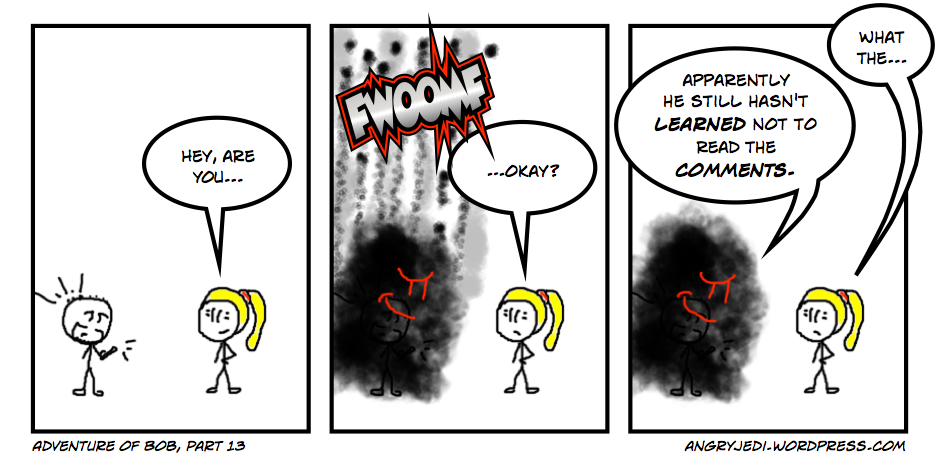
 You know one of the people I admire the most on the whole Internet? Jim Sterling. While I may not always agree with his opinions and the way he argues them, that's not why I admire him. No, the reason I admire him is how he can say something which may end up being controversial in some way (either due to subject matter or by going against popular opinion) and then not let the subsequent barrage of vitriol flying his way bother him. Or, if he does, he manages to hide it exceedingly well and simply brush it off as part of the job. (I have a sneaking suspicion that if it really did bother him, he wouldn't still be in this business.)
I last wrote about this topic back on day 795 of this blog, and the things both I and Sterling said back then still ring true. I'm envious of Sterling because of the way in which he can rise above the abuse and not let negative comments get to him, because I am the exact opposite.
Let me explain to you what it's like to browse a comments section when you suffer from anxiety and depression in various forms. First of all, you find yourself hoping that there are comments there at all. It's nice to know that something you wrote has resonated enough with someone to compel them to respond. It's even nicer if said someone comes along and agrees with you. Everyone likes to be agreed with and made to feel like they're "right", even in topics where there is no clear "right" or "wrong" answer. It's particularly pleasing to know you've made a connection with someone who is often a complete stranger, and that you've been able to bond over the words that came out of your head and onto the page.
Now let's say there's a dissenting comment in there, too. It doesn't have to be a vitriolic or abusive one, just one which disagrees with you in some way. Immediately, all the good work done by the positive comment is undone. Immediately, you feel a knot in your stomach as you start to read the dissenting opinions, and immediately you start to feel like a failure as a human being because your thoughts didn't coincide with someone else's. Should you have written that article at all? Should you continue writing at all? Or should you just pack it in altogether, because every time a dissenting opinion comes along, you end up feeling sick to your stomach?
There is, of course, a specific example I'm thinking of in this case. As you may be aware, I write a regular column about visual novels every week for Games Are Evil. I don't claim to be an expert on the subject, just someone with a strong interest in the medium and an urge to tell others about the great experiences I've had with them. This week, I decided to write about the treatment of sex in visual novels, which often tend to be very explicit on the erotic content front. The first comment I got was from a regular commenter on the column, and fell into the first category I described above. A subsequent one fell into the second category, telling me that I'd chosen bad examples to back up my points and accusing me of not knowing my subject matter. The comment itself was relatively respectful in tone, now that I've had a few hours to stew on it, but I came away from initially reading it feeling pretty shitty about myself. I'd worked hard on that piece and had put myself out there by sharing my opinions, and to have them shot down in that manner and accused of not knowing my stuff was actually quite upsetting.
I am aware that I broke one of the cardinal rules of the Internet by looking at the comments section at all, I am also aware that it's highly possible that I will never see or hear from that commenter again, and I am also aware that everyone is entitled to their opinion and no-one is obliged to agree with me — but that simple failure to connect made me rather upset and has left me feeling quite glum all evening. It's a total overreaction, I know, and I should learn from Sterling's example and grow a thicker skin — or argue my corner better — but, well, that's the experience of living with anxiety and depression. It only takes a few poorly-chosen words to make someone like me feel like crap, and it's mostly our fault for being that way and not doing anything about it.
You should, of course, be able to freely express your opinions just as much as me, but just think about the way you're saying the things you want to say before you hit that "post" button, please?
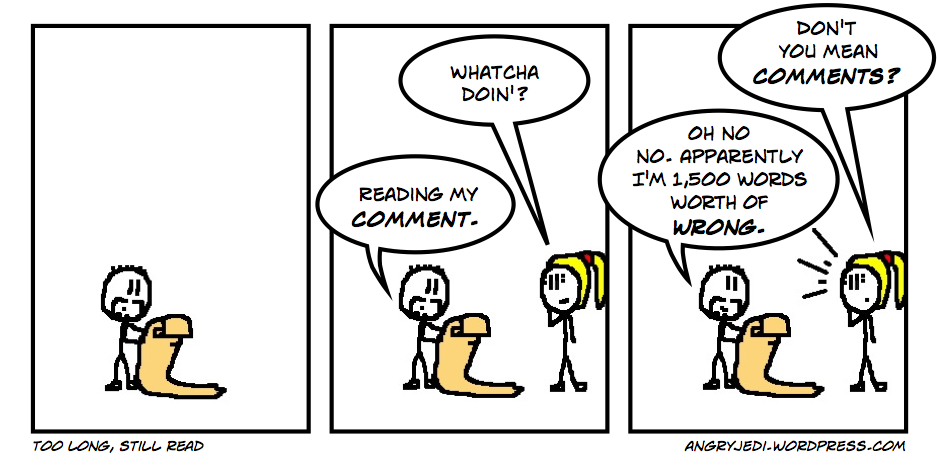 I'm almost entirely certain I have ranted on this topic at least once in the past. But, well, it bears repeating, given what I do both here and professionally.
 I remember back in primary school we were encouraged to never use the words "nice" or "said" because they were boring. There are always better words to use, we were told, so we should be creative and extend our vocabularies.
 aplenty from there on, I feel.
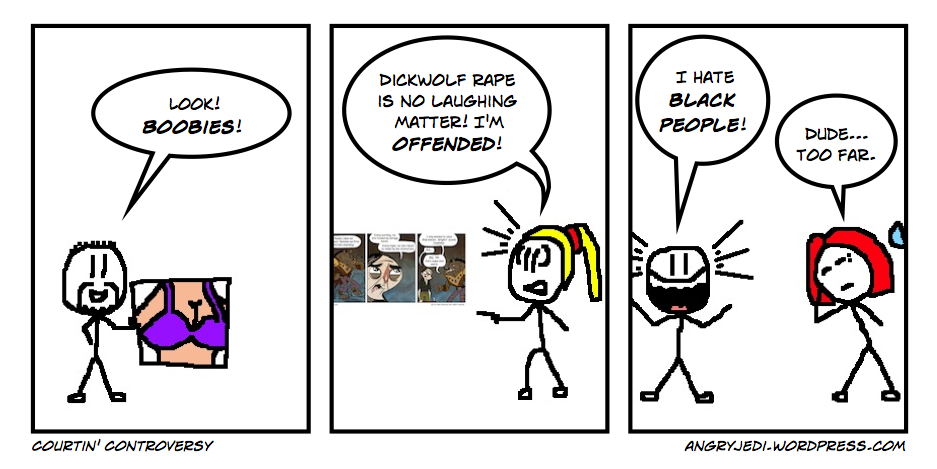 Want to get your voice heard on the Internet? Then you'd better have something contentious to say, or at the very least something to say about something contentious.
 People who comment first on things should be applauded for their tenacity. Assuming they have anything worthwhile to say. However, unfortunately, the sort of person who enjoys pointing out the fact they are the first to comment on something rarely has anything useful to say. This then has the knock-on effect of causing the following commenters to assume that the thing that has been posted is the sort of thing only enjoyed by twats and, by extension, is not something over which a reasonable, thought-provoking or entertaining discussion might take place. Please see what you can do to stop this happening.
 The immediacy with which information is available on you is astounding. During the last paragraph, I was able to quickly look up the word "tenacity" to ensure it was, in fact, the correct word I was thinking of. (It was.) However, this does not mean that more lengthy prose no longer has a place in society. Whether on a message board, a blog post, an online news article or a Wikipedia article, the saying "less is more" is not always true. Consider these two sentences: "Pete is a dude." and "Pete is an awesome dude who likes video games and music, and has also recently taken to punctuating his blog posts with MS Paint stickmen representations of himself and numerous other anonymous people." Which of the two sentences tells you more about Pete?
 Laughter is the best medicine, but it is not punctuation. We already have some perfectly good punctuation marks to use. Here is one: a colon. And a full stop. And oh look – a dash! And an exclamation mark. But what about a question mark? Or some sort of slash/"quotation marks" combination? All of these things are fine and serve to make our written communication more clear.
 I've bought things in the past. I once bought a copy of Oasis' first album Definitely Maybe the day before their second album (What's the Story) Morning Glory? came out. I didn't know any better at the time, as I was just getting into popular music, but I wasn't annoyed, because Definitely Maybe is a good album too. I was quite impressed that my friends at the time didn't feel the need to take the piss out of me for this, because they too knew that Definitely Maybe was still a worthwhile purchase even though the next album was on the way.
 Finally, Internet, I believe that one of your most exciting features that you told everyone about when you first appeared on the scene was the ability to bring the whole world closer together. Terms like "information superhighway" and "global village" were coined for us to all imagine one big happy family holding hands and enjoying things together.