#oneaday Day 643: An interesting thing for you to try

Today, I'd like to share an Interesting Thing with you. Click here to see what it is. I promise it is neither goatse nor a RickRoll (although I would say that if it was either of those things, wouldn't I?)

No, it's a test to see if you can distinguish between two quite-similar-to-extremely-similar colours. All you have to do is click on the screen where you think the (vertical) dividing line between the two differently coloured halves of the screen is.

Sounds easy, right? To begin with, you probably will find it quite easy. But as it progresses, it becomes really quite challenging — although you'll probably notice some peculiarities as you continue.

For starters, you'll likely notice the dividing line more easily if you move your head or even just your eyes. There's probably a scientific reason behind this, and this makes me feel like I should have probably read the companion blog post to this little test before starting to type here, but oh well. No time like the present, is there?

Okay, I've read it, and it's complicated (but quite interesting). Basically there's a value called the "Just Noticeable Difference" (or "JND") and this determines whether or not we can distinguish two very similar colours as actually being different from one another.

A commonly agreed JND measured on one popular scale (used in the test linked above) is 0.02; colours that exhibit this "distance" between one another are different from each other, but to most people who are just glancing at them, they will look the same. The test introduces slightly artificial conditions by making you actively look for the differences — plus it also depends a bit on how well your display is calibrated — but it's still an interesting way to see quite how solid your perception of colour is — and whether or not that varies between different colour types.

For me, my weakness was bright pinks. I found it quite difficult to distinguish between those, but had much less difficulty with darker, less saturated or overall duller colours. I still scored considerably better than the "average", though — my score was 0.0056.

Give it a go! It's much more interesting than doomscrolling… and definitely a better use of your time and the planet's resources than using Google Gemini if you're bored.


Want to read my thoughts on various video games, visual novels and other popular culture things? Stop by MoeGamer.net, my site for all things fun where I am generally a lot more cheerful. And if you fancy watching some vids on classic games, drop by my YouTube channel.

If you want this nonsense in your inbox every day, please feel free to subscribe via email. Your email address won't be used for anything else.
#oneaday Day 78: The Colour of Flavour

I think it's kind of interesting how specific colours have very much come to be associated with specific flavours — and that those colour assignments are almost (albeit not entirely) universal, at least when it comes to packaging.

Take a green packet of crisps, for example; you know that depending on if it follows the Walkers or Golden Wonder model, it will be either salt and vinegar or cheese and onion flavour. Red packets will be salted. Crimson will be smoky bacon. Orange will be chicken. Brown will be beef.

But it's not just crisps. You can generally identify tinned fish by its colour: sky blue for tuna, pink for salmon, sardines and mackerel can vary, but often red or dark blue.

And it's not even food for humans that follows these conventions. The packets of cat food we have follow a similarly recognisable system, too: sky blue for tuna, pink for salmon, red for beef (outside of crisps, this is a common assignment), orange for chicken.

These often make a certain degree of sense. Onions are greenish, for example, so it makes sense for them to be assigned the colour green. Bacon is pink and goes a bit darker when you cook it — particularly if it's smoked — so crimson makes sense. Blue makes sense for tuna because it's from the sea and the sea is commonly represented as blue, and salmon is iconically pink, so its packaging is pink. Brown and red both make sense for beef based on its colour after and before cooking, and its status as the most common "red meat".

I suspect we're at a point where we can directly associate tastes with colours in an almost synaesthetic manner, even outside of the examples that have some logic behind them. If someone says a fizzy drink "tastes like red", I bet you know what they mean, don't you? And interestingly, a drink tasting like "red" does not mean it tastes like either salt or beef. This even progresses into areas that make no sense, like "blue raspberry". Raspberries aren't blue. And yet if I say "blue raspberry" to you, I bet you know what it tastes like. (Very little like raspberries, as it happens.)

I've mentioned in my writing and my videos before that I feel like I have a certain degree of synaesthesia. When I'm playing a video game, for example, sometimes on-screen actions will be satisfying in a way that I can only describe as them "tasting" nice or having good "mouthfeel". I wonder how much of that is something that has happened independently of all this, and how much is a result of how much, today, we directly associate colours with flavours.

Apparently from a casual Google, I'm not the first person to feel like this. There's a paper from 2015 published on Biomed Central that is "on the psychological impact of food colour", for example. Their hypothesis was that "colour is the single most important product-intrinsic sensory cue when it comes to setting people's expectations regarding the likely taste and flavour of food and drink."

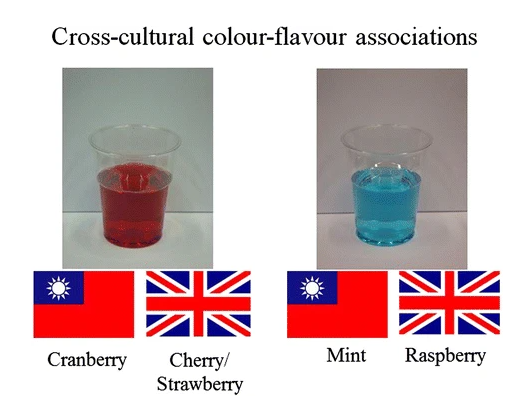
I've only skimmed the study so won't go into detail, but one interesting thing that was picked out was how these colour-flavour assignments can have different cultural meanings. For example:

A diagram of cross-cultural colour-flavour associations, demonstrating a dark red drink and a sky blue drink.

Beneath the images are Taiwanese and British flags indicating the perceived flavours of those colours in the different territories.

In Taiwan, the red drink is assumed to be cranberry. In the UK, cherry or strawberry.

In Taiwan, the blue drink is assumed to be mint; in the UK, raspberry.

The paper's "conclusion" section seemed remarkably inconclusive, though it did admit that "colour cues influence our food and drink-related behaviour in a number of different ways" and "food colouring undoubtedly plays an important role in driving liking and the consumer acceptability of a variety of food and beverage products".

It also noted that "identifying consistent colour-flavour mappings and training the consumer to internalise other new associations is one of the important challenges facing the food marketer interested in launching new products or brand extensions in a marketplace that is more colourful than ever."

So basically, a lot of it comes down to marketing. I still think it's interesting how obvious "standards" have developed, though — and it's interesting to consider that those standards might not be universal from one country to another.


Want to read my thoughts on various video games, visual novels and other popular culture things? Stop by MoeGamer.net, my site for all things fun where I am generally a lot more cheerful. And if you fancy watching some vids on classic games, drop by my YouTube channel.

If you want this nonsense in your inbox every day, please feel free to subscribe via email. Your email address won't be used for anything else.