I've seen it often suggested that "no-one finishes games" these days. Is that really true? I don't know. I am certainly not a representative example here, because I tend to only start games that I know I am going to finish for the most part. It might take quite a while to finish some of these games, if they're epic-length RPGs, but I will generally make an effort to finish everything I start. I have a mostly positive success rate.
I'm interested in this perception that no-one finishes games any more, because it's one of those things that is an alien concept to me — particularly with story-based games. Can you really derive any sort of satisfaction from playing a narrative-focused game and just leaving it unresolved? I guess in some ways it's the same as watching part of a TV series and then dropping it partway through. But it's still kind of alien to me.
So I thought what I'd do today is go through some games I can think of off the top of my head that one might regard as "popular", then see what the Steam Achievement rate is for "finished the game" or equivalent achievements. I appreciate this is an imperfect metric, because it doesn't take into account other platforms (particularly those which don't have achievements, like Switch) but it'll do for a rough idea. All right, let's take a look.
Pragmata

42.3% of people who played Capcom's Pragmata on Steam finished it to the point of seeing the credits roll on a first playthrough. This is a reasonably respectable number so far as I'm concerned, and I'm unsurprised to see this so relatively high to kick us off. Pragmata was praised as one of the first genuinely excellent triple-A games for quite a long time, so it's encouraging to see this many people play it through to completion.
It is less than half of the people who started it, though.

We see a big drop-off when it comes to completing optional material, though. 13.4% completed the main objective in all the Training Simulator side activities, which I completely empathise with; the Training Simulator is by far the worst part of the game and I absolutely hated every second of it. I am, therefore, unsurprised that a similar number of people went through and completed the postgame scenario, "Unknown Signal", since that involves running through a series of Training Simulator-like missions — only without the annoying bits. However, if you weren't to know about the "without the annoying bits" part, I can completely understand you not wanting to bother with it. And the additional bit you get on the ending for completing Unknown Signal is absolutely not worth it, either.
Resident Evil Requiem
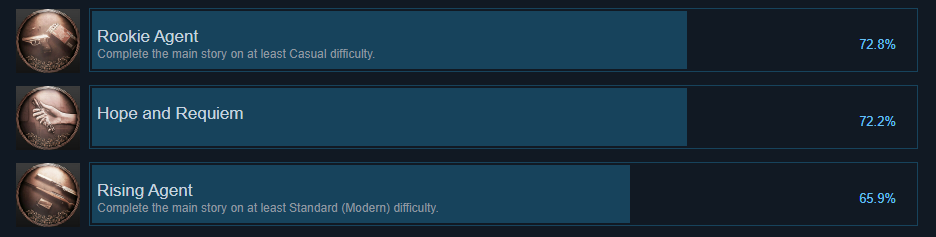
Would you look at that? Nearly 75% of people have beaten Resident Evil Requiem, one of the most well-regarded entries in the series for quite some time. Only 65% of them beat it on "Standard (Modern)" difficulty, though, suggesting that all the Difficulty Level Discourse we've been having for the last few years has had an effect; there's a small but statistically significant number of people who had no qualms about playing on the lowest difficulty level.
Interestingly there is a different percentage for "complete the game on at least Casual difficulty" and "complete the game" ("Hope and Requiem"). I wonder how that happened?
Clair Obscur: Expedition 33

We look at a longer game now with Clair Obscur: Expedition 33. Here, just under 40% of people actually finished the game. I can sort of understand it in this case, because although Expedition 33's main narrative is thoroughly compelling and emotionally engaging, the gameplay is challenging enough that I can see a significant number of people falling off before the end. It's one of those instances where although the developers made a huge, beautiful world and obviously want as many people as possible to see it, they also weren't willing to compromise on the mechanical intricacies of the game. Respect to them for that, but it does mean that significantly less than half of the players who started the game finished it.
Final Fantasy VII Rebirth

Pity poor Final Fantasy VII Rebirth, though, a game where only just over a quarter of people who started it played it through to completion. This is another one that is arguably understandable due to the vast size of the game, but the team behind the game have got to be looking at that figure and feeling a bit disheartened.

But at least it's not the original Final Fantasy VII, which only 8.7% people who played it on Steam have finished. It's a shorter game! But there's also the fact that a lot of the people who would be inclined to buy Final Fantasy VII on Steam have nostalgia for having played it on PlayStation back in the '90s, and as such they may have just fired it up for a session or two to indulge that nostalgia, then set it aside. Less than 10% kind of sucks, though, because I'm sure there's some people coming to it for the first time, starting it and then never seeing it through to its magnificent conclusion.
Blue Prince

Honestly I'm surprised that nearly 40% of people finished Blue Prince, because it's the kind of game that repels you hard if you're not into it. But then you might say that the sort of people inclined to pick up Blue Prince probably already know that it's a game they'll like, and thus there should be a respectable proportion of them who finish it.
I didn't stick with Blue Prince long enough to know if this trophy encompasses all the endgame bullshit you have to do other than playing the annoying house layout game, but either way, even getting as far as just finishing the annoying house layout game is worthy of respect so far as I'm concerned.
Fuckin' hate that game.
I think that'll do for now. I know that's probably far from a representative or statistically significant sample, but on the whole, it seems like, on average, less than half of the people who start a game on Steam finish it. The games that are more likely to get finishes are ones that are on the shorter side, like Resident Evil, while longer RPGs inevitably see a much more significant drop-off. More niche-interest titles likely enjoy a slightly higher completion percentage due to the people playing having a sort of "vested interest" in the game and the genre it occupies, but still.
Anyway, I'm not sure I have a point here. So long as games that you can complete continue to exist, I will continue completing them, one at a time, because that's how I enjoy playing. If you're someone who doesn't beat games, do make an effort to finish one or two. I can pretty much guarantee you'll find it to be a satisfying experience. Just be warned: once you start in earnest, you'll want to beat everything you play… and for some, that way lies madness!
At least you're not chasing platinum trophies. That really is a sure-fire way to ruin all enjoyment of video games.
Want to read my thoughts on various video games, visual novels and other popular culture things? Stop by MoeGamer.net, my site for all things fun where I am generally a lot more cheerful. And if you fancy watching some vids on classic games, drop by my YouTube channel.
If you want this nonsense in your inbox every day, please feel free to subscribe via email. Your email address won't be used for anything else.