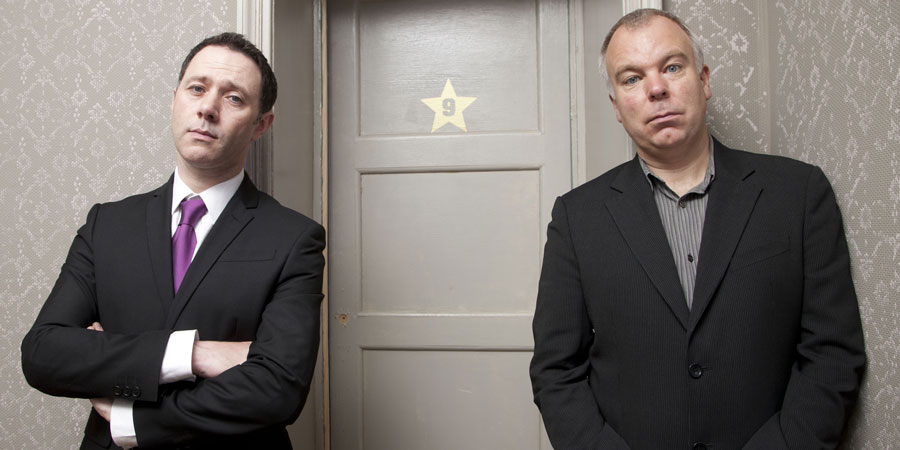
My new TV show obsession is Inside No. 9.

After greatly enjoying The Cleaner — which, I'm pleased to say, I continued to really like after the first few episodes I wrote about in the post linked — I decided that I should really try and wean myself off mindless stupid YouTube videos and watch some more things with a bit of substance to them.

So I decided to take a look at Inside No. 9, which is a show I'd seen a number of people talking about, but knew absolutely nothing about. For some reason, I'd developed the assumption that it was something to do with politics (I think I'd made the unprompted mental leap from "No. 9" to "10 Downing Street" or something) and thus hadn't really paid it much mind.

But then I saw this news story shared by someone I know. (Caution: The Mirror. Also spoilers.) If that was the kind of show we were actually dealing with… then I was absolutely, completely on board. I love this kind of gleefully experimental, darkly humorous stuff, and it seems like I've missed out on rather a lot of Inside No. 9 since it first aired in 2014.

I'm going to try not to talk too much about specifics of the show in this post, because it really is one of those series where the less you know what to expect going in, the more effective it is at what it does. So for now I'll simply say that it is the work of Reece Shearsmith and Steve Pemberton, two members of the League of Gentlemen, and it is some absolutely masterful television.

And I'll leave that there for those who are sufficiently intrigued to check it out for themselves. It's a BBC show, so you can watch it on iPlayer (or, presumably, BritBox in the States) and I think it has also had physical releases. Based on the three episodes I have watched so far, I have nothing but the highest praise for it, and highly recommend it.

For those who want to know a bit more and aren't too concerned about mild spoilers (which I'm still going to try and keep to a minimum), I'm going to drop in a "read more" tag here, and you can join me after the jump to find out a little more if you see fit.

Continue reading "My new TV show obsession is Inside No. 9."

Let's talk about something a bit more positive for once: I'm really enjoying Greg Davies' The Cleaner.

I'm aware I've posted a fair amount of negative complaining of late, and while I don't apologise for that — a lot of these things really need to be said, and by more people than just me — I don't just want to be whingeing all the time. So today I thought I'd write about something I like.

The Cleaner is a new-ish TV series written by and starring comedian Greg Davies, who is probably best known these days as the titular Taskmaster in the excellent "famous people make fools of themselves" programme of the same name. Davies has starred in a number of comedy-drama titles in recent years, however, and I've always liked seeing him do his thing.

I believe my first encounter with him was as Mr Gilbert from The Inbetweeners, where I very much enjoyed how much his character resembled my own head of Sixth Form, Mr Watts, in terms of overall attitude and general disdain for anyone under the age of 18. More recently, I enjoyed his semi-autobiographical series Man Down very much — though I know opinions are somewhat divided on that one, particularly with regard to Rik Mayall's role — and I believe that The Cleaner is his strongest series to date.

The show is apparently an adaptation of a German show known as Der Tatortreiniger, or simply Crime Scene Cleaner, but it's clear from the script that Davies has very much taken the concept and made it his own along the way. It features recognisable elements of both the whimsical, occasionally cynical humour and pathos that Davies excels at, and holds together as an extremely well-produced show.

In The Cleaner, Davies takes the role of Wicky, a crime scene cleaner who has to deal with the aftermath of various horrible things happening. Each episode primarily unfolds as a "two-hander" between Davies and someone who was affected by the crime in question; the context is that Davies has shown up to clean up the mess left behind by the crime after the police have finished their investigation, and there is inevitably someone hanging around or left behind, with varying degrees of relation to the incident.

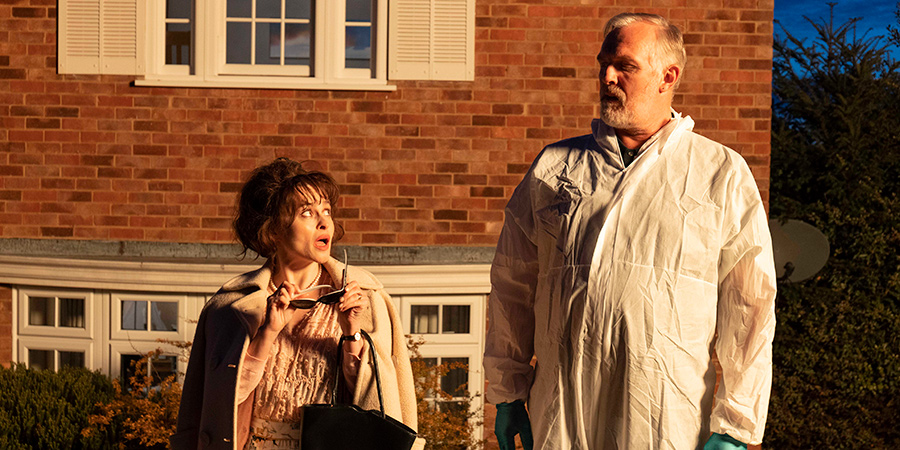
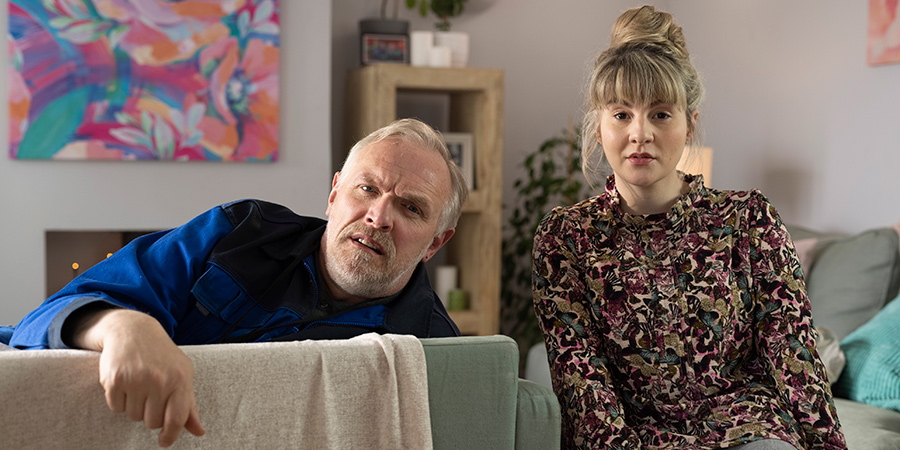
Greg Davies and Helena Bonham Carter in episode 1 of The Cleaner

My favourite thing about the show so far, after seeing four episodes of it, is that each individual story has its own vibe to it, with Wicky remaining the one constant.

It's clear that Wicky is a man who enjoys his job — in the fourth episode, he reveals that it is because it allows him to get a taste of how other people live, if only for a moment, and to set things right for those who had to depart before their time — and is, at his core, quite an intelligent man.

At the same time, there's a certain degree of "salt of the earth" to him; he quite openly admits that "my job lets me buy everything I need and still have enough to get hungover every weekend", and there are often very minor threads running in the background of each episode about his love for curry night at the pub, his friends being sick in his shoes and suchlike.

It's his interactions with the various characters where the show really shines, though, and the way in which all of these characters are very different from one another.

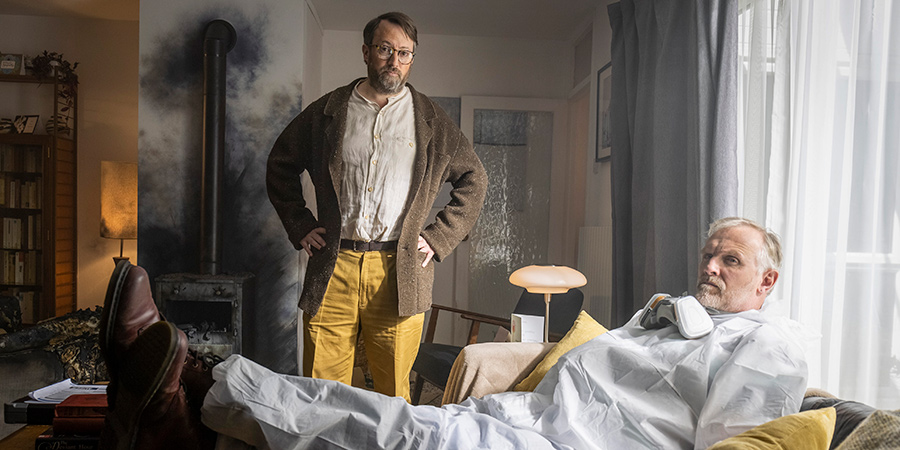
David Mitchell and Greg Davies in episode 2 of The Cleaner

In the first episode, for example, Wicky is cleaning up after a wife murdered her husband in an extremely messy manner. Partway through the cleaning process, he is confronted with the wife in question (played by Helena Bonham Carter, who is still, it has to be said, exceedingly beautiful even when dressed down and covered in blood) and this leads to an extremely strained scenario in which he is very much aware that he is dealing with a murderer, but also finds himself forming something of a bond with her in the process.

In the second, meanwhile, David Mitchell does a wonderful job of portraying a tortured author whose grandmother has just been killed in a gas fire accident. Mitchell is almost certainly drawing on some of his own experience — or at least, that of the persona he perpetually puts across in public — to portray this writer as emotionally repressed to such a degree that he cried more over his cat running away than the gory, doubtless extremely painful death of his grandmother.

In the third, Wicky never gets to visit the crime scene at all, instead finding himself having to contend with the victim's neighbour (Ruth Madeley) while waiting for someone to actually let him in to the crime scene. With his "partner" in this episode being both vegan and disabled, Wicky finds himself constantly putting his foot in his mouth to an exceedingly cringeworthy degree — but again, he forms a bond of note with this young woman.

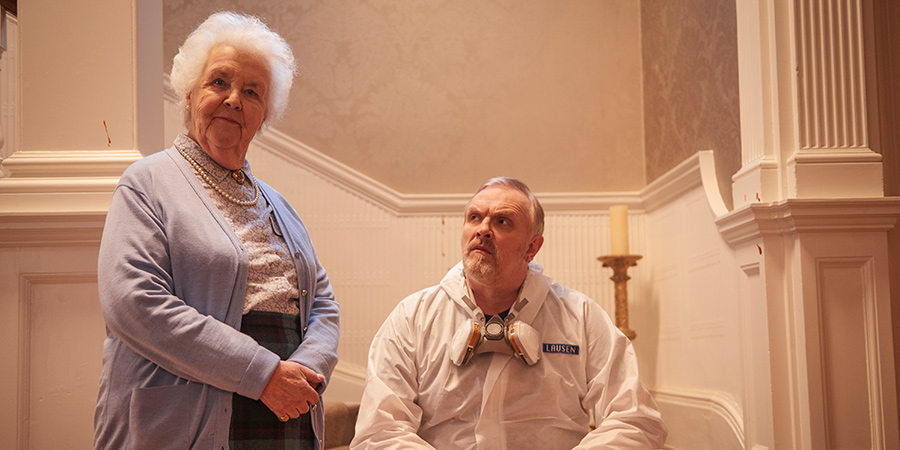
Stephanie Cole and Greg Davies in episode 4 of The Cleaner

And in the fourth, Wicky is called to a stately home in which an elderly woman (Stephanie Cole) interrupted a burglary attempt, which resulted in the death of the burglar by him falling down the stairs and breaking his neck. Cole's character gradually reveals herself to have many layers of unpleasantness to her, but Wicky is faced with a variety of dilemmas to contend with along the way as, again, he forms a temporary but surprisingly strong bond with her.

One of the things I've noticed about the show in general is how Wicky always "leaves something behind" as a result of his visits; he always makes a mark on that person's life in some form or another.

Sometimes, this is a positive thing, such as in the third episode, where he helps Madeley's character come to terms with how she is still in love with the man she abandoned for not respecting her veganism. At others, however, it is very much not a good thing, such as where he accidentally drops a signed Dylan Thomas book belonging to Mitchell's character into his bucket of water, thereby completely destroying the signature and personal message inside the front matter.

Greg Davies and Ruth Madeley in episode 3 of The Cleaner

After four episodes, I'm very much convinced that this is an excellent show, and I'm a little disappointed I didn't come across it sooner! But this is to be expected, as I tend not to follow what's on TV right now these days; I only stumbled across this as the result of a short clip the BBC posted on YouTube the other day, featuring a snippet from Mitchell's episode.

For everything I hate about short-form "content" and clip culture, and how it has collectively destroyed the attention spans of almost everyone, I have to at least be grateful for it in this instance, otherwise I might never have come across this genuinely excellent show!

You can watch The Cleaner on BBC iPlayer at the time of writing.

2307: The Trip

0307_001

When I can't sleep or am otherwise in a position where I am too mentally impaired to do anything active — in other words, all I want to do is stare dumbly at a screen — rather than, as some people do, put the TV on and just watch it, even if I'm not interested in what's on, I like to trawl Netflix for things I've never seen and haven't even heard of before, but which sound interesting.

I've discovered a bunch of interesting things this way, the last of which was the rather wonderful (if cringeworthy) W1A, and more recently I've been watching a show called The Trip, starring Steve Coogan and Rob Brydon.

The Trip is an interesting concept that builds on the fashionable "fake docudrama" trend that began with The Office. Casting Coogan and Brydon as fictionalised, exaggerated versions of themselves, the series follows them as they take a tour of the North of England, stopping at some of the supposed best restaurants in the region with a mind to writing an article for The Observer Magazine. Coogan's original plan for the trip was to take it as a romantic getaway with his American girlfriend Misha, and still be able to use it as paying work, but prior to the start of the series, she moves back to the States to pursue her own career dreams in Hollywood, leaving Coogan more distraught and lonely than he'd care to admit, only inviting Brydon seemingly as a last resort.

The pair's trip across the North is largely irrelevant to the main point of the show, though it does take in some of Northern England's most spectacular sights, a number of which I hadn't heard of before. Instead, the main aspect of the show is the relationship between Brydon and Coogan, and more specifically how Brydon's easygoing nature and sense of contentment with his life — even as he is, according to Coogan's standards, less successful than his friend — gradually draws out Coogan's true feelings about his situation.

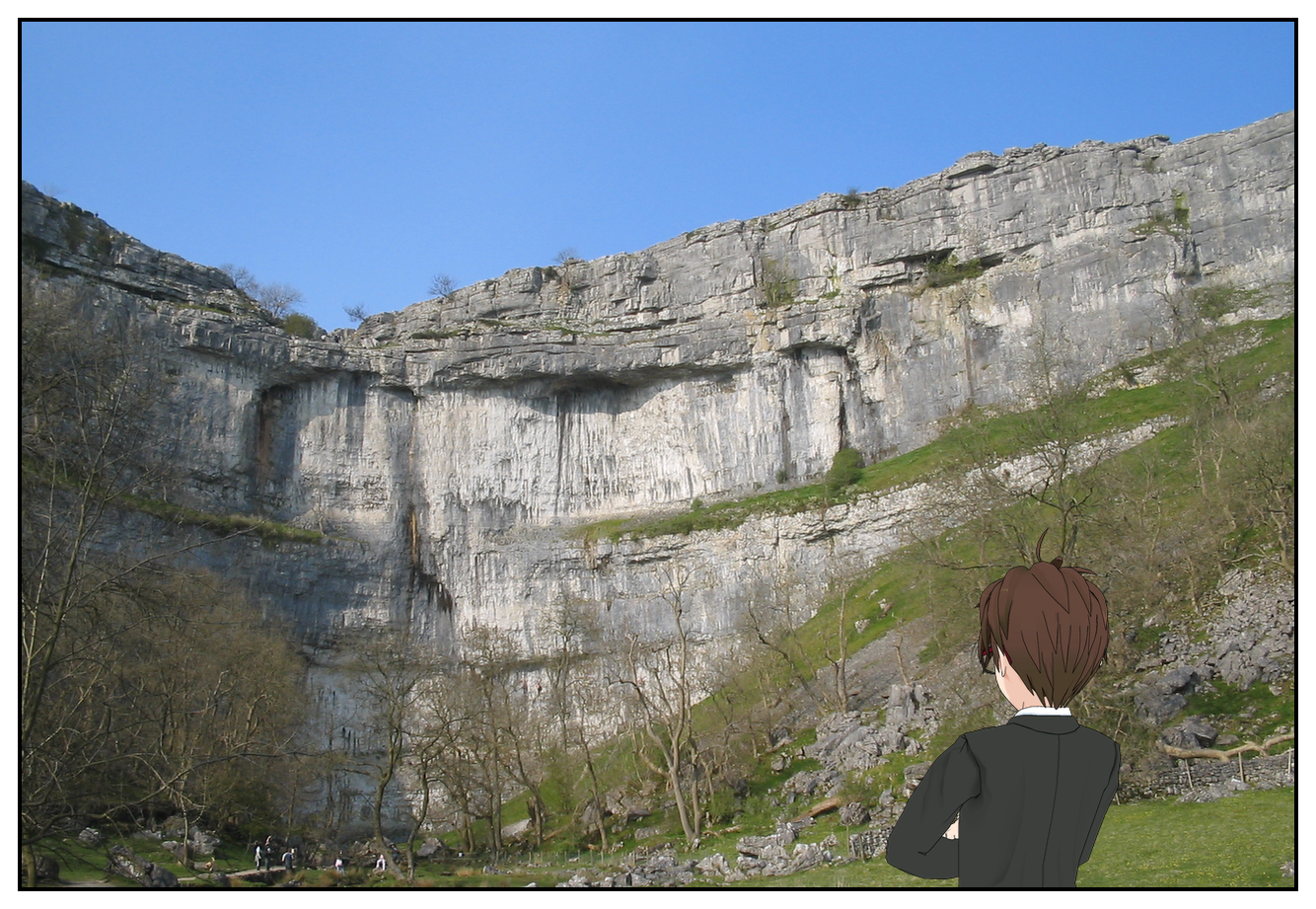
Brydon lives in a small but comfortable family home with his wife and children; Coogan lives in a fancy apartment in London by himself now that Misha is gone. Brydon enjoys his life and calls his wife just to hear her voice, flirt with her and occasionally get a bit down and dirty with her; Coogan calls Misha in the States, sometimes forgetting the timezone difference, sometimes not respecting what she wants, perpetually unusure of what he wants. Brydon brings a sense of levity to any situation he's in, often filling uncomfortable silences with his (admittedly impressive) impersonations of famous people — something which Coogan is forever frustrated that he's just not quite as good at as Brydon; Coogan takes everything much too seriously, sometimes admonishing Brydon for his happy-go-lucky approach to life, sometimes clearly wanting to say what's really on his mind and on one — only one — occasion frustrating a for-once quiet Brydon, who just wants to enjoy the scenery, with a lengthy geological explanation of how the Malham Cove limestone pavement came to be.

The contrast between Coogan and Brydon is potent; it shows two ways you can approach modern life. You can follow Brydon's path, which is arguably the most traditional, straightforward, unambitious path, and enjoy a happy, contented life while never quite attaining true dizzy heights of, say, stardom or being the top of your field. Or you can follow Coogan's path, which is a much more significant gamble: throw everything you have into trying to be the best in your field that you can be, and run the risk of being frustrated that other people can't see what you know about yourself. Coogan's frustration — outright depression, at times — at his situation is downright heartbreaking; his gamble hasn't at all paid off, though he does have the opportunity to make one final one by moving to the States with Misha to do a pilot TV show for HBO. By the end of the first season, however, Brydon has clearly rubbed off on him: after what is clearly an agonising session of soul-searching, he decides not to take that gamble, and instead — presumably — to focus on making himself happy rather than continually being let down by his life and the people he thought he cared about.

The Trip is a funny show; it's a comedy at heart, and the interactions between Brydon and Coogan are well-written, snappy and genuinely amusing. But there are considerably more tragic undertones with Coogan's own personal journey as the titular trip continues. While Coogan comes across as an arrogant dickhead at the start of the show — and still bears this character trait to a certain extent at the end — as the episodes proceed and we get an occasional glimpse into what he's really thinking and feeling, it's hard not to feel bad for him, and the contrast between how his and Brydon's respective lives have turned out is certainly thought-provoking.

I haven't yet watched the second season, but on the strength of the first, I'm very interested to. If you like well-written, fairly gentle, character-driven comedy drama with more than a slight tinge of pathos — as many other good comedies have — then The Trip is well worth your time to take on.

2290: The Excruciating Accuracy of W1A

0290_001

The other night, I was randomly trawling Netflix for something to watch while I couldn't sleep, and I stumbled across a BBC show I'd never seen before called W1A. I later discovered that this was the follow-up to Twenty Twelve (which I also haven't seen yet), and is one of the most effective "fake documentary" series I've seen since the original British version of The Office.

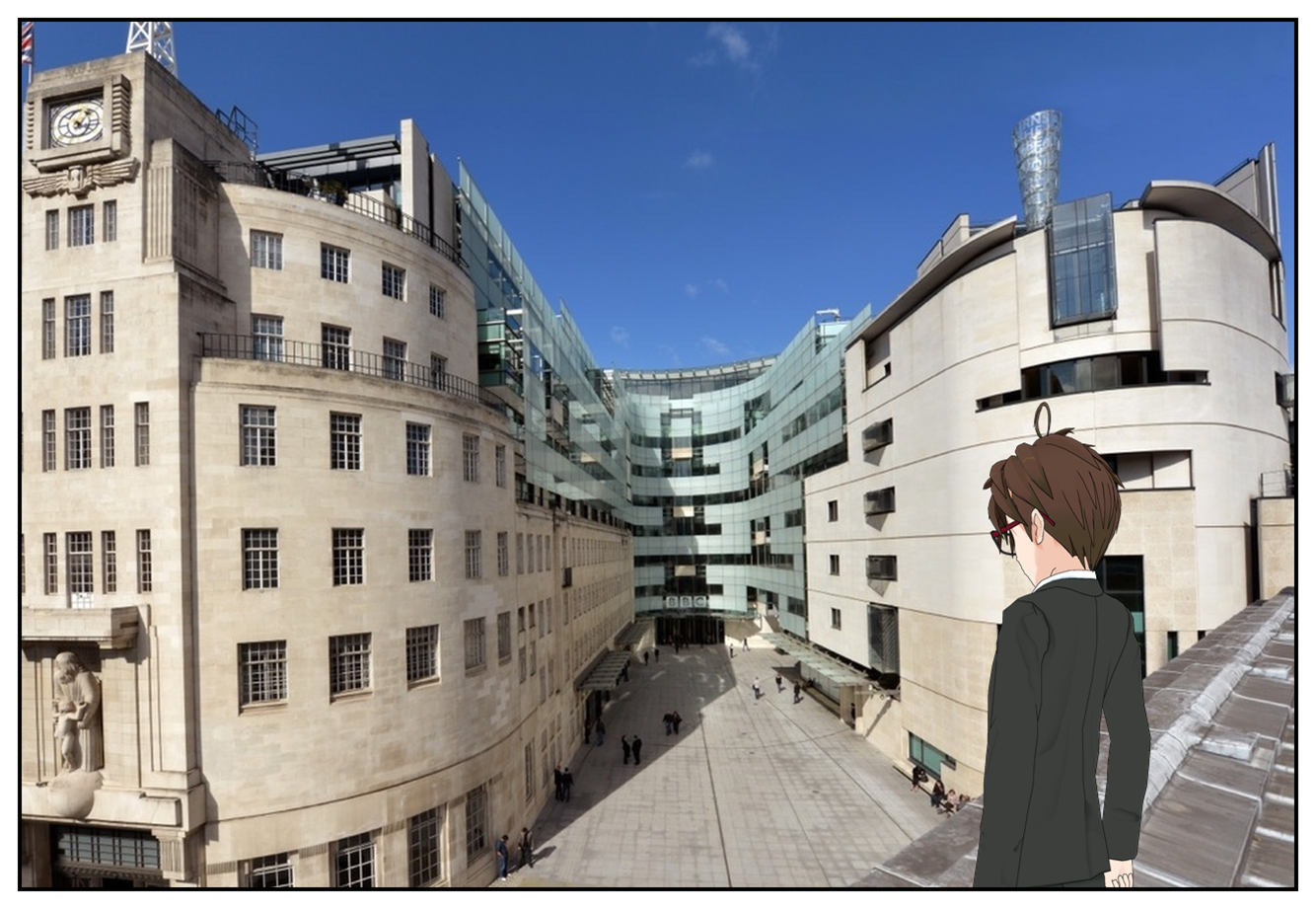
W1A focuses on the BBC itself, which is a pretty ballsy move given how scathing the show is of BBC corporate culture. Casting Hugh "Downton Abbey" Bonneville in the role of Ian Fletcher, the BBC's new Head of Values, the show follows Fletcher's efforts to make sense of the waffling business-speak world that one of the world's most celebrated broadcasters has become in the last few years. Fletcher is by no means a blameless character in all this, but he, by far, comes across as one of the most "normal" and relatable characters in the cast.

The reason for this is that the rest of the cast members are exaggerated parodies of various office archetypes. I would say that they are exaggerated to the degree of absurdity, but not far through the first episode I realised that I had met and interacted with each and every one of these archetypes at various points in my professional life — in education, in office work and in retail — and suddenly it didn't feel quite so absurd after all. It was still amusing, but in a tragic sort of way; the realisation hit me that this is what the world has become these days.

One of the most frequent character traits on display is relentless, unnecessary positivity, even when it's completely inappropriate. It's not unusual to see serious issues being raised in meetings, with the only responses from around the table being a chorus of "Brilliant." "Great." "Well then." "Marvellous." and "Okay then." Likewise, to my chagrin, I've caught myself using some of the character traits of intern Will, most notably his blind agreeing (and declaration that it's "cool" and "no worries") with everything that people say, only to admit that he didn't actually hear what he just agreed to just a moment later.

While I find W1A pretty excruciating to watch — particularly when Jessica Hynes and her painfully millenial PR company "Perfect Curve" are on screen — it's nonetheless rather compelling and almost reassuring in a strange sort of way: a viewer's initial reaction to these seeming caricatures — their repetitiveness and their relentless, inappropriate cheerfulness — as them being absurd in some way is entirely deliberate. The writers of the show know how ridiculous and absurd the situation is, along with all the nonsense that goes on in modern corporate culture — which more often than not cares more about outward appearances than actually making life good for its employees and clients — and the show itself acts as a means of people who are tired of this aspect of modern life to come together, point and laugh, then perhaps go and have a little cry in the corner.

You're not alone in hating the way the world has turned out, says W1A. We hate it too; we've just decided to laugh at it, because what's the alternative?

1378: Oh, Ambassador

Given Dave on Demand's apparent inability to stream anything to my computer at present — we wanted to watch the last episode of Dave Gorman's Modern Life is Goodish — I decided to check out Mitchell and Webb's new show Ambassadors earlier, and was pleasantly surprised by what I discovered.

Mitchell and Webb are an excellent comedy duo, and have proven themselves to be pretty adaptable and flexible through stuff like Peep Show and their sketch show. Of course, David Mitchell usually plays characters that are reasonably close to his real-life persona — or perhaps he adapts his real-life persona to be closer to the characters he plays? — and Robert Webb usually plays slightly supercilious, smug arseholes, but the pair of them actually have a surprising amount of range outside their most well-known roles as Mark and Jeremy from Peep Show.

Ambassadors is a good example of this. The show wasn't at all what I was expecting, but then, I went into it reasonably blind, so this perhaps isn't altogether surprising. I was expecting something along the lines of a modern-day Yes, Minister type thing, with bumbling, incompetent British officials having to deal with comic shenanigans in some far-off country, but what I actually got was something a little more serious. Oh, there was still plenty of ridiculousness along the way, for sure, but the ridiculousness wasn't the main point of the show; in other words, it was more of a "comedy drama" than a straight-up comedy.

Mitchell plays the British ambassador to the fictional country Tazbekistan, while Webb plays his second-in-command — who is actually a little more assertive and confident than his "superior", but who is also being blackmailed for some reason or another that hasn't yet become altogether clear. They're supported by a strong cast of other actors playing officials from both Britain and Tazbekistan, and the first episode revolves around Mitchell having to juggle the seemingly conflicting questions of whether to negotiate the release of a human rights activist or a lucrative arms deal with Tazbekistan for helicopters that can "pick off a rabbit from 70 miles away."

I can't say I'm massively switched on politically and thus can't really comment as to how "biting" the satire inherent in the show really was, but leaving that aside, the show itself was entertaining enough. Mitchell and Webb are always very watchable, and seeing them play characters other than Mark and Jeremy (or variations thereof) is rather pleasing. If nothing else, Ambassadors certainly shows that the duo have the capacity to be serious when it counts — and when strange things do happen, their particular brand of deadpan humour contrasts well with the sillier things going on.

I'll be interested to see how the show develops. With hour-long episodes and the addition of drama to their usual comedy, it's a lot slower-paced than Mitchell and Webb's previous work and thus it will be a good test of their abilities, and whether they can carry an interesting story as well as a series of amusing happenings. The first episode was certainly a reasonably strong start — I'm looking forward to seeing if it continues.

#oneaday, Day 292: TV Get Bent

Most times I watch TV, I'm reminded why I don't watch TV any more, besides the occasional isolated incident of The Apprentice (which I can't really be bothered with this year, anyway). And the reason for that is that 99.87% (approximately) of it is complete, unadulterated, unfiltered dross and bollocks, and the rest are reruns of old, unadulterated, unfiltered dross and bollocks.

Now I understand and appreciate that some people enjoy zoning out in front of the TV and enjoy having things that they don't have to think about. I do the same with video games. But at least I'm interacting with video games, and even the most mindless, dumbest video game requires at least a bit of co-ordination and use of your reflexes. Unless it's Farmville, in which case you just require to be non-vegetative enough to click a mouse a few thousand times. But even that demands more brainpower than staring at the TV.

Not all TV is rubbish of course. But I find myself picking up favourite TV shows on DVD rather than watching them when they air. There are a couple of reasons for this: firstly, being tied down to a schedule at the behest of an inanimate object is a pain that I can do without. Secondly, if I really get into a show, it's nice to be able to watch several episodes of it in succession to get a greater sense of "coherence" than watching a one-off. Try watching a season of 24 when it airs on TV as opposed to being able to watch several in a row on DVD and you'll see what I mean. Not that I ever got into Lost (the TV schedule thing meant I lost—no pun intended—interest about halfway through the first season) but I imagine that, with all its confusion, would be much the same.

The kind of TV that doesn't lend itself to a sense of "coherence"—random quiz shows and reality TV—doesn't particularly interest me anyway. So everyone's a winner, then. TV can keep its dross, its reruns, its uninspired crap and endless repetitions of Alexander the fucking Meerkat adverts. I'll stick to my DVDs, iPlayer and 4OD, thanks.

Will we eventually reach a stage where the concept of traditional TV broadcasting itself is obsolete? Thanks to services like those I've just mentioned, it's entirely possible to have a completely personalised staring-at-the-gogglebox experience consisting entirely of programmes you actually enjoy. And with services like Netflix, LoveFilm and MUBI offering a variety of niche as well as mainstream content, you can even populate your own personal TV and movie playlist with things that would never have been on TV in the first place.

Also there is no need to wait for Alexander the fucking Meerkat to come on screen to go and have a toilet break, either.

The more I think about it, the more this concept sounds very appealing. But will the TV studios ever go for it? The concept of "primetime" is still very firmly in the heads of most broadcasters, and so it's likely that scheduled programming will continue for at least a little while yet. But as time goes on? Who knows. Perhaps one day TV will move to an exclusively on-demand system.

I look forward to that day immensely.