#oneaday Day 379: I watched A Good Girl's Guide to Murder

After enjoying Shakespeare & Hathaway: Private Investigators recently, I found myself hankering after another murder mystery type thing, and BBC iPlayer was good enough to recommend a show called A Good Girl's Guide to Murder, which sounded intriguing. I hadn't heard of the show before but I liked the premise and it sounded like an interesting contrast to the somewhat comedic tone of Shakespeare & Hathaway, so I took a chance on it.

A couple of days later, I've finished watching the full series of six episodes, and I really enjoyed it, so I thought I'd talk about it a bit today.

A Good Girl's Guide to Murder is apparently based on a novel of the same name by Holly Jackson. Specifically, it's an adaptation of the first novel in a series of three and a bit — I say this because the last one is described as a "novella" rather than a "novel" — and it looks as if the show has been renewed for a second season, so presumably the plan, long-term, is to adapt the whole series.

The premise of the show is that A-grade and possibly autistic student Pip is preparing for university admissions, and part of this process involves the preparation of an "EPQ" — an Extended Project Qualification, which some students in England and Wales do to add to their "UCAS Points" total. I'd never heard of this, as it was introduced after my time in the classroom as both student and teacher, but apparently it adds up to about half an A-level points-wise. But I digress.

Pip decides to do her EPQ on a notorious local incident in which a young woman named Andie Bell went missing and was assumed to have been murdered, but her body was never found. Her boyfriend at the time, Sal Singh, was assumed to be the murderer because he was found to have committed suicide shortly after Andie went missing, but something didn't seem right to Pip. She starts investigating and — spoilers, I guess — eventually brings the full truth of the situation to light, though not without encountering numerous roadblocks and a lot of soul-searching along the way.

Being a 17 year old girl, Pip doesn't go about her investigation as a policeman or private detective would. Instead, she engages in the sort of subterfuge only a teenage girl is capable of, aided and abetted in most circumstances by Sal's brother Ravi, who also has doubts about whether his brother was really a murderer. Over the course of the series, she breaks into houses, steals evidence, attends illicit raves, puts herself in mortal peril on multiple occasions and somehow manages to survive the whole experience.

It's very much a "suspension of disbelief" kind of show, because a lot of things just sort of seem to work out quite conveniently for Pip, and there are several instances where she almost gets caught and could quite clearly have been collared after the fact, but manages to escape any real consequences. But once you're immersed in the show, none of this really matters, because it's a really fun ride; you root for the plucky Pip as she repeatedly gets into things well over her head, and come out cheering for her when she finally manages to uncover something missed when the case was originally investigated.

Part of Pip not suffering any real consequences for the things she does stems from the "Good Girl" part of the title; Pip is renowned as a good girl, a straight-A student and someone who has always been well-behaved and sensible. As such, she can get away with a lot of things, even when her parents expressly forbid her from continuing to work on the case on the grounds that it's dangerous and threatens to dredge up terrible memories for several local families.

Towards the end of the series, the show really gets into this theme in a somewhat literary manner: the concept that someone can appear to be a "good person" on the outside, but actually harbour darkness in their heart. Exactly what form this "darkness" can take varies from person to person; in Pip's case, it manifests both through her willingness to flout the "rules" of society to get the job done, and her own sense of guilt over the past. She believes that a chance encounter shortly before Andie's disappearance may have indirectly been a catalyst for all this, so part of her initially altruistic-seeming investigation is to absolve herself of that guilt.

In the case of other characters, the darkness is more obvious. One character, crucial to the eventual outcome of the case, describes himself as being fundamentally a "good person" but having a "dark seed" inside himself; he believes that everyone has such a "seed" inside themselves, and it just takes "the right conditions for it to grow". In his case, it most certainly did grow, leading him to commit unforgivable, unconscionable acts — though to his credit, once he's caught he does appear to be legitimately remorseful — and surprise everyone around him that he was capable of such things.

I don't want to get too much into the details of the story because I think it's worth watching and the twists and turns of the narrative are, of course, part of the appeal. So instead I'll talk a bit about the overall presentation of the show, which is excellent.

The visual direction is striking and dynamic; no scene is truly static, and the show makes great use of close-ups to highlight both characters' emotions and the danger and discomfort Pip finds herself in when getting a little too close to the truth. The actors are all very well-cast — Emma Myers as Pip is particularly excellent, as one would hope for the lead — and manage to nail a feeling of realistic diversity without feeling tokenistic. This is relevant, because matters of racism do play a part in the narrative; as Ravi points out, as enlightened as we might wish we all were, the fact is that certain types of people — particularly middle-class people who live in a small, affluent town — are inclined to believe that a "brown boy" (as he puts it) might not have the best interests of a "blonde white girl" at heart.

The show isn't obnoxious about this message; it only brings it up a couple of times, and it is a worthwhile contemporary talking point. The sort of small town in which the majority of the narrative unfolds is the kind that would be inextricably associated with white, middle-class England, but Pip in particular, as a thoroughly modern Good Girl, is above such things. Part of this is down to the fact that her mother married a Nigerian man after Pip's biological father passed away when she was just a year old, and as such, she has always been exposed to the idea of diversity and tolerance on a daily basis. But it's also a reflection of the modern youth: conscious of social issues, aware that society still has problems, and open about wanting to do their part in making things a little bit better.

Where the show is really striking, though, is in its use of music. There's a lot of contemporary music used on the soundtrack, and it is often used to emphasise powerfully emotional moments; it's always very loud compared to the relatively quiet dialogue sequences, though, making for an attention-grabbing contrast between the more personal, intimate moments and the bigger picture of what is going on.

The contemporary popular music is contrasted with an excellent original score that highlights the tension of numerous scenes, in some cases mimicking "sound effects" to reflect what is going on. During a sequence where Pip's beloved dog Barney goes missing, for example, the soundtrack makes use of a somewhat "sonar"-style motif to reflect the search that is going on; initially, it's almost hard to determine whether the sound is diegetic or not, but as the texture of the track builds up as the tension increases, it becomes clear that it's part of the overall soundscape of the show.

I really enjoyed A Good Girl's Guide to Murder overall. After finishing one episode, I was keen to immediately watch the next, and I must confess I have spent my whole morning watching the final three episodes because I really wanted to see how things turned out. It's compelling, well-crafted and exceedingly well-presented viewing, and while it's perhaps not particularly realistic if you stop to think about things too much, it doesn't take long for that to cease mattering and for you to be drawn in to the narrative.

Yes, it may primarily be aimed at teens — it was a BBC Three show, after all — but don't let that put you off if you're a little older and still enjoy a good murder mystery. I found myself thinking as I watched that it would make a good anime, and I think that's testament to what makes it good — like the best anime series, it's a show that all ages can get something out of; it doesn't talk down to its core audience, and it doesn't feel cringeworthy and insincere to older viewers.

Definite recommend, then. Here's hoping that second series materialises!


Want to read my thoughts on various video games, visual novels and other popular culture things? Stop by MoeGamer.net, my site for all things fun where I am generally a lot more cheerful. And if you fancy watching some vids on classic games, drop by my YouTube channel.

If you want this nonsense in your inbox every day, please feel free to subscribe via email. Your email address won't be used for anything else.
2371: Bad Education

0371_001

My favourite thing about Netflix is the fact that it allows you to try out various series that you might not have thought to take a look at when they were on TV, nor do you feel inclined to go and pick up a DVD or Blu-Ray of them, but which nonetheless intrigued you for one reason or another. Because you're not paying for the series itself — it's just part of your Netflix subscription — you can try things out, and if they're shit, well, you just stop watching them; and if they're good, you can enjoy them to your heart's content on your own terms.

Such was the case with Bad Education, a show originally broadcast on BBC Three. Something being broadcast on BBC Three is more often than not an immediate signal that it's going to be shit, but since I've always had a certain affinity for media of any kind — books, games, films, TV series, anime, visual novels — set in a school environment, I was very much curious about it. And I've been pleased to discover that it's actually not shit. It's actually some pretty solid — and unabashedly offensive — situation comedy, albeit almost totally divorced from the reality of working in education.

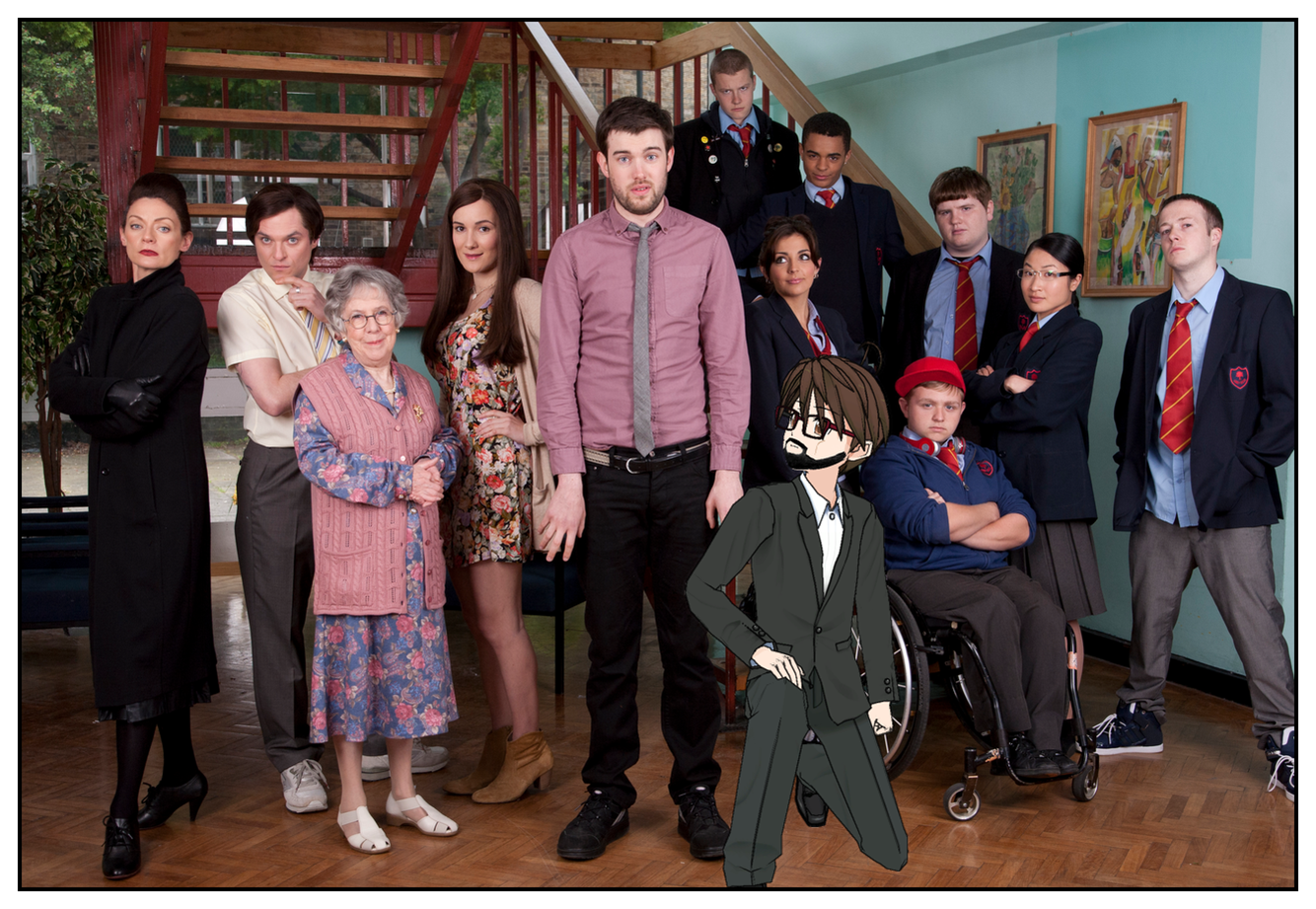
Jack Whitehall stars as Alfie Wickers, an incompetent History teacher who seems rather more concerned with being friends with his (unrealistically small!) form group than actually doing his job properly. Nonetheless, he does care about the kids' education in his own way, with many of his escapades concluding in some sort of life lesson being learned by them — or, more frequently, by him.

Alfie's class is probably the highlight of the show, because it's the most believable, realistic part of it, miniscule size aside. Speaking from the perspective of a former teacher, I can say with confidence that they're the very picture of the class that every school has who are a bit shit at everything — apart from one extremely clever student, whose very presence at a school as shit as that seems completely out of place — but you can't help but like. They remind me very much of class 9VN that I taught in the first school I worked in; for the first few weeks, I thought they were complete shitheads and would never get anything done with them, so appalling was their behaviour and attitude towards Music lessons… and then we discovered that they had a curious affinity for singing songs from musicals. So that's what we did. Or rather, that's what most of them did, while I set the few kids who were actually interested in studying music at GCSE and beyond to some other assignments. The class as a whole ended up being one of the few I actually look back on with a certain degree of fondness.

As for the show itself, it's very much a comedy with a certain degree of surrealism to it. In the second season in particular, it reminds me very much of the gloriously bizarre Green Wing, especially due to the presence of Michelle Gomez, who was also in Green Wing and plays pretty much the exact same character in Bad Education. Its seeming homage to Green Wing is emphasised through chaotic, time-distorted interstitial scenes with heavy visual filters on them to denote the passing of time or the simple division between story beats in the episode — though this only really becomes a thing in the second series, where the show as a whole seems to have a much stronger sense of its identity and what it's trying to do.

The supporting cast is solid, too. Matthew Horne's woefully terrible (and "banter"-obsessed) headmaster Fra$er [sic] is cringeworthy in the extreme in a sort of David Brent manner, but somehow just manages to stay the right side of believable within the context of the show. Harry Enfield is excellent as Alfie's father. And Sarah Solemani's portrayal of Wickers' love interest Rosie Gulliver brings a much-needed "straight man" to the proceedings, though her characterisation is a bit meandering — in particular, her short-lived dalliance with a lesbian side-plot doesn't really go anywhere, and the show subsequently returns to the admittedly solid foundation of the "will they, won't they" relationship between her and Alfie that has been the basis of many a successful sitcom over the years.

Bad Education isn't the best show on television by a long shot, but it's laugh out loud funny, well cast and snappily written. For a BBC Three show, it's god-tier. For something you just want to whack on while you veg out in front of the television, it's solid. As a scathing critique of the modern educational system in the UK, you may want to look elsewhere!

#oneaday Day 913: Funny Bone

Nothing highlights the passage of time more than switching on a comedy show and see who is standing on stage, clutching a microphone in their hand and talking bollocks to an audience.

Also, nothing makes you sound more like you're getting old than bemoaning the fact that "modern comedians" aren't a patch on the standups you used to enjoy.

I've never been a particularly hardcore follower of comedy, but I do enjoy a good standup show, and over the years I've appreciated the work of a wide variety of comics. I've never quite got the reason that comics rise and fall in popularity like fashion trends — surely if something's funny, it's timeless and funny forever?

Well, actually, no. That's not quite true. I recall vividly seeing a show about Tommy Cooper a while back and finding it utterly cringeworthy from start to finish. I couldn't quite put my finger on why, but it simply wasn't funny. Perhaps it's because I wasn't "of that time" that I couldn't appreciate it — but then I look back at some of the stuff that Kenny Everett and Les Dawson did, and that's still hilarious despite being a little out of what I'd describe as "my time".

The earliest real standup I was aware of was a Lenny Henry video my parents had and which I decided to watch one day when they were out. (It was "15" rated and I was not 15 at the time.) While I didn't understand everything that he was talking about — some of the stuff about marijuana went right over my head — I found it very entertaining. It's not fashionable to admit that nowadays, of course, because Lenny Henry is now the guy who did Chef! and the man who advertises Travelodges, but I still find him pretty watchable when he appears on Comic Relief and the like.

The two standups I have the fondest memories of, however, are Eddie Izzard and Bill Bailey. I could watch these guys' shows repeatedly forever. (Perhaps not forever.) Their comedy is distinctive, clever and rewarding — both in different ways. Izzard's work rewards paying close attention to how he weaves the various chaotic threads of the things he is talking about together, while Bailey's alternation between slightly-surreal standup and genuinely excellent musical numbers is just a pure delight to watch.

Going to Edinburgh a couple of times with the university theatre group was an eye-opening experience, as we got the opportunity to see a whole swathe of comedy acts — some great, some not so great. Some of the highlights included Daniel Kitson — aka the terrible DJ from Phoenix Nights — and Marcus Brigstocke, who now makes semi-regular appearances on various TV and radio panel shows. I can't remember the names of any of the lowlights because in most cases it was just embarrassing to watch them fall apart in front of an increasingly-restless audience.

I will always have a soft-spot for improvisation. At university, we played improvisation games as warm-ups for rehearsals, had a weekly "Improv Night" and hosted an occasional  "showcase" event known as Count Rompula, which tended to be largely improvised. (The Web of Dan still leaves me with shivers.) At Edinburgh, one of my favourite memories is seeing improv troupe Boom Chicago (or Boom Shit Cock, as one of our number who was constantly forgetting their name kept calling them) and marvelling at how quickly they picked up on suggestions from the audience and ran with them.

One of the things I like about Eddie Izzard's comedy, in fact, is that it has an air of improvisation about it — though it becomes clear when he successfully weaves all his threads together that there actually is a significant degree of planning that goes into one of his shows.

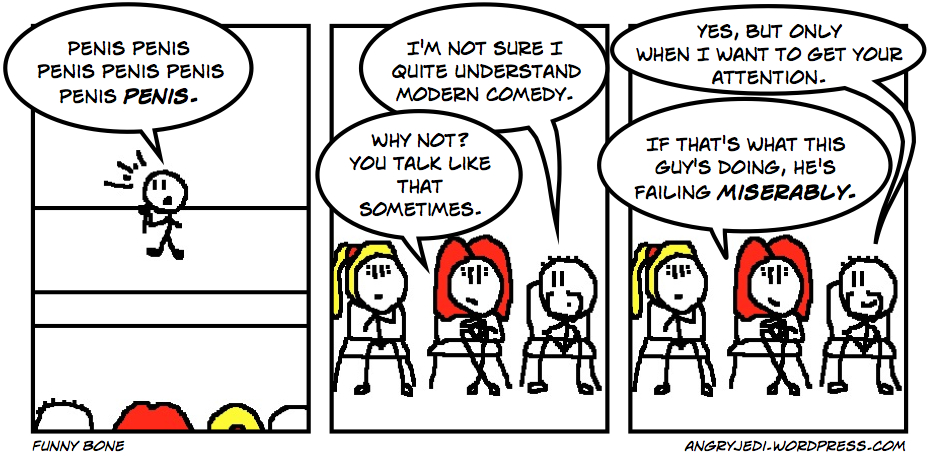
I did have a point to all this somewhere. And that is that — yes, I'm an old man now — modern comics seem to be a bit rubbish, although I am using BBC Three as my yardstick here, which may not be particularly wise. (BBC Three, for those outside the UK or simply unfamiliar with the channel, is the dustbin of television, incorporating some of the most asinine documentaries you'll ever see, a show called Snog Marry Avoid — which is exactly what you think it is — and what they call "experimental comedy". I call it "shite".) In recent weeks, I've seen a guy whose entire shtick seems to be just shouting at the audience (to be fair, Rhod Gilbert does this too and I find him hilarious — the difference being that Gilbert shouts with passion and righteous fury, while this other guy whose name I can't remember simply seems to blurt out obscenities), a sketch in rather bad taste regarding death, and a guy who sang a song about a fridge. (All right, that last one actually was quite funny.)

Perhaps I'm just looking in the wrong place for my comedy kicks these days. As I noted, BBC 3 is a big steaming pile of poo at the best of times, so I should probably start by not using that as a means of judging modern comedy. Suggestions for fun and entertaining stand-up shows to catch would be most welcome, then, so please feel free to share!