#oneaday Day 679: Hold on to the night, there will be no shame

I was randomly reminded of the existence of Robot Unicorn Attack this evening, and I am pleased to report that despite Flash being long-dead, you can actually still play the original (complete with Erasure soundtrack) over at CrazyGames. We are officially living in an age where Flash, as a platform, is old enough to have Web-based emulators. Not only that, this blog is old enough to have posts referring to the original incarnation of Robot Unicorn Attack, along with its excellent Facebook-based incarnation. Now there's something I don't say very often.

For the unfamiliar, Robot Unicorn Attack is a simple, "endless runner" game with just two buttons: one to jump (which can be used again in mid-air for a double-jump), and one for a rainbow attack dash move that can break through crystal stars. Your one and only goal in Robot Unicorn Attack is to survive as long as possible and score as many points as you can across three "wishes" (lives). As the game says when you start it, "you will fail". And indeed you will. But then you will try again, and again, and again.

It's a potent example at arcade-style game design at its absolute best: provide an experience that is extremely easy to understand, even for those who don't play a lot of games, and then balance it just well enough to make it inordinately compelling rather than frustrating, but still challenging. It is unironically one of the most well-crafted games of the 2010s, and I'm glad that people have found a means of preserving it — and in a fashion that is true to its original incarnation, no less. As a Flash game, originally published by Adult Swim, Robot Unicorn Attack's home is very much on the Web, and while I certainly wouldn't be averse to having an offline version I could play at any time I want, you can't get much more convenient than just going to a website and playing using nothing more than the Z and X keys on your keyboard.

Web games are in such a strange place right now. There's always been a certain amount of cloning and overly derivative stuff, but this seems to be particularly rife these days. There are about a billion variations on the "run down the path and go through gates with numbers on them" game. I don't know what the original and first one of those was; I just know there are now so many of them it is, at times, difficult to find anything else.

It doesn't help that a lot of today's Web games are adaptations of mobile games, with all the obnoxious predatory monetisation and infestation with adverts that entails. But, like I say, I'm pleased to see that some of the all-time classics are preserved through emulation — and best of all, no-one can bitch at you about not playing on "original hardware" if you play Robot Unicorn Attack on CrazyGames, or anywhere else it might be hosted, because it always was intended to just be played right there in your browser.

Now that I've rediscovered it, I think it might be time for a high score run or twenty before bed. Sing it with me, now… always, I want to be with you, and make believe with you, and live in harmony, harmony, oh love…


Want to read my thoughts on various video games, visual novels and other popular culture things? Stop by MoeGamer.net, my site for all things fun where I am generally a lot more cheerful. And if you fancy watching some vids on classic games, drop by my YouTube channel.

If you want this nonsense in your inbox every day, please feel free to subscribe via email. Your email address won't be used for anything else.
#oneaday Day 534: An evening of arcade

In gaming today, it's tempting to always want to be making progress on your "big game" of the moment: a lengthy epic that goes on into the tens or even hundreds of hours in length. But one thing I find it helpful to remind myself of on a regular basis is that short-form games very much have their place and their appeal, too. And it's in this area that retro gaming in particular tends to excel.

In recent weeks, I've been having a lot of fun getting to know the NEOGEO games we've released on Evercade this year. Most notably, I've been spending some time with the ever-delightful Metal Slug, which I hadn't spent a ton of time with prior to the Evercade release, and I've even been dipping my toes into the notoriously obtuse fighting game genre a little with Garou: Mark of the Wolves, which first impressions would seem to indicate is one of the more accessible SNK/NEOGEO fighting games in existence.

These games are immediately rewarding and fun. You probably won't be able to beat them on your first go — although in most cases, you can credit-feed — but there's a definite appeal element in the form of gradual mastery. With each attempt from the beginning of Metal Slug, I get to know the game a bit better, I learn more about how to play it effectively, and, assuming I'm paying attention to what I'm doing, I get a little bit further. At this point, I can occasionally make it up to the start of Mission 3 without losing a life; with each new attempt, that "occasionally" becomes "more frequently", and that's a really satisfying, rewarding feeling.

My concern is what I feel like is an increasing number of people getting to a point where they're writing off these short-form experiences as having no real inherent value. Perhaps it's because these games aren't telling a deep, thought-provoking or emotionally engaging story. Perhaps it's simply because they're short. Perhaps it's down to assumptions that short-form or arcade games are inherently "lesser" than 100+ hour epics on computers and consoles today.

I don't know. But I know that I definitely derive value from them, and I continue to feel proud that I'm involved in helping to preserve these games and educate new generations in their appeal elements thanks to my day job.

One day I still want to write a book. Or, at this point, probably several books, given the sheer number of games that are on Evercade by now. I should probably just stop thinking about doing that and actually do it, no?


Want to read my thoughts on various video games, visual novels and other popular culture things? Stop by MoeGamer.net, my site for all things fun where I am generally a lot more cheerful. And if you fancy watching some vids on classic games, drop by my YouTube channel.

If you want this nonsense in your inbox every day, please feel free to subscribe via email. Your email address won't be used for anything else.

2370: Hidden Arcade Gems: Elevator Action II

0370_001

When I was growing up, my father and brother reviewed various pieces of software for the Atari 8-bit and ST computers. (I did a bit of it too, but I was a bit young to do it too regularly.) This meant we got a whole lot of free games; we had a set of shelves absolutely bulging with Atari ST games in particular, and actually buying a game was a pretty rare occurrence for me until I started getting into console with the Super NES and subsequent generations.

Anyway. One of the earliest Atari ST games I remember playing was called Mission Elevator, and I recall my brother mentioning in his review that it was a clone of a game called Elevator Action. I wasn't familiar with Elevator Action, but looking back on it now… yeah, Mission Elevator was a pretty shameless clone, right down to the animations used.

For the uninitiated, Elevator Action Mission whatever is a game where you play a spy tasked with creeping into a building and nicking Important Stuff, which is hidden behind doors. (Mission Elevator's twist on this formula was that sometimes you'd open a door and amusing or weird things would be happening behind it — or sometimes an agent would just pop out and blow your head off straight away, which was always infuriating.) The building is viewed from a side-on perspective, and getting between the floors is achieved by hopping into the titular elevators, then hopping out at the appropriate floor. The elevators move independently when you're not in them, but when you do get in one you can move it freely up and down to the floor you want to get out at.

Elevators are an integral part of the game. Their absence on your current floor can be an obstacle, meaning you'll have to make a heroic leap across the elevator shaft in order to get to the other side… or just wait for them to turn up. (These buildings apparently weren't built with safety in mind.) And not only could they carry you up and down to the different floors of the building, they could also carry enemy agents to your floor, and getting surrounded was bad news. Also, both you and the enemy agents could be killed through getting squished by an elevator descending onto your head — always satisfying to pull off to your advantage; always disappointing to have happen to you.

Anyway. Elevator Action and its shameless clone were fun, but ultimately quite limited. They got harder as they progressed, but they didn't really change all that much.

Enter Elevator Action II, a game whose existence I was completely unaware of until I read an article about the series (which I also didn't know existed) over on Hardcore Gaming 101. This game takes the basic mechanics and objective of the original game (use elevators to get to red doors, nick stuff from red doors, escape) and transplants it to a variety of different situations. The first level has you doing pretty much what you did in the first game. But then you're finding bombs in an airport and all manner of other things in the subsequent levels.

There are also three different selectable characters, each of whom handle a bit differently, and a level structure that feels a little like a belt-scrolling beat 'em up, particularly after the first level. You'll reach points in the level where there are setpieces you'll need to clear before you can progress; in the airport level, for example, while crossing a catwalk between two buildings, you get accosted by a horde of bad guys with jetpacks and have to fend them all off before you can proceed.

Elevator Action II raises the stakes considerably from the original game with a much wider range of enemies, not all of whom are humans. The whole thing feels like you're playing a terrible but enjoyable '80s action movie — right down to levels being introduced by you crashing through a window with a helicopter and other such silliness — and it's an excellent evolution of the original game's formula. My only real complaint is some mildly clunky controls, but they're easy enough to live with, and the game is sufficient fun that they don't detract from the experience too much.

If you have a chance to give Elevator Action II a go, take it. You won't be disappointed!

2349: Arcade Golf...?

0349_001

To my surprise, the game I'm enjoying most out of the Neo Geo collection I got recently is Neo Turf Masters, a golf game. Now, I'm not averse to a good golf game at the best of times, but I'm really surprised and impressed with how well Neo Turf Masters adapts the standard golf game format to a (relatively) fast-paced, challenging arcade format. It really works!

Neo Turf Masters is pretty simple and straightforward as far as golf games go. You don't have to worry about things like elevation when driving your way up the fairway, just smack the ball in the right direction and make sure it doesn't land in places it shouldn't. When it's on the green, line up with the hole and hit the button when your power meter is around the same point as the handy mark showing where you should hit it. Repeat.

It's refreshingly simple, even as the more cartoony golf games (such as Sony's Everybody's Golf series) adopt more complex mechanics, and it works really well for a quick game of golf. Despite the simplicity of the basic mechanics, the game instead provides most of its challenge through some surprisingly fiendish course designs and an extremely unforgiving structure designed to keep you pumping coins into the arcade original version. (Of course, on the port you can simply continue as many times as you like, but this isn't really in the spirit of playing arcade games.)

No, Neo Turf Masters' biggest challenge comes from its unusual "lives" system. You begin the game with 3 lives or "holes" and spend one of these lives any time you get a Par. (For the non golfing-literate, this means putting the ball in the hole in the exact number of shots the hole's Par says.) If you get a Bogey (one more shot than the Par) you spend an extra hole on top of this. But if you get a Birdie (one fewer shot than the Par) you not only don't lose the hole, you get an extra one to add to your stock. I haven't seen what happens if you do worse than a Bogey or better than a Birdie because my skills at Neo Turf Masters are thoroughly average.

I really like this system, though. It has the arcadey addictive quality of wanting to "1cc" (1 Credit Clear) it without using the Continue function, but considering I can only make it to about hole 4 or so before getting a Game Over, I feel it may be a while before I can manage a full round yet. Still, this is a game designed very much in the old-school mould, where you couldn't just plough through it from start to finish — you had to get good at it. And that's fine! If you could just hammer straight through it would be back on the shelf in less than a couple of hours; with only four courses on offer, there's not a lot of "content" (as modern gamers like to say) here, but it will sure as hell take you a while to master the game and its courses enough to be able to clear each of them.

Easy to pick up, difficult to master, then; something of a mantra for retro games, arcade games in particular, and I can see that the Neo Geo library, regardless of genre, very much seems to be designed around this particular philosophy. And I like it!

2347: Discovering the Neo Geo

0347_001

To date, my knowledge of the Neo Geo platform has largely been limited to "it was that one where games cost over £100". Thanks to a recent Humble Bundle, though (running for another 16 hours at the time of writing) I've had the opportunity to have a go at what my friend Chris assures me are a pretty classic selection of games from the platform.

I'm kind of sorry I haven't checked out Neo Geo games earlier, because they fulfil every criteria I have in my head for what I think an "arcade game" should look, sound and feel like. This is largely because as well as being a home console, the Neo Geo also powered plenty of arcade machines in its time, and the versions you played on the console were exactly the same as you'd play in the arcade. Very few other consoles at the time could boast arcade perfect gameplay and presentation.

But what do I mean by what an arcade game should look, sound and feel like? Well, it's largely a nostalgia thing. When I think of arcade games, I think of childhood trips to the seaside — primarily either Hunstanton if we were going for a day trip, or Newquay if we'd gone on holiday to Devon and/or Cornwall — which always involved a trip to the arcades. To Americans, this might sound like a strange thing to get excited about, but here in the UK, we never really had much of an arcade culture — except, for some reason, at the seaside. In other words, an arcade was a rather unusual sight unless you happened to live on the waterfront, so it was a rare treat to be able to pump some small change into these games, many of which either didn't see home ports at all, or saw vastly inferior ports to home computer and console hardware that couldn't keep up with the specialised, dedicated arcade hardware.

When I think of these trips to the arcade, I think of several things. I think of the feeling of putting a coin in. I think of the sound the machines would make when it accepted your credits. I think of the sounds they'd make when you'd press the Start button, and the dramatic presentation of a new player joining or the Game Over screen.

I think of beautifully defined pixel art, far sharper and more detailed than anything I'd see on a system connected to the TV. I think of impressive animation. I think of sprite scaling and rotation. I think of specialised controls.

When I boot up a Neo Geo game, all of these feelings come flooding back to me. Individually, these elements aren't much, but they add up to the "arcade experience" for me, and said experience carries some fond memories.

I'll talk a bit more about the specific games I've had a go with in a later post, but for now I'll just say that, in terms of gameplay, the Neo Geo games are a reminder of a time when gameplay was first and foremost, and "gitting gud" wasn't something seen as elitist or exclusionary — if you wanted to see the end of the game, you either had to git gud at the game, or you had to keep throwing those coins into the machine. (Of course, when playing at home, you have the option to keep putting virtual credits in indefinitely — though as any shmup fan will tell you, the real challenge in these games is going for a 1CC, or 1 Credit Clear — beating the game without ever using the Continue feature.)

I like them a lot, in other words, and I'm looking forward to exploring the rest of these interesting, unusual and extremely addictive games further in the near future.

2262: Have You Played Major Havoc Today?

0262_001

Continuing my exploration of Atari Vault on Steam — and partly in honour of the fact that for some inexplicable (but welcome!) reason, Atari founder Nolan Bushnell followed me on Twitter earlier today — I thought I'd take a look at another game I was previously unfamiliar with: Major Havoc.

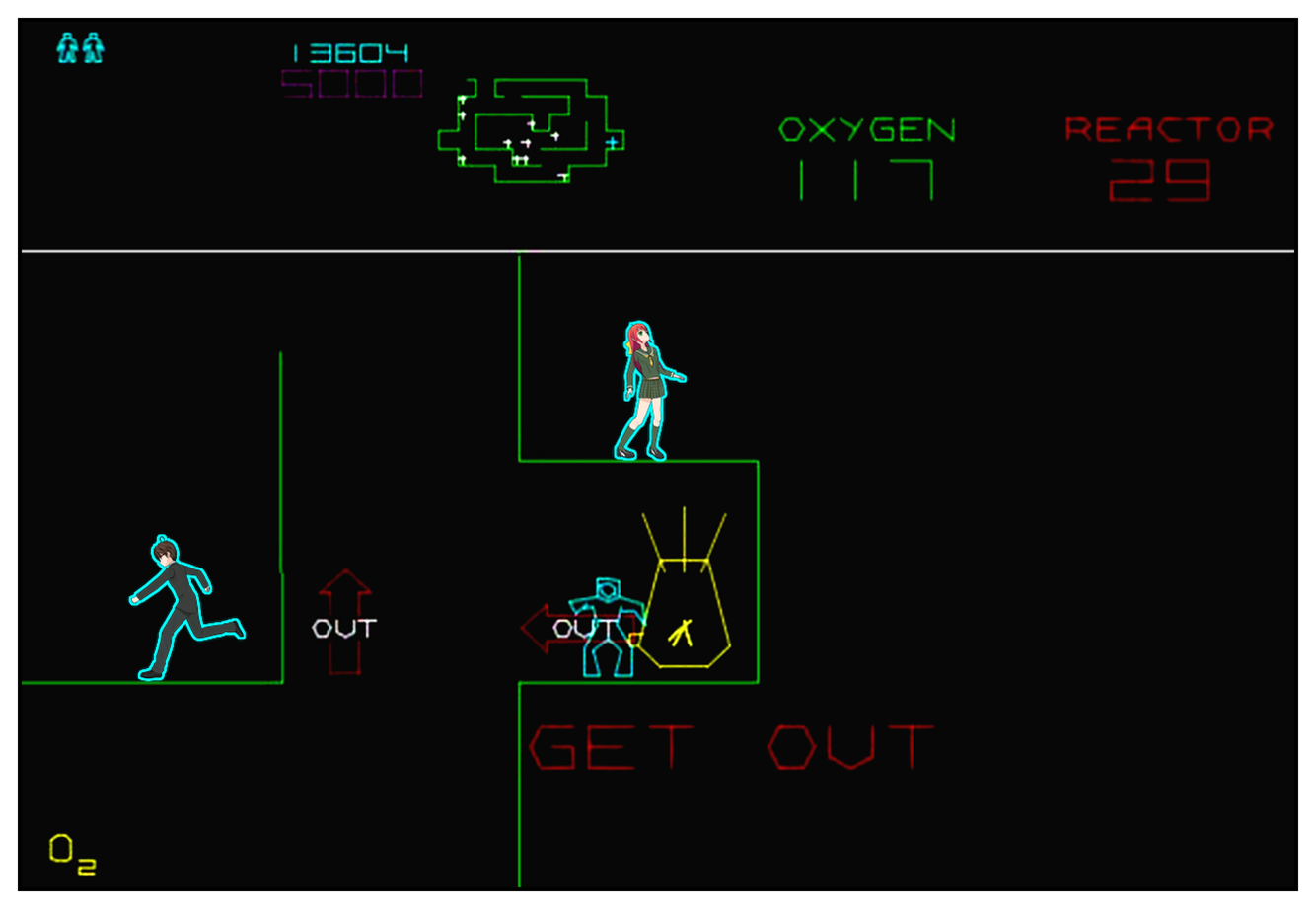
Major Havoc is one of those games from the early '80s that eschewed sprites, bitmaps and pixels in favour of vector graphics, giving it a very distinctive, recognisable look that stands alongside other vector games such as Asteroids, Battlezone, Red Baron, Tempest and Star Wars. In keeping with the inventiveness of video gaming's youth, Major Havoc is a rather peculiar game with some ambitious concepts, and quite possibly one of the first attempts at cross-genre gaming.

Major Havoc is split into several phases. First of all there's a quasi-3D shoot 'em up section, where you control Major Havoc's spaceship at the bottom of the screen and shoot incoming enemies as they come towards you. The interesting thing about this part is that it's not just straight Space Invaders-style waves of enemies: the first level features enemies that turn into a different form and home in on you when you hit them; the second features Galaxians-style swooping enemies, and the third starts with swirling, spiral enemies that draw lines on the screen, which subsequently become a maze you have to navigate your ship through as you approach your destination. (I can't get past this one, so I can't speak to what comes later!)

Following this, you have a Lunar Lander-lite section where you have to land Major Havoc's ship on a flashing white platform atop the target you were approaching in the first phase. Then Major Havoc gets out of the ship and you're seamlessly taken into a side-on platformer with weird gravity (hold the jump button down and you keep rising; let go and you'll fall) where you have to find a reactor, set it to explode and then get back out to your ship before you blow up with it. After that, the process repeats with a different wave of enemies, different platform to land on and different maze to negotiate.

It's a really cool game that tries some things I certainly haven't seen before, and the blend of space shooter and platforming hasn't really been attempted again (to my knowledge, anyway) until FuturLab's very recent Velocity 2x on PlayStation 4 and Vita.

It's also a stark reminder and interesting reminder that differences between Eastern and Western games have always been very apparent, though not always in quite the same way as today — Atari's games of the early '80s capitalised on the popularity of futuristic sci-fi thanks to Star Wars and made effective use of technologies such as vector graphics to create that aesthetic, while Japanese games of a similar era were often based around pixel art with cute aesthetics and more mascot-like characters.

Major Havoc, then: pretty neat, and another nice discovery from the Atari Vault. Looking forward to discovering more. (Also, hi, Mr Bushnell, if you're reading, which you probably aren't. Thank you for following.)

2260: Have You Played Liberator Today?

0260_001

I like retro compilations, not just for the ability to play games from my youth on modern hardware, but also to discover some classics that, for whatever reason, I missed out on when they were first released.

Such has been the case after just a few minutes with Atari Vault, a new release on Steam that packages together about a hundred Atari 2600 and arcade games from the late '70s and early '80s — including a few previously unreleased prototypes, which is kinda cool.

One such discovery I made today was an interesting (and surprisingly impressive for the time) game called Liberator, a quasi-sequel to Missile Command that flipped the concept of the original Cold War-inspired game on its head by putting you in the role of the aggressors, attacking enemy bases on planets in order to liberate the population from the villains.

Liberator, I've discovered, was quite a rare game even on its original release, which might explain why I've never come across it before. According to Gaming History, the original arcade machine sold for a whopping $2,000 and did not prove particularly popular, with only somewhere in the region of 760 cabinets actually being made — all this despite it being a game absolutely made for cross-promotion with Atari's "Atari Force" comic series. The curse of old-school Atari constantly and consistently failing at marketing strikes once again, I guess.

Anyway. The game plays quite a bit like Missile Command in that it's a somewhat different take on the shoot 'em up. Rather than firing directly at things, you fire at a crosshair on screen, and your missiles detonate when they reach the point you fired at. Thus, to destroy things, you have to cause explosions at locations where the enemies will be when your missiles arrive — usually meaning you have to fire ahead of them carefully, anticipating their movements.

Much like Missile Command, you can fire from several different places on screen, and these missile launchers — here depicted as starships orbiting an enemy planet — can be independently destroyed, acting as your "lives" for the game session. The game, then, becomes a matter of balancing your offense on the planet surface, which requires you to destroy enemy missile bases on the rotating globe ahead of you, and defending yourself against incoming missiles and other attacks. Not every attack is guaranteed to hit you, either, so you also need to spot which things you need to prioritise destroying and which you can safely ignore.

It's an interesting game; very simple, but undoubtedly addictive in the same way that Missile Command is. It's a good-looking game for the time period (1982), as well, with some decent pixel art for "Commander Champion", who briefs you on your mission, and a well-done 3D rotating globe effect for the planets you're orbiting. Sound effects, meanwhile, are the same bleeps, burbles and booms from Missile Command — nothing special, but certainly iconic of this particular period in gaming.

There's a lot more to explore in Atari Vault, but I anticipate that Liberator will be one I keep coming back to!

2256: TrackMania Turbo Demo Impressions

0256_001

Those who know me well will know that I've been a huge fan of the TrackMania series since the original release of TrackMania United, and have spent many hours on the various updates to United and the eventual follow-ups TrackMania 2 Canyon, Valley and Stadium. So it was with some excitement that I realised that the next official sequel, TrackMania Turbo, was releasing this week, though I was torn on whether to pick it up for console (PS4, in my case) or PC, which has traditionally been the home of TrackMania.

After playing the PS4 demo for a bit this evening, I think I'm going to grab the PS4 version. I'm very impressed with how at home it feels on console — much of the clunkiness of the PC versions, particularly in the menus, has been tidied up considerably, making it much more controller-friendly, and the addition of a variety of local multiplayer modes makes it eminently suitable for console play. It, so far, seems to be a highly polished product, which addresses what has always been my main criticism of the series as a whole: the fact that in terms of gameplay, it is wonderful, but in terms of interface and user-friendliness, it has traditionally been a ridiculous mess, only made worse by the gazillions of mods server operators apply to their custom dedicated servers, making the game screen more complicated than your average MMO come raid time.

PC players on Steam seem to be a bit salty that TrackMania Turbo has stripped out a number of features they've come to take for granted: specifically, the ability for players to run their own dedicated servers and install gajillions of mods that make players' screens look more complicated than your average MMO come raid time. And while this is a bit of a shame from the perspective of the game's flexibility — something that TrackMania has always prided itself on — I don't think it's going to hurt the complete package, and in fact it may well be good for the series as a whole. TrackMania Turbo will serve as the friendly face of TrackMania, in other words, while the truly hardcore still have United and TrackMania 2 to play and mod to their heart's content. Both of those games are still a hell of a lot of fun to play, after all — and surprisingly good looking, to boot, especially considering their age.

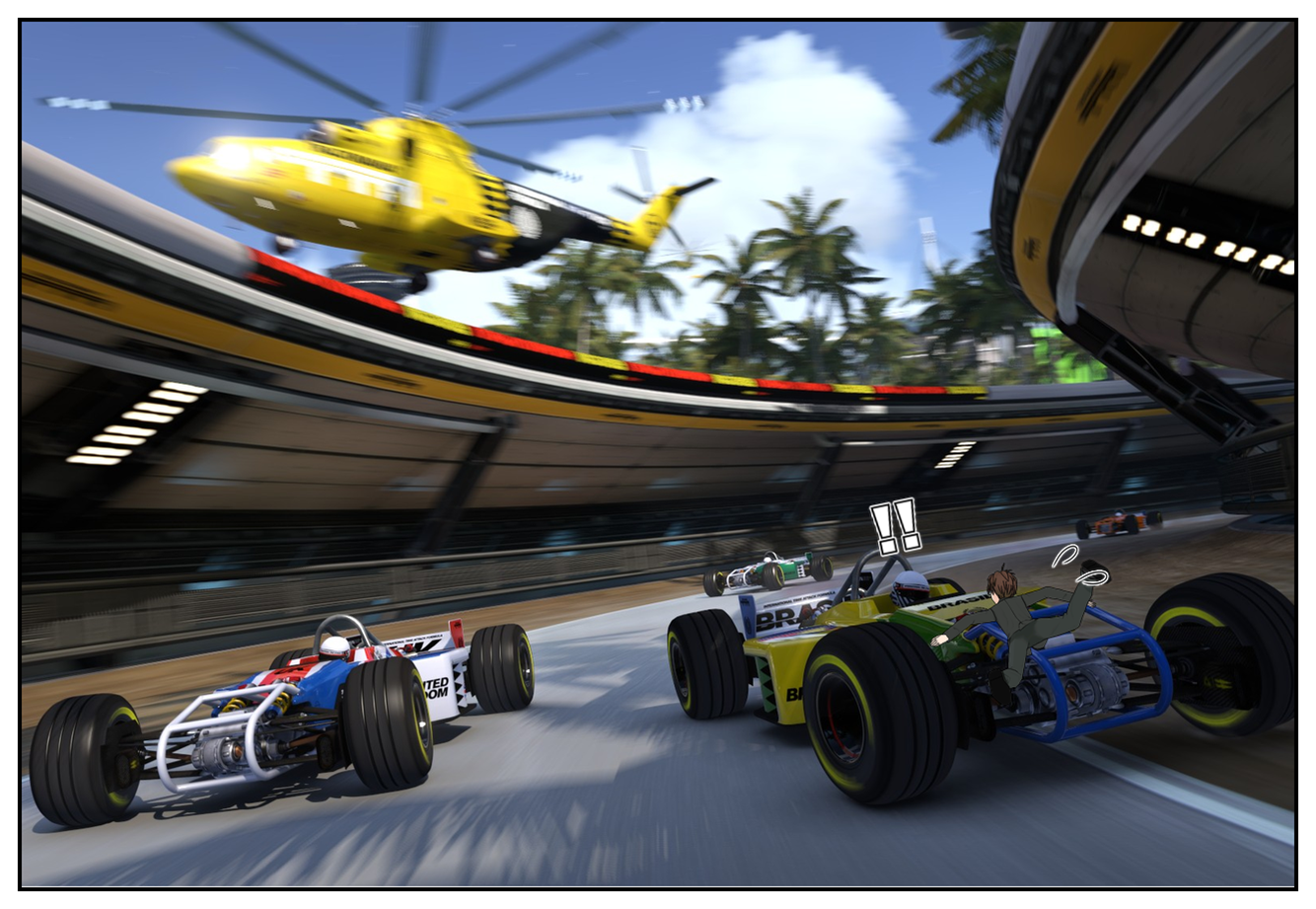
But what of TrackMania Turbo then? How does it shape up compared to its illustrious, if clunky, predecessors? Judging from the five tracks available in the demo, extremely favourably. In fact, if the whole game handles in the way those early tracks do, I'm confident that it will become a new favourite arcade racer.

The thing I like the most is the unabashedly arcadey handling. We're talking Ridge Racer-tier drifting here: release the accelerator, steer around a corner and slam the gas back on and you're going sideways. Hit the brakes and you'll find yourself in an even tighter drift, allowing you to get around even the most ridiculous of corners without losing anywhere near as much speed as if you'd have to drive "properly" like in boring driving sims.

The game screen, sans custom mod clutter, is clean, clear and offers ample feedback on your performance as you play, including split times, worldwide and regional rankings, and fun little extras like arcade-style counters showing how far you've jumped or drifted for — a nice addition that gives the game a very "Sega" feel.

I was debating whether or not I wanted to grab the game today. Playing those five tracks in the demo has made me quite happy to pick it up, though; I can see it being a whole lot of fun, and I hope it's a big success, helping to show console players the joy of this wonderfully silly but skillful and creative series.

2128: Point to Point

0128_001

I'm apparently on a minor retro kick at the moment, what with playing The Legend of Zelda and, also, downloading the "3D Classics" version of OutRun on my 3DS.

I love OutRun. It's one of those games that I used to see in the arcade but, for whatever reason, didn't play very often. (I feel it was probably something to do with my Dad baulking at the idea of paying 50p for one credit, but I usually managed to convince him that it was worth paying this much to play G-LOC, which at least had aeroplanes in it.) We also had the dreadful Atari ST port of Turbo OutRun, which I actually rather enjoyed despite its atrocious framerate, appalling load times (in the middle of a race!) and loss of various animations and game features if you had less than 1MB of RAM in your computer.

Despite all these setbacks, OutRun has always remained a racing game that I've been very fond of, and when the Shenmue series hit Dreamcast with a variety of playable Sega games right there within the game itself, I spent a great deal of time recapturing past glories (or, more commonly, indignities) on OutRun and Super Hang-On. When the PlayStation 2/Xbox era rolled around, I spent a lot of time playing the wonderful OutRun 2, which brought the basic gameplay of the original up to date with fresh graphics, but otherwise played just like an old arcade game. And when the Xbox 360 got a tweaked port of OutRun 2 on its downloadable Xbox Live Arcade service, well, of course I was going to play it again.

3D Classics OutRun is arguably a step back technology-wise from OutRun 2 and its spinoffs; it's based on the original 16-bit sprite-based graphics rather than being rendered in full polygonal glory. This is true to the original game, however, and there are a few little tweaks here and there to bring it a bit more up to date. It runs at 60 frames per second, for one thing, making it look smoother than the arcade version ever did, and makes excellent use of the 3DS' glasses-free stereoscopic 3D for some impressive visual effects. Possibly my favourite "pointless but cool" feature in it, however, is the simulation of the arcade cabinets' movement that you can turn on; OutRun was one of the many arcade games in the period that had "Deluxe" cabinets featuring hydraulics that would cause your seat to move around as you played. Your field of vision on the tiny screen of the 3DS isn't quite the same as literally feeling your car being slammed around corners, but it's a decent enough approximation, and a fun (and optional) effect to play with.

But enough about the technical side of things; every time I play some variation on OutRun I find myself pining for this lost age of racing games. Not necessarily because of the graphics or the style of play or anything — playing racing games with strict countdown time limits can be a bit of a culture shock these days! — but because they feature a subtle difference from most modern racing games in that they are point-to-point racers rather than lap-based.

I like point-to-point races, and we don't see nearly enough of them in modern racing games. There are exceptions, mind you: Burnout 2 had a nice little feature where once you completed the various events in one area, you then had a point-to-point race to get to the next one; Burnout Paradise was almost entirely point-to-point races; the Midnight Club series took an enjoyably chaotic approach to point-to-point racing by allowing you to choose your own route through an open-world city, so long as you hit the checkpoints along the way. But despite these examples, many of the racers we have today are lap-based.

Why is this something I care about? Well, lap-based racers are fun, of course, and allow you to learn the course, even within a single race. Point-to-point racers, meanwhile, have a wonderful sense of going on a journey, and in the case of games like OutRun, it's immensely satisfying to successfully reach the next stage of said journey and see what new scenery there is to admire a little further down the road. OutRun even takes this one step further, by providing a fork in the road at the end of each stage, allowing you to continue in one of two different directions to create your own custom route through the game.

3D Classics OutRun isn't a deep game in the slightest, especially when held up against more modern examples. But there's a purity to the experience that you just don't get in more realistic fare; it's a game that revels in the enjoyment of taking a fast car on a rollercoaster ride and seeing how far you can get this time. I love it, and I'm happy it's still a relevant game in 2015!

2002: Arcade Games are Alive and Well

0003_001

We live in an age where the default assumption about video games is that they will be big-budget affairs with star-studded voice casts, more pyrotechnics than a Michael Bay movie and, indeed, a budget to match. The reason for this is that many of the games that become household names — Call of Duty, Assassin's Creed, Grand Theft Auto — very much fall into this category, at least partly due to their marketing budget, but also due to their perceived "quality". Games have moved on since their roots in the '70s and '80s, or so the popular theory seems to go, and we should be looking to our interactive entertainment for challenging creative works that offer interesting new spins on social themes; deep emotional narratives; and innovative play mechanics.

As someone who grew up roughly alongside the birth of gaming (give or take a few years; I wasn't quite around for Pong) I think I speak for many other members of my cohort when I say that the above is all very well and good and should be celebrated when it's done well, but sometimes all you want to do is shoot or punch the shit out of some things without having to think about anything too complicated.

Astebreed is a great shooter with a ton of immediacy but a rewarding amount of depth for those willing to learn its intricacies.

One of the things I've been gratified to discover about the PlayStation 4 as a gaming platform is that it appears to be becoming an excellent home to a wide variety of arcade-style experiences as well as the big-budget, big-name games of today. The PC has been happily championing this sort of thing for a while thanks to its well-established digital distribution systems, and the Xbox 360 looked for a while like it might be assisting in the revitalisation of the "arcade-style" experience thanks to Xbox Live Arcade (which started to disappear up its own arse once things stopped costing 400 or 800 Microsoft Spacebux and instead took 1200 as the "default") but I feel like this is a field where the PlayStation 4 in particular is really starting to come into its own.

While I'm still ploughing through Omega Quintet on PlayStation 4 (I'm approaching the Platinum trophy now, at last!), the last few games that I've bought and really enjoyed on the platform are all short, arcade-style, score attack-type titles that are just plain fun. None of them are trying to say anything particularly deep and meaningful (with the possible exception of Astebreed, which has one of the densest half-hour narratives I think you'll ever find in a video game) and are instead focused on the simple joy of play: the thrill of taking on seemingly insurmountable odds, the fun of seeing scores climb into the millions, the satisfaction of beating your friends.

Blue Estate is pretty much a PS1/Dreamcast-era lightgun shooter, making good use of motion controls to approximate the arcade experience.

The games in question — and doubtless there are more, but these are the ones I've been particularly enjoying — include cinematic Japanese shoot 'em up Astebreed, Western bullet-hell shooter Jamestown+, the Defender-inspired Resogun, the inordinately satisfying rock-bursting shmup Super Stardust and lightgun-style rail shooter (a genre I thought was dead) Blue Estate. If you're looking for a quick fix of gaming and don't have the time or inclination to sit down and start chipping away at something more substantial like an RPG, I can happily and confidently recommend all of the above; they're fun, they have a ton of immediate appeal but a lot of hidden depth, they're easy to understand and teach to others (and, in most cases, have some form of multiplayer mode) and, for those concerned about such things, they're cheap.

Smoky, beer-scented arcades may well be fast becoming a thing of the past, but the arcade-style experience still very much lives on at home on PS4… and on Vita too, for that matter, but that's probably a whole other day's post, so we'll leave that for another day!