1935: Brave Frontier: Pete's Completely Unofficial and Possibly Inaccurate FAQ

I like writing guides, as I've discussed before, so instead of making some "hilarious" walkthrough of my tedious daily routine as I've done in the past, I thought I'd write something actually useful to someone: a guide on what I've learned about the game Brave Frontier, which I've talked a little about recently, and which isn't entirely forthcoming with all the information you might need to get the most out of it during play. Without further ado, then.

What is this game?

Brave Frontier is a free-to-play mobile RPG from Alim and Gumi. It's available for both iOS and Android devices. There's a linear story to follow, but it's mostly a game about collecting and upgrading "units" — various heroic characters and monsters whom you can recruit into your team, level up and evolve into more advanced forms of themselves.

Do I have to pay to play?

Brave Frontier has an energy system that depletes as you take your party on quests, with later quests or those with larger, more significant rewards costing more energy to take on. If you have insufficient remaining energy to take on a quest, you can either use a "gem" to restore it completely to its maximum level, or wait for it to regenerate at the rate of roughly one point per three minutes. As you level up, you'll gradually gain more maximum energy; one point every few levels, and a more significant jump every five levels.

Gems are also used for "rare summons" — immediately acquiring units of higher rarity levels — and restoring the separate, much shorter energy bar for the player-vs-player Arena mode.

Depending on how casually you play, you'll probably find there is no need to pay for gems — especially in the early levels, when you level up quite quickly and your energy bar is fully restored on each level-up.

How do I get gems?

You can pay for them, but you also get one free every so often; specifically, for completing an entire area in the main story campaign, sometimes as a daily login bonus reward if you play for several days in succession, sometimes as a "Brave Points" bonus for earning points by completing daily objectives.

How do I get units?

There are three ways of acquiring new units:

1) Receiving them as a drop from a quest. With the exception of daily and special event dungeons, these are usually very low rarity units.

2) Acquiring them through "Honor Points". You receive honor points when you borrow another player's character to fill the sixth slot in your party, with 5 points awarded if they're a stranger and 10 points if they're on your friends list. You'll also receive honor points when other people borrow your character to use in their party in the same way. 100 honor points equates to one "free" summon, but again, these tend to be quite low rarity for the most part. It's usually best to save up your honor points until there's a special promotion on promising specific units you wouldn't normally be able to get through these means; the game will make you aware of this when it's available.

3) Acquiring them using gems. 5 gems equates to one "rare" summon, which will net you a unit of three-star ("Rare") or higher rarity. These units will probably form the backbone of your party, but note their "cost" value; when building your party, the total cost of all the units you use cannot exceed your current cost cap. Cost cap increases with your player level alongside your maximum energy.

How do I make units better?

There are three things you need to do to improve a unit: level it up, level up its Brave Burst, and evolve it.

Levelling it up requires you to "fuse" it with other units. Each unit fused to the base unit gives you a particular amount of experience based on what it is, with slightly more experience being given if its elemental type matches that of the base unit. More valuable, rarer units are worth more experience. The most experience can be acquired from units that drop in the "Metal Parade" dungeon in the Vortex Gate; keys to unlock this are issued in the Administration Office in Imperial Capital Randall every weekday except Wednesday, so be sure to go and pick them up as often as possible. Note that when you unlock it, the Metal Parade only stays open for an hour, so only unlock it when you have enough energy to make the most of it!

Levelling up a unit's Brave Burst — its unique special move — relies a little more on randomness than standard levelling. A unit has ten levels of Brave Burst, with some more powerful and rarer units able to acquire a Super and Ultimate Brave Burst after this. To level up a Brave Burst, perform fusion, and look for material units that say "BB UP?" or "BB UP!" on them. "BB UP?" units give a small chance of levelling up the base unit's Brave Burst when fused, while "BB UP!" units will guarantee an increase in Brave Burst. Generally speaking, units that are appropriate to use for levelling up a Brave Burst can be identified by the type of Brave Burst they use. Healer units require other healers to level up their Brave Burst, for example, while attacking units require other units with offensive Brave Bursts.

Evolving a unit is the process you perform when a unit reaches its level cap. The level cap is determined by the number of stars the unit has, or its rarity. Three-star units have a level cap of 40, for example, while five-star units can be levelled to 80. Note that there's a "Zel" (currency) cost every time you perform fusion, and this gets more expensive the higher level a unit is. There's also a Zel fee to pay at evolution time.

To evolve a unit, you must collect the required additional units. These are usually found in the Tuesday daily dungeons in the Vortex Gate. For lower-rarity units, you'll need Nymphs; as you progress through the tiers, you'll need Spirits, Idols, Totems, Pots and Mecha Gods. Initially you won't know exactly what evolution materials are required for a unit, but once you've encountered or acquired the units in question once, they'll be revealed for your reference. Refer to the Brave Frontier Wiki to find the specific units you need if you get stuck.

Keep an eye out for special units such as Frogs — these provide significant, one-off bonuses when fused without requiring a level-up. Some increase attack power, some defense, some recovery power, some HP. Some even open up a second slot for equipping Spheres.

How should I build my party?

It depends how much effort you want to put in. I use a single standard setup for everything I do; it has a mix of different elemental types, a healer unit, a unit who can boost the acquisition of Brave Burst crystals during battle and a unit that can boost attack power. This is good for most situations.

The main quest is split into dungeons that tend to be centred around a single elemental type, so if you want to optimise your party you may wish to build a full party of each elemental type, then choose the appropriate complementary element to the enemies you're facing. Remember, elemental weaknesses are a one-way circle for the most part: fire beats earth beats lightning beats water beats fire (and so on). Dark and light have a reciprocal relationship, meanwhile; they both beat each other.

Special events and daily dungeons are often more challenging than the main quest, so you'll want to bring along your best units for these. For the Metal Parade, you'll want to bring units that hit a lot of times, since the most damage you can do to a Metal unit with a single hit is 1 point.

Pay attention to the unit you choose as Leader, too. Not only do you get the benefit of their Leader skill, which is usually a passive buff of some description, this will also be the unit you loan to other players. In other words, you want your Leader unit to be as attractive as possible (stats-wise or, if you're feeling shallow, the prettiest girl) to encourage people to use it and provide you with Honor Points.

Note that different instances of the same unit can have different "types", so be sure to pick one that you'll find the most effective. "Lord" type units are balanced. "Anima" type units gain more HP than usual when levelling up. "Breaker" type units gain more attack power than usual. "Guardian" type units gain more defense power than usual. "Oracle" type units gain more recovery power than usual.

How do I fight?

Fighting is a simple case of tapping the unit's status bar to cause it to attack; there's no need to wait for one unit to finish its turn before triggering another one, either. In fact, if more than one unit hits something at the same time, a "Spark" is triggered, increasing the amount of damage by a significant amount.

After all your units have taken a turn, you'll receive Brave Crystals (BC) and Heart Crystals (HC). The former are randomly distributed throughout your party and increase their Brave Burst gauge. The latter are likewise randomly distributed and restore hit points. After this is done, the enemy gets a turn. Note than many enemies — particularly bosses — have more than one action per turn, some of which can hit your whole party at once.

You can use items to turn the tide of battle; remember to acquire these from the Town before you leave, and use them before triggering any attacks, since you can only use them at the start of your turn.

Use Brave Bursts wisely. Although you get a bonus to the amount of BC and HC dropped if you "overkill" an enemy, there's little sense in unloading everyone's BB on a single fairy. If you can dispatch a group with normal attacks, do so and save your BB for larger groups or bosses. Also make sure you familiarise yourself with your units' Brave Bursts before you get into battle; not all of them are offensive in nature!

How do I level up quickly?

Remember you level up separately from your units. Benefits of levelling yourself up include a higher energy cap, a higher "cost" cap (allowing you to include more, rarer units in your party) and a full restoration of your energy bar and arena orbs.

You get experience for every "Quest" you complete, whether it's in the main quest or the Vortex Gate. Vortex Gate quests are usually worth more experience than you'd usually get for that amount of energy spent in the main quest, but they're often tougher — and you get nothing if your party is defeated before you beat the boss.

The fastest way to gain experience is with the weekly Karma dungeon on Mondays. Not only does this drop absolutely tons of Karma, a currency used for upgrading the Town and unlocking more effective equipment and consumable items, but also provides a significant amount of player experience. There are three "levels" of this dungeon; start at the bottom and work your way up. You will require some seriously powerful units to be able to defeat the boss at the end of the level 3 dungeon, so don't jump in there unless you're absolutely prepared.

How do I get more money?

Two ways. Firstly, there's a weekly dungeon at the weekend that drops a lot of Zel. Secondly, every Wednesday you can pick up a Jewel Key from the administration office in Imperial Capital Randall. This can be used to unlock the Jewel Parade, which works in the same way as the Metal Parade: it stays open for an hour, after which you'll need another key to get back in, so only open it up when you have the energy to use.

Jewel Parade drops Jewel-type units, which are completely useless for anything other than selling, so take full advantage of this. Acquire as many as you can before the Parade closes, then sell them off for vast profit.

How do I win in the Arena?

You don't have direct control of your units in the Arena, so all you can do is make sure you send your best possible units for the job: it's a good idea to have a healer unit of some description, as this can turn the tide of a battle in your favour. It's also a very good idea to take units with powerful Brave Bursts that can attack the entire enemy party at once, and any units that can provide buffs or increases to BC drop rates are useful, too; generally speaking, whoever gets to Brave Burst first will usually be the victor so if you can push yourself into a position where that's more likely to be you, you'll be golden.

What do I do in the Town?

Three things: acquire raw materials, upgrade the town's facilities, and buy/craft things. The Synthesis shop sells consumable items such as health potions and temporary buffs; remember to "equip" these to your hotbar before entering a difficult quest, as they will make a huge difference. The Sphere shop, meanwhile, allows you to create equippable items that either add special effects to your attacks or increase stats and resistances. Don't neglect these; they can make an otherwise seemingly weak character into a valuable member of your party.

Should I play this game? It sounds stupid.

It is kind of stupid and ultimately fairly pointless — but if you're someone who enjoys collecting things, making them fight other things and making on-screen numbers gradually get bigger over time, you'll probably have at least a bit of fun with it. It has some lovely art and great music, too.

Can I add you as a friend?

Sure. Type in my ID — the easy-to-remember 9630492642 — and we'll both get happy nice things to share.

Where can I find out more?

The Brave Frontier Wiki is a terrifyingly comprehensive resource of information for this game.

1931: Further Tales from the Frontier

Screenshot_2015-05-03-20-39-48I'm quite surprised that a free-to-play mobile game has managed to maintain my attention for over two weeks now: you may recall a short while back when I talked about Brave Frontier, and I'm still playing it today.

I think the reason it's "working" for me is that I'm not attempting to make it the focus of my gaming life or anything, but it's something enjoyable to do during brief moments of downtime — sitting on the bog, waiting for pasta water to boil, being unable to get to sleep, that sort of thing. It also helps that it's a fairly solid game at its core, too; it's not the deepest game in the world, but it has enough substance to keep it interesting in short bursts.

What I find curious about it is that it's essentially Pokemon with all the fat trimmed off, and yet while Pokemon didn't hold my attention at all across the three installments I've tried — Red, Gold and Y — Brave Frontier has managed to keep me interested, and I think it's because of all the stuff that's been trimmed out from the Pokemon formula.

Pokemon, to me, always feels like it's not sure what it quite wants to be. It has the structure of a traditional RPG, but then the collectible, tradable and upgradeable aspect of a trading card game. It is arguably more widely renowned for its competitive metagame than anything significant it brings to the storytelling table, though it has managed to spawn a number of anime series and movies since it first burst onto the scene. The "JRPG" side of it and the "collectible monster battling" stuff always seem to be somewhat at odds with one another, and I think that's what's caused me to lose interest in them partway through every time I've tried.

Brave Frontier, meanwhile, focuses on the collectible battling side of things almost exclusively. There's no exploration, no wandering around caves, just battles of various descriptions and, between those battles, upgrading your units to be more powerful, stronger and capable of taking on tougher opponents. It's satisfying to build up a team that works together, whether you've been trying to go for a specific angle (all the same elemental type, for example, or perhaps a strongly defensive group that can survive against hard-hitting enemies) or whether you've been working with the hand you've been dealt, as I have been.

And the game presents you with interesting, meaningful choices to make every time you boot it up. I still dislike the use of "energy" bars in free-to-play games throttling your play sessions, but as I noted in my previous post about Brave Frontier, this game makes use of it as an interesting "risk/reward" mechanic by presenting you with the option to effectively "gamble" your potential play time against the possible rewards available.

You can spent small amounts of energy working your way through the "Quest" mode, which is a linear sequence of battles of gradually (very gradually) increasing difficulty tied together with a surprisingly not-that-bad, if cliche-tastic storyline. In doing so, you'll acquire a selection of not-very-good units (that can be used as "fusion fodder" to upgrade various aspects of your actually-good units) along with the game's currencies, and you'll also get a decent amount of experience.

Screenshot_2015-05-04-20-25-02Conversely, the daily dungeons that pop up throughout the week each cost significantly more energy to participate in but offer their own unique special characteristics and greater, more predictable rewards — the Monday dungeon, for example, offers significantly greater amounts of experience points than usual, providing you with the ability to level up your "Summoner" character quite quickly, in turn increasing your energy stock and the amount of "Cost" points you're allowed to spend on building your party; other dungeons throughout the week offer units that are required to "evolve" level-capped units to their next tier, large amounts of gold coins or various other rewards. Part of the thing that makes the game interesting is that you have to discover the value of each of these dungeons for yourself; it may not be immediately clear why you'd want to hunt down elemental idols, for example, but once you figure it out you'll know that you need to check in on that particular day to get your hands on some.
There's a certain amount of random-number generation (RNG) at work, of course, but as any MMO player will tell you, that's sort of part of the fun in a perverse, masochistic sort of way: imagine how much more satisfying it is to acquire something you've been trying to hunt down for over a week rather than having it handed to you on a plate. It's frustrating and annoying at times, sure — I'm currently in the aforementioned situation as I attempt to track down the last "Evolution unit" I need to upgrade my party member Selena into her next tier of power — but, as manipulative as it is, it keeps you coming back for another try.

Oh, and I've reached a stage now where my party is winning in the player-vs-player "Arena" significantly more than it loses now, which is satisfying to see. But then the game took me down a peg or two by throwing a boss at me that absolutely obliterated my entire party within a few turns. Time to get busy with the Fusion, I guess…

1921: Keeper of the Records

I'm not sure what's inspired me to check out a few popular mobile games recently, but hot on the heels of Brave Frontier, which I talked a bit about the other day, I decided to take a peek at Square Enix's newest attempt to make a free-to-play mobile Final Fantasy game after the absolutely atrocious Final Fantasy: All the Bravest.

Final Fantasy Record Keeper was initially a little offputting by its association with DeNA; my past experience with this company is that they churn out identikit free-to-play games — mostly of the "gacha" variety, where you randomly draw various things each day in the hope of collecting a complete set, and can pay more to get more draws — that tend to be devoid of gameplay, polish and indeed any reason to play them whatsoever.

I was pleasantly surprised, then, to discover that Final Fantasy Record Keeper is actually a solid, interesting game in its own right. It's not a narrative-heavy Final Fantasy game, mind, but it's pretty up-front about this. What it instead provides is the "gacha"-style collecting mechanics that DeNA have so much experience with combined with some actual gameplay, with mechanics and everything.

The basic formula is pretty simple. Over the course of the game, you assemble a team of characters from past Final Fantasy games, reimagined in 16-bit era pixel art in the case of the more recent installments (VII onwards). You equip this team with "relics" (equipment) and abilities, then take them into a dungeon to work your way through a series of battles and eventually defeat a boss. There's no exploration involved; a dungeon is simply a string of predefined enemy encounters, with each costing a particular amount of "stamina" to participate in, meaning that your play sessions are throttled after a particular amount of time and until either your stamina recharges or you pay up to immediately refill it.

This is pretty much business as usual for gacha-style games, but Record Keeper actually fleshes out the battles with something akin to Final Fantasy's traditional "Active Time Battle" system, whereby battles are both turn-based and real-time at the same time: characters' "time bars" gradually fill, and when they're full, they can take an action. (In a twist on the original formula, somewhat reminiscent of Final Fantasy XIII, they then have to charge the bar again before the action is actually performed.) While this is happening, enemies are making use of their abilities in the same way.

The battles are fairly straightforward, though the ability to exploit elemental weaknesses and challenge special objectives during boss fights makes things a bit more interesting than just tapping the "attack" button over and over again. Where things get interesting is in the customisation aspect, which is always the strongest part of any gacha-style game.

In Record Keeper, the things you "draw" each day (or exchange the game's premium currency for) are the relics, not the characters. These items of equipment have set bonuses to various stats, and certain characters can only equip certain types of equipment. You can level up equipment by sacrificing unneeded items or specific upgrade materials, and when a piece of equipment reaches its level cap, you can combine it with another instance of the same item to buff it up to the next rarity level and then begin the levelling process all over again with a higher cap. Certain pieces of equipment also have special abilities attached to them, all of which are unique to particular characters and based on their iconic moves from their respective games.

Alongside this, the abilities your characters can use have to be crafted using orbs you find in battle. Each character can initially equip just two abilities, and initial abilities only have two uses, meaning you have to carefully think about whether you really need to use that ability when you're in a dungeon, as they don't recharge until you leave, are defeated or are victorious. Abilities can subsequently be upgraded using additional orbs, however, which makes them more effective and gives you more uses of them; they can also be swapped around between characters, too, so if you make changes to your lineup the newcomers don't have to start with crap skills.

Alongside all of the above, you then have the makeup of your party to consider. Characters get large bonuses to their stats and experience points earned if they are from the game the dungeon you're currently playing through is from — for example, Cloud is much more effective in Final Fantasy VII-themed dungeons, while Kain is much more effective in Final Fantasy IV-themed dungeons — but have certain restrictions on what abilities and equipment they can use. Level up an ability too much and you might find a favourite character is no longer able to use it, so you have to be a little bit careful and plan ahead.

Like Brave Frontier, I'm not sure how long I'm going to stick with the game, particularly as it appears to be devoid of any sort of social features and thus the incentive to compete against — or cooperate with — other people. For the moment, though, it's an interesting "collection"-style, battle-centric RPG featuring characters and settings from a series I'm very fond of — though I'm a bit disappointed that, as usual, Final Fantasy XI and Final Fantasy XIV are ignored thanks to their "online game" status as opposed to the series' more traditional single-player installments.

You can find out more about the game and get links to download it — it's available for both iOS and Android devices — on its official website.

1915: Brave New Frontier

I've been out of the mobile gaming, umm, game for a while now because my stint working for the now-apparently-defunct Inside Network opened my eyes to the revolting realities of mobile free-to-play games and how people in suits and sneakers genuinely thought that games where you tap on something every two hours and then have to spend money were somehow innovative.

I've made no secret of my general distaste for this business model, but having left it alone for a little while, I've felt more able to come back and look at some of these games with a slightly less jaded pair of eyes. I looked at one called Valkyrie Crusade over on MoeGamer a while back a year or so ago and was surprised to find myself having a reasonably good time — though at the time of writing, I haven't touched it for a few months now.

More recently, someone I follow on Twitter had been posting some screenshots and enthusiastic noises about a game called Brave Frontier (iOS, Android), so I decided to download it and give it a shot. It has an appealing, colourful art style with a combination of pixel art sprites and super-deformed chibi-esque character art, and promised to have a little more in the way of "gameplay" than many similar titles, most of which revolve largely around collecting "cards" and then tapping a "Continue" button repeatedly until you run out of energy or patience.

Brave Frontier isn't massively different from this formula, but the simple addition of a bit of interactivity to the formula immediately makes it a more interesting, enjoyable game that is ideal for dipping into for a few minutes at a time while you're on the toilet or waiting for public transport.

Here's how it works. You're given an initial few units, one of which is reasonably good and the rest of which are a bit shit, but fill out the slots in your party reasonably. You can take these through "quests", which are sequences of a few battles in a row, culminating in a boss fight. Battles are very simple: you tap on a party member to cause them to attack, and if you time your taps correctly so that multiple units hit at the same time, you cause a "Spark" which deals additional damage. Units also have elemental types that have a significant impact on both attack and defence power.

When all your units have attacked, you get to grab all the goodies that fell out of the enemies while you were clobbering them. These include the game's various currencies, health points and Brave Burst points, the latter of which fills a gauge and allows a unit to perform its unique special move. Health points and Brave Burst points are assigned randomly so you can't guarantee a particular unit will be able to perform their Brave Burst on command, but you can force an enemy to drop more of these shards by ordering your party to focus their attacks on a single enemy, cause an "Overkill" and obtain additional rewards. This, of course, leaves them open to attack from the remaining enemies.

You repeat this process through a series of battles, with your units not automatically healing or recharging between. You fight a boss — most of which so far haven't been significantly tougher than the main enemies — and then you get rewards, which include materials and additional units.

Outside of quests, you can "fuse" units together to level them up — they don't gain experience simply through battle like in a regular RPG. Fusing "metal" units of the same element as a unit provides a significant bonus to the XP they receive, and when you get a unit to its level cap (which varies according to the unit's rarity) you can "evolve" it into a more powerful incarnation by using materials. You can also use materials to craft useful items and equipment for your units, and one of the game's currencies to upgrade the village you call home base — this provides you with resources every so often, and also has a bunch of facilities you can unlock over time, providing you access to more and more items and equipment as you upgrade it.

The game makes use of the free-to-play model's beloved "energy" system, which means you're only allowed to play a certain amount before you either have to pay up or wait for it to restore. Now, I'm not a huge fan of this system, but so far in Brave Frontier it's been fairly unobtrusive, with energy consumption pretty much matching up with the average length of a play session. In other words, by the time you've run out of energy, you'll probably want to go and play or do something else anyway. Interestingly, there are a bunch of "dungeons" that you can take on that require significantly more energy to enter than normal quest battles; the rewards for these are significantly greater, however, as is the overall challenge level. This means that you can choose how you spend your energy rather than it being a "flat rate" — do you blow 50 points at once for the chance to get your hands on some rare, useful, powerful goodies, or do you make steady progress through the main story to unlock access to new areas and acquire "gems" which can be used to recruit the more powerful, more rare units?

I don't know how long I'll stick with the game, but it's enjoyable enough at present, and the art style is lovely. If you happen to be playing, feel free to add me as a friend using ID 9630492642.

1582: My Phone's Not Called "Mate"

So, an update on how I'm doing with my new phone after several days of fiddling around with it. (Said new phone, if you missed my post from the other day, is an HTC One M8 — my first Android phone, though not my first Android device.)

I'm really liking it! Like, way more than I thought I would. There are flaws, certainly — the phone has frozen and rebooted itself while I was in the middle of doing something rather more times than I would have preferred it to in the last few days — but on the whole, it's been a great experience so far and I dare say that I am actually starting to prefer it to iOS.

Don't get me wrong, I'm not going to suddenly become an Android fanboy, largely because I find Android fanboys to be some of the most insufferable fanboys on the entire Internet. Nor do I feel that iOS is now "bad" because of the time I've spent with Android. But there are clear and discrete markets for both, and they both do their own thing extremely well.

iOS, like most of Apple's other products these days, is designed to be accessible, simple and straightforward. I hesitate to say "designed for stupid people" but it's certainly designed in such a manner that stupid people can't break it easily. It doesn't blind you with unnecessary information — if there's something it can do quietly in the background without telling you what's going on, it will. This is great for people who panic when they see technical messages they don't understand; however, on the flip side, it's less than ideal for computer-literate people who like to know what their device is up to — and if it's up to something it shouldn't be (or not up to something it should be).

There are two features on iOS where this is painfully apparent, and as I count myself in the more "computer literate" camp they'd been becoming increasingly frustrating to me.

First up is Photo Stream, a feature whereby you take a photo with the phone's camera and it gets automatically backed up to your iCloud account and synced to any other devices you've also logged into iCloud with. This is, in theory at least, extremely useful for backing up images and just for transferring them from one device to another — from phone to computer, say — without having to faff around with long-winded sync processes or additional hardware. And, a good 90% of the time, it was great. The trouble was, for that remaining 10% of the time it would just not work, and it certainly wasn't going to tell you why. I eventually managed to figure out that if Photo Stream wasn't syncing it was generally for one of two reasons (the battery being below 20% or you not being connected to Wi-Fi) but the phone certainly didn't tell me that.

iTunes Match, the service that allows you "cloud" access to your full iTunes music library from any device, is the same way. A few weeks back, my iPhone simply started refusing to download certain iTunes tracks to itself, which made loading it up with tunes to take on a long trip to be troublesome at best, completely impossible at worst. Again, there was no means of getting feedback on what was going wrong and why some tracks would download but others wouldn't; it simply wouldn't do it. Infuriating. But I can sort of understand why Apple chose not to put frightening error messages in there — so as not to scare off the casual, less computer-literate people.

Android's big selling point is its customisability, and to be fair I haven't explored that a great deal with my new device just yet — I've been largely happy with the stock options so far. It comes preloaded with a standard app launcher and a special "car mode" with big buttons and quick access to music, navigation and other useful features you might need while driving, but I know the option is there for further customisation. I also like how you can have things installed on the device but not visible on the home screen.

What I've really liked so far is the notifications system. I can clear all my notifications with a simple tap on a button, or I can also take action on a lot of them right from the notifications feed — reply to a tweet, archive an email, all manner of other things. It took a little adjusting to the fact that the phone doesn't display messages on the home screen like the iPhone does, but having used it for a few days now, it's actually quite nice to have the peace and be able to review notifications at your leisure rather than when your phone thinks you should.

Plus there's the sound. I'm not normally a fan of playing music out of a mobile phone, but the M8 has some surprisingly competent speakers. They're never going to rival a proper setup, of course, but they're loud, reasonably beefy considering their size, and they make listening to music or podcasts without headphones while doing other things — housework, for example, or, more relevantly to now, packing — eminently practical. Combine with Google Music's much better, more stable  implementation of "cloud music" than iTunes Match offers along with the ability to put an extra SD card in there for storage and you have a device that is a kick-ass media player as well as a solid communication device, too.

So I'm liking it a lot so far, and I'm certainly not missing my iPhone, which I gave to O2 for recycling in exchange for a little over a hundred quid — not to be sniffed at for minimum effort. Whether or not I'll stick with Android in the long term remains to be seen, but frankly it's looking quite positive right now.

1579: "Android?"

I took a bold step and did something very brave today. I… I…

I switched from iOS to Android.

Okay, "very brave" might be understatement of the century, but despite being curious about Google's mobile OS, I've resisted the temptation to ditch the iPhone series to date, largely because I felt that I was too invested in the iOS ecosystem to make breaking free practical.

I pondered this recently, though, and realised that I actually wasn't all that dependent on the iOS ecosystem at all. I run my mail, contacts and calendars through Google, I socialise through Facebook, Twitter and Google+, I take notes in Evernote and… well, that's about it, to be frank; I'm not an especially adventurous mobile user these days, largely because I feel that 95% of apps released these days are superfluous, pointless crap that no-one needs.

And so it is that I find myself with an HTC One "Don't Call Me Mate" M8 Android handset. It's a rather larger handset than the iPhone 4S I was using before, and it's larger than Andie's iPhone 5S, too. I once thought that large phones were worthy of mockery, but having been using the HTC for a day I'm already feeling the benefit of the larger screen size. It's not a huge amount bigger than an iPhone, but it's a significant enough difference that things don't feel nearly as cramped.

Bringing mail, contacts and calendars across was straightforward and easy because I was using Google. The one thing I was a little concerned about was being able to manage my music — something that I have, to date, relied on iTunes for. It turns out that Google's Google Music service has seemingly been designed for this exact situation, allowing you the ability to upload up to 20,000 tracks directly from your iTunes library to then be available for streaming or caching from anywhere. You can listen to them via the Chrome-based web player, or on your Android phone. There's even an optional Spotify-like subscription service where you can stream music you don't own, so as of today I've cancelled my Spotify Premium account and gone with Google instead.

There are things to adjust with on the new phone. Not having notifications on the lock screen is very odd having had them for several generations of iOS hardware, but this is more than made up for by the fact you can dismiss all notifications at once from the notification centre. I haven't delved particularly into the customisation side of things yet, but I understand with a bit of fiddling and tweaking it's possible to rectify this behaviour if it really bothers me.

There are a few things I really like. The fact that if you download an app and discover it's shit, you can delete it and automatically receive a refund if you do so within 15 minutes of purchasing. The way apps work together, sharing information much more easily than on iOS. The way the on-screen keyboard does a fake "haptic feedback" thing where it vibrates very slightly every time you press a key. The camera on this particular device is supposed to be very good, too, but I haven't really tried it as yet.

So far I'm very happy with the new device so far, particularly as the tariff I've moved to post-upgrade is, for once, actually a better deal than the one I was on previously. I'm paying the same and getting more cellular data allowance plus "4G" speeds where they're available, so the overall experience should be superior. I'm looking forward to exploring what it's capable of further; it's a pleasant and fun change, and wasn't riddled with nearly as many difficulties as I was expecting.

But don't worry. I'm not going to become one of those douchebags who comments on every article about a new iOS app/game and just says "Android?" like a brainwashed parrot. iOS is still great at what it does, and if you claim to be a lover of tech, you should be interested and curious in all the alternatives out there rather than swearing blind corporate allegiance to one company purely because they make the handset you currently own.

But that's probably a discussion for another day. I'm going to go and lie in bed and fiddle with my phone for a bit now. Or possibly just play Nanaca Crash on it.

1500: Make a Run

[Aside: Gosh. 1,500 daily posts. Good job, me. I'd celebrate, but I already had something in mind to write about today, sooo…]

Spent a pleasant hour or two teaching and playing Netrunner this evening. This is the third time I've had the opportunity to give this interesting game a go now, and each time I play, I like it a little more.

I think the best thing about it is the psychology aspect of it. Like a good game of poker, success in Netrunner relies as least partly upon reading your opponent, figuring out how they're likely to act and taking advantage of it. When playing as the Corporation, for example, choosing which of your Remote Servers you're going to install Ice in front of is extremely important: do you think your opponent will assume your most valuable cards — the ones they're trying to steal in order to win the game — are heavily protected behind Ice, or will he see through the common bluff of leaving valuable cards unprotected as if they're no big deal?

There's a wonderful sense of tension in the game, on both sides, and the game is seemingly balanced in such a way as to encourage this feeling as often as possible.

In the last game I played today, for example, I was playing as the Corporation, and a victory on points was looking likely. My last Agenda card — the cards I needed to spend credits on to "advance" in order to score — was heavily protected behind three pieces of Ice, and I had enough credits to rez all of them without any difficulty. Moreover, I could see that my opponent James didn't have the Icebreakers he'd need to defeat my pieces of Ice, so I was feeling pretty confident. I advanced my last Agenda until it was one token away from final victory for me, and then it was the end of my turn.

Naturally, James used this opportunity to make a final Run on my Remote Server, obviously hoping to pick up my Agenda and bring himself closer to victory, while denying me the win. He began with the Tinkering card, which made one of my already-revealed pieces of Ice into a type that his Icebreakers could deal with. Uh-oh. He also had enough money to power up his Icebreaker enough to crack through it and deactivate its subroutines. Uh-oh. James broke through the first piece of Ice without any difficulty, so I rezzed the next one — an infuriating little card called a "portal" whose main effect was to send James back to confront the first piece of Ice again. This would fuck him over nicely, since he didn't have enough credits left to confront it again, but unfortunately his Icebreaker was of the correct type to bypass the portal without any difficulty.

This left the final piece of Ice for him to confront. My confidence had evaporated by this point, but I rezzed it anyway. It was pretty weak, but its subroutine would end his Run immediately — and best of all, it transpired that it was of a type his Icebreaker couldn't crack.

My heart leapt. I had done it. I had fended off an attack that had got a whole lot further than I thought it was going to — and now I was going to win for sure. And win I did — and great it felt, too.

I'm starting to get my head around this game now, and I'm really interested to play it some more. It's a big challenge — one false move, or an unfortunate draw of the cards, can leave you in serious shit or even with an instant loss if you're not careful. But knowing the things to watch out for allows you to prepare for most eventualities — and if you're playing against an evenly-matched opponent, it can lead to some genuinely thrilling faceoffs.

I'm not quite brave enough to approach the clearly experienced Netrunner players in the Monday night board game group as yet, but I'm definitely keen to play more. Hopefully I'll have the opportunity to do so soon.

1173: Am I Missing Something?

Yesterday, game-centric social network Raptr reported that in the month of March, its members played more of King's Candy Crush Saga than StarCraft II, World of Tanks and Halo: Reach (all historically very popular games) combined.

This is significant for a number of reasons. Firstly, it shows that Raptr is getting some pretty wide usage by more casual gamers as well as those who care about achievements, hour counts and whatnot — demonstrating (arguably) that a lot of people playing Candy Crush Saga are "serious" enough about their gaming to sign up for a game-centric social network and tracking service.

Secondly, it shows something we all know: the vast numbers of people playing Facebook and mobile games far outstrips those who have perhaps grown up with the industry and who play what one might call "traditional" video games — players whom mobile and social gaming companies euphemistically refer to as "core" gamers.

The second point isn't all that surprising; how many people do you know who don't have a Facebook account? While we're not yet in a world where every single person is permanently jacked in to the social network via a transmitter in their spinal column, I'm willing to bet that regardless of your age, there's probably a large proportion of the people you know who have Facebook accounts, and of those people most of them have probably tried playing some games at least once. The exact same situation is true when we consider smartphone ownership these days — of those who have acquired a new mobile phone recently, it's highly likely that it was one of the two most well-supported platforms out there: iOS and Android. And of those who haven't acquired a new mobile phone recently, a lot of people are investigating tablets as a home computer solution — pretty much all of which run, you guessed it, iOS and Android.

It's the first point that surprises me, though. Raptr is the sort of service that is historically only of interest to those "core" gamers we mentioned earlier, as your average soccer mom who only plays games on Facebook has no real need or desire to keep up with industry happenings or the latest stupid thing that a Microsoft employee has said on social media — let alone how their number of hours played stacks up against their friends. So what does it mean when the number of hours racked up on Candy Crush Saga outstrips some of Raptr's most heavily-tracked, popular titles?

Well, it could mean one of a couple of things. Firstly, it could mean that Facebook and/or mobile gamers are more serious about tracking their playtime and achievements in the games they play than most people thought. I find this rather difficult to believe, to be honest, as the sort of people who only play Facebook and mobile games are typically playing them as a means to fill a spare few minutes rather than as an engaging form of entertainment that they feel particularly passionate about.

Secondly, it could mean that those "core" gamers out there are playing Facebook and mobile games as well as (apparently, more than) "traditional" computer and console games that are aimed specifically at them? Judging by the notifications that pop up on the Raptr client that runs on my PC, this is much more likely; there are several people on my friends list whom I would describe as "core" gamers by that definition, but who are regularly seen playing everything from FarmVille to Marvel Avengers Alliance and Candy Crush Saga.

One question, though: why?

No, seriously, why?

If you're a "core" gamer by the popular definition, you're serious about your interactive entertainment. You might play games instead of (or as much as) watching movies and TV shows. Your exact reasons for playing may vary — those who enjoy Call of Duty play it much like a competitive team sport, while people like me prefer narrative-centric experiences that stimulate similar parts of the brain to movies and TV shows — but the fact is, you're highly likely to make time for your gaming rather than indulge in it as an idle diversion. You'll sit down, you'll play a game for a not-inconsiderable amount of time, then you'll switch off and do something else. Or pass out with the controller in your sweaty mitts.

So if you're investing time and probably money into what is, after all, a hobby rather than a mindless pastime, why, dear "core" gamers, aren't you playing anything better? Don't get me wrong, Candy Crush Saga has performed so well because it's a polished product that is pretty accessible even to those who haven't played many games before, but 1) it's a Bejeweled ripoff, and Bejeweled 3 (or just Bejeweled as it is called on mobile) is a better game with more variety; 2) it's rammed to the gills with obnoxious enforced "social" features that don't actually promote social interaction at all (ask for lives! ask friends to unlock levels! brag about your score!); 3) it's rammed to its other gills with obnoxious monetization — aside from the fact that every so often you'll run into a wall where it literally just stops you from playing unless you either wait for several hours or pay money, there's one powerup in the game that costs £35 and can be used once per level. Thirty-five pounds. Bejeweled 3, which, as previously mentioned, is an infinitely superior game that doesn't bug you every five fucking seconds to insert coins or invite friends, costs £14.99 — less than half the price of that one powerup in Candy Crush Saga — on Steam (and is regularly reduced in price in sales), and sixty-nine pence on mobile phones.

"But Candy Crush Saga is free to download!" I hear you cry. "Surely people aren't dimwitted enough to repeatedly spend money on this when they could just buy a copy of Bejeweled outright and then never have to pay again!" Wrong. Candy Crush Saga is, as I write this, the number 1 Top Grossing app on the App Store. Note: "app" not "game". (It is also the number 1 Top Grossing game, but that shouldn't be surprising given its other position.)

Let me reiterate that. Candy Crush Saga, which is free to download, is making more money than apps that cost money. By a significant margin. It is making more money than high-quality productivity apps for professionals, which typically carry a relatively hefty price tag. It is making more money than high-quality "pay once, play forever" games. It is making more money than Bejeweled, which is basically the same fucking game for the price of a packet of Chewits. It is making more money than anything else on the App Store.

It is at this point I throw my hands up and say I absolutely do not understand why this is the case. It absolutely boggles my mind, because can see why I wouldn't want to repeatedly and indefinitely churn money into a game that isn't noticeably better than another game I've already paid for once (Bejeweled), so why can't these hundreds, thousands, millions of other people? It does not make any sense whatsoever. And this isn't even considering the question above of why on Earth "core" gamers are apparently playing this game so much when there is so much other good stuff out there — too much for one games enthusiast to ever hope to fit into one lifetime, even if they became hikikomori in order to try and do so.

I am so, so torn about this sort of thing, and have been for a while now. On the one hand, it's great that more and more people are embracing video games as a pastime, form of entertainment or even hobby. On the other, the swathes of people who are coming to gaming as a result of free-to-play mobile and social games are perpetuating a business model that, while immensely profitable, is not particularly friendly to the consumer and is actually quite unsafe to people who don't keep a tight rein on their finances. More people playing games? Good. Sending the message that charging £35 for one powerup is okay? Very, very bad.

1155: The Tablet Revolution

Page_1I've come to the conclusion that I'm a dusty old bastard who is set in his ways like an old man. That or everyone else is just plain wrong. Or perhaps a combination of the two.

I'm specifically referring to the "tablet revolution" — that futuristic gubbins that supposes everyone is going to replace their computer/console/handheld/everything with a tablet such as an iPad or whateverthefuck the bajillion Android tablets are called these days. I even read an article earlier where someone from Zynga said that tablets are "becoming the ultimate game platform".

I must respectfully disagree — at least for my needs and wants, anyway.

Our house has three tablets — an iPad 2, a Motorola Xoom and a Nexus 7. The Nexus 7 is currently in for repair, but got a fair amount of use by Andie, largely for free-to-play mobile games and Kairosoft titles. The iPad 2 also gets a fair amount of use by Andie for the same reasons. My Xoom gets barely any use, though the fact I have SNES, Mega Drive and various other emulators on there ready to go at a moment's notice is pretty cool.

But yeah. The fact stands: I hardly use these devices at all. Why? Because for my purposes, they don't offer a superior experience to other bits of kit. For gaming, I have consoles, dedicated handhelds, a laptop PC and a desktop PC. For work, I have my Mac, the aforementioned laptop PC and the desktop PC at a pinch. For browsing the Internet, I have… you know how this goes by now. For me, all of these devices offer a considerably superior experience to all of the tablets we have in this house.

Oh, sure, tablets can ably perform several of these functions, but they don't do any of them as well as the pre-existing devices. About all they do offer, really, is the fact that they're incredibly quick to turn on (assuming they have some charge left in them, which my Xoom in particular rarely does) and are a lot more portable and lightweight than many other devices.

But personally speaking, the fact that, say, the iPad is thin and lightweight isn't enough to make up for the fact that it's a lot more difficult to type on than an actual physical keyboard. And yes, I know, you can pay through the nose and get an iPad-compatible wireless keyboard (or a generic one for Android) but not only does that remove one of the main benefits of a tablet — its all-in-one portability — there's other issues too: the pain in the arse it is to access the file system (on iOS, anyway; this is one area where Android is marginally better), the fact that proprietary iOS and Android apps rarely play nicely with established formats (just try getting a Microsoft Word file with any formatting or layout whatsoever to look even a little bit right in Pages for iOS), the fact that some of the work I do requires the precision of a mouse rather than the cack-handedness of a touchscreen, the fact that some websites I want to use are designed for use on a computer with a keyboard and mouse rather than a touchscreen and a virtual keyboard.

And don't get me started on the games. "The ultimate gaming platform"? Don't make me laugh, Zynga. While mobile and tablet games have been enormously successful in getting more and more new people into video games, and that's a good thing for the industry as a whole, there is no way you can say with any good conscience that tablets are an adequate replacement for more established systems — and better-designed control schemes in particular. Have you ever tried to play a first-person shooter on a touchscreen tablet with no buttons? It is one of the most bewildering experiences you'll ever encounter: why would anyone want to put themselves through that? There are certain genres that work well, of course: strategy games, board game adaptations, word games and adventure games are all good uses of a touchscreen interface… as are the never-ending throng of isometric-perspective building/farming/dragon-raising games that are little more than vehicles for monetisation. There are very few tablet-based games that hold my attention for more than a couple of minutes, in short — the last was Ghost Trick, which doesn't really count as it was a conversion of a Nintendo DS game.

I guess that's sort of the point, though. The main benefit of tablet devices (and smartphones, for that matter) is their immediacy — you turn them on, you tap a button and you're (almost) straight into a game, and you can be out of it again within a matter of minutes if you just needed to fill an awkward silence or wait for someone to come back from the toilet. And that's good, in a way; it just doesn't really fit with how play games. As I noted in a reply to Anne on yesterday's post, I play games as my main form of entertainment. I don't watch much TV, I don't watch movies, listening to music is something I tend to do while engaged in some other activity, and so games are my main "relaxing time" activity. I want to sit and play something for an hour or two (or more) at a time, and between freemium energy please-insert-credit-card-to-continue bullshit and the "bite-size", disposable, forgettable nature of most mobile/tablet games, I just don't get a satisfying experience from them.

Meanwhile, the laptop I bought a short while back is easily my favourite piece of kit in this house. It's powerful enough to play pretty-looking games like TrackMania, yet portable enough to carry around in a bag. Its battery life is decent (though not a patch on a tablet) and it has a nice screen. It's a good means of playing visual novels without having to tie up the TV, and it copes well with anything I might want to throw at it while working on the go. In short, it's an all-in-one device that does absolutely everything I want it to without making any compromises or dumbing the experience down at all. Sure, it takes a bit longer to turn on than the iPad, but it's also infinitely more useful and fun to me.

Fuck the tablet revolution, basically. Long live the laptop. And the games console. And the desktop PC. And the dedicated handheld. And, you know, sometimes, just a piece of paper.

1007: Battle of the Cards

I've made my distaste for the growing trend for Japanese "card-battling" mobile-social games well-known on these pages a number of times in the past, but I've been growing increasingly conscious of the fact that I must be missing something. After all, these titles consistently show up in the Top Grossing charts on both Android and iOS, so there must be something to them that keeps people playing and, indeed, spending.

The other day, I reviewed a new mobile game from Zynga called Ayakashi: Ghost Guild. Before I go any further, let me explain something about the way Zynga does business for those who have always given their titles a wide berth for whatever reason.

Zynga behave very much like Apple do, in that they're not trendsetters — or perhaps more accurately, they're rarely the first to try something, as they're both often the ones to make something popular. What both companies are inclined to do is hang back, watch and wait to see what early adopters of new technology and systems are doing. What is proving popular? What are users ignoring? What are the potential pitfalls in doing something new, and can they be avoided?

Once they've done this, they'll swoop in with something fundamentally very similar to that which has come before, but polished to a fine sheen. Zynga's games are rarely, if ever, original, but it's hard to deny that they often have a significantly higher degree of polish than many other games that may have gotten there first. Similarly, Apple's work on iOS frequently lags behind Android in terms of features — a frequent criticism in the interminably tedious fanboy wars — but when said features hit, they tend to be implemented very well. (Of course, there are exceptions in both cases, but these patterns are noticeable enough to be worth commenting on.)

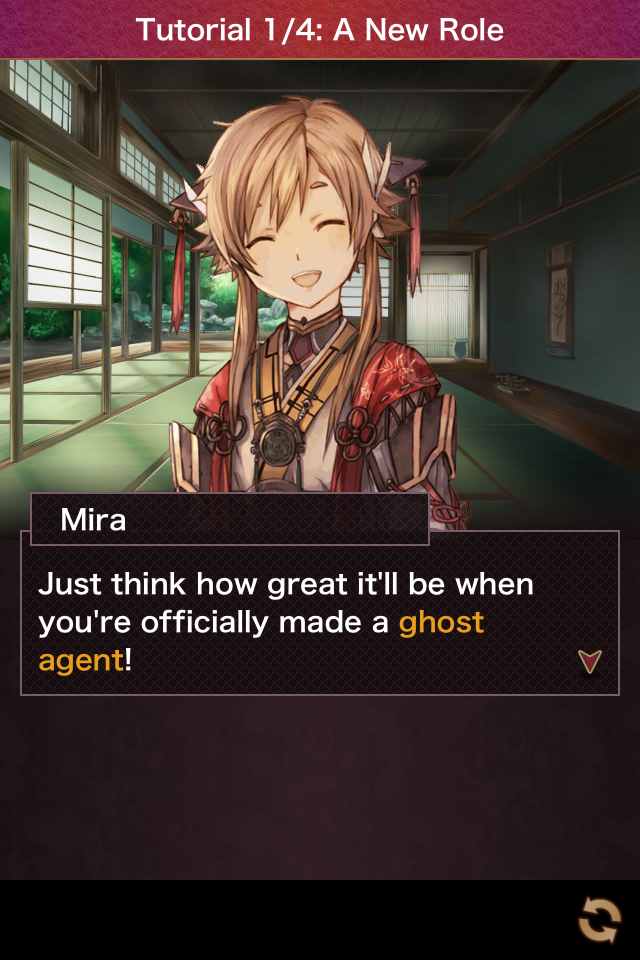
Anyway, I digress; Ayakashi: Ghost Guild is a card-battling title from Zynga, and it follows the outline above to the letter. It's clear that the specific developers behind it have examined what makes early trailblazers tick — many of which, like the inexplicably popular Rage of Bahamut, are very rough around the edges — and then given the whole set of proceedings a pleasing coat of paint. Where Rage of Bahamut is silent throughout, Ayakashi: Ghost Guild has an atmospheric, context-sensitive soundtrack; where Rage of Bahamut's story is completely throwaway and irrelevant, delivered via blocks of text that most players will ignore completely, Ayakashi: Ghost Guild makes an effort to introduce characters and an unfolding narrative with first-person visual novel-style scenes; where Rage of Bahamut's interface resembles a Geocities website from the late '90s… Ayakashi: Ghost Guild's interface resembles a Geocities website from the late '90s designed by someone who owns a copy of Photoshop. (You can't have everything.)

The thing that I've found most obnoxious about these games in the past is their seeming total lack of gameplay. But have I been giving them a fair shot? I have delved into Ayakashi in some detail over the past few days in an attempt to try and understand the appeal a little better, and I'm still not quite sure that I've made my mind up.

For those who haven't played one of these games before, allow me to give you a rundown of how play works, with specific regard to Ayakashi. You start by picking a card, usually from one of three different types that have particular strengths and weaknesses. Cards have an attack rating, a defense rating and a "spirit" value. They also generally have some lovely (and usually rather boob-heavy) Japanese-style artwork on them. Ayakashi: Ghost Guild does not disappoint in any of these regards.

Following this, there are two main components to gameplay — the single-player component, referred to in Ayakashi as the "Story" mode; and the multiplayer component, described simply as "Battle" mode.

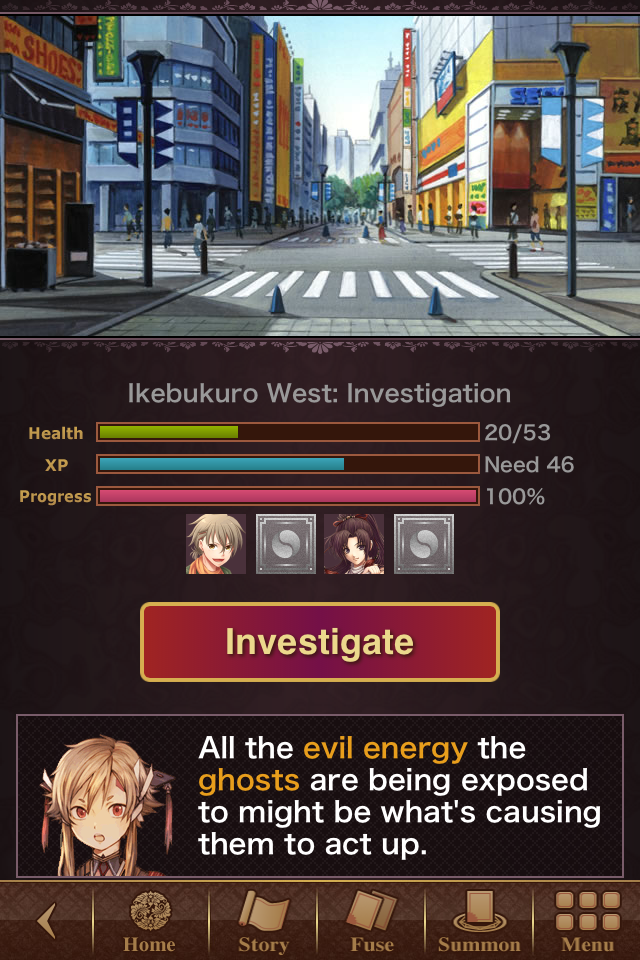
In Story mode, you're presented with a series of linear chapters to work through. To work through a chapter in Ayakashi (and, indeed, in all other games of this type) you simply press a button. At this point, several things happen: an animation plays, you lose some health, you gain some experience and you gain some progress in the chapter. Occasionally you will discover an item or a card — each chapter usually has a set number of hidden items which are clearly marked and discovered completely by chance — or run into another player, at which point you can add them to your "crew" if you have enough slots left. If you fill up the chapter's progress bar, you're given a story scene and can then move on — or stay behind if you want to try and collect the remaining items — and if you fill up the experience bar, you gain a level, gain some points to spend on your basic stats and refill your health to full. Your first few levels give you more health than is needed to level up a single time; after you reach about level 8 or 9, however, you'll either have to wait for health to regenerate (at the rate of 1 point per minute) or purchase restorative items using "Gold", a currency which may only be acquired through in-app purchases. Generally speaking, health is exchanged for experience at a 1:1 ratio; as the story progresses, the health cost and related experience gain for a single press of the "Investigate" button increases.

When levelling up, you have three stats to power up: health, which upgrades the amount in your health pool, allowing you to play Story mode for longer; Attack Spirit, which determines the cards you can hold in your "attack deck" for Battle mode; and Defense Spirit, which determines the cards you can hold in your "defense deck" to protect yourself against attacks from other players when you're not there.

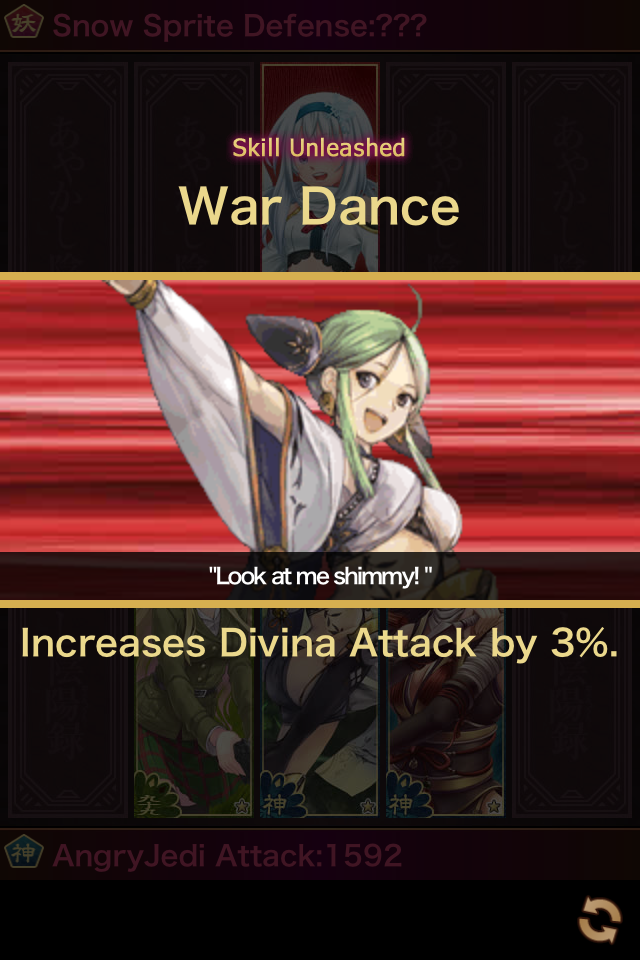
Battle mode consists of you picking an opponent and then letting your attack deck compete against your opponent's defense deck. Some cards have special abilities which boost their base attack and/or defense power, and these are triggered at the start of battle. Following this, the winner is automatically determined with no interaction required from the players. This allows battles to unfold without both players having to be present. After a battle, your available Attack Spirit is depleted by the spirit value of the cards you used, meaning at least initially you can only do one battle at most in a single session if you use your most powerful cards — and why wouldn't you?

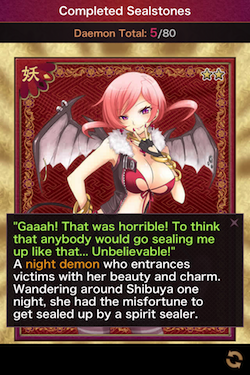
There's a reason to play Battle mode in Ayakashi — the collection of Sealstones. If you collect all of the colours of a particular Sealstone set, you'll get a rare card that is usually significantly more powerful than the ones you just find naturally in Story mode. Beat another player in Battle mode and you get to steal one of the Sealstones they have — but naturally, others will be trying to do the same thing to you, meaning you'll have to leave a strong defense deck behind in order to ensure they don't get nicked while you're not playing. You can also, you guessed it, buy special items with that in-app purchase currency Gold to protect your Sealstones against being half-inched by randoms.

Despite being a massively-multiplayer game, direct interaction between players in Ayakashi is, like most other games of its type, very limited. You can add a limited number of other players to your "crew", with the limit increasing as you level up. When you add a new crew member, you get more ability points — more than when you level up, in fact. You then have the option of "poking" or commenting at them once per day, and are rewarded with "Summon Points" for doing so. Collect ten Summon Points and you can get a free, usually shit, card. You can also get two additional free, usually shit, cards per day — one at any time, the other only at lunchtime.

Those free, usually shit, cards have a use, though — fusion. By picking a card to enhance and then choosing up to ten "material" cards to fuse with it, you can level it up, which increases both its attack and defense power and often makes any special abilities it has more effective, too. Some free, usually shit, cards are specifically designed purely for fusion purposes as they are otherwise terrible but provide massive experience point boosts; in other cases, ensuring you fuse cards of the same "type" (ideally identical ones) together nets you the biggest bonuses. Fusion costs in-game money to perform, though it's the type of money you can earn in the game very easily without having to spend real cash — the game bombards you with it throughout Story mode and you can sell those free, usually shit, cards you've been building up over time.

That's about it. You grind through Story mode, stopping when you run out of health (or until you purchase more if you just can't wait); you twat another player or two in the face to nick something, then you set the game down for a few hours and come back later. Then you repeat the process.

Is that fun? I'm honestly not sure. There is a certain degree of satisfaction to gradually levelling things up and making them more powerful — progress bars are, as we all know, a powerful motivational tool. The fact that Ayakashi has actually made an effort with its story makes it considerably more interesting than most games in this oversaturated genre, too. But the lack of interaction bugs me somewhat; if I'm supposed to be "investigating" a location, I'd like to be actually doing that investigating, not just tapping an "Investigate" button over and over again. If I'm fighting an opponent, I'd like to do more than simply sit back and let the battle resolve itself.

On the other hand, there's an argument that all Ayakashi and its numerous competitors are providing is the same experience you'd get from a "proper" MMO, albeit stripped down to its most bare essentials. What do people like to do in MMOs? Level up, so make that easy. What else do people like to do in MMOs? Compete against other players, so make that easy too. What these games are in effect doing is stripping down the conventions of MMOs into something that is a lot more friendly to mobile gamers' lifestyles — you can pick up Ayakashi for five minutes and "accomplish" something, whereas to do the same in, say, World of Warcraft or Guild Wars 2 takes a lot longer. But in that longer amount of time, you actually get to do stuff.

As I say, after having spent a bit of time with Ayakashi in particular, I find myself a little conflicted. With Rage of Bahamut, I felt justified in my dislike; it's a poorly put-together, amateurish effort that actually felt quite insulting to play. With Ayakashi, meanwhile, Zynga has taken the time to do its usual spit-and-polish routine to make something that isn't outright embarrassing to play from a presentation perspective. I'm just not entirely sure there's a game worth playing — much less paying for — beneath the glitz.

I will feel even more conflicted when the Persona 4 card-battling game eventually makes it to Western app stores.