#oneaday Day 650: Games for Children

I read an article earlier that annoyed me a bit. I'm not going to link to it partly because I don't want to send any particular ire in the author's direction, and partly because it wasn't this specific article that annoyed me, but rather a common talking point that it used as its central thesis.

The relevant quote is this (and I'm aware this is probably as good as linking to it, but whatever; statistically speaking, most people probably can't be arsed to search for it, and the rest think asking an AI will get them a meaningful answer. That latter group are wrong and cunts, by the way.):

I think we need to start acknowledging that too many adults are evaluating games like they're up for the Booker Prize when instead they're well-constructed children's books. We don't need to pretend. We'd be better off being real.

This argument primarily came about because some folks have been looking at the recent Pokémon game, Pokopia, as a reflection on life in a world without humans, and life in a world living with the results of climate change.

The thing with art is that it's a subjective thing. There's authorial intent, to be sure, but there is also the very specific, very personal reaction that someone has to something. And that comes from somewhere. And if multiple people are saying the same things, independently of one another, there's clearly something in the work that speaks to people who are on a particular wavelength.

With that in mind, I feel like it's the height of arrogance to describe something as being childish, which is the main core argument that annoys me not just about this piece, but about other thinkpieces along these lines. Sure, Pokopia is a game designed to be sweet and colourful and friendly to kids or inexperienced gamers, but that doesn't mean it's completely incapable of saying something.

I add to this: being aimed at children does not mean something has lesser value, either. There's a vast canon of "children's literature" out there that is well worth reading by adults today, because it stands up not as "books for kids", but simply as well-crafted stories. Another objection I have to the argument above is that by using a phrase like "well-constructed children's books" as a diminutive, reductive way of talking about things, you are, by extension, implying that nothing designed for kids can have any broader cultural value.

It's an ongoing thing that certain portions of Terminally Online people in particular like to bring up: that Games Have Bad Stories. And it's bollocks! Just as in any medium, there are games that do have bad stories, yes, but there are also many, many examples of those that have good stories. Great stories, even. The implication behind the sentence "too many adults are evaluating games like they're up for the Booker Prize when instead they're well-constructed children's books" is that "games, as a medium, will never have the same value as another medium that I consider inherently more valuable".

I haven't played Pokopia so I can't comment on the specifics of that case. But I can comment on a vast number of other games that very much are worthy of exploring with detailed critique and analysis. I write about many of them over on my other site, MoeGamer! The most recent thing I have written about over there at the time of writing is the incredible Esoteric Ebb, a game that is about as far from being a "well-constructed children's book" as it's possible to be. (And yes, I know I said I wouldn't pick on that article specifically; it just so happens that this particular quote is especially symptomatic of the issue I'm talking about.)

The core thesis of the piece in question is that "we all need to be more honest" when we're talking about games. And I don't necessarily disagree with that. There's a lot of criticism out there where people look at a game and complain about something that it isn't — and which, in many cases, it has never purported to be — rather than evaluating whether or not it was successful at what it was actually trying to do, whether that was implicit or explicit. (I wrote about this back in 2013 on USgamer, now archived on MoeGamer. If you want to know more, look up John Updike's rules for literary criticism.)

But "being honest" doesn't mean that you just go "ah, games are all just children's books, not like real literature and art" and be done with it. Critical, artistic and literary analysis has a place in writing about the medium, whether the subject under discussion is something as seemingly breezy and lightweight as Pokopia, or something as dense and philosophical as Esoteric Ebb.

Video games have been around for a very long time now — and, moreover, using the medium as a means of storytelling is now very well-established in its own right. At some point, the thing we need to "be honest" about is the fact that the medium as a whole is mature, and that there's absolutely no problem with treating it as such.

If you want to treat video games as nothing more than a throwaway bit of fluff that makes you feel better of an evening, I'm not stopping you. There is great value in having something you enjoy that you don't need to engage with on a level beyond "I like doing this because it makes me feel good". But don't throw around "we all need to" like it's some great unacknowledged, universal truth. If someone finds greater artistic, creative value in something and you just don't see it — perhaps just be honest, say you don't get it yourself, and move on. No need to tell everyone else that they're doing it wrong.


Want to read my thoughts on various video games, visual novels and other popular culture things? Stop by MoeGamer.net, my site for all things fun where I am generally a lot more cheerful. And if you fancy watching some vids on classic games, drop by my YouTube channel.

If you want this nonsense in your inbox every day, please feel free to subscribe via email. Your email address won't be used for anything else.
2212: The Stat Connection

0212_001

"Go to your Stats page and check your top 3-5 posts. Why do you think they’ve been successful? Find the connection between them, and write about it."

Daily Post, February 9, 2016

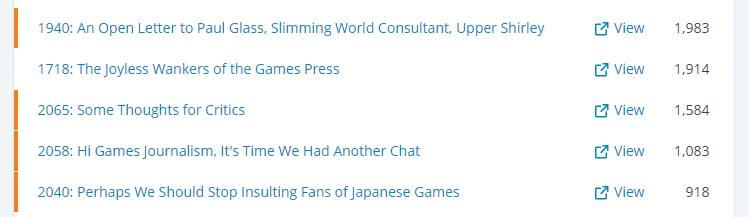
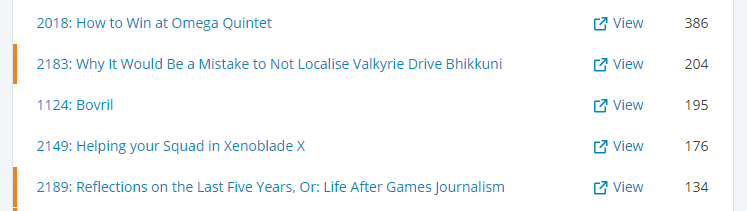
All right. Let's have a look, then. Since we're not that far into 2016 and WordPress doesn't appear to have an "all time" function to search top posts, I'll provide the top five posts (excluding the homepage, which makes up the majority of pageviews but doesn't tell me much) for both 2016 so far and 2015. In other words, these are posts that people saw the title of (probably on social media or via a search engine) and directly clicked through to, rather than simply checking my front page each day.

Here's 2016 so far:

blog2016.png

And here's 2015:

blog2015.png

All right. So let's get analysing.

Since I write about a wide variety of topics on this blog — regular readers will know that it's my personal outlet for venting about whatever is on my mind on any given day rather than any attempt to provide a coherent editorial experience — it's perhaps not surprising that not all of the entries in these two lists have something in common, but there are a few common themes along the way.

How to Do Stuff

Let's look at 2016, first. Both How to Win at Omega Quintet and Helping your Squad in Xenoblade X were written in 2015 (indicated by them not having the orange bar next to them), yet have remained consistently popular since I wrote them. The reason for this is that they are instructional content: guides for video games. Instructions or guides are consistent traffic magnets, regardless of the subject matter of your site, because one of the most common things people search the Internet for is how to do something. Video games sites often use guide content for current popular games to attract visitors to their site and guarantee a baseline of ad revenue, then cross their fingers that readers will click through to other, less "baity" content. It doesn't always work like that, of course, which is why we've seen a rise in deliberately provocative "clickbait" content across the board, not just in games journalism.

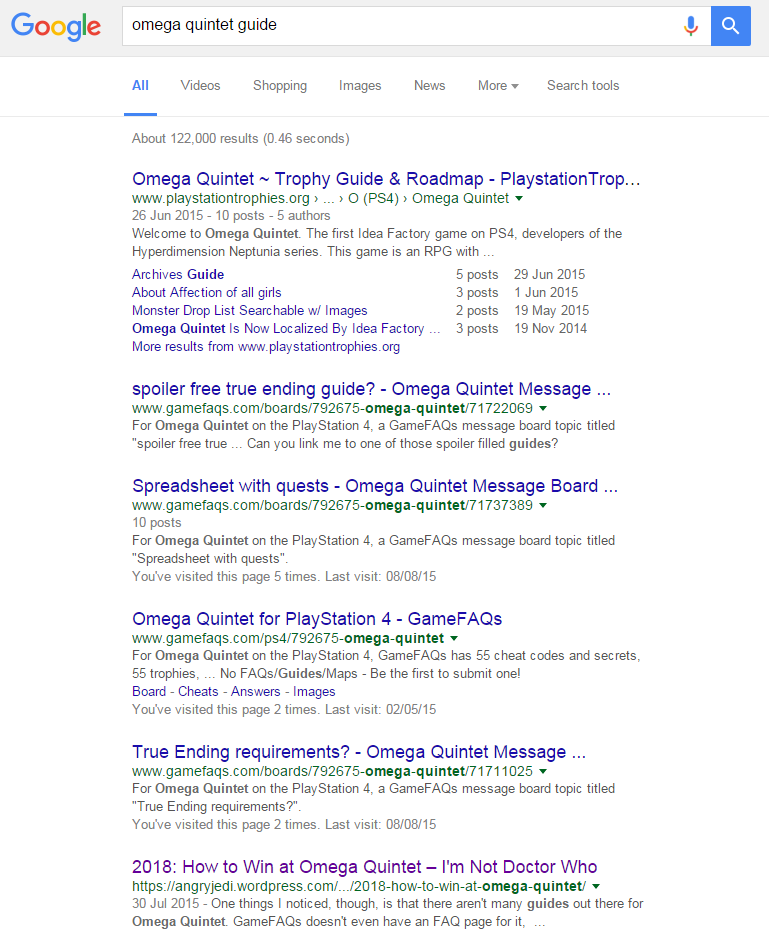
Anyway. The reason that my guide content for both Omega Quintet and Xenoblade X proved popular is that these were both games that had a specific audience, but neither of them were "big" enough for a commercial site to want to devote time and column inches to them. In other words, those searching for help when playing Omega Quintet and/or Xenoblade X would be out of luck when searching the big video games sites, but a cursory Google search would doubtless throw up my posts here fairly early on — indeed, at the time of writing, my post on Omega Quintet appears sixth in my (admittedly personalised) Google search results, embarrassingly with a typo in the preview text which I have now corrected:

omegaguidegoogle.png

It's for this reason that a couple of my other previous posts have proven popular over time: my post on How to Play Pocket Academyfor example, detailing the baffling and frankly illogical mechanics of Kairosoft's mobile-based school sim, rode high in my rankings for quite some time. I tell you: if you want traffic, write posts that tell people how to do stuff, and preferably how to do stuff that mainstream sites haven't covered.

The Power of Sharing

My most popular posts are always several orders of magnitude more popular than their nearest rivals, with perhaps the most impressive example being 2015's An Open Letter to Paul Glass, Slimming World Consultant, Upper Shirley. This post was pretty far from my more regular subject matter on popular media, particularly video games, and yet it was my most popular individual post for 2015. Why? Because it had the absolute shit shared out of it.

Paul Glass was the consultant at our local Slimming World group when I first joined, and his enthusiasm and belief in the programme was and is a big part of why I've stuck with it and had so much success over the course of the last year — I've lost six stone in a year, hopefully with more still to come off. When he revealed that he would be leaving the group to spend more time with his family in far-off climes, I felt it important to express my feelings about what he had helped me accomplish in such a way that I could be clearly understood. I'm shy and socially anxious by nature, and at the time I wrote this I'm not sure how confident I would have felt saying all those words in person, but writing them down on paper is no big deal: I can "fire and forget" that way.

Something told me that I should probably share this post a little wider than just my Twitter followers, though, and so I decided to make one of my extremely irregular visits to Facebook to post a link to the letter on the Facebook group for the Slimming World group in question. That one simple action caused that one single post to absolutely explode in popularity, as it was shared by group members, Paul himself, and subsequently by other people I'd never met involved with Slimming World in various capacities, either as group members or staff.

You never can quite tell what the next big viral sensation is going to be, but there is one thing that all my popular posts do tend to have in common:

The Passion of the Post

It is, I feel, no coincidence that my most widely shared, most popular posts are those in which I feel most passionate about the things that I am writing about. I am a person who, I feel, can express their passion for something pretty clearly through my writing. And indeed, due to the aforementioned shyness and social anxiety mentioned above, I find writing to be the easiest means through which I can express that passion to an audience that can — hopefully — appreciate what I'm saying, or at least respect it.

2015's most popular posts were all about passion, from my letter to Paul to Perhaps We Should Stop Insulting Fans of Japanese Games. Four out of the five posts above were about video games — four out of the five posts were pretty much about the same thing, in fact, which was critics' regular dismissive and unfair treatment of both Japanese game developers and the fans of the games they make — but these posts all resonated deeply both with myself and with the circle of friends I've cultivated on social media, most of whom share the same interests as me.

Consequently, much as my letter to Paul got shared far and wide, so too did The Joyless Wankers of the Games Press (actually written the year before in response to an absolutely atrocious review of Fairy Fencer F on my former stomping grounds of USgamer), Some Thoughts for Critics (a response to Jim Sterling's dreadful and ill-informed review of Senran Kagura 2), Hi Games Journalism, It's Time We Had Another Chat (a response to Mike Diver's equally dreadful and ill-informed review of Senran Kagura 2, a game which is a ton of fun but which proved to be a whipping boy for self-described "progressive" types on the grounds of the female characters' big jiggly breasts) and the aforementioned Perhaps We Should Stop Insulting Fans of Japanese Games (a response to an extraordinarily narrow-minded editorial on USgamer by my former editor Jeremy Parish, and almost certainly the reason he has me blocked on Twitter). I saw these posts get shared and reshared, not only on Twitter, but also on Facebook and Reddit, the latter of which I don't really use myself.

The things I had written had clearly got the strength of my feelings across, and other people felt like they could relate to them in some way — either agreeing or disagreeing — and this caused them to explode in popularity, at least in terms of numbers. The same, too, can be said for 2016's Why It Would Be A Mistake to Not Localise Valkyrie Drive Bhikkunian impassioned plea for the progressive loudmouths not to stop Senran Kagura creator Kenichiro Takaki's new game making it over to Western shores.

Bovril?

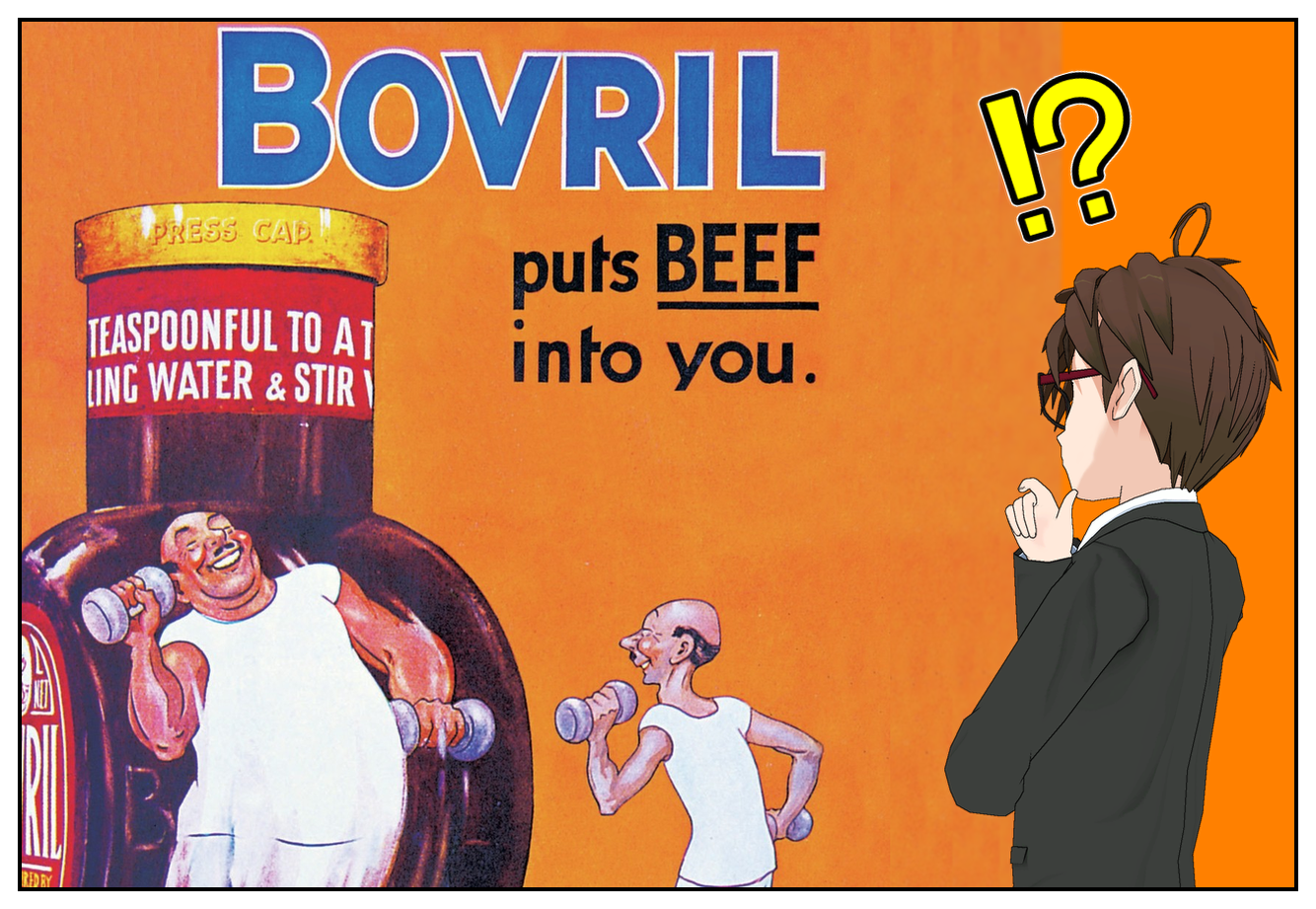
I'll be honest, I have no idea why a post from 2013 about beef-and-yeast-extract black sticky substance Bovril is my third most popular post this year so far, but oddly enough this post has been consistently popular: it finished 2015 in sixth place, just after my various rants at the games journalism industry and also ranked sixth in 2014, but only managed 19th place in its original year of publication.

It's not even a particularly exciting post: it simply describes what Bovril is and how I feel about it. It doesn't even appear on the front page of Google results for Bovril. But I guess it meant something to someone somewhere. Perhaps not many people write about Bovril on the Internet, and my post offered a safe space for Bovril fans to convene and share in silent contemplation of salty beef drinks. Or perhaps it's just one of those things that can't quite be explained.

So what can we learn from this?

There are a few things you can probably see my most popular posts have in common. To my eye, these things are:

  • A clear, conversational title that makes it clear what the post is about — i.e. a simple subject line rather than a "title" that tries to be clever or funny
  • Passion for the subject — clear emotion, either positive or negative, is infectious and relatable
  • Scope for sharing — be it a topic that a lot of people feel strongly about, or something that is written in such a way that presents a strong argument in favour of or against something
  • Complete honesty — even at the expense of a few "bridges" if necessary
  • Instructions on how to do stuff — particularly if nowhere else has published instructions on how to do that stuff

Not all of my most popular posts have all of the above elements — although I do make a specific effort to apply the "complete honesty" element to everything I write — but these are, by far, the most common factors that all of my most popular posts have between them.

I hope that's proved as enlightening for you as it has for me: it's certainly given me some food for thought with regard to what to write about going forward from here, so I'd say both as a writing exercise and an analytical investigation, this post has been a great success.

Thanks, Daily Post!