#oneaday Day 879: Pocket-sized

I mentioned a while back that I had got an Analogue Pocket, and I don't think I've written much about it as yet. So I might as well do that tonight!
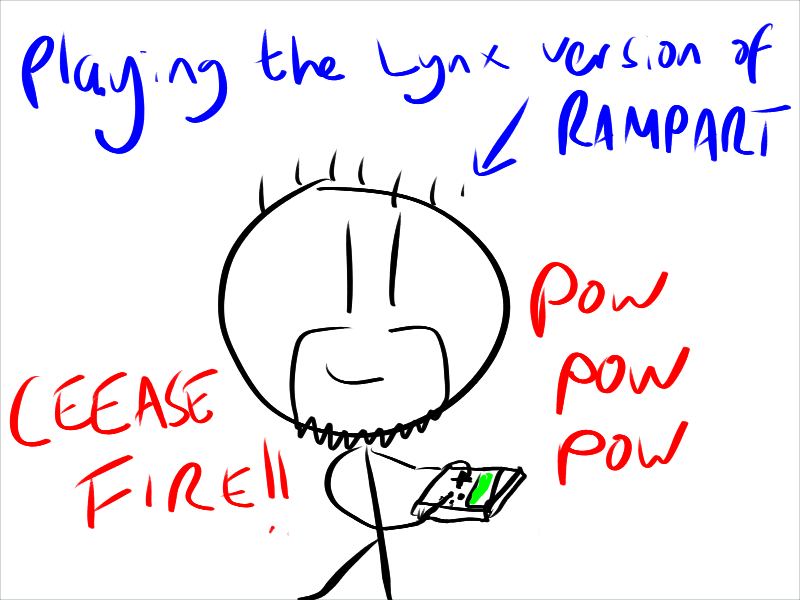
The Analogue Pocket, for the unfamiliar, is a premium-grade (i.e. quite pricy) retro gaming handheld, fashioned in a similar mould to Nintendo's classic Game Boy (i.e. it's a vertical handheld) and featuring four face buttons (plus Start, Select and a Menu) button and two shoulder buttons. It features a cartridge slot that takes Game Boy, Game Boy Colour and Game Boy Advance cartridges, and can play these right out of the box. With optional adapters (which appear to be perpetually out of stock) you can also play Game Gear, NeoGeo Pocket Colour, Atari Lynx and PC Engine/Turbografx-16.

Analogue Pocket has a couple of distinctive selling points. The first of these is its inordinately high-resolution (1600×1440) screen, which you might think is the last thing you need for retro games, but in fact it makes its benefits very clear almost immediately by accurately simulating the classic displays of the aforementioned handhelds — including the distinctive "dot matrix" look of the original Game Boy, the visible scanlines of the Game Gear and Lynx, and the "grid" pattern of the original Game Boy Colour screen. You can turn this feature off if you want, but it's implemented so well that it really does recapture the feeling of using the classic systems.

The second is that it is not a cheapo emulator handheld like the stuff from companies like Anbernic. It's an FPGA device, which means it emulates systems on a hardware level rather than simulating them in software. This, in theory, leads to much more accurate recreations of how the various systems work. Cores for the systems that take the aforementioned cartridges are built in to the Pocket, but the latest firmware updates allow you to install "openFPGA" cores on there, too, and these can be used with ROM files as well as original media. The openFPGA cores also cover consoles and computers as well as handhelds, allowing you to turn the Pocket into a portable powerhouse if you so desire — particularly if you pair it with its optional dock that allows you to connect it to a TV and use external peripherals.

It's an absolute delight to use. After a bit of fiddling around to get it set up — much less than a MiSTer, particularly now there are helpful tools available, though of course you have to avoid the AI shit — it's a wonderful bit of kit. Quick to start up and jump into a game on any of the supported systems, and pretty much flawless performance on almost everything I've played. The only games I've had issues with are a couple of Lynx titles — Gauntlet: The Third Encounter has some iffy screen tearing due to an odd refresh rate (plus the core doesn't seem to support display modes when you rotate the screen, as is necessary for that game) and Rampart refuses to display the image that is supposed to come up before the "rebuild" section but is otherwise fully playable — and everything else has been just as if I'd bunged in a real cartridge and was playing on a real system.

Its ease of use and portability means that I'm very likely to pick it up and just have a play with it when I'm at a loose end — and in doing so I've already discovered some delightful handheld games that I'd like to play more of. Plus SNES, Mega Drive and PC Engine games look amazing on it.

In short, this thing wasn't cheap, but it was a very worthwhile investment. If you enjoy handheld and retro gaming, I highly recommend one.


Want to read my thoughts on various video games, visual novels and other popular culture things? Stop by MoeGamer.net, my site for all things fun where I am generally a lot more cheerful. And if you fancy watching some vids on classic games, drop by my YouTube channel.

If you want this nonsense in your inbox every day, please feel free to subscribe via email. Your email address won't be used for anything else.
#oneaday Day 866: In the palm of your hand

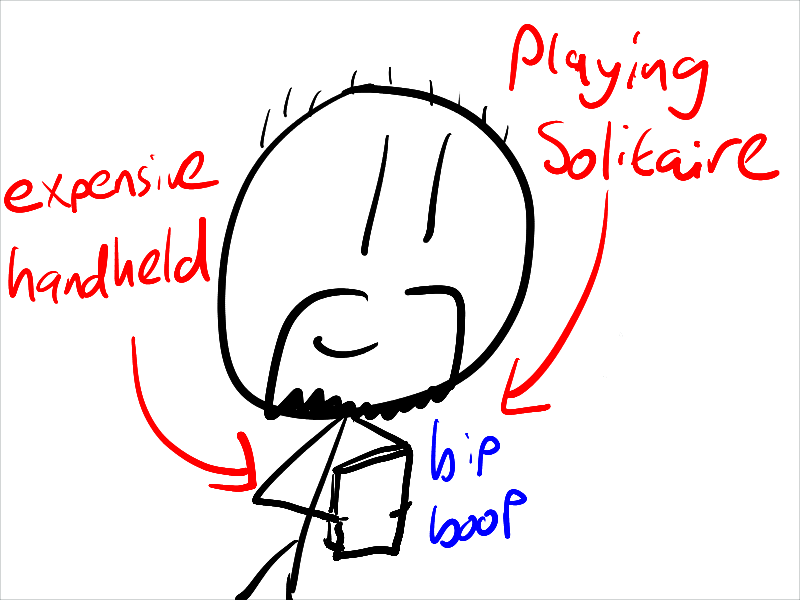
I've had my Analogue Pocket a couple of days now, and I really like it. So what is the game I have played the most on it so far? It is, and this is genuinely not a joke, Solitaire FunPak by Beam Software for original black-and-white Game Boy. (Apparently a Game Gear version also exists, but I haven't tried that yet.)

Given that "handhelds" these days are just as capable as TV-connected consoles, it's easy to forget that they were once quite a distinct breed. That's not to put them down or anything; there are plenty of games for even early-ish handhelds like the Game Boy that you can sink hours into. But there was, at one point, a marked distinction in both the technical capabilities of handhelds compared to their TV-connected big brothers, and the way in which games were designed for handhelds versus TV-connected consoles and desktop computers.

You've probably heard someone — perhaps even me! — say that something makes "a good handheld game", but what does that mean? The specifics have changed over the years, but one thing has remained fairly constant: the best handheld games are things that you can boot up quickly, play for a few minutes to either pass the time or as something to do with your hands while you do something else, then set aside without feeling any sort of "obligation" to keep investing large amounts of time into it.

This could mean any number of things. This could mean simple arcade-style score-attack games. This could mean platformers with short, snappy levels like the Super Mario Land series. This could mean shoot 'em ups. Or, indeed, it could mean board and card game adaptations.

Back when Game Boy was current, I suspect a lot of people would have looked upon something like Solitaire FunPak for Game Boy as not worth bothering with; spending a relatively large amount of money for something you could just do with a pack of cards. But now, with how easy it is to load up a device like the Analogue Pocket or a Chinese emulator handheld with games, these titles show their value: they are good handheld games!

I've actually secretly known this for some time. Not specifically that Solitaire FunPak is a good time, but that simple board and card games make for good handheld entertainment. The game that converted me in this regard was Nintendo's 42 All-Time Classics for Nintendo DS, also known as Clubhouse Games in America, because Americans can't count or something. I don't remember exactly what made me pick this up back in the day, but I do remember being very pleasantly surprised at how enjoyable it was when I booted it up and spent some time with it. Plus the built-in Pictochat and single-cartridge multiplayer made it super-easy to play with others.

So in retrospect, I'm not surprised that I'm having a good time with Solitaire FunPak, which is a solid implementation of exactly what it offers in its title: a selection of solitaire card games, which you can play either individually or as a "tournament" in an attempt to attain the highest score possible. Even if you just play Klondike, there's plenty of value to be had here, but you have a bunch of other fun games to play, too, and they all work well with both the simplistic visual presentation afforded by the Game Boy's limited capabilities, and the likewise straightforward controls.

This is exactly what "a good handheld game" is — and, being on a device that isn't connected to the Internet, and whose games are completely self-contained affairs that don't need updates, you can just relax with it without the possibility of distractions. And it's so nice to play something that is designed as a simple pastime, and which hasn't been monetised out the wazoo or engineered to manipulate your "engagement" into playing for longer, thereby getting you to look at more ads.

Would I have bought Solitaire FunPak back in the day when I had a Game Boy? Probably not, although if I had I suspect I would have actually had a decent amount of fun with it. Am I having fun with it now, though? Most definitely. And I think I might just go play a game or two while I run myself a bath this evening…


Want to read my thoughts on various video games, visual novels and other popular culture things? Stop by MoeGamer.net, my site for all things fun where I am generally a lot more cheerful. And if you fancy watching some vids on classic games, drop by my YouTube channel.

If you want this nonsense in your inbox every day, please feel free to subscribe via email. Your email address won't be used for anything else.

#oneaday Day 864: Grab bag

It has been a fairly boring day, so I will attempt to make it more interesting by talking about several things. Look at me go!

First up, my Analogue Pocket arrived today. Did I need another retro gaming handheld, particularly one that is quite pricy (and extremely pricy when you add the extortionate shipping and customs charges that come with getting one shipped to the UK)? No, of course I didn't. Did I get one anyway? Yes, of course I did. I have been interested in the Analogue Pocket ever since it was first announced and immediately sold out, so I have always been keeping an eye out for them becoming available again. As it happens, they became available again and I was in a position to be able to buy one without guilt, so that's exactly what I did.

I don't have a lot to report on it so far as I've only really set it up and given it a quick try with a few games so far. I am impressed from the little I've seen, though; the extremely, extremely high resolution screen means that it's capable of doing some wonderful display effects to recreate things like the original Game Boy's dot matrix display and the distinct "line" patterns on things like the Lynx and Game Gear displays. It can also do a nice Trinitron CRT simulation, as well as a number of other "generic" effects — or you can mix things up a bit, like applying a simulation of the DMG Game Boy screen onto something that would not have used that!

I'll doubtless have a lot more to say about it in the near future, but suffice to say for now that this thing seems to be built like a tank in handheld terms, and setting it up to use the MiSTer-style openFPGA cores using an application called PocketSync was quick and easy. PocketSync also takes care of things like downloading BIOS files, so it really is just a few clicks to get the thing set up to load any ROM you'd care to name on one of the supported platforms. It's nice to have the option for original cartridges, though, which was the Analogue Pocket's original unique selling point.

Anyway, that's the Pocket. Like I say, I'll do a more detailed writeup about it in the near future, as it's worth exploring in depth, I think. I'm particularly intrigued to try the nanoloop music creation software that comes built-in. It seems fiddly at first glance, but I'm sure once you get your head around the various button controls and know what everything does, it will become much more usable.

What else has happened today? I tried some American flavours of sugar-free Monster that one of our local convenience stores (the one we call "Funny Shop" to distinguish it from the nearby Tesco Express, and in homage to the fact that it sells unusual imported food products from around the world as well as domestic products) and they were both actually very nice. I tried the "Ultra Red White and Blue Razz" one, which is obnoxiously "patriotic", but, as the name suggests, just tastes of blue raspberry, while the Ultra Sunrise flavour might, in fact, be my all-time favourite Monster; it tastes like actual oranges. Not like orange soda flavour, like an actual orange. Highly recommended. I hope we see it more "officially" over here at some point; in the meantime, I will be counting on Funny Shop to keep me stocked.

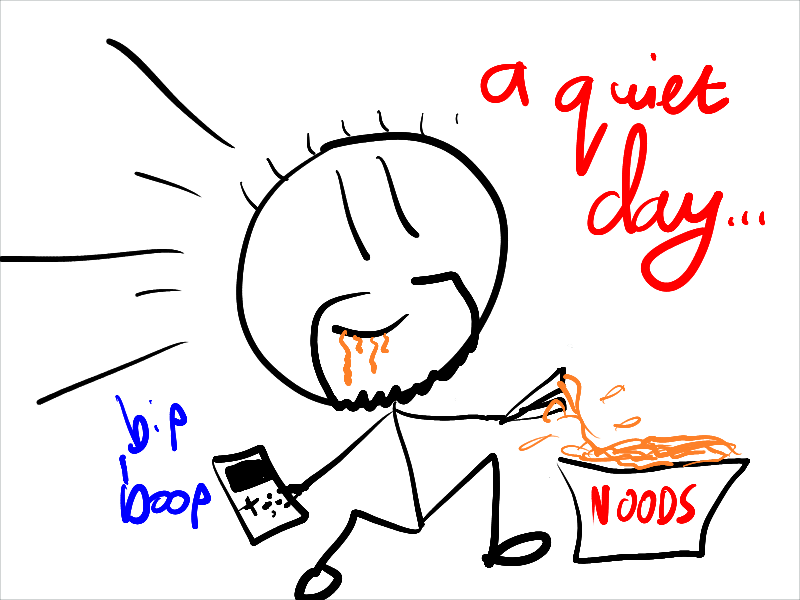
I also tried the Taco variant of Buldak noodles. I have mixed feelings on this. It had a pleasant Mexican-esque smell once the powder and sauce went in, but in terms of flavour it was mostly overwhelmed by the Buldak hot sauce. The "flakes" pouch also contained some of the most unidentified foodstuffs I think I've ever seen. There was something that I assume was supposed to be a bit like taco meat, but I have no idea what it actually was, and it didn't really taste of anything. I am yet to find a Buldak variant that beats the regrettably discontinued Curry flavour, though the sweet fried chicken one is pretty good (yes, that means it is a sweet fried chicken flavour hot chicken flavour noodle) but seemingly getting a bit harder to find. I also tried the Rosé one the other day and had trouble distinguishing it from the Carbonara variant. It was nice, to be sure, and I'll probably seek it out again, but I'm not sure how it distinguishes itself from Carbonara.

Well, that's my day. I think a bit more handheld play is in my immediate future…


Want to read my thoughts on various video games, visual novels and other popular culture things? Stop by MoeGamer.net, my site for all things fun where I am generally a lot more cheerful. And if you fancy watching some vids on classic games, drop by my YouTube channel.

If you want this nonsense in your inbox every day, please feel free to subscribe via email. Your email address won't be used for anything else.