#oneaday Day 629: Another site falls to AI

Earlier today, a review was being shared around. It was a featured review on Metacritic for the new Resident Evil Requiem, and it was very obviously AI-generated — both in terms of the review text itself, and the image and biography of the completely fictional author.

Now, I know there is plenty we can criticise Metacritic for, but to the site's credit, after being made aware of the situation, the review was not only pulled from Metacritic, but the site in question was blacklisted from being featured on there for future reviews, too.

The site in question was VideoGamer.com — not a site I ever particularly frequented, but one that has been around for many years, and one of many, many old games press brands that have been bought up by private equity and turned into sites filled with AI-generated drivel, usually in the form of undisclosed advertorial features pointing people towards shady gambling sites. VideoGamer is not the first site to fall in this way; previous victims have included AdventureGamers and The Escapist, and there are almost certainly countless more that we haven't found as yet.

My initial reaction to anything like this happening is to ask "why?"

Why are once-good sites being replaced with AI-generated drivel? Who do they think is reading this stuff? Why do the people in charge of these hollowed-out husks of websites think this is, in any way, a good idea?

The answer, of course, is that this is the natural endpoint of SEO-driven online writing. The sole reason these articles exist is to get people to click on them and generate advertising revenue for the site's owners. And if they can do that without having to do anything silly like pay actual people to write actual articles, so much the better! (Although the more astute among you out there may well point out that being an AI power user probably doesn't end up much cheaper than hiring an actual person — particularly in the games press, where, as Mat Jones of IGN put it earlier today, "games freelancers will turn in 2,000 words for an egg sandwich". I wish it wasn't true.)

Couple this with the news that Eurogamer and surrounding sites are suffering some considerable layoffs and things do not look altogether rosy. I also learned that VG247 is now little more than an SEO guideslop site; I never really liked that site all that much, but since most of my USgamer stuff ended up archived there after USgamer itself closed down, I do have a certain attachment to it.

The frustrating thing for me is that all this seems so unnecessary. Video games, as an industry, creative medium, art form, whatever you want to call them, are huge. One would assume that would mean they would need a specialist press around to cover them effectively, but given that so many sites have been gutted over the last few years — and, in many cases, replaced with AI slop — something doesn't quite seem to add up.

Sure, we've seen the rise of sites like Aftermath, who do good work, and it was gratifying to see Giant Bomb successfully extricate themselves from their former corporate overlords — full disclosure: I subscribe to both to support them — but neither of them quite take the place of what we used to have. And you can interpret that however you will, because the same is true if you think I'm referring to traditional "news, previews and reviews" websites, or if you think I'm referring to magazines. (Spoiler: I'm talking about both.)

Part of this feels like an extension of the whole "New Games Journalism" discussion we had in the latter-day 1up years. And while that discussion went to some odd places, I do acknowledge that there is some valuable work going on over at a number of worker-owned, reader-supported sites, particularly when it comes to telling the stories of people who work in games. But sometimes you just want to read something simple like what someone thought of a game you're interested in, y'know? And that side of things seems to very much be a dying breed.

One might argue that there's less need for that, what with social media, online discussion and "influencers" (you will never get me to not use scare quotes around that odious term) dominating the way games are promoted online these days. But I still like to read a straightforward review of something — and the continued existence of Metacritic, as flawed as it is as a concept, suggests that there's still a place for that sort of thing.

I can't help but wonder where all this will end up. With people starting to get interested in physical media once again, I would love to see proper magazines become a thing again. I suspect that won't happen, but we certainly can't go on like this. Can we? This feels like how you actually end up with a completely dead Internet.


Want to read my thoughts on various video games, visual novels and other popular culture things? Stop by MoeGamer.net, my site for all things fun where I am generally a lot more cheerful. And if you fancy watching some vids on classic games, drop by my YouTube channel.

If you want this nonsense in your inbox every day, please feel free to subscribe via email. Your email address won't be used for anything else.

#oneaday Day 557: How to torch universal goodwill with one simple interview

Today, Larian Studios, makers of the Divinity series and the universally acclaimed Baldur's Gate 3, found itself in the crosshairs of the Internet's ire due to comments made by its CEO, Swen Vincke during an interview with Bloomberg.

According to Vincke, Larian has been using generative AI behind the scenes to, in his words, "explore ideas, flesh out PowerPoint presentations, develop concept art and write placeholder text". None of which are things you need generative AI for, and all of which are things that people have been perfectly capable of doing with their own human brains for decades. In fact, there are people who specialise in elements of what he described — most notably concept art, which is the area a lot of critics have been focusing on.

Vincke's comments are remarkably ill-considered given the number of times that generative AI use in video games has been subject to backlash from the general public and journalists alike over the course of just the last year — and for many of the same reasons that Vincke is arguing in favour of.

The otherwise well-regarded sci-fi game The Alters was irreversibly poisoned for a lot of people earlier this year when it became apparent that they had used ChatGPT to generate placeholder text for background textures and localised strings for non-English languages.

The umpteenth reboot of Everybody's Golf came under fire for non-specific use of generative AI that I'm not sure anyone ever quite got to the bottom of.

The new Let It Die game, which has no involvement from the previous game's original developers Suda51 or Grasshopper Manufacture, has been lambasted for extensive use of AI-generated material.

The promising "people sim that isn't called The Sims" inZOI turned huge swathes of prospective players away by its game's heavy reliance on generative AI, as well as its publisher Krafton's insistence that they are pivoting to becoming an "AI-first" company.

The latest hot "extraction shooter" (I still don't really know what that is, and no, I don't really care) ARC Raiders got dinged with a 2/5 review score for its use of AI-generated voices — not just because they were AI, but because using AI-generated voices is at artistic odds with the story the game is trying to tell.

Even the once-beloved Oliver Twins, former stars of the UK "bedroom programming" scene in the '80s, got a kicking from press and public alike for their absolutely terrible AI-generated "follow-up" (and I use the term loosely) to their old Spectrum game, Ghost Hunters.

People hate this shit — and with good reason. Generative AI is a lazy, soulless solution for feckless CEOs to foist on their creative teams because they think it will "add value" for shareholders, when in fact there is growing evidence by the day that the entire generative AI scene is financially, environmentally and societally ruinous.

On top of all that, it doesn't work well enough to be worth using! Every single AI "tool" currently available carries a prominent disclaimer that it "might" (read: "will") get things wrong from time to time, making them fundamentally useless for doing anything useful with — and their "fun" uses are causing the Internet to become overrun with even more meaningless, pointless slop than was already splattered everywhere in the first place, on top of boiling all our lakes. At least stupid things from a bygone age like Badger Badger Badger and Seepage (to name just two examples from what I believe to be the golden age of Internet nonsense) are the result of both genuine human creativity and skilful use of creative tools that don't involve typing "make me funny video garfield giant boobs mechahitler piss filter" into a chatbot.

Vincke's point was not that the new Divinity game will be riddled with AI-generated voice lines or visuals. In fact, he claims that the studio is "neither releasing a game with any AI components, nor are [they] looking at trimming down teams to replace them with AI", but that AI is "a toolset for creatives to use and see how it can make their day-to-day lives easier, which will let us make better games".

Vincke has, apparently, been receiving some pushback from within Larian about this — and he's certainly been getting some choice words from former employees today, too. The situation escalated to such a degree that he issued a statement in response to IGN earlier today. Unfortunately, said statement doesn't really say anything — and, worse, attempts to obfuscate his earlier statements by pointedly using the term "ML" (for "Machine Learning") rather than his earlier use of "AI" — today typically interpreted to mean "generative AI" when used in contexts such as this.

For me, the worst thing was his final paragraph:

While I understand [generative AI] is a subject that invokes a lot of emotion, it's something we are constantly discussing internally through the lens of making everyone's working day better, not worse.

Here's the thing. You see that people are getting sniffy about generative AI, something which is well-established by this point to be A Thing The Public Fucking Hates. The sensible thing to do from a public relations perspective at this point, regardless of what you actually think, is to go "okay, you know what, we hear you, this sucks" or something along those lines, and then promise to "do better" or the like. A bunch of people won't believe you, of course, but this is better than going "no, well, I actually do think everyone at Larian should use this, and by 'discussing internally' I probably actually mean mandating that all employees have to use it at least a certain amount", which is how this is all coming across right now.

The particularly dumbass thing about this episode is, as I said above, none of the examples he gave are situations that need generative AI — or even where it is particularly beneficial. In fact, several creative types have commented today on how using "good enough", plausible-looking placeholders is actually detrimental to the entire creative process. Former Rocksteady employee Amy-Leigh Shaw commented thus on Bluesky earlier:

Placeholder text isn't supposed to be unique per line. It is supposed to be an instruction to the writer with a great big warning sign slapped on the top, so that it doesn't slip into the finished game. Unique sentences of bland writing are the least helpful thing to use for that purpose!

I also find that one of the more frustrating blockers to writing is when there's already a (bad) suggestion of what you should say. You are no longer able to organically find the idea because the suggestion in front of you knocks you off the track of your natural thought process.

Shaw is talking specifically about writing here, but several artists agreed that this is the case when dealing with concept art, too. The difference between a hastily scrawled Microsoft Paint doodle and the "this sort of looks right" thing that generative AI spits out is enormous — and in the latter case, it will absolutely colour an artist's interpretation of a scene or character, often unconsciously.

In other words, there's no defence of using generative AI as "placeholders" for text, concept art, voice acting, music — anything that a creative person is actually going to get involved with. The entire point of a placeholder is that it's something obviously shit and out of place so it can be easily spotted and subsequently replaced by a specialist at some point in the development process. Because generative AI produces something that is often "good enough" to the untrained eye or someone not looking closely, it's easy for it to get missed — as happened with The Alters earlier in the year.

Vincke's comments — and his subsequent follow-up statement — have torched a significant amount of goodwill that people had for Larian Studios in the space of just a single day. People fucking loved Baldur's Gate 3 and the previous Divinity: Original Sin games! It feels like it shouldn't have been a difficult job to maintain that goodwill while hyping up your new game — even if some found themselves a tad squicked out by a rather grim trailer at The Game Awards. But no. C-suite gonna C-suite, I guess — and it appears that this is true for companies people had, up until now, actually liked, as much as it is for companies people love to hate. And the net result of this for Larian is that people who were previously excited about a new Divinity game are now not going to touch it.

I know this has certainly given me a great degree of pause on wanting to check out any of Larian's work. I've been meaning to look at the Divinity: Original Sin games and Baldur's Gate 3 for a while — but now I'm in even less of a hurry to do so than I was already.

I'm so very tired of this. I, like many others, cannot wait for this fucking bubble to pop so we can get back to something approaching "normality", whatever that even means any more.


Want to read my thoughts on various video games, visual novels and other popular culture things? Stop by MoeGamer.net, my site for all things fun where I am generally a lot more cheerful. And if you fancy watching some vids on classic games, drop by my YouTube channel.

If you want this nonsense in your inbox every day, please feel free to subscribe via email. Your email address won't be used for anything else.

#oneaday Day 376: The death of ambition

Earlier today, Dave Gilbert, renowned modern adventure game developer and publisher, happened to point out that Adventure Gamers, a website with a near 25-year history, had, at some point, sold out and become an online casino shilling site, leeching off the prior content — which, after 25 years, you can bet had some decent SEO juice, even with the myriad changes to such algorithms over the years — in order to hook people into shady gambling sites.

My immediate reaction to this was "ew, gross", shortly followed by "I bet I could make a really good adventure game site". Unfortunately, this thought was then almost immediately followed by "…but why should I bother?"

This isn't the first time I've thought something along these lines. The modern Web is killing, stifling any sense of ambition I might have once had. It's not one, single thing like generative AI causing me to feel this way — though you better believe the amount of AI slop out there is a big part of it — but rather a continual piling-up of little micro-enshittifications. Over the course of the last 10 years in particular, these micro-enshittifications have all accumulated into the garbage fire that is the Web of 2025: a place where it's hard to find reliable information, where it's even harder to verify whether what you're looking at is reliable information, and where the people with the power to make a difference don't seem to give a shit.

Let me tell you a little bit about myself, in case you've not been here on the previous occasions I've done so.

When I was a kid, I grew up surrounded by computers: specifically, the Atari 8-bit and ST, with MS-DOS and Windows PCs following along around the early '90s. For pretty much my entire childhood, my Dad and my brother were both regular contributors to an Atari magazine initially called Page 6 and later New Atari User, after it took over the name from a publication that was bowing out of the Atari 8-bit scene.

I loved getting a new issue of Page 6 every couple of months; I loved reading through all the features, even if I didn't understand all of them, and it gave me great pride to see my Dad and my brother's name in print pretty much every issue after a certain point. My Dad would cover flight simulators, productivity software and the use of music technology, while my brother would cover Atari ST games. We got a lot of free software out of this arrangement — much of which is now in my possession — and it's fair to say that this played an instrumental role in defining my interests and hobbies growing up.

When my brother left home, he had decided to forego university in favour of a staff writer position on a magazine called Games-X. This was a risky and ultimately unsuccessful venture on the part of publisher Hugh Gollner, but it was a nice idea: a weekly games magazine that covered new releases for the home computers and consoles that were around at the time — the tail end of the 8-bit era, the heyday of the ST and Amiga, and the days when the Mega Drive and SNES were just starting to get some attention.

I was immensely proud to have a family member in the games press, published every week in an actual magazine you could walk into a newsagent and buy. (Page 6 had a stint on newsstands, too, but it eventually went back to its roots as a subscription-only magazine, clinging on to dear life until 1998, impressively.) And my pride only continued after Games-X folded and my brother followed Gollner to the then-fledgling Maverick Magazines, where he initially worked as a staff writer on Mega Drive Advanced Gaming, while his girlfriend at the time held the same position on its Super NES counterpart Control.

It continued further still as he worked his way up the ranks, through several publications and publishing companies, until eventually he found himself in the United States working on the Official PlayStation Magazine and Electronic Gaming Monthly, and helping to launch the pioneering video game social networking site 1up.com — dearly missed.

Every step of the way, I followed his career with interest, conscious of the fact that I was 10 years younger than him, thinking "one day I'll get my chance; I really want to follow in his footsteps, and one day I'll have that opportunity if I just keep trying."

I did keep trying. I did some articles for Page 6, just as my brother had. I did some freelance contributions to PC Zone and the Official Nintendo Magazine, back in the days when one article would get you the money that two months' worth of news posts nets you today. I worked on some little sites, most of which have now disappeared, sadly, and I eventually had the opportunity to work on both GamePro and USgamer, two decent-sized but, admittedly, American sites.

For some reason I had found the UK games press perpetually impossible to crack after a certain point, and after attending a few PR events on behalf of both GamePro I understood why: there was very much a heavily cliquey, old boys' club thing going on, and as a socially awkward (and what I now know to be) autistic loser, that was not something I felt in any way able to crack my way into.

But still I wanted to believe. I wanted to believe that GamePro was the start of something big, until we were told via email one morning just before Christmas that none of us had jobs any more. I wanted to believe that USgamer was another opportunity for something big, until I found myself screwed over and, once again, informed via email, this time on my actual birthday, that I no longer had a job.

After that, I didn't seek any further positions in the games press. I'd taken too many beatings. But I didn't want to give up. That's when I started MoeGamer, which initially began as a means of continuing some of the work I'd done at USgamer covering Japanese games that other publications didn't give the time of day. This was work that people in both the industry and from the "public" side of things told me that they found valuable and helpful, because I wasn't just going "ew, anime art" and writing things off as "pandering" or whatever.

Long-term, I wanted to build MoeGamer into something that really stood by itself: a site where you could look up information on a wide variety of games and find some thoughtful, well-considered writing about it. And I think I have achieved that, even if I don't have the time or energy to update it as often as I'd like; the one positive about my previous job, which was beyond tedious, was that it gave me ample time and energy to write new articles and make new videos.

I still never really "made it", though. Few people online know who I am; even fewer go "oh, wow, a Pete Davison article, gotta read that" — although I do have a pleasingly enthusiastic following in the Evercade community, at least, thanks to my work on the official site — and I just find myself wondering… was all this for nothing? Is there even any point trying any more?

The Adventure Gamers thing stings, because were it 10-15 years ago, I'm pretty sure I could have put together a banger of an adventure game-centric website, developed a decent following and kept it up and running for 25+ years without selling out to online casino shills. But now, from every corner of the Web I read horror stories about sites struggling for discoverability, struggling to earn the money to keep the lights on and struggling to get anyone to give a shit about the written word. There are rare outliers, and the rise of worker-owned, reader-supported initiatives such as Aftermath and Giant Bomb is encouraging — but both of those (and others like them) already had ready-made, built-in audiences thanks to the people involved and their prior positions; how long would a brand-new website with a specialist focus even last these days, if it wasn't "the next project from [insert big name site] alumnus, [name]"?

I feel utterly demoralised. I feel like what was once my dream career just doesn't really exist any more. I recognise that I'm extraordinarily fortunate to have fallen into the position I'm in now, where I get to work on games that I care about, crafting written material to help people understand and appreciate quite why I love them so much — and hopefully help said readers learn to love them, too — but there are days of increasing frequency when I wonder if anyone really gives a toss. The days when I have people screeching obscenities at me on social media because they can't buy a cartridge that is out of print. The days when I have to deal with endless, mind-numbing, Queen's Duck-level "feedback" from people who absolutely don't care about the games I'm working on as much as I do. The days when I'm genuinely fearful for the history and legacy of the hobby I love so much, and where I weep for the traditional, written-word games press, a side of the industry which almost doesn't exist at all any more.

I was born 10 years too late. And believe me, it really sucks to have spent a significant portion of your life thinking "I really want to do that", only to find out, much too late, that "that" just isn't really a thing any more.

The obvious answer to all this is something I've thought of and felt before — that even if there doesn't seem to be a "place" for something, you should do it anyway, because someone, somewhere, will appreciate it. But with every site sold to private equity companies and gutted to turn into an AI slop factory, the motivation and ambition to do something significant and meaningful diminishes, bit by bit. What was once a roaring flame of determination is now little more than a flicker. And I hate that.


Want to read my thoughts on various video games, visual novels and other popular culture things? Stop by MoeGamer.net, my site for all things fun where I am generally a lot more cheerful. And if you fancy watching some vids on classic games, drop by my YouTube channel.

If you want this nonsense in your inbox every day, please feel free to subscribe via email. Your email address won't be used for anything else.

#oneaday Day 375: So very very tired

Earlier today, someone shared a photo of a packet of Uncle Ben's instant noodles or something, which came with a disclaimer on the front that the image of the supposed product festering inside the pouch had been "generated with AI". And I think I felt something actually snap in my brain.

What are we doing. What are we actually doing. I am absolutely beyond sick of this garbage being force-fed to us from every possible angle, and for breathless ball-gargling apologists to come out with all the usual "oh, it's a tool, a tool can't be bad".

No. Fuck off. Generative AI is hot garbage, and I think we've proven that beyond every reasonable doubt at this point. "It hallucinates a bit" should be enough to put absolutely fucking everyone off ever even thinking about using it for research and analysis, and the fact that the companies who trained these models have had to go about it in the most underhanded means possible, potentially destroying creators' rights over their own work in the process, should be enough to ward everyone off. And to cap it all, these people spend billions every month to achieve nothing. Several years into this shit and we're still yet to see convincing use cases that don't have hefty caveats. And still the rich get richer, somehow, and the world, as a whole, gets worse and worse off.

Is the fact that people have been driven to suicide by "conversations" with AI bots not enough? Is the fact that multiple social media platforms are now pretty much unusable and a privacy nightmare due to the flood of AI not enough? Does the prospect of people not actually being able to perform necessary skills — like, say, coding to hold the world's infrastructure together — not absolutely terrify you? And do you not see anything even a little bit wrong with ChatGPT offering to modify an existing piece of writing "in the style of" another magazine so you can successfully pitch something you didn't write a single word of?

Every day, the world gets worse and worse, and frankly, I'm reaching a point where it is becoming less and less desirable to live in it. Couple all this inescapable AI shit with what's going on in America, the looming war in the Middle East (again) and the frankly frightening regressions the world has seemingly been going through with regard to acceptance, tolerance and inclusion, and it's not a pretty sight. It's no wonder that everyone in the world seems to be so argumentative, aggressive and confrontational all the time these days. This is a problem, but it's also a symptom.

When I was growing up, it felt like I was living through one of the most exciting periods in cultural, societal and technological history. Now I'm just embarrassed to be on the same planet as a frankly terrifying proportion of the population, who seem to think that everything we're doing right now is just fine, and we should definitely continue on this course, it absolutely won't cause terrible problems down the line.

I don't know what to do any more. I feel powerless, helpless, alone. And I'm sure I'm not the only one feeling that way.


Want to read my thoughts on various video games, visual novels and other popular culture things? Stop by MoeGamer.net, my site for all things fun where I am generally a lot more cheerful. And if you fancy watching some vids on classic games, drop by my YouTube channel.

If you want this nonsense in your inbox every day, please feel free to subscribe via email. Your email address won't be used for anything else.

#oneaday Day 283: We should probably be resisting generative AI more than we are

There was a good piece by 404 Media on "AI slop" today. Author Jason Koebler described the issue as AI slop being a "brute force attack on the algorithms that control reality", and goes on to explain how those taking advantage of AI are exploiting social media algorithms to such a degree that platforms are now flooded with this garbage, making it hard to find 1) anything made by a real person and 2) anything made by someone you might actually want to connect with.

There is zero value to this stuff, other than self-fulfilling engagement. Presumably the long game is to build up "the numbers" with this shit, then sell the accounts, or make bank off impressions-based ad revenue. And the platform holders don't give a shit; as Koebler points out in his piece, it seems like Mark Zuckerberg actively wants the experience on Facebook to be real humans arguing over AI-generated slop rather than anything real and meaningful.

And I don't understand why we're letting this happen. Not only on social media, but in more "traditional" industries, too. It's happening to a frightening degree in publishing, with myriad "get rich quick" schemes fundamentally being based on churning out multiple AI-generated books every week (or even day) and then profiting off, let's face it, vulnerable people who aren't able to tell the difference between garbage churned out by a robot and something written by an actual human being.

As Koebler puts it, "there is a dual problem with this: it not only floods the Internet with shit, crowding out human-created content that real people spend time making, but the very nature of AI slop means it evolves faster than human-created content can, so any time an algorithm is tweaked, the AI spammers can find the weakness in that algorithm and exploit it."

At the moment, there are a few common responses to generative AI:

  • "I love generative AI! The genie is out of the bottle, so if you're resisting it you're a Luddite who isn't embracing the latest technological innovations!"
  • "Generative AI is just a tool that people can add to their arsenal, like digital art packages. I can't really tell you how or why that's a good thing, but I heard someone else say it so I'm saying it too."
  • "Generative AI might be useful in certain circumstances, but I can't really tell you what they are because no-one really knows or can offer specific, concrete examples that aren't prone to hallucinations to such a degree to make them worthless."
  • "Generative AI sucks balls and I hate it."

I'm somewhere towards the bottom of that list, leaning towards hating it and very much wanting it to go away. At present, I am disinclined to trust the people who claim it will be "revolutionary" for things like medicine, because of the amount of times it fucks simple things up, still. I am also concerned for the field of programming, because as more and more junior coders show up who are only capable of feeding prompts into an AI, not actually doing (and checking!) the coding themselves, we're going to have a real problem on our hands with software development.

At the same time, I'm sure there are some worthwhile use cases for a means of communicating with a computer using natural language. I mean, hell, look at Star Trek; the assumption there was that you could just say "Computer" like you say "Alexa" today, then rattle off an often fairly abstract task for it to complete, and it would do it. That is, presumably, the goal.

But AI isn't there yet, not by a long shot, which is why ChatGPT costs $200 a month for a subscription and can't really tell you what it's for, let alone how to stop it making stupid mistakes, and in the meantime the companies involved in all this shit are burning through both money and the planet's natural resources in pursuit of something which might, in fact, be impossible. "Agents" are coming, apparently, but all we've seen of them so far is making things that are already pretty straightforward to do on the Web (like grocery shopping) actively more cumbersome, and OpenAI's "deep research" tool is utterly laughable at this point, pulling out citation-free forum posts and SEO-optimised slop ahead of actual, worthwhile information written (and reviewed) by humans.

You, reading this, almost certainly know all this, and perhaps you've even read or shared some articles talking about the problems with AI slop and the problems that is causing all over the Internet. But what have you done about it? Because I feel like we should be doing more about it, rather than just pointing and tutting at it, going "whoo, lad, that generative AI sure is a bit shit, isn't it? Someone should do something about it."

The trouble, of course, is that it's difficult to do anything meaningful about it, particularly when big corporate entities like Microsoft are the ones forcing it onto people through things people use every day like Windows, Office 365, and even the bloody Xbox. I mean, sure, you can find ways to disable it when it does show up, but these workarounds often end up circumvented by the corporations, meaning you need to faff around even more to get rid of the shit. And sure, you can install Linux, but that carries its own burden of needing to know how to do that. Which you and I might be comfortable doing, but what about people who use computers more casually; those who don't know how they work, but just want to be able to get on with simple tasks without intrusive AI features popping up every few seconds?

All we can do, really, is make a specific effort not to use generative AI tools when there are other alternatives available. I will never, ever use generative AI on this site, MoeGamer or my YouTube channel to produce words, scripts, images, thumbnails or videos, however tempting it might be as a "quick fix" to get something done. If that means there are things I either can't do or would have to pay a specialist to be able to do, I will either go without the thing or pay a specialist. Or perhaps even learn how to do the thing myself.

That's a crucial one, I think. Over the years, I've learned how to do a lot of things on computers simply by running into an issue I don't know how to solve, researching it myself and learning how to deal with it. Some of that knowledge I've retained, some of it fell out of my brain the moment I finished using it, but on the whole I've had a net gain on knowledge simply through running into problems and taking the initiative to learn how to fix them myself. I suspect many people who grew up with computers throughout the '80s and '90s are the same.

I'm not going to tell you what to do. But I am going to tell you what I'm doing:

  • I will not use ChatGPT to research anything, when perfectly good information is available through well-established, reliable, trustworthy and peer-reviewed sources both online and offline.
  • I will not use AI image or video generation for anything, period. If I need an image or video of something, I will produce it myself, search for a usable (and suitably licensed) stock or otherwise publicly available image or video, providing credit where appropriate, or just not use that image or video.
  • I will not use AI voice generation to make a "famous" voice say something it never said. Even if it's really funny. I will freely admit to having done this in the past (only among friends), but that was before we really knew or understood the numerous negative impacts that generative AI has on both the environment and on culture.
  • I will not use AI to create content for the sake of content. I write here because I like writing. I write on MoeGamer because I like writing about games. I make videos because I like making videos. I am not entitled to a "share" of the Internet based on the volume of stuff I churn out, nor am I entitled to be able to make a living from it. I will not pollute the Internet with meaningless slop.

Someday, there may be a valid use case for generative AI. I am open to that. Right now, I do not believe that is there, and I believe the continued proliferation of generative AI online is actively harmful to the Internet specifically, and human culture more broadly.

It needs to stop. But I'm concerned the "genie in a bottle" people are right, and that now we've started this process of enshittifying the entire Internet, we can't stop it again.

But we can make our own little corners of the Internet a safe haven away from the deluge of sewage. And that's what I'll continue to do.


Want to read my thoughts on various video games, visual novels and other popular culture things? Stop by MoeGamer.net, my site for all things fun where I am generally a lot more cheerful. And if you fancy watching some vids on classic games, drop by my YouTube channel.

If you want this nonsense in your inbox every day, please feel free to subscribe via email. Your email address won't be used for anything else.

#oneaday Day 154: If you can't create without AI, you shouldn't be creating

YouTube recommended me a video earlier. I'm not going to share it because it's shit. But I will tell you about it. It was a video supposedly "reimagining" the video game series Streets of Rage as a "movie". If you've spent any time on social media in the last year or so, you already know what's coming: yes, it's entirely AI-generated drivel, and the complete content of the "movie" consists of nothing but people staring moodily at the camera while there's a slight pan around them, and people walking towards the camera in slow motion.

The video has a quarter of a million views, and a comments section full of people gushing effusive praise over the "creator". This is not the first video that this channel has put out like this; to date, over the last year they have spaffed out 215 videos that are all like this. And not only that, their About section on their channel is very transparently written by ChatGPT.

I hope you don't think it controversial of me to say that if you can't create without using AI, you shouldn't be creating at all. I will, under extreme duress, concede that there are certain uses of AI tools which might be useful as part of the creative process. AI music tools, for example, can be quite effective if you feed them some lyrics you've written yourself. (Getting AI to write lyrics results in extreme garbage.)

But if all you do is put shit into an AI video generator and then spaff it out on YouTube — and you can't even be arsed to write your own bio — you are not a creative person.

The standard argument that insufferable AI types like to trot out at this point is that generative AI "democratises" creativity by allowing anyone to "create". Except it doesn't, because the output is not your own work; you haven't created anything. The result is a pile of plagiarised crap that is immediately identifiable as the product of generative AI.

And anyway, creativity is already democratised. There is tons of free software out there that anyone can download and use, for computers, phones and tablets. YouTube is full of video tutorials on how to get started, improve your techniques and take on some advanced challenges. There are several decades' worth of text tutorials archived across various websites from over the years.

There is no excuse for taking the lazy option and just feeding a prompt into the lake-boiling plagiarism machine. If you want to be creative, be creative. But know that it takes work. And that work is worthwhile, because people will be able to tell when you have put that work in. Those who follow you will see your work improve, adapt and change over time. You'll find your own unique "voice". And there really is nothing quite like being able to express yourself in your own distinctive way; being able to sit back and look at something you made and think, with a slight smile on your lips, "I made that".

With generative AI, there is none of that. You get derivative, immediately identifiable slop that all looks the same and all contains the same basic errors. You never have the experience of refining and improving your own work, because you haven't done any work. You never find your own unique voice, because you are beholden to the algorithms and training data that the LLM you're using has stolen from all over the Internet. And you never, really, truly, express yourself.

In the meantime, until you come to the realisation that all you're doing is spaffing out hollow, soulless pieces of crap that look like creative works but are actually anything but, you are poisoning the entire Internet with your garbage… and, judging by the comments section on the video in question, poisoning the minds of people who aren't familiar with just how fucking easy it is to tell the magic art-stealing machine to steal some art to your specifications.

The planet is doomed. And no-one gives a shit. Sleep well!


Want to read my thoughts on various video games, visual novels and other popular culture things? Stop by MoeGamer.net, my site for all things fun where I am generally a lot more cheerful. And if you fancy watching some vids on classic games, drop by my YouTube channel.

If you want this nonsense in your inbox every day, please feel free to subscribe via email. Your email address won't be used for anything else.
#oneaday Day 33: The Latest Horrifying News from the World of AI

Yesterday, the tech blog 404 Media reported on a horrifying development in the story of the World Wide Web's gradual decline into AI-encrusted unusability: the apparent resurrection of the once-beloved TUAW (aka The Unofficial Apple Weblog), a site that hasn't been active for 10+ years, into an AI-powered slop machine.

To make matters worse, the new owners of the twitching corpse of TUAW have apparently seen fit to "borrow" the identities of the site's former regular contributors, replacing their original headshots with AI-generated portraits or stock images of completely unrelated people and replacing their original archived work with AI-powered "summaries".

Naturally, the former TUAW writers are not all that happy about this. One of the affected individuals, Christina Warren, pointed out that the reason this has been done in the first place is likely "an SEO scam that won't even work in 2024 because Google changed its [algorithm]". She then concluded that those responsible were "Assholes!", which I thoroughly concur with.

This is just the latest in a long line of absolute bullshit brought about by the infestation of "AI" into everything online. There is absolutely no excuse, no justification for what has gone here. Not only is it defacing the legacy of a publication that was once loved — and trusted — by a significant number of readers, it's also destroying the portfolios of the writers in question, who are now saddled with AI-generated slop that has their name attached to it.

"I don't want people to come across the contents coming out of that site and think that I actually wrote like that [very poorly]," Warren told 404. And I can't help but agree — because we have a very real problem online in that sites shuttering often means vast swathes of work by talented writers just goes in the dustbin without warning. And while sites such as the incredible, wonderful archive.org do their best to keep a record of everything that once was, the sad reality is that a lot of stuff is just plain lost.

I know, because I've been on the receiving end of it multiple times.

My stuff might be in here… somewhere… maybe?

One of the first sites I ever wrote for professionally, Kombo.com, no longer exists, and its URL now redirects to a site called "GameZone". Surprisingly, GameZone does seem to have some of Kombo's old articles archived, though none of them are under their original byline, instead all attributed to "kombo" (lower-case). There are 28,435 articles attributed to "kombo", all with the wrong dates on them — they claim to date back to 2012, but there are some with the headline "E3 2010", suggesting that they were simply republished on the "newer" site in 2012 — and no means of identifying who wrote what. As such, it's useless for me to use as part of a portfolio.

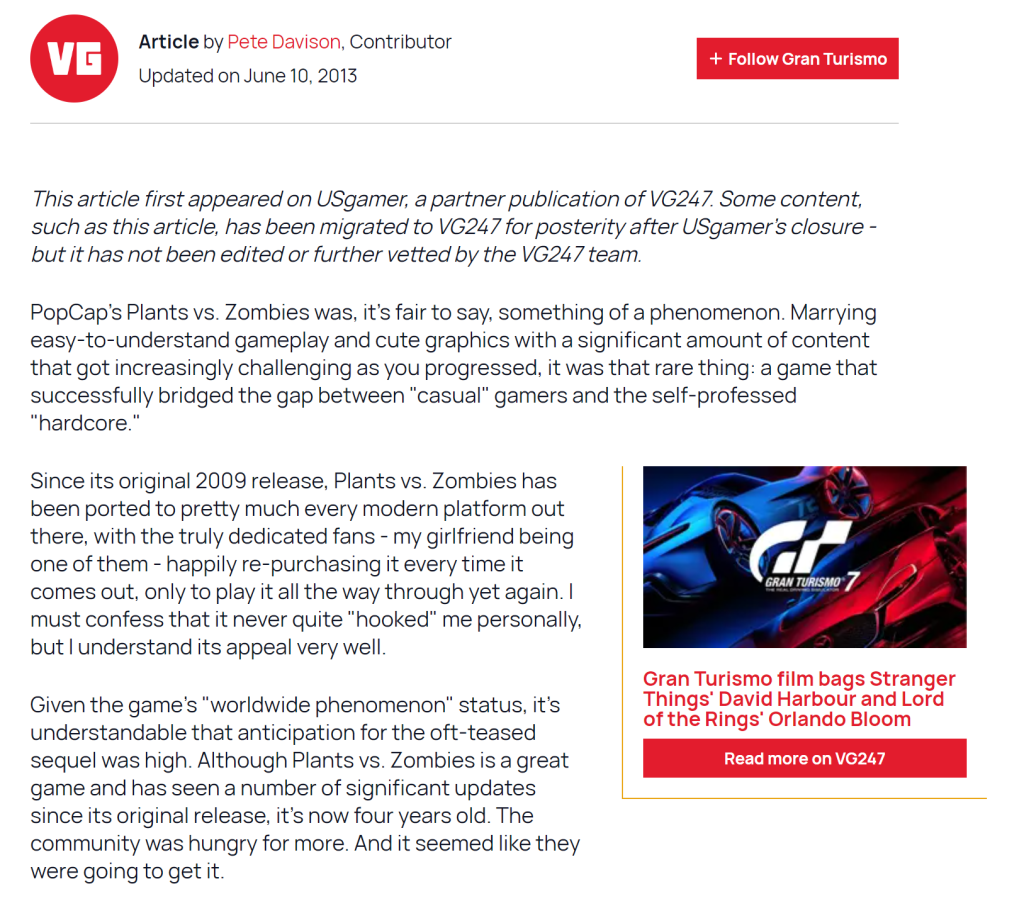
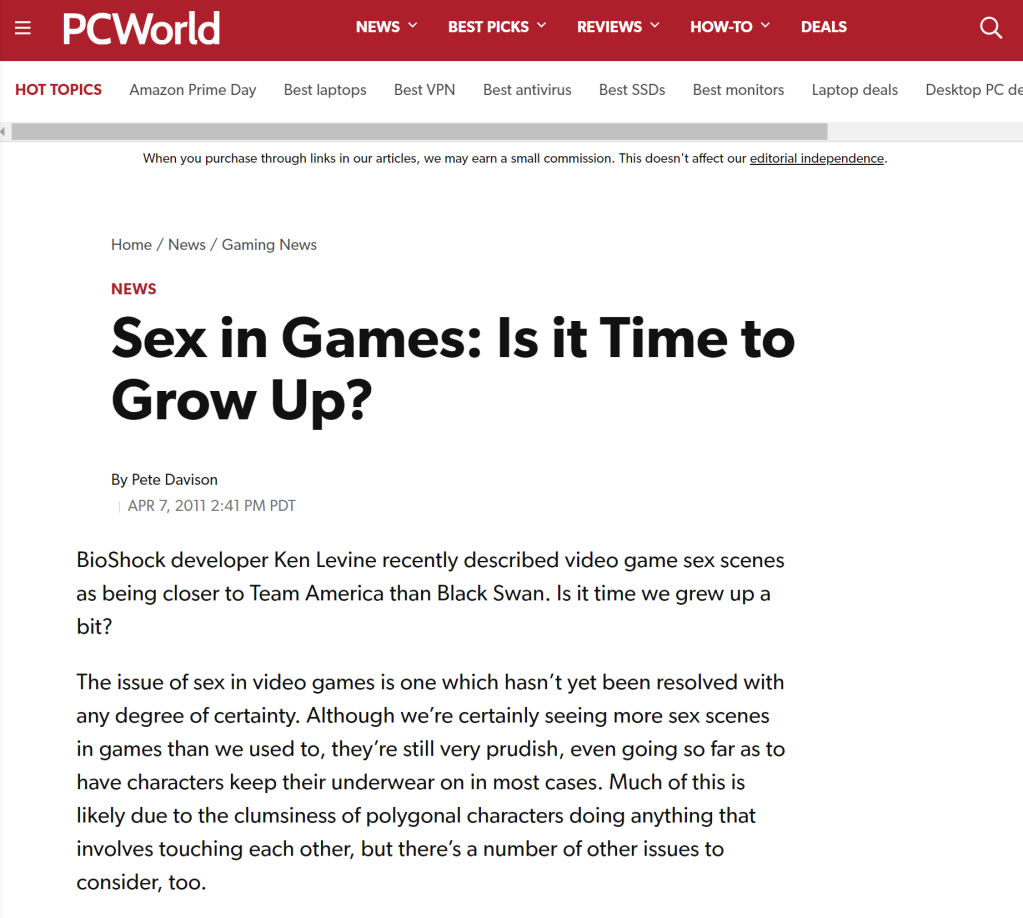
The two "big" sites I wrote for, GamePro and USgamer, also went belly-up at various points. In both cases, again, some of my work ended up archived on other sites. In the case of GamePro, some of my stuff found its way to the American tech site PC World, but a search for my name now throws up a list of useless garbage that quotes my name but doesn't actually link to anything I wrote without manually scrolling through several pages of junk. And, of course, there's no link to my byline for me to easily find everything by me, despite my byline being right there on the articles in question when I can find them!

This is the one and only GamePro article by me I could find after a few minutes of searching. It appears on page 2,689 of a defunct archives page. None of the images or links in the article remained intact.

USgamer, which folded a little more recently, fares a little better in that I actually have an author page on VG247, where the articles ended up — although said author page has no picture, no bio and a link to a Twitter account that no longer exists. There's 8 pages of material from me, which I suspect isn't all of my work from USgamer, but it's a decent amount, at least. I just wish it wasn't on VG247, which is a site I am… not a fan of.

Better than nothing — or being "AI summarised", at least. Just wish it was under a different masthead.

In this respect, I guess I'm actually kind of lucky that my identity hasn't been co-opted by a content farm and all my past work fed into ChatGPT to regurgitate at considerably lower quality than I originally wrote. But I have to confess that reading stories such as this one about TUAW fills me with genuine dread. I'm not overly concerned about AI "taking my job" because it's rapidly becoming very clear that AI writing is both easy to spot and demonstrably inferior to a human being doing the same thing.

But I am concerned about the potential for AI slop with my name attached to it dragging my reputation through the mud. As a writer, I find it grossly insulting to my profession. And simply as a human being, I find what has been done here to be absolutely, totally unconscionable.

There has to be a breaking point somewhere. Soon. Please. I am rapidly running out of what little faith in humanity I have left. And there wasn't a lot left in the first place.


Want to read my thoughts on various video games, visual novels and other popular culture things? Stop by MoeGamer.net, my site for all things fun where I am generally a lot more cheerful. And if you fancy watching some vids on classic games, drop by my YouTube channel.

If you want this nonsense in your inbox every day, please feel free to subscribe via email. Your email address won't be used for anything else.