Pile of Shame: Oct 08

I've had a personal pile of shame lingering for many years now of video games that I bought, played, loved and never got around to finishing. It seems to keep growing, and PC games seem to be ones that I am particularly guilty of leaving ignored for some time. So it was with that in mind that I started to delve into said pile of shame to actually finish some of them. Prior to this post, Divine Divinity was the game that kept me occupied. I remember when I first bought it, my PC wasn't quite up to the job of running it particularly quickly, so that put me off playing it a bit. When I bought a more powerful PC, it was left on the shelf in favour of more fancy-pants games that showed off my shiny new processor and graphics capabilities.

Now I've got my even-more-powerful-than-that Mac happily Boot Camped up to the gills, I find I've been returning to the older games more and more. I think the fact that I can run said older games at 60+fps at 1920×1200 is one of the somewhat attractive aspects of this arrangement – especially when I consider that the intro to The Witcher, which I also picked up recently, ran at approximately 1.5fps at 1920×1200. Ouch.

Anyway, now DD is out of the way I'm going to talk about one game in particular which I've always had genuine affection for because it's just so utterly charming. It's moderately well-known in certain circles for many reasons, but I think there's an equal or possibly even greater number of people out there who won't be familiar with it at all. So what is it?

No One Lives Forever

No One Lives Forever, of course; or, to give it its full title, The Operative: No One Lives Forever, hereafter referred to as NOLF for the sake of my sanity.

NOLF is a first-person perspective shooter from the era of games such as the original Deus Ex. DX is actually quite an apt comparison to this game as both proudly boast of the player's ability to approach situations in a manner of their choosing (normally boiling down to either bursting into a room making lots of noise and shooting everyone in the face, or sneaking into a room quietly and then shooting everyone in the face) and the then-trendy "stealth action" elements.

Where NOLF shines is in its characterisation – both of the game world and of the people in it. NOLF's world is a brightly-coloured Sixties-inspired caricature of the world of secret agents and acronym-based criminal organisations. Many have compared it to Austin Powers but NOLF's humour is in many places far more subtle and less slap-you-around-the-face-with-a-vaguely-phallic-object-whilst-shouting-"Laugh dammit!" than Myers' ouevre. The protagonist Cate Archer, for example, is far from being a wisecracking caricature. In fact, she's actually quite a realistically-portrayed character battling against the sexist tendencies and chauvinistic attitudes of many people from the Sixties who just happens to get into some spectacularly over-the-top scenarious, including, amongst other things, falling out of a plane without a parachute and having to steal one from an enemy goon on the way down.

This is one of the brilliant things about NOLF – juxtaposition. Cate's deadpan and sarcastic delivery of many of her lines (including some brilliantly cutting comebacks to aforementioned chauvinism) contrasts brilliantly with the absurdity of some of the situations she finds herself in. Couple this with the famous "overheard conversations" which few games have handled quite as brilliantly as this game, and you get a great spy tale with a wonderful sense of humour infused throughout.

One thing struck me while playing this game, and it was this: first-person shooters used to be fun. I don't know what it is about recent FPSes but I just don't enjoy the new ones. I've never been inclined to finish a Halo game since the first one, I have absolutely no interest in Crysis and don't even get me started on Gears of War. Yes, yes, I know, it's a third-person shooter but it might as well be in first-person for all the blood, gore, shooting, unimaginative gameplay and brown backdrops. (Yeah, you heard.)

NOLF and other games of its era (and earlier) were something else, though. I haven't been able to pin down exactly what it is I find so compelling about them, though. Maybe it's the fact that they're more colourful. Maybe it's the fact that the gameplay is more varied – for all the great set-pieces in Halo, you were still running around sci-fi themed areas for the duration, whereas NOLF sees you doing everything from diving out of aforementioned plane to doing a deep sea dive to heading to a brilliantly camp Sixties space station, with different gameplay conceits to take into account in each environment. Or maybe it's the fact that the protagonist is an interesting, compelling character that you feel inclined to stick around with for the duration of their journey. I know I couldn't give a crap about Master Chief as he's dull as ditchwater as a character, at least in the way he's represented in the Halo games – the books may be another matter but as Halo interests me so little I've never felt inclined to check it out. Cate, on the other hand, is intelligent, sexy, sarcastic and has a wonderfully dry sense of humour.

I think many modern developers and publishers could learn a lot from revisiting some games from five to ten years ago rather than churning out identikit shooters with pretty graphics. I'd love to see a modern sequel to NOLF. Who knows if it will ever happen?

Next on the Pile are the X-COM games and NOLF2, along with The Witcher, which I'll post some thoughts on soon.
SquadCast: Persona 3

It's the first of our irregular special side-mission podcasts today as we explore the world of teenagers pointing guns at their heads, the tarot and giant penises riding chariots. Yes, you read that correctly. Persona 3 is an incredibly long game – too long, perhaps, for a Squad main mission, so those of us who have played, finished (or "almost" finished) it decided to get together for a chat and a chin-stroke.

This podcast also features Beige and Pishu's report from PAX 08, our regular Personal Piles of Shame section and selections from the soundtrack of the game.

Featuring: Chris "RocGaude" Whittington, Mark "Beige" Whiting, Chris "Papapishu" Person and Pete "Angry_Jedi" Davison.

Subscribe using one of the links below:

M4A Enhanced version via iTunes
M4A Enhanced version via RSS

MP3 Standard version via iTunes
MP3 Standard version via RSS

Spore: My Take

Okay. Let's get one depressingly inevitable thing out of the way first.

O HAI OMG AI CAN HAZ SPORN YA?

Now that's done, we can begin.

There's been a whole lot of ranting about Spore's DRM recently (not least from myself, albeit I seem to be coming from the opposite direction to 99% of the rest of the Internet) but I'm not here to talk about that today. I'm actually going to talk a bit about the game, having spent some time with it and played it from start to "finish" with one of my creatures and started again with another.

I'll start by saying that Spore is enjoyable and plain FUN. Many developers these days are dead set on either creating a movie, or creating something that's self-consciously "hardcore" or something equally unappealing to a cynical old bastard such as myself. Spore eschews all of that by providing an experience that is pleasantly "light" to play yet has something that may not be "depth" but is certainly an addictive quality that keeps me wanting to return to it.

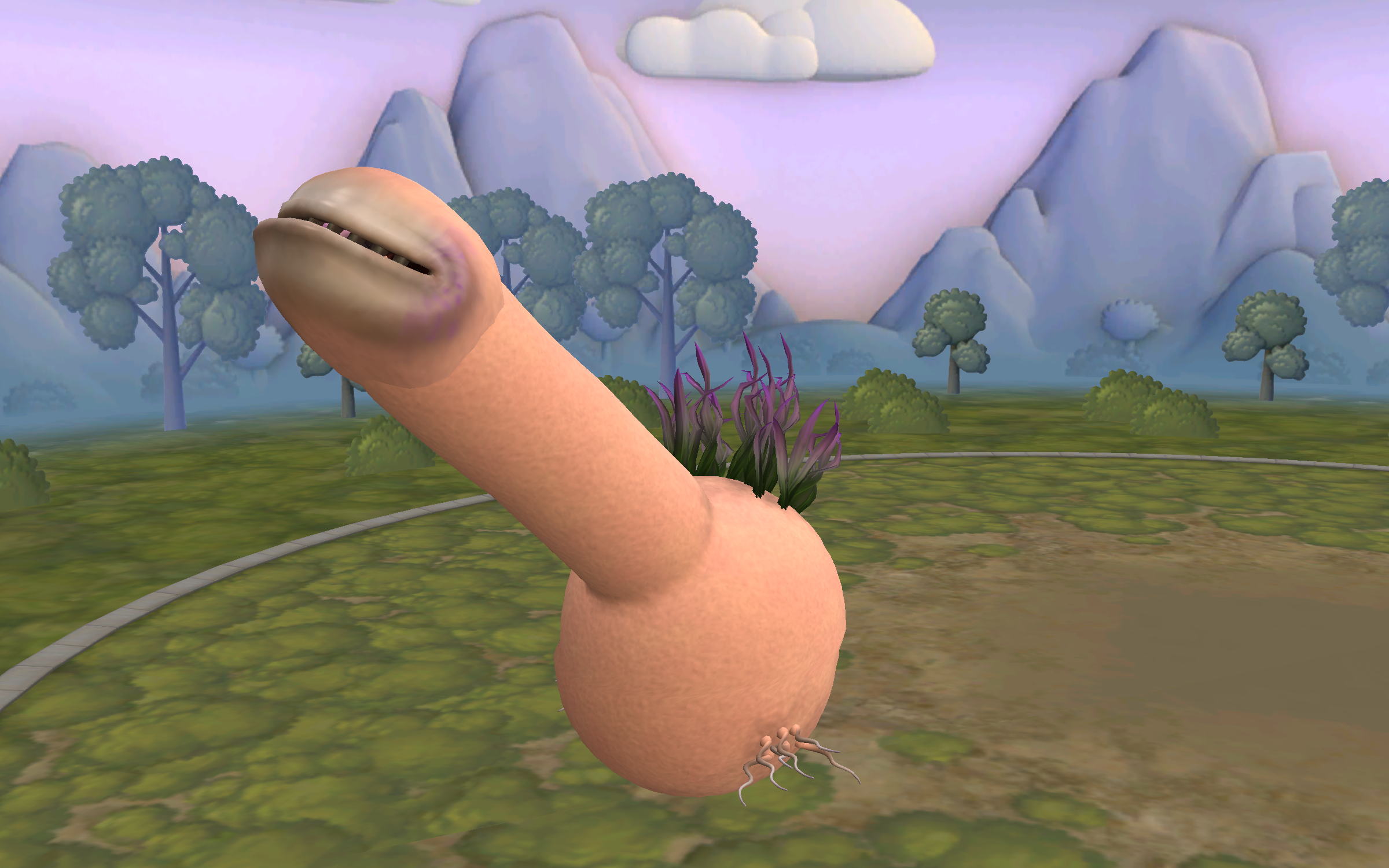
Part of the appeal is, of course, the user-generated content. The fact that, once my little single-celled creature evolves sufficiently to crawl out of the primordial soup and onto land, he/she/it will encounter creatures created by my friends, family and colleagues… well, that's just awesome. Already I've had discussions with several people with amusing stories about my creatures turning up in others' games, and even my spacefaring race's starship turning up and suddenly abducting creatures from their game! (Disappointingly, the above-pictured "Massive Cock Monster", produced by myself and a colleague from work upon his first discovery of the Creature Creator, hasn't appeared in my galaxy as yet but I'm sure it's only a matter of time.)

This is the great thing about replaying Spore. The first time I played it, I didn't notice any of this stuff – I was concentrating on actually playing the game and understanding the mechanics. Fortunately, the mechanics themselves are very simple to pick up and build in complexity at an almost perfect pace – starting with simple directional controls in the Cell stage, adding an MMO-style "hotbar" in the Creature phase for using attacks and social abilities, adding a simple RTS interface in the Tribal phase, refining and increasing the depth of this in the Civilisation phase… before combining everything you've learned throughout the last few hours into the much more lengthy Space phase. And the great thing about the Space phase is that in your travels to the various planets around the galaxy, you can drop down onto a planet and see a computer-controlled species/tribe/civilisation going through exactly what you've been through – you can either sit back and watch it or do your damnedest to interfere with it through various means. Once you've been through the Space phase and experienced this a few times, going back to a previous phase means that you suddenly notice a whole lot of weird shit going on… like a sudden stampede of creatures running away from a now gigantic-appearing spaceship which is lasering them to death, or abducting them, or dropping meteors on the planet.

So that's a lot of fun, and to me one of the best things about the game – the fact that it FEELS like a coherent universe where not only do you go through all these stages, but "everyone else" has to as well – and that "everyone else", despite being computer-controlled, feels like it's controlled by other people thanks to the fact that they were all DESIGNED by other people.

Vaguely related to this is the thing I like most about the aesthetic of the game – the constantly changing sense of scale. Right from the very beginning, Spore is a game about growth. Eat enough primordial goo as a wobbly cell thing and you get bigger, until you can eat the things that used to be screen-sized. Wander around as a creature and everything seems very large. The world is a big place, any invading spaceships seem huge and threatening and it's a scary place to be part of. Become a tribe and you feel like you've taken a step back. What was once a single screen-filling creature has become a group of creatures that appear smaller individually but exhibit a greater influence on their environment. Become a Civ and you barely see your creatures at all, as they spend all their time in buildings and vehicles – but their influence spreads and grows until they have dominated the world. Reach the Space stage and, while your spaceship of your own design is undoubtedly cool, it's presented as quite a small object on screen, making you feel suitably insignificant when surrounded by the thousands of stars that make up the Spore galaxy, until you start conquering or buying out star systems and you see the tangled web of your empire spreading across the galaxy map, growing bigger and bigger with each new conquest.

Other little things tickle my happy places in nice ways. The community side is dealt with well, though I wish there was some notification when someone comments on your creations as at present you have to check your page to see if any comments have come in. There's Achievements too, a clear nod to both Xbox Live and Steam's successful integration of this feature – and they're an interesting mix of achievements too, with a combination of simple "play this game for 40 hours" style ones along with more complex "Win the Civilisation Stage by launching nuclear missiles"-type ones that encourage replaying the game in different styles – plus the fact that playing the game in different styles actually makes a difference. My first race was an aggressive species of carnivore, which meant they spent a lot of their time fighting. (Plus their voice ended up sounding like Brian Blessed, a fact which I was immensely pleased about.) My new species is completely different. They are non-aggressive, social herbivores, which has meant that the strategies required to survive the various stages (they're currently up to the Civ stage) are rather different, focusing on defence or negotiation rather than outright killfests.

So is Spore the masterpiece the hype makes it out to suggest? Who knows. What I do feel, though, is that different people will take different things from it. I will certainly enjoy revisiting it with different creatures with different personalities and abilities and attempting to play the game in different ways. Others may tire of it quickly due to its relatively simple gameplay – simple compared to a more in-depth strategy game, at least. Others may spend most of their time in the Creators and enjoy adding more and more content to both their and other peoples' games. It's certainly a game with a broad appeal and, if we have to use that over-used term "casual" game, it's a good example of a game that is easily accessible by both people who have been gaming for years and those who are relatively new or not as obsessively interested in the hobby as some of us.

(Oh, and the fact that they incorporated the music from M.U.L.E. into the trading screens in the Space phase is enough to make me want to have Maxis' babies… though the purist Atari geek in me wishes they'd used the Atari version instead of the inferior C64 tune. My new creature, Gollumer, is a homage to that game.)

Check out my profile on the Sporepedia and feel free to add me if you've got the game and haven't added me already – the name is, of course, "angryjedi".

An Open Question

Okay. So I set up a site at Tumblr – here it is – and you'll also notice it's now sitting happily in the RSS feeds in your sidebar to the right.

Someone with some Internet savvy about them explain to me the difference between a Tumblog and this monstrosity you're reading right now? So far as I can make out, I can use Twitter to post random short crap or snarky comments about people in ill-taste, ill-fitting T-shirts, Tumblr to post links, videos and slightly longer "minute-by-minute" crap and this place to post long, pretentious ranty crap.

All in all, it's a lot of crap. And yet for some inexplicable reason, people keep reading it. And for that, I thank you heartily. 🙂

That sound about right?

Fuck the Internet

Okay… the irony of saying "fuck the Internet" on a blog post isn't lost on me, but bear with me. There's a rant and a half coming your way right about now about, paradoxically enough, people moaning. However, I feel rather more justified in my meta-moaning than the whiny little sods I will be discussing throughout the next few paragraphs.

But first, a little history lesson, if you'll indulge me for a sec.

My family had been online junkies since before the Internet was a widespread global phenomenon. An irregular "treat" for us was to be able to use our Atari with its mighty 300bps modem to dial up to a local bulletin board system, read some messages and maybe download some BASIC games to play. At the time, I thought this was incredily cool. Looking back, at the time, it was incredibly cool. I mean, being able to use your telephone line to dial into someone else's computer and do stuff with it? Neat.

A few years later came CompuServe, which was a step closer to the "real" Internet, at the time still very much in its infancy for consumers. CompuServe offered a service that was essentially hundreds of these bulletin board services, called "forums" along with news, entertainment and real-time chat services. Again, it was something of a "treat" to be able to go online and look at stuff and to actually be able to communicate with other people. As a matter of fact, as a result of a message exchange between myself and another chap on the CompuServe Gamers' Forum, ten levels that I had created for Wolfenstein 3D made their way onto the official Apogee "Super Upgrades" expansion pack for Wolf3D, netting me a cool $200. I still have a (now very faded) photocopy of the cheque as I thought that was so awesome.

A while into the "CompuServe Age", I read an article in PC Format magazine discussing this new and interesting-sounding thing called the Internet. The article was awash with buzzwords like "telnet", "FTP" and curious sounding things with lots of dots and coms in them. But it was still quite some time before CompuServe actually offered full Internet access.

Now here we are, some ten-to-fifteen years later. Web 2.0 in all its self-publishing, self-expressing, lower-case logo glory is upon us offering anyone with a pulse the opportunity to spill their guts on the Internet and share their innermost thoughts and feelings on a whole variety of topics.

This, on the surface, is a great thing. Never before have people had such an opportunity to self-publish anything they like – be it creative writing, academic research, odes to the fit girl in class 3B or simply waffly old bollocks like this place. Why, then, do so many people feel the need to use this great medium to batter down anything around them?

I have two recent examples of this, though these are by no means isolated examples. They are merely the most recent things where this issue has cropped up. Firstly, we have the "new Facebook". Secondly, we have EA's new game Spore. Let's take these two things in turn.

First up is Facebook. Facebook is such a global phenomenon that I heard on the news this week (on the radio, how old-school of me) that they're planning on making a movie (presumably of the docu-drama variety) on the site's rise to success.

For the unfamiliar… actually, balls to that, even my Mum has a Facebook account. You all know what Facebook is. Let's not forget that it's a free service supported almost entirely by ads that anyone can sign up for and use and never have to pay a penny. It's a social tool that's allowed millions of people across the world to connect with one another and rediscover old friendships after many years, in some cases. In short, it's a pretty marvellous thing that both Facebook themselves and numerous third parties keep adding new features to.

So recently Facebook redesigned their site, changing the way the functionality of the site works and, to me, making it rather more streamlined and clean. It also uses more of the browser window which, when you're working on a 1920×1200 screen, is most welcome. They've obviously worked hard on this site redesign and are still tweaking things even as we speak – each time I log on I see some new little feature that makes navigation and use of the site even easier.

So how does the community at large respond? By creating "OMG 1 MILLION PEOPLE MUST JOIN THIS GROUP AND STAND UP FOR OUR RIGHTS! NEW FACEBOOK SUCKS!". You'd think that Facebook had summoned the spirit of Hitler and then allowed it to rape all the world's children before taking a chainsaw to them, while the shareholders sat in the background wanking and laughing. But no – they've done what any good website does every few years, they've had a refresh and a redesign – and, compared to many websites' complete overhauls that I've seen over the years, this has been a fairly minor one in the grand scheme of things. You can still do everything you used to be able to, and more so in many cases.

So why bitch and moan? It escapes me. Do these people seriously think that getting a million people together in a group that is HOSTED ON THE FUCKING SITE THEY ARE COMPLAINING ABOUT – the site they aren't paying a penny to support yet are happily cluttering up bandwidth with their photos and videos – is going to achieve jack shit? Why bother? Fuck the Internet.

Why bother complaining about the complainers? It makes me feel better. One may argue that all these people are doing is "making themselves feel better" also, but the fact is, it is Facebook's prerogative to change their site as and when they want to – whether it is from the perspective of improving the users' experience (they must be sitting around thinking "Those ungrateful bastards" right now) or from the perspective of increasing advertising revenue (which for a site that doesn't make much money from its users is perfectly reasonable).

Next rant. Spore.

Spore's a great game that came out this week. From Will Wright, creator of the Sim games (and the The Sims games, natch) it allows you to… again, I'm sure you all know about Spore already, so I'll cut to the chase.

Spore ships with some security software by Sony called SecuROM. SecuROM is a system that is designed to protect discs against being copied and installed by hundreds of people… i.e. piracy. As such, it limits a purchaser of a copy of Spore to installing it on three separate machines. That's not, as many people have assumed, three installations and then it's all over… that's three machines.

Who has three machines? How many people, apart from people with more money than sense, buy a new PC gaming rig often enough to make this an issue? I buy a computer roughly once every five to seven years and it serves me fine in that time, unless I want to run something like Crysis – which fortunately I have no interest in whatsoever.

EA released a statement quoting usage and activation statistics from the Spore Creature Creator, released some months prior to the full game. While Creature Creator's stats may not necessarily reflect exactly the same userbase as Spore, the figures were telling. Most users activated the product on one computer. A few did it on two. And about 1% tried to activate on more than three. I'm often loathe to believe company hyperbole, but in this case those figures certainly seem a reasonable assumption in my experience at least. I don't think I know anyone who has more than one computer for gaming purposes. Sure, I know some guys who have PCs for gaming and Macs for professional/creative work, but even then, that's still only two computers.

The nonsense with Spore went way overboard. Amazon.com was bombarded with over 1700 one-star reviews of the game, very few of which commented on the game at all. Several users bandied the word "draconian" around and many promising to go and pirate the game rather than purchase it – indeed, the main argument that many people were throwing around was the fact that somehow Spore had been leaked, cracked and torrented even before the game's street date, thereby, to these people, making the DRM pointless.

The fact is, were there not such wanton levels of piracy on the Internet today, these measures wouldn't be necessary – and the people on Amazon who claimed that pirating the game was "making a stand" are simply adding to the problem, not making a point. EA's a big company and they have to be seen to be doing something more than plugging their fingers in their ears and going "lalalala" on the subject of piracy. While DRM clearly doesn't work as it should at present, at least it represents a symbolic gesture on EA's part to help tackle the problem.

The fact is that Spore's actually a great game, but all this nonsense has put lots of people off playing it, for completely unjustified and ill-informed reasons. It'd be lovely if just, for once, people on the Internet could sit down, appreciate what someone else has done for them, pay for it if it's a paid-for service (like Spore) and appreciate it being free if it's a free service (like Facebook) without bitching and moaning any time some tiny little change to the "norm" comes along. I'm sure there's something Orwellian in there somewhere…

Anyway. Rant over. Assuming no-one else pisses me off my next few posts will be about Spore and other games I'm playing at the moment!

Listen!

Don't worry, I'm not gonna waffle on atcha. It just occurred to me that at least two out of the three games discussed below have awesome soundtracks. In the case of Space Channel 5, it is, of course, the game's raison d'être but Divine Divinity has a notably good soundtrack also. Castle Crashers, while having a great intro theme, has a somewhat more forgettable soundtrack, though it does suit the action nicely.

So without further ado, here's a few clips from both games for your entertainment.

Introducing Ulala! (Space Channel 5)

This first tune gives you a strong introduction to Space Channel 5 – it's played during the first level. By a short while in, you're left in no doubt as to how you're supposed to be feeling while you're playing. Gay. In every sense of the word.

Which One Is Real? (Space Channel 5)

What was the last music game you played with a bebop-like section?

Perfection! Space Elementary School Band (Space Channel 5 Part 2)

You'll either love or hate the infectious cheerfulness of this track.

Blank TV/Ulala Support Chant (Space Channel 5)

A capella! Awesome. This piece of music sums up the whole "get everyone behind you" thing that makes the finales of the two SC5 games so awesome.

Main Theme (Divine Divinity)

The main theme from the game is an interesting composition, eschewing the kind of "epic" soundtrack that Baldur's Gate always went for in favour of a more haunting melody.

Forest (Divine Divinity)

This is a simple piece, but evokes a sense of loneliness which is apt for the setting the music appears in.

Bitva (Divine Divinity)

A huge change of pace for this one reflecting the diverse nature of DD's soundtrack.

Enjoy. You can download the tracks from DD at Larian's official website. As for SC5? You're on your own, though resourceful soundtrack collectors probably know the first places to look.

Antiquity, Rarity, Hilarity

I've got three games to talk about today. Depending on my stamina and how long it takes dinner to be ready, this may take more than one post. But I'm sure you can cope with that, and I'll endeavour not to finish on a cliffhanger… unlike current DVD-du-jour Alias which is currently driving Jane nuts with the cliffhanger that every single episode ends on. Me? I love it, but then I'm a sucker for that sort of thing and could happily sit and watch a whole box set in one go. I'm that lazy.

But I digress. Let's begin this triptych.

The Antiquity

Divine Divinity
Divine Divinity

Antiquity in question is actually not that old, hailing from 2002, but it's actually been sitting on my shelf gathering dust almost since I bought it for full price back upon its release. I've started it several times but never played it in any great depth.

"What is it?" I hear you ask. Well, it's a game with a ridiculous name. Divine Divinity, to be precise, which I can only assume is more meaningful in the original Flemish. It's an RPG by Belgian developers Larian Studios, who remain relatively little-known to this day, but are currently working on a sequel to DD.

Why did I start playing this? Well, several reasons. When I'm between "big releases" on the consoles, I often think about picking this game up again and playing through it but inevitably something else distracts me. This is much the same reason I have never completed Baldur's Gate II, despite the fact that I would very much like to. The main reasons I've decided to stick with it this time include firstly a thread over on the Quarter to Three forums discussing "Diablolikes" in anticipation for the as-yet-undated release of Diablo III, where DD's name came up, and secondly remembering that DD was one of the earliest suggestions for the Squadron of Shame to cover, being a game that garnered considerable critical acclaim on its initial release but is still a relative unknown.

So what is it, and why did it gain such acclaim? At first glance, it appears very much to be a Diablolike, right down to having an interface lifted almost wholesale from Blizzard's classic. However, it's once you get into the gameplay that it becomes very apparent that it's an extremely well-thought out game with a lot more depth than the hack-and-slash of Diablo. If you must compare it to things, it's a curious blend of Diablo, Baldur's Gate and Fallout – taking, as it does, the real-time "twitch" combat and single-character focus from Diablo, the huge world, character interaction, quest systems and ability to strategically pause from Baldur's Gate and the interesting barter-based trading system from Fallout.

It's a blend that works well. What we end up with is a game with considerably more variety than Diablo (not that that game's purity works against it – on the contrary, it is probably one of the contributing factors that makes it so addictive) and the depth of story and interaction of Baldur's Gate without any of the scary intimidating (for some) cogs and gears of AD&D 2nd Edition.

Plus it's huge. We're talking Baldur's Gate II huge here. You spend a considerable amount of time in the first village and the dungeon underneath it before going out into the wider world. And said world is pretty huge – particularly due to the fact that what initially appears to be the "overworld" map is actually just a fraction of a much bigger game area filled with things to kill and quests to complete. Part of the joy of the game is just exploring this world and discovering what it has to offer, but there's a well-structured quest system in place to give you a bit of direction too.

In the foreword to the game manual, the game's designers note that they hope that people will find "their own way" to play the game, and while there are always obvious limitations on any RPG system to do EXACTLY what you want, I do get the impression that you could play DD quite happily as a Diablo clone, wandering around the wilderness and killing things for experience and only completing storyline-critical quests. On the other hand, the way I'm playing is more like a "traditional" (for want of a better word) RPG where I'm travelling between places and attempting to complete quests in an efficient manner.

It's a really excellent game, but I can see the size and length putting some people off. I'm certainly glad I've decided to give it a chance though, as I'm really enjoying it and fully intend to see it through to the end.

The Rarity

Ulala
Ulala

This is a game I actually didn't think existed. I remember reading about it before it came out and then it disappearing without trace. The game in question is Space Channel 5 Part 2. I adored the first game on the Dreamcast and then again on PS2 when it was re-released, despite it being absolutely 100% the most gay game on the planet. And I don't mean that in an Internet-Fuckwad-"Gay-means-crap" sort of way, I mean that this game is super-gay. Don't believe me? Watch this clip.

Convinced now? But didn't you find it utterly infectious? That's the charm of Space Channel 5, a game which is essentially Simple Simon in a camp 1960s sci-fi parallel universe. Part 2 is more of the same, but it has the dubious honour of being one of the rarest PS2 games ever, at least here in the UK.

The reasoning? It has Michael Jackson in it for a few minutes, and was released around the same time as the TV report that suggested that MJ might be… you know, a bit wrong in the head (like no-one knew that already). As a result, the game was hastily pulled, never to be seen again – so much so that boxed copies of the game now go for up to £100.00 apiece. Yes, US-based readers, that's about $200 for one game without any peripherals or anything.

Fortunately, I had a stroke of luck in a browse through Amazon and managed to locate a seller who had the game for considerably less than £100 because it wasn't brand new, but it was pretty much untouched. As a result, I scored the game for under £50 including shipping, and I didn't think it was going to get any cheaper than that to get my hands on a genuine rarity.

But enough about the hard-to-findness. What's it like?

Again, it's super-gay, and super-fun. The gameplay remains fundamentally unchanged, though it adds both a strange two-player mode where one player is in charge of directional inputs and the other is in charge of pressing X and O to "Chu!" and "Hey!" as appropriate along with a survival mode. There's something about it, though, that makes you want to play it again and again, even though the whole game can be beaten in about an hour, and I think it's the infectious cheerfulness of the damn thing.

With the number of damn games that have been predominantly brown ever since Quake came along, it's always refreshing to play a game with lots of bright colours and cheerful music, where even the villains are entertaining rather than threatening. It is impossible to play either Space Channel 5 game and not come out sporting a huge grin on your face. And that's worth a lot – to have something that's genuinely uplifting to play is always a pleasure, and it's something we seem to get a lot less these days as graphics improve to the point where the Holy Grail of "photo-realism" is getting closer and closer.

The Hilarity

Castle Crashers
Castle Crashers

Castle Crashers hit Xbox Live Arcade this week after three years of anticipation and I'm pleased to report that it's an excellent game bringing back memories of chugging 50p pieces into the Turtles, Simpsons and Asterix arcade games (and being inevitably frustrated by the shoddy home ports).

It's also, to tie in with what I said about Space Channel 5, genuinely funny. Developers The Behemoth make a point of creating visually appealing games, as Alien Hominid will attest, but CC is filled with so many laugh-out-loud funny visual jokes that again, it's a game that makes you smile, and a game best experienced with friends, while drunk.

I'm out of time. There may be more discussion of any or all of these titles later. For now, I hope that's given you a taste of my current gaming. Screw big releases, these three are keeping me more than busy enough for the moment!

EBA is a masterpiece

Many of you may already feel this way – others may think I'm talking out of my arse here, but I present for you the reasons why Elite Beat Agents is, in almost every way, a complete masterpiece of game design. You may wonder the timing of this post if you haven't been following me on Twitter, but the fact is, following our discussion on the Squadron of Shame SquadCast about Okami, and bringing up EBA's finale's similarities with Okami's (yes, really) I had an urge to play it again.

The fact that my DS went missing for a short period threatened to stymie this plan, but I eventually located it. It had somehow found its way into a cardboard box filled with discarded letters and things which had, subsequently, found itself under a chair. Exactly how this came to pass, I'm not sure, but it had certainly hidden itself well, making the ability to boot up EBA again a pleasurable experience.

So, why is this game so good?

Play mechanics

EBA is a fine example of the old mantra "easy to learn, difficult to master". In terms of actually interacting with the game, all you have to do is tap on numbered circles on the DS' touch screen in the correct order, in time with some ever-decreasing overlaid circles, preferably in time with the overlaid circle hitting the numbered circle. This, to help matters slightly, is in time with the music. Occasionally you have to drag the stylus along a pathway as well as tap, or frantically spin a big wheel around (producing, as does The World Ends With You, the dreaded "is he playing his DS or is he masturbating?" looks on the bus) – but aside from these three different moves, that's it.

The challenge, of course, comes with the patterns in which these techniques are arranged. On the easiest difficulty level, you're roughly tapping out the beat in quarter notes, occasionally with a few eighth notes thrown in later, but not that many. As the difficulty level cranks up, however, you find yourself tapping out "counter-rhythms" to what is already in the music, or drumming along with the rhythm section, or all manner of other things. Part of the challenge is in interpreting the on-screen patterns into physical movements and, subsequently, what they should sound like. By the time you reach the end of Hard mode and beat it, you'll wonder how anyone could possibly move a stylus that quickly.

Music

It may sound pointless to mention this, but of course a rhythm action game is made or broken on the strength of its music. EBA has a selection of music that covers a pretty wide range of artists, and doesn't limit itself to one genre. Okay, there's quite a bit of guitar-based stuff, but at least there's some variety within there, covering everything from Deep Purple to Avril Lavigne – and then besides that, there's some interesting tracks that you wouldn't necessarily expect to hear in a rhythm action game – Chicago's "You're the Inspiration" being one of them.

Addictiveness

EBA has the "addictiveness gene" down pat, and it achieves this in one very simple way – holding victory just tantalisingly out of reach, just ahead of where you are now. This is particularly apparent on the later levels of the hard difficulty, where you find yourself replaying songs over and over again, making a slight bit of progress each time. That slight bit of progress encourages you to try again, making you think that "next time might be the one". Four hours later when you still haven't finished the song and everyone around you never wants to hear "Jumpin' Jack Flash" ever again, unlike many games, you don't feel too bitter about the whole thing because you know for a fact that you're slightly better than when you started.

This brings up an interesting point. I Tweeted the other day that shooters irritate me for forcing me to replay the same bits and hear the same dialogue over and over again if you fail – the example that sticks in my mind most of all is one section of Gears of War that came quite early on, and is the reason I gave up playing that game and swore never to touch it ever again. Entering a room, you are helpfully informed over the radio that there are "enemies everywhere" and that there's a "sniper up above". Every time you try it. And said sniper has a habit of killing you immediately. So you hear this A LOT.

So why doesn't EBA irritate me in the same way? After all, hearing the same piece of music over and over again must grate. My theory is that because you're constantly interacting with EBA during the piece of music, whereas in a shooter some dialogue tends to come in a bit of "downtime" – either running between locations or in a cutscene – you notice the repetition less.

Emotional impact

EBA is the last game I expected to have a genuine emotional impact on me when I played it, but it achieves it brilliantly – and it does this in several ways. Firstly, there's the fact that the comic-strip "cutscenes" that precede each level are put together in such an entertaining way that, despite the fact you don't get much time to get to know the characters, you really start to care about them. As a result of this, you feel that there's a real sense of consequence if you fail. EBA is one of the few games I can think of where your failure actually causes other characters to cry – and I'm not talking some emo JRPG scene where a single tear falls from our normally stoic hero's eye – I'm talking full-on inconsolable bawling their eyes out crying here. This makes you genuinely feel bad if you fuck up, and is another reason to try the stage again.

Secondly, the choice of music is just perfect for each stage. The best example I can think of, which had me wiping my eyes when I'd finished it, is the stage surrounding the little girl "Lucy", whose father got into an accident and isn't coming home. Lucy is convinced he'll be back because he promised – and around the time of her father's birthday, she urges her mother to "get the house ready for Daddy". The emotion of this scene is clear from the opening of the preceding cutscene and continues throughout the course of the level, helped enormously by the choice of "You're My Inspiration" as the music.

I was also interested to see EBA dealing with themes that you don't often see dealt with – sure, dead parents are nothing new to, again, emo JRPG heroes, but to an innocent little girl?

OMG SPOILARZ

A proper finale

So many games fall at the last hurdle – the finale. Mess up the ending of your game and you'll send people away with a distinctly bitter taste in their mouth. EBA successfully avoids this by using what may be something of a cliché amongst Japanese games – the entire cast of the game coming together behind you to "pray" to you and give you strength – but every time I see it, it works brilliantly. And to tie in with the emotional impact I mentioned above, when you finally do reach the end of that final song, the characters are in such a euphoric state that it would take a cold and harsh person to not feel exultant right there with them.

So there you have it. EBA is a masterpiece… in my opinion, at least.

Ode to Game Music, Part I

This is one of those posts I've wanted to write for a long time, and I have a sneaking suspicion it will be a topic that I will return to regularly – covering, as it does, one of my favourite things about video games: the music. You might think it ironic that I am so interested in one of the more non-interactive elements of interactive entertainment, but the effect of some quality music on the experience of a video game is not to be underestimated.

My first exposure to video game music came very early on with enjoying the title-screen music compositions of artists such as Rob Hubbard on the Atari 8-bit series of computers. These songs formed a big part of the "identity" of a game, and many of these composers became micro-celebrities in their own right. In many cases it could be argued that the quality of the music was actually higher than the quality of the game itself – particularly as many of these early computers didn't really have the processing power to play complex (for the time) four-channel music as well as having a smooth gameplay experience and thus forced you to listen to not-very-interesting sound effects during gameplay.

Here's a couple of fine examples from "back in the day" that stick in my mind:

Zybex (Adam Gilmore)

Warhawk (Rob Hubbard)

Going back to these games now, they're somewhat primitive in every way imaginable, but I have to say, my fond memories of them can almost 100% be attributed to the music that played on the title screens. Both games are now relatively forgettable shooters, but Gilmore and Hubbard's music meant that I'm not about to forget them.

My next generation of computers was the Atari ST which, despite being very good at MIDI, had a shitty three-channel internal soundchip that was 1) considerably worse than the four-channel POKEY chip in the Atari 8-bit range and 2) constantly trumped by Commodore's rival machine the Amiga which had then-revolutionary stereo digital sound. However, a number of developers got around this fact and produced some excellent pieces of music. It has to be said, however, that these pieces of music were still largely confined to the title screens of games. Here's a few more that stick in my mind:

Obliterator (David Whittaker, Psygnosis)

This one sticks in my mind not because it's a particularly interesting piece of music (which, after listening to it again, it clearly isn't – and look how long it took to load the damn game) nor because it's a good example of the ST's capabilities (see what I mean about the horrible soundchip?) but because it evoked the atmosphere of the game nicely. Obliterator involved running around a space station shooting robots and solving puzzles – yes, the same shit we're still doing nearly 20 years later. It was quite a "solitary" game – you spent the majority of your time alone and attempting to navigate the environment using Psygnosis' incredibly weird icon-driven movement and action system that thankfully they abandoned after two games.

Obliterator also sticks in my mind for a second reason – the fact that the music adapted as it went through. The moody piece of music you hear in the video above eventually gives way to a more, for want of a better word, "cheerful" piece as you make progress. This is something that, to this day, I absolutely love. While Obliterator may not necessarily have had the technology to make truly dynamic music, I remember feeling the whole mood of the game shift when the music changed. Suddenly you weren't up against the wall in the dark surrounded by robots, you were a hero.

Gods (Nation XII/Bitmap Brothers)

The Bitmap Brothers were one of the earliest "celebrity developers" of the gaming world – developers who were held in the same regard as today's well-known designers and teams. In the earlier days of gaming, teams were much smaller and budgets were much lower so it was rather more unusual for a development team to come to the forefront in such a way.

One of the ways that the Bitmap Brothers brought themselves into the public eye was through their use of excellent music in their games – the music for Gods which you can hear above being one such example. This piece of music was played on the Atari ST version during the introduction sequence and is, I'm sure you'll agree, poles apart from Obliterator's chiptuniness – which brings us to another point – the Brothers' games also made far better use of the ST's hardware than almost any other developer out there, including taking advantage of the STE's enhancements, such as the ability to display a mighty 512 colours on screen at once (seen to lovely effect in Gods with a nice gradient sky background).

Okay, Amiga owners were laughing at the shoddy ST ports of many games, but the Bitmap Brothers' games made some of the pain go away. 🙂

I hope you've enjoyed some of these tracks. There will be more to come in the following entries!

The Squadron of Shame SquadCast #7: Okami

Released today is the seventh episode of The Squadron of Shame SquadCast focusing on Clover Studios' beautiful game (poncey as it sounds, there really is no other way to describe it) Okami. Along the way we take in a lengthy journey into the depths of Papapishu's mind (fueled by Dance Mania and ADD meds), discuss why good is boring and evil is awesome (and Braid is either a work of art or emo bullshit) and delve into the "this could go on for months" territory of Eastern vs Western game design philosophy.

We also, as usual, discuss our personal piles of shame, including comment on Geometry Wars 2, Braid (twice), Soul Calibur IV, Star Control 2 (hold on, haven't we done that one already?), Siren: Blood Curse and, much to Pishu's disgust, EVE Online.

This episode features a triumvirate of hot Chris action, with Chrises "RocGaude" Whittington, "Iscariot83" Hernandez and "Papapishu" Person making an appearance, along with myself, Mark "Beige" Whiting, Tom "sinfony" Haley and George "Regulus Loves EVE" Kokoris.

Grab the M4A file here, or the MP3 file here. Alternatively, subscribe in iTunes or via RSS.

Enjoy! Please feel free to post comments here or on the Squadron of Shame's club page on 1up.com.