Schools are "failing our children". So say various government watchdogs, quangos, hypocrites, rhinoceroses and jabberwockies. But aforementioned bodies (some of which I may have made up a little bit) don't take into account that it's their fault in the first place that schools are "failing our children". Not to mention the fact that there's also a lot of blame to lay at the feet of both the parents and the kids themselves before you start pointing the Finger of Justice™ at the hard-working teachers and other school staff who are trying very much to make the best of a bad lot.
I quit being a full-time teacher. Twice, in fact. I'm not going to make that mistake a third time. Fool me once and all that. Currently, to pay the bills, I am enjoying the life of a supply teacher. This means that I can choose whether or not to sleep in every morning or maybe be woken at the crack of dawn by a phone call saying some festering scumhole school in the very armpit of Southampton is short of a teacher for today and could I possibly go along with a chair, a whip and a net and see if I can do anything with them? There are two very simple equations to bear in mind here.
1. sb = 0(£) + 100(j) where sb is "staying in bed", £ is money and j is joy.
2. nsbapcdtvfssvas = muchos(£) – 5000(j) where nsbapcdtvfssvas is "not staying in bed, answering phone at crack of dawn, visiting festering scumhole school in very armpit of Southampton", £ is money and j is joy.
So while equation 1 leads to a gain in joy, it does not lead to a gain in money. Indirectly, in fact, it tends to lead to a decrease in money, as staying at home often leads to wandering out in search of coffee. However, while equation 2 leads to an increase in money it leads to a substantial hit in the joy department. And no, that's not a euphemism for your dangly parts.
But I digress in talk of made-up maths. I was about to tell you what is so very wrong with education. Particularly primary-level education, as that's where I've been spending most of my time recently. So let's do another list, shall we? Good. I know how you like lists, particularly if they're illustrated.
1. Overcomplicating everything.
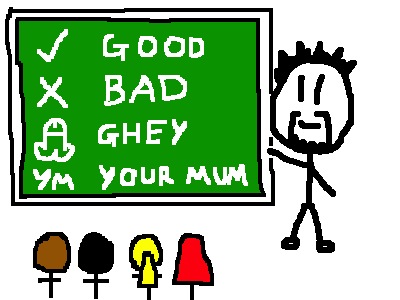
I remember when I was at primary school. A tick meant "correct" and a cross meant "wrong". If you were lucky, you got a brief comment, like "Good." or "Lazy work." depending on whether you'd done good or lazy work.
In the school I was working in today, they had a "marking key" on the wall. A squiggly line meant "look at this". A straight line with a "sp" meant "spelling mistake". A circled letter meant "you should have used a capital letter". A circled empty space meant "you have missed some punctuation". A caret meant "you've missed a word out". And then and only then did the key reveal that, yes, tick means "correct" and cross (or dot, now) means "wrong".
Seriously? These are eight- and nine-year olds we're dealing with here. Some of them can barely read, and you expect them to decipher that babble? Not only that, but then every book is expected to have a comment in there which, at the very least, says something inane like "Well done! You have shown me you are able to use connectives to join sentences together!" or "Congratulations! You successfully subtracted two things using the written method!" or "Super! You were able to recreate the entire Nutcracker Suite through the medium of rectal flatulence!"
Which brings us nicely on to…
2. Using unnecessarily high-level language.
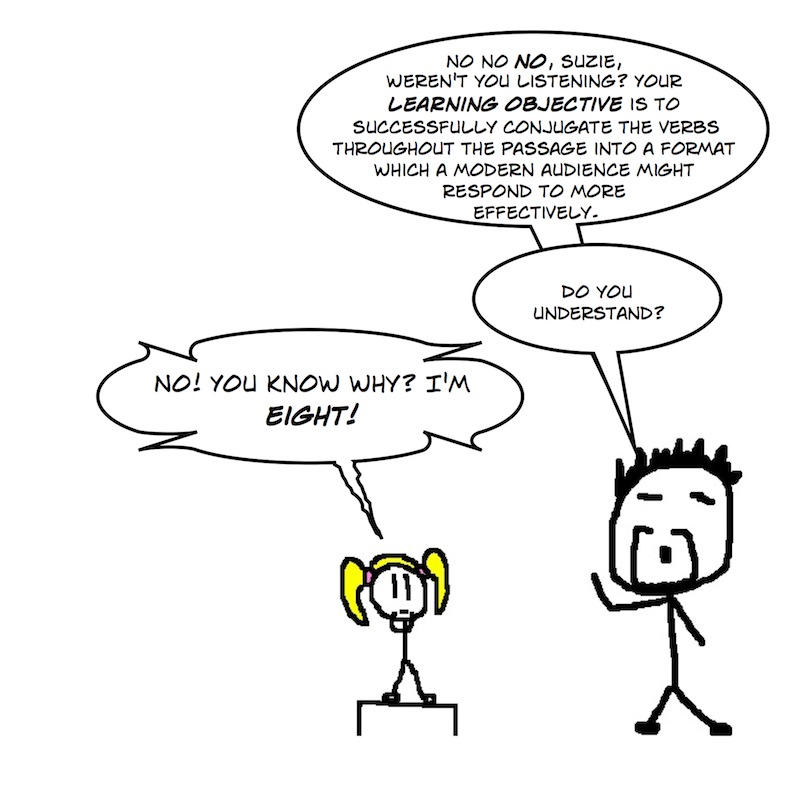 Remember: eight- and nine-year olds. Do they really need to know terminology like "learning objective" and "success criteria"? I am yet to meet a child who actually knows why they write down the learning objective and success criteria other than "it's the stuff we copy at the start of the work, innit". The sole purpose for it is so when the inspectors come to play that the teachers can point proudly at the various learning objectives and say "Look! They've done this!".
Bollocks.
3. Making unnecessary work.
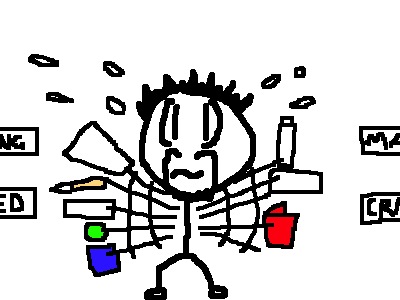
Oh silly me. I made a mistake. The children shouldn't be copying the learning objective and success criteria. The teacher should have prepared them all in advance, trimmed them to size and stuck them in the children's books for them. Bear in mind at this point that a typical class has about 30 kids in it, each with at least five books (literacy, numeracy, "topic", science, art) and each day typically has four or five different things going on throughout the course of it. So hey, with all that to plan, what's a little extra cutting and sticking into ninety different books?
4. Dumb-ass theories that make no sense.
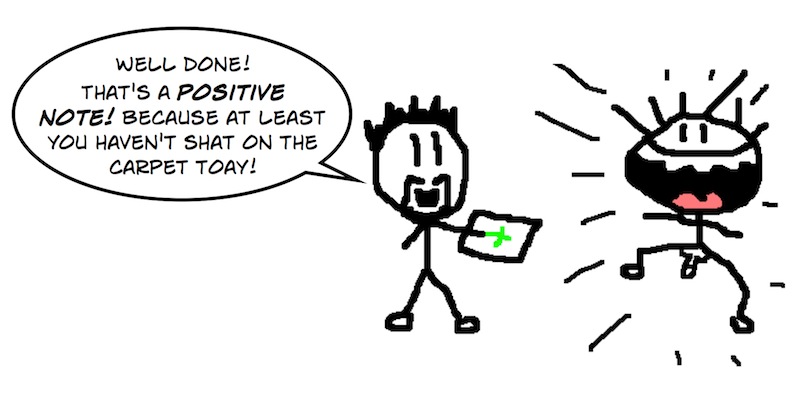
There are too many of these to count. Phonics is one. Anything involving behaviour management is another. Take a quick detour and go and watch this, including the stupid interactive part. The first shot of the class and the obnoxious children in it is the most accurate depiction of what it's actually like to be in a classroom. However, the supposed "strategies" for dealing with the class are complete bollocks. Giving the teen who thinks talking about fucking his classmate's mother a "positive note" if he sits down and gets on with his work? Don't make me laugh.
5. Pressure, pressure, pressure!
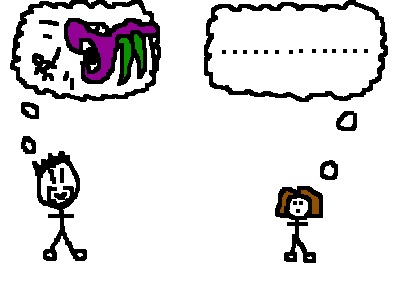
I was talking to someone the other day – I think it may have been Rhiarti – and talking about how the imagination of young people is stifled these days. UPDATE: Yes, it was definitely Rhiarti, right here, in fact. So yes – the imagination of young people is stifled by the fact that they're expected to learn all these million-and-one different techniques which there's no way in hell are going to stay in their tiny heads. I remember "writing" at primary school being all about writing stories. Now, they're expected to write Reports, Explanation Texts, Instruction Texts, Recounts, Narratives and all manner of other things (all inevitably capitalised, too) rather than, you know, just being able to sit down and write to express themselves. Even when they do get the rare opportunity to write a story, it's inevitably got such a long list of completely arbitrary success criteria for them to fulfil that any semblance of creativity has been battered out of them by the end of their school career. Which is sad.
All this is the tip of the iceberg. Don't even get me started on the "three stage lesson", on "thinking skills", "thinking hats", Bloom's Taxonomy, starters, plenaries and all manner of other shit.
So, in summary, a lot needs to change. But unfortunately, all of the things above, which are quite obviously and clearly dumb and stupid, are the sorts of things which men in suits with clipboards think "get results" and "show progress". Well hooray for progress. Somehow we managed without it for a long time. Why can't we go back to those days, for the kids' sake and for the sake of the poor, anxious teachers constantly on the verge of nervous breakdowns?
 Hollywood can take full responsibility for this one, since almost any movie involving a car crash inevitably ends with one or both of the cars exploding into a ball of flames while our intrepid hero manages to get out just in time. So when I was being driven to a piano lesson by my mother one night, and a car misjudging a peculiar junction bumped into the front of our car at less than 20mph (hardcore, right?) I was terribly surprised to not suddenly be engulfed in flames and smoke and be battling for my life. Pleasantly surprised, I might add – even more so by the fact that we could drive off after the accident, because the second thing I assumed about car accidents at the time was that they caused your car to immediately die. However non-severe the accident was. Scrape a lamp-post? Uh-oh, better start walking!
 I am genuinely quite paranoid about this to this day – not unreasonably I feel, as we're taught quite early on that cars run on quite flammable materials and as such probably shouldn't be in close contact with anything that is, you know, on fire. To this day, any litterbug smoker flinging their fag-ends out of their window hasn't been successful in detonating my car behind them but surely it's only a matter of time.
 It probably hasn't escaped your notice that three out of the three irrational fears so far have involved explosions. I don't have a particular explosion phobia – although like most people, it's not something I would choose to stand next to – but it occurs to me that no-one gives you a particular education in the things which do and do not cause explosions. This is clearly a failing of the current education system and should be rectified with a new section of the National Curriculum immediately.
 Okay, sometimes this is true. If you saw Jack Bauer storming a hotel you'd stayed at, that would be pretty cool. But having suffered through many, many episodes of pensioner-based "sitcom" (and I use the term loosely) Last of the Summer Wine when I was little, and then having visited Holmfirth, the Yorkshire village where it is set, I can state with some confidence that this is simply not the case. In fact, I recall being rather disappointed when I discovered that the café in the series was actually a hairdressers in reality. Oh, and the programme still wasn't funny.
 Bearded light-entertainment twat Noel Edmonds (now in charge of the utterly pointless Deal or No Deal) used to have a show on Saturday evenings called Noel's House Party. It was a variety show of the type you don't really get that much any more, unless there's some sort of charity gig like Comic Relief or Children in Need going on in which case they draw the format out over the course of approximately fifteen hours. One of the segments on the show was called Gotcha, where Noel would look right at the screen and start talking, then click his fingers and suddenly on everyone's TV screens, there was a family sitting together on their sofa looking all "OMG!" while Noel was all "LOL!" and the audience was like "ROFL!"
 People who comment first on things should be applauded for their tenacity. Assuming they have anything worthwhile to say. However, unfortunately, the sort of person who enjoys pointing out the fact they are the first to comment on something rarely has anything useful to say. This then has the knock-on effect of causing the following commenters to assume that the thing that has been posted is the sort of thing only enjoyed by twats and, by extension, is not something over which a reasonable, thought-provoking or entertaining discussion might take place. Please see what you can do to stop this happening.
 The immediacy with which information is available on you is astounding. During the last paragraph, I was able to quickly look up the word "tenacity" to ensure it was, in fact, the correct word I was thinking of. (It was.) However, this does not mean that more lengthy prose no longer has a place in society. Whether on a message board, a blog post, an online news article or a Wikipedia article, the saying "less is more" is not always true. Consider these two sentences: "Pete is a dude." and "Pete is an awesome dude who likes video games and music, and has also recently taken to punctuating his blog posts with MS Paint stickmen representations of himself and numerous other anonymous people." Which of the two sentences tells you more about Pete?
 Laughter is the best medicine, but it is not punctuation. We already have some perfectly good punctuation marks to use. Here is one: a colon. And a full stop. And oh look – a dash! And an exclamation mark. But what about a question mark? Or some sort of slash/"quotation marks" combination? All of these things are fine and serve to make our written communication more clear.
 I've bought things in the past. I once bought a copy of Oasis' first album Definitely Maybe the day before their second album (What's the Story) Morning Glory? came out. I didn't know any better at the time, as I was just getting into popular music, but I wasn't annoyed, because Definitely Maybe is a good album too. I was quite impressed that my friends at the time didn't feel the need to take the piss out of me for this, because they too knew that Definitely Maybe was still a worthwhile purchase even though the next album was on the way.
 Finally, Internet, I believe that one of your most exciting features that you told everyone about when you first appeared on the scene was the ability to bring the whole world closer together. Terms like "information superhighway" and "global village" were coined for us to all imagine one big happy family holding hands and enjoying things together.

 My good friend Mr George Kokoris had