#oneaday, Day 220: Five Things I Learned From Gaming

Gamers spend a considerable proportion of their lives justifying their hobby. This is not the way Things Should Be, of course. No form of media or entertainment or hobby should force its enthusiasts to become apologists. But such is the way of things.

Gaming, to some, still has a reputation of being an adolescent male-dominated thing. And sure, there are plenty of male adolescents out there playing things. But the whole thing is so broad and diverse now that absolutely anyone can get involved on one level or another. And by getting involved with gaming, there are some valuable life lessons that can be learned. And I'm not talking about the old faithful, "hand-eye co-ordination".

Patience is a virtue

If there is one thing I think that gaming has taught me above all else, it's the fine art of patience. Specifically, I'm of the opinion that RPGs in particular have taught me this.

RPGs are all about delayed gratification. There's always that next step to strive for, be it gaining another level, saving enough money to buy the Super Death Blade (only to discover it's not as good as your current sword) or beating a difficult boss.

It's not just that though. Games like Phoenix Wright with lengthy conversational sequences are reminders that it doesn't have to be action, action, action all the time. Granted, this kind of thing doesn't appeal to everyone, and there are people out there who skip every cutscene (and annoy the hell out of me, because I like cutscenes, unless I'm seeing it for the forty-seventh time) but it's a Valid Lifestyle Choice for many gamers.

Whatever you may think of crap like FarmVille too, it's obvious that in most cases, these people are displaying patience, too. Unless they're the sort of person who actually spends money on playing those games, in which case they deserve to be fleeced out of every cent they pay to the Shinra Corporation… sorry, Zynga.

Perseverance is also a virtue

Commitment to completing a task is often one of the most difficult aspects of motivating oneself. It's easy to get halfway through a project, feel like you're not achieving anything and give up. Through the awesome experiences I've had through many games, I've learned that a difficult journey often leads to an amazing destination. Take Persona. Both Persona 3 and 4 are 90+ hours long. That's a significant time investment. But the conclusions of both stories were so great that I was happy I'd spent that time playing.

Practice makes perfect

Both the epic Geometry Wars 2 battle the Squadron of Shame had upon this game's first release, and the drunken Joe Danger night my friend Sam and I had a short while back are great examples of this. If at first you don't succeed at something, try it again. And again. And again. And again. And… (repeat until you're top of the leaderboards by a comfortable margin)

RPGs are again symbolic of this. The longer the characters play and do the same things, the better they get at them. Sure, in most cases levelling up doesn't actually mean the player's skills have necessarily got any better. But the characters have. Sad old nerds like myself can pretend that they're levelling up when they get better at doing something.

Where am I?

I have an excellent sense of direction. I attribute this to two things: firstly, getting drunk a lot at university, finding myself at friends' unfamiliar houses, and somehow always managing to get home without being killed or bumraped. And secondly, playing a lot of Wolfenstein 3D and Doom when I was younger. Wolfenstein didn't have a map at all, and Doom's automap wasn't particularly clear. As such, players quickly learn to find their way around by following visual cues and working out where their eventual target is.

To this day, whenever I visit a new city, I actually quite like to get lost for a while to get a feel for where everything is. Also, shoot Nazis.

Creative solutions

This sort of thing is particularly apparent amongst gamers of a certain age who grew up with adventure game logic. How else would I have figured out that I could fix a Sega Saturn controller using nothing but a screwdriver, a piece of toilet roll and a bottle of cheap vodka? Or that the appropriate way in which to remove the ludicrously-difficult-to-remove cover on the light in my bathroom was to use a stepladder and a teaspoon?

There's an argument that watching The A-Team or MacGuyver could produce similar results. But I attribute my particular possession of this quality to adventure gaming.

So there you have it. Gaming is awesome.

I realise that by posting this I'm somewhat guilty of being one of the gaming apologists I mentioned at the beginning. But whaddayagunnado?

Add to FacebookAdd to DiggAdd to Del.icio.usAdd to StumbleuponAdd to RedditAdd to BlinklistAdd to TwitterAdd to TechnoratiAdd to Yahoo BuzzAdd to Newsvine

#oneaday, Day 219: I Like 'Em Chunky

I've been playing Scott Pilgrim vs. The World: The Game recently. Besides being an excellently fun game that hearkens back to the golden days of the brawler, it also has some of the most adorable graphics you'll ever see. By deliberately rendering things in low-res pixel art, it somehow manages to have approximately three thousand times more charm than the shiny brownness that is Gears of War. Granted, Gears isn't a cartoony game, so it's probably not an apt comparison. But even 3D-rendered "cartoony" or light-hearted games pale in comparison to some good old-fashioned pixel art.
It's been a curious transition for art styles over the last few years. As 3D technology got better and better, the pressure was on developers to produce something that looked more and more real. The expression "if graphics don't get any better than this, I'll be happy" was trotted out with every new console generation. People spent hours looking down at the floor in Halo marvelling at how realistic the grass texture was. (Just me? All right then.) Putting things in higher and higher resolution was seen as the gold standard; something for everyone to strive for. Getting something running at 60 frames per second in 1080p? The Holy Grail.

Somewhere along the way during this process, pixel art spent some time being undesirable. I remember emulating Final Fantasy VI on my PC back when I first discovered emulation, and finding the huge pixels made incredibly clear on the PC monitor to be very offputting. I felt like I couldn't see the detail. This wasn't taking into account the fact that by the very nature of pixel art, some detail has to be omitted.

Today, though, I find myself playing PS1 sprite-art based games on my PS3 with all the filters turned off so that I can see those sharp edges. And Scott Pilgrim handles this in the same way. All the artwork is rendered in a deliciously unfiltered manner, which means you can see the "stepping" on diagonal lines, the black outlines around the character sprites and the necessary omission of detail. No-one has a nose, for example.

But you know what? It's beautiful. It's gorgeous. And I'd take a hundred games drawn in this way over another Unreal Engine 3 game. Perhaps it's just oversaturation or "next-gen fatigue" and I'd eventually get sick of pixel art again. But certainly right now, I find it to be an incredibly attractive art style that I'm really glad to see a resurgence of. And my favourite use of HD graphics is, ironically, to render low-resolution pixel art in all its sharp-edged glory.

So you can keep your next-gen sweaty-faced protagonists. (Except Nathan Drake and Elena. They may live.) Give me a good old-fashioned big-eyed protagonist with giant fists and no nose any day of the week. KPOW!

#oneaday, Day 218: I Love You, You Twat

Those of you who've been following me for a while will know that I have been known to make occasional forays into the virtual world of Second Life. For all its flaws and glaring technical errors and furry porn and flourishing sex industry, I always find it a genuinely fascinating experience from both social and creative angles.

I have one particular friend in that "other" world that I want to talk about today. We both started at around the same time, which means our avatars are both around the four year old mark right now. I've been rather more sporadic in my attendance than she has, but ever since we met we've shared a very close friendship which is pretty much unlike any of the other relationships I've cultivated in that particular world. She's one of those "constants" that you know you can always rely on. She's always been there, and has always offered a sympathetic ear when I've needed one.

We've also always shared a mutual love of insulting the crap out of each other. She admonishes me for my long absences and the fact I can type without mistakes at 85 words per minute. In response, I take great delight in drawing attention to her own typos, which have resulted in us inventing a number of our own words that anyone coming into our group is utterly bewildered by. I'm not even convinced we know what "furple" and "plinge" mean. But from the context, they are generally inclined to sound dirty.

Then we'll find something to argue about like children. Last night saw a particularly epic "am not, are too" battle that managed to impress everyone around us with our sheer tenacity. One of us will, at some point, accuse the other of being a pervert. The other will, in turn, bring up something from the past which lends incontrovertible evidence that no, they are in fact the pervert here. And so it goes on. For hours at a time, usually.

This is something that has always baffled me about friendship. At what stage do you make that mutual decision that it's okay to be incredibly rude to one another, especially in front of other people? It's one of those peculiar contradictions that seems to make perfect sense while you're engaged in it, yet is utter nonsense when you think about it. The common theory is that it's a sign you're so comfortable with one another you're happy to say absolutely anything to one another, because you know that you do genuinely care about each other. In the case of my friend and I, there's generally a bit of playing up for the crowd, too—they've come to expect it of us. When we're alone together, we'll generally talk normally and candidly.

I have a number of "real life" friends who are like this, too, so it's not just a case of the John Gabriel Internet Fuckwad Theory coming to life. Board game nights generally degenerate into smack talk and aspersions cast on pretty much everything it's possible to cast aspersions on. And yet somehow without disrupting the gameplay. (Much. Usually.)

I guess it's one of those social anomalies that we'll never truly understand. Still, it always keeps things entertaining.

With that in mind, thanks for reading, you complete bellend.

#oneaday, Day 217: "Book? LOL!"

I forget the exact circumstances of when I came across the quote in this post's title. It may have been on some form of social networking website, or dating site, or something like that. But it was a good few years back now.

The context of the quote was in one of those sections you get on pretty much all online profiles that asks you to list your favourite music, films, TV shows and books. This person's favourite books were listed as "book? lol".

That struck me as rather sad, but perhaps a little unsurprising given the general attention span of most people these days. Why sit down with a book which delays gratification and requires active use of the brain when you can be immediately bombarded with information via TV and the Internet?

It's an age-old argument of course, and one which has probably been running ever since every new information-giving technology came along. However, it seems particularly ironic in the context of the Internet, given that much of it is, in fact, text. Sure, there are pretty pictures and buttons that fart when you click on them and pornography, but it's still fundamentally built on text. You're reading text right now. Is your head hurting yet?

The fact that everyone has a voice on the Internet is one of those things that is debatable as to whether it is a Good Thing or not. But as part of having that voice, everyone has the opportunity to give their thoughts and expand on them as much as they want to. The sad thing is, though, in many cases, people don't feel like they have the time to read (or write) a full, well-considered argument. Instead, they denounce it as a "wall of text" and choose not to read it.

It happens in video games, too. A friend of mine once said that he couldn't get through Phoenix Wright: Ace Attorney because there was "too much reading". It's a game about a lawyer. I'm not sure what else he was expecting.

As a writer, as someone who crafts language and bends it to my will in the name of pretentiousness, self-expression, catharsis and humour, this is sad. The English language is a powerful tool that can say many things. As, indeed, are other languages. But it seems that for many these days, the priority is for quick, snappy, "efficient" communication. And sure, there are situations in which this is entirely appropriate. But I say that shouldn't be the norm. People shouldn't be afraid to speak their mind in as much length as they wish.

My mind is particularly drawn to the early days of the Squadron of Shame. Long before we started producing our podcast, we ran lengthy discussion threads on a variety of games on 1up.com's Radio forum. We'd started as a result of one of the 1up Radio features, so that was our spiritual home. Many of the people who populated that forum were articulate sorts who agreed with my thoughts above, so there were plenty of like-minded individuals there who enjoyed taking part in our discussions and posting their own "walls of text".

But one day, the Powers That Be at 1up decided that it would be a great idea to merge all the forums into "Games" and "Not Games". This meant that lengthy, in-depth discussion threads from groups such as the Squadron were crammed into the same space as "OMG HALO IS BETTR THAN KILZONE". Naturally, this led to problems. In one of the last discussions we had on those boards—on the subject of the peculiar PS2 game Psi-Ops—the posting was almost immediately derailed by a particularly notorious troll who posted "OMG FUCKING MASSIVE WALL OF TEXT" in giant red letters. Said "wall of text" was maybe six or seven paragraphs long and was interesting to read, but as soon as troll boy showed his face, the discussion went off track, not helped by many people (including myself) rising to his bait.

It's a pity that to some people the desire to speak in detail, at length and to produce a coherent argument is seen as a negative thing. Personally I would have thought that a forum—by its very nature an asynchronous method of communication in which people can take their time to consider their responses—was the ideal environment in which to have these lengthy discussions. But apparently not.

This is perhaps an unnecessarily negative picture, of course. There are still people who read books. There are still people who like to post more than five words at a time. There are still people who don't decide to ignore all the rules of spelling, punctuation and grammar "just because it's the Internet"—who came up with that stupid idea, anyway? It's just a pity that, at times, they seem to be declining in number.

Oh well. If you read through all that, you can count yourself amongst the élite!

#oneaday, Day 216: I Wish The X Was Ex

So I believe the new series of The X-Factor kicked off tonight. I'm saying this purely based on a few comments on Twitter that I happened to witness earlier on, and not by having watched it at all. The reason I don't watch it? The X-Factor incites the kind of burning rage and despair at society that is matched only by how I feel during major football tournaments. It's one of the main reasons I don't watch TV at all. Not The X-Factor specifically. But shows like it. And by God there are a lot of them.

And they're always the same. It's all very well saying that it's Just Entertainment, and that other forms of entertainment are just as guilty of the offences that The X-Factor commits.

But no. The X-Factor is pretty much identical every year, bar a couple of minor alterations to the format and the inevitable fake "controversy" over who is going to be a judge.

We start with the auditions. Everyone who watches the show uses the auditions section as the main reason to convince people who don't watch the show to watch the show. "It's funny!" they'll say. "There are really shit people sometimes!"

If I want to watch shit people singing, I'll go direct a school choir. I don't need it on my television. And it's not funny. It's just embarrassing. Yes, these people did it to themselves by signing up for the show. But there's no need for the "clever editing" (hah!) that goes into the show to focus on them quite so much. And what are we supposed to think? The show inevitably builds them up with one of its famous sob stories, then knocks them down flat when the judges decide to brand them "awful". What are we, as viewers, supposed to take away from that? "Hah! Look! This person's had an awful life! But they're shit at singing and quite ugly, so let's laugh at them and their misfortune! They're going to die alone!"

Then, as I recall, there are "Boot Camp" sections, where the judges get to show us all how obnoxiously rich they are out as a result of the clone armies they've built over the years. This is ostensibly the "training" section, where the performers get to learn how to, well, perform better. Funny how we rarely see much in the way of training. Instead, we see when they fuck it up, because that's Better Television.

After that we're into the interminable, never-ending live shows. Every week, the remaining grinning idiots, who have had all semblance of personality sandblasted out of them by this point, come on stage, sing an incredibly twee and wet version of an existing song, listen to some "criticism" from the judges (which inevitably involves one or more of the key phrases "I liked it", "I think you could be the next big thing", "You've got the X-Factor", "You… could win this show" or equivalents towards the negative end of the spectrum) which doesn't actually offer any constructive advice at all, and then bugger off the stage either crying or going "YES!"

During the live shows, the black woman with the incredibly powerful voice will inevitably almost get to the final and then not quite make it. The "novelty act" which everyone thinks is Really Funny will be kept in for an inexplicably long time, despite being a one-joke act who don't actually have any talent whatsoever. During the final, the performer who is the better singer will be kicked out in favour of the performer who is more generic and boring. And during the final, the "Winner's Single" will be revealed to be a dirge-like ballad that makes everyone who listens to it want to kill themselves.

After the show has finished, the Winner's Single will be released, it will sell like the proverbial hot cakes for a few weeks then disappear without trace for at least six months, after which time the winner will then release their "Stunning Debut Album!" by which time the whole world has forgotten who they are, at least it would have had they not been in the tabloids and on Sky News every five minutes every time they pick their bum or scratch their nose. As a result of this, the obsessive fans become like the people I talked about yesterday, and the people who don't watch the show and have no time for manufactured pop nonsense are about ready to commit an act of terrorism.

So there you go. I've saved you having to watch it at all this year. The X-Factor can fuck off and burn in a fire.

#oneaday, Day 215: Who?

Front page of ever-reliable rag The Sun today bore a story about David and Victoria Beckham sacking fourteen members of their staff. That's a whole third of their staff! Disasteriffic! How terrible! How awful! How nightmarish! It must be so tough for them!

Bollocks, of course, and certainly not front-page newsworthy. The thing that comes to mind any time I hear any kind of celebrity gossip is one of those awkward conversations you have with your parents where they tell you all about someone whose name you've never heard before but you're apparently supposed to know everything about, including their medical history, any past indiscretions, marital status and whether or not they or anyone close to them has died recently.

It's easy to do, of course. We all do it. We all talk about our friends to other people as if they know them. Because we know them, we refer to them with a comfortable familiarity. It sometimes doesn't cross our mind that certain people in one group of friends might not know who "Jeff" or "Calin" from another group of friends are.

But with celebrity, it's a different matter. People who are into that sort of thing talk about celebrities as if they are their friends. They excitedly talk about their idols on a first-name basis, assuming you know who on earth they're blathering on about. Worse, sometimes they use nicknames dreamed up by tabloids that make it even more difficult to work out who it is they're on about. If they're involved in football, it'll probably be the first syllable of their surname followed by either "-o" or "-s". Sometimes, it's a reference to pop culture long forgotten, or never known about at all by some people. Does Victoria Beckham still get called "Posh"? I bet she does by someone out there.

I still find it difficult to understand the fascination with the minutiae of these people's lives, though. Fair enough if you want to follow the career of someone who is interesting, or does something that you find particularly stimulating. But these people are not, in most cases, close personal friends. How is the fact that poor old Posh 'n' Becks are having to sack a whole third of their staff to "save money" newsworthy? What are we supposed to get out of that story? Envy? Because that's a Deadly Sin, I believe. Are we supposed to feel compassion or empathy for them? Because the vast majority of us don't have one person to sack, let alone fourteen. Let alone fourteen people being only a third of our "staff".

David Beckham doing something exciting and footbally. That might be newsworthy. On the sports pages, not the front page. Victoria Beckham doing something exciting and pop-starry. That, too, might be newsworthy. On the entertainment pages, not the front page.

Also in the news today: A man saved his daughter from a bear pit. That's pretty heroic. Why isn't that on the front page of The Sun? Because people are more interested in the life and times of poor little rich kids.

#oneaday 214: You're Not Tom Cruise

I'm not Doctor Who, you're not Tom Cruise. So don't even think about attempting to invent your own cocktails.
I say this as a result of a memorable evening one night at university, a good few years back now. It was one of those evenings where we had just decided it was vitally important to get as blind drunk as possible, as is often the wont of people at university. At least one member of our circle of friends was in possession of some of the more "creative" spirits and liqueurs available, so we pooled our resources in an attempt to create The Next Big Thing.

To be fair, given the evidence we'd discovered on how easy it is to make a putridly-coloured yet remarkably tasty cocktail, we had faith in our own abilities to produce something delicious.

Shortly after arriving at university, we had all discovered the joy of the Juicy Lucy, a pint-based cocktail made up of a glug of vodka, a splash of Bols Blue, a bit of Taboo and then the remainder of the glass filled up with roughly half-and-half of orange juice and lemonade. The resultant glass of green liquid looks remarkably like what happens if you fill a pint glass with water and then squirt too much Fairy liquid into it. It also turns your poo green if you drink too much of it, a fact which several of us were unprepared for and thus spent a not-inconsiderable amount of time fretting the next day that we had some form of terrifying bum-cancer.

Alongside the Juicy Lucy was the even-simpler concoction dreamed up by our hall of residence's bar on "Hawaiian Night" (a night when everyone was supposed to wear Hawaiian shirts, and they turned the heating up full)—the Passion Wagon. The Passion Wagon was, again, a pint-based cocktail consisting of a shot of Passoa (passion fruit liqueur) and a bottle of Reef. That's it. It came out bright orange and tasted like Five Alive. It did not, to my knowledge, do anything unpleasant to the colour of one's bodily fluids or waste matter.

So going on that evidence, we figured that making a cocktail was pretty much simply a case of finding things which might taste nice together and then combining them together in a glass. Also, that vodka, when added to any drink, immediately makes something "more alcoholic" without making it taste any different.

How wrong we were. The first mistake we made was forgetting that Baileys curdles quite easily. After creating a number of drinks that looked like someone had spunked in, we decided that we weren't skilled enough to do that clever thing where you make the Baileys float on top. So we left that alone. For a while. Then we elected to try combining various different flavoured liqueurs together. The least (or most, depending on how you look at this) successful attempt was dubbed "The Brown Sauce", owing to its resemblance in taste to HP Sauce. For the readers unfamiliar with the wonder of HP Sauce, it is good on a bacon sandwich. It is less good in liquid form and drunk.

Eventually we gave up and went back to staples like Archers and lemonade. We didn't have another home-made cocktail night after that. We left it strictly to the professionals.

#oneaday, Day 213: Intensity

There's an old saying, isn't there, that claims if you lose the use of one of your senses, the others become much more acute. Having never been blinded, deafened or whatever the equivalent words for losing your senses of taste, smell or touch are, I can't speak for the truth of this. Although I did have a nasty cold one time that stopped me from being able to smell very much, though a good curry sorted that right out, just in time for me to be able to smell the musty flatulence caused by the not-inconsiderable amount of spices therein.
But there is one sphere where pretty much anyone can get a taste of what this is like. The Internet. When you're talking to someone on the Internet, you might not be able to see or hear them. You're certainly not touching them, smelling them or tasting them, unless there's some exciting new Skype-compatible technology you're all using that I haven't heard of yet. But regardless, friendships and relationships form, grow, break, explode, spread, all the things that real relationships and friendships do, in fact.

Except for the fact that the lack of "something"—be it sight, sound, smell, touch or taste—makes everything that much more intense. For many people, cultivating a friendship in "real life" is a drawn-out process that takes some time of getting to know each other, getting a feel for one another, understanding what makes each other tick and so on. This process still happens between people who have met online, but at a vastly accelerated rate. The very nature of communication on the Internet means that responses can be considered more carefully and, assuming you're an honest person, made more honest than you might feel able to be if you're sitting in front of someone, their piercing eyes gazing into your soul.

Of course, the opposite's also true. It's much, much easier to be a bastard and a liar thanks to the wonder of the Internet. And, in many cases, without consequences. Some people find this fun. But the emotion and the hurt it can cause is just as real as the feelings of friendship, affection, even love that can also be felt in these relationships between people who have never seen each other, in some cases.

On the whole, though, the opportunity to meet and talk to people from all over the world is something which should never be taken for granted, whatever form it comes in. Whether it's posting on a message board, writing an email, using Twitter, checking out someone's avatar in Second Life, raiding with guildies in WoW; without the Internet, there's no way that a whole bunch of these people would be in our lives. Old friendships would be lost and forgotten. New friendships might never be made. Soulmates might never find each other. And you wouldn't be able to read the deranged, 1:30am ramblings of someone such as myself.

Some might say the world would be a better place for that. But, y'know, I kinda like it this way.

#oneaday, Day 212: Eat Poop, You Cat!

When you're in a dinner party kind of situation and the conversation seems to be drifting towards some sort of standstill, there are several things you can do to rectify the situation. You can bring out the "big boys' alcohol"—the whisky, the brandy, the port, the strong stuff that only ever seems to come out at dinner parties. You can invite everyone to retire to a different room where you can regale them with tales of how you acquired each and every record in your substantial Bavarian folk music collection. If you're a Cockney, you can gather around the upright piano and have a knees-up. Or you can resort to some sort of game.
Dinner party games aren't quite the same as "board game night" games. Whipping out a copy of Power Grid or Agricola is inadvisable unless everyone at the dinner table is an avid boardgamer already. No; something that is either quick and easy to play, or something that everyone knows is what is called for. On the "something that everyone knows" front, there are mainstays like Trivial Pursuit, Monopoly and all manner of things like that. The downside to these is that they take quite a long time to play. So that leaves the other alternative: something that is quick and easy.

You could play Hangman. But that's a bit primary school, as is I Spy. You could play Murder in the Dark, but you can guarantee that someone has forgotten the rules because there is no one person in the world who can remember all the rules to Murder in the Dark. You could play Musical Chairs, but there's always some killjoy bastard who doesn't want to get up and dance. (Usually me.)

Or you could play Eat Poop, You Cat!

This is not as sinister as it sounds. In fact, it's a very simple, quick and easy game to play. All you need are enough pieces of paper and drawing implements as you have participants. The more the merrier, generally, but the optimum number of people is somewhere around six to eight.

This game is very straightforward. There are no winners and losers. It's purely for fun and entertainment. The way it works is as follows:

1. Everyone around the table writes a short sentence on their piece of paper. For brevity's sake, you may wish to limit the maximum number of words. But generally someone will go over the limit anyway, so that's a largely pointless endeavour in most cases.

2. Everyone passes their piece of paper to the person on their left (or right, if you prefer going that way. You big freak.) and the new owner of the paper has to draw a picture representing the sentence.

3. The person who has just drawn a picture folds over the original sentence and passes the paper around again, so the next person can only see the picture.

4. This next person has to write a sentence  representing what they think the picture is showing.

5. They then fold over the picture, so the next person can only see the sentence.

6. The process repeats until each piece of paper has gone right around the table and back to its original owner, alternating picture-sentence-picture-sentence.

7. The papers are then unfolded.

8. Hilarity ensues.

Like Chinese Whispers, the game often ends up in a rather different place to where it began. It plays on people's imaginations and creativity, and it's pretty rare—and actually fairly undesirable—for people to manage to keep the meaning of the original sentence intact.

There's a whole website dedicated to this game with some fantastic example playthroughs. I can highly recommend you play it the next time you start boring your dinner party guests. Rather than being remembered as that deathly dull host, you'll be remembered as a Super Fun Person! Which is good. Unless you really don't like hosting dinner parties, in which case you may actively wish to bore your guests so much that they never return.

#oneaday, Day 211: The Only Art Lesson You Will Ever Need

"I can't draw!" I hear you cry, assuming you're shouting about not being able to draw at this exact moment, which you probably aren't. But no matter! Help is at hand. You don't have to be an excellent artist to be able to draw things that are distinctive and interesting. I'm going to let you into the secrets of my own craft which you have doubtless seen throughout this blog. The art of the stickman.

I'll tell you a secret: I can draw. Sort of. Not great, and I've never studied it or had any particularly formal training. But I can sort of draw. I just choose not to when it comes to the pictures on this blog, because ever since secondary school when my good buddy Ed "Roth Dog" Padgett and I discovered that stickmen are actually the most expressive things in the universe, we've often chosen to stick to stickmen, no pun intended. On a side note, Roth actually can draw, as you'll see here.

But anyway. Let's begin.

Step 1: Pose

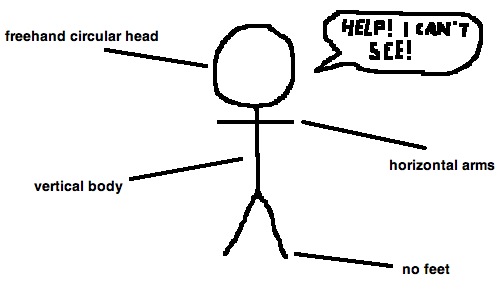
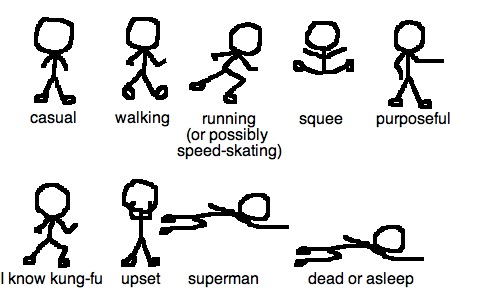
When you're drawing a stick person, the first thing you need to consider is what they're going to be doing. Since the body is very simple and you're going to spend most of the time on the face, this is a simple matter of making a quick decision. Most people stick to the traditional model (figure 1, but you can get stick figures doing all manner of weird and wonderful things (figure 2) even before you've put a face on them. Remember to add feet. Feet make poses more versatile. Adding feet to your stickmen is the difference between standing casually and tapping its foot impatiently.

Fig. 1: The basic stickman
Fig. 2: Possible stickman poses

Step 2a: Normal faces

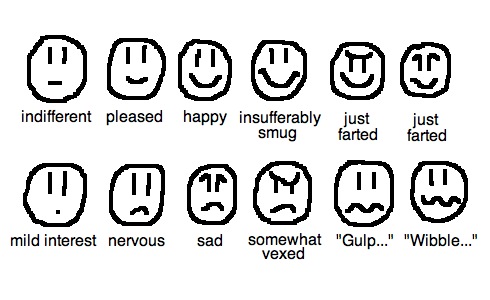
The next step, which a lot of people leave out, stopping at step 1, is to add a face to your stickman. You only need three lines to put a face on a stickman. Two vertical lines for eyes, and one horizontal or curvy line for a mouth. These lines can be modified to produce a variety of expressions (figure 3).

Fig. 3: Possible stickman facial expressions.

Step 2b: Open-mouthed faces

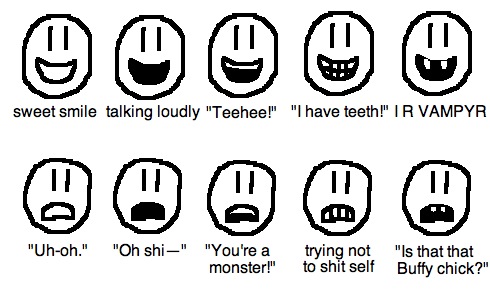
If one of the closed-mouth expressions just isn't expressing things expressively enough for you, then you may wish to consider opening your stickman's mouth. What you put inside your stickman's mouth can make a large amount of difference to what the expression means (figure 4).

Fig. 4: Open-mouth expressions.

Step 2c: Exaggerated faces

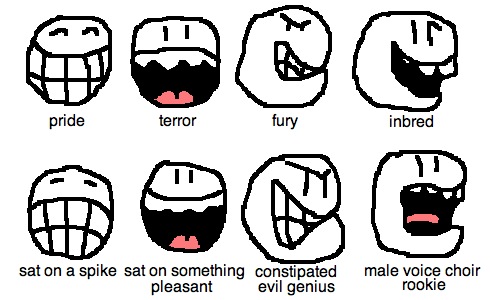
If none of the above faces are quite getting across what you are trying to say with your stickman, then simply throw any semblance of realism out of the window and do something ridiculous. These are stickmen, after all. They can do whatever the hell you damn well want (figure 5).

Fig. 5: Exaggerated expressions.

Step 3: Detail

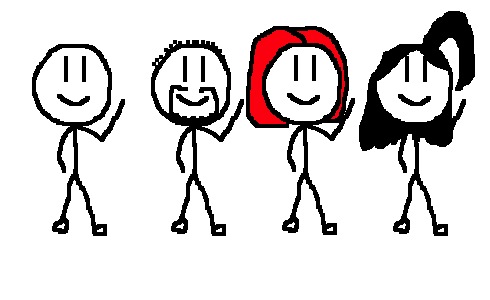
Once you've come up with a pose and a face, all you need to do is add some individuality to the stickman by adding some detail. This is normally done via the medium of hair. Creating different stickman characters is a simple matter of giving them different hairstyles. No-one will ever notice that they have the same faces and poses. You can even change a stick person's gender at the drop of a hat simply by changing the hairstyle (figure 6).

Fig. 6: Hairstyle = character.

And with just those three steps, you are officially done! You have created your own unique character. Congratulations. You're a cartoonist.