 [Compromise: Have decided on a new format. Weekends will have individual pictures like what I used to do. That way I can do them in Paint if I'm away from my Mac.]
So we finally got through a complete game of StarCraft: The Board Game. And after a bit of initial confusion over a few rules-related bits and pieces, the three of us found ourselves understanding the way things worked quite well. It'll probably take a few more games for us to be able to strategise with any real effectiveness, but for a first game, we didn't do too badly — and more importantly, it didn't last for six hours like we were expecting it to. In fact, due to the "Special Victory" conditions, the whole thing ended up being over a little quicker than we anticipated. No bad thing — it means that it doesn't go into that pile of "games that are good but take hours and hours to play" and will hopefully be trotted out relatively often.
It's an interesting game, really, with elements of Risk and Civilization present. There's empire and unit building, conquering opponent territories, researching technologies, and an interesting card-based combat mechanic that gives something of an element of chance without making it completely random. There's also a very wide array of possibilities for things to do, and this coupled with the randomly-generated game board will make for a game which is unlikely to be the same twice in a row.
Things we have learned so far, then:
- If someone has a Z-Axis Navigation Route (or "warpgate" as we kept calling them) linking to one of their own planets from one of their own planets, you'd better assault them sooner rather than later, otherwise you'll find them building up an unassailable fortress.
- Building the Air Support module which, among other things, prevents people from landing troops directly on your base, is an expensive investment that is very worthwhile as it makes life quite inconvenient for invading armies.
- Ultralisks are tough.
- Archons are tougher, especially if they have some fortunate combinations of Reinforcement and Event cards.
- Obstructing another player's orders isn't necessarily a good course of action, because it lets them draw Event Cards, which are quite powerful and also act as the game clock.
- Knock people off Conquest Point spaces as soon as possible rather than trying to do something clever like cut off someone's supply line. If someone has captured conquest point spaces worth a total of 3, it takes them just 5 turns to win.
- Attacking is better than defending to quite a significant degree, so it pays to go on the offensive.
- Force-mining someone's resources then retreating is a petty and amusing way to wreak revenge without destroying your own units.
I'm looking forward to trying the game again soon. It was a lot of fun and despite its apparent complexity (this is a game that easily takes up all of a large table with board, figures, cards and lots of chits) it's relatively straightforward to play once you get how the rules work. Approve, then!
 [I'm away for the weekend so am away from comic-making tools. I could use Windows Paint, but I'm not going to. So there.]
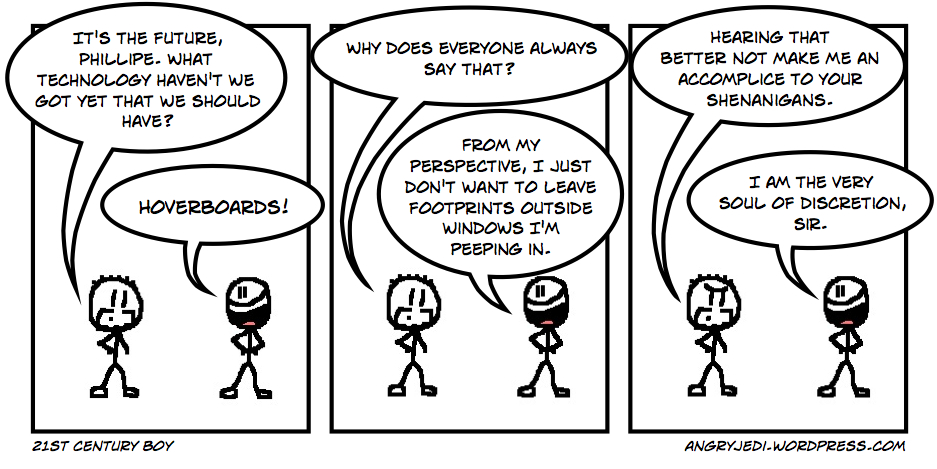 It's the 21st century. If you grew up in the 20th century like I did, this means that you're officially In The Future, because saying "21st century" sounded like it was a very long way off and not, as it happened, just around the corner.
 Those who have — ooh. Hold on. [gets momentarily distracted by the new WordPress interface that has apparently launched today.] Pretty.
 It should be abundantly apparent to most people by now that time is not a static thing and it moves at different rates according to what you are doing. The expression "time flies when you're having fun" is absolutely true, but so, too, is the lesser-known "time crawls when you're in a German lesson."
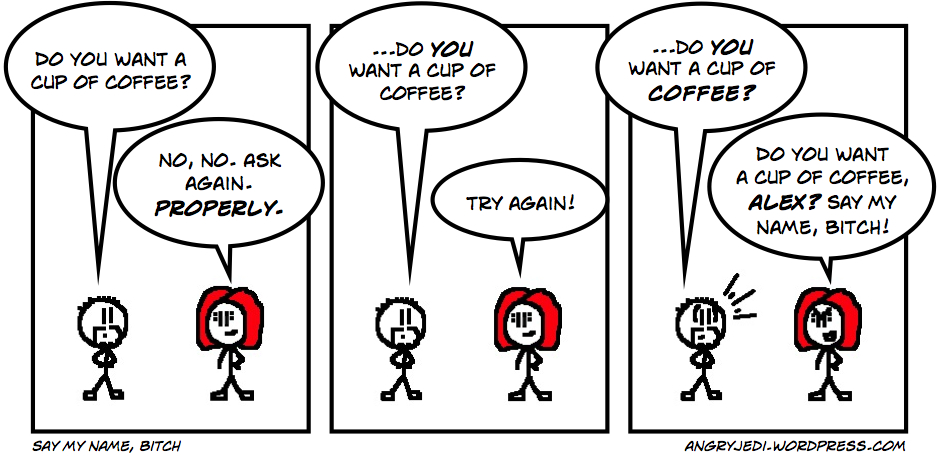 I have something of a — what — phobia? I'm not sure it's that serious, but I have something of a thing about saying people's names, for some inexplicable reason. It might be something to do with the fact that I never really liked my own name or the way my voice pronounced it when I was a kid (hence my habitual shortening of it to "Pete" everywhere in the world these days) or it might just be one of my many strange and inexplicable neuroses.
 Everyone supposedly misses their childhood, a time of innocence and purity when you could make fart jokes without worrying about your potential audience. And sure, there are plenty of awesome things about childhood — and plenty of reasons to ensure you keep an air of immaturity handy should the occasion demand it. But there were plenty of shitty things, too. So, in the best tradition of online journalism, I present to you the Top Five Reasons Childhood was Shit/Awesome.
 I've often been complimented on what is possibly my best virtue — my patience. I've developed this over many long and arduous years, and I attribute my possession of it as a virtue to two things in particular: video games and music.

