#oneaday Day 292: Thriving within limitations

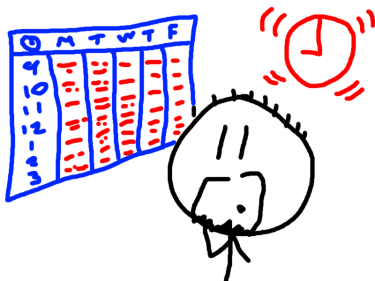
Most of you reading this who are at least A Certain Age will probably think back on your school days with varying degrees of fondness, but I suspect pretty much all of you are glad that those days are behind you for one reason or another — the chief one being the freedom you have once you are no longer constrained to an institution's timetable and rules.

As I get older, this is probably the rose-tinted nostalgia talking, but I increasingly miss that whole sense of structure that the school day had. I'm talking as a student here, not as a teacher; as a teacher, the school timetable was nothing but a source of stress, particularly when I forgot I was supposed to be "on duty" (whatever that actually means) and ended up on the receiving end of snarky comments from dickhead colleagues. But I digress.

No, I'm talking about the sense of structure you have when you are a student: the knowledge of exactly what is going to happen when for the day ahead, and the fact that you know your time is most likely going to be spent in at the very least a vaguely productive manner for the next 8 hours.

Sure, there were always the lessons that summoned up the inevitable sense of dread — Maths for me — and, of course, there was always the blind panic you'd feel when you realised you hadn't done the homework for the lesson that was scheduled for immediately after break, leading to frantic completion of said homework outside, leaning on a wall and hoping your teacher for the next period doesn't wander past and clock what you're doing.

But for the most part, it was nice to wake up of a morning and know what to expect. It was nice to have "favourite days" because that's when your best lessons were. It was nice to know exactly when you'd have the opportunity to work with your friends, or learn from a favourite teacher.

If this all sounds insufferably swotty, I don't know what to tell you; outside of some bullying incidents (where I was the victim, I hasten to add) I mostly thrived in secondary school in particular, and I enjoyed having things that I was good at, and which got acknowledged as things I was good at. Because heaven knows I wasn't "cool", and I knew that wasn't likely to change, ever.

I often find myself thinking whether the daily grind of work could be made better if I split it into discrete "periods" like the school day, with specific times set aside to do specific things. I suspect it actually might, but actually developing that schedule has been my sticking point. As a lot of my work is pretty self-directed, I'd be responsible for both setting and sticking to that schedule, and I'm not sure that's what worked well for me back when I was at school. Rather, I think I thrived because I had a schedule set by someone else, and during that schedule I was told exactly what to do, and exactly what was expected of me — again, by someone else.

I know part of "growing up" is being able to do those things for yourself, but lest we forget, I am what is politely termed these days as "neurodivergent", and thus I find myself wondering if I wouldn't just be better off in a situation where someone sits me down, says "9am-10am, you're doing this. 10am-11am, you're doing this. Then go have a bit of a break. Then 11.15-12pm, you're doing this…" and so on.

Sure, we have weekly Teams meetings (God, I hate Teams meetings… scratch that, I hate meetings in general) but those aren't exactly what one might call "engaging" in the same way a good old-fashioned school lesson was. Perhaps I was just fortunate enough to have, on average, very good teachers, and in other places, school is, in fact, ideal preparation for a life of adult misery in Teams meetings. But I doubt it.

Anyway, perhaps I should actually make an effort and try the "schedule" thing for myself. Who knows, it might actually work? Can't hurt to try, right?


Want to read my thoughts on various video games, visual novels and other popular culture things? Stop by MoeGamer.net, my site for all things fun where I am generally a lot more cheerful. And if you fancy watching some vids on classic games, drop by my YouTube channel.

If you want this nonsense in your inbox every day, please feel free to subscribe via email. Your email address won't be used for anything else.
#oneaday Day 291: If you like old games mags, here's a podcast you might like

The other day, I was contacted relatively out of the blue (no pun intended) on Bluesky by a chap called Ty Schalter, who wanted to let me know he and a fellow writer, journalist and author, Aidan Moher, were launching a new podcast, and would I mind giving it a bit of a nudge on socials.

Firstly, I was flattered that Ty thought I had anywhere near enough reach online to make a difference these days, but I indeed shared it anyway, and am, in fact, doing so again right now. Secondly, I was 100% on board with the concept for the podcast, which was to take a fond look back at classic games magazines. Here's the first episode for you to enjoy:

Now, as I stated in no uncertain terms just the other day, I am a big fan of old computer and video games magazines, and am always up for some discussion of them. These days, it's a bit tempting for everyone to look at the worst of their output, go "ugh, cringe" and leave it at that, but Schalter and Moher are doing the subject justice, judging by their first episode; they're acknowledging that while there are often faults we can pick from a 2025 perspective, these magazines were a vitally important part of gaming culture, particularly in the days before we had always-online Internet and, later, mobile phones.

What you've gotta remember is that in the '90s, if you had an Internet connection at all, it was a dial-up one that you had to ration your time with so as not to leave yourself with an astronomical phone and/or usage bill; earlier than that, the only online services out there were self-contained bulletin board systems. There was also a curious "in-betweeny" phase in the early '90s where services like AOL and CompuServe came to prominence; these offered global online services somewhat akin to the modern Internet, but in their own curated walled gardens. Later, both services provided access to the broader Web, but initially, they were their own little communities.

Why is this important? Because it meant that it was nowhere near as easy to talk about games with people as it is today. There was no magic black slab in your pocket that connected you to the rest of the world, and there was no guarantee that when you "logged on" with your computer that you'd find someone you wanted to talk to. There certainly wasn't the opportunity for carving out your own little space online as there is today, and absolutely no social media. (Maybe it wasn't all bad.)

This meant that magazines played a crucial role for video game enthusiasts: they were the main way that people who enjoyed games found out about new releases, the latest news and in-depth information about stuff that was already out. They were a point of common contact that, when we met up with our "real-life" friends (remember them?), we could use as the basis for a discussion. They were a connection to the outside world — and for many of us, a lifeline that made us feel much less alone in our passion for what is, most of the time, a fairly solitary pastime.

Schalter and Moher get this. They understand that for many of us, magazines were "the gaming community". We came to the mags not just for the games, but in many cases, for the personalities involved and the opinions we trusted. We'd obsess over a 250-word review of a 40-hour RPG, reading it repeatedly and drinking in the screenshots, wondering what it would be like to actually play the thing. We'd base our purchasing decisions on the arbitrary numbers the reviewers thought up, for better or worse. And we'd get to know the studios behind our favourite games through special features, interviews and preview reports.

Many of these things can be argued to still be present in today's games press, to be sure. But the daily churn of gaming news online makes it somehow less special than it was to get a monthly magazine. What game would be on the cover? What games would get in-depth features? What games were getting walkthroughs, tips and cheats? Would there be any cool cover-mounted gifts or bonus booklets included?

While it can be funny to look back and laugh (or cringe) at The People We Were 20-30+ Years Ago, it's important to take a look at the full picture for an understanding of why things were the way they were — and why so many people are still nostalgic for an era long past.

That's what the Fun Factor podcast seemingly aims to explore, and judging by the first episode — which features lengthy reminiscences about Final Fantasy VII that I'm sure will be familiar to anyone Of A Certain Age — it's going to be a good listen over the long term.

So go give that first episode a listen now, and if you're so inclined, support the podcast on its official website. You can also follow the pod, Ty and Aidan over on Bluesky.

I'm excited to see where the show goes from here, as it's a subject near and dear to my own heart. And if you have any fond nostalgia for that supposed "golden age" of magazines, I recommend checking it out, too. 'Cause heaven knows we could all do with some fun, happy stuff to enjoy right now, I'm sure.


Want to read my thoughts on various video games, visual novels and other popular culture things? Stop by MoeGamer.net, my site for all things fun where I am generally a lot more cheerful. And if you fancy watching some vids on classic games, drop by my YouTube channel.

If you want this nonsense in your inbox every day, please feel free to subscribe via email. Your email address won't be used for anything else.
#oneaday Day 290: Foxit? More like Fuckit

Good one, I know.

As I alluded to yesterday, I've been spending a bit of time collecting together scans of old computer and video games (and Computer & Video Games) magazines with a mind to sticking them on an old Kindle Fire tablet to use as a portable "magazine reader". As part of that process, today I found myself looking for PDF readers, both for Windows and for Android.

I wanted one for Windows so that I could potentially use it to make some videos about the magazines I don't have hard copies of, and neither Chrome nor Firefox's built-in PDF handling quite does what I wanted. (Chrome, notably, still lacks the ability to display two-page spreads but assume there is a "cover page", meaning it fucks up magazine and book layouts and there's nothing you can do about it.) So I did what any normal person does, and I Googled it, even knowing that Google itself has been gradually going down the toilet.

After skipping past the fucking useless AI summary and sponsored links, I clicked on an article that was absolutely bullshit SEO bait ("The best free PDF readers for Windows!") but was at least from a vaguely reputable outlet, TechRadar. This article informed me that Foxit was the best PDF reader for Windows.

Great, I thought. I've used Foxit before in the past. I doubt it's changed that much.

EH. WRONG.

Foxit has enshittified itself beyond all recognition. Not only has it made the inexplicable decision to model its UI on Microsoft's odious "Ribbon" interface, it also boots up with a floating "AI" button that you can't get rid of without some tinkering deep in the options and then quitting and restarting the program.

Let's take each of these in turn. First, the Ribbon.

I hate the Ribbon. I've despised the Ribbon ever since Microsoft introduced it in Microsoft Office 2007, and every time I use a program that uses this obnoxious piece of crap instead of normal toolbars and drop-down menus, I make a specific effort to find something else to use instead.

The Ribbon is an eyesore. The Ribbon takes up far too much space on the screen. The Ribbon's myriad tabs and huge buttons make it a massive chore to find simple functionality, since each tab is organised with no real care or attention. It doesn't conform to any standard functionality, so you'll find the same functions in different places in different applications, and it feels the need to take over the entire fucking window when you want to do something as simple as open, save or close a file, or look at the program's settings page.

In Foxit's specific case, I am honestly struggling to think of why a supposedly "lightweight" PDF reader has enough functions in it to warrant having a multi-tab Ribbon. I need a PDF reader to do one thing: read PDFs. Occasionally I might need to copy and paste images and text from a PDF, and the ability to take a snapshot of a section of a PDF and save it as an image is always nice. But I do not need multiple tabs worth of disorganised functionality, making it a chore to do something as simple as display two pages side by side and let me flip through the entire document like… well, like a magazine or book.

This is what people are talking about when they say "the computer" is constantly being enshittified. Things that worked perfectly well are being "updated" for no other reason than to say that they have been updated. Simple, straightforward, intuitive interfaces that remained standard conventions for decades are being uprooted in favour of borderline abusive design that forces you to click through page after page of crap in order to find the one thing you're looking for. And for what? To say that the company is "growing"? To say that the company is "innovating"? Fuck that. Just make me a fucking PDF reader that lets me read PDFs.

Which brings me to the "AI" button. I do not need a fucking AI button in my PDF reader. If I have opened something in a PDF reader, I intend to read it or print it. I am not going to ask a fucking chatbot that gets things wrong an average of a third of the time you ask it things to "summarise" the thing that I'm trying to read either for information or pleasure. I am not going to ask a fucking chatbot that gets things wrong an average of a third of the time you ask it things to "analyse" the document or figure out "trends". I am a human being. I have a brain. I can do these things myself. I do not need "AI" to "do it more quickly". Believe it or not, I enjoy reading. I enjoy researching. I'm not so fucking lazy that I need a fucking chatbot (&c. &c.) to take the human part out of the equation. Because that's just depressing.

Things weren't much better on the Android front. I tried Foxit on Android as well, just out of curiosity, and sure enough, while it lacked the Ribbon (the one benefit of a phone screen is that it's too small for such a shitty interface) it still had the odious little AI bubble. So I uninstalled it immediately.

If you've been in a similar situation at any point, may I recommend Sumatra PDF for your desktop PDF reading needs, and PDF viewer lite for Android. Both of those seem to fit my needs perfectly well right now: no ads, no subscriptions, no Ribbon, no AI, no bullshit. Just a thing to read PDFs with. Which should not be a hard thing to find in 2025. But apparently this is the world we've built for ourselves.


Want to read my thoughts on various video games, visual novels and other popular culture things? Stop by MoeGamer.net, my site for all things fun where I am generally a lot more cheerful. And if you fancy watching some vids on classic games, drop by my YouTube channel.

If you want this nonsense in your inbox every day, please feel free to subscribe via email. Your email address won't be used for anything else.

#oneaday Day 289: Some games magazines I used to like

I love old games magazines, and will frequently re-read them years after they were relevant. In fact, I'm currently in the process of assembling a collection to bung on an SD card and pop in my otherwise unused Kindle Fire 7 to use as a portable retro magazine library. I've also got a vague plan to make some more videos on classic magazines, as I really enjoyed making the first two on Page 6 magazine — you can watch those here (issue 1) and here (issue 2).

In the absence of anything else to write about — I've been playing Xenoblade Chronicles X for most of the weekend, and I already wrote about that earlier — I thought I'd give a rundown of some magazines I used to like, and which I may well take some time to cover on YouTube at some point.

Note: I say "magazines I used to like"; most of them are magazines I knew someone who worked on, usually my brother. I make no apologies for this.

Page 6/New Atari User

This is the one I bring up most commonly on my channel, and for good reason: three members of my family (my Dad, my brother and me) were involved in it at various points, and it's the magazine that launched the career of my brother — a career that, with him being a big bossman at IGN now, he's still in.

Page 6, as it was initially known, started life as a user group newsletter. Within one issue, the editor Les Ellingham had decided that he wanted to fulfil a grander ambition: to publish the UK's first Atari-specific magazine. And he only went and did it. For an astronomical amount of time, considering the subject matter, too; Page 6 ran in one form or another from December of 1982 until the autumn of 1998, and it was still covering the Atari 8-bit in its very last issue.

Page 6 was an enthusiasts' magazine. It wasn't a games magazine; Les in particular was keen to stress from the outset that while computers were excellent games machines, there was also a ton more you could do with them. And part of the point of the magazine was to educate people on the possibilities their computers offered. It achieved that through articles about software releases (including both games and "serious" software), interviews, tutorials, type-in listings and plenty more.

It was always a pleasure to read. One gets the impression that it was a real labour of love for Les in particular, and there are plenty of occasions where his editorial page came across as very frustrated that other people didn't seem to care quite as much as he did — but I cared. I still do care. Page 6 was a formative part of my youth, and revisiting old issues today, I still feel a lot of the same magic I felt in the early days of computing.

Read them all at Atarimania.

Atari User

Showing up a little later, Atari User from Database Publications (later Europress) launched in 1985 and ran until November 1988, at which point Page 6 acquired the rights to the Atari User name and rebranded as New Atari User. Page 6 was still on the newsstands at that point, and it was thought that the Atari User name would attract more casual interest, since "Page 6" is a nerdy reference to an area of the Atari 8-bit's memory that only people already well-versed in the system's "culture" would understand.

At heart, Atari User was a similar sort of magazine to Page 6, covering both games and "serious" applications, perhaps with a slightly greater focus on things that, if not games, were at least entertainment of a sort. Like Page 6, there were a variety of features each issue, including type-in listings, and often some interesting-looking "Gadgets" sections for electronics projects you could do with your Atari. I never tried any of them — I was a bit young — but they always looked interesting.

I enjoyed reading both Page 6 and New Atari User because they each had a very different style to them. Page 6 always felt like it took itself very seriously, with a fairly no-nonsense, stern, professional-looking layout in each issue — not to say that individual articles lacked personality and humour, mind; I'm talking purely aesthetically — while Atari User made use of the bigger budget it had thanks to being part of a larger corporation by producing colourful issues with large, attractive pieces of artwork and photography throughout. I was sad when Atari User went under, as it was one of those magazines that it was just fun to look at thanks to its colourful cover art.

Read them all at Atarimania.

Antic and ANALOG

Antic, subtitled The Atari Resource, was one of two Atari-specific magazines from the States, with ANALOG (short for Atari Newsletter And Lots of Games) being the other. You could get them both relatively easily in this country via specialist importers. Antic and ANALOG were both, like Page 6 and Atari User, magazines that revelled in the joy of home computer ownership. Part of that was gaming, yes, but it was also about programming, productivity and creativity.

I actually haven't revisited Antic and ANALOG for many years and I think I'm long overdue to, as I remember enjoying them both. I do remember Antic having noticeably thicker issues, while ANALOG became renowned for its excellent machine language type-in listings. So they're both going on my portable magazine library, assuming it works as I hope it does.

Read Antic and ANALOG at Atarimania.

Games-X

Page 6 was where my brother got started writing about games, but it was Games-X that truly launched his career properly; he left home to work on it, and it ended up being the beginning of a whole life in the games press.

Games-X was unusual: it was a weekly games magazine (a decision which founder Hugh Gollner later described as "a big mistake" financially), and most other magazines at the time were monthly. Page 6 was bi-monthly (as in, every two months, not twice a month). This naturally allowed it to be a lot more "up to date" with gaming news than many other magazines, but it was also fun to be able to buy a new games magazine every week, initially for just 60p an issue.

Games-X covered that strange period late in the ST and Amiga's lifespan when consoles were just starting to really get a foothold in the UK. The majority of the focus in each issue was on home computer games, but there was a dedicated console section — and the next magazine my brother worked on after Games-X was Mega Drive Advanced Gaming.

Games-X had a fun, irreverent attitude to it and, in many ways, was very "'90s", with everything that entails. I still really like it, though, and think it stands out as a magazine that deserves to be remembered a bit more than it is.

Read them all at RetroCDN.

Advanced Computer Entertainment (ACE)

I don't think I actually had many issues of this, but I enjoyed every one of them a great deal. Advanced Computer Entertainment, or more commonly just ACE, was a multi-format magazine that one gets the impression liked to think it was a cut above the other games magazines around at the time. It was still about video games, sure, but it lacked some of the '90s abrasiveness of other publications, and took things a bit more "seriously", for want of a better word. One might call it the Edge of its day, only marginally less pretentious. (And yes, I checked; Edge launched in 1993, while ACE folded in 1992.)

That is, after they got over an initial rocky patch where there were more errors in the early issues of ACE than I think I've ever seen in any other magazine. Typos, mistakes, outright blank sections of pages — they had it all. But once it settled down, it was a very high quality magazine that I always enjoyed. The magazine was noteworthy for its "Pink Pages" section in the rear, a no-nonsense "reference" guide to new releases, charts and review summaries, plus a bizarre "Stock Market" section that never really made much sense, but I believe it was an early attempt to try and aggregate review scores for various developers and publishers, if I remember rightly.

I rather liked that ACE took things seriously. The silly humour of other magazines could be entertaining, to be sure, but it was nice to be able to read a magazine about games that was just… about games, rather than about its writers trying to launch a comedy career. As with Page 6, that's not to say that individual articles and writers lacked personality or a sense of humour; it's just that humour wasn't the main point, whereas with some other magazines around at the time, particularly once we moved into the 1990s, it felt like they were trying to be a funny magazine first, about video games second.

Read them all at Atarimania.

PC Zone

Now, this may make me sound a bit like a hypocrite after what I literally just said, but I always enjoyed PC Zone, even before my brother's time there as editor and publisher. PC Zone in its prime always felt like it struck a good balance between humour and information, and I loved it for that. It acknowledged that games were fun, silly and often stupid, but also recognised that people were passionate about them — sometimes to a fault.

PC Zone is also noteworthy in retrospect for being an early outlet for Charlie Brooker, and his articles were always a highlight, as were his eminently silly The Cybertwats cartoon strips, which got the magazine a bunch of complaints on multiple occasions, particularly after he depicted Lara Croft machine-gunning someone's cat to a particularly violent and bloody demise.

When people talk about old magazines being fun, I think of PC Zone. While in retrospect some of it may have been a bit "lads mag"-ish (see: front cover depicted above), it never really felt particularly exclusionary. Plus I spent two weeks doing work experience in their offices and, although I didn't really do much other than make a lot of cups of coffee and tea (and write a review of Virtua Fighter PC) that fortnight remains one of the happiest of my life.

Read them all at Pix's Origin Adventures.


And there's more I could be going on with, but I think that's probably plenty for now. If you're a retro computer and gaming enthusiast, you could do far worse than familiarise yourself with the above publications. And the links I've provided will let you do just that.

Note: I will not be held responsible for anyone complaining at you suddenly taking a lot longer in the toilet.


Want to read my thoughts on various video games, visual novels and other popular culture things? Stop by MoeGamer.net, my site for all things fun where I am generally a lot more cheerful. And if you fancy watching some vids on classic games, drop by my YouTube channel.

If you want this nonsense in your inbox every day, please feel free to subscribe via email. Your email address won't be used for anything else.

#oneaday Day 288: Some interesting links I found this week

I'm trying to do a bit less scrolling through what little social media I still use, and a bit more reading of interesting blogs, articles and what have you. To that end, I've set up Feedbin as an RSS reader (it's pretty good — subscription-based, unfortunately, though that does mean it's nice, clean and ad-free) and am taking a bit of time each day to just read some interesting things. Moreover, if someone happens to share an interesting-looking site, I'm adding it to my Feedbin so I can keep up to date with other posts on those sites, rather than simply forgetting they exist like I have done in the past.

To that end, I'd like to share a few posts I happened to run across this week. Not all of them are recent posts, but I happened to read them this week in my travels around the Internet. You might enjoy them too, so here they are.

The Case Against Gameplay Loops

https://blog.joeyschutz.com/the-case-against-gameplay-loops

This is a nice post that echoes some of my own thoughts on the weird increase there has been in people talking about "gameplay loops" recently. Many games are based on a gameplay loop, for sure, but it's often quite reductive to talk about them that way, and it's certainly not good for talking about games as a creative medium or work of art.

Writer Joey Schutz echoed my own concerns about being conscious of gameplay loops to the detriment of your own enjoyment, which I wrote about here. He cited the example of the game Tactical Breach Wizards, a game which I've heard good things about from people whose opinions I trust.

"[This game] felt fresh and interesting, with good mechanical hooks and nuanced abilities," he wrote. "But at some point along the way, it began to feel stale to me. After beating a boss, the game declared in big, bold letters 'Act 2 out of 5 COMPLETE'. My God… 3 more acts and I'm already tired! So I put it aside and went on with my life."

The fact that this kind of thinking is causing people to fall out of love with games well before finishing them is what concerns me. Schutz quotes some figures about estimated completion rates and, as someone who finishes pretty much every game he starts, this makes me sad.

But anyway. This post was good and you should read it.

Constraints are the Point

https://hey.paris/posts/constraints-are-the-point

This is a nice simple one: a response to all the wild flailing and gesticulating generative AI enthusiasts engage in any time they talk about how generative AI is going to "revolutionise" gaming.

"Imagine being able to walk up to an NPC and ask them anything!" they say.

"Nobody actually wants that!" anyone with any sense says.

I've pretty much spoiled this whole post with the above description, but you should read it anyway, as it's a lot more thoughtful about it than I am.

Why DigitallyDownloaded.net isn't going to review Assassin's Creed Shadows

https://www.digitallydownloaded.net/2025/03/why-were-not-going-to-review-assassins-creed-shadows.html

Matt of Digitally Downloaded is a personal friend of mine, and I 100% support him in his decision here, especially after having seen the harassment he gets after terminally online fanboys look him up via Metacritic if he gives a game an "outlier" score.

I feel for Ubisoft right now — and it's not often I'll say that, I can tell you — because no-one should have to put an anti-harassment support plan in place for releasing something they've worked hard on for a very long time. But the "discourse" around this game is absolute garbage-tier, demonstrating the absolute worst of the disgusting culture war that continues to rage around popular entertainment.

"Poorly analyzed US-centric garbage" – Why do Americans keep ignoring European gaming history?

https://www.timeextension.com/news/2025/03/poorly-analyzed-us-centric-garbage-why-do-americans-keep-ignoring-european-gaming-history

I've pretty much covered this in yesterday's post, but it was interesting to see a Bluesky spat covered on a commercial website. If you didn't catch some of the better responses throughout the day (or you're not on Bluesky), this is a good look at what happened.

The Dying Computer Museum

https://ascii.textfiles.com/archives/5672

From Jason Scott of the Internet Archive and textfiles.com, this is a sobering read about what happened to what appeared to be a thriving computer museum after its main benefactor passed on. I'm sure this isn't the case for all museums, but I sincerely hope that similar efforts to preserve computing history in this country have a suitable plan for what happens after their main curators pass on, because it'd be a terrible shame to see stuff that had been put out for the public to enjoy to end up on the auctioneer's block, doomed to end up in a private collection and never seen again.


Anyway, that's that. I hope you enjoyed those. I don't know if I'm going to do a post like this every week, but I am going to make an effort to bookmark interesting things as I come across them, then share them when I can. So look forward to another post like this in the near future, I guess! I'm going back to Xenoblade Chronicles X now. Ta-ta!


Want to read my thoughts on various video games, visual novels and other popular culture things? Stop by MoeGamer.net, my site for all things fun where I am generally a lot more cheerful. And if you fancy watching some vids on classic games, drop by my YouTube channel.

If you want this nonsense in your inbox every day, please feel free to subscribe via email. Your email address won't be used for anything else.

#oneaday Day 287: European video game history discourse is happening again

As the title says, European video game history discourse is happening again. I'm not going to link to the post in question, because I like the chap who inadvertently kicked this off and I don't want him to have to put up with any more angry Europeans than he already is contending with. But I will comment on the whole subject, because it's a topic worth discussing with some commonly held assumptions that need challenging.

So here we go.

"The Great Video Game Crash" didn't happen in Europe

This point is one that, I think, is finally getting through to a lot of people. The notorious "crash" of 1983 following the absolutely flooded market of third-party Atari 2600 games was a purely North American phenomenon, and it only affected the console market.

It was a bad thing, to be sure, putting a lot of developers and publishers out of business, and it can probably be pointed at as the main reason that platforms like the ColecoVision and Intellivision didn't survive. And it's definitely true that the arrival of the NES on the scene marked a renaissance for the console games market in North America.

But it just didn't happen in Europe. I didn't even know it was a thing until the Internet came about. The reason? Because most of us in Europe were happily making use of home computers at the time, and we continued to do so throughout most of the '80s and early '90s.

Europe's console game sales are a miniscule fraction of those seen in the States

The same reasoning can be applied to this. Yes, I entirely believe that considerably fewer console games were sold in Europe than in North America. This is because consoles weren't nearly as widespread as home computers were. Growing up, I didn't know anyone who had a console for many years. I didn't even know for sure if the ColecoVision came out in Europe until quite recently when I found an ad in an old home computer magazine.

But I did know people who had home computers. We had Atari 8-bits. My best friend in primary school and a girl I moderately fancied both had BBC Micros. Another friend had a Spectrum. Another still had a Commodore 64. One even had an Electron.

There are a few considerations here. One, home computer games were often much cheaper than console games — though this wasn't always the case, particularly for games distributed on ROM cartridge. Cassette-based games were very cheap, though, particularly on the Spectrum and C64, and disk-based games weren't crazy expensive for the most part — though disk drives were, since back then they essentially had a whole other computer inside them to control the damn things!

However, what you also have to consider is that many games had considerably wider reach than their commercial, officially recorded sales figures might suggest due to piracy. Piracy was absolutely rife in the early home computer sector, and while this probably wasn't good for the overall health of the industry, it somehow never caused a "crash". Piracy has also, long term, been amazing for preservation purposes, because pirated disks (pretty much always disks) often had pre-release or beta versions of games on them, and in many cases these particular versions of these games were not preserved by their original developers and publishers.

Thirdly, home computers were programmable. And, outside of dedicated games magazines, which were in a minority compared to "general computing" magazines for quite a few years, most publications encouraged computer users to get involved in programming their machines themselves. Magazines published type-in listings each month, allowing you to get "free" software in exchange for the cover price of the magazine, a bit of your time and some blank media to save it on. Public domain libraries appeared and thrived. And many folks simply wrote their own software to do something their computer couldn't already do. With BASIC built-in to pretty much every 8-bit machine, anyone could become a programmer just by turning the damn thing on.

Home computers continued to thrive even with the advent of consoles

The NES didn't "save" gaming in Europe in the same way that it did in the States. It was present, sure, but the only person I know who had one was my Uncle Peter (or perhaps more accurately, his daughter Gemma). We certainly didn't have one. I knew one guy who had a Master System, but I think he only had one game for it and he certainly didn't consider himself a gaming nerd.

Console gaming really started to pick up in Europe — or at least in the UK, from my experience — with the advent of the 16-bit era. That's when we really started to get a glut of specialist gaming magazines focusing on individual platforms, and that's when I knew more people who started to get Mega Drives and SNESeses.

But those consoles never replaced home computers. My best friend in high school, Edd, had a Mega Drive, but he spent much more time on his Amiga 500. I had a SNES, but I still spent much more time on the Atari ST and even the Atari 8-bit, which we still kept out and in use for many years. And the press reflected this, also: multiformat magazines tended to prioritise Amiga and Atari ST, with console games often relegated to their own little section, like they were a curiosity. And just as there were specialist gaming magazines for platforms like the SNES and Mega Drive, there were also individual mags for the ST and Amiga, too. And in many cases, those mags were more substantial than their console counterparts — often aimed at a slightly more mature audience, too.

Not only that, but the "free software" sector continued to thrive, too. While the ST and Amiga didn't ship with built-in BASIC like their 8-bit predecessors, there were still plenty of easily accessible packages for both that allowed anyone to get programming. Public domain software, likewise, continued to thrive, with public domain titles distributed through magazine coverdisks, through public domain libraries and through early online services such as bulletin boards.

Particularly notable from this era are STOS and AMOS, flavours of BASIC for Atari ST and Amiga respectively, which featured game-centric features such as sprites, sound generation, interrupt-based music and all manner of other good stuff. Both, as you might expect, were widely used to make both public domain and commercial titles by enthusiast developers. STOS and AMOS were made by Francois Lionet and Constantin Sotiropoulous, the former of whom founded Clickteam. Clickteam made Klik and Play, which saw several follow-ups, the latter of which, Multimedia Fusion (or just Clickteam Fusion now), is still in use to this day to make commercial games. Played Freedom Planet? You've played a game whose lineage can indirectly be traced back to STOS.

Things only really shifted firmly in favour of consoles when the PlayStation showed up, but even then, MS-DOS PC gaming had already hit its stride with the advent of 256-colour VGA graphics and sound card support.

Without the European home computer scene, there's a lot of today's developers that wouldn't exist

This is the most important thing to bear in mind, I think. So many of today's developers and publishers can be traced directly back to '80s home computer labels.

Codemasters? They used to specialise in budget-priced cassette games made by teenagers in their bedrooms. Rare? They started out making Spectrum games. Sumo Digital? They can be traced back to Gremlin Graphics, who were there from the very early days of 8-bit home computer games. And there are countless more; if you were to go through everyone Of A Certain Age in today's European games industry, you will almost certainly find a significant portion of them who cut their teeth working on home computer games.

Hell, this is even the case in the States, too. Folks who were making home computer games in North America, in many cases, continued on into careers in the later console sectors. I learned the other day that Cathryn Mataga, maker of the excellent Shamus and Zeppelin on Atari 8-bit, also made the frankly incredible port of Dragon's Lair to Game Boy Color, to name just one example.

Revenue isn't the whole story, not by a long shot

It keeps coming back to this. Sure, the money numbers might look smaller for the European games industry throughout the '80s. But in terms of the usage of these systems, the passion, the things that are harder to track through anything other than anecdotal evidence and the lived experiences of folks who were there? Absolutely nothing beat the home computer scene of the 8-bit and 16-bit era in Europe.

Hell, our favourite Atari computer magazine ran from 1982 until 1998. That's an astonishing achievement for a publication that covered the Atari 8-bit platform from its very first issue right up until its sad finale. And Atari 8-bits were a niche platform; the Spectrum, Commodore 64 and Amstrad all did way better in the market.

Look, I'm not saying American video game history isn't important. It is. It's where video games as we know them today were born, after all. But we've gotta get over this assumption that anything that happened outside of North America or Japan was somehow not important. '80s home computing was — is — much more than just a fad or a scene. For many folks, it was video games. For many folks, it was life. And acknowledging that doesn't make Pong, the Magnavox Odyssey, the Atari 2600 or the NES any less cool or revolutionary.


Want to read my thoughts on various video games, visual novels and other popular culture things? Stop by MoeGamer.net, my site for all things fun where I am generally a lot more cheerful. And if you fancy watching some vids on classic games, drop by my YouTube channel.

If you want this nonsense in your inbox every day, please feel free to subscribe via email. Your email address won't be used for anything else.

#oneaday Day 286: It's Xenoblade time

It's Xenoblade Chronicles X: Definitive Edition release day, and I was very good and didn't even boot it up until I'd done all my work for the day and emptied the cats' litter trays and gone out to get some stuff from the shop. Still managed nearly four hours of getting into the swing of things.

It's a delight to return to this game. As I've alluded to several times, I'm going to do some more in-depth coverage of this over on MoeGamer as I play through, but I thought I'd also post some first impressions from the Switch port here, since it's what the majority of my evening has consisted of.

It's been a long time since I played the Wii U version (ten years, in fact!) but a lot of things already feel comfortably familiar. I even inadvertently picked the exact same voice for my character that I did first time around, though I didn't realise I'd done that until she came out with one particular line that suddenly triggered a memory.

Xenoblade Chronicles X is an absolutely massive game, but it does a good job of easing you into things. The early story missions take you through the absolute basics you'll need to know to get up and running, then by about the third chapter you can start enjoying some of the game's more "freeform" structure by taking on various missions. As you continue to progress the main story, you unlock other features such as the online modes and the ability to pilot (and later fly) the "Skell" giant robots. Crucially, though, the game doesn't throw all this at you at once. You can quite feasibly spend a very long time playing the game before even getting anywhere close to jumping into a Skell.

The main thing I was wondering about, which is how they'd implement the hex-based "segment map" that was originally on the Wii U GamePad's screen while you played, has been incorporated about as well as they could have done given the Switch's lack of a second screen. It's now a separate Map screen that you can access from the game's main menu, which means you can't look at it while you're wandering around, but it does also mean you can concentrate on it without having to worry about Tyrants coming to attack you while you tinker with your mining probes.

Performance and visuals-wise, the Switch version does a great job. There are understandable technical limitations of the same ilk seen in other Xenoblade games on the console — most notably characters and some objects "popping in" as you approach rather than being drawn from a distance — but, given the scale of the game and the relatively underpowered hardware it's running on, it's just fine. The tweaks to the interface to make it more readable are very welcome indeed, and I suspect even more so for those playing in handheld mode; this is really a game made for big TVs, though, as the vistas throughout remain absolutely spectacular.

Coming to this almost straight off the back of Xenoblade Chronicles Definitive Edition, it's also interesting to note how different the combat feels. While the basic mechanics are almost identical, the focus on responding to your party members' callouts and the ability to switch between ranged and melee weapons on the fly really makes battles feel a lot more dynamic. Enemies move around a lot more, too, meaning you also have to move a lot more to be able to strike them from the side or behind — and a welcome addition over the original Xenoblade's combat is a clear on-screen indicator as to whether you're considered in front of, flanking or behind an enemy.

I'm very happy to be back on Mira, and since I have no other "big games" going on right now, I'm going to see quite how much of this game I can complete this time around. Because although I finished the storyline of the Wii U version, I feel like I only scratched the surface of the things the game has for you to do. Because as I saw someone else point out the other day, Xenoblade Chronicles X is actually two stories: one is about your companion Elma rather than you, and that's the "main scenario" you go through. The other is the emergent narrative you build yourself: your career with BLADE, the missions you complete, the people you encounter, the choices you make. And it's that latter part that goes on for a lot longer than the relatively short main scenario.

Because I was deep into Final Fantasy XIV at the time Xenoblade Chronicles X came out for the first time, I felt a certain amount of "guilt" at getting too invested in the latter. But since I've drifted away from Final Fantasy XIV for the moment, Xenoblade Chronicles X is getting my full attention. And if you're yet to play it, I highly encourage you to check it out this time around. You no longer have the excuse that it's on a platform that no-one owns, because it's on one of the most popular console platforms in the known Universe.

Anyway. I wanted to post something about it today at least. I should probably go to bed now, but there are missions to do, things to find, Tyrants to fight…


Want to read my thoughts on various video games, visual novels and other popular culture things? Stop by MoeGamer.net, my site for all things fun where I am generally a lot more cheerful. And if you fancy watching some vids on classic games, drop by my YouTube channel.

If you want this nonsense in your inbox every day, please feel free to subscribe via email. Your email address won't be used for anything else.

#oneaday Day 285: On that thing what Gareth Southgate said

Former England manager and renowned penalty whiffer Sir Gareth Southgate recently delivered the prestigious Richard Dimbleby lecture, as reported by The Guardian (and doubtless some other places, but The Guardian is where I saw it).

The thrust of Southgate's speech was the plight of young men, and how they are, I quote, "feeling isolated, grappling with their masculinity and with their broader place in society".

I agree with this part, though I'd probably broaden it to "most men" rather than just "young men". We are encountering a problem I could have predicted a decade ago: that strides forward in progressive attitudes are leaving some men feeling somewhat cast adrift.

This isn't to say that the broad shifts in progressive attitudes are in any way wrong, I hasten to add, whatever the current United States administration might be attempting to do right now. No, on the contrary, it's good that, on the whole, we have much less sexism, racism, homophobia and transphobia than we used to have. We haven't eliminated any of these problems, unfortunately, but progress has been made.

As part of all that happening, though, there was a certain amount of demonisation of privileged groups in society. Not universally, by any means, and again, I'm not saying that white men deserve to be "better" than anyone else. But for a good decade or more, men have been facing something of an existential crisis as society attempted to "make up" for their historical position of privilege. And this, in turn, has led to things like the loneliness epidemic among young men, the alt-right pipeline and all that business. That's a thing that has happened. The question is why.

Southgate argued that these men "spend more time online searching for direction and are falling into unhealthy alternatives like gaming, gambling and pornography". This quote, unsurprisingly, is the one that has been largely taken out of context and objected to. And I don't disagree with the people who did that. While gambling is hard to defend, I firmly believe there's a place in society for both gaming and pornography, and that neither of them are inherently evil things. The problem, as with so many things, is the groups that spring up around those things.

Which, as it happens, is what Southgate's speech went on to criticise.

"This void is filled by a new kind of role model who do not have their best interests at heart," he said. "These are callous, manipulative and toxic influencers, whose sole drive is for their own gain. They willingly trick young men into believing success is measured by money or dominance, never showing emotion, and that the world — including women — is against them. They are as far away as you could possibly get from the role models our young men need in their lives."

The key nuance that Southgate is missing here is that while some "influencers" (ugh, I hate that word, but I'll use it for the sake of quotations in this instance) in the gaming, gambling and pornography spaces are having a harmful effect on young men's wellbeing, this is not a universal thing by any means. (Again, I'd make the argument that gambling is the hardest to defend here, but even that's by no means a universal negative — look at things like The National Lottery and the charitable organisations attached to them.) I hate to be all "not all [x]", because people seem to take that as you having lost an argument, but it really is the case in this instance.

What he's getting at is exactly what I described above (and back in this post) — disenfranchised young men are finding what they believe to be "role models" in figures like Andrew Tate and Jordan Peterson, who are saying the things they want to hear, and reinforcing harmful attitudes. And these figures "recruit" from fields that young men are interested in — like gaming, gambling and pornography.

The nuance is that gaming, gambling and pornography aren't themselves to blame for the existence of Tate, Peterson and others like them, but rather they just happen to be where figures like that found their most fertile markets. Being into gaming, gambling or pornography doesn't mean you're immediately going to get sucked down the alt-right pipeline into a life of perpetual fury at the world — but I can see how that happens, as I've described elsewhere.

I think it's important to highlight the positives of these things. Gaming, in particular, is probably the fastest growing creative medium in the world, and is a truly democratised form of art. Anyone from a solo independent developer to a huge multinational corporation can make a game, and the market will support that. Granted, it's harder for a solo independent developer to make as much of a splash as a huge multinational corporation with an army of marketing specialists, but it's not impossible — look at stuff like Vampire Survivors and even Minecraft's origins.

Gambling, as I say, is harder to defend, but not impossible. While a gambling addiction can be utterly devastating to individuals and families alike, I don't see the harm in an occasional flutter on the National Lottery, particularly when the money is going to Good Causes™. Sports betting, I'm not even going to try and defend. But you hopefully see my point.

And pornography. While there has always been exploitation and suffering surrounding the production of pornography, today we have a society where sex workers aren't treated as something shameful to be swept under the rug, but where they have meaningful contributions to online discourse, and where the most prolific, uh, performers can make a surprising amount of money, often for just posting videos online. We have artists who focus on drawing pornography as a means of self-expression, or to cater to the tastes of their audience. And that audience gets to explore their fantasies and learn about their tastes in a safe environment.

All of these fields have their negative, toxic ends. "Gamer" discourse surrounding the recently released Assassin's Creed Shadows, for example, shows that we still have a lot of work to do with regard to racism. I don't know anything about the gambling influencer sphere, but it doesn't seem like… something I want to get involved with. And, of course, pornography still has the exploitation element, even in seemingly democratised scenarios such as OnlyFans.

But then… doesn't anything have its toxic element? Southgate's own field of football has its own problems with racism, homophobia, xenophobia, hooliganism and violence, but I don't see him acknowledging that. It feels just a little disingenuous to specifically pick out the things he did in his speech; it's approaching "moral panic" territory, and while there are things we can work on with regard to all of those fields, I don't think it's justified to make blanket statements like "gaming is an unhealthy alternative to having a father figure".

Toxic influencers are a different issue to the games industry in general. The games industry has its own problems that it still needs to grapple with, but it is not a direct, straight line from gaming to Andrew Tate. Southgate argues that "success is about much more than the final score; it isn't a straight line, and it's not a single moment". The same is true for negative cycles, too; you can't point to one single thing and go "that is the cause of all my woes".

For my part, I believe the increasingly abusive practices of algorithm-driven social media are more harmful than anything else when it comes to the situation men find themselves in these days. Because social media is how those harmful messages get out and how they are spread — often with the full approval of the platform holders, because they know the most toxic waste of the Internet is that which gets the most "engagement". But social media is just part of a much more complicated picture, and one we could do well with trying to zoom out and see the entirety of.

Men are suffering. Men are feeling isolated. Men are grappling with their masculinity and with their broader place in society. Gaming and pornography, like anything else, within reason, can be a comfort for those men when engaged with in moderation. They are not the enemy. It is, however, correct to say that toxic "influencers" are a real problem, so that is what we should perhaps be looking at more closely.


Want to read my thoughts on various video games, visual novels and other popular culture things? Stop by MoeGamer.net, my site for all things fun where I am generally a lot more cheerful. And if you fancy watching some vids on classic games, drop by my YouTube channel.

If you want this nonsense in your inbox every day, please feel free to subscribe via email. Your email address won't be used for anything else.

#oneaday Day 284: It's almost Xenoblade time

Just two more days until Xenoblade Chronicles X arrives on Switch. Well, actually, in 15 minutes (as I type this sentence), it will technically be "Xenoblade Chronicles X is out tomorrow".

I am, if it was not already clear, really looking forward to diving back into this wonderful game. I am a little concerned it's going to get lost in the rush of other stuff that's coming out this week — most notably the new Assassin's Creed game, which, after a lot of people tutting and clicking their tongue at Ubisoft for the last few years, everyone seems to be all over, regardless.

One doesn't have to cannibalise the other, of course. I have zero interest in Assassin's Creed, but am eagerly awaiting Xenoblade Chronicles X, and I'm sure I'm not the only one in the same position. My concern is that the people with the loud voices and the column inches to spare will concentrate entirely on Assassin's Creed and not give Xenoblade more that a cursory look. And that will be a great shame indeed.

But rather than moaning about it, I am going to do what I do best: hyperfixate on it for an indefinite period of time, and write extensively about it over on MoeGamer. That's right, I'm essentially resurrecting the "Cover Game" feature, though I don't know if it's going to be a fixture. I certainly am going to give Xenoblade Chronicles X the multi-article treatment, though, taking a look at its mechanics, narrative, setting, worldbuilding, aesthetics, music and all manner of other good stuff in a frankly obsessive amount of detail. Because, dammit, it deserves it.

My whole thinking behind the Cover Game feature on MoeGamer when I first started it was that I wanted to give niche-interest games the same level of blanket coverage that big-name triple-A stuff gets. And, while I've covered a few games that some might argue were triple-A in and of themselves — most notably Final Fantasy XV — I stuck to that philosophy, without clickbaiting and without resorting to a million pieces of "guide content" to juice up the SEO.

It's been a long time since I've done that over on MoeGamer, primarily because when I was in my prime of doing it, I was working an incredibly boring job that afforded me an extraordinary amount of time to doss off during the daytime without anyone noticing. So rather than just sitting around being bored, I used that time to write. And I wrote a lot.

Today, my day job is more actively involving, and I'm busy pretty much every day, so any kind of writing has to be done in my free time. I don't begrudge myself that time, to be clear, but it does mean time I would otherwise be spending researching what to write about has to be taken up… doing the actual writing, y'know.

Anyway. Xenoblade Chronicles X is worth it. It's a spectacular game. If you've never come across it before, it, for me, remains the benchmark "lost on an alien planet simulator", even beating out far more sprawling affairs such as No Man's Sky and Elite Dangerous. These games aren't directly comparable, of course, but taking a look at Xenoblade Chronicles X — and indeed the Xenoblade series in general — shows what a difference having a large but nonetheless handcrafted world can make to your immersion in something. No Man's Sky and Elite Dangerous may have a bajillion killion haptimillion planets and solar systems to explore, but since they're all procedurally generated, a lot of it is… well, a bit boring. That's how I feel about them, anyway; I've struggled to hold my attention with either of those games, despite respecting what they're doing.

Xenoblade Chronicles X, meanwhile, dumps you on just one wonderfully crafted world and tells you to get on with things. One wonderfully crafted world with several very distinct areas, at least one of which will be heaven for anyone who has ever appreciated a Roger Dean album cover, from what I recall.

But anyway. Xenoblade Chronicles X is nearly here, and I'm looking forward to it. The press may yet surprise me and give it some solid coverage, but regardless of whether or not that actually happens, I will be there, pen in hand, ready to report from the front lines of Mira.

BLADEs assemble!


Want to read my thoughts on various video games, visual novels and other popular culture things? Stop by MoeGamer.net, my site for all things fun where I am generally a lot more cheerful. And if you fancy watching some vids on classic games, drop by my YouTube channel.

If you want this nonsense in your inbox every day, please feel free to subscribe via email. Your email address won't be used for anything else.

#oneaday Day 283: We should probably be resisting generative AI more than we are

There was a good piece by 404 Media on "AI slop" today. Author Jason Koebler described the issue as AI slop being a "brute force attack on the algorithms that control reality", and goes on to explain how those taking advantage of AI are exploiting social media algorithms to such a degree that platforms are now flooded with this garbage, making it hard to find 1) anything made by a real person and 2) anything made by someone you might actually want to connect with.

There is zero value to this stuff, other than self-fulfilling engagement. Presumably the long game is to build up "the numbers" with this shit, then sell the accounts, or make bank off impressions-based ad revenue. And the platform holders don't give a shit; as Koebler points out in his piece, it seems like Mark Zuckerberg actively wants the experience on Facebook to be real humans arguing over AI-generated slop rather than anything real and meaningful.

And I don't understand why we're letting this happen. Not only on social media, but in more "traditional" industries, too. It's happening to a frightening degree in publishing, with myriad "get rich quick" schemes fundamentally being based on churning out multiple AI-generated books every week (or even day) and then profiting off, let's face it, vulnerable people who aren't able to tell the difference between garbage churned out by a robot and something written by an actual human being.

As Koebler puts it, "there is a dual problem with this: it not only floods the Internet with shit, crowding out human-created content that real people spend time making, but the very nature of AI slop means it evolves faster than human-created content can, so any time an algorithm is tweaked, the AI spammers can find the weakness in that algorithm and exploit it."

At the moment, there are a few common responses to generative AI:

  • "I love generative AI! The genie is out of the bottle, so if you're resisting it you're a Luddite who isn't embracing the latest technological innovations!"
  • "Generative AI is just a tool that people can add to their arsenal, like digital art packages. I can't really tell you how or why that's a good thing, but I heard someone else say it so I'm saying it too."
  • "Generative AI might be useful in certain circumstances, but I can't really tell you what they are because no-one really knows or can offer specific, concrete examples that aren't prone to hallucinations to such a degree to make them worthless."
  • "Generative AI sucks balls and I hate it."

I'm somewhere towards the bottom of that list, leaning towards hating it and very much wanting it to go away. At present, I am disinclined to trust the people who claim it will be "revolutionary" for things like medicine, because of the amount of times it fucks simple things up, still. I am also concerned for the field of programming, because as more and more junior coders show up who are only capable of feeding prompts into an AI, not actually doing (and checking!) the coding themselves, we're going to have a real problem on our hands with software development.

At the same time, I'm sure there are some worthwhile use cases for a means of communicating with a computer using natural language. I mean, hell, look at Star Trek; the assumption there was that you could just say "Computer" like you say "Alexa" today, then rattle off an often fairly abstract task for it to complete, and it would do it. That is, presumably, the goal.

But AI isn't there yet, not by a long shot, which is why ChatGPT costs $200 a month for a subscription and can't really tell you what it's for, let alone how to stop it making stupid mistakes, and in the meantime the companies involved in all this shit are burning through both money and the planet's natural resources in pursuit of something which might, in fact, be impossible. "Agents" are coming, apparently, but all we've seen of them so far is making things that are already pretty straightforward to do on the Web (like grocery shopping) actively more cumbersome, and OpenAI's "deep research" tool is utterly laughable at this point, pulling out citation-free forum posts and SEO-optimised slop ahead of actual, worthwhile information written (and reviewed) by humans.

You, reading this, almost certainly know all this, and perhaps you've even read or shared some articles talking about the problems with AI slop and the problems that is causing all over the Internet. But what have you done about it? Because I feel like we should be doing more about it, rather than just pointing and tutting at it, going "whoo, lad, that generative AI sure is a bit shit, isn't it? Someone should do something about it."

The trouble, of course, is that it's difficult to do anything meaningful about it, particularly when big corporate entities like Microsoft are the ones forcing it onto people through things people use every day like Windows, Office 365, and even the bloody Xbox. I mean, sure, you can find ways to disable it when it does show up, but these workarounds often end up circumvented by the corporations, meaning you need to faff around even more to get rid of the shit. And sure, you can install Linux, but that carries its own burden of needing to know how to do that. Which you and I might be comfortable doing, but what about people who use computers more casually; those who don't know how they work, but just want to be able to get on with simple tasks without intrusive AI features popping up every few seconds?

All we can do, really, is make a specific effort not to use generative AI tools when there are other alternatives available. I will never, ever use generative AI on this site, MoeGamer or my YouTube channel to produce words, scripts, images, thumbnails or videos, however tempting it might be as a "quick fix" to get something done. If that means there are things I either can't do or would have to pay a specialist to be able to do, I will either go without the thing or pay a specialist. Or perhaps even learn how to do the thing myself.

That's a crucial one, I think. Over the years, I've learned how to do a lot of things on computers simply by running into an issue I don't know how to solve, researching it myself and learning how to deal with it. Some of that knowledge I've retained, some of it fell out of my brain the moment I finished using it, but on the whole I've had a net gain on knowledge simply through running into problems and taking the initiative to learn how to fix them myself. I suspect many people who grew up with computers throughout the '80s and '90s are the same.

I'm not going to tell you what to do. But I am going to tell you what I'm doing:

  • I will not use ChatGPT to research anything, when perfectly good information is available through well-established, reliable, trustworthy and peer-reviewed sources both online and offline.
  • I will not use AI image or video generation for anything, period. If I need an image or video of something, I will produce it myself, search for a usable (and suitably licensed) stock or otherwise publicly available image or video, providing credit where appropriate, or just not use that image or video.
  • I will not use AI voice generation to make a "famous" voice say something it never said. Even if it's really funny. I will freely admit to having done this in the past (only among friends), but that was before we really knew or understood the numerous negative impacts that generative AI has on both the environment and on culture.
  • I will not use AI to create content for the sake of content. I write here because I like writing. I write on MoeGamer because I like writing about games. I make videos because I like making videos. I am not entitled to a "share" of the Internet based on the volume of stuff I churn out, nor am I entitled to be able to make a living from it. I will not pollute the Internet with meaningless slop.

Someday, there may be a valid use case for generative AI. I am open to that. Right now, I do not believe that is there, and I believe the continued proliferation of generative AI online is actively harmful to the Internet specifically, and human culture more broadly.

It needs to stop. But I'm concerned the "genie in a bottle" people are right, and that now we've started this process of enshittifying the entire Internet, we can't stop it again.

But we can make our own little corners of the Internet a safe haven away from the deluge of sewage. And that's what I'll continue to do.


Want to read my thoughts on various video games, visual novels and other popular culture things? Stop by MoeGamer.net, my site for all things fun where I am generally a lot more cheerful. And if you fancy watching some vids on classic games, drop by my YouTube channel.

If you want this nonsense in your inbox every day, please feel free to subscribe via email. Your email address won't be used for anything else.