#oneaday Day 948: Please Find Another Term for "Nice Guys"

I had a lengthy discussion with a couple of people on Twitter earlier regarding the term "Nice Guy" and the negative connotations it appears to have picked up recently.

For the uninitiated, the term "Nice Guy" (with caps) refers to the sort of creep who hangs around women in an attempt to get into their pants simply by trying to make himself the "default" choice. He does his best to worm his way into their life and make himself available, and doesn't take no for an answer, instead preferring to guilt-trip his targets and complain to anyone who will listen about being "friend-zoned".

Now, I won't lie; I've used the term "friend zone" before (usually jokingly) and, when single, have got depressed that certain women whom I liked and was spending a lot of time with didn't seem to reciprocate my feelings. Or, to be frank, in most cases didn't know about my feelings at all. Because I didn't tell them. Because I am a nervous wreck in even the most mundane of social situations at times, let alone a high-pressure one like confessing that you like someone. If I had been turned down, I would have left it at that. (And in fact, in one case where I did confess my feelings and got turned down, I hit the brakes immediately.)

In short, while I may have, in the past, used some of the terminology or exhibited some of the behaviours of these "Nice Guys", I am certainly not and have never been a creep. I do not and have never believed, as the wise Mitu Khandaker once said to me when describing this phenomenon, that "if I put in enough Kindness Coins then Sex will fall out".

I do consider myself a nice guy (no caps), though.

Herein lies the problem I have with this term "Nice Guy" (with caps). It carries with it such baggage that it is no longer possible to refer to yourself or someone else as a "nice guy" (no caps) because of the negative associations with "Nice Guys" (with caps).

See where the confusion is coming from, now?

The thing is, being a person who considers himself (and is often described as) a "nice guy" (no caps) makes me feel like absolute fucking shit any time the "Nice Guy" (with caps) discussion comes up. I know that it's not about me, I know that I don't exhibit those behaviours or put women in unsafe or uncomfortable situations, but it still makes me feel like crap. I already lack confidence in personal (not professional) social interactions, especially when meeting new people. I already worry about coming across as a dick, as being boring, as being a creep, and now, with this "Nice Guy" phenomenon and the widespread adoption of "Nice Guy" (with caps) as the accepted terminology, have to worry about whether or not I'm being too nice and coming across as, in the words of my fine friend Campfire Burning (a participant in the discussion from an earlier and another self-professed "nice guy" (no caps)) a "creepy misogynistic would-be or actual rapist or paedophile".

So please, for the love of all us genuine nice guys (no caps), please please please find another way to describe these creeps. There's one, in fact. What's wrong with "creep"? Or "jerk"? Or "terrifying, predatory guy who just won't leave me alone"? Or "Hello, police, please? Yeah, I'm being stalked."

I know the reason that people refer to them as "Nice Guys" (with caps) is because they refer to themselves as "Nice Guys" (with caps), but in doing so you're just reinforcing the stereotype that the words "nice" and "guy" when put together is somehow a bad thing. And it isn't. Those of us who are nice guys (no caps) are being slammed with the reputation of an unpleasant, undesirable part of society. And that is most certainly Not Okay. So cut it out. Please.

#oneaday Day 947: Further Enthusing Regarding School Days HQ

When I picked up School Days HQ, it was largely out of a combination of curiosity at why the game (or, more specifically, its 2005 original incarnation) was such a fondly-regarded game that J-List and JAST USA were pushing so hard, and a general enthusiasm for any kind of story set in a school. Seriously, I'm loco for anything set in a school. Persona, Buffy the Vampire Slayer, even crappy teen "coming of age" movies. (Fortunate, then, that Andie enjoys such works also.)

Regardless of the reasons for my fascination with school in general, I was expecting to be done with School Days relatively quickly and to be moving on to other things.

I was wrong.

After a single playthrough, the game helpfully informed me that I had seen just 12% of what it had to offer. After a second playthrough, that was largely similar throughout but had a very different ending, I was at 17%. Third time around, I'm starting the third episode of six and I'm somewhere around the 20% mark.

What's keeping me coming back and playing this rather simple game over and over and over again?

Story. Characters. Simple as that. Each playthrough has followed a different narrative path and has taught me something new about the characters and their relationships with one another.

In my first playthrough, I played it "straight". I always do this with visual novels or titles such as Catherine that are clearly inspired by them — all choices I make are the ones that I — or possibly the person I would like to be — would make. In School Days, you have the added pressure of having to make decisions in a relatively short space of time, with refusing to act at all also being taken as a valid choice, so I had to go with first impulses. I ended up with an ending that was somewhat bittersweet.

Spoilers follow.

School Days' setup is that protagonist Makoto likes pretty but shy girl Kotonoha. Sekai, the confident girl he's been forced to sit next to when his class changed seats, immediately latches on to Makoto and discovers that he likes Kotonoha thanks to the picture on his phone that he surreptitiously (and slightly creepily) snapped on the train. She agrees to help him get together with Kotonoha, and one of twenty different endings ensues.

In my first playthrough, as I say, I played it straight, or as if I was Makoto and genuinely in love with Kotonoha. I maxed out Kotonoha's "affection bar" pretty quickly by saying the right things and being supportive of things like her phobia of being touched. Makoto dropped everything to do things with her. He let her be alone when she wanted to be alone, and was there when she needed him. This all went terribly well, culminating in her opening up to Makoto (in more ways than one, fnarr) and accepting him as her boyfriend. Eventually, the pair made plans to spend Christmas Eve together in an expensive hotel paid for by Kotonoha's family, where they proceeded to, not to put too fine a point on it, bang each other senseless.

Unfortunately, all this happened without any consideration whatsoever for Sekai's feelings. Early in the game, we get an indication that Sekai might, in fact, like Makoto when she steals a kiss from him as "payment" for her help with Kotonoha. She denies this, however, giving the couple space and dealing with her own issues by herself. This doesn't stop rumours circulating that she and Makoto are together, however, which doesn't make her feel any better. She enters a cycle of depression, ending up so wrapped up in her own sorrow that she is almost unable to function. Her friends intervene and rescue her, but whatever there once was between her and Makoto is gone forever. Makoto himself says to Kotonoha in this ending that he doesn't care who he has to hurt, as long as he's with Kotonoha. She seems quite happy with this situation.

My second playthrough followed an initially similar path. Despite my attempts to get Makoto and Sekai together instead, I still found myself on the "Kotonoha" plot branch — the story diverges quite wildly at the end of the second episode and proceeds down either the "Sekai" or "Kotonoha" route according to the choices made at the beginning, splitting into about a bajillion other branches along the way.

This time around, however, Makoto was clearly confused, and more than a little miserable. He wasn't sure that he wanted to be with Kotonoha, and missed Sekai, who was deliberately distancing herself from the couple in order to let them be together. Makoto tried to confess his love to Sekai, but she told him to stop being such an idiot and focus on his girlfriend. And rightly so.

But things continued to decline. Makoto's heart really wasn't in the time he spent with Kotonoha, and things came to a head at the school festival. In my first playthrough, Kotonoha takes the bold step of inviting Makoto to the hidden "break room" behind her class's display to, uh, get over her phobia of being touched; this time around, however, the same situation arose and Kotonoha said nothing, largely because Makoto made his excuses and pretty much ran away before they could talk about anything.

Instead, Makoto made a choice: he went and found Sekai, who was waiting by the bonfire at the end of the festival. The school's traditions and legends dictate that a couple who dances together by the bonfire will stay together for at least the next year, and knowing this full well, Makoto and Sekai dance together, and they both seem genuinely happy for the first time. The two enter a curious "friends with benefits" relationship, where Sekai agrees to be Makoto's "practice girlfriend" with whom he can do all the stuff that Kotonoha won't let him do, but it is abundantly clear that both of them actually like each other.

To cut a long story short, Kotonoha shows her latent bunny-boiler tendencies, forcing herself on Makoto and snapping a compromising picture of him in order to try and convince Sekai to give up. Sekai is understandably devastated and refuses to talk to anyone, let alone Makoto, but when he spends the entire night sitting on her doorstep looking completely and utterly defeated and is found by her mother, her heart melts and the two share the genuine couple's embrace that they've been craving, while Kotonoha is left to stew and Think Very Hard About What She's Done.

In my third playthrough, which I haven't finished yet, I made a specific effort to woo Sekai from the beginning. It's tough to do this — firstly because Sekai is seemingly resistant to Makoto's advances and secondly because it genuinely makes me feel like absolute shit to treat Kotonoha like crap — but if you keep pushing enough in the right direction, the plot takes a wildly divergent path in a different direction. Rather than focusing on Makoto and Kotonoha, Sekai takes centre stage. It seems that she's been avoiding both Makoto and her own friends — the former because she doesn't want to get in the way of the relationship she helped build, and the latter because they believe her to already be together with Makoto and keep asking questions. It was impressive how much of a change some slight tweaks to remarks and context made to the plot, and I'll be interested to see how this particular path develops.

End spoilers.

As that lengthy explanation probably demonstrated fairly aptly, this is a title with a considerable degree of depth — not in gameplay terms, but in a narrative sense. Both Kotonoha and Sekai (and Makoto, for that matter) are very complex characters with a variety of facets to their personality — only some of which you appear to see on any one given playthrough. Three times around and I'm still learning new and interesting things about these characters, which will hopefully help me to make the "right" choices in the end.

But that then begs the question: with 20 different endings, what is the "right" one? School Days certainly has its fair share of bad endings (though I haven't seen any yet) but who's to say these are "wrong"? Similarly, the first ending I got with Kotonoha was technically a "good" ending, I guess, but I was still left feeling distinctly shitty about how I'd treated Sekai in the process.

This is genuine emotional engagement right here. The Feels, if you will. And along with that comes a real sense of your choices having real consequences. This combination of factors, it turns out, is enough to keep me coming back time after time to see what happens next. I don't need beautifully-rendered guns, I don't need slick platforming, or creative mechanics; all I need for a game to keep me compelled is three strong characters and some increasingly fucked-up relationships between them.

Further posts on this subject will undoubtedly follow, especially if I come across any particularly noteworthy endings along the way.

#oneaday Day 946: Things I Actually Miss About School

For the most part, I don't miss my own school days. I spent a lot of them being bullied by douchebags who hopefully haven't amounted to anything by now, one of whom I rather memorably punched in the face just as the headmaster was coming around the corner. (He sided with me after the fact, noting that my outburst of aggression was quite understandable, given bully in question's history. I got away with nothing more than a "five minute report", a piece of paper I had to get signed by teachers every five minutes during break and lunchtime.)

But there were good times too. So I thought I'd share a few.

The Rough Book

Our school library used to sell exercise books for a few pence, just in case you lost yours and wanted to replace it without having to tell your teacher that you'd lost your book. The librarian (Mrs Miller, no! We will not let you go!) asked no questions, though, other than "what colour would you like?"

And so it was that my friend Ed and I brought in the concept of the "Rough Book" — an exercise book ostensibly for quick scribblings, sketching and note-taking but which usually ended up completely covered in graffiti, drawings of cocks and an elaborate middle two pages flamboyantly depicting the name of whichever girl I had made the mistake of telling my friends I fancied that week.

A key part of the Rough Book's appeal was keeping it secret, and for the most part we managed to do so without it being confiscated or even spotted. It was immensely satisfying but also a bit sad to reach the end of one — while it was possible to look back on all the silly drawings we had done over the course of a few weeks, the book's "magic" was lost, and it usually found its way into the bin eventually — largely because we didn't want our parents and/or teachers seeing all the pictures of cocks and swear words we'd scrawled all over every available inch.

Music Concerts

Our school used to do two big concerts a year — one in the summer, one around Christmas time. The weekly rehearsals for the various groups tended to revolve around practicing pieces for these big events, which always enjoyed a strong turnout from parents and friends of the school. Going to music groups was one of my main forms of socialising at school — since I lived seven miles away, it wasn't always easy to just pop over to a friend's house for pizza and video games, and music groups gave me a chance to make some new friends and see some of my existing friends in a new context. They were fun.

There was something special about concert night, though — a strange, almost romantic atmosphere in the air. Inevitably, being a horny teenager, I'd interpret this atmosphere as "God, I'd really like to get off with someone" and spend as much of the evening as possible attempting to flirt with the girls from the clarinet section. (Ahh, Nikki. How hot you were.) Being a zitty, socially-incompetent loser with crap hair, I inevitably failed to drum up the confidence to do anything to take advantage of the romance in the air, but all of the girls were good enough to humour me and not just tell me to fuck off, which was nice.

Learning Shit

You know, I actually enjoyed the whole "learning" part of school. (This is probably why I was bullied so much.) I loved the fact that on any given day, we got to learn German, saw a plank of wood in half, spectacularly fail to compose a "reggae" piece and listen to our maths teacher make up an anecdote about the time he went windsurfing and knew he was exactly 200 metres from the shoreline. Exactly how much of that stuff has been retained over the years is perhaps questionable (my use of German nowadays can probably be filed under "racism", or "Englishman Abroad" at the very least) but I enjoyed learning it at the time.

Except maths. I hated maths with a passion. Maths homework used to make me genuinely angry. In retrospect, this was silly, because a lot of things in the real world involve maths to various degrees. Granted, I have little use for quadratic equations in my daily life (and thus can't remember what they are) but things like basic algebra and arithmetic occasionally come in handy.

The Canteen

I typically used to take a packed lunch to school, so eating in the canteen was a rare treat. They served chips and pizza and other awesome things, most of which Jamie Oliver has probably banned by now. In the upper school dining hall (which was later converted into part of the new sixth form centre that my year was the first to pass through) you could get chips and frickin' cheese.

The Teachers

Yeah, I actually miss the people who taught me. It would probably be horrifying to see how much they've aged by now, since the mental image I have of all of them is how they were between the years of 1992 and 1999, but there were some truly fine folks at the chalkface of my school. There were scary teachers, friendly teachers, knowledgeable teachers, weird teachers and, yes, hot teachers — but I can't remember any that I particularly disliked as such. (Except for the guy who taught me four-part harmony for A-Level music, but he was a peripatetic music teacher and thus didn't count.) I wonder how many of them are still there. I also occasionally wonder how many of the students I worked with during my thankfully short teaching career will remember me in years to come?

That's enough waxing nostalgic for tonight, I think. Time to sleep.

#oneaday Day 945: Reviewing is Broken, August 2012 Edition

Game reviews are broken.

This is a pretty well-established fact by now, I would have thought, but the issue rears its ugly head any time something interesting but flawed such as Papo & Yo shows up and is, overall, worthy of praise but riddled with technical issues.

Let's stay with Papo & Yo for a moment to illustrate my point. (I won't be spoiling the game here, so read without fear.)

Papo & Yo is, technically and objectively speaking, filled with flaws. The frame rate is pretty poor at times, there's a lot of screen tearing and the collision detection is occasionally a bit off.

Does this make it a bad game, though?

No.

Does it prevent it doing what it sets out to do?

No.

This is ultimately all that should matter. And yet IGN notes that "poor design outweighs any interesting concepts", ultimately concluding that the game is "bad".

Well, yes, if judged next to something that is longer, more polished and designed primarily as a "game", I guess Papo & Yo is "bad". The problem comes when you consider the fact that all games are not created equal. Papo & Yo was put together by an extremely small team who did not have the budget to do more than they did. It succeeds admirably in telling its powerful, emotional story despite its technical flaws, which cease to matter almost immediately after starting to play. It was also not designed to be a "good game" — it was designed to be a vehicle for telling its story.

I'm reminded of a post I wrote a while back concerning visual novels and interactive movies. Back in the dawn of the CD-ROM era, if anyone dared to release a title like this that focused on the story at the expense of what would be traditionally called "gameplay," it was slated without mercy. The mantras of the day were "gameplay is king" and "graphics do not make the game".

To be fair, a lot of these "interactive movies" were simply poor stories, too, largely proving that (at the time) game studios simply did not have the budgets to compete with Hollywood. But some were enjoyable, and I can't help feeling that some of them may have had a better response had they been released today with better technology and storage capacities.

You see, gameplay isn't king. Not all the time, anyway. In something like Geometry Wars, sure, gameplay most certainly is king, though the beautiful neon presentation certainly doesn't hurt. But in something like School Days HQ or Papo & Yo, gameplay is not king. Gameplay is not even in the king's court. Story is king. And alongside this comes the necessity to judge a game based on how well it is achieving its objectives rather than how "good" it is compared to all other games. In no other medium do we judge individual creative works against everything else ever created in the same medium. No; we judge bestsellers against bestsellers; literature against literature; arthouse movies against arthouse movies; blockbuster against blockbuster.

Both School Days and Papo & Yo are "bad" if we're to judge them against other, more "gamey" experiences. In School Days all you do is watch animé sequences for 20 minutes and then occasionally get to pick between two options. In Papo & Yo all you have to do is navigate the environment and solve some fairly simple puzzles. But neither game is setting out to be a "fun" game. Both of them are setting out to do one thing and one thing only: tell a story. They accomplish this in completely different ways. And they both succeed admirably, regardless of their game mechanics and regardless of any technical issues.

Most gamers I speak to on a regular basis seem to recognise this fact. So why, exactly, do we persist in judging all games to the same standards? This isn't about giving a "free pass" to "art games", as I have seen a few commentators remark in the last few days. It's about judging a game on just one thing: how well it achieves its goal. Screen tearing (which, let's not forget, blighted the original Uncharted to a very noticeable degree) does not affect how well Papo & Yo spins its tale just as, to flip the argument around, the stupid, nonsensical story doesn't affect the fun factor of Call of Duty.

As always, then, the best way to judge whether or not a game is something you want to play is simply to try it for yourself — or at the very least discuss it with your friends and get the opinions of people you trust. "Good" and "Bad" are relative, arbitrary and ultimately quite useless descriptors when referring to creative works, and so I firmly believe the sooner we get out of the habit of judging all games against some ill-defined "canon of greatness", the better.

#oneaday Day 944: Uncovered: The Truth Why Gentlemen (And Some Ladies) Spend Longer in the Toilet

I can exclusively reveal to I'm Not Doctor Who a revelation: the real reasons why gentlemen (and some ladies) spend a long time in the toilet when doing a poo. This is a phenomenon that has long mystified the ladies (and some gentlemen) of the world, most of whom can be in, evacuated and back out again in the space of a couple of minutes. Your average gentleman (or some ladies), however, will regularly be in there for upwards of half an hour or so.

One question is on the lips of these gentlemen's (or some ladies') various significant others: what on Earth are they doing in there?

It is, of course, true that evacuating one's bowels continuously for 30 minutes would probably end with all of your internal organs falling out (yes, even the ones that aren't connected to the digestive system) so it's clear that not all of the time is spent doing, well, that. Likewise, the subsequent cleanup operation takes a matter of minutes at most. That leaves probably at least 25 minutes unaccounted for — so what is going on in that time period?

The answer is quite simple: anything which could quite easily be done in a more comfortable chair or in bed. Reading, checking emails, writing emails, checking Twitter, composing blog posts (yes, I have done in the past and no, this isn't one of them), playing video games, punching out board game components, small arts and crafts projects, installing software updates on various devices, learning a foreign language, listening to music — all of these are valid toilet activities for the dedicated "long stay" toiletgoer.

One may ask at this point why anyone would want to do any of those things on the toilet when there are many more comfortable seats in the rest of the house, many of which have an Internet connection nearby. The rather straightforward answer is "privacy, peace and quiet". For those who have trouble saying "I want to be alone," what better solution than shutting oneself behind a door which common decency prevents others from opening, even if the actual locking mechanism is broken?

You see, the bathroom is a haven of calm. Within that cramped little room lies a place for philosophers to determine their theories on life, the universe and everything; for authors to find their muse; and for committed Temple Run players to beat their previous high score while feeling one or both of their legs getting steadily more numb. It is a bastion of peace, free from the distractions of everyday life (unless the postman knocks on the door to deliver a package you've been really looking forward to) where one can go to be free, to partake in any activities they please — naked, if they so desire. There are few people on this planet who will shatter the sanctity of the the closed toilet door, and in most cases it's because they really need to go and will usually knock first.

So there you have it. A secret revealed. Should you have a partner who spends a long time in the toilet, judge them not too harshly, for they are simply setting their mental affairs in order, putting the day on "pause" for a moment before returning to tackle life's challenges once more. Allow them their moment of calm (unless you really need to go to the toilet) and marvel at their rejuvenated self once they emerge, ready to face the day.

#oneaday Day 943: School Days HQ First Impressions

I mentioned a while back that I'd acquired a copy of School Days HQ from JAST USA/JList, but I didn't play it very far due to a few rather nasty bugs that unfortunately made it on to the master CDs. Two rather hastily-deployed patches later and the game now appears to be fully playable without issue, which means I can get stuck into it. I'm now two "episodes" in — I'm not sure how many there are in total — and ready to give some first impressions.

School Days HQ, for the uninitiated, is a remake of a visual novel originally released in 2005 for Windows, PS2 and PSP. It's unusual in the visual novel genre in that instead of static backdrops with characters and text overlaid atop them, it's fully animated. "Fully" might be a slight exaggeration, as the game has something of a tendency to cut to images of the sky or a particularly interesting piece of ceiling whenever something that might have been difficult to animate happens, but for the most part the game looks rather convincingly like an animé series you'd watch on TV and, occasional strange cuts aside, is well-directed, with good use of split-screen and other special effects. In essence, it's an interactive movie rather than a visual novel, but it tends to be lumped in that genre due to its similarities in structure and gameplay. And, of course, the fact it has bonking in it.

Said gameplay involves a lot of watching and occasionally making decisions that will branch the story off in different directions. You can't afford to sit back and relax in School Days HQ, however, because decision points come without warning and "expire" after a short period of time — effectively making "say nothing" a valid option in most situations. This is an unusual feature for visual novels and for narrative-based games in general — the only other recent examples I can think of are The Walking Dead from Telltale and Heavy Rain, both of which have more in common with the visual novel genre than more "conventional" game styles. (I suppose choosing not to do the Paragon or Renegade actions in Mass Effect might sort of count, too.)

School Days HQ's narrative is all about close personal relationships, a favourite theme of mine. Protagonist Makoto finds himself sitting next to class cutie Sekai when their seats are rearranged, and through a bit of underhanded manipulation on Sekai's part, admits that he has a bit of a crush on the very shy Kotonoha, a girl from another class. Sekai, who firmly establishes herself early on as a complete control freak, makes it her goal to get Makoto and Kotonoha together and succeeds in her machinations.

Both Makoto and Kotonoha are almost painfully awkward together, however — extremely hung up on the conventions of polite Japanese society and not quite sure how to cope with the prospect of a relationship — it takes two dates before they'll call each other by their first names. Sekai, meanwhile, appears to have her own designs on Makoto, but so far in the story has done nothing but help the couple — with a bit of gentle teasing along the way, however. Given that she took her "payment" for getting the two together in the form of a kiss from Makoto and then spent her train journey home crying, however, it's clear that all is not as it seems with Sekai, and I'm expecting a distinctly messy love triangle as the story proceeds — something which has already been rather strongly foreshadowed.

So far I've very much enjoyed what I've seen. The animation and voice acting is decent quality, the subtitles appear to be well-translated and the timed decision points give the player a strong feeling of involvement even though, as usual for the genre, they're relatively infrequent. The characters are interesting, and the plot, while seemingly mundane, certainly has a lot of potential to head off in a bunch of different directions — including, as I understand it, some distinctly fucked-up ones. Which is nice.

As with many visual novels, the game is specifically for adults and features explicit sexual scenes. There haven't been any yet, but given that the game supports bona fide wanking machines for both sexes, it's fair to expect that there will be at least a few on the game's various paths. There's also the usual unnecessary (but seemingly expected) "fanservice" throughout — there were two rather gratuitous shots of shimapan in the first episode alone, though the second episode seemed to restrain itself from further pervertedness — fitting, since it largely revolved around Makoto worrying whether or not him attempting to hold Kotonoha's hand would make her see him as a "pervert".

I'm looking forward to continuing through the story. Its episodic nature means that it can be easily digested in small chunks like a TV series — and I mean this literally, as each episode opens with a short teaser, plays an opening title sequence and ends with a credits crawl. As such, it's an experience that can easily be fit around other things or marathoned all in one go.

Will I get a good or bad ending, though? That remains to be seen. I hope I get a good one. I kind of like these characters.

#oneaday Day 942: Trails in the Sky

[Aside: This is the one-thousandth post on this blog. Hooray! Another 58 days until I've completed a thousand days of daily blogging, however.]

My current gaming "jam", as I believe the kids are saying nowadays, is Legend of Heroes: Trails in the Sky, just Trails in the Sky or its immensely entertaining acronym TitS for short. It's a Vita-compatible PSP game from Falcom, published by Xseed in the States and Ghostlight in the UK, and it was originally available for Windows PCs in Japan, though in the West I believe we've only seen the PSP release.

It's good. Real good. And, like recent RPGs that I've had a particular blast with — Xenoblade Chronicles, The Last Story, Pandora's Tower — it is good due to its willingness to dispense with the conventions of the JRPG genre and to incorporate good ideas from both Western RPGs and the more specialist strategy/tactical RPG subgenre. This exhibits itself in two main ways: its battle system and its game structure.

Battles in Trails in the Sky are a slightly more involved affair than your stereotypical "line up in front of each other and take it in turns to slap one another" JRPG combat system. Instead, battles take place on a grid, and characters have to actually move around as well as use their skills. Certain skills can affect areas, too, meaning that positioning is more than just a gimmick. This system is combined with a mechanic similar to the "Conditional Turn-Based Battle" system seen in Final Fantasy X, whereby the turn order for the next few rounds is displayed at the side of the screen and can be affected by various factors.

The game's "Craft" special ability system also allows player characters to "jump the queue" in the turn order at times if their "Craft Points" bar is full, allowing the player to manipulate the turn order to their advantage. This is an important aspect to gameplay, as certain turns are marked with symbols that denote various bonuses to the active character — a guaranteed critical hit, increased damage, a small amount of healing.

Structurally, the game is somewhere between a traditional JRPG and a more freeform Western title. The game's main plot is rigidly linear and leads the party through various locales which then become their "base" for a while. But while they are there, they have the opportunity to take on a bunch of optional quests which range from defeating tough monsters to delivering packages or locating ingredients. They're generally pretty simple stuff, but each is bookended by a short story sequence for context, giving the player a greater feeling of immersion in the game world by allowing them to get to know some of the incidental characters a bit better. It also makes the game feel less linear, as these optional quests can be tackled in any order — though some will expire if too much progress is made on the main plot before completing them.

There's another reason to do these quests: they're one of the few ways to make money. Rather than monsters inexplicably dropping fountains of gold when they expire, they instead drop crystals that can be used to synthesise new special abilities at a special location in towns, or sold for a profit. Questing is a much more reliable source of income, however, as it's better to save up the crystals for upgrading characters.

Mechanically, then, Trails in the Sky is interesting if not quite "revolutionary" — it's certainly enjoyable to play. But the highlight for me so far has been the excellent localisation. Characters are well-defined and have a strong sense of personality even though there's no speech or any real animation. Through a simple combination of well-written text and mood portraits, you get a real feel for who these people are and how they relate to one another. Particular praise should be given to the interplay between the two main protagonists Estelle and Joshua, who have clearly been set up to have a ridiculous amount of sexual tension between them for the duration of the game despite being polar opposites in terms of personality. It's also surprising to see an openly bisexual character making an appearance, though he is treated somewhat less than respectfully by Estelle, as she refers to him as a "pervert" within minutes of finding out about his preferences. (To be fair to her, though, he kind of is a bit of a pervert, though not because of his sexuality. His stalkerish lusting after Joshua seconds after meeting him for the first time is a bit creepy.)

I'm only about 10 hours in to the game so far but it claims to be about 50 hours in total. That's a decent size for a handheld RPG — hell, it's a decent size for an RPG generally. Any more than that and it can become a bit of a slog. I hope the excellent characterisation and fun battles continue throughout, as it's been a blast so far — so if you have a PSP or Vita and are looking for some top-quality questing, give it a shot.

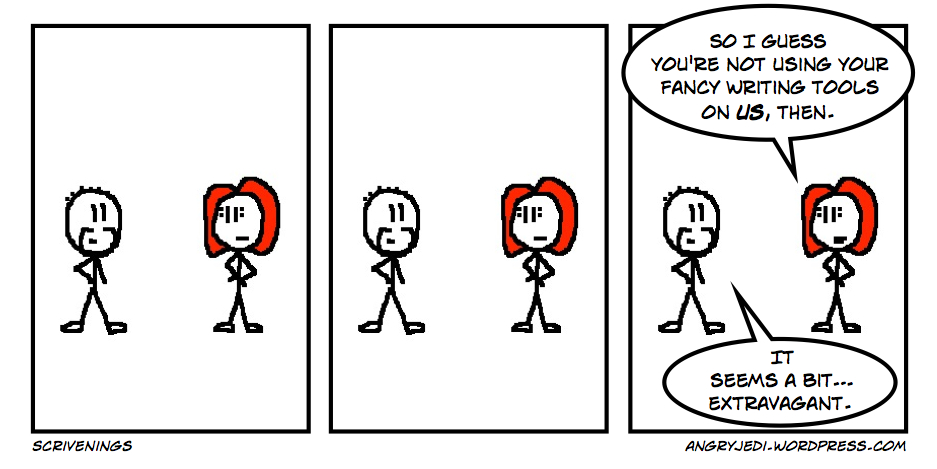
#oneaday Day 941: Scrivenings

I've been spending a bit more time with Scrivener, a writing tool that I picked up a while back and then didn't do much with for a little while. Having paid actual money for it, though, I figured it was high time I delved into it and actually started using it for a project rather than it being one of those things that just gathers (virtual) dust as a symbol of past good intentions.

I decided that the project I was going to use it for was a visual novel. Regular readers will know that I find this simple but effective form of interactive storytelling to be a fascinating medium, and I have been toying with the idea of writing one for quite some time, usually falling at the first hurdle when I remember I have little-to-no graphical talent, which somewhat precludes me from incorporating the "visual" bit.

But, I figured, no sense worrying about graphics if there's nothing for them to visualise. So I decided to actually start writing it, and to use Scrivener to plan it out in advance.

Now, when I write, I must confess that I rarely go through a formal "planning" process. This is probably fairly evident in these daily blog posts, which tend to spew forth directly from my brain and out of my fingers in some sort of hideously unorganised stream of consciousness. But it's the way I've generally worked on more formal pieces over time, too. During A-Levels and university, I never "planned" an essay on a piece of paper beforehand. I never used the "outline" function of Word, I never scrawled things on Post-Its and then moved them around. I just wrote, then tweaked, fiddled and moved things around once I'd written a first draft. It worked for me.

Mostly.

That approach doesn't work so well with long-form fiction, whether you're attempting to create a linear narrative for a novel or a non-linear branching narrative for a game or visual novel. I have a number of stalled novel projects on the go simply because I'm not entirely sure where they're going. In some cases, I have an idea of what the end might be, but it's the stuff in the middle I haven't figured out. How to get from the beginning to the end, as it were.

So, as I decided to start work on this visual novel project (which, like an irritating PR agency for a company making an iOS game you don't give a shit about I'm "not ready to talk about yet") I also figured that I would give this whole "planning" thing a shot. I recalled seeing the spectacularly comprehensive flowchart for Katawa Shoujo (mild spoilers within), and knew that if I was going to put together even a relatively simple VN project, I would have to figure out some sort of way to keep it organised.

Fortunately, Scrivener has delivered just that brilliantly. In order to plan out the basic sequence of events, I've used the "corkboard" facility and its special mode where you can drag around virtual index cards as you please. I've written short synopses of each scene on each index card and laid them out in a logical fashion to depict the various routes the player might be able to take through the story. Each index card then corresponds to a separate "subdocument" in the whole Scrivener project, allowing scenes to easily be split up and composed a little bit at a time rather than simply being confronted with a daunting blank page and no idea where to start.

Then there's pleasing little touches that help with the actual writing process, too. When writing in "Script" mode (which I'm using to compose the VN), simple keyboard shortcuts allow you to easily switch from writing actions to character names to dialog and back again. You can create links to other subdocuments or your research (which you can also store within your Scrivener project). You can split the editor window so you can refer to a piece of source material as you write. And when it's all done you can "compile" your project ready for publishing as a physical product, ebook or other format.

I've barely scratched the surface of the features it offers, but already I can see it becoming an essential part of the writing process. Progress on the VN project is going well so far — I've synopsised (huh… according to spellcheck that IS a word) the whole of the first "act" of the game and am now starting on in-depth scripting for each scene. Following this, I'll work on the various diverging paths through the narrative and hopefully end up with a suitably comprehensive document ready to plug into Ren'Py and then flutter my eyelashes at someone who can draw. Following that, who knows? Perhaps I'll have a finished game one day.

#oneaday Day 940: Insert Coin

When I was young, I loved arcades. There was something magical about going to one of those dingy rooms, inserting your pocket change into a slot and playing games that were far beyond anything home computers and consoles offered. The arcade experience was all the more "special" here in the UK, as traditional game arcades tended to only be found at the seaside. As a resident of a landlocked county growing up, a trip to the seaside was typically a sign that it was "holiday time" — and, consequently, "arcade time."

I liked the arcade experience so much I regularly tried to recreate it at home. I liked playing games that specifically called the feeling of playing an arcade game to mind — I recall Stratos on the Atari 8-bit being one of the earliest examples, later followed by the (rather poor) Atari ST ports of titles like Turbo OutRun and After Burner. I also loved the original Starfox/Starwing for how much it felt like it could have been an arcade machine — everything about its presentation called to mind a "50p a go" sit-down machine that was actually hooked up to my television. Especially the noise it made when you pressed Start on the title screen. (Seriously. I loved that game almost entirely for how arcadey that noise was.)

For some reason, though, I've never owned an arcade stick — the ultimate accessory in making your home gaming systems feel authentically arcadey. I think it's been partly due to the fact that I've never been particularly good at fighting games — the primary reason most people get such a peripheral. But with Persona 4 Arena and Dead or Alive 5 coming soon, I figured it was time to take the plunge and give one a try, particularly as it would also likely prove to be a fun addition to the "bullet hell" shmups I like playing, too.

The stick I eventually settled on — after the whole CeX/PS3 Street Fighter IV stick debacle, now thankfully resolved — was the catchily-named Qanba Q4RAF. I can pretend to know what I'm talking about when I say that this stick has Sanwa components and is dual-modded out of the box to allow compatibility with PS3, Xbox 360 and PC. The latter feature is the primary reason I chose this stick — it's not the cheapest, but given that I wouldn't have to buy additional sticks for the other systems if I found myself enjoying the more authentic "arcade" experience, it seemed like a sensible option. I have it on the good authority of the Internet that Sanwa components in an arcade stick are A Good Thing, too, so there's that.

I spent a bit of time trying it out today. In Street Fighter IV on the PC, it performed admirably, and allowed me to reliably perform a Shoryuken motion without any difficulty whatsoever — something I have always had trouble doing on a pad, and particularly on the Xbox 360's dreadful D-pad. Just the positioning of the buttons made a lot of moves significantly more comfortable to perform, too. So while I am no expert at virtual fisticuffs as yet, I feel that using the stick will certainly help me to get better.

I also tried it out with Deathsmiles on the 360, one of my favourite shmups. Here, the stick really came into its own, allowing easy shooting in both directions as well as access to the game's other functions. The digital stick proved a lot more sensitive and accurate than I expected, too, allowing for very precise movement amid the hails of bullets. I'm looking forward to trying it out with titles like DoDonPachi Resurrection, Akai Katana and Gundemonium Recollection.

Finally, I tried it with Scott Pilgrim on the PS3. Again, it worked well, with the chunky controls and clicky stick feeling very much like the way this game was intended to be played. A successful test all round, then — and absolutely no issues in switching between the three different platforms.

I'm a total convert, then — and now very much looking forward to the experience of playing Persona 4 Arena properly arcade-style. Hell, just looking forward to playing Persona 4 Arena. Damn, I miss those characters.

#oneaday Day 939: Deeper Into the Dark

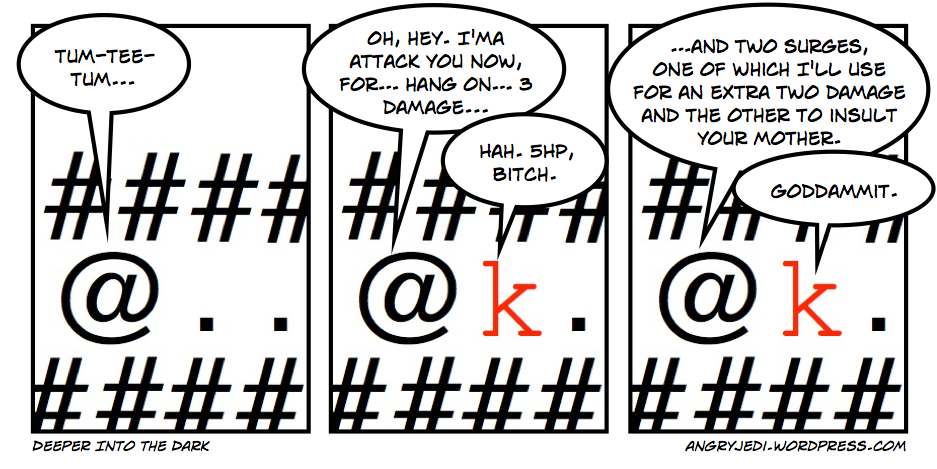
Last night, I had the good fortune of being able to spend some more time with my friends playing Descent: Journeys in the Dark Second Edition (hereafter, once again, referred to as Descent 2). The game has been a big hit so far, which is pleasing, as there's a hell of a lot to it and a significant amount of replay value even once your group plays through the 20+ hour campaign once.

This time we had a full complement of five players — me as the Overlord and four hero characters, two of whom we "boosted" up to an equivalent level to the two who played the first quests in our first session. We took on a new quest and played it through to completion. It took significantly longer with five people as this (1) meant that there were four people to argue about the best way through which to eviscerate my monster minions and (2) I had more monster minions with which to attempt to eviscerate my four opponents. Overall, I found it a much more satisfying experience with five players total, which perhaps explains why the game's BoardGameGeek page rates it as "best with 5 players".

The game has so far appeared to be weighted quite heavily in favour of the heroes in that they have won every quest so far. I'm not complaining about this, mind — it's quite fun to struggle against these difficult odds, and I'm assuming (hoping, really) that the odds will even or perhaps tip in my favour as the campaign progresses to more difficult challenges. Or, of course, I could just be rubbish at being the Overlord. (I know for a fact on more than one occasion I screwed myself out of a potentially significant advantage by forgetting to play Overlord cards such as "pit trap" and "tripwire" that could have stopped players from moving and thus blocking me off from completing objectives — but this is entirely my fault, so I didn't ask for a "do-over" as that wouldn't really be in the spirit of things. I have learned my lesson.)

There are a ton of things to like about the game, though. Unlike many "dungeon crawlers" (which, as I've previously said, Descent 2 really isn't) the rules are relatively lightweight, but pretty flexible, and the custom dice used for combat allow for a large amount of variety. For the unfamiliar, every attack roll uses a blue "attack" die, which has a 1 in 6 chance of missing and does varying degrees of damage on its other faces. Each weapon or special attack then uses one or more of the red and yellow dice — red ones offer the potential for more damage, while yellow ones offer more in the way of "surges" — little lightning-bolt symbols that can be spent to perform a weapon's special actions — some might be able to "pierce" the enemy's defensive dice, for example, while others might do additional damage, apply an effect or knock the unfortunate victim backwards. Combine the various weapon, skill and item cards with the pool of dice available and you have a wide variety of possibilities that keeps combat constantly interesting.

And that's just within a single encounter. Pulling back to look at the bigger picture, the entire campaign can play out completely differently according to how the heroes and Overlord perform, and the quest choices that the hero players make. Rather smartly, the game only requires players to complete three out of five possible "Act I" quests before an "interlude", followed by three out a possible ten "Act II" quests, each of which is presented as part of a pair according to whether the heroes or Overlord won the corresponding act I quest. I didn't explain that very well. Basically, Act II's available quests change according to who won various quests in Act I. There, that's better.

On top of that, the Descent 2 Conversion Kit allows content from the original Descent: Journeys in the Dark to be used with Descent 2, opening up a whole swathe of possibilities. And then you can guarantee that Descent 2 will also have its own expansions ready to roll before long, meaning that this is a game with a potentially very long lifespan — which is why I'm so very pleased that my group has taken to it so well. Anything that puts off yet another humiliating, crushing (and bewildering) defeat in Agricola is just fine with me.