1541: Reclaiming the Inbox

Oh my goodness, email. What a massive pain in the arse you are. And yet you shouldn't be; you should be a convenient, quick means of asynchronous communication, and instead you're a cluttered, nigh-useless mess.

At least my personal account is. So I'm trying to do something about it. When unnecessary mailing list entries that I never read show up, I unsubscribe with due haste. When my inbox starts to fill up with useless crap, I highlight it all and archive it — if I haven't read it immediately, it almost certainly isn't important to go back to in a few days' time.

With a little coercion, I'm confident that I can start getting my inbox back under control. The trouble I'm having is largely due to the period of time where my personal email was also my professional email — while I was working on GamePro I didn't have my own address — and consequently got signed up to about a bajillion PR lists. Subsequently, when I worked for Inside Network, I then got signed up for a bajillion more PR lists for mobile games and apps — and there are a fuckload more mobile games and apps released every week than there are on computers and consoles. (And approximately 2 or 3 at most worth caring about, if that.)

The reason I'm doing this is because I actually want to start using email again. When I think back to the early days of having an email address, receiving new messages was exciting. Spam was rare, and it always felt like an "event" to see Outlook Express pop up its progress bar and indicate that yes, messages were incoming via the magic of dial-up Internet. (Random, no-longer-existent free ISPs for the win. I was a "Hot Toast" man, myself.) This was because it was an event to receive a message — someone had taken the time to actually write to you.

These days, the former function of email is largely covered by social media — to a point, anyway. But it's not quite the same, particularly with how much both Facebook and Twitter have wandered off from their original incarnations when they were first introduced. Facebook these days — even with my recently pruned feed — is nothing but links with people going "OMG SO AMAZING" or some other such hyperbole, while Twitter is inherently limited thanks to its character counts, and is becoming increasingly intolerable anyway thanks to the increasing regularity with which the social justice crowd continue to peddle their opinions and refuse to listen to anyone else.

Then there's longer-form writing such as this blog, but that's a broadcast rather than a personal message. Sure, I could write private password-protected posts and send them to individuals or small groups of people, but if I'm going to do that, I may as well just send them an email in the first place. It feels impersonal.

Which leaves email, as one of the most long-standing means of digital communication out there, as arguably the most practical means of actually getting in touch with other people — so long as you take control of it, that is. Going forward, my "good intention" is to try and use email a lot more than I have done in the past, perhaps to keep in touch with people I don't speak to enough on a daily basis or even to get to know people I want to know a bit better… a bit better.

This is a bold plan, I know, and I wonder if it will prove to be a fruitless endeavour if everyone else has the same saturated inbox problem as me, but it's worth a try. Email is a brilliantly simple but amazing technology that brings people closer together, and it's wasted by most of us on a daily basis as we take it for granted. So I'm going to try and stop doing that. Maybe. We'll see.

No you can't have my email address. Unless you ask really nicely.

1540: Darkness

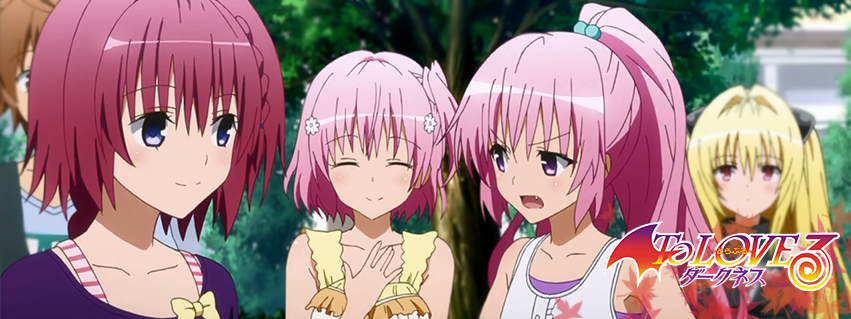
The focus of the new season is very much on what were previously secondary characters.

I'm finally on to the final (well, most recent) season of To Love-Ru, aka To Love-Ru Darkness, and it's been really interesting to see this show's evolution over time in several ways, even over the course of just a few years.

The first series of To Love-Ru came out in 2008 and was a fairly conventional episodic format in which each episode was largely self-contained. Motto To Love-Ru, which followed two years later in 2010, instead followed the "mini-episodes" approach of Ika Musume/Squid Girl. And To Love-Ru Darkness, which aired two years after that in 2012, returns to an episodic format, but with a much stronger sense of ongoing plot and frequent use of cliffhangers to close off each episode.

The atmosphere has changed markedly over time, too. The original series of To Love-Ru was rather silly, light-hearted nonsense that, as I've previously mentioned, was pretty undemanding fluff that you can watch without having to concentrate too hard — but it did close out the season with a spectacular two-part finale that brought things to a natural break, if not complete closure.

Motto To Love-Ru, meanwhile, was enjoyable but for the most part felt even more "disposable" thanks to its short mini-episodes. Over the course of the series, we got a better understanding of the various characters involved by simply seeing them in a variety of different situations, but there was relatively little in the sense of overarching narrative that advanced as the series progressed aside from the introduction and exploration of a couple of new characters. The season finale, meanwhile, was a big moment for several of the characters involved, but in a completely different way to the original show. Rather than being an overblown epic involving protagonist Rito battling against unfeasible odds in an attempt to prove himself as in the first season, it instead was a fairly low-key affair that, in contrast to the rest of the run, linked its three mini-episodes together and culminated in a long-awaited confession from Rito to lead heroine (and super-cute space alien) Lala — and an unfortunate misunderstanding as he attempted to also confess to secondary love interest Haruna (who is likewise super-cute, but not a space alien).

To Love-Ru Darkness picks up directly from where Motto To Love-Ru left off, in contrast to how Motto To Love-Ru assumed some time had passed between the first series, the first set of OVAs and the new season. And it has a noticeably different focus so far in the few episodes I've watched, too; rather than focusing on the relationship between Rito and Lala that was the centrepiece of both To Love-Ru and Motto To Love-Ru, early episodes instead explore the character of Lala's sister Momo, whose devious machinations sort of have Rito's interests at heart, but are fundamentally largely incompatible with the norms of Earth society.

Lala, the centrepiece of the previous two seasons, doesn't even appear in a lot of promotional artwork for Darkness.

In short, Momo decides after seeing Rito make his heartfelt confessions at the end of Motto To Love-Ru that she, too, likes Rito, and decides that the best thing for everyone involved in the increasingly complicated love polygon situation they all find themselves in would be if Rito marries Lala, becomes King of the Universe and consequently no longer bound by the rules of Earth society, then marries everyone else that he has ever had feelings for or who has had feelings for him. She, in short, is firmly in favour of creating a harem of concubines for her beloved — a harem in which she, too, will play her role, of course.

Rito, thus far, is somewhat resistant to this idea, since being of the "perpetually confused protagonist" mould, he is still not quite sure what his true feelings are with regard to Lala and Haruna, let alone Momo (who keeps showing up almost naked in his bed at night-time, much to his chagrin), class representative Kotegawa (whom Rito has a habit of falling over into inappropriately), the extraterrestrial assassin Golden Darkness (who clearly doesn't really want to kill Rito) and, indeed, his own sister Mikan, who has struck up something of a friendship with Golden Darkness. Constantly yanked from one situation beyond his control to another, I can sense that this season is going to see some of Rito's toughest trials to date — particularly now that some new characters, such as Golden Darkness' "sister", have gotten involved.

In keeping with the previous seasons and OVA sets, the amount of fanservice has once again been ratcheted up, with the number of bare nipples and panty flashes in To Love-Ru Darkness having increased noticeably since the original (rather tame in comparison) season and even since the somewhat more suggestive Motto To Love-Ru. The show refuses to devolve into nothing but T&A, however; even amid all the clear and present fanservice, there's still an ongoing plot that, this time around, seems to blend the silliness of the earlier seasons with something that provides a bit more meat on the bones.

It's shaping up to be an interesting season, all round, and I'm looking forward to seeing where Rito's misadventures take him next.

1539: Winding Up

The weekend is coming to a close, and another week of work beckons. After that, there will be another weekend, and the whole cycle will repeat over and over and over again.

This weekend has been quite nice despite the fact we haven't really done all that much. Andie and I paid not one but two visits to a nice local restaurant/bar/lounge type place called Trago Lounge that we were first introduced to for a friend's birthday a while back. We went there on Saturday for one of their excellent burgers — the "Hero Burger", which also features chorizo, some unidentifiable green goo that tastes nice, chipotle mayo and a pickled chilli in a toasted, crispy brioche bun is delicious — and enjoyed it so much we decided we'd drop in for breakfast today.

Trago Lounge has a substantial breakfast menu, largely inspired by the sort of stuff you'd typically get in an American breakfast-specialist place such as the Half-Day Cafe in Marin County, CA that my parents always insist on going to every time we go and visit my brother. (To be fair, they do do amazing breakfasts.) Today, I tried a stack of eggy bread with crispy bacon and syrup — predictably yummy, though the bacon was a little overdone — while Andie had what was called "dirty beans", which was essentially a bowl full of home-made baked beans (three different types) with a healthy dollop of barbecue pulled pork and some lumps of toasted ciabatta to dip. It's not what I would have called "breakfast" per se, but Andie enjoyed it. (It was a little too oniony for me, however.)

After that, we wandered into town for an idle look around and I ended up buying a new television. I recently came into a bit of money, you see, and while I'm intending on saving most of it, Andie quite rightly suggested that it was probably worth spending some of it on something nice that I'd enjoy. After a considerable amount of umming and ahhing — there really wasn't all that much I want to spent a considerable amount of money on right now, aside from, you know, the house we're buying — Andie suggested replacing my current TV, which is now a good few years old. It still works perfectly well, I might add, but the new one is significantly bigger, has an almost bezel-free edge, is an LED screen (as opposed to my current TV's LCD), has optical sound output instead of analogue and has a lot more options to tweak for optimising performance when watching TV, watching movies or playing games. Oh, and it's 3D, too, because it's apparently impossible not to buy a 3D TV any more, despite 3D TV not really being anywhere near as much of a thing that everyone tried to convince us a year or two back.

Anyway, that's turning up on Wednesday because John Lewis apparently don't stock anything above 50 inches in store (it's 55) so we're both looking forward to that. And that, really, was my weekend. Oh, I found two Atmas in Final Fantasy XIV earlier on, but I'm sure you don't want to hear about that. And people got angry on Twitter earlier on (not at me!), but people always get angry on Twitter and I'm frankly beyond giving a shit about any of it any more.

So that's that, really. Night night.

1538: Loot Whore

Playing both Final Fantasy XIV and Diablo III — two fundamentally similar but also quite different games — this weekend has got me thinking about loot. Yes, this is a very specific thing to be thinking about, but I find the two games' differing approaches to providing the player with new equipment to be quite interesting.

At heart, the difference between the two games is in whether gear acquisition is purely vertical (Final Fantasy XIV) or whether there's a degree of horizontal… ness about it, too.

What do I mean? Well, in Final Fantasy XIV, the equipment you put on your character is largely determined by your level. And when you hit the level cap, you then work your way up through several "tiers" of equipment that are increasingly challenging to acquire. Item Level 50 items are provided to you as the final stages of your class' quest; Item Level 60 items come from entry-level endgame dungeons; Item Level 70 items used to come from endgame currency and now come from more challenging endgame dungeons; Item Level 80 items come from Crystal Tower; Item Level 90 items… you get the idea. Everything comes from a specific place, and you generally have to "work" for it — items you purchase require grinding out the requisite amount of currency before you can afford them by running dungeons and other content, while items you acquire as loot from dungeons are random drops that, in many cases, will require a large number of runs of the same dungeon to acquire a complete set of.

In Diablo III, conversely, you are constantly thrown new gear. Every other fight you get into, a monster drops something. And with the recent Patch 2.0, it's usually something interesting that has an impact on your stats, damage, healing potential or other stuff. You'll be swapping out equipment very regularly as you find new bits of gear; consequently, equipment starts to feel a lot more "disposable" than it does in something like Final Fantasy XIV. Diablo certainly has an element of vertical progression, too, as items get gradually better over the course of the whole game and have minimum level requirements to use, but when you strap on a new piece of armour it's on the understanding that you might not be holding onto it for very long, unlike, say, my Sorcerer's Coat that my Final Fantasy XIV Black Mage has now been wearing for a number of months now. (That thing must reek.)

There are other ways to handle it, too. Japanese role-playing games tend to take a vertical approach, with new "tiers" of equipment presenting themselves as you progress through the linear storyline, with the "ultimate" equipment usually either tucked away in a secret place or secreted behind a significant challenge. Western role-playing games tend to allow pretty much any character to strap on anything at all, though if your class isn't proficient in it you can expect penalties to your performance. Western role-playing games also tend to festoon their worlds and dungeons with hundreds of the same shitty pieces of armour and weaponry, and then hide a few good bits and pieces in the deepest darkest dungeons. And then you have weird hybrid games like The Witch and the Hundred Knight, which is a Japanese role-playing game that takes heavy cues from loot-whoring role-playing games like Diablo, which combine a toned-down degree of player choice/horizontal progression with vertical advancement as the game goes on.

It must be a really tricky balance to get right, and I don't envy the people who have to design all that gear and ensure it's reasonably well-balanced for the game. (Although unbalanced super-gear can be a lot of fun, too, so it's not unusual to find at least one massively overpowered piece of gear in many games — at least in the single-player sphere.) I'm not sure, on the whole, which system I prefer — if indeed any — because they each have their pros and cons. I really like the sense of achievement that acquiring a new piece of equipment in Final Fantasy XIV brings, for example — it feels like you've done something major. Conversely, I like that the sheer volume of loot in stuff like Diablo allows you to tweak and tailor your character a lot more to your liking — but it is a faff to have to keep comparing stats every few minutes.

There you go. One of the nichiest posts I've ever done. It's late. I'm going to bed.

1537: Lord of... Whatever

I decided to give Diablo III another chance now that the new expansion and its version 2.0 is here, bringing new loot rules and a bunch of other tweaks to the mix. And you know what, it's a big improvement.

I actually enjoyed the original incarnation of Diablo III more than most, and I maintain that its move to an MMO-like always-online structure was actually a pretty good idea from the perspective of easily allowing drop-in, drop-out multiplayer. I did find that it didn't hold my interest after I'd beaten it once, though, much like Diablo II; the fact that in order to unlock the other difficulty levels you had to play all the way through the campaign again and again and again just wasn't appealing — particularly if you wanted to try another character and thus had to start all over again.

One of the biggest additions in the new expansion is called "Adventure Mode" and is probably the aspect I'm most interested in. Unfortunately, access to Adventure Mode is locked behind completing the story-based campaign (including the new Act introduced in the expansion) and thus I find myself having to play through the whole bloody game again because the character I previously finished it with was on the American servers and the people I'm most likely to be playing with this time are on the European servers. I understand why Blizzard separated people by region, but it doesn't stop that particular aspect of the game's always-online nature from sucking a big load of balls.

Anyway, as I understand it, once you unlock Adventure Mode you can just play Adventure Mode whenever you want, and that's a much more appealing prospect. Unlocking the entire map from the get-go rather than forcing you to play through that interminably tedious desert sequence (why do action RPGs always have interminably tedious desert sequences?) again and again and again, Adventure Mode sees you tracking down "Bounties" in various areas of the game world and receiving rewards for them, and occasionally jumping into a "Nephalem Rift" where things go utterly bonkers and you have to kill bajillions of enemies.

It's Diablo in its purest sense, in other words; stripped of the narrative aspects that people skip through and focusing entirely on the game's most enjoyable aspect: the grind, and the drive to earn ever-better items of equipment for your characters. Making the experience non-linear rather than forcing you to play through the campaign repeatedly is a masterstroke, and is likely to give the game a lot more longevity. It also makes it much more friendly to short play sessions, since you don't feel tied to checkpoints in the plot to have made "meaningful" progress. It's just a shame you can't just jump straight back into it — though with the effort Blizzard puts into the story of the campaign, I understand why they want people to see it at least once.

I do find myself wondering why they bother, though. Much like I question the wisdom of including a single-player campaign in Call of Duty year after year when people are much more inclined to spend their time in the multiplayer mode, I can't help thinking Diablo would be a better game without the plot. And I generally like the nonsensical plots of role-playing games — but Diablo's mechanics jar so forcefully with its narrative aspect that it's hard to ignore. The mechanics are ridiculously fun, bringing in strong influences from arcade-style games such as time-limited challenges, secret levels and difficult-to-defeat opponents that yield massive rewards — and yet the plot takes itself deadly seriously. It doesn't quite mesh when you're supposed to feel bad for a major character in series lore dying (spoilers!) one minute, and the next you are literally punching the skeleton out of monsters.

Still, I can't complain too much. I am actually enjoying the new run through the campaign — helped partly by the fact that you can start on a higher difficulty level now rather than being forced to coast through the super-easy "Normal" mode — and am making good progress with my current Monk character. I still prefer Final Fantasy XIV as an online RPG, but I'm looking forward to having the opportunity to play online a bit more with my friends very soon.

If you played Diablo III back when it came out and have since left it behind, I'd encourage you to give it another look; the updates from Patch 2.0 alone are well worth exploring, and the additional content in the expansion looks like being a lot of fun indeed.

1536: Looking for the Calm Lands

I'm having one of those occasional periods where I don't feel my mental health is in a great place. I'm feeling a bit stressed out (for no specific reason), I've been feeling wracked by anxiety before I go to sleep for the last few nights and I find myself occasionally lapsing into depressed feelings during the day, particularly if I stay in working for the whole day.

I think part of the cause is the working from home aspect. It may sound like a dream situation to be able to sit in your pants all day every day tapping away at a computer without fear of interruption from man or beast (well, occasionally from beast if I hear the rats causing mischief in the other room) but in actuality, it's a ticket to Stir Crazy-Town, and thus every so often I just feel the need to get out of the flat and go work at the coffee shop or something. Somewhere. Anywhere but here.

It's an underacknowledged aspect of working from home, this stir crazy business. And I think it's particularly apparent if you live in a fairly small environment such as a flat. In our flat, my study is just one wall away from the bedroom, which in turn is just one wall away from the living room. The temptation is always there to just wander into the living room, flop down on the sofa and stare at the TV for a few hours — or, on particularly bad days, to just go back and lie in bed for a bit. But, as I've established pretty firmly for myself, that's a terrible idea, because if I don't get up as soon as I wake up, I'll fall asleep, wake up five minutes before I need to work and make the whole anxiety-depression-stress thing a whole lot worse.

Going out to work at the coffee shop, like I did today, helps largely from the "change of scenery" aspect, and also helps remove a lot of distractions from the immediate vicinity. While distractions can sometimes be helpful motivators — "I'll do this, then reward myself with [distraction]" — they can also be… well, distractions. You know how it is. Today I felt like I got a lot more done than usual for sitting down, focusing and concentrating on what I was doing, even if sitting on one of Costa's arse-numbing chairs for most of the day hunched over my laptop isn't quite as comfortable as working on the big screen of my Mac in my rapidly-disintegrating-but-still-quite-comfy office chair. But at least I can break to get a coffee or a cake or a sandwich when I want to. (I know I can do this at home, too. But I have to make them myself.)

It doesn't really help that I feel like I have a lot on my plate at the moment. There's a lot of games I need to cover, and my inbox is full to bursting every day with PR pitch after PR pitch that I just don't have time to contemplate in the depth they deserve. Pro-tip to anyone eyeing a career in the games journalism biz: reviewing games is the worst part of the job, despite the freebies. Review commitments make it very difficult to play the things you want to play, and in many cases they even make it difficult to explore the review titles in as much depth as you want. At the same time, I feel it is important to give consideration to a lot of the titles I end up reviewing, as many of them are often dismissed outright or treated somewhat unfairly by other critics, so it's a tough balancing act at times.

Oh, and the air quality around here is shit at the minute thanks to a combination of a Saudi Arabian dust storm (apparently) and a big fire just down the road from us earlier today. This isn't helping me recover from the plague that laid me low recently.

I don't know. I'm just having a complain. Things aren't too bad really, I guess. They've certainly been worse. Like I say, it's just one of those times when my mental health is getting the better of me. I should probably just go sit in bed and play Steins;Gate until I fall asleep or something. That sounds like a good idea, doesn't it?

1535: El Psy Kongroo

I've already written on the subject at some length over on USgamer, but on the offchance you haven't paid us a visit recently, I thought I'd wax lyrical about my initial experiences with Steins;Gate here, too.

Steins;Gate, for the unfamiliar, is a visual novel from popular developer Nitroplus, whose name you may remember from the excellent "giant robots fight Cthulhu" visual novel Deus Machina Demonbane that I played a while back. Unlike Demonbane, it's not an eroge — though Demonbane's sex scenes were, for the most part, more horrifying and uncomfortable than anything else — but it's still an unabashedly adult affair, just one without any graphic uglies-bumping. It's an enormously well-respected title, known better to most people in the West through its apparently excellent anime adaptation, and an official English localisation has been a long time coming. But come it finally has, thanks to localisation and visual novel specialists JAST USA — one of my favourite publishers in the world for the last few years — and finally everyone can get in on the action.

Steins;Gate is a science fiction tale that, for the few hours I've played so far, centres largely around the concept of time travel and parallel worlds. The main character is a gloriously chaotic individual afflicted with chuunibyou ("middle school second-grade syndrome") — he's utterly convinced that he's a mad scientist and that he's being pursued by a shadowy group called The Organization. Whether or not his delusions turn out to be true or not remains to be seen, but it's certainly an interesting setup; much like Demonbane put the player in the shoes of a protagonist that was a character in their own right rather than an obvious blank-slate cipher, so too does Steins;Gate.

This time around, the narrative influences aren't drawn from Lovecraft, but instead from popular science and science fiction, both Eastern and Western. The game makes frequent references to real-life concepts, particularly with regard to topics like time travel and parallel world theories as well as the real-life modern-day myth of time traveller John Titor. The game makes unsubtle changes to things it mentions throughout (Jojo's Bizarre Adventure becomes Juju's Bizarre Adventure, for example, while the IBM 5100 computer Titor supposedly travelled back in time to retrieve becomes an IBN 5100), presumably to avoid breaching about a bajillion copyrights, but it's always clear what it really means. There's a constantly updated glossary you can refer to as you play, too, that gradually fills up with a wealth of information ranging from Japanese cultural tidbits to scientific and technology history.

It's clearly a setting that has had a lot of thought poured into it. In many ways, although the premise, style and genre are completely different, Steins;Gate reminds me of Aselia the Eternal in the sense that the writers obviously had a very clear vision of how their version of the world worked and how the various characters fit into it all. This was very true in the case of Aselia the Eternal, which I maintain has one of the most well-realised, well-depicted fantasy worlds of any game I've ever played, despite the inherent restrictiveness of the visual novel genre, and is already shaping up to be very true in the case of Steins;Gate. Nitroplus' title goes a step further with all the supplementary information you can refer to as you play — not to mention the fact that clicking the "Internet" option on your in-game phone opens an actual website for the main character's "Future Gadget Lab".

And speaking of the phone, the means through which you interact with Steins;Gate is bizarre and intriguing. Rather than making the usual binary choices that visual novels tend to present you with, Steins;Gate instead makes use of the protagonist's phone as its main means of interaction. As you progress, you'll receive email messages from characters and have the option to respond to them or not; you'll also receive phone calls and have the option of answering them or not answering them, and various other things will happen in and around your phone. The choices you make as to whether or not you engage with these various distractions determine the paths down which the plot proceeds, giving the flow of the story a much more "natural" feel than some visual novels with extremely obvious decision points. (Not that there's anything wrong with that!)

Anyway. I'm but a short way into the overall plot as a whole as I type this and thus there's not a lot more I can say thus far save for the fact that I'm really enjoying it and looking forward to seeing where it goes. It's an immediately intriguing, compelling tale with some fascinating, unconventional characters and an utterly gorgeous art style, so if you're looking for a new interactive story to delve into, I'd encourage you to check it out and grab a copy as soon as you can.

1534: Self-Study

I successfully managed to get up early and do some Japanese self-study today. I'm glad I finally managed to make myself do it, because with a month off from my classes for Easter, I really, really need to undertake some independent study if I'm going to continue to progress.

Today I prioritised the reading and writing aspect, as those are areas where I'm weak. I want to get away from reading in romaji (Japanese words spelled using Western characters) as soon as possible and into being able to parse and understand hiragana and katakana before moving onto the more complex matter of kanji.

I've been gradually building up my hiragana knowledge in particular quite a bit for a while now, but I'd somehow convinced myself that I only knew about half of the characters involved. Actually, I knew a whole lot more than that, with it only really being the characters for ね (ne) and ぬ (nu) giving me a bit of grief — that said, writing them down like that will probably help me remember them a bit better.

I've been working through the companion Kana Workbook for the series of Japanese coursebooks we've been using in class (Japanese for Busy People, if you're curious), and it's proven to be quite a good resource. It walks you through how to draw each of the characters accurately, and highlights common sticking points such as characters that look similar to one another (ぬ nu and め me, for example, or ね ne, わ wa and れ re for three even more confusing examples) as well as little quirks such as the ability to change the basic sound of some characters with a smaller character following it — に ni plus や ya becomes にゃ nya, for example — or the ability to double a consonant by adding the つ tsu character in small format — for example, いつ itsu versus いっつ ittsu. And then there's the times where characters don't mean what they normally mean — は is normally ha, for example, except when it's being used as the particle wa, while お is usually the character for the vowel o unless you're using the particle o, in which case you use を instead because of course you do.

I've hardly touched katakana as yet and I was a bit concerned as it's a whole new set of characters that refer to the same syllables but which, in many cases, look completely different. For those unfamiliar with Japanese script, katakana is used both as a means of highlighting text similar to how we use italics, and also to denote "loan-words" from other languages such as English. For example, you'd write the Japanese word for "computer" — konpyuutaa — in katakana rather than hiragana since it's a loan word from English, and the two character sets make the word look rather different: こんぴゅうたあ versus コンピューター, to be exact — note how katakana uses a long dash for long vowels rather than the extra vowel characters hiragana uses. Confusing, non?

However, then I thought back to learning English and how we effectively have to learn two alphabets — lower-case and upper-case, not to mention how different fonts depict certain letters such as "a" — and it suddenly didn't seem quite so bad after all. I mean, what's another forty-something characters to learn? Yeesh.

Still, I'm getting there. I'm making good progress and I'm confident I'll be able to read at least some Japanese script a bit more fluently in time if I keep practicing. In the meantime, it's back to studying.

1533: Motto

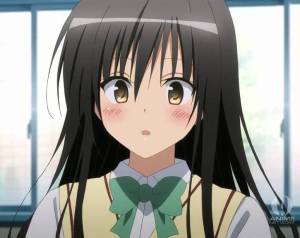
Kotegawa is the best.

As a suitable means of switching my brain off when I need it (which is quite frequently at the moment) I've been continuing to watch To Love-Ru and am now onto the second series, Motto To Love-Ru.

I was interested to discover that this second series is structured rather differently to the conventionally episodic first season, instead adopting the same approach as Ika Musume (aka Squid Girl) by making each individual episode up out of three short stories rather than one large story that kind of sort of ties into the overall narrative. That said, narrative coherence is not a huge priority in To Love-Ru, since there are a couple of points throughout the series where things just evidently happen "between episodes" without explanation — or perhaps they just happened where I didn't notice. (Or, more likely, in the original manga, since it's not at all unusual for anime adaptations of popular manga to simply skip over chapters at a time for brevity's sake.)

The series remains enjoyably fluffy, however, despite the predictability of the protagonist Rito falling over at least once per episode either face-first into someone's crotch or with his hands on someone's boobs. Despite the occasional bout of fanservicey smuttiness — which gradually increases in frequency between the first series and the first set of OVAs, and then again between the OVAs and the Motto second season — the show remains consistently good-natured, with it generally being Rito as the one who is ridiculed and made to look an idiot rather than the rapidly expanding female side of the cast, most of whom tend to come off pretty well out of their various misadventures.

Except for when Yami is the best.

And as clichéd and tropey as a lot of those female cast members are, they all have their own appeal elements and twists on the usual formula. The stern, harsh class president Kotegawa, as you might expect, has her deredere side to go with all the tsuntsun, and predictably, it's adorable. Meanwhile, teen idol Run-chan's twist is that she turns into a boy when she sneezes — a side-effect of being an alien, naturally — while Oshizu is a ghost whose spirit has a tendency to evacuate her artificial body whenever she gets scared, such as when she sees a dog. (Naturally, one of the other characters has a dog, so this situation comes up quite a bit.) And then there's Yami-chan, aka Golden Darkness, who is all the things I loved about Ell from My Girlfriend is the President and then some. Also, she has hair that can turn into weapons and punch people. Hnnnnng, as they say.

I'm not even going to pretend that To Love-Ru is anything more than fanservicey, switch-your-brain-off fluffy nonsense that is designed for pure entertainment value rather than attempting to say anything big or meaningful. It doesn't have the clever Lovecraftian references of the rather similar (but later) Haiyore! Nyaruko-san, nor does it have the clever self-awareness of other comedy anime. It's simple, it is, at times, sexy, and it is, at times, utterly stupid. And sometimes that's exactly what you need from a piece of entertainment. And thus I make absolutely no apologies whatsoever for enjoying it; it's a delightful accompaniment to my brain's boot-up sequence while I'm having breakfast of a morning, and it's likewise a pleasant accompaniment for the shutdown sequence of an evening before I go to bed.

Anyway. Once I'm done with To Love-Ru (the rest of Motto, followed by some OVAs, followed by the third and, currently, final season To Love-Ru Darkness) I will watch something a bit more intelligent, I promise. Maybe. Possibly.

Come on, I survived Clannad. I deserve this! 🙂

1532: Get It Done

Oh, for the ability to extend days as long as necessary so you can fit everything in. Oh, for the ability to call up motivation on demand and just get things done with time to spare.

There are lots of things I want to get done at the moment. You may recall quite some time ago that I was working on a game project with RPG Maker and that I was very excited about it. I am still very excited about it, and yet I haven't done a whole lot on it recently. Why? I can't really explain that, other than the fact I just feel like there hasn't been a whole lot of time to do so recently.

I'm not sure whether or not that is actually true or whether it is just the perception in my mind, but that's certainly the way it's been feeling recently. I get up, I do work, I flop down in the evening, I relax, I go to bed, I repeat the process throughout the week and then take the weekend to recover.

I could, of course, use my time more efficiently. I could get up earlier in the morning and do stuff, and in fact I had been intending to get into some good routines having rejoined the gym/swimming pool complex in town, but unfortunately getting horribly, revoltingly ill put paid to those plans almost as soon as I had put them into motion. As soon as I shake off the last remnants of whatever plagues have been filtering through my systems, I will get back on that.

In the meantime, though, there's nothing stopping me getting up early and, instead of going to the swimming pool or the gym, working on my game instead. Tomorrow morning I will at least make an attempt to do that, though it will depend on how I feel when I wake up.

I also need to do the same with my Japanese studies, since I now have a month off from classes and don't want all the things I've learned to fall out of my head.

I think I am probably going to have to make myself some sort of schedule to try and stick to, though the mistake I often make with this sort of thing is making it too strict and consequently not wanting to stick to it. I think if I can set myself aside a few hours in the morning before I start work — I start late — to do something productive, be it game development, Japanese revision or going to the gym/pool, then that will get me into good habits and good routines, and thereby get some things done. When the evening comes, then, I can settle down and relax without guilt and do what I want to do. Maybe.

This is all fine and good until I get a bunch of lengthy, time-consuming games to play through for review and as luck would have it, several of those are on the way now. But we'll cross that bridge when we come to it; for now, let's try and get into some good habits and get shit done!