It's 2016! It is the distant future to someone who was born… well, any time before about 1990, I'd say. And with our dash towards the future comes unimaginable technological advancements, many of which have made the world a significantly better place.
And then there are those things that sounded like they might make the world a better place when they were originally suggested, but which have actually turned out to be shit.
Here's a "best of" collection of what I think are Parts of the Modern Age That Probably Sounded Like a Great Idea at the Time, But Which are Actually Shit.
Push notifications
I remember when the original iPhone launched without Push notifications, and everyone who owned a Nokia N95 looked down their nose at Apple for being so backwards.
Then came push notifications for email, which meant that you could get a little popup on screen telling you when you had new messages.
Then came push notifications for apps, which meant that, say, calendar and task apps could remind you of things even when they weren't open.
And then the floodgates opened.
Now every fucking thing on your phone clamours for your constant attention all through the day and night, unless you specifically tell it not to. Games complain at you if you haven't played them for a day or two. Apps bug you to rate them. And somewhere in the middle of all this chaos, the few actually important notifications get lost.
Fuck Push notifications.
Software updates
Hey, mobile phones and computers being always connected to broadband Internet is great, isn't it? It means that developers can add new functionality and fix bugs "on the fly", making your experience with their work improve over time!
Well, yes, that's all very well and good, but I really don't need my calendar app updating three times every week, nor do I really need any new functionality adding to an app that allows me simply to send messages to my friends. I certainly don't need all my apps to "refresh" their interfaces every six months, making them completely unrecognisable from what I originally downloaded and, in many cases, significantly worse rather than better to use.
There's a side-effect of this, too: stupid people now seem to expect constant updates of new "content" and whatnot to their apps, and complain, whine and bleat at developers if they' don't "continue to support" their work after they've finished it. You know that saying about a work of art never being finished? Pity the poor software developers', whose work in 2016 is literally never finished.
Disposable media
Hey! In 2016 you can watch a movie at the click of a button or listen to music you haven't bought. Great, huh?!
Well, yes, until you take a closer look at the general population's collective attention span and realise that it is now pretty rare for anyone under the age of 25 to listen to a complete three-minute pop song from start to finish, let alone an entire album. Digital media of all types has been completely devalued by the world's ease of access to it — not to mention the ease with which anyone can produce and publish it.
Speaking of which…
Everyone has a voice
Why bother watching movies or documentaries by people who have years of experience in the field and are quite happy to spend months, even years researching their work, when you can log onto YouTube and watch some dribbling dimwit with a video titled "SOMETHING like THIS??!!" bellow their ill-informed opinions all over your face? Why indeed.
Social media
I caught the tail end of an incredibly obnoxious programmed featuring Hugh Fearnley-Whittingstall last night where he set out to publicly shame coffee companies and Amazon for using too much cardboard. He just came across as a tosser.
Unfortunately, this particular use of social media has become more important than its original purpose: actually socialising. And when people aren't shaming one another, the brands are getting involved with their latest #hashtagcampaign to try and get their product "trending" or "going viral" as quickly as possible.
Git tae fuck.
Everything
Everything is shit. Burn it all. I'm off to go and play board games with my friends and not look at my phone.
A while back, I wrote a piece on my other site MoeGamer about how free-to-play games had quietly got good. While there is, make no mistake, still a veritable flood of absolute shit being released on a seemingly daily basis, occasionally someone gets it right, and it's worth celebrating when they do.
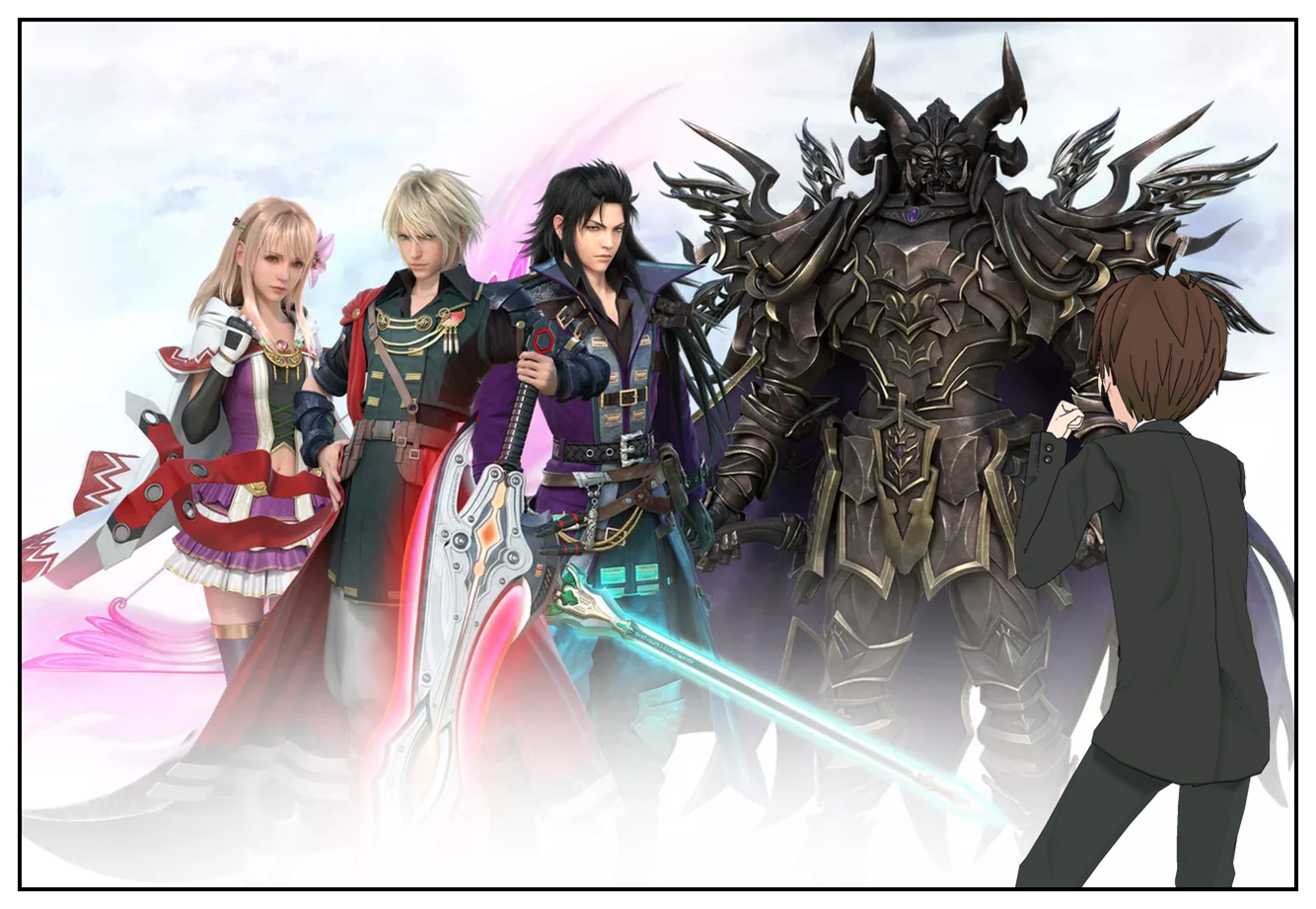
Which brings us to Final Fantasy Brave Exvius, a free-to-play mobile game developed as a collaboration between Final Fantasy rights holder Square Enix and mobile game specialists Alim and Gumi.
The astute among you will recognise the latter two as being behind Brave Frontier, one of the mobile games I had previously praised for not being a total pile of shit. Brave Frontier wasn't without its problems — most notably a lack of any real strategy in the combat thanks to a relatively limited number of things you could do — but so far as mobile free-to-play RPGs went, it was certainly one of the better ones, featuring an interesting story with some enjoyable characterisation and a wide variety of units presented in beautiful pixel art.
FFBE, as I shall refer to it from hereon, is essentially Brave Frontier 2 with a Final Fantasy skin. And that's not a bad thing at all, because it manages to fix the few issues I had with Brave Frontier while simultaneously being a surprisingly decent Final Fantasy game in its own right.
I'll rewind a moment for the benefit of those not already familiar with Brave Frontier and explain FFBE.
In FFBE, you take on the role of Rain, a young and rather idealistic member of the castle knights, who appears to have some unresolved daddy issues in true Final Fantasy tradition. Rain is accompanied by his longstanding friend Laswell, who ironically seems to have gotten on with Rain's father better than Rain himself. While out on patrol, Rain and Laswell encounter some strange happenings, including a mysterious girl called Fina trapped in a crystal and a man in dark armour who appears to be up to no good.
Unsurprisingly, the man in dark armour is indeed up to no good, and Rain and Laswell return to their home city to find it has been attacked. Their adventure then begins in an attempt to determine what the motivations of the black-clad man are and who exactly this "Fina" girl actually is.
Gameplay has a number of components. Firstly is the metagame, where you collect various units by "summoning" them using premium currency (which the game is pretty generous about doling out for reaching significant milestones), summon tickets (which often come as rewards for logging in regularly, or as part of events) or "friend points" accumulated when making use of your friends' units. The units vary in strength and their rough power level is denoted by a "star" rating — the more stars, the more powerful, or rather, the more stars, the more potential a unit has, because in order to make it useful, you're going to have to level it up. In other words, a fully levelled two-star unit may well be a better choice than a completely unlevelled four-star unit.
Levelling up can be accomplished in two ways: by gaining experience from participating in battle (an option that was absent in Brave Frontier) or by "fusing" it with other, unneeded units. In the latter case, you can fuse a unit with any other unit, but there are particular benefits if you fuse with an identical unit, or with a special "experience" unit, the latter providing you with significantly more experience points than a regular unit and thus being the best means of quickly levelling a character if you happen to have any on hand.
Your party can also be equipped with weapons, armour and accessories, which improve their stats to varying degrees, and most units can also equip up to two additional Abilities above and beyond their innate abilities that they acquire as they level up. In this way, you can customise your units as you see fit according to the challenges you know you're likely to be facing, or simply munchkin them all with the best gear possible so you can steamroller your way through every encounter.
On top of the battle units, you'll also acquire Espers a la Final Fantasy VI along the way, which can be attached to specific characters to provide them with various passive bonuses as well as a super Summon attack when a meter fills up to maximum in battle. Espers can be levelled up independently of characters, though you have to use collected materials to do this rather than just grinding, and each level awards them with Skill Points that can be used to unlock various abilities, both passive and active.
Once you're finished fiddling with your party lineup, you can either visit a town or go into battle. Pleasingly, visiting towns is presented in traditional top-down RPG style and there are even sidequests to complete, giving a great degree of personality to the world that Brave Frontier lacked somewhat, thanks to it being entirely menu-driven. For those for whom time is money, however, there's also a quick access menu that quickly warps you around town to the important places like the shops, though in doing this you'll probably miss out on NPCs who might have useful information or quests for you.
When you choose to go into battle, there are several different ways you can do this. You can advance the story, which presents you with a string of battles that you have to complete without stopping, punctuated by cutscenes. You can "explore" an area you previously completed the story for, which again goes into a top-down RPG-style exploration mode punctuated with random battle encounters. You can visit the Colosseum to battle monsters and earn points towards various prizes. Or you can enter the Vortex to the Farplane, which has a different special dungeon every day, plus a series of other specialised dungeons that you can unlock as you desire — one for free, additional ones for premium currency. These specialised dungeons provide a convenient means of acquiring experience points for your units, money, crafting materials or other materials needed to power up units or Espers, but the payoff is they tend to cost significantly more energy to jump into than story missions.
Yes, there's an energy system, but like in Brave Frontier, if you manage it carefully it never becomes an issue. Following story quests tends to see you level your player up regularly enough that your energy bar rarely empties — not only does its capacity expand when you level up, but it also gets refilled to maximum — so this is the best thing to do if you're spending a bit of time with the game. Alternatively, if you know you only have a few minutes, by far the most effective use of your energy is to tackle the most difficult Vortex dungeons you can manage, as not only will this burn through your energy but it will also provide you with far more loot and experience than regular missions tend to provide in the same amount of time.
The battle system itself is very much like Brave Frontier, with one notable exception: units have more options than just attacking or using their special Burst attack when it's charged up. Individual units can use items now, rather than you using items on your party from your omniscient overseer perspective, and each unit unlocks individual abilities as they gain levels, which are appropriate either to their Job if they're generic units or appropriate to their original incarnation if they're making a guest appearance from another Final Fantasy.
Yes, indeed, Brave Exvius features a considerable amount of series fanservice by incorporating characters from past Final Fantasy games, and they work exactly as they should; Edgar from Final Fantasy VI has his machinist "Tools" abilities present and correct, for example, while more magically-inclined characters have plenty of magic spells to fling around to take advantage of enemies' elemental weaknesses.
Which perhaps brings us to an obvious question: is this better than Final Fantasy Record Keeper, which is also a fanservice-heavy Final Fantasy free-to-play mobile game?
Yes, it is. And I don't hesitate one bit when saying that.
Record Keeper is a clunky mess of a game, with loading screens literally every time you tap a button. It's slow, sluggish, poorly optimised and generally a chore to play, and even the wonderful SNES-style pixel art depictions of every Final Fantasy from I to XIV don't make up for this. Record Keeper also has no real focus; it sees you leaping around from timeline to timeline pretty much at random, attempting to act as a sort of Final Fantasy Greatest Hits but losing all sense of coherence in the process. This lack of focus also extends to its progression and collection systems, in which you collect characters, but also equipment items, and the main "fuse and improve" mechanics come with the far less interesting equipment than the characters; it's way less fun to upgrade a sword that supposedly appeared in Final Fantasy XII than it is to buff up Balthier to the max.
Record Keeper makes nostalgia the main — no, the sole — point of its existence, and it suffers for this, particularly when it comes to the underrepresented Final Fantasies like XIV and XI. FFBE, meanwhile, uses nostalgia wisely; it just drip-feeds you classic characters without making a big deal about it, and it doesn't demand any knowledge of the previous games — if you're a Final Fantasy newcomer, you might just find that Firion is an awesome fighter, but if you know your Final Fantasy history, you'll have an understanding of where he actually came from, for example.
FFBE, while suffering from occasional loading breaks and the requirement to be online at all times while playing, at least preloads enough stuff into memory for it not to have to load after every button press, and both in combat and when wandering around town, it's smooth as butter.
Oh, and FFBE is also a beautiful-looking game. And a beautiful-sounding game, featuring one of the best Final Fantasy battle themes of all time. Yes, seriously. Listen.
Basically… look, it's really good, all right? And regular readers will know I don't say that lightly about free-to-play games.
A fairly quick one tonight as I'm suddenly very tired, but I'll make it a "Pete's RPG Maker Game Teaser" post just to make up for it, or something.
I thought I'd talk a little about lighting effects, because they make a huge difference to the overall look and feel of a game (or part of a game's setting) and can add a lot to the overall personality of something you're making.
More than anything, lighting effects can be a huge contributing factor in ensuring your game doesn't look like "just another RPG Maker game", which is by far the most common criticism of games made with RPG Maker. Hey, you provide people with tools, they're gonna use them, sometimes lazily.
Anyway. Yes. So far as I'm concerned, the best ways to make your game not look like "just another RPG Maker game" without actually replacing the built-in graphics is a combination of fiddling with lighting effects (and screen tints to go with them) and tweaking the user interface so it's no longer recognisable as the default RPG Maker battle system. (Of course, there's nothing wrong with just using the default bits and bobs while you're learning, but once you start feeling ambitious, it's a good idea to try and put your own personal stamp on the project, and the easiest way to do that is through careful selection of audio-visual assets.)
So here are a few comparison screenshots of a map in the RPG Maker editor, which doesn't show lighting, and in the game itself (which also features elements of the UI).
Here's how a security computer room looks in the editor. (The checkerboard background means there's nothing there. If you set up a parallax background, it will appear where the checkerboard is; otherwise if will simply render as black in the game.)
And here it is in game, using a lighting plugin for adjustable, colour-able light radiuses wherever you like on your maps. Makes some really nice atmospheric effects.
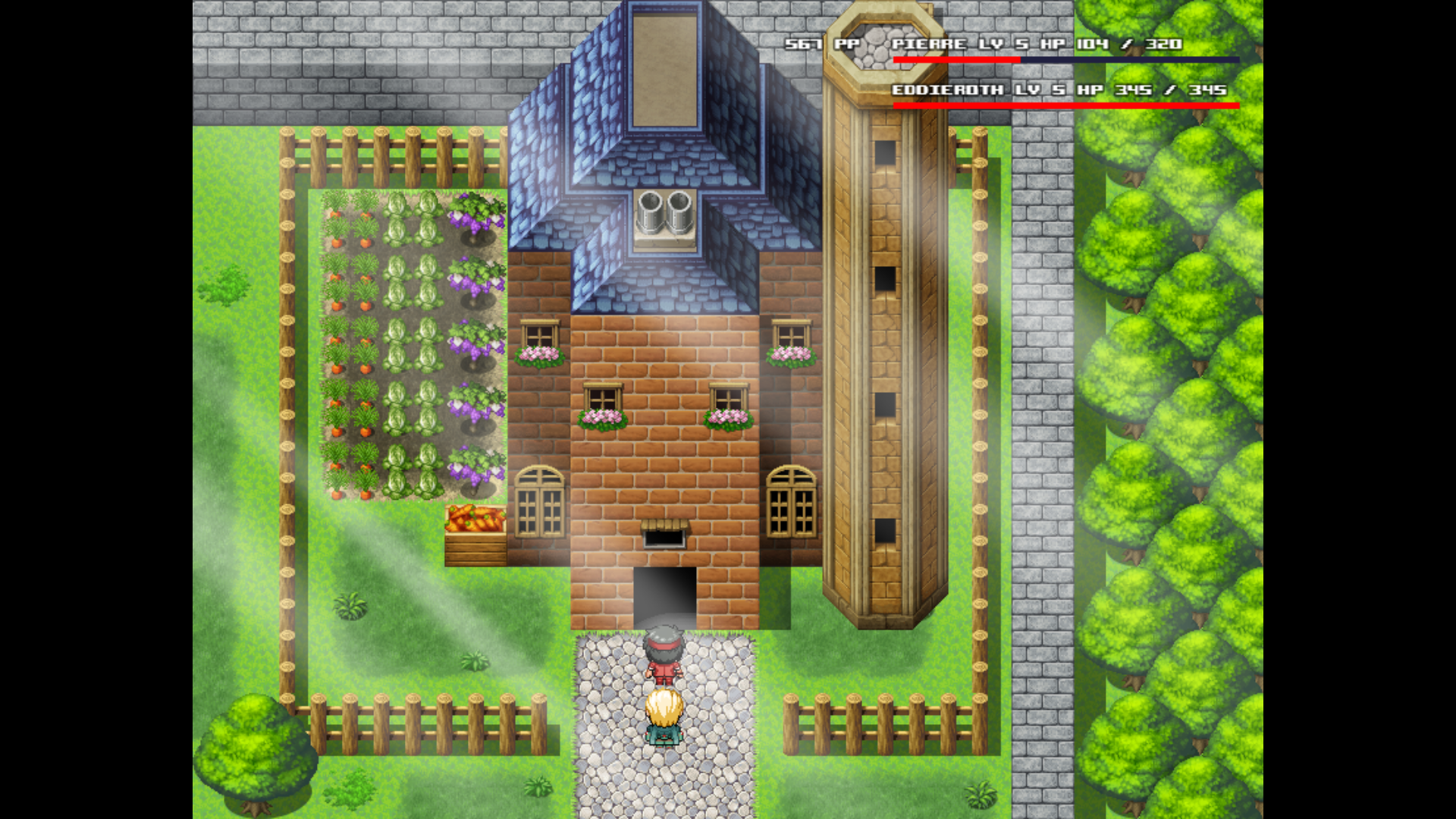
Here's a house (currently with no door, because I haven't made the inside yet) in the editor:
And here it is in game, the simple addition of a transparent "sunbeams" overlay image giving it a bit more life:
Here's the edge of a swamp in the editor:
And here it is in game, featuring a moving "mist" overlay image, plus a change to the screen tint that gives it a slight purple hue as well as desaturating the colours a bit:
Finally, here's part of a forest labyrinth in the editor:
And here's the dramatically different presentation in game, featuring an adjusted screen tint and a tiled overlay to simulate the leaf canopy blocking out sunlight:
I know to all the jaded pros out there it probably still looks like "just another RPG Maker game", but given that I'm mainly using this project to experiment with the software and see how easy it is to put a complete experience together, I'm happy with the twists on the standard look and feel I've got going on so far.
After repeated exhortations of extremely enthusiastic approval from my friend Tom, I decided to watch the movie Turbo Kid this evening on Netflix. I was not disappointed.
Turbo Kid is a study in contradictions. It's a movie that is a perfect recreation of 1980s action flicks, but it was made in 2015. It's not a comedy, but it's hilarious. It is, at heart, simplistic and straightforward, but nonetheless compelling and thought-provoking. More than anything, though, it's terrible, but it's stunningly brilliant.
Turbo Kid is set in the apocalyptic far-off future wastelands of the year 1997, where some awful disaster that isn't really explained (but was probably something to do with the Cold War and/or robots) has turned everything to shit. Our story centres around a nameless young boy, known only as The Kid, who was orphaned early in the post-apocalyptic period, but who has, against all odds, managed to survive in the wasteland through scavenging and keeping his childish hopes and dreams alive through vintage comics about his favourite superhero, Turbo Rider.
Early in the movie, The Kid meets Apple, who initially seems to be a charmingly dimwitted young girl, but subsequently is revealed to be a robot, because '80s movie. Apple is dying thanks to getting hit in a skirmish, and The Kid, who after some initial reluctance to even be around her having been alone for so long, agrees to help her find some replacement parts before her "heart gauge" (rather beautifully depicted in Zelda-style pixel art on an embedded display in her wrist) runs out and she deactivates forever.
I'll spare you the rest of the details, but suffice to say, The Kid finds himself taking on the role of Turbo Rider to the best of his capabilities, and there are plenty of ridiculous action scenes along the way, not to mention a particularly loathsome villain in the form of self-appointed wasteland baron "Zeus" — who of course has a connection with The Kid, because '80s movie.
I was reading an article in a GamePro from a couple of years ago the other day, and someone — I forget who offhand, but I think it was someone like Tim Schafer or his ilk — made the very good point that the best comedy is made of juxtapositions, most commonly the juxtaposition of serious words with silly visuals, or vice-versa. Turbo Kid is pretty much entirely designed around this philosophy: it takes itself very seriously and never, at any point, winks knowingly at the audience to go "DIDYA SEE THAT?!". Instead, it makes use of the exact same techniques '80s action movies did to juxtapose the ridiculous with the deadly serious: terrible, extremely obvious special effects; excessive amounts of blood and gore; unnecessary swearing at the most bizarre moments; but, at heart, a rather touching story of a kid who realises he doesn't want to be alone in the world any more.
Of particular note is the blood and gore, of which there is lots, but it's so insanely exaggerated — again, like the best worst '80s action flicks — that it's impossible to feel grossed out by it. In one scene, a man gets his face thrust into the spinning blades of a blender. In another, someone gets his guts pulled out by them being attached to the back wheel of a bicycle (in this particular post-apocalyptic future, everyone rides pedal bikes — which sort of makes sense, when you think about it, as fuel would eventually run out). In the climactic battle scene, the dismembered torso and legs of two other enemy grunts become firmly lodged on the head of a third enemy. And, of course, Turbo Rider/Kid's unique gadget is a device on his wrist that immediately causes anyone it is pointed at to explode into a fine red paste.
Turbo Kid really benefits from being written and constructed as an '80s action flick, without any fourth wall-breaking self-awareness going on. In being designed this way, it provides commentary on how desensitised to violence we are these days — many of the more gory scenes in the film would likely have got the movie banned as a "video nasty" back in the '80s — while at the same time pointing out how far popular culture has supposedly come in the last 30+ years. Or you can look at it another way: it can be interpreted as a fond look back at the '80s, when not all entertainment was expected to have some sort of socially aware "message" behind it (with the possible exception of children's cartoons, which tended to lampshade these messages extremely obviously) and it could sometimes just be about many boys' childish fantasies: the ability to point at a bad guy and have them explode into goo.
If you have an hour and a half to spare, then, be sure to check out Turbo Kid on Netflix. If you grew up in the '80s and/or you enjoyed Far Cry: Blood Dragon (which is a similarly hilarious but loving homage to the more ridiculous side of '80s popular media), you will very much appreciate what it has to offer.
Doubtless I'll be writing about this in more detail at some point in the near future over on MoeGamer, but while it's still new and fresh I thought I'd give some initial impressions on Fairy Fencer F: Advent Dark Force, Compile Heart's latest PS4 release.
FFF:ADF, as I will refer to it hereafter, is a Neptunia Re;Birth-style reimagining of the PlayStation 3 game Fairy Fencer F. It includes the whole story of the original game, updated and expanded with all-new mechanics, plus a whole bunch of brand new content as well, making for what looks to be an absolutely sprawling mammoth of a JRPG that I'm very much looking forward to sinking my teeth into.
For the uninitiated, FFF:ADF casts you in the role of Fang, a lazy asshole who we're introduced to as he's been locked in prison for stealing bread. Three days earlier, it transpires, Fang pulled a legendary sword known as a Fury out of the ground, and thus found his fate inextricably intertwined with the adorably cute but rather headstrong fairy Eryn. Fang, wanting nothing more than a good meal and a warm bed, finds himself rather hastily recruited into a quest to find all 100 other Furies scattered around the world and use the power of the Fairies within to wake up the Goddess and prevent some sort of horrible catastrophe from occurring.
FFF:ADF follows Compile Heart's usual RPG formula fairly closely. Town scenes are menu-based and allow you to visit a number of different locations to purchase and sell items or just chat with NPCs. As you progress through the game, more facilities become available in town.
When you leave town, you'll likely be entering one of the game's dungeons, which are filled with enemies you can see wandering around the map, and perhaps an event and/or a boss fight to complete.
Striking an enemy with your weapon while you're in the field — a challenge made significantly easier than in the Neptunia series by the simple addition of a visual and auditory cue when you're in range to connect a hit — allows you to get the jump on an enemy; mistiming it or letting an enemy run into your back, conversely, lets them ambush you.
Combat initially appears similar to the Neptunia series but there's a few twists on the basic formula. For starters, characters only begin with a basic attack rather than a multi-hit combo. Multi-hit combos can be unlocked later — and they include fighting game-style techniques such as launching and juggling enemies — but initially the bulk of your damage will probably come from your special skills, which are further subdivided into weapon skills and magic spells.
The thing that's looking most interesting about FFF:ADF at this early stage is its progression system. Whereas Neptunia's character progression was completely linear — though once you unlocked abilities you could customise your characters to a minor degree, and Megadimension Neptunia made more of this by making different weapons capable of different combos — in FFF:ADF you earn WP ("Weapon Points") through combat, which can then be spent on unlocking abilities, buffing stats and activating passive skills. In practice, there's probably a "right" order to unlock things in — and if previous Compile Heart RPGs are anything to go by, you'll probably unlock everything by the time you're through — but it's nice to at least feel like you have some options.
Other cool features include a battle system that allows up to six party members at a time, which will hopefully make for some interesting encounters later in the game — I only have two characters at present! Neptunia's Challenge system is back, too, providing you with useful stat boosts in exchange for completing various tasks.
It's early days yet, but FFF:ADF looks like Compile Heart's most polished title to date; there's none of the weird screen tearing from Omega Quintet and, so far, none of the frame drops of Megadimension Neptunia, and the 2D art (courtesy of Neptunia artist Tsunako) is as gorgeous as ever.
I'm looking forward to seeing what this game has to offer; everything I've heard from people who have already played it makes me feel like it's going to be a really solid JRPG, and I'm excited to see what other gameplay features I'll be fiddling around with as I progress further.
I hope you've been enjoying my work on MoeGamer over the last few months; with the Ys: Sights and Soundsarticle published today, that's now four full months of following my new "cover games" format, with a few tweaks along the way.
You may have noticed that with Ys I shifted slightly from the fixed article formats I followed for Senran Kagura, Megadimension Neptunia and Dungeon Travelers 2. This was partly to make the things I write seem less formulaic, and also, in my opinion, represents a better means of splitting up the things I want to talk about across the several articles.
Probably the biggest change from before is making the first piece each month cover the historical context of the game rather than putting this in the same piece as a discussion of the game mechanics, as to a certain extent introducing a game or series requires talking about its historical context anyway. By extension, discussion of game mechanics are now in their own dedicated post, and in the case of series like Ys, this affords the opportunity to talk about how the way the games actually play has evolved over time.
You may have also noticed an article about the wonderful cyberpunk visual novel VA-11 HALL-Asneak in; I'm going to start adding a few one-shot posts like this alongside the month-long coverage of the Cover Game as a means of talking about certain topics with a little more immediacy rather than waiting for the following month to post something. Me posting a one-off article about a game doesn't preclude it from getting the full Cover Game treatment at some point down the road, but to minimise the possibility of me repeating myself too much, I'll try and leave at least a few months in between this happening.
So what's coming up? Well, next month you can expect an in-depth look at something that isn't a game at all, but rather a piece of software that will help you to make your own games: Degica and Kadokawa's RPG Maker MV. Over the course of the month, we'll look at the history of the RPG Maker series and its numerous incarnations over the years as well as the new and exciting features MV has brought to the table. For those of you interested in getting your hands dirty with amateur game development, this coverage will include some tutorials and handy links, too!
In the near future, you can also expect at least one article on the subject of the recently released rail shooter from Inti Creates and PQube Games, Gal*Gun Double Peace, too. It really is a very unusual game indeed, and, of course, due to its subject matter, it's something that the mainstream gaming press completely ignores at best and refuses to take even a little bit seriously at worst. It is, however, well worth your time; despite the hilarious premise, it is both a solid rail shooter and an interesting take on dating sims, with some fun characters and an absolute ton of unlockable and collectible content to keep you busy for a long time.
I'll also do my best to try and remember to post updates to you lovely backers a bit more often, too; your support is very much appreciated, particularly as the missus and I have been struggling a bit with financial matters recently due to her long-term sickness keeping her out of work for a good few months and my reliance on erratic freelance income. Your pledges have helped take a bit of the edge off these trying times, so a thousand thank yous for that.
Do please point family and friends in the direction of MoeGamerand this Patreon page if you think they might be interested in my work and the things I cover, and know that I am extremely grateful to those of you kind enough to think my work is worth a bit of change each month. You make the time and effort that goes into putting these posts together all the more worthwhile.
Here's to many more months of moe moe kyun kyun~ or something. <3 you all!
Since I've just spent a bit of time painstakingly stitching together the various screens that make up the maps for one of my as-yet unrevealed game's "worlds", I thought I'd take the opportunity to tease said game a little by sharing said stitch.
Here we go, then:
This isn't the complete map as yet, though most of the south to southeasterly portions are now done. There's a fair bit to do in the north and the west of the map, and then I can finally start making some events to go on it. And building dungeons! Fun times ahead.
I decided early on to make the game non-scrolling and instead move screen to screen in a somewhat old-school fashion. This has proven to mostly be beneficial to my overall efforts of putting things together, because it means I can tackle it in small chunks rather than being overwhelmed by the prospect of creating an interesting scrolling map. It's also been a challenge, however, to ensure that the player can't wander off the side of one screen and find themselves on the next embedded in a wall. Fortunately, the very act of stitching the map above together has helped me to spot any such glaring errors and fix them easily.
To design this map, I did a simple old-school adventure game-style map on paper first, using a square for each screen or "room" and lines to indicate connections between rooms. Then I numbered each of the boxes, since RPG Maker numbers the maps you create, and the plugin I'm using for automatic transitions when you walk off the side of a screen is dependent on these numbers, before finally tackling it a bit at a time. In order to finish this "world" I'll need to get up to map number 125; as of the stitch above, I've reached 84, so things are flowing along quite nicely so far.
I had a rough concept in mind for the overall map when I started, though it's evolved a bit as I've been putting it together. I'm trying to give things a vaguely realistic scale rather than the skewed, exaggerated scale seen in RPGs with a "world map" screen; to put it another way, it's more a Zelda approach to an overworld than a Final Fantasy, though the gameplay uses a separate turn-based battle screen rather than Zelda's action RPG-esque combat.
As I've mentioned a couple of times, this is just one of several worlds players will visit in the game. Each world is going to have a slightly different style of play about it: this one has the aforementioned Zelda-style overworld with discrete dungeons to complete; another is going to be a Resident Evil-inspired haunted mansion kind of affair with plenty of puzzles; a third will be a more linear sci-fi world; a fourth will place emphasis on character interactions and narrative rather than combat; and the final world, which you'll only be able to enter once the previous four have been completed… well, that's a secret!
As a great man once said, please look forward to it.
Turns out the simple act of explicitly acknowledging the fact I'm aware of this issue with my own attention span has helped me to do something about it.
In the times when I've been working on my RPG Maker MV project, I've been considerably more productive than I have been in the past, with far less staring into space and far more in the way of map-making. The current map count for the project now stands at 72, which means I'm well over halfway to assembling the first of the five "worlds" in the game, which is also likely to be the most complex and largest, and so a good idea to get out of the way first. (I know I'm well over halfway because I've mapped out what I want the final overall map to look like on paper, and numbered each of the individual "rooms".)
I've also found this awareness to be very helpful when doing actual work rather than just pissing around with RPG Maker. I've finally had some freelance work start flowing in again, and I've been managing to sit down and concentrate on it enough to get it done efficiently and in plenty of time to submit for the deadline without having to do a last-minute rush on everything. (Even when I did a last-minute rush, I always got stuff in on time, mind you; it was just rather more stressful than it really needed to be.)
Whether this new way of thinking will stick around — and, for that matter, if it's anything to do with the new anti-anxiety drugs I'm on, which have just about stopped making me feel perpetually stoned now, thankfully — remains to be seen, but I'm going to take full advantage of it while it's here, and maybe even get a creative project or two actually finished. That'd be something, eh?
Incidentally, I'm not quite ready to reveal the full extent of my RPG Maker MV project as yet, since its very nature is something I'd like to keep as a bit of a surprise for some of my friends. Over the coming weeks as things start to come together, though, you can expect a few teasers of what I've been up to. I will, however, say up front that I've mostly been using RPG Maker MV's stock art resources with it (albeit with some lovely lighting effects courtesy of a wonderful plugin), because that always seems to be something that people whinge about with RPG Maker projects, even those just done for "fun" like this one. I am hoping, however, that the story, the writing, the characters and the humour in it will more than make up for my own lack of artistic talent and consequent reliance on provided art resources.
There's also going to be some great music in it; some of it stock RPG Maker tracks (RPG Maker MV's provided music is seriously way too good not to include at least some of it!) and some provided by members of the RPG Maker community. If I'm feeling particularly adventurous, I might even compose some of my own work for it, but let's take things one step at a time, shall we…?
Lightgun and rail shooters generally aren't regarded as particularly deep and meaningful experiences for the most part, and this is fine; after all, sometimes all you want to do is hold a plastic gun in your hand (or aim a crosshair) and blow seven shades of shit out of everything walking your way.
Sometimes, though, these games go the extra mile and provide a surprising amount of depth beneath the facade of mindless blasting. Nintendo's Star Fox series has been a good example of this in the rail shooter genre since Star Fox 64, with its complex scoring and medals system, and Gal*Gun: Double Peace does something similar for the (lightgun-less) lightgun shooter genre. Which may surprise you.
Gal*Gun's wrapper mechanics are that of a dating sim — a proper, full-on, stats-based one like True Love rather than the games that get called "dating sims" but are actually just visual novels with romantic themes. The protagonist has statistics determining his intelligence, athleticism, fashion style and lewdness, and these can be adjusted over the course of a playthrough either by taking girls into the "Doki Doki Field" and poking them until they emit some extremely suggestive moans, or by purchasing items between stages. The difference between the two approaches is that while purchasing items allows you to choose the stats you raise (or lower, if you need to) so long as you have the ability to pay for it, taking girls into the Doki Doki Field generally affects more than one stat at a time to a more significant degree, and each and every one of the girls in the game has a different impact on your stats. In other words, if you're trying to form a particular "build" — something that becomes particularly important in the more "freeform" mode that unlocks after you've beaten the main story-based routes — you'd better learn which girls are most useful for your purposes.
The stats are relevant in a couple of instances. Firstly, in the story-based routes, your stats need to be at a particular level in order to choose certain dialogue options. For example, if your lewdness level is too low, you are unable to make lecherous comments towards the heroines, which is probably for the best. Secondly, in the freeform mode, in order to pursue a particular girl, you'll need your stats to be in specific regions in order to be the type of guy they want you to be. I haven't got far enough to try out this mode yet, but it presents an interesting twist on the formula; in the story-based routes, you can pretty much get away with just raising all your stats as high as possible in order to have the maximum available options in dialogue.
As for the story-based routes' structure, they have a Good End and a True End, with the latter being dependent on a combination of your overall score for the playthrough being high enough and your affection rating with the heroine being high enough by the time you reach the final chapter. The latter is mostly a case of saying the right things in dialogue sequences, but it's also affected by the "event" levels where you're doing something other than just blasting incoming girls.
The scoring system, meanwhile, has a certain degree of depth to it, too. Most of your points come from fending off the girls who relentlessly charge towards the protagonist, but just blindly blasting away won't get you the best scores. No, in order to score highly, you need to achieve "Ecstasy Shots", which allow you to one-hit eliminate a girl by hitting her in a weak point. These are helpfully indicated when you move your crosshair over the girl by a piece of Japanese onomatopoeia appearing, though you can also learn where each girl's weak point is over time, too. There are four main weak areas: red popups indicate you should hit them in the head, orange means the neck, yellow means the torso and pink means the legs.
Each time you get an Ecstasy Shot, your combo counter increases by one. Your combo is broken if you take damage or eliminate a girl "normally" without performing an Ecstasy Shot. There's also an additional Quick Bonus for eliminating girls in rapid succession.
The Ecstasy Shot system makes the shooting a lot slower and methodical than the typical franticness of regular lightgun shooters, and there are a couple of other techniques you can use to tip the scales in your advantage, too. Firstly, shooting a girl anywhere but her weak spot without eliminating her stuns her for a moment, preventing her from doing her attack animation briefly. Secondly, holding down the fire button allows you to do a "Charged Shot", which covers a wider area and can likewise stun enemies briefly. Thirdly, taking one or more girls into the Doki Doki Field and poking them until not-an-orgasm-honest causes a smart bomb effect to go off, taking out all girls in the vicinity as if you'd Ecstasy Shotted them. These techniques are particularly helpful — even essential — during the sequences where enemies come at you from all sides and you have to manually turn to face several different directions to fend them off as they approach.
As well as the points earned through eliminating enemies in each level — not all of whom charge at you, so some need to be quickly taken out as they wander past during transitions between "shooting gallery" areas — there are also three bonuses at the end of each level for clear time (the quicker the better), amount of damage taken and accuracy, ranked between one and five stars, with five stars providing significantly more points than anything below. Clear Time is a particularly variable one, as many of the levels offer branching routes, with some being significantly quicker than others, but perhaps counterbalancing this with fewer enemies to chain Ecstasy Shots off.
As well as clearing the various story routes and attaining high scores, there are loads of hidden collectibles to uncover throughout the game. Some of these are hinted at by the "requests" you receive on your phone between levels, and largely involve finding either hidden objects or characters and shooting or staring at them, depending on what the request was. Others are simply hidden objects and provide anything from point bonuses to new costumes — the game's Dressing Room mode allows you to customise each and every character in the entire game to your own personal preferences (including undies), though disappointingly, the PS4's Share facility is blocked while you are using this, meaning you can't take pictures of your own personal take on the cast.
Alongside the hidden objects are student and teacher handbooks hidden in plain sight around the levels; shooting these unlocks parts of each character's profile, and you can complete said profile by taking each character's bust, waist and hips measurements by using the "zoom" function (also used to locate hidden objects by seeing through otherwise opaque scenery such as locker doors) and staring at them in the appropriate region before you blast them into euphoria.
On top of all that, there's at least one hidden ending that you can achieve by fulfilling a particular set of conditions (they're fairly obvious, but I wasn't expecting them to actually lead to a full-on ending) and a Score Attack mode that allows you to play either a whole story route or an individual stage and record your best score and highest combo.
So yes. There's a lot to this game. It's no Time Crisis, in other words, which, while it was great, pretty much played all its cards within twenty minutes if you were the slightest bit skilled with a lightgun. Gal*Gun, meanwhile, looks set to keep me busy for a very long time indeed.
After the sad departure of Clover a little while back, it wasn't long before Andie and I decided that it was far too quiet in the house without a pet around. It was surprising quite how much "presence" Clover and her predecessors had had in the house, and indeed it felt rather empty without her.
So it was that we headed off to the Stubbington Ark, a local RSPCA-run animal shelter, where we went "just for a look" at the cats they had up for adoption.
Naturally, we immediately found not one but two cats that we wanted to take home with us, and so we decided to set things in motion sooner rather than later. A couple of days later, a representative from the RSPCA was sniffing around our house to make sure we weren't some sort of cat-killing psychopaths, and thankfully we got the all-clear; then yesterday, we got to pick up our new friends and listen to them howling at us from inside the cat carrier while we drove them home.
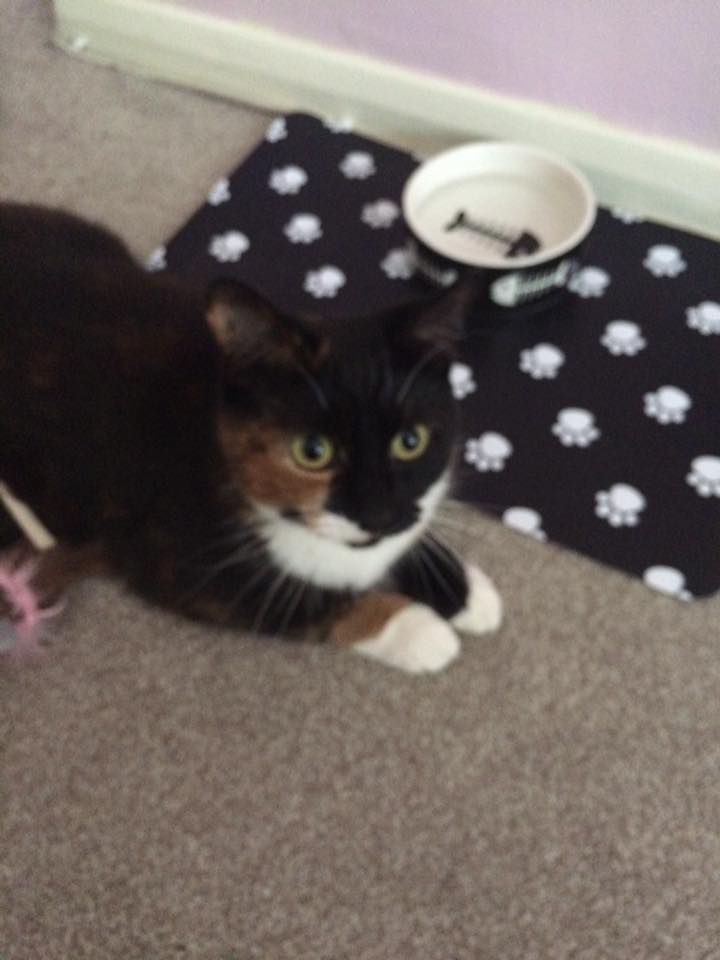
This is Ruby:
And this is Meg, which we've decided is actually short for Megatron. (If we were able to name our own cats, we were going to call them Patrick Stewart and Megatron, but Ruby and Meg both already had names, so Meg will just have to deal with being an effeminate Megatron on occasion.)
They've both settled in very well, very quickly. The spare room is now "their" room, so far as they're concerned, and they're already finding the best places to sit and be in the way as much as possible.
We also had the inevitable "new pet scare" on the very first day we had them; Meg managed to jump out of a window that was only open a crack, and went for a little explore outside. Thankfully, she came back of her own accord after a few minutes, and we're now sweltering in a house with no open windows while they get fully accustomed to their new home. It's a rite of passage with every new pet that something like that has to happen, it seems; when we got Lucy rat she decided to pretend to be dead ten minutes after we got her home, which was mildly upsetting (though in retrospect it was probably to try and get Lara off her back, because Lara was fussing over her to a ridiculous degree); and pretty much all of the other rats managed to escape their cage quite early in their time with us and hide under various items of furniture.
So yes. We now have cats. Friendly cats. If you visit us, be prepared for that!