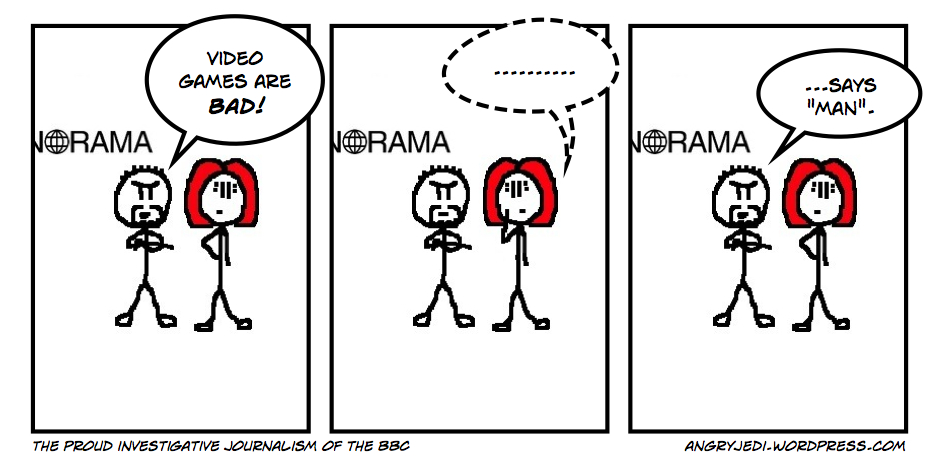
 An hour ago, the BBC aired an episode of Panorama, our go-to investigative journalism programme, on the subject of video games. The subject, predictably, was the ever-present "are video games addictive?" question that has been raised and not answered many, many times prior to now.
The programme made a few fair points that are more common sense than anything else. Firstly, those with addictive personalities are prone to becoming addicted to games. Many games have in-built reward mechanics which those who get easily addicted to things will… well, get addicted to. Social games like Farmville, MMOs like World of Warcraft and popular multiplayer titles like Call of Duty all take great pains to ensure a regular stream of rewards and gratification being sent in the player's general direction. Whether it's a "medal", a "completed quest" or simple experience points, there's a constant flow of something that leads the player to believe they're achieving something. Those who become addicted to things easily can use that as a justification.
Secondly, the programme pointed out that parental controls need to be used more effectively. Many children and teenagers are given free reign on their use of video games and as such don't limit themselves on how much to play, to the exclusion of other things. Parents need to get better-informed about the facilities available to them to control their children's playing habits. This is, sadly, something that many parents are very resistant to, despite the fact that the tools are there for use, particularly on the Xbox, which offers some of the most robust family controls that there are—as does the Mac, oddly enough.
There were no concrete conclusions drawn, however. The "conclusion", if you can call it that, was that more research was needed from an independent body.
The thing is, this discussion has been going on for decades now, and no-one has thought to actually do that research in an appropriately investigative and non-biased manner.
I was reading through a few Formspring answers from Leigh Alexander (I think) the other day and she made the very good point that those of us out there who write about games can't be called "journalists" in the same sense as those who write for, say, national newspapers on breaking stories. Our role as members of the games press involves reporting on carefully-disseminated information provided by PR companies, critiquing products on general release (occasionally before general release) and sometimes interviewing a developer from the industry. There's no real "investigation" there, there's no hard-hitting stuff. That's not necessarily a bad thing, but given that mainstream media tends to come down on the more negative side of the fence when investigating gaming, I think there's certainly scope for a counter-argument: someone who does know the industry well investigating the burning issues. And investigating them thoroughly using established journalistic, sociological research techniques.
Who's going to be the first person to step up and do that, though? More to the point, would anyone read it or take it seriously? Gamers, by their very nature, are defensive creatures, having been made out to be "the bad guys" by the mainstream media once too often. And those not "in the know" are often inclined to have their minds made up by sensationalist stories in the aforementioned mainstream media.
What we need is balance. What we need is a hero.
Wait, what?
 Are you morally-conscious? Feel like you should be doing more to help your fellow man, but feeling a bit strapped for cash at the moment? Don't feel like putting together some sort of fund-raising event because, after all, it is a bit cold outside and it might snow.
 I've just done something I haven't done for a while. I've beaten a game with no Achievements. No, I don't mean that I played the game so terribly that I didn't get any Achievements (I don't think there's a single Achievement-supporting game out there that will allow you to do that)—I mean I started, played, enjoyed and beat a game which did not support Achievements of any kind, be they Steam Achievements, Xbox Achievements, PSN Trophies or a built-in Achievement-like system.
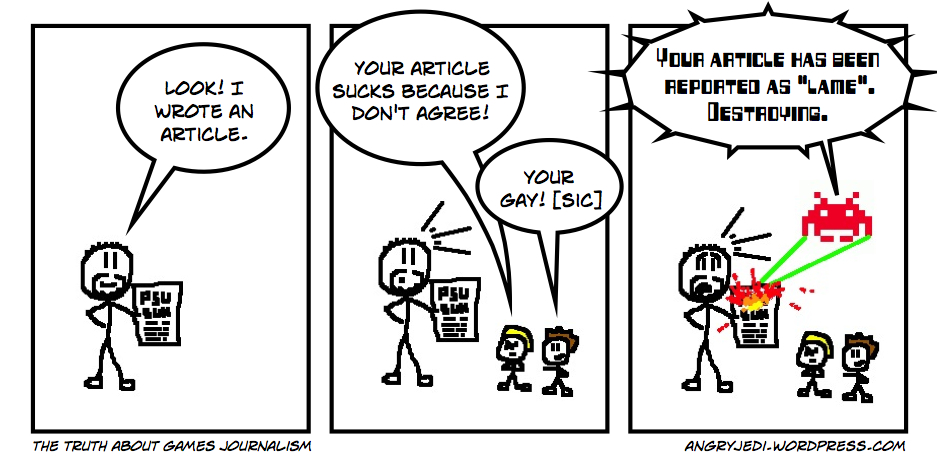 There is an increasingly popular—and increasingly worrying—tendency for games journalism and writing about games (which some people are keen to point out are two different things) to be judged as "broken" or "lame".
 Yes, you have read that correctly; one of the options for reporting an article as unworthy of appearing in the N4G news feed is that it is "lame".
 Somehow I don't think that anyone who is reading this blog will fall into the category that I'm about to talk about, but I'll direct this at everyone generally just in case.
 Ladies and gentlemen, we are afflicted with a plague of the Information Age. The plague of "Google/the search bar is your friend". A plague of laziness, if you will, as this is a catch-all response which makes it look like you're being vaguely helpful and/or knowledgeable when in fact all you're doing is being an arrogant asshole and trying to get out of answering a question as quickly as possible.
 If the name Paul Chambers doesn't mean anything to you at the moment, then take a moment to read
  Most times I watch TV, I'm reminded why I don't watch TV any more, besides the occasional isolated incident of The Apprentice (which I can't really be bothered with this year, anyway). And the reason for that is that 99.87% (approximately) of it is complete, unadulterated, unfiltered dross and bollocks, and the rest are reruns of old, unadulterated, unfiltered dross and bollocks.
 So the new Xbox Dashboard went live today. Pretty neat, isn't it? Lots of new sound effects, a clean white aesthetic, Kinect compatibility and all manner of other goodies. In fact, let's take a look at the list of new features, shall we?