2342: A Belated Account of My First VR Experience

0342_001

It occurred to me a few days ago that I had a go in Virtual Reality recently and didn't write about it. Let's rectify that right now.

My friends Tim and Tom both grabbed the HTC Vive pretty much as soon as it became available, because both of them have disposable income and a gaming-related gadget fetish. Last week, I finally had the opportunity to give Tim's setup a go. And I came away rather more impressed with the whole thing than I was expecting to be.

The Vive headset itself is surprisingly comfortable and not ridiculously bulky like the Virtuality headsets of the '90s, which were my only previous experience with VR. The picture quality was reasonably good, too — certainly a far cry from the Virtuality screens, which felt like holding two Atari Lynxes up to your face — but I did find it a little tricky to position the headset absolutely perfectly so that everything on the display was in focus; I found stuff around the edges (particularly the lower edge) was difficult to remove the blurriness from, but I adjusted to it after a little while.

The first thing I tried was the Vive "training" setup, which gives you some examples of how to interact with virtual worlds using the headset and the two Vive controllers. It introduces you to the idea of "room scale" play — the ability to actually physically move around and have your body movements accurately reflected in your virtual viewpoint — and how the Vive controllers offer 1:1 motion tracking that is so accurate, even though you can't see your own hands while you have the headset on, you can still reach out, grab the controllers and press the buttons without any difficulty.

I think the most immediately striking thing about the Vive's VR is the room scale thing, which is, after all, that particular setup's unique gimmick. I was very surprised how natural it felt; there was no kind of input lag when moving my head around, nor when I moved my body; I could tell I wasn't actually in the location I was looking at, due to the lack of tactile feedback in the environment, but I could move around and interact with things as easily as I could in the real world. Particularly impressive in the training demo was the part where you inflate balloons using the controllers, and can then hit them around the room as if they were right there. Again, there was no tactile feedback, but the accuracy of the motion tracking was such that I could intuitively reach out to hit them with a controller, and they would react appropriately. Impressive.

The next thing I tried was Space Pirate Trainer, which is one of the first games to come out on the platform. It's a very simple affair that sees you standing on a platform wielding two pistols and having to shoot down waves of drones that pop up from all sides. The pistols can be switched to various different fire modes, and you can physically dodge the incoming laser bolts from the drones to avoid being hit.

This latter aspect was the thing I found most unusual and surprising to adjust to. I've played games that involve physical movement before — primarily on the Wii, but a couple of EyeToy and Kinect games, too — but I've never played a game where you can see a bullet flying at your face and actually lean out of the way of it. I mean, sometimes I instinctively do it when playing Overwatch (I can't help it!) but in Space Pirate Trainer you actually have to do it in order to survive. And it's not a Time Crisis-style situation where you can either be "hiding" or "shooting" — you can position yourself how you please. You can kneel down to crouch under the shots. You can sidestep them. You could probably even jump over them if you tried. It's kind of amazing, although the game itself is fairly bare-bones, to say the least.

Next up I tried Google's VR art package Tiltbrush. This is actually one of the things I was most interested to try, despite it being utterly "directionless" — it is what you make of it, in other words.

Essentially, Tiltbrush allows you to paint in 3D using various materials. The left Vive controller acts as an artist's palette with several sides, and the right Vive controller acts as your paintbrush and cursor to pick things from the palette. You can then paint with light, colour, fire and various other substances, then the truly impressive part is that you can physically walk around your creation in 3D to admire it from all angles. By extension, this also means that you can create 3D sculptures rather than just flat paintings, and indeed many of the example materials produced by both Google and the community are designed with this in mind. What's really nice about them, too, is that loading them up allows you to watch a recording of the exact strokes and steps they took to create the finished product; it can be fascinating to watch and, moreover, give you some ideas of your own on how to make some interesting designs.

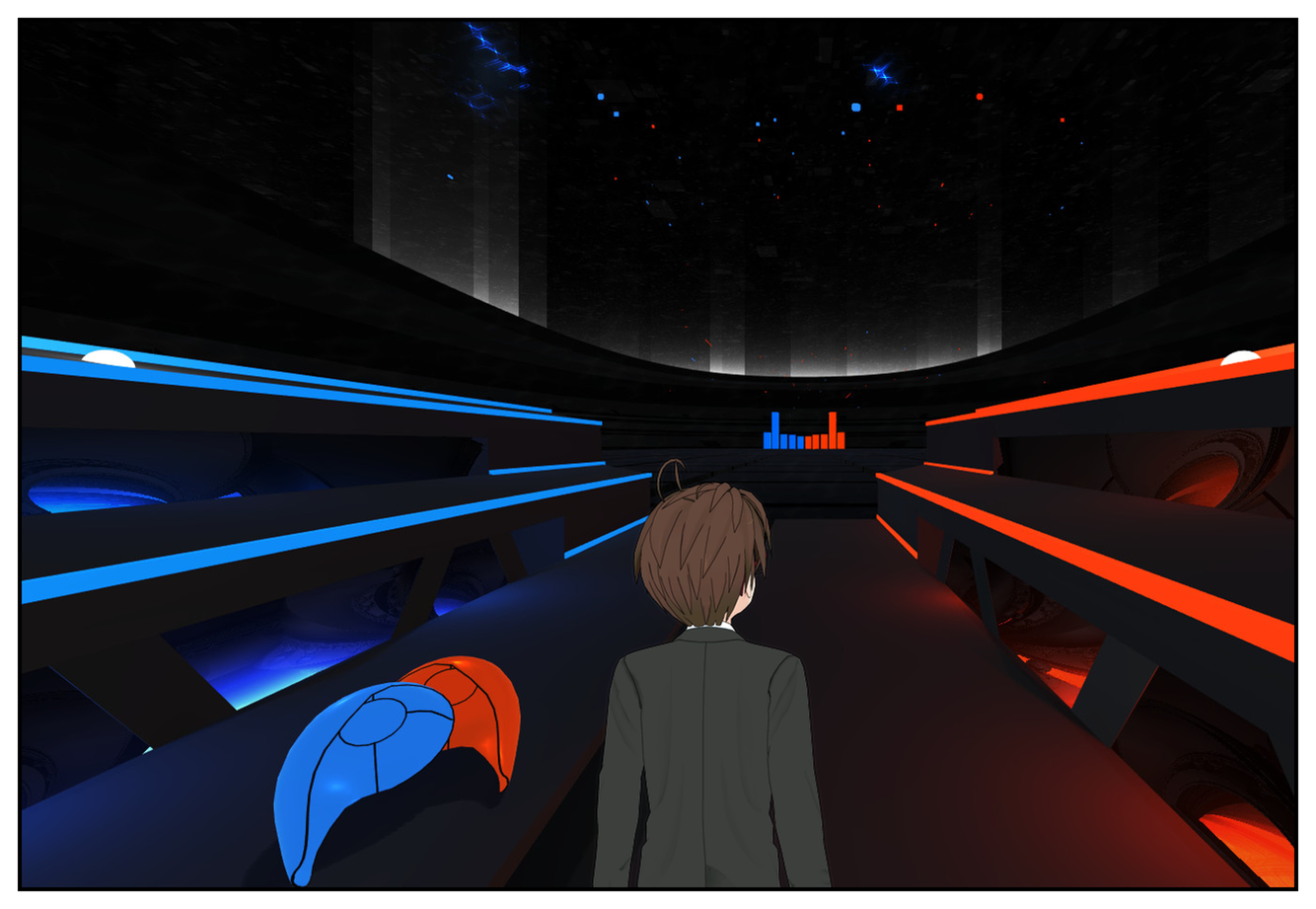
Last of all, I tried Audioshield, a game by the developer of the excellent Audiosurf, and a game designed in the same mould: create levels from your own music tracks or those pulled from Soundcloud, then play through them. In the case of Audioshield, you wield two different coloured shields, one in each hand, and have to block incoming coloured balls that reach you in time with the beats and sounds in the music. While there's less moving around than something like Space Pirate Trainer — the balls only come from one side, though you will have to look up and down — it's probably the most "physical"-feeling of the games I played, in that there was a very strong urge to "punch" the balls (hurr) as they arrived, rather than just blocking them. Indeed, the game rewards you for actually doing this, as well as moving around more than is necessary ("dancing", in the loosest possible sense of the word, in that convulsing like a spastic having an epileptic fit while in anaphylactic shock will also get you credit)  to actually block the incoming beats.

By the time I took the Vive headset off, I was actually sweating. The various games — particularly Audioshield — proved to be a surprisingly intense workout, although the foam thing on the headset that goes around your eye area also seems to just naturally get a bit sweaty. (That and Tim's flat is usually the temperature of the Sun.) I'd had a great time, and I came away much more convinced that VR is something that is going to be really cool in the near future than I had previously been. I'm still not necessarily convinced it's the future of gaming as some seem to think, but I'm certainly completely on board for experiences like Tiltbrush and its ilk.

I'm very interested to see how the launch of PlayStation VR in October of this year affects the VR landscape in general. I have a strong suspicion that it will help drive the technology into the "mainstream", and we'll start seeing a lot more interesting products than the current swathe of what are effectively tech demos that we have now. Very impressive, fun tech demos, admittedly — tech demos that make me kinda want a Vive of my own — but tech demos nonetheless.

So yes. VR looks like it's going to be around for a while yet; we finally have the technology that allows us to have fairly convincing experiences in our own home, which is considerably more than can be said for the last time VR tried to be a thing back in the '90s.

2341: Taking a Break from Social Media; Here's Where to Find Me

0341_001

I've reached this situation before, as longtime readers will doubtless remember, but I think I've lost patience with public social media (specifically Twitter and Facebook), and as such I think for the benefit of my mental health and overall enjoyment of life, I'm going to step away. I'll talk more about the reasons in a moment for those of you who are interested, but before I do that I'd like to share the important stuff: how you can get in touch with me if you so desire.


Email: pjedavison at gmail dot com, or you can use the Contact page on this site, which comes through to the same address.

Google Chat: My only real form of private IM; same email address as above. I have a few other IM services but don't use them much, so please don't try and chat to me on Skype because I probably won't know you're trying to reach me!

Discord: You can drop in on my server at https://discord.gg/0PVr1hioSgchWQAs and/or add me as a friend under ID Amarysse#2465.

Pete's Pile of Shame: I'm going to post some "live" thoughts and media relating to the games I'm playing over at this new site. Feel free to leave comments.

Note that I will be leaving my various Twitter accounts open, but not monitoring them. They will simply reshare my articles and posts from my sites. Likewise for Facebook. Please do not try to contact me using either Twitter or Facebook, because I won't reply or even see your message!

If you want to play games with me, here are my various game IDs you might want:

PSN: Angry_Jedi
Xbox Live: sonicfunkstars
Steam: http://steamcommunity.com/id/angryjedi
Battle.net: AngryJedi#2260
Final Fantasy XIV: Amarysse Jerhynsson, Ultros server (VinCo Free Company)


Okay. Onto the reasoning for me stepping away, if you care.

To put it bluntly, I'm tired of negativity, because that's what social media seems to have become a magnet for. If people aren't sharing the latest in Awful News from Around the World, they're trying their damnedest to be contrary at every opportunity. No-one agrees with anything any more; everyone seems to perpetually feel the need to "correct" everyone else or have a differing viewpoint.

It's the problem with everyone being able to express their opinions, in other words: everyone feels the need to have their own opinion, and heaven forbid it be the same as someone else's. Arguments erupt over the most stupid things, and people snark about things that don't matter with sufficient aggressiveness and determination to make considering talking about almost anything an unpleasant prospect. As someone who already feels a great amount of social anxiety during in-person interactions, to start feeling this way about online interactions, too — a manner of interacting which I had previously found much more comfortable and pleasant, but which I am starting to recoil away from — this is not the way I want to be feeling.

I'll give you a simple example from today: earlier, I learned that Microsoft sells hilariously awful-looking soft porn movies on its marketplace — a storefront which is accessible on its Xbox One console — and yet we still can't have Adults Only-rated games on consoles due to outdated concerns about Wal*Mart and Gamestop not stocking their shelves with anything controversial. I made a glib observation to this effect, and rather than a simple response of "Oh, interesting" or "huh, that is weird", the first response I got felt the need to correct me on my use of the word "porn". Apparently "topless" is not the same as "porn".

This interaction in itself wasn't anything unusual or particularly hurtful, but it was the proverbial straw that… you know. It exemplified everything that's come to frustrate me about social media in the last few years; coupled with the fact that no-one ever seems to be happy about anything any more — between people whining about misogyny, sexism, racism, homophobia, censorship, Donald Trump, black people, white people, Asian people, Nazis, neo-Nazis, Germans, Belgians, gamers, games journalists, Anita Sarkeesian, feminists, men's rights activists, Facebook, Twitter, Simon Cowell, Nigel Farage, gun enthusiasts, people who drink Mountain Dew, people who do fanart "wrong" and any number of other things, it's no wonder I'm feeling particularly miserable and negative about life in general, really, is it?

So the most sensible thing to do from a mental health perspective when something starts making you miserable is to cut that thing out of your life altogether. Preferably cold turkey. But the thing that always makes me hesitate is the fact that amid all the negativity and bullshit, I have struck up some genuine friendships, and I'd hate to lose those. I'd hate to lose contact with people like Mike Cunningham from RPGamer; Steve Baltimore, Joe "Eritach" Sigadel and several others from Operation Rainfall; the glorious perverts of Anitwitter such as Vyers, Ashley, Luka, Firion, Bubbel, Xiaomu, Rin, Radkatsu, TheHatPerson and doubtless hundreds of others I've forgotten to mention. (If I didn't call you out by name here, it's to save time and space, not because I don't want to stay in touch! Unless you're a shithead. In which case I probably wasn't following you anyway.)

As such, then, the details above are there in an attempt to stay in contact with people I want to stay in contact with, despite intending to leave what has previously been our primary means of communication behind. Please do feel free to use them and to say hi to me using any of the means listed; they're there to be used, so don't feel like you're "intruding" in any way by sending me a friend request or a private message via some other non social media means.

In order to continue one thing I did enjoy about Twitter — posting "live" thoughts and reactions to games I'm playing — I've set up this site to continue doing so. It'll probably be primarily PC games on there, as sharing console or handheld screenshots and other media is a bit more of a faff, but if you want to see what I'm up to and share your own thoughts on games I'm playing, feel free to drop by and leave a comment.

I'll be leaving my various Twitter accounts and my Facebook page active in order to share things like these blog posts and my other content from around the Web, but I won't be actively checking them, so please don't use them to try and get in touch with me. No, really; I've turned off notifications on my phone and everything, so if you try and say something via one of those means, I won't see it.

I'll be continuing to post here each and every day, sporadically on my new site and (hopefully) weekly on MoeGamer. Those are the best ways of keeping up to date with what I'm doing and having a chat with me, so feel free to follow and comment on any of them.

Hopefully stepping away will allow me to regain a little perspective and a lot of wasted time on a daily basis. If nothing else, it's probably healthy to get away from relentless negativity, particularly when I'm already depressed and anxious.

Thanks for reading if you came this far; hopefully I'll hear from some of you elsewhere on the Internet sometime soon.

2340: The Rise of GOG

0340_001

I remember when GOG.com — or Good Old Games, as it was originally known — first launched. It was an exciting moment, because it promised to be a storefront absolutely filled with PC games from my childhood. PC games that it had previously been near-impossible to 1) acquire in the modern era and 2) get running on modern computers. (Okay, 2 was less of an issue because DOSBox was already a thing by then, but 1 was a problem, at least, and not everyone knew how to set up DOSBox properly.)

I've kept my GOG.com account since launch, and just recently I find myself starting to drift more and more towards them and away from Steam. I'm not going to abandon my Steam account, obviously, since there are several hundred games in there, but GOG is starting to prove itself to be a real contender in the online digital storefront battlefield.

The GOG.com of today is a little different from when it launched, as its change in name will attest. Rather than focusing entirely on retro PC games, GOG.com now provides a mix of both retro and modern titles, and has recently even started doing "Early Access"-style games, though not to the same degree as Steam.

In fact, "not to the same degree as Steam" is a running pattern when it comes to GOG, and the platform is benefiting from it. While Steam is presently suffering from a deluge of low-quality titles released on a seemingly daily basis — the mobile app store problem, now for your home computer! — GOG.com's marketplace is considerably more curated than Steam, and the few Early Access titles that are up on GOG are already decent quality rather than shovelware thrown out with an Early Access tag in an attempt to excuse shittiness.

In other words, discovering new games on GOG.com is a lot less of an issue than on the Steam of 2016 because you don't have to pick through pages and pages of shitty Eastern European games with "Simulator" in the title, or perpetually Early Access Minecraft knockoffs, or games by people who don't understand what the fundamentally appealing elements of pixel art are, or… you get the idea. This isn't to say that there isn't some shit on GOG, of course, but it's far from the flood of effluent that Steam has been suffering from for a while.

And then there's GOG's new client, Galaxy. While still lacking a few features to put it on parity with Steam's well-established client — most notably an in-game overlay for chat, achievements and web browsing — it's a very good start, offering a well organised, nicely presented game library and features like playtime recording and a datestamp for the last time you played a particular title. Perhaps most notably — and most understandably, given GOG.com's original pledge, which still holds true today, to remain a DRM-free digital storefront — is the opportunity to both automatically install games through the client a la steam and download DRM-free standalone installers for each and every game on the platform for backing up onto physical media or other hard drives. Coupled with the fact that GOG games often come with a variety of digital extras including manuals, soundtracks, artwork and all manner of other goodies, this is the next best thing to a physical copy — and if you feel strongly enough, you can even burn these installers to a CD or DVD and make your own physical copy using the materials provided. (I'm probably going to do this for the Ys games; I like them enough to want them on my actual shelves.)

GOG's summer sale has also been excellent, with deep, generous discounts on a variety of games as well as a fun metagame that was very generous with its prizes. Rather than providing useless shit like emojis, profile backgrounds and trading cards like Steam, GOG's summer sale metagame sees you earning experience points with each purchase and action performed on the site, with three free games on offer at various XP milestones. And they're good games, too — specifically, Spelunky, Gabriel Knight Anniversary Edition and Dreamfall Chapters.

I anticipate I'm going to be using GOG.com a lot more in the near future; there's still work to be done — some games promise achievements but they haven't been implemented yet, for example — but the future looks bright for this growing storefront that refuses to compromise its principles.

Keep it up, GOG; you've got a loyal customer in me.

2339: Adol Wins Again

0339_001

I finished Ys: The Oath in Felghana tonight, after a bit less swearing at the initially unassailable-seeming final boss than I anticipated.

That was an absolutely brilliant game. Well-paced, enjoyable to play, challenging but never insurmountable and certainly didn't outstay its welcome; my game clock read just over 12 hours at the end, although GOG Galaxy claims I actually played it for 24 hours, which can probably be accounted for with a number of boss fights that took a significant number of attempts to clear.

Make no mistake, Oath was a difficult game, but it never felt overly punishing. Indeed, any time that I found myself staring at a Game Over screen, I always knew that it was my fault. Specifically, it was usually the result of overconfidence: charging headlong into a group of powerful enemies, hoping to obliterate them all quickly and gain a ton of XP, but instead getting torn to shreds. Or, in the case of boss fights, it was a matter of learning the attack patterns and then being able to execute suitable countermeasures.

The boss fights were a particular highlight, because they featured an absolute ton of variety and mechanics to pay attention to. The first couple of bosses were very much about dodging and timing, while others were about inventive use of your skills to avoid damage. What I particularly liked were the several encounters that initially seemed absolutely impossible to complete, but which after a bit of practice and careful observation proved to be somewhat less of a problem than I initially believed they would be.

Oath is old-school in its sensibilities in that failure is part of the experience. When you first encounter a boss, you pretty much need to fail in order to understand what it's doing and how it affects you. I've said this before, but in many ways it reminds me of fighting fast-paced versions of Final Fantasy XIV bosses: all mechanics can be countered and dealt with in some way, whether that's through dodging, skill use or various ways of protecting yourself. There are always clear visual and auditory cues as to what's about to happen, allowing you to prepare yourself appropriately, and in situations where you're expected to perform more complex actions such as switching between skills in the heat of battle, the encounters are designed in such a way that you always have time to perform the actions you need to rather than suffering under a relentless assault. Indeed, it's certainly possible to defeat the final boss without taking any damage because there's an Achievement for doing so, and I imagine most of the others can also be handled in such a manner.

I also enjoyed the plot a great deal. While I missed the presence of Feena and Reah from Ys I, II and Origin, the new characters were well-defined and interesting. The villains in particular had some interesting plot arcs, and the game threw up several unexpected curveballs towards its conclusion.

Character highlights for me included series recurring character Dogi, who despite being big enough to crush walls comes across as one of the nicest people in the world, and this game's vaguely implied romantic interest Elena, who was both adorably cute and a genuinely likeable character. I felt a bit bad leaving her behind at the end of the game, but I'm getting the impression protagonist Adol is a bit of a player; I'm anticipating a variety of other cute girls over the course of the games in the series that I'm yet to play.

I've said it before, but I'll say it again; I'm sorry that I haven't checked out this series sooner. I'm having an absolute blast with it, and I'm very much looking forward to the upcoming Ys VIII, which I'll be very surprised if we don't see come West courtesy of Xseed Games in the near future. Given how much I've enjoyed the series so far, I feel fairly confident saying that I'll probably be there day one when it finally comes out.

2338: Link's a Boy, Deal With It. Or Spend Some Time With These Awesome Female Protagonists Instead of Moaning

0338_001

Nintendo revealed its new Zelda game today, or, more accurately, showed off a decent amount of gameplay. It looks lovely, both from an aesthetic and gameplay standpoint, though it remains to be seen if they can provide a Zelda narrative that keeps me interested more than most of the previous incarnations.

Naturally, this being the ever-offended Internet, most of the discussion surrounding Zelda was about the fact that, shock horror, Link is still a boy. You know, like he's been for the last 30 years, as an established character — indeed, one of the most recognisable characters in gaming after his Nintendo stablemates Mario and Luigi.

A bunch of people seemed to have got the idea in their head that Link "should" be female in this new Zelda. Nintendo had fueled the fire a little with some concept art and, later, a character called Linkle (seriously?) in 3DS title Hyrule Warriors Legends, but nope; the new Zelda game will feature a male protagonist, just like its predecessors, and — spoiler — will probably also feature a princess called Zelda.

Don't get me wrong, a female Link could be cool, but that's about all. If Nintendo were to change Link to a female character now, it would look like change for change's sake, and Nintendo isn't really about that… to a fault, some might say. There's also an argument that people want to see a representation of themselves on the screen, but no; despite the fact that Link has never spoken in any of the Zelda games, he's still an established character. You are playing as Link; you are not playing as you.

But let's not get bogged down in this; there's a whole argument to be had over Zelda lore and Link actually being lots of different incarnations of one heroic spirit, but that's for another day. Instead, I want to talk about something more general on this topic.

This exchange on Twitter bothered me:

https://twitter.com/IvoryOasis/status/742786606466142208

"They" presumably being either Nintendo, or Japanese developers in general. Either way, it's just plain wrong. Here are some excellent female protagonists from Japanese developers, including Nintendo:

Samus Fucking Aran

If Nintendo consider women "2nd class", how is it one of their most beloved characters is a woman? The fact that Samus is a woman is widely known now, of course, but back when the original Metroid came out it was a genuine surprise to see her take off the helmet of her power armour and reveal that yes, indeed, she was a woman.

This was in 1986. 30 years ago. To my knowledge, not one person has argued that Samus should be rebooted as a man.

Arnice

The protagonist of Nights of Azure by Gust is a thoroughly capable young woman who doesn't take any shit from anyone. Not only that, she's also gay, so double diversity points there.

Pretty much every protagonist in the Atelier series

With the exception of the three Atelier Iris games and half of Atelier Escha and Logy, all the protagonists of the Atelier games have been female. There are 16 Atelier games, plus spinoffs and reboots, and the series has been running since 1997.

Everyone in the Senran Kagura series

The Senran Kagura series has a cast that expands with each new installment, and there are very few male characters. The focus is squarely on the female characters, each of whom get a decent amount of time in the limelight and, in the Versus games on PlayStation platforms, their own side stories to further flesh out their characters. Estival Versus has 25 playable female characters, plus several additional DLC characters.

Everyone in the Neptunia series

The entire main cast of the Neptunia series (with the exception of important character Umio in the latest installment) is female. In fact, there seem to be very few men in these games at all, and when they do show up, they are usually shown to be incompetent or evil. The Neptunia cast has become so strong and recognisable now that it's transcended its original role-playing game genre into visual novels, strategy games and beat 'em ups, with more doubtless to come in the future.

Estelle Bright

Estelle from Trails in the Sky was easily my favourite thing about that game. She was a great protagonist for a traditional RPG: optimistic, enthusiastic and courageous. She also had a dry wit and a good line in putdowns for those who thought she was too tomboyish in her behaviour, and acted as an excellent, well-crafted centrepiece for an interesting, memorable ensemble cast.

Yunica Tovah

One of the three protagonists in Ys Origin, Yunica overcomes a considerable amount of adversity in her world: she can't use magic like many of her peers, but instead of getting mopey and depressed about it, this just makes her throw herself into bettering herself in other ways. She strikes an interesting balance between traditional femininity in her behaviour and being a total badass when it comes to combat, swinging around battleaxes and two-handed swords like they weigh nothing at all.

2B

Not much is known about Nier Automata yet, but if the first game's ambitious, emotional story is anything to go by, there's going to be a very interesting story surrounding the female android protagonist of this sequel.

Bayonetta

Two of the best character action games in the last few years have a woman in the leading role. Bayonetta is designed in the exaggerated superhero mould, and her portrayal in the games deliberately emphasises her sexuality, which she takes total ownership of throughout. Also she rides a motorbike up a rocket into space before punching God in the face.

Milla Maxwell

My love for Tales of Xillia protagonist Milla is well documented, but she bears mentioning again, because she's awesome. An incredibly interesting character with some fascinating development over the course of the two games in which she appears, Milla subverts a ton of tropes and ended up being one of the most memorable characters I've had the pleasure of spending time with in the last few years.


I could go on, but that's probably enough for now.

Needless to say, my point is probably clear: Japanese devs (including Nintendo) emphatically don't think of women or female characters as "second class". In fact, I can name considerably more Japanese games with female protagonists than Western ones. And they're cool, interesting, well-written characters, too — even in the more fanservicey games like Senran Kagura, which many people find to have an extraordinary amount of character development if they go in on the assumption it's about tits.

But let's not let facts get in the way of a good bit of stupid, pointless outrage, shall we?

In other words: stop getting upset that a character who has been male for 30 years is still male when there are a huge number of awesome female-led games from Japanese devs. And stop lying, while you're on. kthxbai

2337: Sony Gets It

0337_001

I stayed up and watched Sony's E3 press conference tonight, as it's usually a good show. This year it perhaps wasn't their strongest performance compared to some of their other recent efforts — last year in particular being a very memorable highlight — but it was still an enjoyable presentation.

The thing I like about Sony's presentations in particular is that they never forget why they're there: for the games, for the players. Sony's presentation this year was almost minimalist in the amount of explanation and talking there was: rather than hours of Andrew House extolling the virtues of the PlayStation's OS and additional services, the team instead elected largely to let the game footage and trailers do the talking.

And for sure, Sony certainly seems to have a solid lineup in the coming year. Of particular note were the PlayStation VR titles, which included a surprisingly good-looking Resident Evil VII (which, in the absence of a new Silent Hill game, very much appeared to be going down the "psychological horror" route, a decision that I absolutely endorse) and, of all things, an absolutely gobsmacking-looking new Call of Duty that appeared to feature seamless transitions between wandering around a capital ship, flying a small fighter craft, hopping out in zero gravity to cause mischief, then jumping back in when the mission was complete.

PlayStation VR is probably the most exciting thing Sony has lined up in the near future, and it's coming relatively soon: it's set for an October release. At the moment I'm having some difficulty picturing how it will work, particularly after having had a go with the room-scale gameplay of the HTC Vive at my friend Tim's house (an experience which I will write about at some point soon, since I haven't already) but I have faith Sony will do something cool with it.

Perhaps the most exciting thing about PlayStation VR, though, is the fact that, as a console VR platform, it's likely to give VR as a whole a kick up the backside into starting to produce full-scale games rather than the more experimental fare that make up the majority of the Vive and Oculus Rift libraries at present. Its (relatively) affordable price point also puts it within reach of consumer electronics enthusiasts, too, so it's going to be one of the main ways everyone starts getting VR headsets in their houses, I think. And I'm really excited to have a go on some of the games Sony was showing off.

So while there weren't any huge bombshells in Sony's presentation — apart from a release date for The Last Guardian, finally, along with confirmation that Hideo Kojima is indeed working on something that looks both baffling and awesome — it was a solid showing. Not their best, but nothing to be ashamed of either. And once again, while Microsoft, Ubisoft and EA all pander to their investors, Sony proves that they know that without the people who play the games, there wouldn't be an E3 at all.

2336: From the Shores of Felghana

0336_001

I started Ys: The Oath in Felghana today after finishing the main story of Ys Origin. (I do intend to go back and replay Origin on the harder difficulties as well as grind through its extra modes and unlockables, but that will be a gradual process!) So far I've played about two hours or so into the main story, beaten four bosses and yelled more curse words at a game than I can remember doing for a very long time.

Oath in Felghana is hard. Really hard. Like, really really hard. I did not know this going in, so feeling quite confident off the back of clearing Ys Origin (which was challenging, but not mega-hard) I thought I'd start Oath on Hard rather than Normal.

I started to think that I had maybe made the wrong decision when the first boss took me a good ten attempts. When the second one took me probably twenty or thirty tries — including having to stop after a few attempts because I was getting pretty wound up by the whole thing — I seriously considered restarting on Normal or Easy, but my pride prevented me from doing so.

Then I beat that boss, and I remembered what I had discovered during my first runthrough of Ys Origin. Ys games, so far as I can tell, are not games intended to be breezed through without any resistance whatsoever. They're short, yes, but whenever their diminutive length is quoted, it isn't taking into account all the times you'll have to retry the difficult bits. Because you'll have to retry the difficult bits a lot. In other words, Ys Origin and Oath in Felghana may well be "10 hours long", but that figure assumes that you'll beat all the bosses first time and won't make any stupid mistakes while exploring lava-covered ruins. And I can assure you that you won't beat all the bosses first time, and you most certainly will make stupid mistakes while exploring lava-covered ruins.

This difficulty makes it all the more satisfying, though. There's a feeling of genuine "release" when you finally overcome a difficult challenge, and much like Ys Origin, I've found that while the bosses in particular are difficult, you'll almost certainly find yourself getting a little bit further each and every time you try, rather than stagnating with absolutely no idea whatsoever what to do. Oath, like Origin, is so well designed that it manages to "train" you how to beat its bosses without giving you any explicit instructions. The animation and sound cues, the attack patterns, the overall "rhythm" of the encounters — all of them are carefully tuned to make each encounter surprisingly intuitive, and while many of them aren't especially complicated in terms of mechanics, you'll need to practice in order to perform what the game is asking of you flawlessly. And you will need to be as close to flawless as possible, because Oath in particular is very unforgiving.

It's funny. The Souls series kicking my ass and forcing me to learn encounters is one of the things that ended up putting me off it, but I'm really enjoying it in the Ys series. This leads me to believe that it's perhaps not this actual style of game that puts me off, but the aesthetic; Ys is colourful, cheerful and energetic, while Souls is dark, dreary and depressing. While there's a time and place for dark, dreary and depressing, I tend to prefer that sort of thing in my survival horrors and adventure games; when I'm RPGing, I want to be heroic in a colourful fantasy land filled with pretty girls. And Oath in Felghana is certainly delivering on all fronts so far.

2335: Goddesses

0335_001

I finished Ys Origin's true route this evening, and if the first two games hadn't already convinced me this is a series that will stay with me a long time, that ending would have certainly done it. The way it establishes the backstory of things that are just a matter of course in Ys I and II is beautiful, and it brings a whole new layer of meaning to the overarching storyline and mythology of the series. I'm looking forward to seeing how — if? — this mythology fits into the games I'm yet to play.

The thing that's struck me most from these three games in the series that I've played so far is how beautifully the goddesses Reah and Feena are handled. It's hard to tell whether this is the work of the original Japanese script or Xseed's excellent localisation, but either way, they're wonderfully depicted characters that act as an important centrepiece to these three episodes of the overall storyline.

The most striking thing about them is how overwhelmingly nice they are. And I don't mean in a bland, uninteresting way; both Reah and Feena are convincingly friendly, approachable characters despite being divine beings, and there's a decent amount of the backstory in Ys Origin in particular that deals with their loneliness and desire to have friends among the humans rather than being revered as the powerful beings they are. Indeed, even in Ys I where series protagonist Adol Christin encounters an apparently amnesiac Feena, she seems keen to cling on to him and develop a close personal relationship.

They're a study in contrasts, too, despite being similar in appearance and bearing. Feena is kind and gentle — the sort of person it would probably be nice to have a hug from. Reah, meanwhile, is more willful and stubborn, but counterbalances this with a similarly graceful demeanour and a desire to always be hospitable to those who have the confidence to approach and address her. They make a good pair, and while we don't see a huge amount of either of them in the first two Ys games, this is more than made up for in Ys Origin, where we get to spend quite a bit of time with both of them.

Perhaps the nicest thing about them is the feeling that the Ysian religion, based on following the teachings of the Six Priests and worshipping Feena and Reah, is both plausible as a belief system and comforting. It's not infallible, by any means, either — indeed, Toal comments to the goddesses in Ys Origin that they are "barely even half perfect", and it's partly everything the goddesses and their helpers put in place that led to the apocalyptic situation that greets you from the outset of Ys Origin — but it's obvious that the goddesses, both as people and as mythological figures, bring great comfort to the populace. In a world where JRPGs in particular often take rather ruthless aim at religion as part of their narratives, highlighting the negative aspects rather than the positives, the Ysian approach to belief systems is almost refreshing.

I think that sums up the tone of the series quite nicely, too. While there's plenty of darkness, evil and unpleasantness going on — arguably more so in Ys Origin than in and II — there's an overall warm feeling to the series that brings to mind comforting childhood stories like fairy tales and fables. I anticipate that this feeling will become stronger as I spend more time with regular series protagonist Adol in the subsequent games, but the three distinct stories in Ys Origin unfolded in a compelling, interesting manner, too; they presented a convincing back story to what unfolds 700 years later in Ys I and II, and I'm left with an almost overwhelming desire to immediately go back and play and II again having seen what Origins' story had to offer.

I'll save that for now, though; I've still got Oath in Felghana, Ys VI, Ys Seven and Memories of Celceta to get through. And I'm looking forward to all of them.

2334: Another Blog on Depression, and How Unemployment Fits In

0334_001

My good friend Dan wrote this excellent post on depression the other day, initially as an email-based TinyLetter, and subsequently as a blog post to be more widely shared.

It struck a chord with me. My experiences over the years haven't been anything near as traumatic as what Dan has dealt with, but a lot of the things he describes in his piece are very familiar indeed.

Here is the major issue with depression… it’s a dirty fucking liar. When I’m laid out on my bed (not in it, that requires movement) the black dog learns to speak. It doesn’t even do so with a pleasant cartoon voice, it’s one laced with bile and venom; a deep booming voice that rattles my core. Living with that constant voice is miserable. The black dog tells me that I’m no good at anything; that I’m a terrible parent; that nobody loves or appreciates me. It’s no use arguing with him at these times because his droning is relentless.

What makes it worse is that in every positive message I see around me, I’m left with a residue of self hatred. A friend of mine lands a great freelance writing position, that’s great… the black dog chews my ankle and says “you could have done that, but you didn’t because you’re useless. To be honest, you probably wouldn’t have even got the chance. Waste of space.”

Hoo, do I ever know this feeling. Part of it is a sense of impostor syndrome: the feeling that you'll never be quite as good at a thing you actually should be quite confident in as other people. The rest of it is simply a crippling sense of self-doubt and a lack of general self-confidence.

Unemployment really doesn't help with this. The worst thing about unemployment isn't the lack of money, though that certainly doesn't help and leads to a lot of worries and stress that can be otherwise avoided. No, the worst thing about unemployment is how it gradually eats away at your confidence, convincing you more and more each day that you're a worthless human being, that no-one will ever want you, that your skills are useless.

This is about where I am at the moment. I've been spamming out job applications for the past week or so, forgoing my usual approach of taking hours over a single application and then getting upset and depressed when it comes back as a rejection. While I know it's pretty much a crapshoot and random chance plays as much of a role as your actual talent for a position, it's still extremely demoralising the longer it goes on for. As I browse through lists of available jobs, I find myself wondering if I'm able to do them, even entry-level menial jobs. Even with jobs I know that I could do, like anything involving IT, I find myself hesitating over them because I don't feel confident that I'd be able to get my skills and enthusiasm across. Not having any particularly relevant qualifications or experience for the fields I'm interested in is a problem, too: my qualifications all relate to teaching, which theoretically could transfer to some sort of training position, but for stuff like IT the only thing I have to offer is my innate knowledge. That knowledge is solid, secure and fairly comprehensive, but not having a piece of paper to prove I have any of that knowledge leads to a constant sense of anxiety and inadequacy.

I hate this feeling. And I know all I have to do is keep plugging away in the hope that something good happens, and I'll almost certainly feel better once I have some regular money rolling in again. In the meantime, though, it's hard not to feel like a worthless, useless waste of space — even though I know that I'm not. That ol' Black Dog just keeps telling me that I am, and every day it gets harder and harder to reject his evaluation.

2333: Human Slaves in an Insect Nation

0333_001

Andie and I went to see Bill Bailey this evening. Bill Bailey is one of my absolute favourite live performers, and I always enjoy seeing his shows. I have, however, watched most of his past content many, many times on DVD and online, so I was more than ready to see some new material.

Fortunately, his new show Limboland proved to be entirely new material, albeit with a few cheeky nods back at his past work for those of us who have been enjoying his blend of music technology wizardry and comedy for years now.

In some senses, it was a little odd to have such an up-to-date Bill Bailey show, because the last time I watched one of his shows, things like social media and YouTube hadn't worked their tendrils into every facet of our existence as they have today, and so it was momentarily jarring to hear Bailey making jokes about YouTube commenters. This feeling soon passed, though, and the content fit very nicely into his set.

As usual, he made impressive use of the music technology he had on stage to provide a true multimedia experience. Of particular note was his iPhone ringtone megamix, where he blended together some of the most commonly heard (and irritating) iPhone ringtones to create a surprisingly solid piece of electronica, and his Ambient Electronica Workshop, in which he created a fake Moby track using samples obtained from audience members. The death metal versions of Lady in Red (which he performed through gritted teeth, having spent a considerable amount of time in his past shows mercilessly mocking Chris de Burgh) and Twinkle Twinkle Little Star were also extremely memorable highlights.

Bailey's humour is chaotic and sort of directionless in a way; he comes on stage and sort of just starts rambling — in one of his past shows he noted that he doesn't really know how to start performances — but his manner of speaking, his friendly manner and the vivid pictures he paints with his words make him a consistent delight to listen to, whether he's talking about the impending EU referendum or going off on some surreal tangent about lizard girlfriends or Lionel Richie thinking that all horses are white.

I think what I particularly like about Bailey is that he's not in any way threatening or scary like some comedians can be. When he interacts with the audience, he mocks them sometimes, but it's always a gentle, friendly mocking rather than outright acidic, spiteful comments. And when he's just delivering his material, it's like listening to an old friend or family member with a particular penchant for delivering anecdotes — perhaps with a few embellishments here and there — talking to you during a quiet evening in your living room as you sip port, or over the dinner table as you await the arrival of the raspberry pavlova to conclude your meal.

I'm sure that were I ever to come face to face with Bailey I would react much like he said he did when he encountered Sir Paul McCartney — that is to say, much like I reacted when I encountered the father of the adventure game, Don Woods, i.e. turning into a dribbling, awkward moron (even more so than usual, I mean) — but since that is probably unlikely to happen I can continue to enjoy the mental image of Bailey as "the friend I never had"; someone I always enjoy spending time with, and even after several years without seeing him, the second he comes back we're right back to the way we've always been together.

In short, Limboland was a wonderful show, and if you have the opportunity to see him live, I highly recommend you take it.