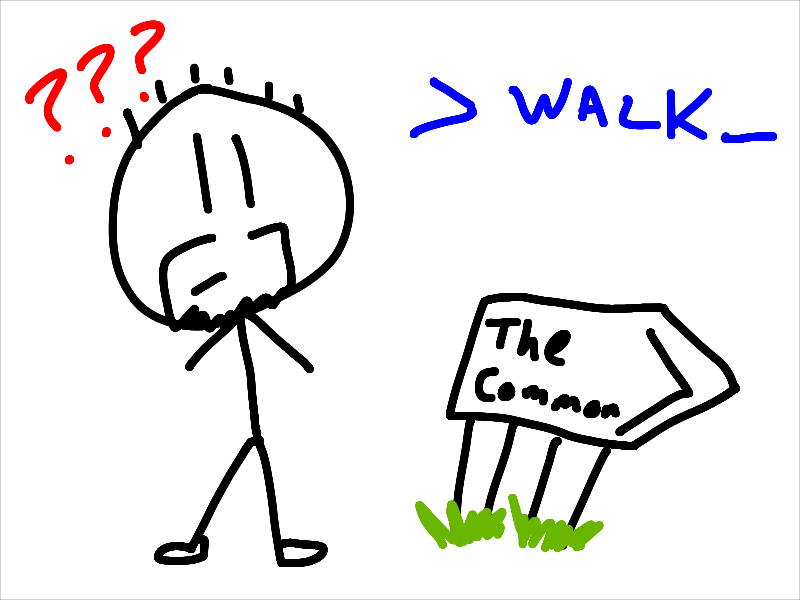
I apparently completely forgot to write anything yesterday. To be fair, I was mildly hungover and thus didn't really want to do much other than play Terranigma, which I made some excellent progress on. I think I'm coming towards the end of that game, so I'll have more to write about it over on MoeGamer when that's done and dusted.
As I'm typing this, it's lunchtime, and this makes me think about what games are suitable for lunch break play. Really, you can play anything over your lunch — and indeed I have done in the past — but there are certain types of games that are eminently more suitable than others.
Long RPGs, for example, are probably not optimal for lunch break play — unless they're designed with a sort of "bite-sized" structure. Good examples of this that I've enjoyed in the past include the Neptunia series, which has small dungeons you can delve into, beat up some enemies, get some crafting materials and maybe complete some quests, and be done in less than an hour. The inverse of this is the grid-based dungeon crawler, where you really need to sit down and concentrate on what you're doing, lest you completely lose the thread of your explorations.
I found Splatoon Raidersto be an ideal lunch break game, because each of its stages are no more than about five minutes, tops. That means you can dip in and play a good few levels in just a short space of time, and feel like you've had a worthwhile experience. Recommended.
Driving games can also be good for this — in fact, after I'm done here, I might just boot up Forza Horizon and drive around a bit. Again, the bite-sized nature of most events in driving games make them eminently suitable for short sessions, such as playing over lunch.
Then, of course, there are arcade games, which are the very definition of this sort of thing. Arcade machines were designed for you to pass by, think "ooh, that looks fun, I'll have a quick go" and while away a few minutes. In most cases, the games are challenging enough, or designed with a built-in maximum play time, that you can enjoy one game multiple times during a short break — or you can sample multiple for a varied bit of fun.
This is why handhelds used to be brilliant to take to the office pre-COVID. Back in those Before Times, I had an office job that was about a 15 minute drive away, so in theory I could come back home and play something at home — indeed, on several occasions I even managed to get a full YouTube video recorded over lunch, which I'm not sure how I achieved in retrospect — but it was much more practical to pop the Vita or 3DS in my bag, stick on my headphones and just blot everything out while I sat on the sofa near the coffee machine, eating sandwiches and playing Neptunia.
I kind of miss that! I mean, I don't miss having to go out to work every day, but having a reason for handhelds to exist was fun. These days, of course, it would probably be the Switch 2 and/or the Evercade EXP-R coming out with me, and both of those are amply stocked with plenty of good "lunchtime games".
But now I work from home, I have a lot more choice. That can sometimes be overwhelming, but it's also nice. It means I can enjoy a wide variety of different things over my lunch break, and then easily get back to work at a suitable stopping point.
So that's what I'm going to go and do right now…
Want to read my thoughts on various video games, visual novels and other popular culture things? Stop by MoeGamer.net, my site for all things fun where I am generally a lot more cheerful. And if you fancy watching some vids on classic games, drop by my YouTube channel.
If you want this nonsense in your inbox every day, please feel free to subscribe via email. Your email address won't be used for anything else.
I had a roll of Rowntree's Fruit Pastilles yesterday. While looking up the nutritional information to add it to my calorie-tracking app — I may have been having a little treat, but I was keeping within my daily calories — I discovered that the tube felt the need to inform me that "1 portion" is "half a tube". No it fucking isn't. Who the fuck eats half a tube of Fruit Pastilles?
I know why this is the case, of course. It's a misguided (and probably legally enforced) attempt to get us all to practice better portion control and, collectively, to Be Less Fat. However, we all know what actually happens: people look at that "portion" advice, then just double it (or, in some cases, multiply it by four or more) in order to calculate what they are actually eating. And I just feel like food companies could probably save everyone a lot of time and effort if they just put what the calorie value for the whole thing was.
Like, take a pizza. Buy a frozen pizza and the calorie information will probably be for half of it. Buy a takeaway pizza and the calorie information will be "per slice". Motherfucker, if I am buying a pizza of any description I am eating that whole thing, so just tell me what the damage is so I don't have to get the bloody calculator out. I will accept full responsibility for my actions. Just tell me.
Likewise, take one of those massive bars of Dairy Milk. According to those, "1 portion" is "3 squares". No it fucking isn't. The only time people buy a massive bar of Dairy Milk is when they are depressed, and when that happens they are almost certainly going to eat the whole thing while crying in front of the TV. (Ask me how I know.) So just tell me how many thousand calories are in that whole bar of chocolate so I can come to terms with the consequences at a later time when I am feeling less emotionally fragile.
I feel calorie information on food packaging might actually have more impact if it was more honest like this! "If you eat this whole quiche, that's most of the daily calorie intake for an average human being!" Great! Now I know, and I will thus probably think a little bit harder about whether or not I actually really want to eat that whole quiche, or if I'm just doing so because I'm in the middle of a binge-eating spree that is almost certainly fuelled by some combination of depression, anxiety and/or autism.
And don't even get me started on foods that are clearly portioned out, but which will only ever give you calorie information "per 100 grams". That's the point where I really don't want to start doing maths. Don't make me do fucking percentages just to figure out how guilty I should be feeling for eating the thing. Just give me the calorie information for a realistic portion, and perhaps for the entire packet of the thing just in case it accidentally ends up all taking a trip down to see Mr Tums.
To put it another way, stop trying to shame me for eating more than I "should" and help me make an actually informed decision using helpful information! By the time I am able to successfully curtail my appetite, I don't mind dividing some of these things into halves or quarters or whatever, although one would hope once you have reached a good, "healthy" weight (which is its own discussion, I'm sure) you have less need to be exacting about counting calories. But during that period where accurate calorie information is actually helpful — i.e. when you're trying to lose weight — I think it would benefit everyone to be completely honest and lay out the cold, hard facts. I think it would genuinely be a lot more effective at helping to get people to reconsider before overeating!
And stop trying to kid yourself that anyone is eating half a tube of Fruit Pastilles!
Want to read my thoughts on various video games, visual novels and other popular culture things? Stop by MoeGamer.net, my site for all things fun where I am generally a lot more cheerful. And if you fancy watching some vids on classic games, drop by my YouTube channel.
If you want this nonsense in your inbox every day, please feel free to subscribe via email. Your email address won't be used for anything else.
People in Steam reviews like to declare a game "dead" when the author of said game hasn't updated it for more than about two weeks, but we all know that's just entitled little shits who don't understand that sometimes a creative work is actually finished. However, there absolutely are "dead" games out there, by varying definitions — some are impossible to play any more (I weep for Darkspore, which I bought on sale once, never got around to playing, and it was made completely unplayable before I even had a chance to try it at all) while some are just delisted from digital storefronts. It's the latter I want to talk about today — specifically, the first Forza Horizon.
My first — and, prior to last night, last — encounter with Forza Horizon was with Forza Horizon 4, which I had extremely mixed feelings about. Sure, it was cool to have an open-world driving game set somewhere that looked and felt a bit like the UK, but the way it was structured to have all the hard edges completely smoothed off, lest some player somewhere felt any "friction", made the whole thing feel utterly meaningless. We're talking about a game where you can come last in every event you enter and still make progress. Not what I'm looking for in a driving game, so after getting frustrated with that, I pretty much swore off the subsequent entries in the series.
However, I was aware that earlier entries in the series were very well-regarded, and in the absence of owning an Xbox One or Series Whateverthefuck, the only one accessible to me was the first one for Xbox 360. This has apparently been delisted from everywhere for some time now, but you can still get second-hand physical copies, and indeed, that's what I did on a trip to CEX some time ago.
I booted it up last night for the first time and found it quite enjoyable. However, one thing became increasingly apparent the longer I played: the fact it, plus all its DLC and microtransactions, had been delisted from sale made it well and truly "dead" — to such a degree that there are certain functions in the game you just flat-out can't access any more, despite the menu options still being there.
This is apparent right from the game's title screen, where you have the option to play "Horizon Rally"… except you don't, because you need the Horizon Rally DLC for that, and you can't get that any more, leaving you with a completely useless menu option, plus a number of loading screen tips informing you that you can buy it from the Xbox Marketplace… which, as previously noted, you cannot.
I thought I was going to have a real problem when I opened the map screen and there were button prompts for "Treasure Map" and "Fast Travel Anywhere". Now, you see a button prompt in a game, and it's reasonable to think that it's a built-in function of the game, right? You press the button indicated, and the thing happens. That's how it usually works, right? Not in Forza Horizon land. Pressing either of these buttons gives you a pop-up informing you that you can buy those two pieces of functionality — which, respectively, allow you to immediately teleport anywhere on the map, and reveal the location of hidden items on the map — using "Tokens", which you can, of course, get from the Xbox Marketplace. Except you can't do that because everything about Forza Horizon has been delisted.
I was concerned in the former case that this meant the entire fast travel feature would be unusable because you couldn't buy a fucking microtransaction any more, but thankfully progressing a little further revealed that there is still a built-in fast travel facility — it's just a bit more inconvenient, since you can only fast travel to specific landmarks that you've previously visited and not, like, the various race events that appear across the map. I wasn't so concerned about the treasure map, meanwhile, since all it is, basically, is a cheat code that you have to pay for.
Little remnants of Forza Horizon really, really wanting you to pay up for microtransactions that no longer exist are riddled throughout the entire game. At least one load screen tip for every loading break will have some sort of exhortation to buy something. Those broken Fast Travel Anywhere and Treasure Map buttons don't go away. If you want to buy a new car in the game, you can do so with the credits you earn through gameplay or "Tokens" that you can no longer purchase with real money.
I guess I should be thankful that Forza Horizon is, at least, still playable, even with all its online functionality and purchasable bullshit inaccessible. If anything, I prefer the fact that there's now no means of simply paying money to not play the game, which is what at least some of these options amounted to. You'd just think they'd, you know, turn all that shit off in a patch if they knew it was no longer going to be available. I mean, presumably they added in the "Horizon Rally" option at some point when it was actually available — why not just remove it again in a final update when the servers and DLC went offline?
We're going to start running into this more and more as time goes on, and it's not always going to be optional DLC and microtransactions that are affected. Thankfully, we have not yet reached a point where patch servers are no longer available for console games that require them, but at some point we are going to have to reckon with the fact that a lot of today's physical releases ship either broken or incomplete, and I'm not sure the work has been adequately done to prepare for that time when the "official" patch servers are no longer available.
This, of course, is a big part of what the whole "Stop Killing Games" movement is about — and I know that certain parts of the gaming history and preservation communities are at least starting to have a think about the best way of handling all this. I'm just concerned that it's going to be too late by the time we find a solution; how many more games out there are technically functional, like Forza Horizon, but have elements that are now completely inaccessible?
Want to read my thoughts on various video games, visual novels and other popular culture things? Stop by MoeGamer.net, my site for all things fun where I am generally a lot more cheerful. And if you fancy watching some vids on classic games, drop by my YouTube channel.
If you want this nonsense in your inbox every day, please feel free to subscribe via email. Your email address won't be used for anything else.
When you are attempting to better yourself — particularly if you know said process is going to be a long, drawn-out affair — I have learned, over the years, that one of the worst things I can do is compare myself to others. This may not be universally true — hence my use of "I" instead of "you" — but as time has passed, and I have taken on numerous such attempts to varying degrees of success, I have come to realise that it is definitely true for me.
You see, in my case, comparing myself to others inevitably leads to feelings of inferiority and frustration when really there is no reason for me to be comparing myself to anyone other than… well, myself.
Take one thing I'm always very conscious of when I go out for a walk, as I did this evening: because of the size I am, and because of my general overall fitness level, I walk quite slowly, even when in my head I am thinking "I am walking quite briskly". I can be walking at an exertion level that makes me slightly out of breath, and people who are just out for a casual stroll will be overtaking me without any evident effort on my part. Were I to pay attention to this — like I have done in the past, which is why I can say all this at all — this would be frustrating! Why can't I walk as fast as a "normal" person? Am I annoying the "normal" people who walk much faster than I do? God, I'm such a waste of space and energy!
But no. The sensible part of my brain, which I am growing better at listening to, reminds me that I have absolutely no reason to be comparing my walking speed to that of anyone else, because I am not, in fact, getting in anyone's way. The Common is a big place, and its paths are more than wide enough for anyone who wants to go faster than me to just walk around me. And, moreover, I am not walking with any of those people, meaning that my overall speed is not causing anyone to have to wait around for me to catch up.
(This is, however, something I am conscious of any time I am out and about with friends or work colleagues, and we are all walking somewhere together. I simply cannot keep up with most of them under many circumstances. And that is frustrating, from a combination of people showing me an often unintentional lack of consideration, and my own annoyance at not being able to do things like a "normal" person.)
When I'm by myself, then, the only thing that really matters is me. The only thing I should be comparing myself to is myself, because it's quite nice to see gradual improvements in your own performance — and even with the fairly casual nature of my walking excursions over the course of the last couple of weeks, I have already seen a slight improvement in terms of the amount of time it takes me to cover the two kilometres of the route I habitually take.
But then there are times when you don't even need to know that. It's not a competition. It's not a race. There is no way you can speed up this whole process. It is something that happens gradually, through building good habits, and thus, when it comes down to it, the only really important thing is that I am just doing the thing at all. Have I successfully got out of the house into the fresh air and got some exercise? Yes? Then great. That's a success.
This is the thing. When attempting to improve yourself — particularly if you are neurodivergent — the temptation can be to give up when you can't immediately fix the problem you're trying to solve. But it doesn't work like that. Instead, you should allow yourself to celebrate those small victories, even if they are much smaller than victories you have had in the past.
I'll give you an example. A good few years ago at this point (2011, to be exact, since I was blogging here at the time!), I successfully "ran" (and I use the term loosely) the Bupa 10K in London, along with some friends I have since, sadly, fallen out of touch with. (Miss you, Vee and Gracie!) This was, for me, an incredible achievement — and one that only came about because I had successfully followed the Couch to 5K and Bridge to 10K programmes over a long period.
I cannot run a 10K now. I cannot even contemplate walking 10 kilometres right now. I cannot even really contemplate walking five kilometres. And that's OK! 2011 was fifteen years ago. I wasn't in amazing shape then, but I was in considerably better shape than I am now, and I was also fifteen years younger. As such, it makes absolutely no sense to try and compare myself against that yardstick (or should that be 10K-stick?) because so much has changed in that intervening period. Yes, it would be nice to be able to get back into a state where I could contemplate surviving a journey of 10 kilometres on foot — be it by walking or jogging — but right now, it is an irrelevant target for me.
Right now, my target is just to get up of the sofa, get out into the fresh air and just do something, at least a few times per week. I have given myself the arbitrary goal of two kilometres because that just happens to be the exact distance of a "lap" that I do on the Common right now, and because that is something which, in my current state, feels attainable but still challenging — in other words, it's a level of effort that I feel is actually doing something.
I was tempted to write "even if that might not seem like very much to some of you" after that, but stopped myself. Because, as I say, what it seems like to anyone else doesn't matter. Everyone's circumstances are different. I'm sure I know plenty of people who can jog 5K, 10K, even more, without even thinking about it. And, right now, it achieves nothing for me to compare myself to them because they are simply operating in a completely different league. And that is, once again, fine.
So I will continue muddling along at my own pace. At some point, I will up the distance and/or time that I will be walking, but I don't feel ready for that just yet, so I'm not going to do that just yet. I will do it when the time is right, not when anyone else says that I "should" do it — but when I feel I want to do it.
And, with any luck, this will build itself over time into a healthy habit that will be of great benefit to me. That's all that really matters!
Want to read my thoughts on various video games, visual novels and other popular culture things? Stop by MoeGamer.net, my site for all things fun where I am generally a lot more cheerful. And if you fancy watching some vids on classic games, drop by my YouTube channel.
If you want this nonsense in your inbox every day, please feel free to subscribe via email. Your email address won't be used for anything else.
At lunchtime today, I thought I would actually go out for a bit and have a quick look in my local CEX. It's only about a five minute drive away, so I had plenty of time to grab a sandwich and then have a bit of a browse. And on past visits to CEX, I have usually come away with an armful of goodies, which I have acquired for pretty good prices — even if some are missing the manuals. Today, however, I found myself browsing the selection and not really feeling drawn to anything in particular.
I've been feeling this a bit recently, particularly with regard to recent releases. There are exceptions, of course — I've picked up Star Fox, Rhythm Paradise Groove and Splatoon Raiders for Switch 2 over the course of the last month, and when I got home from CEX, I found myself ordering copies of the first four Saints Row games (original versions, not remasters, as I've heard mixed reports about the latter) as well as the newly announced EDITIONS from LostInCult for Sektori, Dread Delusion and Easy Delivery Co. So in actual fact I probably spent a lot more than I would have spent if I'd come out with an armful of 360, PS3 and PS4 games from that CEX.
But I don't know. I just wasn't feeling it in the store today. I had a couple of things in mind that I thought I might like to look out for (notably, the aforementioned Saints Row games, following a discussion with a pal earlier) and those did not appear to be in attendance, and there wasn't much else jumping out at me. I thought about trying to expand and/or complete my collection of Need for Speed games on Xbox 360, but the vaguely responsible part of my brain pointed out that I haven't played the parts of that collection I already own as yet, so it would probably be a little silly to get more. (Actually, it wouldn't have made much difference; they were like £1.50 each; I just couldn't be arsed.)
I don't want to say that I'm falling out of love with gaming, because that very obviously isn't true. But with all the recent, unwelcome moves in the current industry — Microsoft continually stepping on rakes, Sony putting an expiration date on physical media, Nintendo continuing to push Game Key Cards — it's hard not to feel a bit cynical about current things, and that my relationship with the hobby is changing. On top of that, stuff that is a few years old now is still good! Since I'm not someone who has ever got particularly sniffy about resolution and frame rate, I'm pretty sure I'll have just as good a time with those Xbox 360 versions of the Saints Row games as I would have done if I'd picked up the (pricier) PS4 or Switch versions.
I mean, hell, outside of Splatoon Raiders, the other "big game" I'm currently playing is on the SNES. And I'm glad that I have the ability to enjoy this broad range of stuff — ranging from late '70s/early '80s computer and console stuff right up to brand new releases. I know not everyone feels able to do that for one reason or another, and honestly I feel a bit sorry for those people who can't. Perhaps you just had to "be there" for it all to have those positive associations, and if I was 20-30 years younger I might feel differently about games that ran at sub-1080p resolutions and less than 60 frames per second.
But, as it happens, that is not the case, and thus I will continue to enjoy my Old Shit alongside very carefully selected and curated New Shit, and try not to spend too much time mourning an industry that, in its current state, seems determined to self-destruct.
Want to read my thoughts on various video games, visual novels and other popular culture things? Stop by MoeGamer.net, my site for all things fun where I am generally a lot more cheerful. And if you fancy watching some vids on classic games, drop by my YouTube channel.
If you want this nonsense in your inbox every day, please feel free to subscribe via email. Your email address won't be used for anything else.
I am exceedingly tired. I slept like absolute garbage last night — although I suspect literal garbage actually probably sleeps quite well — and have been feeling the effects all day: a complete inability to focus, a total lack of desire to do anything apart from "just go back to bed", and just a general feeling of "ugh".
I'm not really sure why I slept so badly last night — conditions in the bedroom (ooer) weren't particularly different from any other given evening, as we had the air conditioning blasting, I had my blackout sleep mask on with some calming noises playing, but still I kept waking up, feeling uncomfortable and/or needing a piss. At 4am I got up and evacuated what must have been over a litre of piss from my body. That'll learn me for Hydrating.
I'm going to get an early night tonight, I think, so I am writing this post in good time to be able to do that, and I'm probably going to skip a walk around the Common this evening also. There are times when you have to listen to your body, and my body right now is telling me that it needs some decent rest. So that's the plan for later tonight, at least.
In the meantime, I have plenty I could be doing, but I think I'm probably going to play some more Terranigma this evening. I've been playing a lot of Splatoon Raiders — it's a great "lunchtime game" with how bite-sized each individual "raid" is — and I want to make some progress on Terranigma. Interestingly, my video on its immediate predecessor, Illusion of Time, overtook my video on Soul Blazer in a fraction of the time in terms of views. Neither have done amazingly in terms of total views, but as I always say: the views are not why I'm doing this. I do this because it's fun, and because it's nice to have a sort of record of the things you've experienced and your thoughts about them.
Same reason why MoeGamer exists, really. I have loved writing about the games I have enjoyed ever since I was a young child — I bet my parents still have the ring binder with all my dot-matrix printouts of "reviews" I wrote when I was a kid somewhere — and I don't see that changing any time soon. It's my way of just sort of "getting a bit more" out of an already rewarding and fulfilling hobby. The feeling of creating something, even if it's just some blurted-out thoughts representing your opinion about something, is always satisfying — and I can look back over both this site and MoeGamer and feel pride in what I've created to date, and excitement for what is still to come.
Also it gives me a sort of perverse pleasure that MoeGamer has now lasted considerably longer than the site I was laid off from when I made it in the first place. I guess passion will always trump commercial interests.
Anyway! That was a random string of consciousness, for which I make no apologies. I am off to have some dinner, play Terranigma and then at least attempt to be in a position conducive to getting some sleep before the clock strikes midnight.
Want to read my thoughts on various video games, visual novels and other popular culture things? Stop by MoeGamer.net, my site for all things fun where I am generally a lot more cheerful. And if you fancy watching some vids on classic games, drop by my YouTube channel.
If you want this nonsense in your inbox every day, please feel free to subscribe via email. Your email address won't be used for anything else.
Once upon a time, there was a website called Bitmob, whose users would get quite upset if you capitalised it "BitMob". On that site, the community could publish their own articles, and those which caught the attention of the site's staff would get featured on the front page. It was a great way for a lot of people to get their first taste of being published online; indeed, a number of people whose work I first saw on Bitmob have gone on to have successful careers elsewhere in the games industry — with notable examples including Mike Minotti and Jeff Grubb from Giant Bomb.
I was fortunate enough to have my work featured on the site on a few occasions, with my most popular piece by far being an adaptation of Bayonetta's opening scene as if graphics didn't exist and the entire thing unfolded as a text adventure. (Aside: attempting to track down an archive of this is how I learned that most of Bitmob's original site content is still online, but some "Software as a Service", probably AI-related company appears to be leeching off the site's SEO from back in the day.)
Anyway, in the absence of anything else to write about (although right now I could write something about companies leeching off past sites' SEO… we'll save that for another day though, as this absolutely will not be the last time I come across this phenomenon, I'm sure) I thought I would do the same for my walk around the Common this evening. Are you ready? Let us begin.
You inexpertly guide your little car into the narrow parking space and realise that you have parked a little too close to the car next to you, so you reverse out and manoeuvre yourself into what you think is a slightly more advantageous position. When you attempt to open your car door, you realise that you have not, in fact, made things any better at all. Giving up before humiliating yourself further, you squeeze through the slightly too narrow gap between your car and its neighbour, and prepare to face the early evening.
A WALK ON THE COMMON Copyright (c) 2026 Petefocom, Inc. All rights reserved. A WALK ON THE COMMON is a registered trademark of Petefocom, Inc. Version 69 / Serial number 420069
Cemetery Road, Car Park You are in the car park of the common — actually just a narrow side street with some parking spaces demarcated down one side. The sun is low in the sky, such that it is difficult to look in a westerly direction, and the air is warm and a little humid.
The road (and car park) continues to the northwest. To the southeast, you can hear the rushing traffic of The Avenue.
Your car is here.
What would you like to do? > INVENTORY
You are carrying: Your keys Your wallet Your phone A pair of headphones (worn) Your watch (worn) Clothes (worn)
What next? > REMOVE CLOTHES
You feel that would probably be a bad idea while you're out in public. Also, in a park? Talk about clichéd. If you're going to streak, do it somewhere a bit more imaginative.
What next? > SE
You came all this way to have a walk in the park. No point turning back now. And anyway, if you want to go back that way, you're better off getting into your car.
What next? > EXAMINE WATCH
This is a fancy-pants fitness tracker thingy that your wife got you. She wasn't dropping a hint; you had indicated that you might be interested in using one in an attempt to actually get fit.
The watch's display is off.
[You won't see "What next?" any more.] > TURN ON WATCH
The watch's display lights up immediately. A picture of Patti, one of your cats, greets you, along with the time. It is 7.30pm.
> USE WATCH
Please be more specific about how you want to use the watch.
> TRACK FITNESS
I don't know how to "TRACK" something.
> START WATCH
You flick the screen over to the right, choose the "Walking" activity and wait for the countdown to begin.
Your watch begins tracking your steps.
> LOOK AT PHONE
Your phone has the album "Black Sabbath" by Black Sabbath cued up and ready to go. The play button looks inviting.
> PRESS PLAY
Your phone starts blaring Black Sabbath at full volume. You quickly press the Pause button. Perhaps you should turn the headphones on first.
> TURN ON HEADPHONES
You turn on the headphones. They make a soft "beep" sound, then a second "beep" to indicate they have connected to your phone.
> PRESS PLAY
Black Sabbath begins to play inside your head, thanks to your cheap and cheerful bone-conducting headphones. Now you're really ready to get started.
> NW
Cemetery Road, Carriage Drive Entrance You've reached the end of the "car park" section of Cemetery Road. The road itself continues a short distance to the northwest, but becomes a dead end shortly thereafter. A path into the Common itself proceeds to the north. Painted white letters on the ground indicate that this particular pathway is known as "Carriage Drive South".
> N
You begin walking.
Carriage Drive South You've entered the Common proper. To the south is Cemetery Road and the car park. Either side of you are some pleasantly rustling trees. Carriage Drive continues in a northerly direction for a short distance.
> N
Carriage Drive Corner Carriage Drive makes a sharp turn here. Squinting against the low, early evening sun, you can just about see an small lake behind a fence in the distance to the west. One of several entrances to the Common lies to the south.
A man with no shirt on zooms past you. He is upsettingly toned and even more upsettingly sweaty. You cannot even begin to imagine what it would feel like to be able to move at that speed using nothing but your own legs.
There is a Really Good Dog here. And their owner too, I guess.
> LOOK AT MAN
He's long gone. You're not sure you want anything to do with him, anyway. Just being in his presence for less than a second made you feel inferior.
> LOOK AT DOG
Are all dogs good dogs? It doesn't matter, because this one is.
> W
Near Cemetery Lake Thus named because it's near the cemetery, not because they've buried people in it — not to your knowledge, anyway — Cemetery Lake is a filthy but nonetheless relatively picturesque pond that occupies a space to the north of the path you're currently on, behind a fence. A bunch of ducks are languidly paddling around on the grimy surface of the water, evidently looking for remnants of the last generous visitors. Carriage Drive proceeds to the east and west.
> N
You can't go in that direction. The fence is in the way.
> CLIMB FENCE
You don't think that would be a good idea. Not only are you not good at climbing things, you also have an excellent talent for hurting yourself quite badly when doing things you are not good at.
A child riding the tiniest bicycle you have ever seen wobbles past, followed a few seconds later by what looks like a long-suffering parent.
> W
Park's Edge Corner You sense you're quite close to the edge of the park, as you think you can hear traffic on the other side of the bushes. The path makes another sharp turn here, proceeding to the north, parallel to the edge of the park, or to the east, back towards Cemetery Lake.
You think you can smell weed.
> N
Park's Edge The pathway continues in a north-south direction. Trees flank the path on both sides, giving the area a pleasant "tunnel of green" look.
You can definitely smell weed.
> N
Suspicious Bushes The greenery thins out a little on one side to reveal a clearing with a bench, and some bushes behind it. The bushes look suspicious. You figure that if you were going to get up to no good, these would be some great bushes to do it in. The pathway continues in a north-south direction.
The smell of weed seems to be coming from the direction of the bushes.
> LOOK AT BUSHES
You figure they're probably having a nice time without you. Leave them be.
A woman wearing a pair of shorts that are so tight you think they might just be painted on jogs past.
> LOOK AT WOMAN
Before you are able to make a definitive determination of whether or not the shorts are real or just an illusion, she is long gone.
> N
Junction You've reached the point where several paths meet. To the west is one of the Common's numerous exits. The pathway continues to the north, southeast and south.
A child, in tears and holding a balloon, waddles along the path, closely followed by a mother who looks about ready to murder someone.
Through your headphones, Black Sabbath is interrupted by the robotic voice of your watch indicating that you have successfully completed a kilometre in 14 minutes and 59 seconds.
> POP BALLOON
As entertaining at that would be, you unfortunately don't have anything sharp on you.
The child and distraught mother pass by. The former's wails fade into the distance, and an almost tangible air of despair follows shortly afterwards.
> SE
The Flats This area of the Common is called The Flats, because it's really flat. It's also the widest open space on the whole Common, and the place where events tend to happen. Right now, in the heat of the summer, all the grass is dead, the whole place looks like a desert and nothing much is going on, other than a few kids having a half-hearted kickabout. So much for "public green spaces". The path continues to the southeast, and reaches a junction to the northwest.
The upsettingly toned man runs past again. You wish he would put a shirt on.
> SE
The Flats, Starting Lines This part of The Flats is evidently where they start races of various descriptions, because there are two starting lines: one red, one blue. Judging by other markings on the path of the same colour, the red route is about 2.5km in length, while the blue route is 3.5km. The pathway continues into a wooded area in the southeast, and back to the middle of The Flats to the northwest.
A woman jogs up the path in the opposite direction to you. The pockets on her shorts appear to be inside-out and are flapping up and down in a mildly distracting manner as she bobs along at her own pace.
> TALK TO WOMAN
Are you mad? Talking to a stranger? You are not only autistic, you are also British. Besides, she looks busy.
> NW
Not to artificially constrain your adventure, but for the purposes of this blog post's tortuously convoluted narrative I will remind you that this is the direction you just arrived from, and thus you probably want to go southeast.
> SE
Near The Hawthorns You're in a wooded area of the Common, close to a small building that proclaims itself the "Hawthorns Urban Wildlife Centre". The gate to the Centre is closed and locked. The pathway gradually bends around to the south, and proceeds in the other direction, towards the Flats, to the northwest.
> OPEN GATE
I mean, I did tell you it was locked, but you had to go and check for yourself, didn't you? The gate is locked. Now perhaps you might give your narrator a bit of respect.
> S
The Corner of the Common You've reached the corner of the Common. A gate kind-of sort-of blocks the path in such a way that vehicles wouldn't be able to drive in, but people can still get around. To the northwest is the Cemetery Road car park, and the pathway proceeds towards the Hawthorns Urban Wildlife Centre to the north.
The upsettingly toned man runs past again. You feel like he is accelerating. You begin to wonder if, were you to keep walking, he would eventually reach infinite velocity, then realise that this is probably a rather silly thing to wonder and go back to wishing he would put a shirt on his sweaty, rippling, muscly back.
> CURSE MAN
You mutter a curse under your breath. To your surprise, the man bursts into flames with a horrifying scream. A moment later, the screams have ceased, and there is nothing more than a pile of ash on the floor. That'll learn him.
> NW
Cemetery Road, Car Park
Your car is here.
Through your headphones, Black Sabbath is interrupted by the robotic voice of your watch indicating that you have successfully completed two kilometres in 29 minutes and 26 seconds.
Congratulations! You have completed A WALK ON THE COMMON. You probably shouldn't have murdered that man, but how were you to know that you were capable of inflicting truly horrific curses just with the power of your mind? No-one will ever believe it was you, anyway.
Probably.
Want to read my thoughts on various video games, visual novels and other popular culture things? Stop by MoeGamer.net, my site for all things fun where I am generally a lot more cheerful. And if you fancy watching some vids on classic games, drop by my YouTube channel.
If you want this nonsense in your inbox every day, please feel free to subscribe via email. Your email address won't be used for anything else.
One of the things I always try and remember is that, from a mental health perspective, it can be valuable to celebrate the small victories, however inconsequential you think they might seem to others, or however minor they might feel in comparison to some of the things they are dealing with. Successfully overcoming something is always a thing worth patting yourself on the back for, and thus today I would like to do just that for myself.
I mentioned the other day that I had been going through the basics of DaVinci Resolve, largely out of necessity because my prior video editor of choice, Hitfilm Express, is no longer available — and, indeed, the company that made it no longer exists, it seems. I had been putting off learning DaVinci Resolve for the longest time because it's the sort of application that you open up and you can feel its UI laughing at you. "You'll never know what all these buttons are for," it says. "You may as well just close me right now and not even bother."
Well, today I decided that I was going to put my three chapters' worth of training to the test and edit myself a YouTube video. And, to my great pleasure, it was immediately just as straightforward as the last seven years I've spent using Hitfilm Express. Yes, there are a number of differences between the two applications — most notably that DaVinci Resolve is a considerably more complex, fully-featured program that can do other things besides editing video — but it seems that I have successfully ported over all the important knowledge from Hitfilm Express to DaVinci Resolve.
I haven't yet done everything in DaVinci Resolve that I used to do in Hitfilm Express — notably, I still need to learn how to do titles and keyframe-based animation and compositing — but taking on the relatively simple project that I did today has given me the confidence to explore the application further, either with or without the training manual by my side. After all, I learned Hitfilm without any real training material — most of the knowledge there I ported over from past experience with Final Cut Pro on Mac, which again, had its own way of doing certain things.
When tackling anything like this, it's taking that first step that is always the most difficult. In fact, I'd go so far as to say when doing pretty much anything, the first step is always the hardest — whether you're talking about working on an elaborate project, or simply motivating yourself to stand up and go and do something with your day.
I have proven myself victorious over several little things like that today — firstly, getting off the sofa and recording the voiceover for my video, then actually going through and editing the thing, and finally, troubleshooting a little issue I had with the export — and I am officially giving myself a pat on the back for my achievements. Now I can spend the remainder of the evening Doing Something Fun without any sort of guilt or feelings of obligation whatsoever.
Getting rid of those feelings of guilt and obligation completely are a whole other matter, of course, but one step at a time and all that. One step at a time.
Oh, and here's the vid, if you want to watch it:
Want to read my thoughts on various video games, visual novels and other popular culture things? Stop by MoeGamer.net, my site for all things fun where I am generally a lot more cheerful. And if you fancy watching some vids on classic games, drop by my YouTube channel.
If you want this nonsense in your inbox every day, please feel free to subscribe via email. Your email address won't be used for anything else.
I'm having one of those days where my brain feels restless, where it feels like I "should" be doing something, but as far as I am aware, I have no commitments this weekend whatsoever, so I should just be taking the time to relax, enjoy myself and mentally prepare for the week ahead. (There's nothing particularly special about the week ahead, either, just the weekend is generally a good time to mentally prepare yourself for actually having to do things for, like, your job and stuff.)
I'm unsure where this particular anxiety stems from, but it's not an altogether uncommon phenomenon. It seems it is most frequently associated with ADHD, which I have not been formally diagnosed with, but which from talking to people who do have it, I recognise a lot of the things they mention — much like I did with autism before I went and got myself diagnosed. I'm not in any great hurry to get myself diagnosed in that regard, though I suspect, as with the autism diagnosis, that having it confirmed (or otherwise) might help me to think about my own brain in a more helpful way.
But regardless! That doesn't fix the immediate issue, which is my brain is currently doing somersaults wondering what I should actually do today. And it's not as if I have a shortage of options. I could play some Final Fantasy XI, now I am into the Treasures of Aht Urhgan expansion. I could play some Terranigma, which I started the other day and enjoyed a lot. I could play some Splatoon Raiders, which I am also having fun with. I could record a voiceover for my Illusion of Time video and then edit said video now that I have learned the basics of DaVinci Resolve. I could even record some voiceovers for some work videos and get those out of the way if I really wanted to.
Or I could do something completely different. I could actually leave the house for some reason, perhaps pay a visit to CEX in town and see if they have anything interesting. I could go for a walk on the common (although I feel like the exact time I'm typing this is probably not the best time to do that, given how hot and humid it appears to be outside, so I will probably save that for later). I could pull down a random game from the shelf and give that a go. I could do some creative writing. I could write about a game I've been playing recently. I could record some Let's Play-style videos (again, I think it might be a bit too hot to do that right now). I could learn what "colour grading" is. I could practice some Japanese.
This is the problem, y'see. The problem is not that I have nothing to do, it's that I have a lot of options for what I could do, and pretty much all of them would be enjoyable and/or fulfilling in some way. One might say that this means it doesn't really matter which one of them I pick, as I will be having an enjoyable and fulfilling experience regardless. But for some reason, when this sort of mental block strikes, it doesn't quite work like that; my brain starts to feel genuine anxiety over whether or not I am picking the "correct" or "best" option, whatever that means — and there really is no "correct" or "best" option here. There is nothing I have to do; there is nothing that will make my life significantly better or worse if I do or don't do it. So all I need to do is just… pick something.
My intent was to follow that paragraph with something along the lines of "So I'm off to go and… [x]". But as I went to type that, my brain started a tug-of-war process with itself, still worrying over whether or not I was making the right choice. So I'm going to set myself a firm but friendly ultimatum — without being aggressive or sergeant-majorish about it — and say that by the time I finish writing this paragraph, I will have made a decision of what to do for the immediate now, not necessarily the whole day, but for the period immediately following completing this paragraph. Whenever I finish this paragraph. I am absolutely, positively, definitely not stalling for time while I attempt to get my mind in order. Definitely not. Perish the thought! Who would do something like that, even? That's ridiculous. I can absolutely, definitely make a decision on what Nice Thing I would like to do today.
I'm going to go and play Terranigma for a bit. Then we'll see what happens from there.
There, see, that wasn't so hard, was it?
Want to read my thoughts on various video games, visual novels and other popular culture things? Stop by MoeGamer.net, my site for all things fun where I am generally a lot more cheerful. And if you fancy watching some vids on classic games, drop by my YouTube channel.
If you want this nonsense in your inbox every day, please feel free to subscribe via email. Your email address won't be used for anything else.
After determining that the NVMe drive in my PC was kaputt, which is where the vast majority of the issues I've been having with this PC have stemmed from, I reluctantly reinstalled Windows… again. This is always a pain because it takes time to get the system back to how you liked it before — and, of course, there are times when software that you used to use just isn't available any more.
I knew that sooner or later I was going to have to confront the fact that Hitfilm Express, my video editor of choice for the last 7 years or so, no longer exists in any form, but I had been putting off learning the most commonly recommended replacement for free hobbyist video editing: DaVinci Resolve.
I've loaded up DaVinci Resolve before to have a look. I was immediately daunted by an incredibly complex-looking interface, closed it down and went back to Hitfilm Express. Now, however, I don't have that option, unless I want to spend time faffing around looking for a dodgy download of the old version of Hitfilm Express I was using, and spending even more time trying to track down my license key for it — a license key I can't just log in and retrieve, because although the software would still activate online with it last time I had to reinstall, the actual website for it is no longer in existence. Which is, y'know, nice.
Anyway, tonight I was at a bit of a loose end, so I decided I would bite the bullet, install DaVinci Resolve and start working through some initial tutorials. The people behind DaVinci Resolve are good enough to have a bunch of training materials on their website — including full written books (which you can either buy as a physical book or get a free PDF of) as well as the obligatory video tutorials. I work much better from a book than a video, so I am extremely grateful for them offering those free PDFs — though it's a little fiddly attempting to read it on the same screen I'm using DaVinci Resolve on, so I may try and upload it to my Kindle.
The Beginner's Guide to DaVinci Resolve that I've been following along today seems to be very good. It doesn't assume knowledge, but it also doesn't move at such a glacial pace that people like me, who have past experience with other video editing software, get bored and switch off. In a couple of hours this evening, I have probably built up enough basic knowledge of the software to be able to reasonably comfortably do most of the things I could confidently do in Hitfilm Express, with the exception of a few bits and bobs about keyframing, animations, titles and such.
I'm impressed with DaVinci Resolve thus far. Although its interface is maddeningly crammed — not at all uncommon in today's creative software, as anyone who has used a recent Adobe product will attest through gritted teeth — once you know what you're looking for, you can get things done very quickly in a variety of different ways: through menus, through drag-and-drop, and through keyboard shortcuts. I'm going to have to unlearn a few of the ways I did things in Hitfilm Express, to be sure, but since I was almost entirely self-taught on that software and doubtless only using a fraction of its capabilities, I don't think that's going to be too much of a problem.
I'm especially impressed by how easy it is to add things like transitions and basic motion graphics — it's so easy to do these things that it almost feels like cheating. It's also very flexible in how you can edit clips together — including replace, ripple, roll and slide edits — so I think it's going to be a lot of fun to get to grips with once I start using it for my own projects.
I'm going to keep working through the training material for the minute, though, as there are some things covered in there that I've never really learned — like colour grading, for example. I don't know how much detail a self-professed Beginner's Guide is going to go into in that regard — although there are further, more specialist books to work through after I've had my fill of this one — but it will be nice to have an understanding of something that, to date, has remained a bit of a mystery beyond "drag the sliders around a bit until you think it looks OK".
I have a few videos in the pipeline that I will need to edit soon — a bunch for work, and at least one personal project — so it will be interesting to put DaVinci Resolve to the full test by doing something other than a tutorial on it. But from my experiences thus far this evening, I think it's going to be less of an issue to make the switch to this program than I thought it was going to be — which is, frankly, a blessed relief.
Want to read my thoughts on various video games, visual novels and other popular culture things? Stop by MoeGamer.net, my site for all things fun where I am generally a lot more cheerful. And if you fancy watching some vids on classic games, drop by my YouTube channel.
If you want this nonsense in your inbox every day, please feel free to subscribe via email. Your email address won't be used for anything else.