1780: Happy 20th, PlayStation

The PlayStation is celebrating its 20th birthday in Europe today. What better way of celebrating than with a rather lovely picture of Hyperdimension Neptunia's Noire, personification of the PlayStation brand and platform, dressed up to the nines and clearly in slightly awkward party spirit?

B3kOC_0CMAAjD29Hnng, I'm sure you will agree.

Lovely Noire aside, the PlayStation's 20th anniversary feels like a suitable occasion to share some fond memories of my time with Sony's platforms over the years, and what PlayStation has meant to me. I realise that by doing this I am, of course, falling into Sony's cunning marketing trap, but since I'm not a professional games journalist any more I can say whatever the fuck I want, not to mention post pictures such as that seen above.

Anyway.

My first memory of PlayStation is much like my first memory of many consoles from the SNES and Mega Drive era onwards: a unit came home with my brother, courtesy of his work on games magazines, accompanied by a few games, and thus I had the opportunity to try it out well before any of my friends ever did — though I would find myself biting my lip and never being sure whether or not five minutes after the poor chap had arrived was too soon to go rifling through his bags in search of technology and game cases.

The first three games I ever played on PlayStation were Ridge Racer, a pre-release version of Tekken (which had a bug or two here and there) and Raiden Project. Ridge Racer was, of course, absolutely gobsmacking at the time (though I still find it amusing that it upstaged itself with its fourth installment coming bundled with a remake of the original that ran at twice the resolution and twice the framerate) and Tekken was one of the most "physical"-feeling fighting games I'd ever encountered. (That cracking sound Paul Phoenix makes when he throws someone still makes me wince.) Conversely, I was initially unimpressed by Raiden Project owing to the fact that its 2D sprite-based graphics looked like the sort of thing the SNES and Mega Drive had been offering us for years by this point. (I later realised that I was being somewhat blinded by the then-revolutionary 3D graphics of the former two games, and came to enjoy Raiden Project a whole lot.)

Ridge Racer and Tekken were both noteworthy for incorporating something that I haven't really seen since: games to play while you waited for the main game to load. Ridge Racer offered Galaxian — and unlocked bonuses if you managed to complete it before the main game loaded — while Tekken offered Galaga. Both were impressive, arcade-perfect ports that ran flawlessly while the game loaded in the background, and I'm sad that this concept didn't take off more, perhaps due to Namco remaining somewhat tight-fisted with the technology. These days the best we get is an interactive loading screen that lets us practice our moves or something, but these tend to only come up once the game has already loaded, not the moment you put the disc in.

Eventually, for some reason, I came into possession of that same (Japanese) PlayStation that had originally come home with my brother. I forget the exact circumstances — I imagine it was due to him getting an official local model — but I was certainly extremely grateful for it. Unfortunately, as still happens with many console games today, the PlayStation was region-locked, meaning that it would only run Japanese games straight out of the box; running European games required you to either install a mod chip (which also enabled piracy, since it effectively bypassed the console's internal copy-and-region-protection systems) or make use of a somewhat questionable trick involving a piece of Blu-Tac, a pen lid, a Japanese game disc and the European game disc you were actually trying to play.

Oh yes, the disc swap trick: most PlayStation owners of the late '90s at least tried it at one point or another. Essentially the trick involved allowing the console to read the copy protection and region info from a disc it would normally accept, then quickly swap this disc out for the game you were actually trying to run. It was a somewhat perilous process that required you leave the lid of the console open at all times (propped open by the pen lid, which was also pressing down the button that told the console the lid was closed) and then whip out the first disc the moment it stopped spinning quickly. It often took a few attempts to get right, but my gosh, the first time I got Final Fantasy VII running in this way was an exciting day indeed.

Ah, Final Fantasy VII. I've waxed lyrical about this game many times on this blog, so I won't reiterate that here, but I will say that at the time it was hyped up to me as "a game that will actually make you cry" and it did not disappoint. It introduced me to the wonderful world of roleplaying games, and gave my friends and I many, many hours of entertainment, since we all finished it several times over. In retrospect, I have no idea how we had the time to do this, but I do know that to date, I have played Final Fantasy VII from start to finish at least ten times over.

Even in those early days, I was someone who enjoyed investigating interesting-looking and strange games, particularly those of Japanese origin. I recall spending a whole lot of time playing the wonderful dance-off game Bust-a-Groove as well as cracking RPGs such as Breath of Fire III, Star Ocean: The Second Story and, of course, subsequent installments in the Final Fantasy series. Visiting my brother over in the States also saw me picking up a number of games that, for whatever reason, never made it to the UK's shores: titles like Brave Fencer Musashi, Parasite Eve, Xenogears and Lunar: Silver Star Story.

Have another Noire to break things up a bit.

I was well into university by the time I joined the PlayStation 2 generation. I wasn't an early adopter, but I was intrigued by this new console and the supposedly immense power it had. But once again when I picked one up, it was not to grab the latest and greatest new titles — the game I chose to purchase my console with was a little-known adventure by Konami known as Shadow of Memories, to date one of the most interesting narrative-based games I think I've ever played.

For the uninitiated, Shadow of Memories casts you in the role of Eike, a man who keeps getting murdered and then having the opportunity to go back in time and save himself. The solutions to the situations become increasingly convoluted as you progress through the story, occasionally involving travelling back hundreds of years in order to, say, prevent a tree from being planted and, by extension, removing the place your assailant was hiding. I'd encountered strong stories in games before — particularly through the aforementioned Final Fantasy VII and adventure games on PC — but Shadow of Memories was noteworthy for me in that it was a console game that had taken the bold step of having neither attack nor jump buttons — it was simply about exploring, enjoying the story and working your way to the truth. (To date, I still haven't seen the game's true ending; I should probably rectify that at some point.)

Shadow of Memories aside, it took me a while to come around to the PlayStation 2, largely due to the fact that for a little while, there didn't seem to be that many role-playing games available for it. I later discovered that this was an inaccurate assessment, of course — and in fact am still discovering great RPGs on the platform today, two hardware generations later — but it took me a little while to warm up to it.

Outside of RPGs, though, the PlayStation 2 did play host to some wonderfully memorable games. The Timesplitters series provided some of the best local multiplayer shooting since GoldenEye — largely due to being developed by the same people — while many a drunken evening was spent with my friend Sam post-Poundstretcher (the regular "everything is really, really cheap" evening at the Student Union) playing various incarnations of the Grand Theft Auto series. And some strange things from that era have remained in our collective vernacular ever since; if we'd never played State of Emergency (not Rockstar's finest hour, but actually a surprisingly fun game) we'd never have come across the phrase "[do something] for BOOOONUS SCOOOOORE!", which is frequently still used among our friendship group whether we're cooking, playing a video game or gathered around the tabletop for a board game.

Have some more Noire. And yes, that brooch is supposed to look like the old Sony Computer Entertainment logo.

I've had an interesting relationship with the PlayStation 3. Initially, I didn't quite see the point of it — in fact, I vividly recall doing some podcasts with my friends Edd and Woody where we were fairly merciless about that big ol' lump of black shiny plastic, but then we were all fairly obnoxious Xbox 360 fanboys at that point, too.

I forget what caused me to pick up one in the first place. I think it was simply a pretty good deal — the console and three games for an eminently reasonable price. The games were Ghostbusters, Fight Night and something else I've forgotten. I played about ten minutes of Ghostbusters, booted up Fight Night once and didn't play it, then quickly found that downloadable games like Flower were much more interesting than many of the retail titles available at the time. My Xbox 360 still got considerably more use — primarily due to the fact that multiplatform titles were often better on 360, and that my friends would typically play multiplayer on 360 — but I always held on to the PS3.

These days, the situation is a complete reversal. I haven't turned on my Xbox 360 for a very long time now — I don't think it's been a whole year, but it's certainly been a good few months — whereas my PS3 still gets regular use, largely due to the fact that, as has been the PlayStation platform's wont ever since its inception, it's still the best place to go for Japanese role-playing games, including titles like the Neptunia series which have since become some of my favourite games of all time. (Yes, really.)

And this isn't even getting into Sony's portable platforms the PSP and the Vita, both of which are criminally underrated platforms full to absolute bursting with top-quality entertainment to cater to all tastes and play styles. My Vita is getting more use than any of the other gaming platforms I own right now thanks to games like Hyperdimension Neptunia Re;Birth1 and Senran Kagura Shinovi Versus, and there's plenty more queued up beyond those two titles, on both PS3 and Vita.

As for the now year-old PlayStation 4? Well, I still don't have one yet, but frankly, with new Neptunia and Senran Kagura games both on the horizon for the new platform, it's clearly only a matter of time before I cave and grab one, isn't it? It just remains to be seen how long I can hold out. I've been doing all right so far, but it only takes one game — perhaps something unexpected — that I really have to play right now for me to take that plunge. Soon. But perhaps not just yet.

Anyway. Happy birthday, PlayStation. You — and let's not forget the myriad developers behind all the games I've talked about today and more — have brought my life great joy over the years, and you continue to fill my free time with fun and frolics even now, 20 years later. Long may it continue — for another 20 years and beyond, maybe?
 

1779: A Quiet Night In After a Night Out

I've pretty much come to accept by now that I don't really "do" big social occasions. And by this I mean that I generally don't have a lot of desire to "go out" in the sense that people tend to use the non-specific phrase "go out" — that is to say, going to a pub, sitting and drinking and not really doing anything interesting or exciting.

It was my work Christmas meal this evening. Andie and I both went along and we had an enjoyable time. The food was very nice, the home-made cakes for dessert were frankly ridiculous in size (the entire cake was literally the size of an average human head, and a single slice offered roughly as much "cake" as you would get in about ten normal-sized slices anywhere else) and the entertainments laid on by two of my colleagues, who had clearly spent a significant amount of time planning the evening together, were fun.

Once all that finished, though, and we were into the "freeform" part of the evening — the part where you're supposed to lounge around, sip your drink and make small talk with the people around you — I felt absolutely no desire to stick around whatsoever, and neither did Andie, so we made our excuses, headed back home and were safely in our own house with the heating on well before 9pm.

I'll hasten to add at this point that our lack of desire to stick around for the "freeform socialising" that follows more organised and/or structured fun was nothing to do with the people we were with. On the contrary, I like my colleagues very much: I enjoy working alongside them, I have a decent relationship with them in that we can chat about stuff other than work as well as have a good old complain about whatever has gone wrong with our respective jobs (95% of the time through no fault of our own) to a sympathetic ear, and I do enjoy having the opportunity to go out and socialise with them outside the office, which can, as anyone who has worked in a large corporation will be able to attest, feel somewhat oppressive at times.

No, my desire to scarper after the meal and the activities were done was more to do with the fact that I simply don't find socialising for socialising's sake to be very fun or enjoyable. In fact, in most cases, I find it to be the exact opposite of fun and enjoyable: a feeling of anxiety starts to build up in my mind as I subconsciously count the seconds of silence that have elapsed between me and the person standing closest to me, and I start running through potential conversations in my mind before rejecting all of them on the grounds that they might make me sound like I'm "trying too hard". Ultimately, I tend to just end up sitting in a corner feeling thoroughly miserable and, frankly, why would you voluntarily put yourself through that when the door is right there?

Socialising with a purpose, though? I'm fine. I love a board game evening or an afternoon of Mario Kart with friends. I enjoy a post-performance meal after a show that we've all participated in — though it's been a good few years since one of these now. In other words, I appreciate opportunities to socialise where there are things to do — enjoyable things, that is — in lieu of unmemorable, instantly forgotten small-talk, and likewise I appreciate opportunities to socialise where there are ready-made conversational topics like "how did the show go?"  or "we sure showed that giant plant monster who's boss, huh?"

I've come to accept this part of myself over the years. I just worry a bit at times that other people might not be quite so understanding.

1778: Enough with the "Nintendo on Mobile" Nonsense

Another article about whether or not Nintendo should move into the lucrative but (largely) morally bankrupt world of mobile phone games came up today, this time from Forbes.

Thankfully, Forbes' Erik Kain actually has his head screwed on correctly, unlike the various analysts who have, over the last few years, said that Nintendo "should" go mobile owing to the decline of dedicated handheld gaming in favour of gaming on smart devices, and the general underperformance of the Wii U compared to both its peers and its predecessor the Wii.

Nintendo's in a very different position to where it was during the Wii and DS years, for sure, but the company is coming into the Christmas period in a strong position with regard to games. The Wii U in particular is in a much better position than it has been, with strong first-party titles like Mario Kart 8 and Super Smash Bros. (as well as Captain Toad Treasure Tracker soon) doubtless having places on many Christmas lists. The 3DS, meanwhile, is largely keeping to itself for the most part, but still has an enormous library of great games to draw from — not to mention backwards compatibility with the wealth of fantastic software available on DS.

Kain brings up an excellent point in his piece, which is something I've been saying for a while: Nintendo shouldn't move into mobile game development because the philosophy behind it is fundamentally different to the way Nintendo does things. And not, for my money, for the better; while excellent mobile games like The Room, 80 Days and the like exist, for every one of those there's a Candy Crush Saga, Hay Day, Clash of Clans: mindless tapping games designed not to be in any way fun, but instead to extract as much money out of their players as possible. And, worryingly, players are lapping these up. The aforementioned games all make obscene amounts of money each month — enough to be able to afford advertising campaigns that rival (and in many cases exceed) the presence of the most big-budget triple-A titles — and they're all a load of cack.

Nintendo, conversely, is all about the fun, and I've been reminded of this as I've played Super Smash Bros. and revisited Mario Kart 8 this week. Nintendo makes games by the old book: they're not trying to be movies, they're not trying to be spectacular, they're simply trying to be enjoyable fun that anyone can pick up and have a go with, but which those willing to put in a bit more time and effort can get even more out of. Every time I play a Nintendo game, it feels like that Christmas I got a Super Nintendo; they're games just made to be enjoyed and savoured for the joy of playing, nothing more. They have no desire to be "art" — though for sure there's artistry in both their aesthetic and top-quality mechanical design — nor any desire to say something about the human condition; they're just… you know, fun.

Moreover, they're games that are designed to gradually train players to get better and progress a little bit at a time, demonstrating their skill rather than how deep their pockets are. If you get stuck in a Nintendo game, it's up to you to get good, scrub; no paying to skip a difficult bit here.

Up until very recently, Nintendo games didn't even have downloadable add-on content; that's changed with Mario Kart, but even that demonstrates Nintendo's "players first" attitude. Rather than pre-purchasing the DLC costing as much as a new game as tends to happen with new triple-A games and their obnoxious "Season Passes" on Xbox, PlayStation and PC, Mario Kart's DLC costs £12 and clearly shows exactly what it is you're getting for your money and when. (8 new tracks and 4 new characters now; another 8 new tracks and 4 new characters in May of next year; alternatively, you can pay about £8 and get just the first half now.) Not only that, but when playing online, the player-base fragmentation issue that DLC creates is deftly taken care of by a simple on-screen button that asks whether or not you want to play with the new tracks included, or just those that came on the disc. Simple, effective.

I have not played a single mobile game for… probably well over a year now. Very little has appealed — though I do intend to give 80 Days a go at some point — and, moreover, the problems both Android and iOS have with discoverability have only continued to get worse and worse as time has gone on; the market is flooded with identikit crap from developers trying to make a quick bit of cash from reskinning existing games and cloning popular titles. There's the odd diamond in the rough — stuff like Monument Valley, Threes! and the aforementioned 80 Days — but it's very much in the minority and, frankly, even these great games are very rarely up to the standard of what you can get on 3DS and Vita, whether technically or in terms of gameplay.

Conversely, I take my 3DS and my Vita to work every day and play an hour of something like Senran Kagura Burst (3DS) or Hyperdimension Neptunia Re;Birth1 (Vita) every lunchtime, and I have an absolute blast. I can enjoy a game without requiring an Internet connection, without having to pay up to progress, and without "social features" constantly bugging me to share my every move on Facebook and Twitter. I've said it before, I'll say it again: I'll continue to prefer dedicated handhelds for portable gaming for as long as companies like Sony and Nintendo continue to make them, and it will be a sad day for me when the only available portable gaming platforms are mobile phones and tablets. I hope that day never comes.

Now, maybe a Neptunia dungeon or two before sleep…

1777: Rivalry With an Inanimate Object

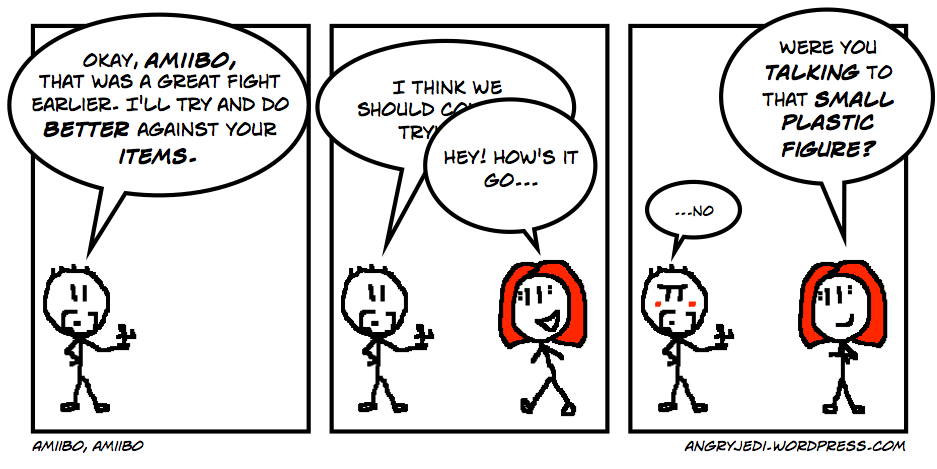
Page_1One of the most peculiar things about the new Wii U version of Super Smash Bros. is the compatibility with the "Amiibo" figurines that are sold separately.
During the run-up to release, I'd misunderstood their reason for existence, assuming them to be a means of effectively customising an individual fighter to your liking, then being able to take it around to a friend's house and use your own custom character in multiplayer battles.

I had my concerns about this; any time you introduce an element of customisation to something — particularly if said customisation involves "growth" of power and abilities — you run the risk of giving an unfair advantage to anyone with the customisations, and a disadvantage to anyone playing with stock characters. I had a vision of someone coming over with a level 50 Amiibo and repeatedly kicking my arse with it, not necessarily because they were actually any good with the character, but because they'd simply levelled it up enough.

I needn't have worried, because Amiibos don't work like that. What they do instead is provide you with a computer-controlled opponent that plays alongside you, learns over time and levels up its abilities, gradually becoming stronger and more powerful. You can customise it by feeding it equipment and choosing the special moves it is able to use, and level it up simply by allowing it to participate in games — be it as an opponent in a free-for-all multiplayer battle (you can even go one-on-one against it) or as a teammate in cooperative or team-based modes.

What's interesting about this is that because there's a physical object involved as well as persistence — after you've finished a play session, you write the data back to the Amiibo simply by plopping it on your GamePad for a moment — there's a much stronger relationship between you and this small lump of plastic. I'd even go so far as to say you may well develop a kind of rivalry.

It sounds odd, but it's absolutely true. Andie and I were playing some multiplayer earlier, and we had the Amiibo as a third player for a while — although I took it out for a bit when she started winning pretty much every match. After Andie stopped playing, I brought the Amiibo back in for some one-on-one battles, and it's actually been a lot of fun trying to figure out how to beat her, because as she's levelled — a process which is pretty quick up until about level 30 or so — she's gradually become better and better at playing, and is now a rather challenging opponent that I can still beat, but who certainly doesn't go down without a fight. Victories against her feel somehow more meaningful than a battle against random computer opponents.

While I'm not sure how much the Amiibos add to the experience as a whole — I'm interested to take mine over to my friend's house to bring her into his game and see how that works — they're an interesting little twist, and the figurines themselves are attractive and eminently collectible. I'm not sure whether or not I'll collect them, but they're inexpensive and decent quality, so I'm not ruling out maybe a couple more, particularly if a Shulk one decides to make an appearance any time soon…

1776: SMAAASH

Not realising that Black Friday has apparently become A Thing over here, I went into town to pick up a copy of Super Smash Bros. for Wii U earlier. It took over half an hour of queueing in Game to pick up a copy, but at least I didn't get to the front of the line and find there were none left. (I didn't get a Gamecube controller adapter, though; stupid "preorders only" rule.)

Most of you reading this probably know what Super Smash Bros. is, but on the offchance you don't, it's become one of Nintendo's flagship series over the years thanks to it essentially being a disc full of Nintendo fangasms. It's sort of a fighting game — though nowhere near as technically demanding as more traditional fighting games — that stars a wide variety of characters either from Nintendo's own lineup or from games that have appeared on Nintendo consoles at some point or another, as well as one or two special guests.

I've been playing a bit of the new game this evening and like its predecessors, it appears to be a lot of fun, if somewhat overwhelming in terms of the sheer number of different things available to do. There's a straightforward Smash battle, Classic Mode, All-Star Mode, Events Mode, Stadium Mode, online and probably several others I've forgotten, each of which are subdivided into various other things and most of which can be played either solo or with friends. Some can be played cooperatively with a partner against the computer, others are purely competitive. The most extreme multiplayer offering the new game has is an utterly chaotic 8-player mode in which it's nigh-impossible to tell what the fuck is going on, but it's an enjoyable sort of nonsense nonetheless.

There are some interesting additions, too. The ability to create your own fighter using any of the Miis on your Wii U console makes for some entertaining possibilities, particularly since they're customisable with three different fighting styles, selectable (and unlockable) special moves, equipment, costumes and headgear. The Amiibo functionality, where you can use small figurines to communicate with the game via the Near-Field Communication panel on the Gamepad, is fun, too, and not quite what I expected; rather than your Amiibo containing a fighter than you personally use, it instead acts as more of a sort of virtual pet that you can feed equipment to (don't think too hard about how that works), customise the special moves of and gradually level up by allowing it to participate alongside you in battle. Because the figurine itself holds data, you can then take it to a friend's house and bring your Amiibo into their game, too, so they can face off against the fighter you've been training up to be an unstoppable killing machine.

I'm really happy to see slightly lesser-known games such as Xenoblade Chronicles getting headline character love, too. Xenoblade's protagonist Shulk is an enjoyable, interesting character to play as, and the Xenoblade stage is challenging and cool-looking. (Plus it features recurring villain Metal Face showing up to cause mischief throughout, which is a lot of fun.) It sure makes me pretty hungry to see the new Xenoblade game in action on Wii U, though…

Aside from that, the customisation of the game has never been better. You can tinker around with how frequently items appear, which music plays in which stage and how often and even switch levels to a stripped-down, simplified "Omega Mode" (essentially little more than a floating platform) for a true test of your skill without environmental hazards being a pain. There's even an online mode — "For Glory" — where you play without items on Omega stages, and I have a feeling this is where the true Super Smash Bros. legends will learn to shine.

It's unfortunate that none of my friends are around this weekend as I was hoping to have a good session of local multiplayer with them. Still, I shall console myself with the vast amount of other content in the game — and perhaps attempt to give some online friends a kicking — and smile as the Wii U once again shows that it has some of the most enjoyable, most interesting and most polished games in all of the "next" generation of console hardware.

1775: Geometry Wars 3: Some Initial Thoughts

Page_1I never thought I'd get to write the following sentence: I played a bunch of Geometry Wars 3 tonight.

Geometry Wars 2 was an absolute masterpiece, and one of my favourite games from one of my favourite studios — the sadly defunct Bizarre Creations, who were also behind some of my favourite racing games (the Project Gotham series and the wonderful Blur). It struck a perfect balance of challenge and instant gratification, allowing anyone to pick it up and play, but only those who took the time to concentrate on what they were doing to truly master it and attain the most astronomical scores. It also featured one of the finest implementations of online leaderboards of any game, ever. And the dissolution of Bizarre made me think that we'd never see a new game in the series. Here we are, though.

Is Geometry Wars 3 the masterpiece that its predecessor was? To be honest, it's a bit early to tell yet. I wasn't immediately taken with its new aesthetic — the old-school neon vector art has been toned down a bit in favour of a new (and still distinctive) look that I have a feeling will probably grow on me in time — but then I sat down to "try out" Pacifism mode (one of my favourite modes from 2, in which you may not fire your weapons and can only defeat enemies by dodging through exploding gates when they pass nearby), looked up and realised I'd spent somewhere in the region of an hour staring glassy-eyed at the screen just like I used to do with Geometry Wars 2. So that's a good sign, then.

Here are some further observations, bullet-pointed for your convenience.

  • It has 3D levels. The flat plane is still there for "Classic" mode — essentially a retooling of Geometry Wars 2's modes — but in the main single-player "Adventure" mode you'll find yourself fighting on spheres, cubes, dishes, sausages, flat planes with holes in, circles with spinning walls and all manner of other peculiar arrangements. And it really adds a different spin (no pun intended) on the gameplay; having to consider the ability to "wrap" around a 3D shape forces you to think about your strategy somewhat differently to being enclosed in an arena. Not only that, but moving around on irregular shapes (such as the aforementioned sausage) can lead to you having to play with the battlefield skewed at some crazy and challenging angles if you're not careful about how you move.
  • The music has been remixed. The tunes are all based on the various themes from Geometry Wars 2's various modes, but I think I preferred the old mixes. The new versions have suitably thumping bass and drum parts, but the mix of the Geometry Wars 2 versions just sounded "fuller" and more satisfying to listen to.
  • There are bosses. In "Adventure" mode, anyway. Said bosses have a habit of 1) sitting on an awkwardly shaped playfield (the second boss, whom you fight on a cube, is a particularly troublesome chap) and 2) launching hundreds of enemies at you while you're attempting to fill them full of hot plasma death. Naturally, you only get one life for boss levels, too, so no fucking it up and hoping for the best.
  • There's a progression and upgrade system. Again, this only applies to "Adventure" mode. Early in the game, you'll unlock a "drone" that follows you around and behaves in various ways according to which one you've selected. You can upgrade both your drone and its special attack using the little diamond-shaped Geoms you collect in the levels, which are normally used simply to increase your score multiplier. Additional drones and special attacks are unlocked by progressing through the levels in "Adventure" mode and by attaining a particular number of stars by beating target scores in each level.
  • There's a weird new mechanic called Super State. The clichéd computerised voiceover will occasionally say "Super State" and inform you that there's an arrangement of static targets somewhere on the playfield. Destroy them all and you get a powered-up weapon for a brief time, rather than the approach from previous games where once your shots were powered up, they stayed powered up. It's a fun little twist that forces you to weigh up whether it's worth the risk of trying to destroy the targets, or simply muddle on with your regular weapon. It can be particularly perilous on "Adventure" mode's 3D stages.
  • Leaderboards are still awesome. In the "Classic" modes, you can always see your nearest rival in the corner of the screen, and at the end of a session you can see how you stack up against your friends and the global leaderboards. In "Adventure" mode, each level has its own individual leaderboard for you to take on, giving you something to strive for even if you've cleared every level with three stars.
  • There's an online mode. There are two ways to play, only one of which I've tried so far. Summoner splits players into two teams and then puts them in a Domination-style game where you have to capture towers by shooting them, and then the towers start coughing up enemies for you to destroy with your teammates. Highest score at the end of a short time limit — matches are really short and snappy — wins. Die and your team suffers a penalty to its score multiplier. It seems like fun, but unfortunately in the matches I've tried so far all of my opponents (and teammates for that matter) have just sat there and not done anything. This did mean I won by default, however, which was nice.
  • There's a local co-op mode. I haven't tried it yet, but this was quite fun in Geometry Wars 2.

That's about it for my initial impressions, then. I'll undoubtedly play some more in the next few days and have some more detailed thoughts to ponder, but for now I'm quietly impressed. As I noted above, I'm not quite sure yet whether or not it's as good as Geometry Wars 2 was, but it's certainly a solid, enjoyable game that I'm looking forward to getting to know a bit better.

(Oh, and if you're playing the PC version, I recommend playing in Borderless Windowed mode; the full-screen mode inexplicably caps the frame-rate at 24fps, which is just baffling.)

1774: Last Chance, Twitter

I know I've been very anti-Twitter and very anti-social media in general recently, but an unfortunate side-effect of "going dark" is, to be perfectly frank, loneliness.

It kind of sucks that social media is the default means of people communicating with one another today. I'll grant that it's a convenient and easy means of people to talk to each other without sharing completely "personal" details like email addresses or phone numbers, but I sort of miss the days of sending lengthy emails back and forth with people. I know the option is still there to do that, but how many people would actually respond, I wonder?

This is a preamble to the fact that I have rejoined Twitter in an attempt to reconnect with the people I effectively severed social ties with when I went dark a while back. I don't regret doing that — remaining clear of some of the most ridiculous Internet drama in years has been thoroughly pleasant, and it makes me glad to have the close friends I do have who have stuck by me even as I was harder to get hold of — but I have found myself somewhat wanting for conversation at times.

And so we come to this, then: an attempt to recapture whatever it was that attracted me to Twitter in the first place, and kept me as an avid user for a long time until I became thoroughly disillusioned with the whole thing.

The temptation with Twitter is to follow everyone and everything. A follow isn't the same as a friendship request on other forms of social media: it's not reciprocal. You can follow someone and they remain completely unaware of your existence. This isn't necessarily as harsh (or creepy) as it sounds, since many Twitter users make use of the social network primarily as a broadcast medium for keeping people up to date on the latest happenings or pointing them in the direction of posts, forums and articles that are a better place to hang out and talk in detail. Twitter is, after all, shit for nuanced discussion, as anyone who has ever attempted to discuss anything deeper than how nice the sausage you're currently eating is will have undoubtedly discovered.

I'm not going to do that this time, though. I'm not going to use Twitter as the noisy, messy hodgepodge of microblogging tool, text messaging service and RSS reader that it once was: the emphasis for me now is on the thing I always enjoyed using it for most: talking to people from all over the world.

I'm not going to follow hundreds of people. I'm not going to feel obliged to follow people who follow me unless I find them interesting. If people start retweeting things that upset or annoy me, I'll simply turn off their retweets — retweets, after all, are by far the most irritating feature of Twitter in my experience since it's a means of someone shoving a third party's opinion in your face — and if they remain annoying or upsetting after that then, well, maybe I don't really want to be following them after all.

My account is public at present, but once I have a nice little collection of followers gathered once again, I'm turning my account back to private, which means my tweets won't be public and people will have to request to follow me rather than just being able to do so. My professional life is now completely separate from my online existence, and as such I have no need to "network" online by sucking up to "important" people and trying to make them aware of my existence by building up as much "social capital" (to co-opt a phrase that means something else) as I can.

I can instead concentrate on using Twitter as a means of talking with friends and — hopefully, anyway — having a bit of fun. And with any luck, this will help at least partly deal with the feelings of isolation and loneliness I've been feeling recently.

1773: Panel Beater

It was fashionable a while back to hate on that staple of British TV, the comedy panel show. I'm not entirely sure what there was to complain about — aside from the sheer number of this type of show on our screens, of course — but I never quite fell in line with what appeared to be popular (well, Twitter) opinion.

Why? Well, because I really enjoy panel shows. They're simple, enjoyable, lightweight, eminently disposable entertainment that are perfect for vegging in front of the TV, watching over dinner or falling asleep in front of. They don't place any particular demands on the audience, though if they're a topical show they can be one means of viewing the week's happenings, albeit through a comedically skewed lens.

And some of them have been running for a very long time indeed, which is impressive in itself. Have I Got News For You is, I believe, one of the most long-running examples, but I was surprised to discover the other day that music quiz Never Mind the Buzzcocks has been running for double-digit years, too.

These shows have remained fairly true to their original format over the years, though Never Mind the Buzzcocks has degenerated into chaos in an extremely enjoyable manner as the years have passed, with the latest series fronted by Rhod Gilbert being more like a bunch of slightly drunk mates sitting around pissing about than an organised game show.

The format has given us some true greats of television in more recent years, too. Few could deny that the show now most readily associated with the plummy tones of Stephen Fry — Q.I., of course — is an absolute classic of entertaining, educational television that masterfully combines cheeky humour with genuinely interesting facts about the world we live in and the people we share it with.

I've even pondered experimenting with the format myself in the form of a video games podcast in the panel show style. I still think it has a ton of unexplored potential in non-mainstream TV spaces, and think it would be an interesting thing to do at some point. It would also require a ton of preparation, however, so I'm not sure how practical it would be to do on a regular basis. Something to ponder, though!

1772: Around the Virtual World

Page_1I find Internet culture endlessly fascinating and, at times, more than a little terrifying.
One of the most interesting things about Internet culture is how small it makes the world seem at times. I recall when online connectivity was just starting to become a thing — beyond the old-school world of direct-dial bulletin board systems, that is — and as well as the obnoxious phrase "information superhighway" being coined, a second, lesser-known but rather accurate phrase came into brief usage: "global village".

The concept of the Internet — or, perhaps more accurately, the Web — as a global village is an interesting one, and if you spend some time wandering around online, you'll come to recognise the village's various haunts. There's the village hall that hosts everything from coffee mornings to neo-Nazi rallies (Facebook). There's the pub where everyone is always talking over everyone else and no-one's really listening to one another (Twitter). There's the deceptive village shop that looks small but actually carries a frighteningly comprehensive array of products of all descriptions (Amazon). There's the coffee shop where socialites of all descriptions like to hang out and have in-depth discussions about everything from literature to their sexual conquests (Reddit). And there's that dark, unlit back alley that very few people go down, but down which you'll find either an army of like-minded outcasts or a horde of terrifying monsters, depending on your outlook (4chan and its successor 8chan).

There's far more to the Internet than this, of course; the global village has become more of a town over the years, but it's never really lost that sense of having "landmarks" around the place: easily recognisable places from which you can easily get your bearings and which, should you choose to make them your regular hangouts, provide a sense of comfortable (or sometimes uncomfortable) familiarity.

They've all evolved over time, too. Take Facebook; when it originally launched, it was designed for college students. Then it expanded to take in young, cool people in general, and allow them to keep in touch with their close personal network of friends easily. Then it expanded again to become more public and open. And today, of course, almost everyone is on Facebook to some degree or another, regardless of age, gender, interests and even level of computer literacy.

Change hasn't always been for the positive, of course — although how you regard these changes, positive or negative, is partly down to your own individual feelings and how you want to communicate online. Twitter and I, for example, parted ways when it was becoming increasingly apparent that the microblogging service was being used by a lot of people more as a broadcast medium — and sometimes an echo chamber — than a means of communicating effectively. Its inherent limitations started to strain at the seams as people, for some inexplicable reason, started to think that it was an appropriate medium for having in-depth debates about complex issues. (It really isn't.) Then the marketers found it, trying to encourage us to tweet using the hashtags for their products seen on adverts or TV shows — who does this? And over time the noise built and built and built until, much like Facebook, it was not what it once was. For some people, it's still fun; for me, it had lost much of the charm that caused me to use it a great deal in the first place.

There's a lot going on behind the scenes in a lot of places, too. Take Wikipedia, for example; at face value, it appears to be a perfectly reputable source containing a vast array of information about pretty much anything you would care to name. Ostensibly being a reference work, much of it is written in an impartial, unbiased manner — though there are exceptions. And it's in those exceptions you start to see that yes, this is something that is put together and constantly maintained by humans, many of whom are doing it simply because they enjoy doing it. Dig further and take a peek at the inner workings of Wikipedia and you'll see that it's far from a solo effort; teams of editors are constantly discussing, debating, arguing and even fighting over the most peculiar of topics; in order to deal with such situations, the site has formed its own quasi-government to arbitrate disputes, with unfortunate instances going through strict, formal procedures managed not by Wikipedia creator Jimmy Wales, but by councils of users. It's fascinating to observe.

There are billions of people on the planet, a significant proportion of whom now have some form of access to the Internet. With that in mind, it's kind of crazy how small the Internet feels sometimes. That "global village" really is a thing and, while just like any other village, not everyone gets along with everyone else, the virtual world we've all helped build together is a fascinating thing indeed.

Just be careful if you venture into some of those dark corners. You might not like what you find… but on the other hand, there's always the possibility of being pleasantly surprised, too. Explore at your own risk!

1771: Dungeon of the Endless is Pretty Great

Page_1Before I left my friend Tim's yesterday, I quickly gave him a tour of Amplitude's Dungeon of the Endless, one of the three games in the studio's Endless series of sci-fi strategy games and, I think, my favourite of the three overall. Demonstrating the game to Tim reminded me how much I like it, and thus I spent a fair amount of time both last night when I got home and today playing it.

For the uninitiated, Dungeon of the Endless is a peculiar affair somewhere between roguelike, real-time strategy game, turn-based strategy game, tower defense game and board game.

Here's how it works. Your party of heroes (initially two, but expandable up to four by finding and recruiting additional characters as you progress) have crash-landed in a dungeon. The only way out is to use the otherwise destroyed spacecraft's energy crystal to power the ancient elevators which proceed upwards through the twelve levels of the complex. Inconveniently, of course, these elevators only go up one floor at a time, so on every level you have to go through the same process of exploring, finding the exit and then transporting the energy crystal from the start point to the exit. Do this twelve times and you win; let the crystal be destroyed or all of your heroes die and you lose.

Each level is randomly generated, and they get larger and more complex as you progress, but still follow the same basic formula. A level is constructed out of individual rooms separated by doors, and opening a door is akin to starting a new "turn" in Dungeon of the Endless' stablemates Endless Space or Endless Legend. Upon opening a door, you produce a particular amount of Food, Science and Industry, with the exact amount dependent on various conditions, including the heroes you have on your team, the modules you've built around the dungeon and whether or not there's anyone trained to operate said modules and improve their output.

Food is required for healing, levelling up and, occasionally, recruiting new heroes. Science is used for researching new modules to construct and resetting ability cooldowns. Industry is used to actually construct things. There's also a fourth resource called Dust, whose main use is to increase the power capacity of your crystal. Every ten units of Dust you acquire, you earn the ability to power an additional room. Powered rooms — which have to be connected to the crystal or to other powered rooms — can have modules built in them. Unpowered rooms have the chance of spawning waves of monsters every time you open a door — or indefinitely once one of your party members picks up the crystal and starts transporting it.

Playing the game effectively involves carefully strategising how you can balance exploring the dungeon to find the exit, constructing defensive positions to protect the crystal from attack, and powering rooms in such a way as to prevent enemies spawning in inconvenient locations — or perhaps to funnel them towards an easily-defended position. It's initially overwhelming, but once you master the basic strategy — power rooms along the path to the exit, place heavy defences in between where the enemies are likely to spawn and where you're going to be heading — it's satisfying, but still challenging. As the game progresses, the enemies get stronger and come out in greater numbers, so you'd better have levelled up your heroes and researched some better modules in preparation for the increasing intensity of the assaults.

Being inspired by roguelikes, Dungeon of the Endless has a pleasing amount of replayability thanks to random elements that make each playthrough a little different. The maps are different each time, for starters, but there are also more subtle changes like the technologies available to research. In the last game I played, for example, I had access to the "Knowledge is Power" turrets, which power themselves up significantly according to how much Science you've collected. I stockpiled an enormous amount of Science in the earlier levels, meaning that these relatively inexpensive turrets got me through a lot of the game thanks to their astronomical stopping power. (They didn't help me finish the last level, however, in which you're very short on power and other resources and powerful monsters just seem to keep coming.)

I haven't yet tried the multiplayer mode, in which you each control a single hero, but it has the potential to be interesting in a slightly different way to the single-player. I'm interested to try it sometime soon; hopefully the opportunity will arise!