1105: Braindead

Page_1It's coming up on 1am and I'm struggling of things to write here. But write I must.

Well, let's review how things are going. That's usually a good way to fill a day's post, as nothing especially interesting has happened today. Unless you count letting our pet rats out for a run around in the hallway and going to Yo! Sushi (not at the same time) as being somehow "interesting". I guess both of those are sort of interesting — I mean, I enjoyed them both — but really, you sort of had to be there in both instances.

It's coming up on the end of the first month of 2013, and we're still in that weird sort of limbo where it doesn't quite feel right to talk about the year being 2013. I mean, I'm not sure what I'm really expecting to "feel" different, after all, but a new year is always a symbolic sort of thing, after all.

This year has already started somewhat differently, though, because I'm in a nice flat in the city I wanted to (and indeed used to) live in. I'm close to my friends (geographically speaking, obviously) and have even had them over to visit more times in the last month than I did in the year and a half I lived in Chippenham, which is good and makes me happy. I feel like I'm in a relatively comfortable situation — I enjoy my job, particularly as I get to work from home; I have an awesome girlfriend who puts up with my idiosyncracies and shows an interest in the things I'm passionate about; I have two surprisingly entertaining pet rats to whom I probably attribute far too much in the way of perceived personality; I'm relatively comfortably off money-wise, having cleared a bunch of longstanding debts last year (though student loan is still outstanding and probably always will be, gah); and, to cut a long, tedious and fairly directionless list short, I'm feeling fairly positive about the future.

As anyone who has suffered with one of the various forms of depression and/or anxiety will attest, though, it's not always that easy to keep feeling positive, even though things are generally seemingly going sort of all right. It's easy to lapse into negative feelings or self-doubt, and wonder if the things you're doing are really the right things. It's easy to want to make big, grand gestures to define yourself and feel like your life is moving in the right direction, but at the same time it's difficult to either carry those things through — or even to know if they're the right thing to do in the first place.

I'm content for now, though, occasional lapses in mood aside. It's a pleasant feeling. I know I still have some way to go before feeling "better" — if it's ever truly possible to feel "better" from these sorts of issues — but I at least feel like I'm heading in the right direction. When I look back at some of the posts I made over a thousand days ago, I see someone who was desperately unhappy and struggling to make it through the day for much of his time. It's hard to let memories of bad times like that go, but I'd be lying if I said things weren't massively better than they were way back then.

Onwards and upwards, then. The end of January will see us take ownership of a new sofa that will hopefully fit up the stairs into our flat, have our Internet properly connected and subsequently feel like we're "properly" settled in.

Bring it on 2013, I'm a-ready for ya.

1104: Tsuntsun, Deredere

Page_1It's funny to think that it was only this time last year that I played Katawa Shoujo, rekindled my love for all things Japanese and got properly "into" the visual novel medium. Over the course of last year, I played a bunch of VNs and took some tentative steps into the world of anime, too, and I haven't really looked back since. I've found a medium (well, several forms of closely-related media, really) that "speaks" to me, and that's always a pleasant feeling, particularly when there is a whole shitload of stuff in that medium for you to explore and discover.

Because it was only last year that I got into all this shit, though, it was only last year that I found out what the word "tsundere" means. I had occasionally heard it mentioned by people I knew were into anime and Japanese games, but I'd never thought to look it up before — perhaps because I assumed it was an obscure, specialist piece of jargon relating to something that I wasn't, at the time, particularly immersed in.

There's a good chance that there are a few of you reading this who have absolutely no fucking idea what I'm talking about right now, so allow me to educate you. Then you can walk away from one of these posts feeling like you've learned something for once. Wouldn't that be nice? Of course it would. Let's go, then.

"Tsundere" is a word primarily (though not exclusively) used in relation to characters in Japanese media (manga, anime, games and everything in between) who run "hot and cold". Tsunderes are usually female, though not always. The word is a portmanteau that combines parts of two different words to describe the two main moods of the character — tsuntsun describes the part of the personality that is aloof and/or irritable or even outright hostile; deredere describes the soft, squishy and adorable lovestruck centre that the abrasive exterior is protecting.

The tsundere is a stock character in a variety of Japanese works, and can pretty much be guaranteed to put in an appearance in any "harem" stories — i.e. those that include a male protagonist and a disparate gaggle of female heroines who flock to him for various reasons that are not always to do with love or sexuality. (Popular anime Sword Art Online has been described by some as a harem work, for example; even though the main focus of the story is on the romantic relationship between protagonist Kirito and female lead Asuna rather than Kirito attempting to knob his way around cyberspace, a number of episodes introduce a female character who is drawn to the protagonist for some reason before disappearing without a trace by the next episode.) They are a character type that is obviously exaggerated for either comic or dramatic effect — sometimes both — and thus it's unlikely that you'd find a real-life tsundere. At least, not one that takes quite the same form as you'd see one in an anime or game.

The tsundere can be recognised through a number of different means. Most commonly, it's through the use of the iconic combo of stuttering slightly when around the object of their affections, and the curiously-specific denial of something that belies their deredere side through what initially appears to be tsuntsun behaviour. ("What? I-it's not like I've been thinking about you or anything…!") Other tell-tale signs include excessive use of the word "baka" (idiot, stupid) for the slightest misdemeanour and blushing beet red when confronted with an obviously romantic or sexual situation that they haven't steeled themselves for.

Most tsunderes have tsuntsun as their default behaviour pattern and lapse into deredere when they let their guard down, but characters who represent an inversion of this format exist, too, spending most of their time adorably lovestruck and occasionally lapsing into abrasiveness and hostility if provoked. The latter type can easily be confused with the yandere, which also has deredere as their default behaviour type, but hides proper full-on psychotic mania underneath if the object of their affections either doesn't want them or is taken away from them. (A tell-tale sign that an anime yandere is about to go bonkers, incidentally, is that their eyes go completely blank, lacking the usual "sparkles" seen in the corner of anime eyes. If a character goes like that, you should probably get worried, and you can pretty much guarantee that someone is going to die very soon.)

Yanderes aside, the tsundere's behaviour is usually tolerated and accepted by their friends, and rarely commented on directly — it's just the sort of person they are. The object of their affections usually has to take the brunt of the tsuntsun side, but close friends who want to help the tsundere get closer to the person they obviously like often have to deal with this, too. More often than not, the long-suffering best friend either just shakes it off or is completely oblivious to it, having presumably learned to tune it out a long time ago.

There's something oddly attractive about a tsundere character, which probably explains why it's such a commonly-appearing trope. I couldn't possibly speak for everyone on why this is, but from my own personal perspective, I find the commonly-used "hard-hearted bitch showing a softer side" approach to be an effective one that helps me to sympathise with the characters in the relationship. Reasons that "tsuntsun by default" tsunderes act the way they do vary by story, but one thing is constant — letting that deredere side out is a sign that they're letting down the barriers around themselves and showing another character that they both trust them and care about them. It can be a very touching moment if handled effectively.

Here are a few of my favourite tsunderes. Oh come on, you knew this was coming.

noireNoire (Hyperdimension Neptunia)

Noire, the character who represents Sony and the PlayStation in the Hyperdimension Neptunia series of games, is very obviously a tsundere thanks to her regular use of curiously-specific denials when talking to Neptune in particular. She seems aloof, arrogant and abrasive most of the time, but gradually reveals herself to be someone who just really likes to try and do their best at all times. She obviously likes Neptune, despite what often appears to be open hostility, and has found that her efforts to make the land of Lastation as good as it can be have left her lonely.

President4Irina (My Girlfriend is the President)

Irina Vladimirovna Putina, the Rusian [sic] president in the visual novel My Girlfriend is the President, is a textbook tsundere. Spending most of her time early in the game alternating between yelling at the protagonist Junichiro and twatting him around the head with her slapping fan every time he does something pervy (which is quite often), she eventually shows a softer side and ends up being a positive influence on Jun. Jun also has a positive effect on her; while she manages to mellow him out somewhat, his easygoing nature helps her be less uptight.

Yuru Yuri no Uta Series 07 - Sugiura AyanoAyano (Yuru Yuri)

Poor old Ayano is the butt of a bunch of jokes in the slice-of-life anime Yuru Yuri. The feisty redhead is obviously carrying a rather large torch for resident chaotic character Kyoko and is completely unable to express her feelings adequately, instead regularly flying into a blind rage at Kyoko's slightest misdemeanours. Kyoko, being Kyoko, doesn't mind at all, and is oblivious to Ayano's feelings. The only one who is truly aware of Ayano's crush is student council member Chitose, who regularly fantasises about the pair of them, usually resulting in a violent nosebleed.

1102: The Golden Age of Magazines

Page_1I really love re-reading old games and tech magazines, particularly those from the '80s and '90s. There's a rather wonderful sense of innocence about the monsters that video games and Internet culture would become, and an even more pleasant feeling of knowing that an article was written to be a lot more "permanent" than the somewhat disposable writing for websites we have today. I'm not saying that writing is inherently worse today, of course — on the whole I think it's a lot better for the most part — but that the sheer volume of it these days makes it more and more difficult to build up a portfolio of specific pieces you're really proud of rather than stuff that's just been churned out for the daily grind.

Taking video games magazines specifically, I particularly enjoy the completely different approach to games criticism seen in the mid- to late '90s. Because reviews came out on a magazine's street date rather than under the carefully-timed embargo of a PR department, you could generally feel pretty secure that the writers in question had spent a healthy proportion of the preceding month with the game, and that you knew they would have explored it inside out in most cases rather than rushing through. Consequently, we got a lot of reviews that were more like multi-page features, filled with big images, annotated screenshots, quotes from the developer and all manner of other things. Sometimes you even got reviews in a completely different format — PC Zone magazine, which I was loyal to initially because I liked it and later because my brother became the big boss man over there (also I wrote a number of articles for it), liked to experiment with short-form quick reviews for budget or crap games, and also held regular "Supertests", in which they took a variety of different games in the same genre (often flight sims of various descriptions) and compared them directly to each other to determine which one was "best".

You know what the absolute best thing was, though? No comments sections. I must confess that when reading a 1998 copy of PC Zone on the toilet the other day, I instinctively found myself glancing at the end of a somewhat contentious article (written by none other than Charlie Brooker, who used to be a regular for Zone, believe it or not) to see the ranty comments. I had already flipped the pages to the end of the piece before I realised I was holding a magazine in my hands, and that its content was static and non-interactive. It was probably for the best; Brooker's article was a candid exploration of "why girls don't like games" which was very, very amusing, very, very irreverent and would not have got within a mile of today's Misogyny Police before being torn to shreds — despite the fact that it had a wealth of valid points and was clearly intended to take the piss out of anyone who believed that games were solely "boys' toys". But I digress. The point was, there was no opportunity to respond immediately to an article and belch forth the first opinionated effluvia that came into your head; if you wanted to respond, you had to damn well write a letter (or, later — much later — an email) and hope it got published in the following issue. PC Zone engaged in what is surely one of the first acts of trolling their comments sections on a number of occasions, tasking Brooker with responding to the most offensive, rude and generally disrespectful messages on a special "Sick Notes" page. Hilarity inevitably ensued, usually at the expense of the person who had written in.

I kind of feel like there was a lot more character about the old magazines in general. I read PC Zone primarily because I enjoyed the writers' work and knew their tastes and senses of humour; I knew that David McCandless was obsessed with Doom and Quake (particularly multiplayer); I knew that Chris Anderson loved X-Com; I knew that you could count on Brooker for an irreverent, hilarious article — his Fade to Black preview written entirely as a short story about "Monsieur Conrad 'Art" in Franglais was a particularly memorable example.

Different magazines had their own distinctive personalities, too — I contributed walkthroughs and tips books to the Official UK Nintendo Magazine for a while and was obliged to write using a particularly loathsome house style that effectively required me to write like a chav. Lots of "ya"s and "yer"s, and Mario was perpetually referred to as "Mazza". It was a magazine primarily aimed at children, of course, so this style was understandable, of course — looking back on it, though, it's more than a little cringeworthy.

I sort of miss magazines, then — I know they're still around and all that, but the magic just isn't there any more when you can get access to high-quality writing for free at your fingertips thanks to the Internet. That's sort of sad, really; while you can take an iPad into the toilet with you and browse your favourite sites, it's still not quite the same as having a proper magazine to leaf through at your leisure.

1101: Just Finish the Damn Thing

Page_1I've lost count of the number of "make my own game" projects I've started and abandoned over the years. I've started a new one recently which, theoretically, should be relatively straightforward to finish, so I will keep you all updated on its progress occasionally via this blog.

I'm no programmer, so I tend to gravitate towards solutions that allow you to flex your creative muscles and create interactive entertainment without having to, well, code anything. My weapon of choice for the last few attempts has been the excellent RPG Maker VX Ace, which is an immensely powerful tool capable of doing some really great things while at the same time allowing pretty much anyone to churn out a fairly generic top-down JRPG without too much difficulty.

It's the "capable of doing some really great things" part that I often find myself struggling with. Y'see, the trouble with being presented with a wealth of possibilities is choosing which ones you want to pursue and which ones you want to ignore. The temptation is to incorporate as many of them as possible in an attempt to make something as awesome as possible, but inevitably if you do that — particularly if you're working alone — you'll hit a brick wall where something doesn't quite work properly with something else, get disheartened and probably give up.

I'm talking vaguely. Let me give some specific examples. The new game I've started making as a means of proving I can take a project through from start to finish is simply an adaptation of the quests from MB/Games Workshop's classic board game Hero Quest. Given that the structure and storyline of the Hero Quest board game is very much a generic sort of dungeon crawler, this shouldn't be too difficult once I've done what I always initially think of as "the annoying bit" — setting up the characters, statistics, skills and whatnot, and finding some appropriate graphics for their sprites. (I call it "the annoying bit" but if I sit down and get on with it, I actually find this part quite fun after a while.)

Anyway, I'm about halfway done with "the annoying bit" — its initial stages, anyway — and already I'm finding myself torn in several directions. Do I stick with RPG Maker's rather generic first-person battle interface? It doesn't evoke the feel of Hero Quest that much, but then trying to adapt a board game and sticking too religiously to its rules can often ruin the "computer gaminess" of it. All right then, I thought, I'll stick with this battle system, but I'll tweak it so things like damage formulae are a little closer to rolling the dice in the game. Except when I thought I'd done that, I discovered that my ineptitude with composing damage formulae to accurately simulate dice rolls created a number of monsters that were literally impossible to hurt. Not good. I replaced the formula with its original one, which deals with much higher numbers than your average tabletop game. Will that ruin the atmosphere? Is "Rogar does 96 damage" somehow less powerful than "Rogar does 4 damage"? Probably not. That's a stupid thing to think.

I'm probably overthinking it, I know, and should just get on with it. What I think I really need to do is just make the game with the default systems, and then tweak and fine-tune afterwards. Difficulty balancing and that sort of thing is an important part of testing, so I'll leave that until there's actually a game there to test — there's no point getting hung up on problems that don't actually exist yet.

So that's the plan. Over the next few days I will be taking some time to plug in Hero Quest's various spells and items into the game in a format that will work within RPG Maker's style of play, then I'll put the game itself together. Then I'll show it to some select friends — this project probably won't get a wide release, unless it actually ends up being surprisingly good — and then, flush with satisfaction at having actually carried something through to completion for once, I can embark on something a little more ambitious.

One step at a time.

1100: The One where Pete Watches 'Friends' for the First Time in Quite a While

Page_1I went through a phase a few years back of watching just two or three different TV series over and over again on a cycle. They were my passive-consumption "comfort food", if you will — things I turned to when I didn't really want to do anything, but didn't really want to fall into that pit of depressed ennui that normally ends up with staring at the wall for hours at a time. Those shows included Spaced and Black Books, which are two series I still own the DVDs for and will never get rid of, and Friends, which I have never owned a complete collection of but have had scattered home-recorded VHS tapes and a few purchased DVDs and videos over the years — also, for many years, it was on a constant cycle of repeats on E4 alongside Scrubs.

Friends is something that I've watched so many times now that I can pretty much recite it word for word along with any episode that's on. It kind of fell out of favour with the public in its latter stages as many people saw it as outstaying its welcome, but I enjoyed it consistently all the way through. As I say, it was comfort food; you knew what to expect with every episode. It was never anything adventurous, but the characters were both relatable and attractive, the situations they got into often personally relevant, and the quips and jokes memorable and, yes, genuinely amusing.

I started re-watching Friends again the other day having come into possession of a complete collection, only this time around I'm watching the "extended cuts" that came out a few years back. These aren't Lucasesque "special edition" versions, they're simply about 5 minutes longer per episode, with numerous scenes restored to their full length and, in many cases, adding a whole bunch of additional context and depth to the characters and setting that simply wasn't there before due to the constraints of the TV scheduling.

I'm really enjoying them so far. This extra footage means that watching the show again after a few years' break strikes a wonderful balance between the comfortably familiar and the brand-new — and, given how well I know the original versions, I can immediately recognise when something is new. In many cases, scenes that had rather awkward and obvious edits on TV now make much more sense, and in some cases there are scenes that I simply don't think were even there at all in the first place — Joey's first meeting with his colourful agent Estelle, for example.

More than the pleasure of getting some "new" Friends to watch, though, I'm overwhelmed with the feeling of comfortable nostalgia that watching this show always infuses in me. I've spent so much time with these characters inside my TV over the years that I feel like they're my friends, too — a fact helped by the fact that I still, to this day, tend to group people in my mind according to which one of the main cast they most remind me of. (Shh. Don't tell anyone.)

One thing I'd forgotten about is that the show appeared to coin the term "friend zone" back in its first season, where Joey uses it to describe Ross having waited too long to make his move on Rachel. I shan't get into any of that endless discussion over people who use the term "friend zone" today because it's inordinately tedious and frustrating, but I wonder how many people remember where it actually came from and its original context. A few years back, I would have deemed it unthinkable for someone to not have knowledge of Friends, but a lot of years have passed since then.

And yet, I struggle to think of a recent TV show I've been quite as attached to as Friends. I've enjoyed various American comedies that have come since — How I Met Your Mother was originally sold to me as something of a successor to Friends in many ways, and I have major soft spots for Parks and Recreation and 30 Rock — but for me, nothing will ever be quite the same as the time I spent with Monica, Phoebe, Rachel, Ross, Chandler and Joey. However well (or otherwise) you think it may well have aged, there's little denying that for many people of a similar age to me, Friends was and is a touchstone of popular culture that will always carry at least some degree of personal resonance.

1096: Colourspace

Page_1I wrote a thing about veteran independent game developer Jeff Minter the other day for Games Are Evil — you should go read it, then go buy all the iOS games I listed in that article, as they're all fab.

For me, though, some of Jeff Minter's most memorable creations weren't games at all — they were what he called "light synthesisers". The first of these was Psychedelia for the 8-bit computers of the time, superceded the following year by Colourspace, which is where I first became aware of… whatever lightsynths actually are.

Essentially, a lightsynth — as it existed back then, anyway — is a piece of software that allows you to play with colours and shapes as you see fit. In the case of the Atari 8-bit version of Colourspace, which is where I first encountered it, you used the joystick to move a cursor around the screen, then held the fire button and moved around to make shapes, colours and swirly patterns. The exact behaviour of the program could be tweaked in various ways, too, allowing for colour-cycling, variable pixel sizes — something the Atari was good at due to a nifty little feature called Display List Interrupts — and for the colours and shapes to flow over or under static on-screen graphics such as logos. Minter notes on his website that for a long time, this was his "performance lightsynth" of choice, and he often showed it off as a means of demonstrating both what he and the hardware of the time were capable of. (He also claims he sold a copy to Paul Daniels and was subsequently rude to him when he phoned up for technical support.)

The 16-bit era saw a new version of Colourspace released for the Atari ST. The shift to a platform that is much closer to what we understand as being a "PC" today meant that Minter could take advantage of things like mouse control for more fluid movement of the shapes, colours and patterns, and the relatively large amount of memory in the ST (512K or a whopping 1MB!) meant that performers could load a selection of images and switch between them at will to help supplement their dancing swirly patterns. Minter himself performed using Colourspace for the ST on a number of occasions, including hiring out the London Planetarium for a laser-and-Colourspace extravaganza to celebrate the new version's launch.

Following Colourspace came Trip-A-Tron, an evolution of the formula that still allowed for simple real-time swirly patterns, but also featured its own scripting language allowing clever people (cleverer than I was at that tender age) to remotely control other computers running Trip-A-Tron via the MIDI port, triggering various animations, rendering scenes in 2D and 3D and all manner of other exciting things. I never really got deep into Trip-A-Tron because the thickness of the manual was somewhat disconcerting for a youngster like I was then — Minter notes it took him longer to write that manual than it did to write some of his earlier lightsynths!

One thing that does stick in my mind from Trip-A-Tron, however, is a peculiar artistic project Minter undertook with a musician named Adrian Wagner known as MerakMerak was a wordless, abstract story about the adventures of an android in space, and it was a spectacular combination of psychedelic visuals and memorable music that I can still remember today. Disappointingly, there don't appear to be any clips from Merak anywhere on YouTube, but Wagner did rerelease the video on DVD more recently — I'm quite tempted to pick up a copy, but worried that my memories of this remarkable work won't match up to the reality.

The really interesting thing about this whole "lightsynth" concept of Minter's is that it was one of the first real examples of computers being used for pure creativity and self-expression. It was entirely what you made of it, and it was fuel for the imagination. I remember vividly spending hours at a time playing with the Atari ST version of Colourspace, which allowed you to render starfields and came with a preset background that looked like the bridge of a spaceship. I'd imagine a grand space opera, rendering the abstract shapes and spectacular light shows of this vessel flying into combat, putting up a brave fight and being eventually destroyed. I'd swirl the mouse around to create abstract shapes and trails, adjust the colour-cycling patterns to change the atmosphere and eventually fill the screen with an explosion of colourful particles as the ship, in my mind, blew to pieces.

Minter's latest lightsynth is known as Neon, and a version of it comes built in to every Xbox 360 console as the music visualiser. The sad thing is that the frustrations Minter expressed in the article I linked to above mean that it's unlikely we'll see a new lightsynth from this eccentric genius any time soon. His tweets on the subject pretty much speak for themselves.

The end of an era, to be sure. Unless anyone's up for crowdfunding a new Colourspace?

1095: Czerny's School of Repetitive Strain Injury

Page_1I did some actual honest-to-goodness piano practice today. It's been some time since I practiced "properly" and I'll admit that it wasn't for a particularly long session today — I had work to do — but it's a start at least.

I started learning the piano when I was about five years old and have been playing ever since. Since leaving university — and particularly since leaving the teaching profession — it's fallen a little by the wayside, though, for various reasons. You never really "lose it" if you've been doing it for as long as I have, though — sometimes it just takes a little concerted effort to get yourself back to where you were before.

Why did I let it slide? Difficult to say, really. Poor self-discipline, mostly, but I also attribute it at least partly to feelings of anxiety and depression. If I get depressed, there's really very little that I find myself actively wanting to do. Many is the time where I've spent hours at a time literally just staring at a wall feeling sorry for myself, even though I know how stupid that is, and that I'd probably feel better if I actually did something. As those who have suffered feelings like this will know, though, it's not always that easy to get up and do something.

Music is a good outlet for such feelings, however, because by its very nature it is able to express a wide variety of complex concepts and emotions without the necessity for any words whatsoever. People more talented at improvisation than I am can just sit down at a keyboard and make something up to reflect the way they're feeling — as a classically trained pianist first and foremost, however, I find this somewhat difficult and thus tend to rely mostly on music that has been composed for me.

This isn't a lesser form of expression by any means — it may be slightly less creative, but you can certainly channel those emotions into a piece of music composed by someone else and put your own interpretation on it very easily. Particularly if the piece of music in question is from an era of music where the composers made a point of writing pieces that were particularly expressive and/or open to interpretation. It's for this reason I've always gravitated more towards the Romantic and early 20th century periods than anything else — Baroque music still leaves me cold with its much stronger focus on technical expertise rather than expression, though some Classical period works for me.

Rather than jumping in to something I can't quite play today, though, I decided to get out the books of technical exercises I got a while back but have underexplored somewhat. I can still run through all the scales back to back (though my accuracy when playing at speed needs some work) but sometimes (all right, most of the time) it's nice to practice your skills with something that sounds a bit more like an actual piece of music.

I have a few books of technical exercises from composers with difficult to spell and pronounce names like Dohnanyi, Pischna and Czerny — it was the latter's "Art of Finger Dexterity" books I went for today, starting from the first exercise in the first book. Its position at the front of the book doesn't mean it's a particularly "easy" one, mind; it involves rattling up and down scales at high speed in one hand while playing block chords with the other, then later shifting to parallel and contrary motion perpetually-moving semiquaver passages. It is exhausting, but oddly satisfying to play, particularly when you actually get it right. I was expecting my finger dexterity to be much worse than it was having had so much time off from a concerted effort to practice, but I was pleasantly surprised to find myself whipping up and down these passages without too much difficulty. Which is nice.

One of the things I've felt over the years with the piano is "I'll never be able to play that" — either because it looks technically demanding, or it's fast, or it's in a difficult key, or whatever. With some persistent, consistent and regular exercise, though, I have faith I'll be able to build my skills up somewhat and perhaps tackle some more adventurous pieces than I have done in the past.

Eventually, anyway. In the meantime, I shall continue to enjoy playing Final Fantasy and Persona themes for fun!

1094: Today: The Walkthrough

Page_1January 16

This is quite an easy day to get through — all you have to do is make sure you get all the tasks done by the end of the day and you're good to go. As always, save your game as the day begins in case you make a mistake, and use any free time you have to go secret-hunting. See the SECRETS section for more details.

Morning

You have three main objectives in the morning: wake up, have breakfast and complete your work. All can be easily achieved quite quickly if you focus on the task at hand and save item-hunting for later.

You'll start the day with "tired" status, which makes it more difficult than usual to wake up. After the cutscene where Andie leaves for work, repeatedly tap the Triangle button to force yourself out of bed. Don't worry if you fail, though — it's actually pretty challenging to succeed in this. You can try again, but you'll take a hit to your HP each time you do so, so you might find it easier to just fall asleep again and wake up once the "tired" status has evaporated — there's no real benefit to the early start beyond having more time available.

Once you're up, walk to the bathroom and press X to start the morning routine. Skip the animation if you want — you've probably seen it plenty of times by now. Once you re-emerge, walk to the kitchen and press X in front of the bread bin to examine it. Pick up the BREAD and make sure you examine it in your inventory rather than just eating it — it's mouldy, so use it on the bin unless you want to find yourself with a rather inconvenient toilet-focused status effect lasting the rest of the day.

Pick up the BREADSTICK instead, then open the fridge and pick up the EGGS. Open the drawer next to the fridge and take the SMALL PAN. Use the pan on the cooker, then use the cooker again to turn it on. You can stand and wait — there's some amusing comments if you keep examining it — but it's a better use of your time to walk over to the other side of the room and use the coffee machine. Pick a CAPSULE according to how much EP you have — if you've been following this walkthrough exactly so far, a green one will probably suffice. Use the capsule on the machine, then open the cupboard across the room from the machine to take a CUP. Use the cup on the machine, then use the machine. Voila! One coffee. Drink it immediately — coffee provides a nice boost to EP, but isn't nearly as effective if you allow it to cool.

By now the pan should be starting to boil, so use the eggs on the pan, then use your phone in your inventory to automatically set the timer. You have four minutes in which to wander around the house and its environs before the eggs are ready. A good use of your time is to empty the bin — walk up to the bin and use it to take the BINBAG out, then use the bag to pick it up. You won't be able to open your menu or access your inventory while carrying the bag, though you can put it down if you need to.

Open the front door while carrying the bag, run down the stairs and out of the front door. Use the binbag on the green bin, NOT the blue one, then run back into the building, up the stairs and back into your flat. You should be back just in time for the timer to expire and your eggs to be ready — use the cooker to automatically take them out and prepare them; use the breadstick on the resulting plate to finish preparing your meal; use the finished meal to trigger a cutscene.

When you regain control, you'll be in the study in front of the computer. Three battles will ensue as you attempt to get your work done, but you can pause to regain lost HP/EP between each one.

Battle 1: Blitz (HP 50,000)

This is an easy one. Kick off with a Comparison, follow it up with Context, Quip and finally Verdict.

Battle 2: Cross (HP 60,000)

This one's a little tougher. Kick off with a Comparison again, but use your phone in the second round for additional damage. Follow with Praise, Quip, Question and finally Verdict.

Battle 3: Snapper (HP 70,000)

Despite the higher HP, this is the easiest one of all. Quip, Question and Verdict is all you need to do here.

Afternoon

The main objective in the afternoon is to pick up the missing package, but it'll help you out to pick up some supplies at the same time. Fortunately, we can do both things in one expedition.

Pick up the CARD from the desk in the study. Then go to the living room and open the drawer to pick up the DRIVING LICENSE. It's very important you get both of these items!

Pick up your COAT and equip it — it'll be on the back of the chair as usual. Pick up your SHOES and equip them — they'll be in the hallway. Then open the front door and use your keys on it to lock it. You don't have to do this — burglaries are triggered by random chance, so you won't always suffer one if you don't lock the door — but it's best to be safe.

Run down the stairs and out of the building's front door. There's no need to use your keys on the building's main door — this one doesn't affect the odds of burglary.

Now we have a fair old trek ahead of us. You can trigger a time challenge now if you want to — the rewards are pretty worthwhile, so we might as well do so. Run around the back of the building to the  car park and look behind your car — you should see the icon there. Use it to start the clock.

Head out of the car park and on to the main road. Keep an eye out for cars and cross if it looks clear, but remember they don't stop for you! If you're worried about safety, you can use the crossing, but you'll find attaining the best rank on the time challenge difficult if you do so.

Follow the road west for quite some time. When you come to some more traffic lights, turn right and start heading north-west. You'll see there's a shop here, but we're not going to use that just yet — priorities!

Continue north-west up the road, and cross the road when you come to McDonald's — it's not a true crossing, but the small island in the middle of the road means you can keep safe if the traffic gets heavy. Continue north-west on this side of the road, taking care to avoid the hoodie-wearing enemies. They won't bother you if you don't bump into them, so keep a wide berth as much as possible.

Don't worry about finding the post office — you'll get a cutscene when you reach it. When you regain control at the counter, use the card then use your driving license to identify yourself. Pick up the package but don't open it yet.

If you were quick enough, an S-rank on the time challenge should be yours. Enjoy the reward in the gallery.

Now retrace your steps south-east back to the shop we saw earlier. Purchase some BREAD and some items of your choice to restore the HP and EP you've used up today. Then continue back east to return home. Run into the building, up the stairs and use your keys on your door to enter. Use any of the food items you bought in the kitchen if you need to.

Open the package when you're ready to trigger a cutscene. Oh my!

Evening

There's not much you need to do in the evening, so spend some time restoring your HP by playing with the rats in the living room. When Andie returns, you'll get a cutscene; after it finishes, talk to her again, then go to the kitchen, pick up the JUICE, open the fridge, pick up the WATER and use them both on a GLASS from the cupboard. Pick up the resultant DRINK and take it to Andie for a reward.

When you're ready to start the final events of the day, go to the study and use the computer. A battle will ensue as usual.

Battle: Inspiration (HP 109,400)

Whew, these battles are starting to get pretty tough now, huh? Charge up a bit by using Focus three times, then Ponder. This should give you the Inspired buff, which is when you should trigger your Tortured Metaphor ability. While this is active, simply repeatedly attack Inspiration and it'll all be over before you know it.

1091: You've Got... You Know

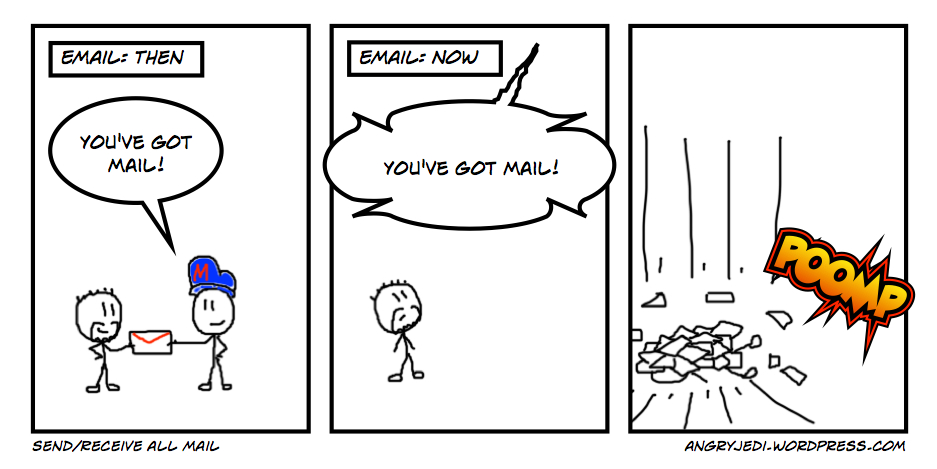
Page_1Speaking as someone who grew up with the early days of popular online activity (BBSes, CompuServe and finally the "proper Internet") I find it mildly interesting (or at least worthy of a late-night blog post, which isn't necessarily the same thing) how much the role of email has changed over the course of the last 15-20 years or so. I am prompted into these thoughts by a casual glimpse at my own inbox, which currently contains a devilish 666 messages, none of which visible on the front page are, to my knowledge, written directly to me by an actual human being.

This is something of a change from the earlier days, when clicking "Send/Receive Mail" in Outlook Express was an exciting moment, and you knew if the progress bar came up you had email incoming. Who would it be from? Would it be from someone interesting? What would they have to say? Would there be an attachment? In just a minute or two (LOL DIALUP) you would find out, and then you'd lovingly file the email into an appropriate folder to keep for all eternity. (I say "you" again when, of course, what I actually mean is "I". I don't know if everyone else was quite so fastidious with their email organisation when they first got online, but I certainly ran a tight ship… for a while, anyway.)

Looking at my inbox today, though, it's clear that email has a very different purpose today to what it once had. Whereas once it was effectively one of the only forms of social media (the others being forums and live chat rooms) it is now a general repository for crap. You'll occasionally get a meaningful message in there from someone who actually has a brain and a soul, but more often than not, if my inbox as of right now is anything to go by, it'll be a string of automated messages notifying you that so-and-so has added a new track to a playlist in Spotify (unsubscribe!), so-and-so has commented on something you don't give a fuck about on Facebook (unsubscribe!) or that that website you signed up for just so you could download a .zip file containing some porn/games that you wanted wants to wish you a happy birthday.

A relatively recent addition to the types of email you get nowadays is the guilt-trip "PLEASE COME BACK!" email. This happens with everything from mobile apps to online games, but the execution is always the same. "Here's all the great stuff you're missing out on!" it'll say, usually worded in such a way as to make you think that you're somehow doing something wrong by not using a service you currently have no need for. Often there will be some sort of bribe involved in getting you back, particularly when it comes to online games of various descriptions.

A Facebook game I reviewed a while back known as Outernauts was particularly bad for this. Outernauts was highly-anticipated by a lot of people because it was from a high-profile studio (Insomniac, for those in the know) and was aiming to be a social game that appealed to the sort of people who typically only played standalone, "pay once, keep forever" games on computer and console. It wasn't awful, but the overzealous means through which it was monetised — the ever-obnoxious "energy" mechanic — prevented anyone from being able to enjoy it for more than a few minutes at a time. Consequently, after an initial surge of interest, the very players it was trying to attract dropped it. Some months after I reviewed it and criticised it for its aggressive monetisation, it "relaunched", apparently with "fast recharging energy". It was still a pain in the arse to play. Some months after that, it relaunched again, this time promising "near limitless energy". Note: "near limitless", not "limitless".

I'm getting off the point slightly, but the fact is, every time Outernauts decided to do something a little different, it sent a begging email to me pleading for me to take it back, because it can change, it won't annoy me any more, it won't do that thing that annoys me any more. It was too little, too late, though; my experiences with Outernauts while reviewing it left such a sour taste in the mouth that I had (and still have) no desire to return, "near limitless energy" or not. That probably won't stop them sending me another email the next time they change something, though. Unless I blocked them. I might have blocked them.

Another offender in this sort of thing is a service called Earndit which I evidently signed up for at some point in the past. (I think I mistakenly signed up for it while looking for Fitocracy while the latter was still in closed testing; the two are different services but do have a few things in common.) Earndit sends me an email every week with sickly-sweet, overly-apologetic language about how I haven't earned any points this week, and that if they have it wrong I should get in touch with them PLEASE LOVE ME etc. It's annoying.

The response to all this annoying email is, of course, to unsubscribe from the mailing lists I've found myself on, send these messages to the spam folder or just to stop using my actual email address to sign up for things. But it's a pain to keep on top of. You can be as careful as you like to tick/untick the boxes that give websites permission to spam you with crap, but some will still get through, and over time there'll be so much incoming stuff that it's almost impossible to keep on top of your "unsubscribe" needs. The knock-on effect of all this is, of course, that genuine messages from real people can easily drift by completely unnoticed. If this has happened to you, it is nothing personal; you can blame Zynga, EA, Facebook, Twitter, Spotify, Google and indeed any of the million-and-one completely unnecessary social networking apps for mobile devices that I've reviewed over the course of the last year.

I miss the old days; the days when being notified you had a new message was exciting. Checking your email used to be a pleasure; now it's a chore.

1090: Housewarming

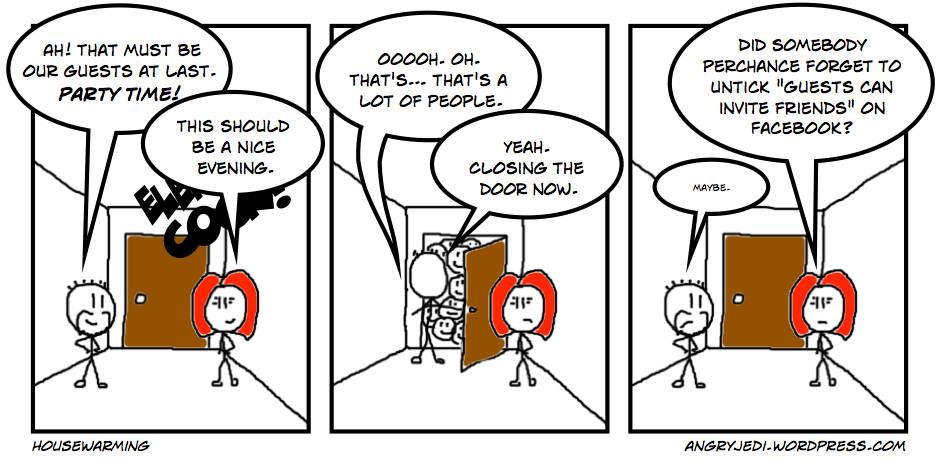
Page_1Tonight Andie and I are hosting a housewarming party. We attempted to do this in the last house we moved into, but failed miserably at getting people to come, making it a rather quiet affair. (We did have some people, just nowhere near what we were hoping for!)

(Aside: If you are a friend of mine and in the Southampton area and were inexplicably left off the invites list on teh Facebookz, it was not intentional and you are welcome to come and join us — just drop me a text or a message via various forms of social media and let me know you're coming.)

Anyway, yes. We are throwing a party. Now there's a word that changes its meaning as you get older and, theoretically, wiser.

When you're a kid, a "party" is a big deal, because it's something well out of the ordinary and, usually, a celebration of an important event — typically a birthday. I remember going to a number of birthday parties for various kids in the village where I grew up, and it was always fun doing things like playing Pass The Parcel and that stupid game where you had to put on a scarf, hat, coat and gloves and then eat a bar of chocolate with a knife and fork. You know, that one. No? Just me? Damn rural upbringing.

Then you get to be a teenager, and a "party" is typically an illicit sort of affair where you take over the house and invite too many people around while your parents are away. I attended a few of these and threw one of my own that I got into a lot of trouble for and still feel somewhat guilty about to date. (It was an awesome party, though, to be fair.) The key thing here was the illicit nature of it, though — it was an occasion for teenagers to do things they weren't supposed to do, like drink, smoke and… err, anything else that teenagers who weren't me probably did. (I had a somewhat sheltered life.)

Then you get to university, and "parties" become acceptable again, though they tend not to be tied to a particular occasion. "[Insert name of person you barely know] is having a party tonight," your housemate will say. "Want to go?" The correct response is, of course, "yes," because undoubtedly there will be a ton of drink, possibly stuff to eat and, in the eyes of a horny late-teens-early-twenties person, the potential to get laid that inevitably never comes to anything. (Not that I'm complaining; I was never really the one-night stand type.) The thing with parties of this nature, though, is that they tend to have no real purpose — they're purely social occasions designed to get people together, not a celebration of anything. They're barely even a celebration of friendship, because inevitably there'll be a bunch of people there who no-one seems to know, who will have showed up as a sort of "friend of a friend" arrangement.

There are exceptions to the above, of course — after-show parties from Theatre Group productions at university were always entertaining. I will never forget the one which coined the phrase "The Chair of Eternal Disappointment" and subsequently went on until well after sunrise, moving on from the original house party to a dirty, horrible beach on the banks of the river that we somehow found our way to. On said beach, we engaged in improvisatory theatre and then our friend Tom got his knob out before eating some dirty seaweed and commenting it "tasted of oil and poo".

Then you leave university and enter the adult world, and parties tend to take on that air of vague respectability once again. Rather than being aimless, meaningless social occasions, they tend to revolve around a special event, much as they did in childhood. In our case, we're celebrating our housewarming, but they're also often thrown in celebration of the new year or someone's birthday. In many ways, an adult party (not THAT kind of "adult party") is a lot closer to the joyful exuberance of a child's party than anything else, albeit with everyone usually behaving in a slightly more respectable manner than your average child.

The exception to the "special event" classification of adult (NO) parties is, of course, the "dinner party", which isn't really a "party" as such in that you're not really celebrating anything. No, rather you're just having people around for dinner, presumably in an attempt to show off your cooking skills and talk in a respectable, grown-up way around the dinner table before retiring to the living room to, I don't know, listen to jazz or something. I'm not quite sure at what age you start having "dinner parties" but it doesn't feel quite like something that's "right" just yet. Do people even have "dinner parties" any more? The very concept of "dinner parties" feels like something from an Alan Ayckbourn play.

Anyway, there's no real point to this post, I'm aware, I just wanted to write something before everyone arrived and starts eating the copious amounts of party food we have laid on for them. As I say, if you're in the Southampton area, are free tonight and missed out on an invite (probably because I assumed you were no longer in the area) then feel free to show up and say hello — contact me for the address.

Now I'm off to gaze longingly at the bajillion cupcakes Andie's made.