1542: Terebi Desu

Our new TV arrived today at some ungodly hour in the morning — which felt all the more ungodly for the fact that excellent Vita dungeon crawler Demon Gaze had kept me enraptured until 3am — and I've been having a bit of a play with it. (For the curious, it's a Samsung Series 6 55-inch LED TV; it has a catchy three thousand-digit model number but I have no idea what it is.)

When Andie suggested we grab a new TV, I was a little concerned that it might not be a significant upgrade over what we already had — a 40-inch Samsung, albeit one that is now about four or five years old. After all, despite the fact that my previous TV was an end-of-line model when I bought it — making it much cheaper — it was pretty good. Three HDMI ports, built-in Freeview tuner, full 1080p support — it had pretty much everything I needed, though it would have been nice to have an optical output port. Everything I connected to it worked just fine, though, ranging from the PlayStation 2 through the SCART port (yummy, blurry standard-def picture) to the various games consoles and PC through the HDMI ports.

With the previous TV working just fine, why buy a new one, you might ask? Well, having spent this evening playing some Final Fantasy XIV on it and having watched some anime and TV on it earlier… yes, it was a good investment. The increase in size is extremely noticeable — it's big enough to have a touch of "peripheral vision" now, giving a much more immersive feel to both video and games — and the LED screen is lovely, bright and clear. I have no idea if I've optimized its settings appropriately — I've put the PC input into Game mode, because prior to that there was noticeable input lag, but haven't really fiddled with much else — but it certainly seems to look very nice, although as Andie pointed out, the bigger the screen you get, the more of a dog's dinner standard-definition footage and TV broadcasts look. Oh well.

It's a Smart TV, too, which means it has two remotes, one of which has a trackpad rather than, you know, just being normal, plus "apps" for doing shit old, dumb TVs don't do. There's stuff like BBC iPlayer and Netflix built into it, for example, and even apps for things like Spotify and the like. (There are also games to download, but somehow I don't see them being particularly worthwhile, and as such I will be giving them a wide berth.) I'm not entirely convinced how much I will use the "smart" features over time, but it's nice to have them there, I guess — not to mention the fact it is seemingly now impossible to buy a new TV that isn't 1) "smart" and 2) 3D.

The 3D thing surprises me somewhat, I must confess. I thought 3D TV and gaming had been a colossal failure, and yet all the televisions we looked at over the weekend were 3D in one form or another. The TV we ended up getting is "active 3D", which is supposedly better because you have to turn the glasses on before they work properly (and for some other reasons, too) and sure, it's quite fun — we watched a couple of trailers in 3D earlier and it was quite cool — but it's not something I can see myself using a lot of, and certainly not for protracted periods of time. It will almost certainly be something to show off to people who come and visit, but little else.

Anyway, I'm very pleased with it. It fits nicely on our TV stand and doesn't look too big or too small, and it's a noticeable upgrade over what we had before — plus the almost bezel-free design, with the picture going right the way to the edges of the front of the unit, looks absolutely smashing.

I'm sure I'll be taking it for granted before long — and I'm not looking forward to moving it when our new house is sorted — but yes; I'm glad we got it. And now I'm off to bed because I've been staring at it all evening and I think my eyes could probably do with a rest!

1541: Reclaiming the Inbox

Oh my goodness, email. What a massive pain in the arse you are. And yet you shouldn't be; you should be a convenient, quick means of asynchronous communication, and instead you're a cluttered, nigh-useless mess.

At least my personal account is. So I'm trying to do something about it. When unnecessary mailing list entries that I never read show up, I unsubscribe with due haste. When my inbox starts to fill up with useless crap, I highlight it all and archive it — if I haven't read it immediately, it almost certainly isn't important to go back to in a few days' time.

With a little coercion, I'm confident that I can start getting my inbox back under control. The trouble I'm having is largely due to the period of time where my personal email was also my professional email — while I was working on GamePro I didn't have my own address — and consequently got signed up to about a bajillion PR lists. Subsequently, when I worked for Inside Network, I then got signed up for a bajillion more PR lists for mobile games and apps — and there are a fuckload more mobile games and apps released every week than there are on computers and consoles. (And approximately 2 or 3 at most worth caring about, if that.)

The reason I'm doing this is because I actually want to start using email again. When I think back to the early days of having an email address, receiving new messages was exciting. Spam was rare, and it always felt like an "event" to see Outlook Express pop up its progress bar and indicate that yes, messages were incoming via the magic of dial-up Internet. (Random, no-longer-existent free ISPs for the win. I was a "Hot Toast" man, myself.) This was because it was an event to receive a message — someone had taken the time to actually write to you.

These days, the former function of email is largely covered by social media — to a point, anyway. But it's not quite the same, particularly with how much both Facebook and Twitter have wandered off from their original incarnations when they were first introduced. Facebook these days — even with my recently pruned feed — is nothing but links with people going "OMG SO AMAZING" or some other such hyperbole, while Twitter is inherently limited thanks to its character counts, and is becoming increasingly intolerable anyway thanks to the increasing regularity with which the social justice crowd continue to peddle their opinions and refuse to listen to anyone else.

Then there's longer-form writing such as this blog, but that's a broadcast rather than a personal message. Sure, I could write private password-protected posts and send them to individuals or small groups of people, but if I'm going to do that, I may as well just send them an email in the first place. It feels impersonal.

Which leaves email, as one of the most long-standing means of digital communication out there, as arguably the most practical means of actually getting in touch with other people — so long as you take control of it, that is. Going forward, my "good intention" is to try and use email a lot more than I have done in the past, perhaps to keep in touch with people I don't speak to enough on a daily basis or even to get to know people I want to know a bit better… a bit better.

This is a bold plan, I know, and I wonder if it will prove to be a fruitless endeavour if everyone else has the same saturated inbox problem as me, but it's worth a try. Email is a brilliantly simple but amazing technology that brings people closer together, and it's wasted by most of us on a daily basis as we take it for granted. So I'm going to try and stop doing that. Maybe. We'll see.

No you can't have my email address. Unless you ask really nicely.

1540: Darkness

The focus of the new season is very much on what were previously secondary characters.

I'm finally on to the final (well, most recent) season of To Love-Ru, aka To Love-Ru Darkness, and it's been really interesting to see this show's evolution over time in several ways, even over the course of just a few years.

The first series of To Love-Ru came out in 2008 and was a fairly conventional episodic format in which each episode was largely self-contained. Motto To Love-Ru, which followed two years later in 2010, instead followed the "mini-episodes" approach of Ika Musume/Squid Girl. And To Love-Ru Darkness, which aired two years after that in 2012, returns to an episodic format, but with a much stronger sense of ongoing plot and frequent use of cliffhangers to close off each episode.

The atmosphere has changed markedly over time, too. The original series of To Love-Ru was rather silly, light-hearted nonsense that, as I've previously mentioned, was pretty undemanding fluff that you can watch without having to concentrate too hard — but it did close out the season with a spectacular two-part finale that brought things to a natural break, if not complete closure.

Motto To Love-Ru, meanwhile, was enjoyable but for the most part felt even more "disposable" thanks to its short mini-episodes. Over the course of the series, we got a better understanding of the various characters involved by simply seeing them in a variety of different situations, but there was relatively little in the sense of overarching narrative that advanced as the series progressed aside from the introduction and exploration of a couple of new characters. The season finale, meanwhile, was a big moment for several of the characters involved, but in a completely different way to the original show. Rather than being an overblown epic involving protagonist Rito battling against unfeasible odds in an attempt to prove himself as in the first season, it instead was a fairly low-key affair that, in contrast to the rest of the run, linked its three mini-episodes together and culminated in a long-awaited confession from Rito to lead heroine (and super-cute space alien) Lala — and an unfortunate misunderstanding as he attempted to also confess to secondary love interest Haruna (who is likewise super-cute, but not a space alien).

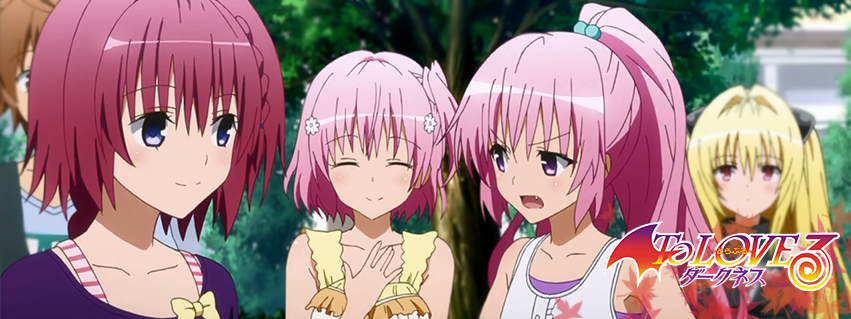
To Love-Ru Darkness picks up directly from where Motto To Love-Ru left off, in contrast to how Motto To Love-Ru assumed some time had passed between the first series, the first set of OVAs and the new season. And it has a noticeably different focus so far in the few episodes I've watched, too; rather than focusing on the relationship between Rito and Lala that was the centrepiece of both To Love-Ru and Motto To Love-Ru, early episodes instead explore the character of Lala's sister Momo, whose devious machinations sort of have Rito's interests at heart, but are fundamentally largely incompatible with the norms of Earth society.

Lala, the centrepiece of the previous two seasons, doesn't even appear in a lot of promotional artwork for Darkness.

In short, Momo decides after seeing Rito make his heartfelt confessions at the end of Motto To Love-Ru that she, too, likes Rito, and decides that the best thing for everyone involved in the increasingly complicated love polygon situation they all find themselves in would be if Rito marries Lala, becomes King of the Universe and consequently no longer bound by the rules of Earth society, then marries everyone else that he has ever had feelings for or who has had feelings for him. She, in short, is firmly in favour of creating a harem of concubines for her beloved — a harem in which she, too, will play her role, of course.

Rito, thus far, is somewhat resistant to this idea, since being of the "perpetually confused protagonist" mould, he is still not quite sure what his true feelings are with regard to Lala and Haruna, let alone Momo (who keeps showing up almost naked in his bed at night-time, much to his chagrin), class representative Kotegawa (whom Rito has a habit of falling over into inappropriately), the extraterrestrial assassin Golden Darkness (who clearly doesn't really want to kill Rito) and, indeed, his own sister Mikan, who has struck up something of a friendship with Golden Darkness. Constantly yanked from one situation beyond his control to another, I can sense that this season is going to see some of Rito's toughest trials to date — particularly now that some new characters, such as Golden Darkness' "sister", have gotten involved.

In keeping with the previous seasons and OVA sets, the amount of fanservice has once again been ratcheted up, with the number of bare nipples and panty flashes in To Love-Ru Darkness having increased noticeably since the original (rather tame in comparison) season and even since the somewhat more suggestive Motto To Love-Ru. The show refuses to devolve into nothing but T&A, however; even amid all the clear and present fanservice, there's still an ongoing plot that, this time around, seems to blend the silliness of the earlier seasons with something that provides a bit more meat on the bones.

It's shaping up to be an interesting season, all round, and I'm looking forward to seeing where Rito's misadventures take him next.

1539: Winding Up

The weekend is coming to a close, and another week of work beckons. After that, there will be another weekend, and the whole cycle will repeat over and over and over again.

This weekend has been quite nice despite the fact we haven't really done all that much. Andie and I paid not one but two visits to a nice local restaurant/bar/lounge type place called Trago Lounge that we were first introduced to for a friend's birthday a while back. We went there on Saturday for one of their excellent burgers — the "Hero Burger", which also features chorizo, some unidentifiable green goo that tastes nice, chipotle mayo and a pickled chilli in a toasted, crispy brioche bun is delicious — and enjoyed it so much we decided we'd drop in for breakfast today.

Trago Lounge has a substantial breakfast menu, largely inspired by the sort of stuff you'd typically get in an American breakfast-specialist place such as the Half-Day Cafe in Marin County, CA that my parents always insist on going to every time we go and visit my brother. (To be fair, they do do amazing breakfasts.) Today, I tried a stack of eggy bread with crispy bacon and syrup — predictably yummy, though the bacon was a little overdone — while Andie had what was called "dirty beans", which was essentially a bowl full of home-made baked beans (three different types) with a healthy dollop of barbecue pulled pork and some lumps of toasted ciabatta to dip. It's not what I would have called "breakfast" per se, but Andie enjoyed it. (It was a little too oniony for me, however.)

After that, we wandered into town for an idle look around and I ended up buying a new television. I recently came into a bit of money, you see, and while I'm intending on saving most of it, Andie quite rightly suggested that it was probably worth spending some of it on something nice that I'd enjoy. After a considerable amount of umming and ahhing — there really wasn't all that much I want to spent a considerable amount of money on right now, aside from, you know, the house we're buying — Andie suggested replacing my current TV, which is now a good few years old. It still works perfectly well, I might add, but the new one is significantly bigger, has an almost bezel-free edge, is an LED screen (as opposed to my current TV's LCD), has optical sound output instead of analogue and has a lot more options to tweak for optimising performance when watching TV, watching movies or playing games. Oh, and it's 3D, too, because it's apparently impossible not to buy a 3D TV any more, despite 3D TV not really being anywhere near as much of a thing that everyone tried to convince us a year or two back.

Anyway, that's turning up on Wednesday because John Lewis apparently don't stock anything above 50 inches in store (it's 55) so we're both looking forward to that. And that, really, was my weekend. Oh, I found two Atmas in Final Fantasy XIV earlier on, but I'm sure you don't want to hear about that. And people got angry on Twitter earlier on (not at me!), but people always get angry on Twitter and I'm frankly beyond giving a shit about any of it any more.

So that's that, really. Night night.

1536: Looking for the Calm Lands

I'm having one of those occasional periods where I don't feel my mental health is in a great place. I'm feeling a bit stressed out (for no specific reason), I've been feeling wracked by anxiety before I go to sleep for the last few nights and I find myself occasionally lapsing into depressed feelings during the day, particularly if I stay in working for the whole day.

I think part of the cause is the working from home aspect. It may sound like a dream situation to be able to sit in your pants all day every day tapping away at a computer without fear of interruption from man or beast (well, occasionally from beast if I hear the rats causing mischief in the other room) but in actuality, it's a ticket to Stir Crazy-Town, and thus every so often I just feel the need to get out of the flat and go work at the coffee shop or something. Somewhere. Anywhere but here.

It's an underacknowledged aspect of working from home, this stir crazy business. And I think it's particularly apparent if you live in a fairly small environment such as a flat. In our flat, my study is just one wall away from the bedroom, which in turn is just one wall away from the living room. The temptation is always there to just wander into the living room, flop down on the sofa and stare at the TV for a few hours — or, on particularly bad days, to just go back and lie in bed for a bit. But, as I've established pretty firmly for myself, that's a terrible idea, because if I don't get up as soon as I wake up, I'll fall asleep, wake up five minutes before I need to work and make the whole anxiety-depression-stress thing a whole lot worse.

Going out to work at the coffee shop, like I did today, helps largely from the "change of scenery" aspect, and also helps remove a lot of distractions from the immediate vicinity. While distractions can sometimes be helpful motivators — "I'll do this, then reward myself with [distraction]" — they can also be… well, distractions. You know how it is. Today I felt like I got a lot more done than usual for sitting down, focusing and concentrating on what I was doing, even if sitting on one of Costa's arse-numbing chairs for most of the day hunched over my laptop isn't quite as comfortable as working on the big screen of my Mac in my rapidly-disintegrating-but-still-quite-comfy office chair. But at least I can break to get a coffee or a cake or a sandwich when I want to. (I know I can do this at home, too. But I have to make them myself.)

It doesn't really help that I feel like I have a lot on my plate at the moment. There's a lot of games I need to cover, and my inbox is full to bursting every day with PR pitch after PR pitch that I just don't have time to contemplate in the depth they deserve. Pro-tip to anyone eyeing a career in the games journalism biz: reviewing games is the worst part of the job, despite the freebies. Review commitments make it very difficult to play the things you want to play, and in many cases they even make it difficult to explore the review titles in as much depth as you want. At the same time, I feel it is important to give consideration to a lot of the titles I end up reviewing, as many of them are often dismissed outright or treated somewhat unfairly by other critics, so it's a tough balancing act at times.

Oh, and the air quality around here is shit at the minute thanks to a combination of a Saudi Arabian dust storm (apparently) and a big fire just down the road from us earlier today. This isn't helping me recover from the plague that laid me low recently.

I don't know. I'm just having a complain. Things aren't too bad really, I guess. They've certainly been worse. Like I say, it's just one of those times when my mental health is getting the better of me. I should probably just go sit in bed and play Steins;Gate until I fall asleep or something. That sounds like a good idea, doesn't it?

1534: Self-Study

I successfully managed to get up early and do some Japanese self-study today. I'm glad I finally managed to make myself do it, because with a month off from my classes for Easter, I really, really need to undertake some independent study if I'm going to continue to progress.

Today I prioritised the reading and writing aspect, as those are areas where I'm weak. I want to get away from reading in romaji (Japanese words spelled using Western characters) as soon as possible and into being able to parse and understand hiragana and katakana before moving onto the more complex matter of kanji.

I've been gradually building up my hiragana knowledge in particular quite a bit for a while now, but I'd somehow convinced myself that I only knew about half of the characters involved. Actually, I knew a whole lot more than that, with it only really being the characters for ね (ne) and ぬ (nu) giving me a bit of grief — that said, writing them down like that will probably help me remember them a bit better.

I've been working through the companion Kana Workbook for the series of Japanese coursebooks we've been using in class (Japanese for Busy People, if you're curious), and it's proven to be quite a good resource. It walks you through how to draw each of the characters accurately, and highlights common sticking points such as characters that look similar to one another (ぬ nu and め me, for example, or ね ne, わ wa and れ re for three even more confusing examples) as well as little quirks such as the ability to change the basic sound of some characters with a smaller character following it — に ni plus や ya becomes にゃ nya, for example — or the ability to double a consonant by adding the つ tsu character in small format — for example, いつ itsu versus いっつ ittsu. And then there's the times where characters don't mean what they normally mean — は is normally ha, for example, except when it's being used as the particle wa, while お is usually the character for the vowel o unless you're using the particle o, in which case you use を instead because of course you do.

I've hardly touched katakana as yet and I was a bit concerned as it's a whole new set of characters that refer to the same syllables but which, in many cases, look completely different. For those unfamiliar with Japanese script, katakana is used both as a means of highlighting text similar to how we use italics, and also to denote "loan-words" from other languages such as English. For example, you'd write the Japanese word for "computer" — konpyuutaa — in katakana rather than hiragana since it's a loan word from English, and the two character sets make the word look rather different: こんぴゅうたあ versus コンピューター, to be exact — note how katakana uses a long dash for long vowels rather than the extra vowel characters hiragana uses. Confusing, non?

However, then I thought back to learning English and how we effectively have to learn two alphabets — lower-case and upper-case, not to mention how different fonts depict certain letters such as "a" — and it suddenly didn't seem quite so bad after all. I mean, what's another forty-something characters to learn? Yeesh.

Still, I'm getting there. I'm making good progress and I'm confident I'll be able to read at least some Japanese script a bit more fluently in time if I keep practicing. In the meantime, it's back to studying.

1533: Motto

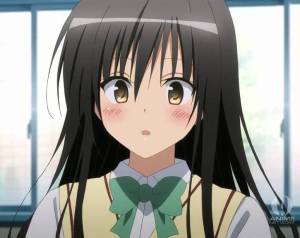
Kotegawa is the best.

As a suitable means of switching my brain off when I need it (which is quite frequently at the moment) I've been continuing to watch To Love-Ru and am now onto the second series, Motto To Love-Ru.

I was interested to discover that this second series is structured rather differently to the conventionally episodic first season, instead adopting the same approach as Ika Musume (aka Squid Girl) by making each individual episode up out of three short stories rather than one large story that kind of sort of ties into the overall narrative. That said, narrative coherence is not a huge priority in To Love-Ru, since there are a couple of points throughout the series where things just evidently happen "between episodes" without explanation — or perhaps they just happened where I didn't notice. (Or, more likely, in the original manga, since it's not at all unusual for anime adaptations of popular manga to simply skip over chapters at a time for brevity's sake.)

The series remains enjoyably fluffy, however, despite the predictability of the protagonist Rito falling over at least once per episode either face-first into someone's crotch or with his hands on someone's boobs. Despite the occasional bout of fanservicey smuttiness — which gradually increases in frequency between the first series and the first set of OVAs, and then again between the OVAs and the Motto second season — the show remains consistently good-natured, with it generally being Rito as the one who is ridiculed and made to look an idiot rather than the rapidly expanding female side of the cast, most of whom tend to come off pretty well out of their various misadventures.

Except for when Yami is the best.

And as clichéd and tropey as a lot of those female cast members are, they all have their own appeal elements and twists on the usual formula. The stern, harsh class president Kotegawa, as you might expect, has her deredere side to go with all the tsuntsun, and predictably, it's adorable. Meanwhile, teen idol Run-chan's twist is that she turns into a boy when she sneezes — a side-effect of being an alien, naturally — while Oshizu is a ghost whose spirit has a tendency to evacuate her artificial body whenever she gets scared, such as when she sees a dog. (Naturally, one of the other characters has a dog, so this situation comes up quite a bit.) And then there's Yami-chan, aka Golden Darkness, who is all the things I loved about Ell from My Girlfriend is the President and then some. Also, she has hair that can turn into weapons and punch people. Hnnnnng, as they say.

I'm not even going to pretend that To Love-Ru is anything more than fanservicey, switch-your-brain-off fluffy nonsense that is designed for pure entertainment value rather than attempting to say anything big or meaningful. It doesn't have the clever Lovecraftian references of the rather similar (but later) Haiyore! Nyaruko-san, nor does it have the clever self-awareness of other comedy anime. It's simple, it is, at times, sexy, and it is, at times, utterly stupid. And sometimes that's exactly what you need from a piece of entertainment. And thus I make absolutely no apologies whatsoever for enjoying it; it's a delightful accompaniment to my brain's boot-up sequence while I'm having breakfast of a morning, and it's likewise a pleasant accompaniment for the shutdown sequence of an evening before I go to bed.

Anyway. Once I'm done with To Love-Ru (the rest of Motto, followed by some OVAs, followed by the third and, currently, final season To Love-Ru Darkness) I will watch something a bit more intelligent, I promise. Maybe. Possibly.

Come on, I survived Clannad. I deserve this! 🙂

1532: Get It Done

Oh, for the ability to extend days as long as necessary so you can fit everything in. Oh, for the ability to call up motivation on demand and just get things done with time to spare.

There are lots of things I want to get done at the moment. You may recall quite some time ago that I was working on a game project with RPG Maker and that I was very excited about it. I am still very excited about it, and yet I haven't done a whole lot on it recently. Why? I can't really explain that, other than the fact I just feel like there hasn't been a whole lot of time to do so recently.

I'm not sure whether or not that is actually true or whether it is just the perception in my mind, but that's certainly the way it's been feeling recently. I get up, I do work, I flop down in the evening, I relax, I go to bed, I repeat the process throughout the week and then take the weekend to recover.

I could, of course, use my time more efficiently. I could get up earlier in the morning and do stuff, and in fact I had been intending to get into some good routines having rejoined the gym/swimming pool complex in town, but unfortunately getting horribly, revoltingly ill put paid to those plans almost as soon as I had put them into motion. As soon as I shake off the last remnants of whatever plagues have been filtering through my systems, I will get back on that.

In the meantime, though, there's nothing stopping me getting up early and, instead of going to the swimming pool or the gym, working on my game instead. Tomorrow morning I will at least make an attempt to do that, though it will depend on how I feel when I wake up.

I also need to do the same with my Japanese studies, since I now have a month off from classes and don't want all the things I've learned to fall out of my head.

I think I am probably going to have to make myself some sort of schedule to try and stick to, though the mistake I often make with this sort of thing is making it too strict and consequently not wanting to stick to it. I think if I can set myself aside a few hours in the morning before I start work — I start late — to do something productive, be it game development, Japanese revision or going to the gym/pool, then that will get me into good habits and good routines, and thereby get some things done. When the evening comes, then, I can settle down and relax without guilt and do what I want to do. Maybe.

This is all fine and good until I get a bunch of lengthy, time-consuming games to play through for review and as luck would have it, several of those are on the way now. But we'll cross that bridge when we come to it; for now, let's try and get into some good habits and get shit done!

1530: 50 BC

Over the intervening years since leaving home, I've either discarded or left behind a lot of the trappings of childhood. But one of the things that has constantly travelled with me is my modest collection of Asterix books — by no means complete, not by a long shot, but consisting of a number of adventures I occasionally like to revisit.

For those unfamiliar with Asterix — I'm not sure how well known it is these days — it was (is?) a series of full-length comic book stories based in the era of the Roman occupation of Gaul, circa 50 BC. Originally composed by French duo Goscinny and Uderzo and subsequently translated into a variety of different languages around the world, the stories combine a certain degree of real-life ancient history with material that is played purely for laughs to ridiculous effect. Central to all the stories are the eponymous protagonist Asterix, a cunning Gaul who is usually entrusted with his village's most important matters, and his overweight, somewhat dim friend Obelix who fell into a cauldron of magic potion as a baby and was consequently blessed with permanent superhuman strength.

The books range from relatively small-scale adventures in which Asterix and his friends defend the village from the Roman encampments that surround them to grand adventures that see the indomitable Gauls heading off to places such as India and the Middle East. Elements of sci-fi and fantasy — usually in the form of magic — are incorporated into some of the later books, but the emphasis is always on vaguely plausible but ridiculous situations that poke fun at modern society through the lens of ancient Roman times.

A particularly identifiable characteristic of the English translations — I can't speak for the other languages — is the sheer number of utterly cringeworthy puns used throughout, usually in the form of character names. Asterix and Obelix are pretty self-explanatory, but they're joined by village chief Vitalstatistix, druid Getafix, blacksmith Fulliautomatix, fishmonger Unhygienix, bard Cacofonix and numerous others. The female Gaulish characters have similarly unsubtle names — Vitalstatistix's wife is called Impedimenta, for example — as do the Romans, who usually have amusing Latin names of some description. One story features a centurion called Cumulo Nimbus, for example, while another features an athletic legionary called Gluteus Maximus.

The books are filled with visual gags, too, not just in the panels' artwork, but in elements such as typesetting and fonts, too. An Egyptian adventure in which Asterix and friends visit Cleopatra, for example, features a number of sequences in which Egyptian characters "speak" in hieroglyphics, for example, while in Asterix and the Great Crossing, which sees Asterix and Obelix initially accidentally discovering America and subsequently coming into contact with some Viking explorers on the way home, the language barrier between the Gauls and the Vikings is represented by the latter adding stereotypically "Scandinavian" punctuation to the things they're saying. It's a visual equivalent of the TV series Allo Allo representing characters speaking in different languages through different accents, essentially.

What I've been most surprised about on this most recent revisiting of the few Asterix books I do own is the fact that they hold up very well despite, in some cases, dating back to the 1960s. Not all humour ages terribly well and indeed there are certain elements of the Asterix books that clearly come from a, shall we say, somewhat unenlightened age, particularly when it comes to depictions of people of non-white races, but to be honest, there's a certain appeal to the fact that the early books in particular just don't give a toss about political correctness and end up being often darkly hilarious as a result.

I've never got around to expanding my collection since leaving home, but I've now read the few Asterix books I do own so many times to know them pretty much inside out. Perhaps I should look into getting some of the ones I've never read — if these ones hold up well enough, then it'd be a pleasure to read some completely new ones that I don't know at all.

1527: Trope-ical Crush

The word "tropes" has taken on something of a pejorative meaning in recent years, but I find something oddly comforting about the use of common, established, recognisable tropes — particularly when it comes to Japanese entertainment. I also find it interesting that Japanese entertainment — both games and anime — is a lot more willing to fully embrace the idea of tropes as part of the medium's language rather than attempting to hide what it's doing.

Take the common character tropes, for example. In a typical "harem" situation (usually a male protagonist surrounded by female characters, one of whom is typically positioned as the "main" love interest, but the others of whom are optionally also either interested in the protagonist or the objects of the protagonist's affections) you tend to have your tsundere, your kuudere, your childhood friend, your "princess" type, your genki girl and, depending on how many characters are involved, numerous others. And yet the predictability of this type of cast makeup, for me, doesn't prove to be tiresome; quite the opposite, in fact. I enjoy being able to point to the various characters and say "well, she's clearly… and she's clearly…" because it provides a recognisable, established starting point for these characters that can then subsequently be built on over the course of the rest of the work.

Exactly how — or if — these tropes are built upon by the work depends entirely on the work in question. Some works embrace the established tropes wholeheartedly and make the characters into textbook examples of the character types they initially appear to be: a valid approach. Conversely, some works deliberately work to subvert the tropes they establish in their early hours with some surprising twists and turns for the characters: also a valid approach. And, for some archetypes, subversion of expectations is part of the trope itself: witness the tsundere, for example — usually frowning, overly defensive and, at times, somewhat aggressive — and how her character arc typically involves her "softening" and showing her deredere side. Or the yandere — quiet and meek, but with something seriously unpleasant festering inside that demure exterior. Knowing that at some point she's going to strike doesn't diminish the impact when it happens; if she's a particularly well-disguised yandere, it's even more shocking and surprising.

I'm a fan of tropes, then; I enjoy that feeling of comforting familiarity that comes about when I come across a new character and recognise their traits. And everyone has their favourites, too; for me, I must confess to having a soft spot for tsunderes, but I do also like a kuudere and there's always something heartwarming about a nice childhood friends romance. And the older sister "nee-chan" type. And a cutie imouto. And… Oh dear. (Essentially, I think I'm saying that my ideal anime harem would be made up of the cast of My Girlfriend is the President.)

If you'll excuse me, I'm off to bed to read TVTropes. (Warning if you're at work: settling down for a "quick read" of that site is a good way to lose a few hours.)