1719: Album for the Young

I made myself a music playlist the other day. Contained therein was a selection of music from my teenage years, which is when I started actually buying CD albums and singles for myself — beginning, as I believe I've said before, with Oasis' Definitely Maybe just a day before (What's the Story) Morning Glory? came out.

Like most playlists I make, I was putting full albums rather than individual tracks in there, as I like to have a full selection of music from favourite artists available. Hitting the "Next Track" button is simple enough if you happen to be served up a stinker of an album track, so it is, for me, a case of better to have too much than too little.

Now, here's where I did things a little differently. Normally, when I put music on these days, as many people do, I believe, I choose a playlist, hit Play, then hit the Shuffle button so I get a random selection of tracks from those that I've picked. I could make the time or effort to curate playlists a little more carefully and not have to rely on Shuffle, of course, but I rarely do that these days; the only exceptions have been when I need a particular amount of music, or when I want to choose some very specific tracks to, say, take to the gym or something.

When I selected this playlist and started playing it in the car the other morning, though, I decided that I wasn't going to follow my usual pattern, and was instead going to listen to the tracks contained therein a full album at a time. If it was good enough for my fifteen year-old self, I'm sure it's still good enough for me now — and I don't like to think that the 21st century has given me such an attention span deficit that I can no longer deal with more than one track by the same artist in succession.

I used to enjoy listening to albums when I was younger. True, I rarely did it as an activity by itself — I would usually put an album on while doing homework, or reading, or something like that — but I would usually listen to a whole album once I put it on. This was at least partly due to the fact that the age of music on physical media meant that you had to get up and change a disc (or even cassette, a medium which even made it difficult to listen to a specific song) if you wanted to hear something by a different artist — but it was also due to the fact that even then, I was conscious of most albums — good albums, anyway — being designed as coherent works in and of themselves. Sure, it was the individual tracks you'd tend to hear played on the radio or the television, but a well-designed album had a beginning, middle and end: it took you on a musical journey, and sometimes even told a story.

Listening to these albums this way for the first time in a very long while has reminded me what a good experience it can be to settle down and immerse yourself in just one album; just one artist's work, the tracks presented in the order they believed that was best, rather than some arbitrary random picker thingy.

Particular highlights of drives this week have included the Manic Street Preachers' Everything Must Go, a favourite of my teenage years that I primarily picked up in the first place because a girl I fancied was totally into it; Propellerheads' decksanddrumsandrockandroll, an album I never actually owned but always enjoyed listening to; and Prodigy's The Fat of the Land, which remains, to date, a wonderfully "industrial"-sounding album filled with fire, energy and not a small degree of filth. (Not in a sexy way, either; I'm talking the kind of smoky, dusty, grimy filth that belches forth from a factory chimney.)

The latter in particular has been a pleasure to rediscover, at least in part because there's really nothing quite like it getting mainstream airplay these days; it remains a product uniquely of its time, and listening to it takes me back to the first time I heard Breathe on a school bus, courtesy of my classmate Peter Miles (a noteworthy acquaintance during my school life for being someone who challenged me to a fight that neither of us showed up for, and who was good enough to lend me a long leather coat so I could dress up as a Gestapo agent for a murder-mystery party just a couple of years ago), and discovered that an artist I'd previously written off on the grounds of the fact I didn't really like their previous single Firestarter was actually rather thrilling to listen to.

So while I'm not sure I'm going to start just sitting down and doing nothing but listening to an album — something that I've never really done, even back when iTunes was something we could only dream of — I'm certainly going to be making an effort to use the Shuffle facility a whole lot less when I'm listening to music in the future. There's an artistry in the construction of a good album, just as there is (arguably more obvious) artistry in the composition and production of an individual track; it's something that not many people take the time to appreciate these days, so it's something that I fully intend to (re-)explore a little more in the coming days.
1717: The Story of Your Mail Archive

During a quiet — and, I won't lie, somewhat bored — moment today, I decided to take a look back in my GMail archive and see exactly when I started using that account. I've had a number of different email accounts over the years, some of which have lasted longer than others, but I had a feeling that GMail had stuck with me longer than anything else. (Except perhaps for Hotmail, which I keep around to sign up for things I don't want to sign up my "real" email address for. And for my Xbox Live account, because in Microsoft's wisdom, they don't allow you to change the email address associated with your account, meaning I was forever stuck with it, not that email really matters to Xbox Live anyway.)

Sure enough, my GMail account has been with me for somewhere in the region of four or five years or so. Prior to that, I made use of a .mac/MobileMe/iCloud account (the name has changed several times since I opened the account in 2007 as part of my employment at the Apple Store), and before that, I was using Yahoo. Prior to that, I was using various different proprietary addresses that I got with Internet service providers, and since I moved every year while I was at university — and quite frequently thereafter, too — I changed email address a lot, much to, as I recall, the annoyance of my brother, who never knew which address to contact me on.

Anyway, I digress; my GMail account hails from 2009, and it was interesting to take a look back to what was going on in my life around then. I can use this blog for that too, of course — and often do, as narcissistic as that might sound — but looking back at past emails is a little different because it's not just a record of my thoughts spilling out on the page as I saw fit to express them; it's my thoughts spilling out on the page as I saw fit to express them to another specific person.

As those of you who have been reading this blog for a few years will recall, 2010 was Not A Good Year for Pete, and indeed the early pages of my email history reflect that to a certain degree.

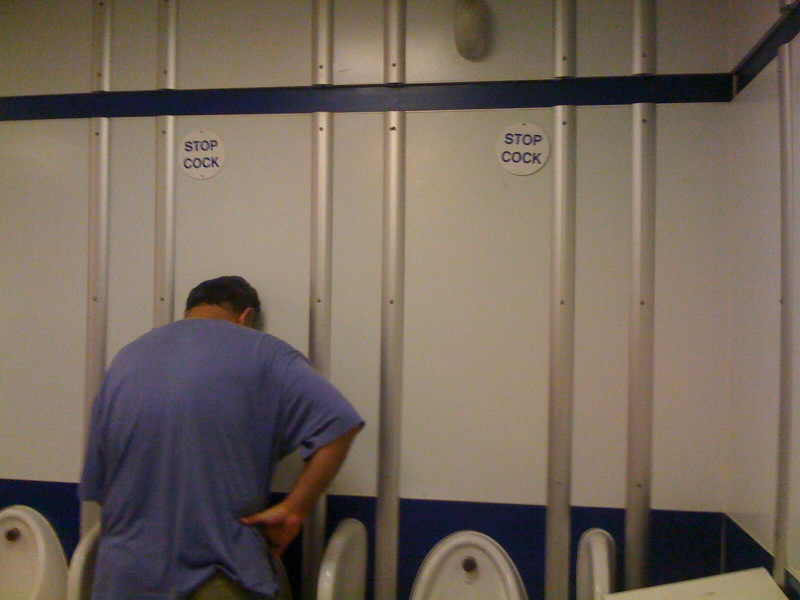
Before that, however, was an email from a former colleague containing nothing but this image:

photoIt still makes me giggle.

Anyway, the first few pages of my GMail are actually made up of messages imported from my .mac/MobileMe account, which I was running in parallel with GMail for some time (and indeed still am, though I don't really use it any more). In those early messages, I can see the first time I was hired as a professional games journalist — Joey Davidson and Brad Hilderbrand were good enough to take a chance on me and hire me for the now sadly defunct Kombo.com. The pay was crap, but it was something at a time when I had nothing else, and I got something far more valuable out of that experience: friends. People I still speak to today — indeed, just today I had a quick chat with Joey via instant message, which was nice.

Around that time, I was preparing for a trip to PAX East in Boston, at which I'd have the opportunity to meet a number of members of the Squadron of Shame for the first time — and to catch up with some I'd had the pleasure of meeting once or twice before. I was also looking forward to the opportunity to cover a big event as a journalist, though sadly I wasn't enough of a bigshot at this time to be able to score a proper press badge, and as such had to write about things at the show largely from a consumer perspective.

Shortly after my return from PAX East, you may recall that my life fell to pieces, and you can see almost the exact moment this happens, since there's a sudden flurry of sympathetic messages from friends and family alike. Thus began a very dark period in my life, and one that still, I must admit, brings tears to my eyes to relive, even when looking at it through the cold, clinical view of plain text.

So let's not do that.

Instead, fast forward a bunch of pages and I was very surprised to spot an email from a familiar name: Shahid Ahmad, who is now best known as Sony's most enthusiastic employee, and champion of the Vita. Shahid apparently commented on one of my posts somewhere — I can't quite tell where from the email exchange, but it was a post about the game Mr. Robot, which I recall enjoying a great deal — and we'd evidently had a discussion about Chimera, a game which he made back in the days of the Atari 8-bit and Commodore 64 home computers, and which he has trying to remake ever since. (He was talking about a remake a while back on Twitter; apparently, he's been trying to make this happen since at least 2010.)

Somewhere around the 37,000 email mark (still in 2010), I seemingly start using GMail a bit more for communicating with people and signing up for things. There's still a bunch of stuff coming in via MobileMe, but messages without that tag are starting to appear more and more.

Around the 35,000 email mark, I start working for GamePro. Of all the sites I've worked on over the years, I think GamePro is the one that I think of most fondly and am most proud of. I feel I struck a good balance with my news coverage, and there was tangible proof that I — specifically me — was responsible for bringing in a significant amount of new traffic with the work I was doing. Unfortunately, this seemingly wasn't enough to prevent the site from being unceremoniously wiped off the face of the planet some time later, but it was nice to know at least.

Aside from my own developments, it's also interesting to see what names I still know today have been up to over the years. It's nice to see Tom Ohle of Evolve PR's name crop up a bunch of times, for example — that man's one of the hardest-working PR folks in the business, and also someone who always put across the impression of genuinely believing in the games he was representing — as well as folks I've worked alongside moving from outlet to outlet.

And then, of course, there's the first appearance of Andie in my Twitter direct messages (Twitter's email notifications used to look a whole lot different!) and… well, we all know what happened there. (She's sleeping upstairs in the house we own together right now as I write this.)

So anyway. Having rambled on for over a thousand words about nothing more than my email archives, I think I'm ready to call that a night. It's been an interesting trip back along memory lane — not always pleasant or comfortable, but certainly interesting — but I think I've sated my curiosity for now, at least.

So what's the earliest email you still have, dear reader?


1716: Desperately Seeking Information

Something a friend of mine said in an online chat earlier made me think about the way we, humanity, use the Internet on a daily basis — and particularly the role that social media plays in many of our lives.

He said that as human beings, we crave information. It doesn't matter what that information is, we're just hungry for it; forever consuming, devouring any input we can get our brains wrapped around, however mundane, stupid or fury-inducing.

After he said this, I took stock of my online existence since leaving Facebook and Twitter behind. I still haven't looked at the former at all; I've peeped at the latter once or twice to see if I had any mentions or direct messages — I didn't (apart from a share of this post by a dentist who clearly hadn't read it at all), which, I won't lie, smarted a bit, but I'll live.

What I have done, however, is almost immediately replace them with other things. I was always intending to make more active use of the Squadron of Shame forums, for example, but they have become my primary go-to hangout online — which makes their occasional lack of activity a little frustrating. (Come join up and talk in a chin-strokey fashion about games!) But that's not all I'm doing: instead of relying on what Twitter is talking about for a picture of the day's news — a practice which tends to give you an inherently biased picture of what is going on, due to the political tendencies of some of Twitter's most vocal users — I'm specifically seeking out sites like the BBC and the Guardian to read about stories at my own pace. (I still skip over anything that just offers me a video and no text, though; fuck video.)

I am not, however, reading a great deal about video games. This is less about losing interest in them — which my marathon Xillia 2 session this evening will emphatically attest that I am not — and more about feeling there aren't really any sites out there that speak to (or for) me. I've discussed this with a number of people with whom I share similar proclivities, and many of us tend to feel the same way: while the ad-based revenue model for these sites continues to be in place, we're never going to see the sort of coverage that we're interested in seeing. Those sites that do try different things — like Polygon with its now-defunct features section, or 1up with its community-driven nature — end up either closing down altogether, or at the very least shedding the things that made them unique and becoming yet another identikit site of daily triple-A and indie darling news churn.

But I digress. The point is, the information void I left when I cut social media out of my life was immediately filled by something else. It's a compulsion; an uncontrollable urge. As a human being, my brain demands information; it needs input. More input.

I'm not entirely sure if that's a healthy compulsion, since as I noted above, the 21st-century brain doesn't appear to be all that selective about what it wants to absorb into itself. Perhaps if the brain craved nothing but new knowledge — information that would allow it to let its host function as a better human being — that might be absolutely fine.

But no. The 21st century brain is interested in menstrual menaces and megachile perihirta (commonly known as the Western leafcutting bee); in cats drinking from squirt bottles and… oh, you get the idea.

The human brain is a mysterious thing. Whatever you may feel about the information you stuff into it on a daily basis, though, I think we can probably all agree that the Internet has had a profound impact on how we perceive, seek out and consume information these days, hmm?

1714: Arachnid Dentistry

I had an enjoyably bizarre dream last night, or possibly early this morning — I'm not quite sure. It doesn't really matter when it occurred; what does matter, however, is that it was most peculiar, and has somehow stayed in my memory for most of the day rather than, as dreams are often wont to do, dissipating in a puff of imagination shortly after getting up.

I will preface this by saying there was no poo involved in this dream. I'm sure you're devastated.

Anyway. The main premise of the dream was that Andie and I were living somewhere that was not the house we now own between us. Instead, we were the proud owners of what appeared to be a rather house-like flat that was actually inside another building. In other words, the flat itself was multi-level, like a house, but its "front door" actually opened into a corridor of the building which contained it rather than onto the street. I recall commenting on this to dream-Andie, noting that she had been adamant about getting a house rather than a flat (she had; it was one of our few "musts" when looking for a new place) and that we'd somehow ended up with a flat instead.

For whatever reason, I elected to step outside what was seemingly our newly acquired flat to go and explore the rest of the building. I followed the corridor from our front door through another set of doors, and discovered that just a little way down from where we now lived was a dental surgery. This struck me as a little odd at the time, but I just shrugged it off. We lived next door to a dentist, and that was just how it was.

I'm not sure how long I walked for, but the building itself appeared to be rather large, with different areas fitted out in noticeably different manners. Lower down — apparently our flat was quite high up in it — the building appeared like a classy hotel, with ostentatious decor and lush carpets; higher up, meanwhile, the drab walls, endless fire doors and strangely arranged staircases called to mind some form of student accommodation I'd spent time in in the past. It wasn't the halls of residence I lived in; I have a feeling it was either some friends' halls, or possibly a sixth form college where I stayed for a residential music course while I was a teen. Either way, it was somewhat out of place when compared to the richly decorated lower levels.

At some point, I got lost. I found myself somewhere on the lower floors in what appeared to be the headquarters of an affluent, successful company — all leather sofas, marble-effect (or possibly just marble) tabletops and shiny floors. Whichever way I turned, I couldn't seem to find the way back where I came from, and eventually ended up on the street. Apparently this building was in Toronto, somewhere near where my friends Mark and Lynette used to live, as I recognised the street corner on which I found myself.

I went back into the building and found that this time I was able to successfully navigate my way back into the hotel lobby-like area, up the stairs into the dorm-like area, and eventually past the dentist back to our flat.

When I came back in, I'm not sure if the arrangement was different or if I just hadn't noticed it before, but bizarrely, there was a shower room right by the living room. Even more strangely, there was a hole in its wall where bricks had seemingly just been removed, leaving an open "window" between the shower and the living room.

For some reason, I opened the door of the shower room and lay down on the floor. There was a computer keyboard in front of me. I started typing, and as I did so, hundreds of small spiders started emerging from the shower's plughole, then crawling into the corner of the room and disappearing. As I continued to type, the spiders kept coming, but they always seemed to be going the same way. I wasn't sure what I was doing, and I didn't really want to know. All I knew was that I needed to keep typing and typing and typing and typing… you know, much like I'm doing right now.

Then I woke up in a state of some confusion that was swiftly followed by disappointment that I was probably too late to go out and get a McDonald's breakfast.

Explain that one, then.

1712: Les Oignons

There are, as you'll know if you've been reading this blog a while now, many things that I do not like and wish to change about myself. Some of these are things I probably could change if I tried hard enough. Others are things that appear to be hard-wired into me, and I couldn't change them now even if I tried.

One of the most frustrating things in this latter category is my dislike of onions.

I have hated onions for as long as I can remember. Initially dismissed by my parents as me just being a fussy eater — like most children, I was fairly fussy about a lot of unfamiliar foods when I was young — I continued to insist that not only did I simply not like onions, but they actually made me want to be sick.

That's not an exaggeration, either; even today, if I can so much as taste a bit of raw onion, it makes me retch and completely puts me off whatever it is I am eating that has turned out to be stuffed full of onion. I won't even eat something that has had raw onion on it, because I remain convinced that raw onion infects the flavours of everything around it, making everything else taste of onion even when the offending slices themselves have long been removed.

The strange thing about my violent dislike of onion is the fact that, in many cases, I'm absolutely fine with it if it's been cooked into something. I don't mind a pasta sauce that incorporates a bit of onion, for example — so long as it's not too much — and I don't mind a curry or Chinese dish that has a bit of onion in it — though again, not too much. Basically if I can taste it, it's out; I cannot think of a single dish that is improved by the presence of onion, but handled correctly I can at least tolerate it.

What's even stranger is that over the last couple of years or so, I've started to find even specifically onion-based things more palatable than I have done in the past. I can eat and even quite enjoy an onion bhaji, for example — though in most cases these have been deep-fried to such a degree that any resemblance to actual onions is by that point purely coincidental — and I have been known to have battered onion rings with steak and the like, too — though I will add to that that I usually smother them in so much sauce that it becomes impossible to discern their oniony origins.

Despite these changes in the last few years, though, I'm doubtful I'll ever be able to eat onion in the same way as a lot of other people I know — and I certainly doubt I will ever get to a stage where I like it enough to specifically want to add it to things. This is frustrating, because it's surprising quite how much food out there — particularly stuff designed for lunchtime consumption like sandwiches, wraps and the like — is absolutely rammed full of onion, in many cases ruining what sounds like an otherwise delicious item of food for me and, more often than not, making it completely unpalatable.

Oh well. I've survived 33 years without onions; I'm pretty sure I can probably go the rest of my life without them, too.

1711: Soporific

I have… a problem.

Said problem is that if I have to sit still and do nothing while concentrating on someone else talking for any length of time, I get extremely sleepy, regardless of how tired I actually am. My eyelids start to get heavy, my body gets tired and all I want to do is just curl up and get comfortable for a bit of a nap.

This is a problem because the times when I am supposed to sit still, do nothing and concentrate on someone else talking for any length of time are generally occasions where it would be impolite to fall asleep. Weddings and funerals, for example, but also meetings.

I've suffered with this issue for as long as I can remember — certainly for as long as I've been an adult. I remember it happening on occasion at university during lectures, but more often than not this could be attributed to a heavy night out the previous evening and a hangover weighing on my mind. (My peers found it terribly amusing when I had to quietly slip out of our weekly piano workshop to go and be a bit sick. Well, I didn't want to throw up all over the Turner Sims concert hall.) At other times, I could fend it off by occupying my brain somewhat: either taking notes if I was actually interested in the subject of the lecture, or doodling the lecturer getting sucked off by some sort of sinister vacuum cleaner-like contraption if I wasn't. (This happened once; it wasn't something I found myself drawing on a regular basis.)

It's mildly embarrassing, but fortunately I've never managed to actually completely fall asleep before. I've come perilously close, I must admit, but I always manage to maintain my faculties and remain in the land of the living. I came perilously close on more than one teacher training day while I worked in schools, too, particularly since said training days tend to ignore everything we're ever taught about engaging people and helping them learn and instead tend to consist of someone waffling on and on and on for hours about something which is, quite possibly, a load of old bollocks.

The peculiar thing is the moment I step out of the situation where I'm supposed to be concentrating on someone else droning on about whatever, I can be back to full alertness in a matter of seconds, with no trace of tiredness. It's just that while I'm sitting there, expected to take in everything that is being said and actually retaining very little of it at all — usually because it's not relevant to me and thus immediately filtered out by my brain — my body appears to go into its shutdown sequence. And I'm sure I'm not the only one.

Or am I? That would be awful, and even more difficult to explain than falling asleep in a meeting already would be. But I guess we'll cross that bridge if — yes, if — we come to it!

1710: Perfectionism

"I'm a perfectionist" may be the lamest, most clichéd answer possible to that equally lame and clichéd job interview question "what is your biggest weakness?" but, well, it really is a weakness.

Why? Because perfectionism often makes you feel responsible for things that aren't your fault. Perfectionism often makes you feel bad for making mistakes based on information you weren't given. Perfectionism often ruins an otherwise pleasant day when that one thing that didn't go quite as well as all the other things weighs on your mind more than the considerably greater number of positive thoughts you could be having.

I came to the conclusion today that I suffer from perfectionism. I hate doing a bad job. I hate feeling like I've made a mistake. I hate feeling like I could have done more.

I made a mistake today. It wasn't a big mistake. It didn't get me into trouble. It didn't hurt anyone or spoil anyone else's day, and thinking about it rationally, from a distance, it wasn't really a "mistake" at all since, as noted above, I didn't have all the information available to hand. It does, however, have the potential to make more work for me — thankfully there is plenty of time to complete said work if it is necessary — and it's probably something I could have avoided. I didn't, however, and now this has happened. And I feel bad.

I'm assured that I shouldn't feel bad, that I wasn't to know, that it might not even be a problem at all — I won't know that latter part until tomorrow — but it's too late; the knowledge that I Did Something Wrong has already sunk in and already made me a bit mopey on the way home. Thankfully I managed to distract myself in time, so with any luck I won't be spending the evening in a depressed haze staring at a wall as often happens on such occasions, but the fact remains: perfectionism stinks.

I'm not sure where this stems from. My most plausible explanation is that it likely hails from my childhood, where I was typically — not to blow my own trumpet here, it's a statement of fact — one of the top-performing students in the class, both in primary and secondary school. On the few occasions where I failed to live up to the standards I had apparently set for both myself and others to expect of me, I felt really bad. I still have a vivid memory of a two-page spread in my Class 2 (year 3 or 4 in new money, I think) Maths book where the left page — on which I had completed a single sum — was adorned with the teacher comment "Lazy work" in red pen, and the right page — on which I had completed three sums, two of which were incorrect — was forever blemished with the words "Very poor", also in red pen.

I was mortified at the time; the rest of my school books were so consistently good and I was so regularly praised and rewarded — "go and colour in a square on your rocket" — that doing something badly brought me crashing down to earth and upset me a great deal. I didn't want anyone to see those pages in my books; they were a stain on my otherwise good record. To my credit, though, I always made sure I was both more industrious and careful in Maths lessons from that point on, even though I absolutely loathed that subject right through until the end of secondary school.

To date, though, every time something doesn't quite go right, I end up feeling like I did that day I got that book back with those two awful pages. Whether it's a negative comment on something I've written, an offhand remark by someone I know or simply the knowledge that I messed up somewhere — even if no-one else knows — it hits me right in the Black Dog and, more often than not, ruins an otherwise good day.

Thankfully, the very act of writing this post is helping banish such thoughts from my mind, and I fully intend to go and have a thoroughly pleasant evening now. So suck that, perfectionism.

1709: Stories All Around

Whenever I see a police car or an ambulance screaming down the road in the opposite direction to the way I'm going, I can't help but wonder where they're going, what they're doing and what the story behind that split-second encounter was. For a brief moment, my own story — usually something rather mundane like going to the shops or to get some petrol — intersects with that of some other people; an exciting, possibly tragic story that I will likely never know the details of.

That doesn't stop me wondering, though.

Stories are all around us. Everyone you see is living their own story. And while few of them live up to the obnoxious banner currently hanging in Southampton's WestQuay shopping centre (which promotes a local photography studio and reads "The Most Important Story Ever Told: Yours"), they're all different and they're all interesting in their own way. It can be kind of mind-boggling to contemplate quite how many things are going on at any given time, particularly when you contemplate how many things happen to you — however mundane — on any given day.

It's in acknowledging the fact that stories are going on all around us — and continue without our intervention — that it becomes possible to craft a convincing, compelling fictional world. And it's true across all forms of media: many comic books these days unfold in shared universes, with foreground events in one series fading into the background in others, but still being acknowledged; crossover TV shows keep their own narratives mostly parallel, but occasionally bend inwards a little to meet for a fleeting episode or two before diverging again; prolific authors spend volume after volume building up a convincing mental picture of how their world works, and the many adventures that the people therein have over time.

And the same is, of course, true of video games. The most well-crafted video games embrace this feeling of stories happening all around us at any time and, more so than any other medium, allow us to explore them at our leisure, pursuing the threads we're interested in to build up a full picture of what it must really like to be an inhabitant of a virtual world.

This sort of thing is particularly important in sprawling role-playing games, where a poorly crafted world can do great harm to the immersion factor of the game. It's the reason why the Elder Scrolls games have never really resonated with me: I never got the sense that the people wandering around and occasionally looking in my direction mattered; I never got the sense that they had their own personal stories, even when they formed the basis of a quest or two. There was the odd exception — tucked away in a few nooks and crannies were some interesting diary entries and illicit items that suggested all was perhaps not as it seemed with a character that seemed otherwise respectable — but for the most part, the identikit nature of most of the characters in these games was immensely offputting.

It will doubtless not surprise you to hear that this is one thing I feel Final Fantasy XIV does exceptionally well, much as its predecessor Final Fantasy XI did before it. Although the world is primarily populated by static NPCs who go about their same old business at all times of day or night — that and the players, of course — the game does, on regular occasions, make the effort to make the land of Eorzea feel truly lived-in.

This is most apparent in the relatively recently added "Postmoogle" quests, in which you're recruited (somewhat reluctantly) by the Deputy Postmoogle to deliver a series of letters to various characters around the realm. Mechanically, these quests are little more than "go here, talk to this person" fetch quests, but if you stop and pay attention to what is being said — and who is involved — they take on a whole new amount of meaning.

This is because they involve characters that you will have seen elsewhere out and about in the world in various contexts.

One quest sees you accompanying the aptly named Hunberct Longhaft and his two adoring Miqo'te companions around the city of Ul'Dah; your only previous contact with these characters will have been during one of the major "FATE" events out in the world, at which point there was little time for conversation, but just enough time to wonder exactly what was going on between Hunberct and the two Miqo'te.

Another sees you engaging in conversation with a group of four gladiators whom you've likely only ever encountered as the last "boss" of the dungeon Halatali (Hard). Another still delves into the background of the "aesthetician" — the character you can summon from your inn room to get a new haircut — and his Ishgardian heritage.

It's not just the Postmoogle quests that do this, however. Many of the sidequests that have been added since the game's launch acknowledge popular minor characters, such as the ill-fated adventuring party you run into early in the game's main scenario, whose erstwhile leader is beheaded in battle "off-camera" while you run your first dungeons. The next time you meet the group, the healer of the party — the deceased leader's fiancee — is carrying his head around in a bag with her, stricken with guilt; the next time you meet them, which is much, much later, at level 50, long after the initial main scenario is over and done with, things have gone very, very wrong indeed.

Final Fantasy XIV is far from the only example of this idea of stories being all around us being used effectively in video games, but it's one of the best in recent memory.

I still can't help wondering where that ambulance was going, though. I hope the person it was on its way to help is all right.

1707: Speccy

I bought some new glasses recently, at great expense. (For those of you with 20/20 vision, be happy; glasses are expensive.) I picked them up this morning and I was actually quite excited about it — I've felt that my current pair haven't been quite "right" for a little while, and a recent eye test confirmed that yes, my right eye in particular seems to have changed a bit, and a new pair of glasses probably wouldn't be a terrible idea. (They probably weren't a terrible idea anyway, since my current pair are now several years old and, having been attached to my face for the majority of that time, are now also covered in that unpleasant but reassuringly familiar clink that builds up around the nosepiece of glasses that are worn on a daily basis.)

Anyway, I put on the new glasses to try them and they immediately felt a little odd. I was assured that it was largely to do with the fact that my eyes were adjusting to the new lenses, though; after all, if my right eye had changed a bit, it had probably been overcompensating somewhat for the lenses in my current pair. I was then encouraged to keep them on for the whole day in order to try and adjust, and discouraged from returning to my old pair.

Well, I tried. I kept the new pair on for most of the day, but when I reached mid-afternoon and found myself sporting a headache that I can only describe as "excruciating" — it was near migraine-like in its intensity, nausea-inducing tendencies and quantity of colourful flashing lights it was attracting in front of my vision — I came to the conclusion that no amount of "adjustment" was going to fix this; the glasses were simply not quite right.

This is a bit of a bummer, since it means I have to make another appointment with the opticians to attempt to get this sorted. I imagine it will probably result in another eye test, too, which will be a pain to schedule around work, and then, of course, I'll end up having to wait for some new lenses, assuming they do need replacing. This isn't the end of the world, since my current glasses are still perfectly acceptable, but I was looking forward to enjoying the improved clarity and magic blue light-reducing lenses of the new ones.

Sadly it seems that is not to be for now; it would seem unwise to try and just cope with a pair of glasses that make me feel slightly cross-eyed at best and make me want to throw up and fall over at worst. With any luck, I'll be able to get them sorted out this week.

These things happen, of course, but I can't deny being a little disappointed by all this. I've not had a bad experience with opticians in the years since I started wearing glasses, so it's a shame to run into this issue. Now comes the test of whether Boots' customer service is up to snuff or not… I guess we'll find out on Monday!

1706: Bug Me and I Leave You

Given the ubiquity of technology these days, there's a lot more competition between apps and online services than there ever was in the past. This means that all of them have to stoop to increasingly low levels in order to get people to "engage" with them, leading to a situation we've simply not had prior to the last few years.

That situation comes in the form of apps and services begging you to use them. It's obnoxious, obtrusive and, more to the point, makes me disinclined to make use of that app or service ever again. In fact, in most cases, if an app or service begs me to use it or come back, I will simply uninstall it or unsubscribe from their mailing list.

The most egregious example I can think of recently was an app called TuneIn Radio. I was recommended this as a good means of listening to both streaming Internet radio and podcasts, but was dismayed to discover after firing it up just once that it then insisted on reminding me of its own existence at least once a day via a push notification that was usually recommending something I had absolutely no interest in whatsoever. ("Listen to TalkSport!" Oh, how little you know me.) However good the app is, notifications bug me enough at the best of times, so in the bin it went.

I'm still getting email messages from services I had to sign up for when I was reviewing endless reams of shitty mobile-social apps for Inside Mobile Apps, too. Eventually I simply registered for these services with an email address I don't use any more, and this mitigated the problem somewhat, but there are still times where there are services that I haven't touched for a year or more feel the need to email me and remind me that they exist.

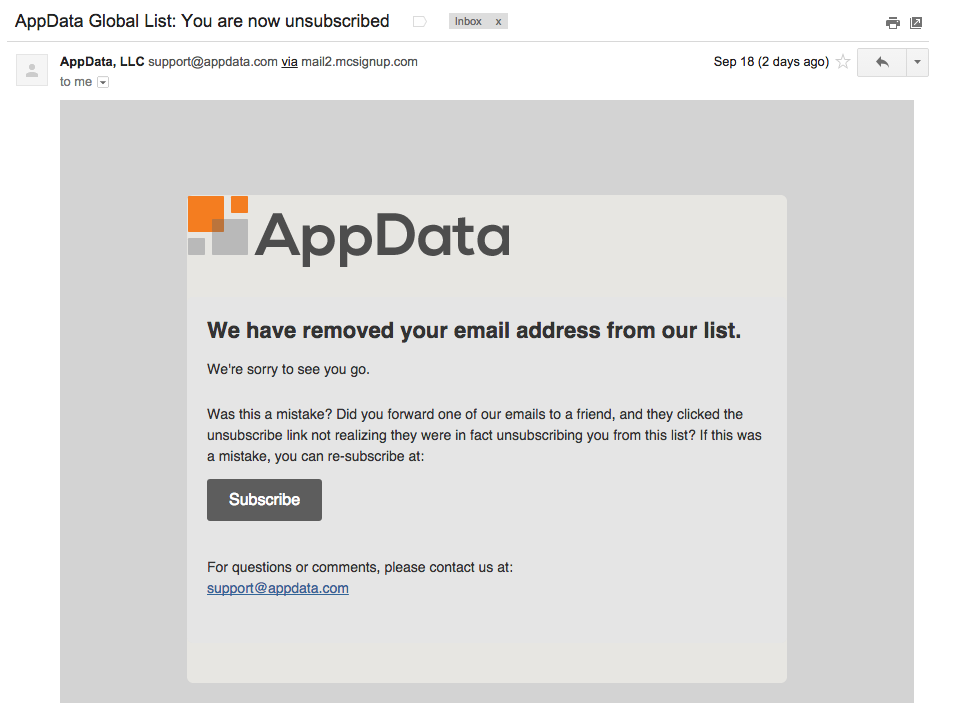
Worse, when you unsubscribe from these mailing lists you inevitably end up signed up to, you're often questioned as to why you'd ever want to stop your inbox being cluttered up with this meaningless crap. I had one email the other day from a service called AppData, a ludicrously expensive analytics service that was attached to the Inside Social Games and Inside Mobile Apps sites I used to write for, which asked whether I had unsubscribed "by mistake". Seriously. Look.

Screen Shot 2014-09-20 at 13.06.32

The sheer arrogance of this is absolutely astonishing. "Oh, no, whoops, I unsubscribed from your marketing spam by mistake. I actually do want you to try and sell me things! Sign me back up, quick!" Or, indeed, "oh no, the pointless marketing spam I forwarded on to my friend [who does this?] annoyed them so much that they tried to unsubscribe themselves and instead unsubscribed me! Sign me back up, quick!"

I kind of understand why this happens. As I said at the beginning, the sheer amount of competition between mobile app and online service providers these days is ridiculous, so they have to resort to ever more drastic measures to retain their users, and hopefully convert them into paying customers — or at least people who will click on ads.

I can't say I feel much sympathy, though. Surely having to resort to this is not a signal that you should market harder. Surely having to resort to this is, instead, a sign that there is far too much pointless, useless crap on the market, and maybe you should try a bit harder to come up with an idea that is actually innovative and helpful to people rather than a rehash of other things people already use? Harsh as it may sound, these days I find myself smiling a little with every email I receive that informs me a pointless, stupid mobile-social service that I reviewed a year or more ago is closing down. I'm glad; there's too much noise in our lives anyway even with just the well-established services like Twitter and Facebook, so stop adding to it.