1716: Desperately Seeking Information

Something a friend of mine said in an online chat earlier made me think about the way we, humanity, use the Internet on a daily basis — and particularly the role that social media plays in many of our lives.

He said that as human beings, we crave information. It doesn't matter what that information is, we're just hungry for it; forever consuming, devouring any input we can get our brains wrapped around, however mundane, stupid or fury-inducing.

After he said this, I took stock of my online existence since leaving Facebook and Twitter behind. I still haven't looked at the former at all; I've peeped at the latter once or twice to see if I had any mentions or direct messages — I didn't (apart from a share of this post by a dentist who clearly hadn't read it at all), which, I won't lie, smarted a bit, but I'll live.

What I have done, however, is almost immediately replace them with other things. I was always intending to make more active use of the Squadron of Shame forums, for example, but they have become my primary go-to hangout online — which makes their occasional lack of activity a little frustrating. (Come join up and talk in a chin-strokey fashion about games!) But that's not all I'm doing: instead of relying on what Twitter is talking about for a picture of the day's news — a practice which tends to give you an inherently biased picture of what is going on, due to the political tendencies of some of Twitter's most vocal users — I'm specifically seeking out sites like the BBC and the Guardian to read about stories at my own pace. (I still skip over anything that just offers me a video and no text, though; fuck video.)

I am not, however, reading a great deal about video games. This is less about losing interest in them — which my marathon Xillia 2 session this evening will emphatically attest that I am not — and more about feeling there aren't really any sites out there that speak to (or for) me. I've discussed this with a number of people with whom I share similar proclivities, and many of us tend to feel the same way: while the ad-based revenue model for these sites continues to be in place, we're never going to see the sort of coverage that we're interested in seeing. Those sites that do try different things — like Polygon with its now-defunct features section, or 1up with its community-driven nature — end up either closing down altogether, or at the very least shedding the things that made them unique and becoming yet another identikit site of daily triple-A and indie darling news churn.

But I digress. The point is, the information void I left when I cut social media out of my life was immediately filled by something else. It's a compulsion; an uncontrollable urge. As a human being, my brain demands information; it needs input. More input.

I'm not entirely sure if that's a healthy compulsion, since as I noted above, the 21st-century brain doesn't appear to be all that selective about what it wants to absorb into itself. Perhaps if the brain craved nothing but new knowledge — information that would allow it to let its host function as a better human being — that might be absolutely fine.

But no. The 21st century brain is interested in menstrual menaces and megachile perihirta (commonly known as the Western leafcutting bee); in cats drinking from squirt bottles and… oh, you get the idea.

The human brain is a mysterious thing. Whatever you may feel about the information you stuff into it on a daily basis, though, I think we can probably all agree that the Internet has had a profound impact on how we perceive, seek out and consume information these days, hmm?
1714: Arachnid Dentistry

I had an enjoyably bizarre dream last night, or possibly early this morning — I'm not quite sure. It doesn't really matter when it occurred; what does matter, however, is that it was most peculiar, and has somehow stayed in my memory for most of the day rather than, as dreams are often wont to do, dissipating in a puff of imagination shortly after getting up.

I will preface this by saying there was no poo involved in this dream. I'm sure you're devastated.

Anyway. The main premise of the dream was that Andie and I were living somewhere that was not the house we now own between us. Instead, we were the proud owners of what appeared to be a rather house-like flat that was actually inside another building. In other words, the flat itself was multi-level, like a house, but its "front door" actually opened into a corridor of the building which contained it rather than onto the street. I recall commenting on this to dream-Andie, noting that she had been adamant about getting a house rather than a flat (she had; it was one of our few "musts" when looking for a new place) and that we'd somehow ended up with a flat instead.

For whatever reason, I elected to step outside what was seemingly our newly acquired flat to go and explore the rest of the building. I followed the corridor from our front door through another set of doors, and discovered that just a little way down from where we now lived was a dental surgery. This struck me as a little odd at the time, but I just shrugged it off. We lived next door to a dentist, and that was just how it was.

I'm not sure how long I walked for, but the building itself appeared to be rather large, with different areas fitted out in noticeably different manners. Lower down — apparently our flat was quite high up in it — the building appeared like a classy hotel, with ostentatious decor and lush carpets; higher up, meanwhile, the drab walls, endless fire doors and strangely arranged staircases called to mind some form of student accommodation I'd spent time in in the past. It wasn't the halls of residence I lived in; I have a feeling it was either some friends' halls, or possibly a sixth form college where I stayed for a residential music course while I was a teen. Either way, it was somewhat out of place when compared to the richly decorated lower levels.

At some point, I got lost. I found myself somewhere on the lower floors in what appeared to be the headquarters of an affluent, successful company — all leather sofas, marble-effect (or possibly just marble) tabletops and shiny floors. Whichever way I turned, I couldn't seem to find the way back where I came from, and eventually ended up on the street. Apparently this building was in Toronto, somewhere near where my friends Mark and Lynette used to live, as I recognised the street corner on which I found myself.

I went back into the building and found that this time I was able to successfully navigate my way back into the hotel lobby-like area, up the stairs into the dorm-like area, and eventually past the dentist back to our flat.

When I came back in, I'm not sure if the arrangement was different or if I just hadn't noticed it before, but bizarrely, there was a shower room right by the living room. Even more strangely, there was a hole in its wall where bricks had seemingly just been removed, leaving an open "window" between the shower and the living room.

For some reason, I opened the door of the shower room and lay down on the floor. There was a computer keyboard in front of me. I started typing, and as I did so, hundreds of small spiders started emerging from the shower's plughole, then crawling into the corner of the room and disappearing. As I continued to type, the spiders kept coming, but they always seemed to be going the same way. I wasn't sure what I was doing, and I didn't really want to know. All I knew was that I needed to keep typing and typing and typing and typing… you know, much like I'm doing right now.

Then I woke up in a state of some confusion that was swiftly followed by disappointment that I was probably too late to go out and get a McDonald's breakfast.

Explain that one, then.

1712: Les Oignons

There are, as you'll know if you've been reading this blog a while now, many things that I do not like and wish to change about myself. Some of these are things I probably could change if I tried hard enough. Others are things that appear to be hard-wired into me, and I couldn't change them now even if I tried.

One of the most frustrating things in this latter category is my dislike of onions.

I have hated onions for as long as I can remember. Initially dismissed by my parents as me just being a fussy eater — like most children, I was fairly fussy about a lot of unfamiliar foods when I was young — I continued to insist that not only did I simply not like onions, but they actually made me want to be sick.

That's not an exaggeration, either; even today, if I can so much as taste a bit of raw onion, it makes me retch and completely puts me off whatever it is I am eating that has turned out to be stuffed full of onion. I won't even eat something that has had raw onion on it, because I remain convinced that raw onion infects the flavours of everything around it, making everything else taste of onion even when the offending slices themselves have long been removed.

The strange thing about my violent dislike of onion is the fact that, in many cases, I'm absolutely fine with it if it's been cooked into something. I don't mind a pasta sauce that incorporates a bit of onion, for example — so long as it's not too much — and I don't mind a curry or Chinese dish that has a bit of onion in it — though again, not too much. Basically if I can taste it, it's out; I cannot think of a single dish that is improved by the presence of onion, but handled correctly I can at least tolerate it.

What's even stranger is that over the last couple of years or so, I've started to find even specifically onion-based things more palatable than I have done in the past. I can eat and even quite enjoy an onion bhaji, for example — though in most cases these have been deep-fried to such a degree that any resemblance to actual onions is by that point purely coincidental — and I have been known to have battered onion rings with steak and the like, too — though I will add to that that I usually smother them in so much sauce that it becomes impossible to discern their oniony origins.

Despite these changes in the last few years, though, I'm doubtful I'll ever be able to eat onion in the same way as a lot of other people I know — and I certainly doubt I will ever get to a stage where I like it enough to specifically want to add it to things. This is frustrating, because it's surprising quite how much food out there — particularly stuff designed for lunchtime consumption like sandwiches, wraps and the like — is absolutely rammed full of onion, in many cases ruining what sounds like an otherwise delicious item of food for me and, more often than not, making it completely unpalatable.

Oh well. I've survived 33 years without onions; I'm pretty sure I can probably go the rest of my life without them, too.

1711: Soporific

I have… a problem.

Said problem is that if I have to sit still and do nothing while concentrating on someone else talking for any length of time, I get extremely sleepy, regardless of how tired I actually am. My eyelids start to get heavy, my body gets tired and all I want to do is just curl up and get comfortable for a bit of a nap.

This is a problem because the times when I am supposed to sit still, do nothing and concentrate on someone else talking for any length of time are generally occasions where it would be impolite to fall asleep. Weddings and funerals, for example, but also meetings.

I've suffered with this issue for as long as I can remember — certainly for as long as I've been an adult. I remember it happening on occasion at university during lectures, but more often than not this could be attributed to a heavy night out the previous evening and a hangover weighing on my mind. (My peers found it terribly amusing when I had to quietly slip out of our weekly piano workshop to go and be a bit sick. Well, I didn't want to throw up all over the Turner Sims concert hall.) At other times, I could fend it off by occupying my brain somewhat: either taking notes if I was actually interested in the subject of the lecture, or doodling the lecturer getting sucked off by some sort of sinister vacuum cleaner-like contraption if I wasn't. (This happened once; it wasn't something I found myself drawing on a regular basis.)

It's mildly embarrassing, but fortunately I've never managed to actually completely fall asleep before. I've come perilously close, I must admit, but I always manage to maintain my faculties and remain in the land of the living. I came perilously close on more than one teacher training day while I worked in schools, too, particularly since said training days tend to ignore everything we're ever taught about engaging people and helping them learn and instead tend to consist of someone waffling on and on and on for hours about something which is, quite possibly, a load of old bollocks.

The peculiar thing is the moment I step out of the situation where I'm supposed to be concentrating on someone else droning on about whatever, I can be back to full alertness in a matter of seconds, with no trace of tiredness. It's just that while I'm sitting there, expected to take in everything that is being said and actually retaining very little of it at all — usually because it's not relevant to me and thus immediately filtered out by my brain — my body appears to go into its shutdown sequence. And I'm sure I'm not the only one.

Or am I? That would be awful, and even more difficult to explain than falling asleep in a meeting already would be. But I guess we'll cross that bridge if — yes, if — we come to it!

1710: Perfectionism

"I'm a perfectionist" may be the lamest, most clichéd answer possible to that equally lame and clichéd job interview question "what is your biggest weakness?" but, well, it really is a weakness.

Why? Because perfectionism often makes you feel responsible for things that aren't your fault. Perfectionism often makes you feel bad for making mistakes based on information you weren't given. Perfectionism often ruins an otherwise pleasant day when that one thing that didn't go quite as well as all the other things weighs on your mind more than the considerably greater number of positive thoughts you could be having.

I came to the conclusion today that I suffer from perfectionism. I hate doing a bad job. I hate feeling like I've made a mistake. I hate feeling like I could have done more.

I made a mistake today. It wasn't a big mistake. It didn't get me into trouble. It didn't hurt anyone or spoil anyone else's day, and thinking about it rationally, from a distance, it wasn't really a "mistake" at all since, as noted above, I didn't have all the information available to hand. It does, however, have the potential to make more work for me — thankfully there is plenty of time to complete said work if it is necessary — and it's probably something I could have avoided. I didn't, however, and now this has happened. And I feel bad.

I'm assured that I shouldn't feel bad, that I wasn't to know, that it might not even be a problem at all — I won't know that latter part until tomorrow — but it's too late; the knowledge that I Did Something Wrong has already sunk in and already made me a bit mopey on the way home. Thankfully I managed to distract myself in time, so with any luck I won't be spending the evening in a depressed haze staring at a wall as often happens on such occasions, but the fact remains: perfectionism stinks.

I'm not sure where this stems from. My most plausible explanation is that it likely hails from my childhood, where I was typically — not to blow my own trumpet here, it's a statement of fact — one of the top-performing students in the class, both in primary and secondary school. On the few occasions where I failed to live up to the standards I had apparently set for both myself and others to expect of me, I felt really bad. I still have a vivid memory of a two-page spread in my Class 2 (year 3 or 4 in new money, I think) Maths book where the left page — on which I had completed a single sum — was adorned with the teacher comment "Lazy work" in red pen, and the right page — on which I had completed three sums, two of which were incorrect — was forever blemished with the words "Very poor", also in red pen.

I was mortified at the time; the rest of my school books were so consistently good and I was so regularly praised and rewarded — "go and colour in a square on your rocket" — that doing something badly brought me crashing down to earth and upset me a great deal. I didn't want anyone to see those pages in my books; they were a stain on my otherwise good record. To my credit, though, I always made sure I was both more industrious and careful in Maths lessons from that point on, even though I absolutely loathed that subject right through until the end of secondary school.

To date, though, every time something doesn't quite go right, I end up feeling like I did that day I got that book back with those two awful pages. Whether it's a negative comment on something I've written, an offhand remark by someone I know or simply the knowledge that I messed up somewhere — even if no-one else knows — it hits me right in the Black Dog and, more often than not, ruins an otherwise good day.

Thankfully, the very act of writing this post is helping banish such thoughts from my mind, and I fully intend to go and have a thoroughly pleasant evening now. So suck that, perfectionism.

1709: Stories All Around

Whenever I see a police car or an ambulance screaming down the road in the opposite direction to the way I'm going, I can't help but wonder where they're going, what they're doing and what the story behind that split-second encounter was. For a brief moment, my own story — usually something rather mundane like going to the shops or to get some petrol — intersects with that of some other people; an exciting, possibly tragic story that I will likely never know the details of.

That doesn't stop me wondering, though.

Stories are all around us. Everyone you see is living their own story. And while few of them live up to the obnoxious banner currently hanging in Southampton's WestQuay shopping centre (which promotes a local photography studio and reads "The Most Important Story Ever Told: Yours"), they're all different and they're all interesting in their own way. It can be kind of mind-boggling to contemplate quite how many things are going on at any given time, particularly when you contemplate how many things happen to you — however mundane — on any given day.

It's in acknowledging the fact that stories are going on all around us — and continue without our intervention — that it becomes possible to craft a convincing, compelling fictional world. And it's true across all forms of media: many comic books these days unfold in shared universes, with foreground events in one series fading into the background in others, but still being acknowledged; crossover TV shows keep their own narratives mostly parallel, but occasionally bend inwards a little to meet for a fleeting episode or two before diverging again; prolific authors spend volume after volume building up a convincing mental picture of how their world works, and the many adventures that the people therein have over time.

And the same is, of course, true of video games. The most well-crafted video games embrace this feeling of stories happening all around us at any time and, more so than any other medium, allow us to explore them at our leisure, pursuing the threads we're interested in to build up a full picture of what it must really like to be an inhabitant of a virtual world.

This sort of thing is particularly important in sprawling role-playing games, where a poorly crafted world can do great harm to the immersion factor of the game. It's the reason why the Elder Scrolls games have never really resonated with me: I never got the sense that the people wandering around and occasionally looking in my direction mattered; I never got the sense that they had their own personal stories, even when they formed the basis of a quest or two. There was the odd exception — tucked away in a few nooks and crannies were some interesting diary entries and illicit items that suggested all was perhaps not as it seemed with a character that seemed otherwise respectable — but for the most part, the identikit nature of most of the characters in these games was immensely offputting.

It will doubtless not surprise you to hear that this is one thing I feel Final Fantasy XIV does exceptionally well, much as its predecessor Final Fantasy XI did before it. Although the world is primarily populated by static NPCs who go about their same old business at all times of day or night — that and the players, of course — the game does, on regular occasions, make the effort to make the land of Eorzea feel truly lived-in.

This is most apparent in the relatively recently added "Postmoogle" quests, in which you're recruited (somewhat reluctantly) by the Deputy Postmoogle to deliver a series of letters to various characters around the realm. Mechanically, these quests are little more than "go here, talk to this person" fetch quests, but if you stop and pay attention to what is being said — and who is involved — they take on a whole new amount of meaning.

This is because they involve characters that you will have seen elsewhere out and about in the world in various contexts.

One quest sees you accompanying the aptly named Hunberct Longhaft and his two adoring Miqo'te companions around the city of Ul'Dah; your only previous contact with these characters will have been during one of the major "FATE" events out in the world, at which point there was little time for conversation, but just enough time to wonder exactly what was going on between Hunberct and the two Miqo'te.

Another sees you engaging in conversation with a group of four gladiators whom you've likely only ever encountered as the last "boss" of the dungeon Halatali (Hard). Another still delves into the background of the "aesthetician" — the character you can summon from your inn room to get a new haircut — and his Ishgardian heritage.

It's not just the Postmoogle quests that do this, however. Many of the sidequests that have been added since the game's launch acknowledge popular minor characters, such as the ill-fated adventuring party you run into early in the game's main scenario, whose erstwhile leader is beheaded in battle "off-camera" while you run your first dungeons. The next time you meet the group, the healer of the party — the deceased leader's fiancee — is carrying his head around in a bag with her, stricken with guilt; the next time you meet them, which is much, much later, at level 50, long after the initial main scenario is over and done with, things have gone very, very wrong indeed.

Final Fantasy XIV is far from the only example of this idea of stories being all around us being used effectively in video games, but it's one of the best in recent memory.

I still can't help wondering where that ambulance was going, though. I hope the person it was on its way to help is all right.

1707: Speccy

I bought some new glasses recently, at great expense. (For those of you with 20/20 vision, be happy; glasses are expensive.) I picked them up this morning and I was actually quite excited about it — I've felt that my current pair haven't been quite "right" for a little while, and a recent eye test confirmed that yes, my right eye in particular seems to have changed a bit, and a new pair of glasses probably wouldn't be a terrible idea. (They probably weren't a terrible idea anyway, since my current pair are now several years old and, having been attached to my face for the majority of that time, are now also covered in that unpleasant but reassuringly familiar clink that builds up around the nosepiece of glasses that are worn on a daily basis.)

Anyway, I put on the new glasses to try them and they immediately felt a little odd. I was assured that it was largely to do with the fact that my eyes were adjusting to the new lenses, though; after all, if my right eye had changed a bit, it had probably been overcompensating somewhat for the lenses in my current pair. I was then encouraged to keep them on for the whole day in order to try and adjust, and discouraged from returning to my old pair.

Well, I tried. I kept the new pair on for most of the day, but when I reached mid-afternoon and found myself sporting a headache that I can only describe as "excruciating" — it was near migraine-like in its intensity, nausea-inducing tendencies and quantity of colourful flashing lights it was attracting in front of my vision — I came to the conclusion that no amount of "adjustment" was going to fix this; the glasses were simply not quite right.

This is a bit of a bummer, since it means I have to make another appointment with the opticians to attempt to get this sorted. I imagine it will probably result in another eye test, too, which will be a pain to schedule around work, and then, of course, I'll end up having to wait for some new lenses, assuming they do need replacing. This isn't the end of the world, since my current glasses are still perfectly acceptable, but I was looking forward to enjoying the improved clarity and magic blue light-reducing lenses of the new ones.

Sadly it seems that is not to be for now; it would seem unwise to try and just cope with a pair of glasses that make me feel slightly cross-eyed at best and make me want to throw up and fall over at worst. With any luck, I'll be able to get them sorted out this week.

These things happen, of course, but I can't deny being a little disappointed by all this. I've not had a bad experience with opticians in the years since I started wearing glasses, so it's a shame to run into this issue. Now comes the test of whether Boots' customer service is up to snuff or not… I guess we'll find out on Monday!

1706: Bug Me and I Leave You

Given the ubiquity of technology these days, there's a lot more competition between apps and online services than there ever was in the past. This means that all of them have to stoop to increasingly low levels in order to get people to "engage" with them, leading to a situation we've simply not had prior to the last few years.

That situation comes in the form of apps and services begging you to use them. It's obnoxious, obtrusive and, more to the point, makes me disinclined to make use of that app or service ever again. In fact, in most cases, if an app or service begs me to use it or come back, I will simply uninstall it or unsubscribe from their mailing list.

The most egregious example I can think of recently was an app called TuneIn Radio. I was recommended this as a good means of listening to both streaming Internet radio and podcasts, but was dismayed to discover after firing it up just once that it then insisted on reminding me of its own existence at least once a day via a push notification that was usually recommending something I had absolutely no interest in whatsoever. ("Listen to TalkSport!" Oh, how little you know me.) However good the app is, notifications bug me enough at the best of times, so in the bin it went.

I'm still getting email messages from services I had to sign up for when I was reviewing endless reams of shitty mobile-social apps for Inside Mobile Apps, too. Eventually I simply registered for these services with an email address I don't use any more, and this mitigated the problem somewhat, but there are still times where there are services that I haven't touched for a year or more feel the need to email me and remind me that they exist.

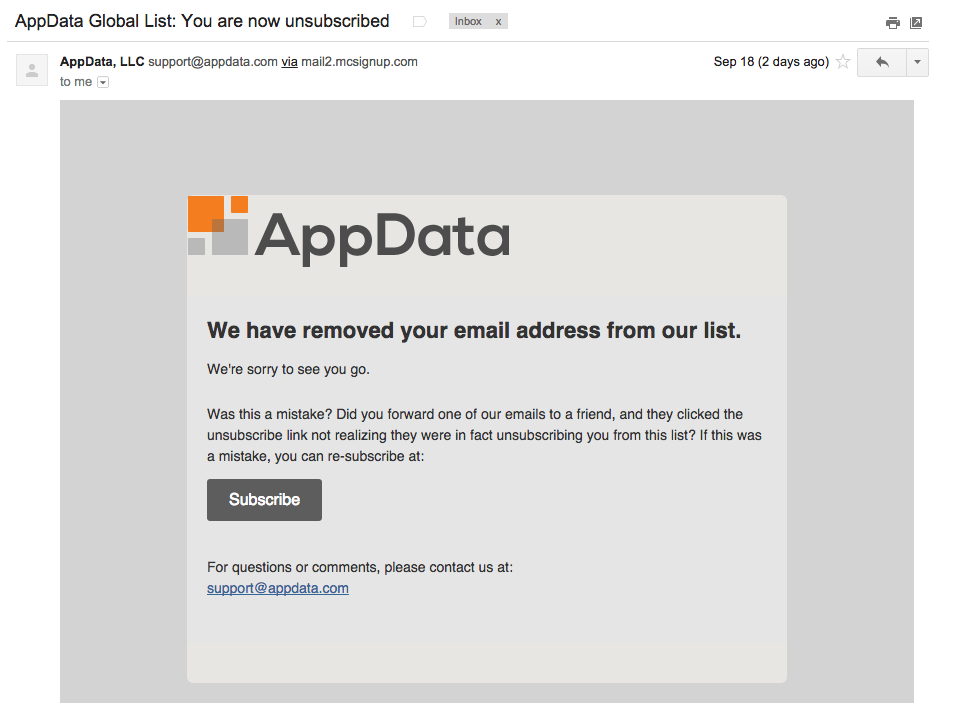
Worse, when you unsubscribe from these mailing lists you inevitably end up signed up to, you're often questioned as to why you'd ever want to stop your inbox being cluttered up with this meaningless crap. I had one email the other day from a service called AppData, a ludicrously expensive analytics service that was attached to the Inside Social Games and Inside Mobile Apps sites I used to write for, which asked whether I had unsubscribed "by mistake". Seriously. Look.

Screen Shot 2014-09-20 at 13.06.32

The sheer arrogance of this is absolutely astonishing. "Oh, no, whoops, I unsubscribed from your marketing spam by mistake. I actually do want you to try and sell me things! Sign me back up, quick!" Or, indeed, "oh no, the pointless marketing spam I forwarded on to my friend [who does this?] annoyed them so much that they tried to unsubscribe themselves and instead unsubscribed me! Sign me back up, quick!"

I kind of understand why this happens. As I said at the beginning, the sheer amount of competition between mobile app and online service providers these days is ridiculous, so they have to resort to ever more drastic measures to retain their users, and hopefully convert them into paying customers — or at least people who will click on ads.

I can't say I feel much sympathy, though. Surely having to resort to this is not a signal that you should market harder. Surely having to resort to this is, instead, a sign that there is far too much pointless, useless crap on the market, and maybe you should try a bit harder to come up with an idea that is actually innovative and helpful to people rather than a rehash of other things people already use? Harsh as it may sound, these days I find myself smiling a little with every email I receive that informs me a pointless, stupid mobile-social service that I reviewed a year or more ago is closing down. I'm glad; there's too much noise in our lives anyway even with just the well-established services like Twitter and Facebook, so stop adding to it.

1704: The Improved Posting Experience

All right, WordPress, you win. After bugging me constantly with urges to try the "improved posting experience" while I was just trying to write my blog, let's give this "improved posting experience" a go and see if it's actually any better than the "posting experience" most WordPress users are accustomed to. Here we go, then.

Screen Shot 2014-09-18 at 23.20.32

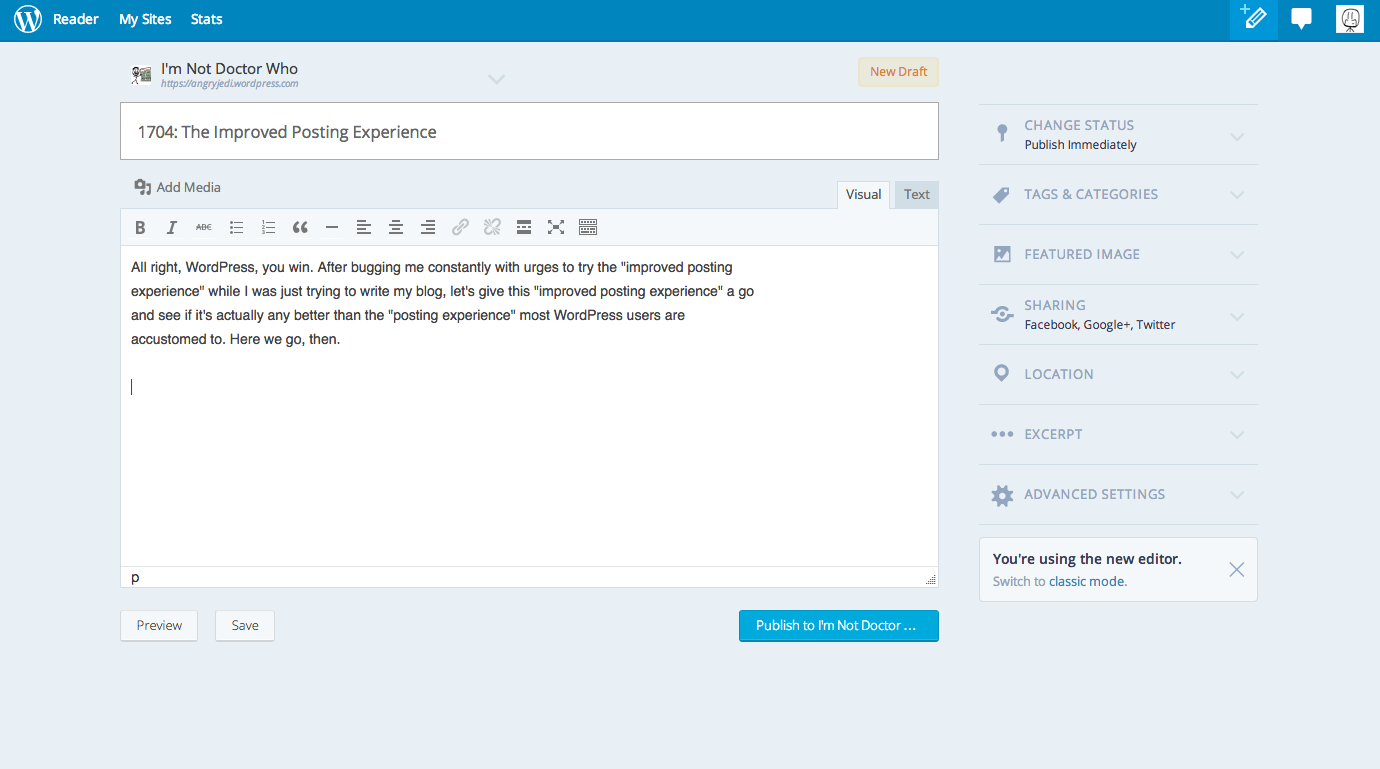
So first up, it's pretty blue. This puts it in line with the main WordPress.com site, where those using WordPress.com to manage their blog and/or be part of the WordPress community of bloggers can tweak their blog settings, fiddle with multiple sites and subscribe to other people's blogs. In that sense, it's consistent; however, where it's inconsistent is with the rest of the WordPress dashboard, which is still the black and grey it's ever been.

Let's take a look at functionality.

Screen Shot 2014-09-18 at 23.20.57

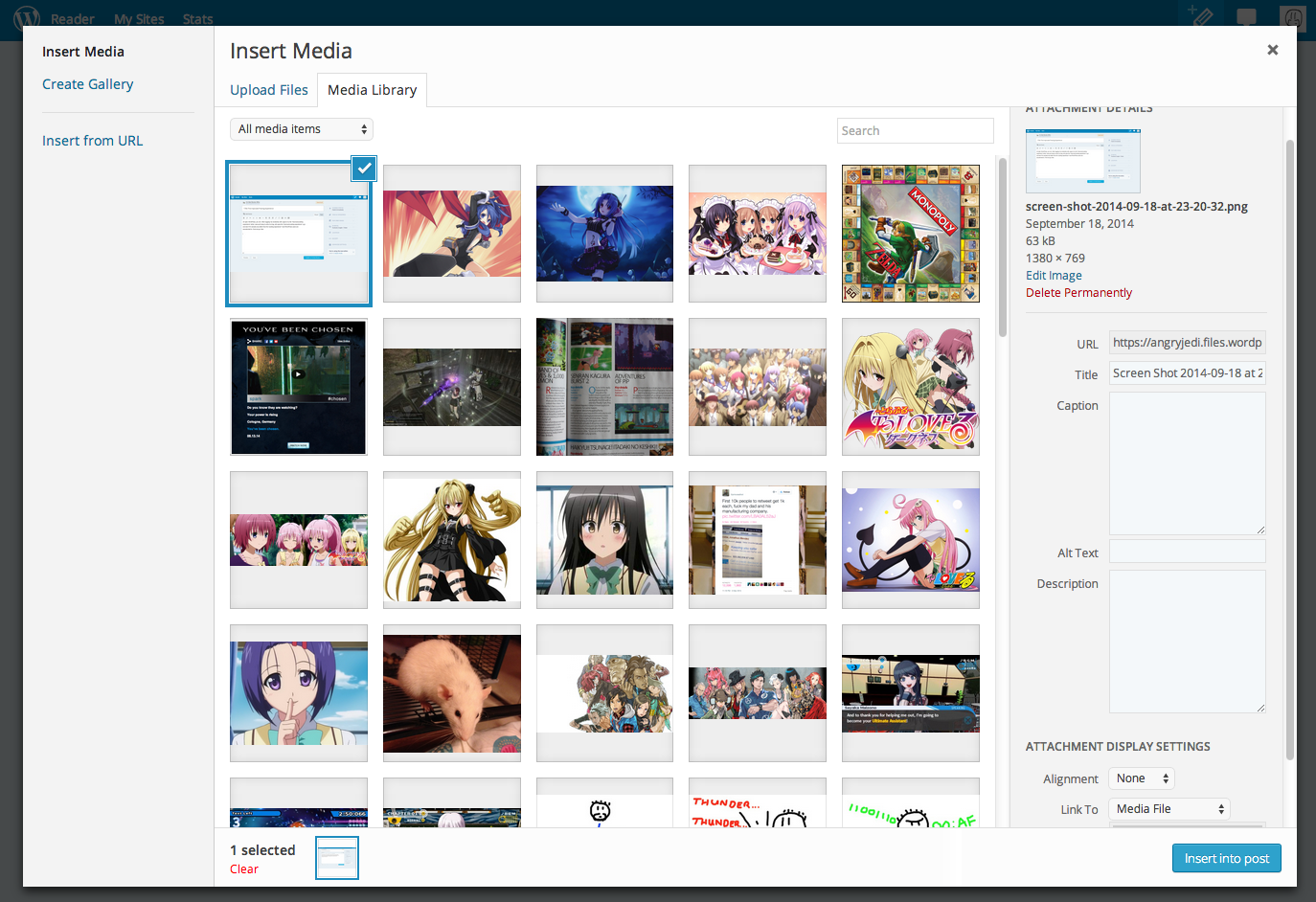
There's drag and drop for images… sort of. You can drag an image file onto the post editor, but this doesn't automatically insert it into the post at the point where you drop it, disappointingly; rather, it simply brings up the regular media browser (which now doesn't match the new editor) and uploads the image, at which point you can insert it into the post where you left the cursor. (This didn't work first time I tried; I had to close the media browser, reposition the cursor, then open it again and then insert.) It also inexplicably forgets the default setting for image size that you might have been using in the "classic mode" (ugh) "posting experience".

As for other functionality, there's the same toolbar as the regular WordPress "posting experience" (no, I'm not going to stop the sarcastic quotation marks around that phrase anytime soon) but, like the media browser, it forgets your default settings, in this case whether you have the "kitchen sink" second row of buttons (allowing access to styles, underline, justification, text colour, special characters, indents, undo and redo — all pretty useful stuff) open or not.

Over on the right of the editor, there's a bunch of pop-open menus for the post's status (draft, scheduled, published), tags and categories, a featured image, whether the post will be shared on social media (and whether there will be a custom message), an attached location, a front-page excerpt, and the mysterious "advanced settings", which include… drum roll…

…a custom slug, the author of the post, the format of the post, its visibility, whether or not it's a sticky, and whether it allows likes, shares, comments and pingbacks. Hmm. Not all that advanced, really.

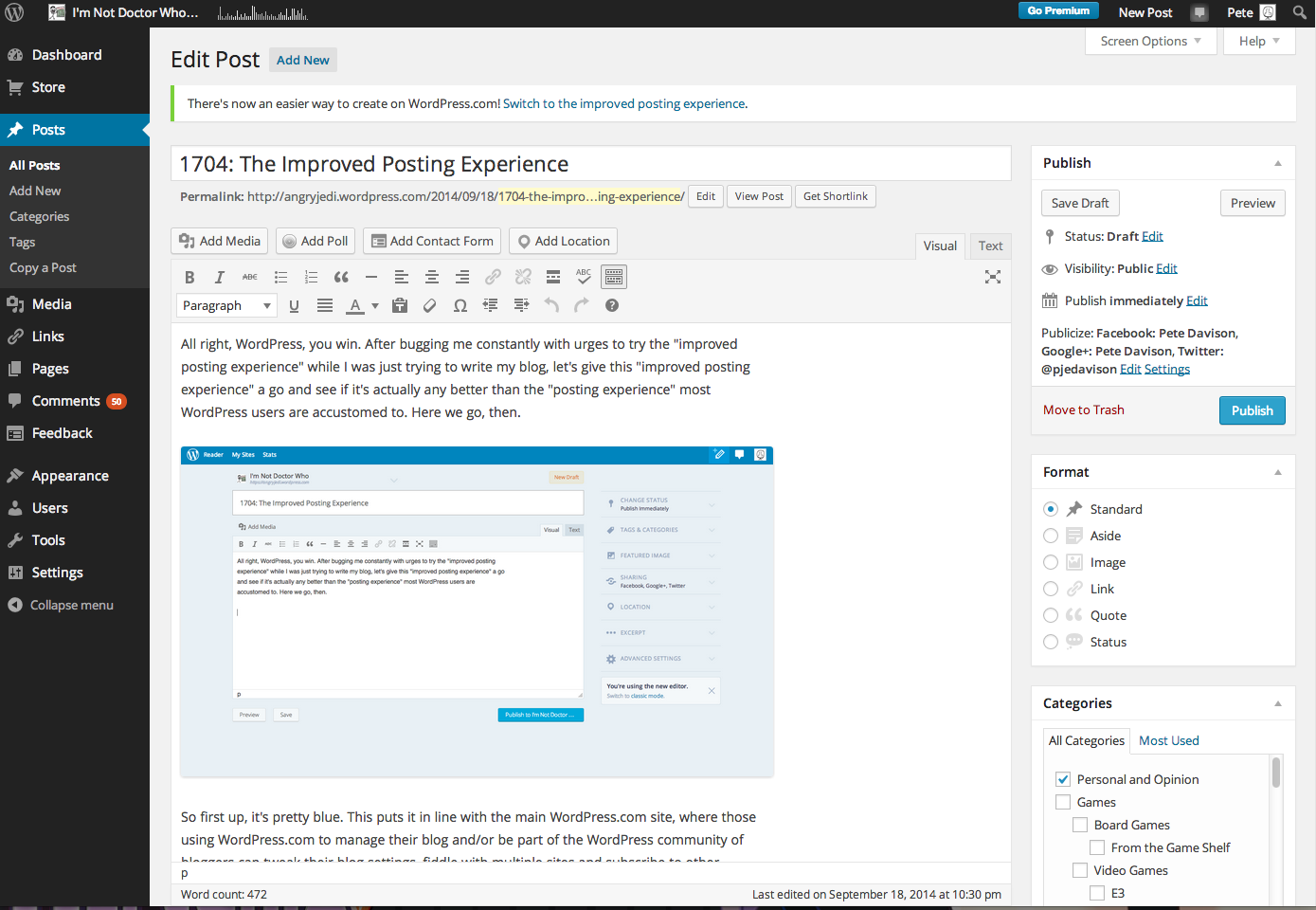
I can't really tell what's better about this "improved posting experience" to be honest, and in a number of ways it's actually inferior. It certainly looks quite nice — the pop-open menus on the right keep things very neat and clean, for example — but it has this improved look at the expense of ease of access to information and settings.

Screen Shot 2014-09-18 at 23.31.46

The standard WordPress editor may be more cluttered and rather more clinical-looking than the soft blues of the "improved posting experience", but it's also considerably superior. Information and settings can be popped open and closed at will — it's all open rather than closed by default — and the screen gives you much more information, most notably on the status bar at the bottom of the editor, where you have a word count and a "last edited" date — both of which are completely absent from the "improved posting experience". There's also easy access to all other aspects of your site via the left-hand side menu.

Also worthy of note: when I started writing this post, there was a button to switch back to "classic mode" which promptly disappeared when I saved a draft. Getting back to the standard editor required logging back into this site's dashboard, going to the post list and then choosing to edit my draft. Somewhat cumbersome.

I can see the intent behind the "improved posting experience" — it's to strip out all the stuff that might prove daunting to those less familiar with technology and software such as WordPress. It's an attempt to make it into a simple and clean blog editor along the lines of Tumblr. Trouble is, that's never what WordPress has been about; WordPress has always been the blog solution to go to when you want customisability and a lot of control over what you're posting, when and how — and without having to mess around with HTML and CSS for styling.

Perhaps the "improved posting experience" will encourage more new users to give blogging a serious go. And that's ultimately a good thing. For people like me, though, who have been using WordPress for years now, it's very much a step backwards rather than forwards.

1703: Beans, Beans, Beans

I've never really felt like all those pieces of conventional wisdom regarding certain foods and drinks actually have the intended effect on me — at least not until the last few years or so. I'm not sure if they're actually having more of an effect on me as I get older, or if I'm simply more conscious of the effect they're having on me. Either way, I'm starting to notice that some of the things regarding food and drink I've long had a certain degree of doubt over are perhaps a little more true than I thought.

Take coffee, for example. Now, my past resilience to caffeine — I've long been able to drink a cup of joe in the evening and not have it affect my sleep patterns, though this is perhaps due to the fact that my sleep patterns are already somewhat questionable — can perhaps be attributed to the sheer amount of the stuff I've put into my body on a regular basis ever since I was quite young. Coffee is seen by some as a "grown-up drink" — perhaps because of its bitterness, and the fact that, without milk, it's an acquired taste — but I've been drinking it in various forms for as long as I can remember. Okay, for the first few years of my life it was milky Nescafé, but as soon as the world discovered fancy, expensive coffees I was right there with everyone — though I must confess I don't go as far as some people, largely because I have no idea what a "wet latte" is.

Anyway. The fact is, I've always drunk a lot of coffee — and buying a nice coffee machine a while back certainly didn't help me cut back, not that I particularly wanted to. As such, my body has apparently grown somewhat accustomed to caffeine, and thus a simple coffee never felt like it had a huge amount of effect on me. Sure, if I drank too many coffees and Red Bulls in a day, I'd get the shakes and feel a bit sick — as bad a feeling as any hangover, that, let me tell you — but for the most part, I never felt like caffeine made me any more "alert" or gave me a buzz as legend had it that it was supposed to.

Recently, however, I've cut back on coffee somewhat, largely due to the fact that it costs money to go and get a decent coffee at work (I could take instant, but, frankly, I'm a snob about coffee now and find that most instant — with the possible exception of Nescafé Azera, which is actually pretty good — tastes like crap) and thus I drink far less on any given day. And, as a result, I feel like caffeine is having more of an effect on me. I know a morning coffee certainly feels like it helps — and if I need to pep up a bit in the afternoon, another cup feels like it helps too. It's possibly psychosomatic, of course — which is what I've long suspected when it comes to caffeine — but, well, it's working for me.

An area where I have less doubt is in the matter of baked beans. Now, those of you with fond memories of the schoolyard will doubtless remember the short piece of juvenile poetry that taught everyone that while beans were indeed good for one's heart, they had a habit of also afflicting one with a certain degree of flatulence.

I've never really actually considered this to be true, despite the popular perception of eating beans being akin to allowing a Northern mining town free rein to hold brass band rehearsals somewhere within the cavernous expanse of your rectum. However, once again, just recently I have discovered that there may, in fact, be a degree more truth in this piece of popular wisdom than I had initially anticipated.

I had a jacket potato for lunch the other day, you see. My workplace canteen boasts some of the largest baked potatoes I've ever seen, and they're cooked nicely so that there's a bit of crispiness to the skin while they remain fluffy and not dried out within. There are few fillings available for said baked potatoes, but one of them is the old staple baked beans, optionally with the addition of cheese. I indulged in this classic combination, then went back to work in the afternoon. Upon reaching the end of the day, I found myself feeling a little bloated, but thought little of it and walked the 15-minute walk back to my car.

Upon reaching my car and sitting down inside, it happened: an attack of flatulence that bore an uncanny resemblance to distant — but rapidly approaching — rolling thunder. Starting subtly but quickly building in a crescendo of gaseous overtones, the entire affair lasted a good ten seconds or so, after which the feeling of being somewhat bloated had magically passed. It took another ten minutes for me to stop laughing enough to be able to drive off safely.

Naturally, upon discovering that the canteen's particular brand of baked beans had such a dramatic impact on me, I had to try again. And so it was that today I indulged in another gigantic jacket potato with beans and cheese — and a jelly for afters, because who can resist a jelly? — and so it was that once again, upon returning to my vehicle after a long day staring at my computer screen, I erupted in a cacophony of full-bodied guffs that I can hardly deny were extremely satisfying to release. I was even a bit sorry that no-one was around to hear them.

So yeah. Beans, beans, good for your heart; beans, beans really do… you know.