2048: You're A Monster

0048_001As I've mentioned a couple of times recently, I've been reading the Monster Musume manga as well as keeping up with the anime adaptation, and I've been enjoying both a great deal.

While Monster Musume is, on the surface, a somewhat pervy ecchi harem series with all the requisite sexual tension plus copious boob and panty shots (albeit attached to non-human girls with "monstrous" features), at its heart beats a heart of gold and a number of positive messages: accepting people for who they are without judgement; not relying on first impressions to figure people out; standing up for what you believe in; and forgiving people when they make a mistake, particularly if they make it while they're trying to learn something new.

I find the monster girl angle particularly interesting. As I noted when I first started checking out the anime, I'm unfamiliar with the monster girl trope in general, so it was somewhat jarring to see these obviously non-human girls initially; they've clearly all been designed with traditionally attractive anime/manga character visual tropes in mind, but in most cases there's just enough of the monstrous to make you feel a little uncomfortable if you're not already au fait with taking a walk on the wild side.

BL8LlZr

In the case of Monster Musume, we have Miia's extremely long snake tail, its companion clumsiness and her specifically snake-like characteristics such as her fangs and the fact she sheds her skin regularly; we have Papi's bird legs and wings instead of arms attached to a distinctly young-looking body; we have the fact that Centorea's arse is a horse (and her knockers are enormous); we have the fact that Suu is a slime girl who initially is completely unable to communicate through any means other than mimicking the things she has observed others doing; and, of course, we have Rachnea the spider-lady.

It's interesting how the sequence in which these girls are introduced goes: although Miia is one of the more "monstrous" girls in a visual sense, in terms of character she's probably the most "normal", albeit rather more lovestruck than your average young woman. Papi is naive and innocent — considerably more stupid than her supposed actual age, with her intelligence and common sense more appropriate for her somewhat childlike appearance — and doesn't quite fit in to "normal" society as a result, but is still reasonably recognisable as acting somewhat "human-like". Centorea lives by some distinctly "fantasy world"-style values — all "honour" this, "my lord" that, plus her arse is a horse. Suu is in many ways the most "alien" of all the monster girls, at least in the early chapters; she has no idea that she regularly puts poor protagonist Kimihito at risk of drowning every time she embraced him a bit enthusiastically, and her initial inability to communicate puts her at a distinct disadvantage compared to the other girls (while also providing plenty of comic relief, as you might expect). Mero — who, so far, has been the least interesting, least developed character to me — presents an interesting take on attitudes to folklore by being obsessed with the tale of The Little Mermaid, but for its tragic angle rather than its romantic aspects.

In many way, though, Rachnera is one of the most interesting characters. In terms of visual design, being a spider woman, she's the most obviously "non-human" of the lot; while Suu acts in an alien manner, she at least takes on humanoid form at the best of times. Rachnera, meanwhile, is quite literally an enormous spider with a woman's upper half, and is consequently quite frightening to look at, particularly given how she's introduced in some delightfully creepy scenes. Kimihito is true to his values, though, and doesn't judge her by her appearance at all; when he first encounters her, he even appears largely dismissive of her monstrous nature and fetishises her spider legs, being a self-confessed "leg man".

dddd

Rachnera is one of the most grounded, honest characters in Monster Musume, as it happens. She arguably acts in the most "adult" manner of the whole lot — though this can be taken in several ways, since not only is she mature in her attitudes and responses to situations, she's also very sexually aggressive. More importantly, though, she's completely at ease with herself, accepting both her monstrous nature (and all the difficulties that can sometimes cause) and her sexually adventurous side, particularly her predilection for bondage play, which a number of different cast members end up on the receiving end of with varying degrees of willingness.

To me, Rachnera was the most initially jarring monster girl to make an appearance — largely because I still haaaaate real spiders — but from what I've seen of her so far, she's also one of the most likeable. She's not necessarily the one I find the most attractive (I think that dubious honour goes to Miia) but, well, she does have a fine pair on her, and she's an interesting character whom it would probably be fun — if, at times, unsettling — to hang out with.

I'm looking forward to the rest of the series and seeing how these characters develop. It's easy to dismiss Monster Musume as cheap fanservice — as it is with many things that initially appear to be cheap fanservice — but as I've said, beneath the boobs and lamia panties (they're stick-on!) and sexual assault by slime girls, it's a delightful series with a wonderfully positive message.

I'm glad my friend Chris convinced me to check it out for myself, because without his wild enthusing about monster girls, I would have probably thought I'd be too squicked out by the girls' more monstrous aspects to enjoy it. But, as it turns out, it's not at all difficult to start accepting people just as people, regardless of what their extremities look like…

2046: Reading Material

0046_001

Since my post a few days ago about getting into manga, I've been well and truly bitten by the bug, as it were, and I'm also about to branch out into my first light novels, which we'll come onto a little later.

So far, I've read the first volume of Monster Musume, Is It Wrong to Try to Pick Up Girls in a Dungeon?  (better known as DanMachi) and High School DxD, and have subsequently picked up the subsequent five volumes of Monster Musume and two more of High School DxD. (The later volumes of DanMachi have proven surprisingly difficult to track down, a fact not helped by the fact that Amazon has its listings for the light novel and manga versions all squished together into a not-particularly-clear form.)

Longtime readers or those who know me will recognise all of the above titles as series that I've watched the anime of, and this was a deliberate choice. I was initially hesitant to do so, but it turns out that reading the manga having seen the anime (or, I imagine, vice versa — I haven't done this way round yet) doesn't particularly diminish the experience any. In fact, in many cases the manga, being slightly longer in form than your typical anime's 13 20-minute episodes, goes into more detail than its animated counterpart, often with new story threads, deeper exploration of characters and sometimes even a different overall tone.

Light novels, meanwhile, are something I haven't explored at all, and until recently I wasn't even particularly sure if there was a distinction between them and, you know, just a plain ol' novel. "Light novels" are very much a Thing in Japanese popular culture, though, with many popular series starting as a light novel and subsequently being adapted into other forms of media such as manga, anime, video games and visual novels, so I was curious to investigate this particular part of culture.

I haven't read any yet, but I have picked up two volumes of Sword Art Online: Progressive, a retelling of Sword Art Online's original Aincrad arc, focusing on more personal stories and a single "floor" of the game at a time. It's an ambitious project, considering the Aincrad arc supposedly unfolded over the course of several years and 75 floors — the first two volumes just cover floors 1 and 2 — but I'll be interested to see if it comes to fruition, plus the Sword Art Online anime drew some criticism from certain quarters for rushing through the narrative of the original light novel it was based on, so I'll be interested to see the story retold (and tweaked a bit, from what I understand) from a new perspective.

Anyway, if you were wondering, a "light novel" appears to be the Japanese equivalent of young adult fiction: relatively short works, often illustrated, but primarily text-based rather than the visual nature of manga. I'm interested to dive in; it's actually been quite a while since I've read any book (i.e. one with words rather than one with pictures and speech bubbles — not that there's anything inherently "inferior" about that format) so this will be a nice return to form if the Progressive novels prove to be a compelling read; I used to absolutely devour books, but for one reason or another, I've not really found a lot of time for reading in the last few years.

Ironic, really, considering the number of words I've typed on this here blog over the last few years — including a substantial number of fiction prose — but perhaps this will give me some ideas of my own!

2045: Pondering Localisations and Translations

0045_001

There was a bit of salt being spilled earlier today on the subject of translations and localisations. It's clearly a topic that people feel very strongly about so I'm not going to give a "judgement" one way or the other on it, simply share my own thoughts.

The discussion surrounding this issue came about as a result of Gaijinworks' recent release of Class of Heroes 2 on PSP. Gaijinworks is a company that specialises in localisations of Japanese games, and is made up of, among other people, former Working Designs staffers. Working Designs was a company from the PS1 era who also specialised in localising Japanese games.

The use of "localisation" rather than "translation" is important there, because the two terms refer to two distinctly different schools of thought on what to do when bringing non-English material into English-speaking territories. A translation is exactly what it sounds like: it's taking the original text and, as literally as possible, reproducing it in another language. A localisation, meanwhile, takes the essence of the original text but takes varying degrees of artistic license with it in order to make it more accessible to people outside of its original audience.

The furore over Gaijinworks' localisation of Class of Heroes 2 largely stems from the fact that, in the eyes of many people who prefer more literal translations, the team had taken unnecessary liberties with the original text, even going so far as to put in completely incongruous ability names for certain character classes — the most egregious being the Samurai class' use of "Pimp Slap" and "Hammer Time". The whole thing would have probably died down a bit quicker were it not for whoever runs Gaijinworks' Twitter account turning on the snark and speaking to disappointed customers in a tone that… wasn't entirely appropriate, shall we say. Consequently, the company has done a bit of damage to its reputation among fans of Japanese games; on the one hand, both Working Designs and Gaijinworks are known for their talent in localisation rather than translations, so people should have perhaps expected something like this to happen; on the other hand, however, responding to criticism with snark and the suggestion that people learn the original language (sure! It's just that easy!) isn't the best way to recover an unfortunate situation.

But I don't want to dwell on that too much, because I'm sure there's still plenty more arguing to do there — and anyway, to be perfectly honest, localisation that takes some liberties doesn't really bother me all that much, so long as the essence of the original text and characters is left intact.

A good example is the Ace Attorney series by Capcom. In Japan, these are set in Japan, known as Gyakuten Saiban (Turnabout Trial) and star a character called Naruhodou Ryuuichi. In the West, they are set in the USA (albeit a version of the USA where there are traditional Japanese villages randomly scattered around the place) and their protagonist is called Phoenix Wright. There are all manner of other changes around the place — and the games aren't any weaker for it. In fact, Westernising it made it a lot more accessible to a much wider audience — so much so that it's widely renowned as one of the best mainstream adventure game/visual novel series in recent years.

The reason a lot of companies choose to localise rather than translate is to do with things that… well, simply don't translate. In the cast of Ace Attorney, the protagonist's name "Naruhodou" is based on the Japanese word "I see" — something that your average, non-Japanese-literate Westerner wouldn't know. Making his surname "Wright", though, opens up all sorts of potential for punning fun — potential that the games seize at every opportunity. Right, Wright? Or should I call you Phoenix Wrong?

Then there's things like the fact that Japanese puns work in a completely different way to English ones; take Squid Girl, for example. In the Japanese original, Squid Girl ends all her sentences with the words "de geso" instead of the more common "desu" (roughly, "it is"), the former being a bastardisation of "desu" that incorporates the Japanese word for "squid legs". Likewise, all the episode titles are expressed as questions, only using the word "ika" (squid) at the end of the sentence rather than the particle "ka" which denotes a question. Because both of these puns rely on Japanese grammar and particles, which are very different to English, it's simply not possible to translate these things directly. So instead we get a localisation, where Squid Girl speaking in English instead takes the English approach to punning, shoehorning in references to squids and ink at every opportunity. Squidn't that ink-redible?

Ahem. Anyway. The point is, in some circumstances, localisation works well and helps to expand the audience of something beyond what it would have if it remained more true to the original. This is particularly true when it comes to cultures that are very different from one another — such as, say, Japanese and American or English cultures. People like to be comforted by the familiar, and making something more comfortable is a sure way of getting people who might not have otherwise given a particular game a chance to actually try it out for themselves.

On the flip side, localisation loses some "authenticity", and consequently isn't entirely appropriate in all circumstances. Take the Persona series, for example; its third and fourth installments in particular are heavily based on Japanese culture, particularly surrounding teenage and high school life. While there are similarities between Japanese and Western high-schoolers, there are enough differences — particularly with regards to things like how people address one another — to make it worthwhile using a more literal translation. Not only does it make the experience more authentic for those who wish to use it as a means of immersing themselves in a culture they find fascinating, it also provides a very effective means of learning about that other culture from scratch.

Some games take this idea of education and really run with it. Visual novel Steins;Gate, for example, includes an in-game glossary that explains everything from otaku terminology to Japanese cultural norms as you work your way through it — the first instance of a non-English term or reference is highlighted, providing the player with the opportunity to look it up, and from that point on, it simply uses the term as it would be used in Japanese. In this way, you familiarise yourself with everything from elements of Japanese popular culture to ways in which people address one another — and again, it's a fascinating way of learning something while you enjoy the story.

And then there are situations where either approach could work. A good example would be something like the Hyperdimension Neptunia series, whose English scripts over the years (initially by NIS America, now by Idea Factory International) have had a somewhat mixed reception from longstanding fans — particularly those familiar with the original scripts. There are some changes that just seem to have been put in for the sake of a quick pun that wasn't present in the original — the English version's use of "CPU" (Console Patron Unit) instead of the Japanese version's "megami" ("goddess"), for example, as well as Neptune's use of distinctly Western-style slang. Personally speaking, this sort of thing doesn't bother me too much — it works as a pun, although arguably it's making a bigger deal of the whole "look! all these girls are games consoles!" thing than the original Japanese script did — but there are some people who get pretty upset about this sort of thing.

I guess what we can conclude from all this is that, unfortunately, there is no one single optimal way to handle these things. Localise things too much and you risk alienating the purists who want something that is as true as possible to the original text. Conversely, translate something too literally and you either get something that reads very awkwardly in English, or something that isn't entirely accessible to someone who isn't already familiar with various aspects of Japanese culture. The ideal situation would appear to be somewhere in the middle, but very few people seem to get that balance absolutely right, and doubtless we'll continue to see salt being spilled any time things tip a bit too far in one direction or another.

Me? I really don't mind either way. I relish the opportunity to learn more about a culture I find fascinating through more literally translated works, but equally I very much enjoy a good localisation that remains reasonably true to the tone and intention of the original; in the latter case, it might perhaps help to think of it as a "remake" of sorts rather than a translation. Or it might not, in which case you can feel free to rant and rave about it as much as you like on social media. More often than not, though, I'm simply happy to have these games (and anime series, and manga series, and visual novels…) brought to the West in my native language so that I can enjoy them in some form, even if it's not always quite the exact same as the original.

2044: No, Thank You

0044_001

In response to The Daily Post's writing prompt: "No, Thank You."

"If you could permanently ban a word from general usage, which one would it be? Why?"

I'm going to cheat a little here and not talk about a specific word, but more a general style of communication. There are numerous words that could be used to represent this style of communication, but not one that particularly stands out more than others, so I'm going to talk in more general terms.

As most of you know, the rise of the Internet over the course of the last few decades has made it easier than ever for people to communicate with one another. And with that ease of communication has come a relaxation of the rules of formality when communicating. In some ways, this is a bit of a shame, because the distinction between formal and informal use of language can often send implicit signals to the people in an interaction as to what is and is not appropriate to talk about. But in others, I'm actually very much relieved about this, because formal language is so mind-numbingly impersonal it's borderline offensive to be confronted with.

I'm thinking particularly in terms of "professional" email messages here, and I'll give you an example of the distinction. I've been doing some freelance work for a company for a while. When I started, the company was very much in its infancy, with relatively few employees and a single point of contact for the work I was doing. Said point of contact was a delightful young woman who was always chatty, helpful and charming whenever we spoke to one another. It was a pleasure to interact with her, even though for the most part we were only ever exchanging standard pleasantries and details of work assignments. But just little things like her squealing enthusiasm for me when I told her I was getting married, or chats about the extremes of weather we've seen this summer — all of those things were nice, and gave me a feeling of being "connected" to her and, by extension, a feeling of "belonging" to the company as a whole, despite simply being an outside contractor.

A few weeks ago, my former contact was replaced as she (presumably) moved on to other duties in the company as it has started to grow. She's still with the company and tends to get copied in on email messages, but I haven't heard a peep out of her since. Her replacements are like robots. And I mean that pretty much literally — every message I get from them absolutely stinks of copy-and-paste, email-by-template communication… largely because they clearly are copy-and-paste emails-by-template, and it's easy to tell this due to the fact that there are the exact same words in each one.

There's a good reason for this sort of thing, of course; as companies grow and have to communicate and collaborate with more and more people, it's not considered to be particularly efficient to manually type out each and every message. So in come the templates, the form letters, the copy-and-paste boilerplate text.

Efficient it may be, but that feeling of "connection" is gone as a result. I don't know these people, and even having sent messages to them in the same tone as I spoke with my previous contact, they've made no effort to engage with me in any way; I may as well be downloading assignments from an automated message board.

This is frustrating enough by itself, but combine it with the passive-aggressive tone that business communications tend to take — all "gentle reminders" and "looking forward" to something you haven't done yet — and it's not something that I feel is particularly conducive to a good working relationship.

It doesn't really bother me all that much, to be honest; the company in question is a means to an end (said end being "getting money") for me right now, and ultimately a personal connection with it isn't all that important to me. I just find it a little sad that what was once friendly, personal interactions between two people now feels like sending commands and requests to an automated system. You're human beings; act like it!

So, to (sort of) answer the original question, then: I would ban business-speak, form letters and email templates from general usage and insist that everyone communicate with everyone else as an individual. It would help make the world just a little bit friendlier as a result, and I feel that would work wonders for making people feel more positive about all sorts of things.

2043: This Would Go Great with Cola

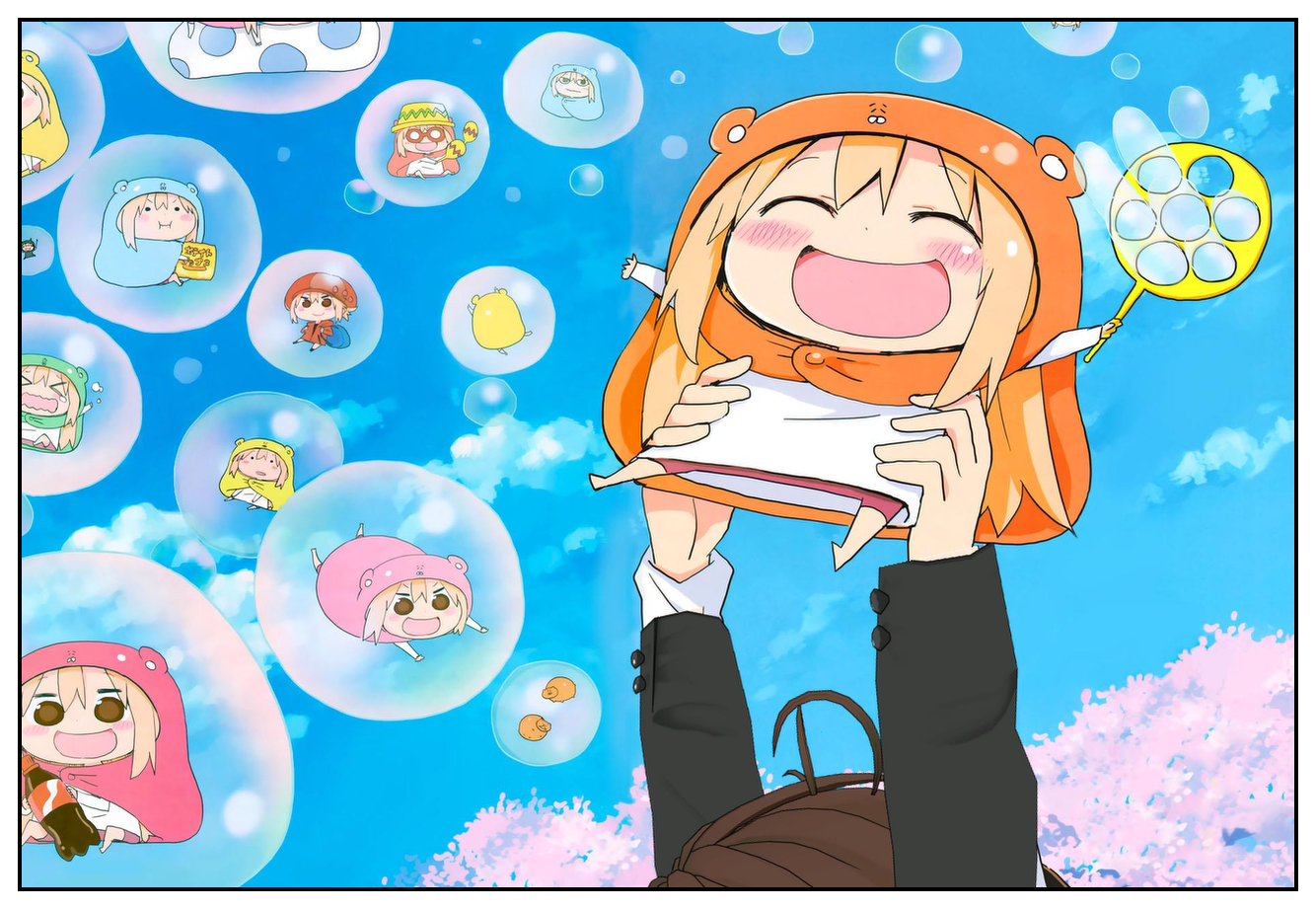
0043_001One of the highlights of the current anime season is Himouto! Umaru-chan, a rather odd little show that takes the Squid Girl approach of splitting each "episode" up into several shorter little vignettes in which nothing really happens, but it's entertaining nonetheless.
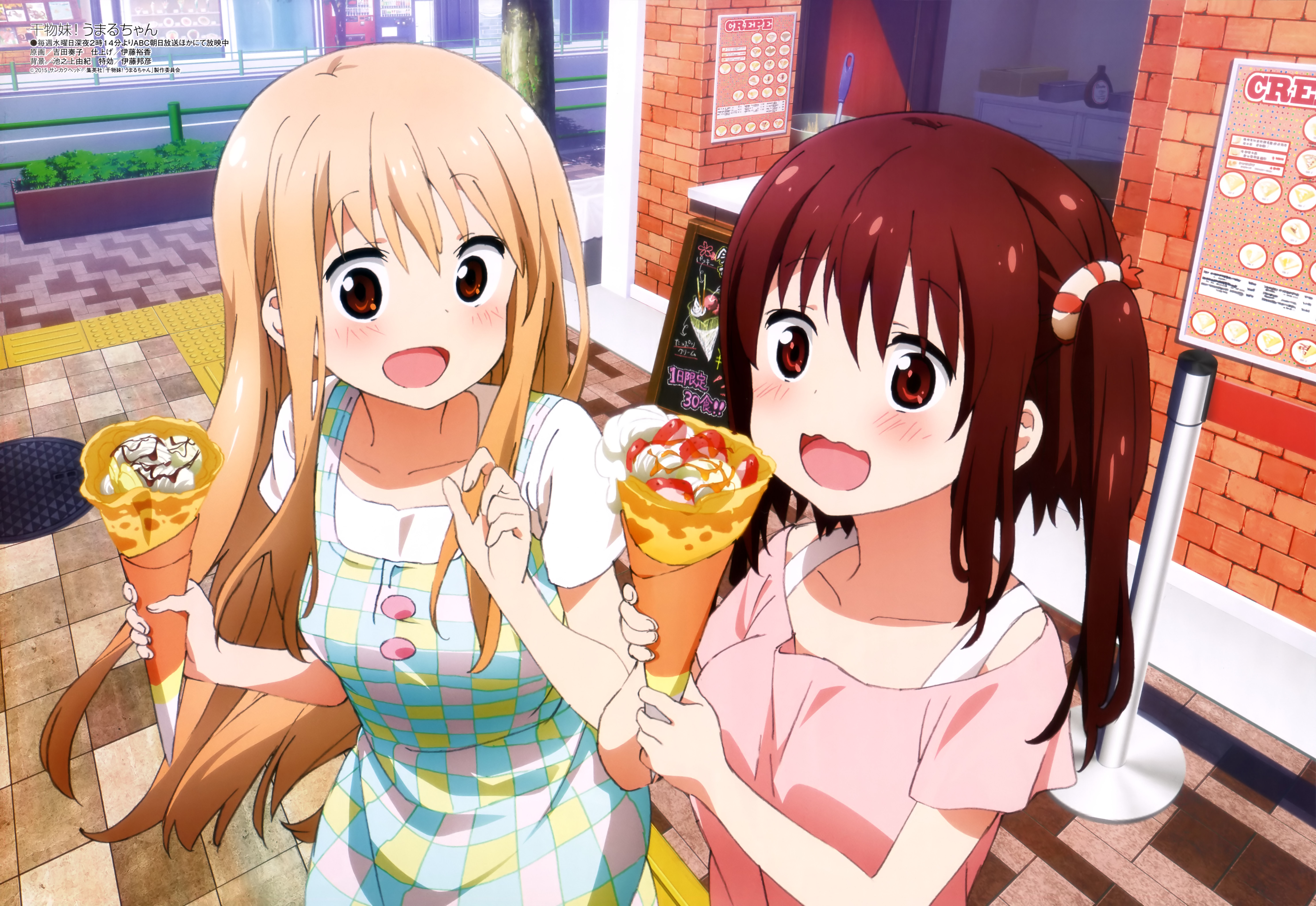
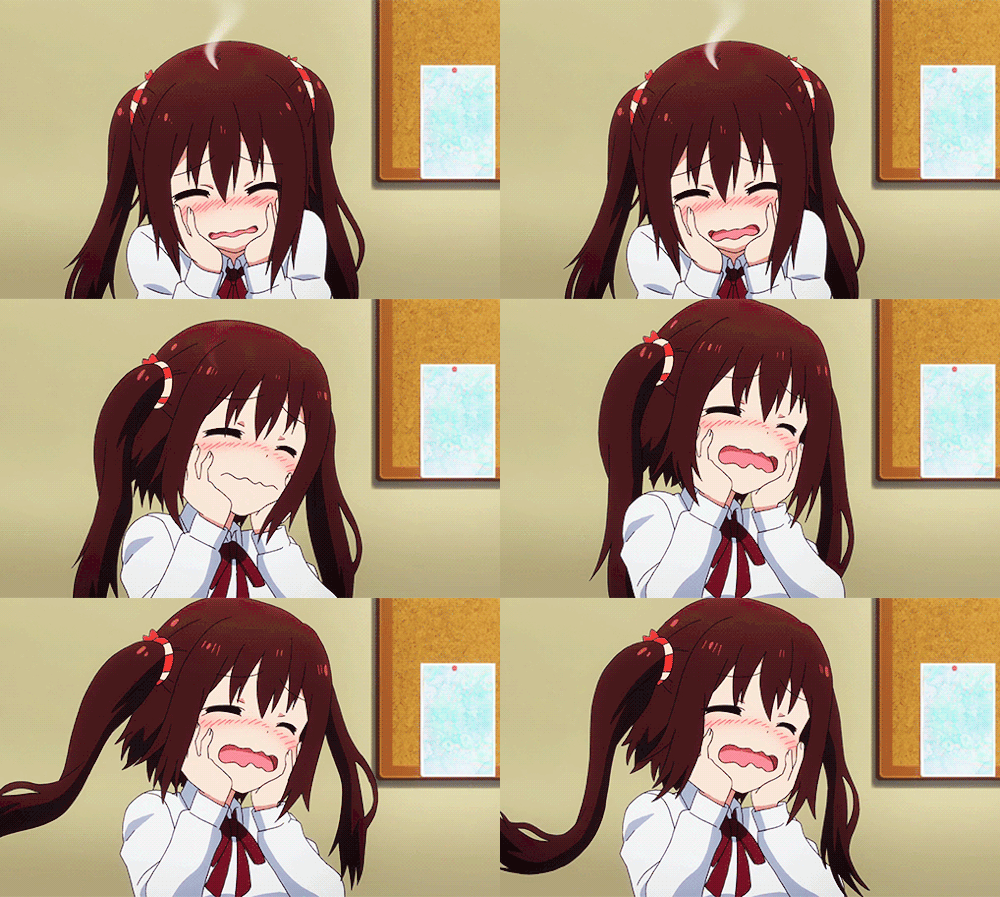
Umaru (as I shall refer to it hereafter for simplicity's sake) is a show that exemplifies the Japanese concepts of honne and tatemae, these being a person's "true feelings" and their "public face" (or, literally, "facade") respectively. Title character Umaru is the very model of beauty and respectability when she's out in public: she's the darling of her whole school, always gets the best grades, is good at sports and is respected by everyone. Back home, however, she's a lazy slob who sponges off her long-suffering brother and sits around in her hamster hoodie playing games and drinking cola all day.

Himouto!.Umaru-chan.full.1907662

Umaru highlights this contrast by literally changing the character's appearance when she switches from one "face" to the other. When she's out in public being the beautiful and respected Umaru-chan, she's the epitome of moe — long, flowing hair; big, sparkling eyes; a calming, gentle voice — but when she gets back home she immediately becomes represented by a short, aggressive, chibi character that is cute in an entirely different way to "full-size" Umaru. Her behaviour and mannerisms are completely different, her voice becomes louder and more forceful, but it's abundantly clear that this is when she's at her happiest.

As the series progresses, Umaru reveals a third persona: that of the elite gamer "UMR". UMR is something of a balancing act between the two extremes she had previously exhibited up until this point; she's realistically proportioned and acts like a normal human being, but is passionate and enthusiastic about gaming — not to mention in possession of some serious skills. UMR is by far the most naturally likeable of all Umaru's personalities since she tends to keep things fairly low-key — she even dresses considerably more conservatively than her "ideal schoolgirl" persona — but is also a lot more honest about who she really is.

ebina

The idea of the necessity of putting up a facade for the rest of the world to respect you is a defining characteristic of the series, and it's not just Umaru who exhibits this. Umaru's friend Ebina, for example (above), is an attractive, busty young girl who draws the eyes of everyone around her, but she's afraid to open her mouth in case her country bumpkin dialect slips out, as it occasionally does when she's feeling at ease and comfortable. Likewise, recurring character Kirie is completely unable to approach moe Umaru at school, despite wanting to, but she manages to bond with lazy slob Umaru — whom she actually believes to be Umaru's younger sister, just to complicate matters — over games, cola and laziness.

Over time, these characters all become better defined, and their different personas start to merge into one another. I'm interested to see whether or not the series intends to "say anything" with this concept by its conclusion, or whether it's simply going to continue using them for comic effect. Either way is fine by me; Umaru is not the kind of show that particularly feels like it needs to have a strong moral message — though I won't deny it will be somewhat satisfying to see the precocious little slob version of Umaru get her comeuppance for taking her poor brother for granted by the end of the run!

Regardless of how it ends, Himouto! Umaru-chan has been a really fun series so far, and I hope there's more in the future.

2042: Question Time

0042_001For today's post, I'm going to raid my Retrospring inbox for questions, then answer them. (I'll be posting these answers on Retrospring as I go, too, so if you follow me on Twitter and have read these already, you can safely skip this post.)

Let's begin!

Is chivalry dead?

I wouldn't say it's "dead" per se, but I do feel like it's almost frowned upon in today's hyper-sensitive culture surrounding gender. Acts that one person believes to be "chivalrous" can be interpreted as "benevolent sexism" by another, so it feels almost like chivalrous acts are being discouraged — at least when it comes to traditional things like a man holding the door open for a woman, "ladies first" and all that sort of thing. Personally speaking, I think this is a load of old tosh, but in the interests of keeping people quiet I just try and be a decent sort of chap to anyone, regardless of gender.

Ever regretted something you've done even though you know it's really just a small and unimportant thing?

Oh yeah! Many, many times. As I sit here I'm having trouble thinking of a specific example, but yes, most definitely. With the anxiety-riddled way in which my mind works, too, I inevitably end up spending hours or even days worrying about whether or not I should have done that thing.

I guess a good example would be from back before I started doing Slimming World; a hefty proportion of my weight gain could probably be attributed to simply not knowing when to stop, and consuming, say, an entire bag of sweets even though I'd maybe start feeling a bit queasy halfway through the bag and should probably have stopped then. I regretted doing that every time it happened, because I could see the consequences. It took a long time to pluck up the courage to admit it was a problem and finally do something about it, though. Now I'm 4.5 stone lighter than I was when this was an issue, and I certainly don't regret that particular decision.

What are some of your favorite Japanese Role Playing Games?

I really have trouble picking favourites, as I tend to have a positive outlook on whatever I'm playing, and it's pretty rare I will abandon something completely — I usually try to "see the good" in things where possible, because that's much more fun and rewarding than writing something off immediately. As a result of this, I've become a fan of many games that have either flown under the radar or been poorly reviewed by the media.

Favourites off the top of my head include the Hyperdimension Neptunia series, Tales of Xillia and its sequel, Criminal Girls, Omega Quintet, Final Fantasy XIV, ZHP: Unlosing Ranger vs. Darkdeath Evilman (really must beat that one day) and… oh, too many to list.

In games where you have the option of playing Good or Evil, which side do you generally pick?

Good. Always. I find it way too difficult to play Evil; I get emotionally attached to things very easily indeed, and I feel really bad mistreating them, even if they're just a collection of pixels. The only time I ever really successfully played "evil" was when I worked through the Dark Brotherhood storyline in Oblivion. Even then, once I was done with that and the Thieves' Guild's quests, I couldn't resist embarking on a journey of redemption and was pretty much a paragon of virtue by the time I was finished with that game.

How do you feel with ecchi in anime when it's not central ?

I like it! I'm a red-blooded male and I enjoy some tits and ass as much as a typical red-blooded male can be expected to. I feel ecchi is most effective when it's incorporated as part of a work's overall aesthetic, though, rather than just dropped in for the sake of a quick panty shot just to say there's a panty shot in there. Senran Kagura is a good example, though that's a game, I know: there, the ecchi is simply part of the game's overall look and feel, and after spending some time with the game it's simply What It Does.

Would you rather talk online publicly or privately?

I can't really give a straight answer to that one, because it's different for different situations. I talk about things privately with my friends when I don't want to "go public" with something, or if it would be inappropriate, unprofessional, a breach of an agreement or outright illegal to do so. But I also talk about things publicly, because that's one of the main ways you meet new people and find out more about them on the Internet. Without talking about things publicly, I wouldn't have made some of the great friends I've made on the Internet over the last few years.

Ever felt like pretty convincing evidence is staring you straight in the face but you still fervently deny whatever it is the evidence is pointing at?

I'm sure there are plenty of examples of this, but admitting what they are wouldn't be fervently denying them now, would it? Human beings are stubborn creatures; when we get an opinion on something, we sure as hell don't like to change our minds about it.

DO YOU LIKE TO CYBER-TEXT?

Sure. The written word can be a powerful, uh, stimulus. To the… imagination. Yes, imagination.

Do you own any collector/premium/limited editions of things you like?

Yeah! I didn't used to bother with limited editions, but since getting into Japanese games and anime, I've been much more inclined to pick up special editions where possible, I think perhaps because I'm aware these things are "rarer" by their very definition of being more niche interest than, say, your Assassin's Creeds or your Call of Duties. I'm enjoying being a collector of these things, and I proudly display them on my shelf at home. They're a conversation piece as well as being something that brings me comfort, as strange as that might sound.


All right, I think that'll do for now. If you want to ask me random stupid questions now and again, pay my Retrospring profile a visit here — you can even ask questions anonymously if you want!

2039: He's On the Manga

0039_001

I decided today — and not for the first time — that with my interest in all things Japanese, it was high time that I got involved in manga: the print side of Japanese popular entertainment, and, in many cases, the original source of various series that go on to become popular anime series.

People who are big into manga are always going on about how the original manga (or, if you're a real otaku hipster, light novel) is, more often than not, better than the 13-episode anime adaptation. And, to be fair, I can sort of see their point; while anime has a lot more immediacy about it thanks to the combination of colour, music, sound, voice acting and, you know, animation, the longer format of manga allows it by its very definition to go into more detail, to explore characters, themes and storylines further, and to provide a more "comprehensive" experience for fans. Plus it's the otaku equivalent of watching a movie adaptation of a book and going "well, the book was better" (which it often is).

Anyway. The manga I decided to jump into are ones that I'm already reasonably familiar with the anime adaptations of. I considered picking up the Sword Art Online manga, but I kind of want to check out the light novels rather than the manga, since that was the original original version, and most people say that it explores the storyline at a much more manageable pace than the breakneck speed of the anime. Instead, then, I picked up the first volumes of Monster Musume and High School DxD.

I haven't checked out DxD yet, but I've read the first couple of chapters of Monster Musume. So far I'm impressed with how true the anime has stuck to the tone and feel of the manga, though the manga itself is a bit more explicit in a number of ways — most notably with the presence of nipples, but also in another sense in that it fleshes out the storyline and characters' inner thoughts a lot more. So far it hasn't been vastly different from the anime, but I understand that differences between anime and manga tend to come a little later as a series progresses; anime often skip out large chunks of the manga with varying degrees of success, and I believe in Monster Musume's case there are characters who are in the manga who aren't in the anime. Possibly. Maybe.

The other advantage of reading the manga — assuming you stick with it through multiple volumes, of course — is that you can read further on in the story than the anime tends to go. A lot of 13-episode anime seasons end just as they're getting interesting — DanMachi (aka Is It Wrong to Try to Pick Up Girls in a Dungeon?) was the last show to do this — and then present their audience with a substantial and frustrating wait before they can see any more. Meanwhile, in many cases, the manga comes out first, allowing you to continue following your favourite characters' (mis)adventures well before the adaptation hits the airwaves.

So far I don't know how long I'll stick with these series or any others I decide to pick up. I've enjoyed the couple of chapters of Monster Musume that I've read so far, and it's a fun, different way to engage with a series that I've come to enjoy a whole lot since it launched. So we'll see!

I should probably reorganise my bookshelves in anticipation, though…

2037: I Killed a Volcano

0037_001Another Sword Art Online Re:Hollow Fragment post, I'm afraid, but, well, deal with it; it's good, I'm enjoying it, and I want to talk more about it.
I was describing the game to a friend earlier and the thing that struck me is how utterly different from your typical JRPG it is. It's extremely non-linear at heart — that is to say, there are a number of parallel linear objectives to follow at any given moment, but it's always entirely up to you which one you pursue at any given moment, or even whether you pursue them at all or just decide to grind out a few levels fighting powerful enemies.

So far the "main" quests I've encountered include the ascent of Aincrad, which is the way you "beat" the game; the storyline that unfolds as you unlock access to each part of the Hollow Area; the "Grand Quest" which mysteriously appears on one trip to the Administration Area; and a line of waifu-specific objectives that demand you go into the Hollow Area with a specific companion and complete a particular kind of Hollow Mission, the exact details of which are usually given in fairly vague terms, so you have to figure out exactly which missions will fulfil their criteria for yourself.

In my relatively brief session on the game earlier, I chose to forego the waifu quests I had previously been working on (largely because I couldn't find a Hollow Mission that involved fighting kobolds or goblins to progress Silica's questline) and instead continue with the Grand Quest. This part of the game — which I believe was added in a free update post-release on the original Vita version — involves entering a mysterious new part of the already mysterious Hollow Area, known as the Abandoned Area, and promises the reward of powerful new Sword Skills that you can't get anywhere else.

The Abandoned Area is introduced to you with a beautiful garden, one end of which is dominated by an enormous pair of doors — doors which are, of course, locked. However, since Sword Art Online is well and truly aware that it is a game, it very much follows the rules of a game, and consequently there are two obvious depressions in the door where "something" most certainly fits. And, wouldn't you know it, there are two pathways out of the garden, each of which leads to a different "dungeon" area — one in some fiery caves, another in the mountains. And oh! It just so happens that your map indicates that there's a powerful Area Boss waiting in the furthest reaches of each of these areas. Guess what you have to do to progress the Grand Quest?

It's not just as simple as wandering in and smacking the boss about a bit, though, not least of which because the bosses are challenging encounters with plenty of mechanics to figure out. In order to even get at the boss of the fiery cave area, you need to complete a number of different Hollow Missions that reveal some interesting facts about the local fauna — most notably the explosive bugs that become petrified when they die, and which conveniently explode with sufficient force to knock down walls when triggered by the correct catalyst. Once you've discovered this useful piece of information, you then have to scour the area for other instances of these petrified bugs, blow them up and see if they reveal a convenient pathway through to the boss.

The mountain area is similar in execution, though it is set up in such a way as to prevent you from progressing too far without completing the fiery caves first — you need a key item to melt open a door that is frozen shut. In this area, however, you quickly encounter the Area Boss without too much difficulty, who promptly screeches at you with a noise so terrible you're forced to retreat. The challenge here, then, is to uncover a means of protecting yourself against his powerful sonic attacks. I'm yet to discover exactly what that means is, but it will almost certainly involve a convenient Key Item somewhere, because that's how games work and, as previously noted, Sword Art Online is very much aware that it is a game.

The fiery cave area boss — dramatically known as Gaiard the Volcano — is a great fight that is far more than simple hack and slash. It's a fight where you'll have to pay attention to what moves are coming up — they are telegraphed in various ways — move carefully to avoid them, order your companion around (assuming you brought one with you) and take every opportunity you have to get in your most powerful attacks. It's an intense fight that really doesn't let up for a moment; opportunities to attack are short and easy to miss if you're not paying attention, and you need to keep a close eye on your partner's condition, too; letting them die is as instant a Game Over as if you died yourself. It's extremely satisfying when you finally clear it, however; it took me a good few attempts, but like the very best boss fights, it never felt like I was being smacked around by cheap, unfair moves — I learned something every time and progressed a little further, until eventually I was able to counter almost all his earth-shaking attacks and take full advantage of the openings that were presented throughout the battle.

If you're the sort of person who enjoys setting their own objectives and pursuing things in whatever order they like, then, Sword Art Online Re:Hollow Fragment is something that will very much appeal. Plus I was delighted to see today that it appears to be a top-seller on PSN right now, which means that it's a game that is getting noticed, played, enjoyed and promoted by people who like it. That makes me really happy; while it is far from the most technically proficient game in the world — the upscaled PSP graphics and somewhat inconsistent frame rate will be a culture shock for many — it's a beautifully designed, enormously addictive and extremely playable game that I can see myself spending a very long time with before I move on to something else.

2035: I Pledge Allegiance

0035_001

In response to The Daily Post's writing prompt: "I Pledge Allegiance."

"Are you patriotic?" asks the Daily Post today. "What does being patriotic mean to you?"

Hmm. My initial reaction to this would be to say "no", but on a bit of reflection it's a little more complex than that. I mean, I don't consider myself patriotic in the sense that I'd be willing to die for my country or anything, and I have no desire to go into politics or the military or any other field that would allow me to represent Great Britain on the world stage.

But I do kind of like being British, even though there are things I hate about it and there are things about it that I am ashamed of. For a lot of outsiders — particularly Americans — stereotypical Britishness (such as that which I have a tendency to exhibit) carries with it a certain air of respectability and even authoritativeness, and that's quite a nice feeling. Plus supposedly girls find British accents sexy, which is not something I'm particularly concerned with now I'm married, of course, but again, it's quite nice to know.

Really, the thing I don't like the most about being British is the fact that thanks to the international nature of the online age — the "global village" as I believe people used to like calling it — I have a lot of friends all over the world: some in Europe, some in Australia, some in Japan, some in the Americas, some in Canada. And while I welcome the opportunity to be able to talk to these people every day online thanks to places like this blog, Twitter and other services out there, it is occasionally a bit of a bummer that I only have relatively few friends who are actually local to me, and thus it's quite a challenge to be able to get people together to do things that we'd all enjoy. I'm a little envious of those people who do live near friends that they're able to see more than once every couple of weeks, to be honest.

This, of course, isn't specifically tied to being British, but I think it's a contributing factor in there. The things that I'm into, I feel, are not stereotypically "British" in nature. I'm supposed to be into football and cricket and motorsports, and I don't like any of those things (except, in the latter case, in virtual form) — instead I relish geeky pursuits such as video games, board games, anime, writing, music, that sort of thing. All of these things "feel" like they're more popular, more widespread, more accepted in places such as the States. And while there are small communities of people who get together to indulge in these things here in the UK, I feel like I'm yet to really latch on to any of them. Andie and I used to attend a regular board gaming get-together in a local pub, but for one reason and another (primarily the amount of time it took us both to get back from work at the time) we stopped going along.

I'm also trying to involve my friends in my enjoyment of anime, but this has proven to be a bit of an uphill struggle to date. Perhaps I just need to pester them a little bit more; the last time I mentioned it, there was at least a little bit of interest, particularly at the prospect of an "anime, food and drink" evening shamelessly stolen from my Canadian friends who hold such an event on a regular basis.

I feel like I've kind of got off topic a little bit here, but no matter. I guess, to return to the original question, no, I don't especially consider myself patriotic, but I'm not ashamed to be British, either. I don't try and pretend I'm something I'm not, but I'm also aware that the path I walk is a little outside that which we can call "normality", for want of a better description. And I'm kind of cool with that; it'd just be nice to be able to share these things a little more easily with others, I guess.

2034: The Hollow Area

0034_001Been playing some more Sword Art Online Re:Hollow Fragment for the past few days, and I'm thoroughly enamoured with it. It's quite unlike any RPG I've played before, though I must say, it does a pretty good job with the whole "simulated MMO" deal, particularly as you can even play it in cooperative multiplayer.

I've mostly been exploring the "Hollow Area" part of the game, which is the vast new section originally added in the Vita version of the game; the original PSP version only covered the last 25 floors of Aincrad up to the final boss on Floor 100. Aincrad is a mostly linear experience; the Hollow Area, meanwhile, though gated by story progression in a few places, is much more non-linear in nature since you can freely move between regions, take on any "Hollow Missions" you choose or simply explore, fight monsters and seek treasure.

Interestingly, this aspect of the game is the one area where Re:Hollow Fragment differs from a real MMO: while the first time you enter a new zone in an MMO you'll probably take some time to explore and map it fully, most MMOs design their areas in such a way as to be easily navigable by large groups of people, and once you've been everywhere, you've been everywhere; no further exploration needed. When it comes to dungeons, any kind of exploration is usually discouraged entirely in favour of a linear sequence of encounters culminating in one or more highly scripted boss fights. There's nothing wrong with this; when it comes to herding a group of players towards their objective together — particularly when they might not be able to communicate with one another due to issues such as the language barrier, console players not having a keyboard to hand or people simply being unwilling to talk — it's best to keep things as simple as possible so no-one gets lost, everyone can have a good time and work their way through efficiently.

Since Re:Hollow Fragment doesn't have to worry about "real" players (for the most part — multiplayer assumes you're already familiar with how the basic game works) it's free to be a bit more interesting with its areas. So we have mazes, networks of caves, perilous clifftops (that you can fall off and die instantly) and dungeons with multiple routes and secret passages, many of which you'll need to pay return visits to at a higher level to get the most out of. It's an absolute pleasure to explore, and all the more rewarding when you come across a powerful monster to fight or a treasure chest containing an awesome treasure item.

The "powerful monster" aspect is worthy of some note. I'd heard a few people compare this game to Monster Hunter when it first came out; I haven't played Monster Hunter myself so can't comment with a huge amount of authority, but it never struck me as a particularly obvious comparison to make. That is, until I started ranking up some of the regions in the Hollow Area and coming across the "NM" (Named Monster) and "HNM" (Hyper Named Monster… I think?) encounters, which pit you against powerful, boss-tier enemies that demand a little more than just hack and slash. Now I kind of Get It… that moment when you think "That thing looks awesome… let's kill it!"

That said, the game isn't particularly hack and slash even with its trash mobs, anyway; it has an interesting combat system based around a combination of carefully timed button presses (Phantasy Star Online-style) and skills with cooldowns a la traditional MMOs. While Kirito starts a fair distance down the Dual Wielding path he's depicted following in the anime, you're free to change to any other weapon type whenever you like, and in fact if you want to farm Skill Points to learn new abilities, you're going to need to do that, since Skill Points are earned most reliably by levelling up weapon proficiencies. What's nice is that each weapon type has its own unique set of skills to learn along with its own unique animations and timings for "Exact Attacks". Branching off each weapon type are support skills, too, ranging from healing and buffing to passive abilities that improve your overall position in battle.

Then there's the Implementation system, which works alongside the skill system. While the skill system is presented as being part of the Sword Art Online game Kirito and his friends are trapped in, the Implementation system is the game's equivalent of turning on Google Labs in GMail; it tasks you with "researching" various things during Hollow Missions (and only during Hollow Missions) and then rewards you with experimental game adjustments — anything from stat buffs to the ability to receive new item drops from NMs and HNMs — and even entire new game systems, such as the Original Sword Skill system, which essentially allows you to record a "macro" of your favourite skills and chain them together at will. The challenges you'll be tasked with completing range from the simple (defeat 20 enemies) to the infuriating and time consuming (land 200 perfectly timed Exact Attacks) but the rewards are very much worth it, and this array of challenges — there are well over a hundred of them in total, I believe — give the game a great deal of variety as it becomes less about simply hacking your way through monsters as quickly as possible, and more about defeating them in specific ways in order to efficiently complete these research objectives.

Perhaps one of the most interesting things about Re:Hollow Fragment is the fact that all this stuff is technically optional. All you have to do to finish the game is climb to floor 100 of Aincrad, beat the last boss and hooray, you win. Any RPG player worth their salt knows that making a beeline straight for the final boss is rarely a good idea, though; sure, you might clear the game quickly, but you'll also miss out on potentially some of its coolest aspects. As such, I'm unsurprised to have found myself well and truly captivated by exploring the Hollow Area, while my progress on Aincrad has stalled after just two floors. The Assault Team don't seem to mind, though, and the game's generous complement of waifus are more than happy to accompany me on my various adventures, so all's well.

I can see myself spending a long time with this game, and I'm actually keen to play some more multiplayer (particularly as two trophies relate to multiplayer sessions — though you can play "solo multiplayer" in a party with your characters from single player) — it's been a very pleasant, enjoyable surprise so far, and I'm looking forward to continuing to explore its hidden depths. And then jumping right into Lost Song when it comes out in a few months!