2503: What We Do in the Shadows

Watched a pretty great movie this evening: What We Do in the Shadows.

This is a 2014 movie written by and starring Jemaine Clement (Flight of the Conchords) and Taika Waititi. It's a mockumentary film that focuses on the lives of a household of vampires that live in Wellington, New Zealand, and chronicles both the mundanity of their daily lives and some of the more outlandish events that transpire over the course of several months.

It's a brilliantly written, beautifully acted film, delightful in its understatedness and use of awkward humour. The mockumentary style is used effectively in a similar style to The Office — there's no commentary on the action, it's pure "fly on the wall" observation, and in presenting itself in this manner it seems oddly plausible even with the obviously supernatural nonsense going on throughout.

The movie captures the struggle between vampires' baser urges and their desire to retain at least some of their humanity. The central characters are all rather likeable chaps despite obviously being killers, and it's all set up so that we sympathise with them. You get the real impression that they feed only out of necessity, and certainly aren't averse to befriending humans, as exemplified by the presence of "Stu", a singularly unremarkable man who works in IT that the gang all latch onto and make a pact never to feed on.

It's not an angsty vampire movie by any means, however. There are a couple of tragic scenes that are played down to such a degree that they're almost shrugged off, and this is both amusing and representative of the rather casual attitude towards existence that those blessed or cursed with eternal life tend to hold. The movie also subverts the audience's expectations in a number of places, particularly with regard to one of the central cast members supposed nemesis, known only as "The Beast".

It's a lot of fun, in short. It's a movie where not a lot happens — much like mockumentary TV series such as The Office didn't really have a lot going on either — but this means it can focus almost entirely on the characterisation of the central cast. In doing so, we're led to sympathise and empathise with them despite their obviously dark tendencies, and shown that a touch of humanity can show up in the strangest of places.

Most of all, though, it's a movie that's just plain funny, whether it's the ridiculous visual gags involving the vampires' ability to fly, the overblown gore when one of them accidentally nicks a major artery while feeding and makes "a real mess in there", or the hilarious rivalry between the vampires and the werewolves, with both groups acting like silly teenagers rather than immortal beings of pure darkness.

Highly recommended, in other words; if you get the chance to sit down and watch it, it's well worth a couple of hours of your time, even if you're not typically into horror or vampire movies. It's just some wonderfully gentle — and, at times, deliberately awkward — humour with plenty of heart, and a real feeling that everyone involved just wanted the audience to have as much fun as they did. And, for me anyway, something being produced with that kind of attitude is well worth praising and enjoying in this age of increasingly commercialised productions.

2502: Black Friday

Spare a thought for the retail workers of the world, who have to work on days like today.

I'm still not 100% clear on where Black Friday came from — and, moreover, why it crossed the pond from America to Europe — but I have pretty mixed feelings about it on the whole.

On the one hand, it's nice to have a period of time when you know you can rely on getting low prices and decent deals on things that you might be interested in buying. In the online sector, events such as Steam sales and "Cyber Monday" deals demonstrate this clearly.

On the other hand, compressing aforementioned low prices and decent deals into a single weekend — or, in some cases, a single day — seems a little counterproductive when it comes to brick-and-mortar operations in particular.

An event such as Black Friday means that stores are probably going to be rammed full of people, making it a less pleasant experience for everyone shopping and significantly harder work for those people working the store who have to try and answer questions, ensure everyone gets served, keep the shop looking as presentable as possible and ensure no-one is wandering out of the door in possession of things they haven't paid for.

At the same time, though, an event such as Black Friday may encourage people to pick up things that they otherwise wouldn't have thought to purchase or been able to purchase at their normally higher prices. I personally haven't bought anything this Black Friday — at least partly because I was working the damn thing — but if I was going to buy something like an Xbox One (the one "next-gen" console I still don't own), Black Friday would appear to be a decent time to do so.

Like I say, mixed feelings. And if you've been out there in the rush and the chaos of people trying to get a hot deal, as I say, spare a thought for the folks who are rushed off their feet trying to make sure everyone leaves satisfied.

Now I'm going to bed to pass out and wait for my feet to stop hurting.

2501: Thanksgiving

We don't really "do" Thanksgiving over here in the UK, but I thought it would be a nice thought exercise in positivity to use today's post to simply list some things I'm thankful for. There's plenty that is shit in my life at the moment, but this post is not about that.

I am thankful to my wife for standing by me while times have been tough, even as she had her own shit to deal with.

I am thankful for my friends who have stuck by me through the difficult times in my life over the last few years. Some of them I speak to more often than others; some of them I see more often than others; some of them I don't speak to or see nearly as often as I'd like. I'm still thankful for all of them.

I am thankful for my family who, likewise, has stuck by me through the trials and tribulations of the last few years. There has always been support there when I needed it, even if I didn't really know how to ask for it without feeling bad.

I am thankful for those who read my blog, whether they're silent readers or those who reach out to talk about the things I've posted. The purpose and angle of this blog has sort of evolved over the years, but as I said yesterday, I've always found it to be a helpful outlet.

I am thankful to video games for providing me with something to be passionate about; a medium that excites and inspires me on a daily basis. I am particularly thankful to those creators (mostly, though not exclusively, of Japanese origin) who have created works that particularly resonated with me for one reason or another; titles with which I could get emotionally invested, or titles in which the main casts became like "friends".

I am thankful to the people I interact with online who are interested in similar things to me, who don't judge me negatively or make assumptions based on my tastes, and who are happy to be enthusiastic with me.

I am thankful to the written word for providing me with a more reliable means of expressing myself than the spoken word.

I am thankful that I have somehow survived all the trials I've faced to date, which gives me a small amount of hope that one day, someday, everything will finally turn out all right.

2500: Traditional 500-Post Pondering

So, post 2,500. I was going to try and write something meaningful, but then I worked a 12-hour shift (voluntarily) and now I'm knackered and my feet are killing me, so my heart's not quite in it. Still, onward we go.

Occasionally in recent months I've found myself wondering if I should keep this blog going, and/or if so, how long for. Why am I still doing it, who is it for and am I getting anything out of the experience?

On the whole, I think that yes, I do find it to be a valuable and helpful experience on the whole. It's a means for me to express myself to people who know me in a way that I might not find particularly easy or practical to do so in person. It's a means for me to talk about the things I love without having to worry about boring people in the same room as me — if you're not interested in something I talk about for a post or two, simply don't read it. And, of course, it's a means to continue practicing the craft of writing, not that there's a "right" way to do it. (Except for those people who insist on writing all their posts in lower-case letters. Those people are wrong.)

There are things on here that I'm glad I've talked about, and things I wish I'd never brought up. There are good times and bad times; there are things I'm happy about and things that make me infuriated.

More than anything, though, this blog is me. It's a record of, frankly, what has ended up being a rather turbulent period in my life, and it's been something I can focus on each day even if everything else around me might have been shit. It's been a great outlet and a good means of broaching difficult topics as well as a place where I can happily vent my feelings, good and bad, on a daily basis.

So yes, I'm carrying on. Until when, I can't say. But 2,500 daily posts in, it kind of seems like a shame to stop now, huh?

2498: Contributing Something

I went back to "proper" work today for the first time in quite a while. It's nothing fancy or exciting — just a seasonal retail job in our local video game emporium — but I enjoyed my time there last year and was fortunate enough to be called up to help out over the impending holiday season.

While retail is fairly mundane work for the most part, it is at least a nice opportunity to get out of the house, do something and actually interact with human beings, which is something I feel like I've been sorely missing for a while. Don't get me wrong, social anxiety is still present and correct, but I feel like I can usually cope better with interactions in a structured environment such as retail, where both parties involved in a conversation are there for a specific reason. The customer is there to either get some information or buy something, and I am there to provide whatever it is they are asking for, or to provide them with a suitable alternative if the thing they want isn't available.

It can be quite rewarding, too — not financially, since retail pay remains fairly poo across the board, but in terms of knowing that you've helped someone. At this time of year in particular, a lot of people come into shops they might not normally go into wanting to buy presents, and this means that they often need advice. Well, that exhaustive knowledge of video games had to be useful for something, didn't it?

Since I worked my first retail job — I've done several over the years — I've found that the way I communicate with customers usually puts them at ease and encourages them to trust what I am saying. I'm not sure exactly what it is — perhaps it's the fact I display genuine enthusiasm for the things I'm talking about, or perhaps my teacher training lets me explain things suitably for all levels of knowledge — but it usually seems to go down well, and I've sent many a customer on their way with a smile on their face over the course of the last few years.

I'm not sure I'm cut out for anything more than working the floor, keeping things tidy and ringing up sales — although I guess you don't know until you're in a position to take a bit more responsibility and try it for yourself — but for now at least, this is providing both something to do and some money coming in, which is what I needed.

What will happen to me next year is anyone's guess. But I suppose that's the holiday period covered, at least.

2492: Fresh Meat

0492_001

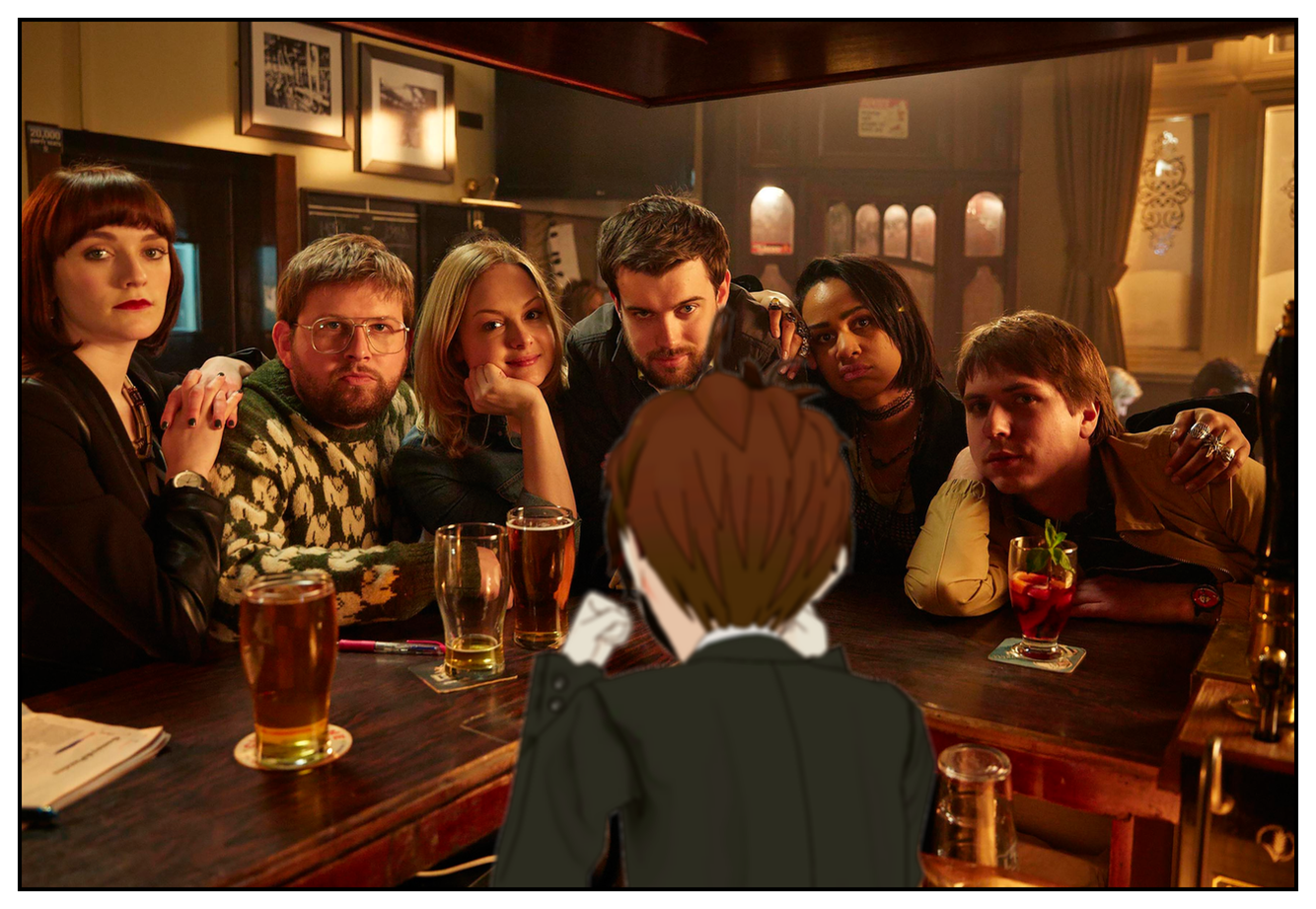
Fresh Meat is a show by Jesse Armstrong and Sam Bain, of Peep Show fame. Across four seasons, it concerns the lives of a houseful of university students from their initial arrival at university through to the end of their final exams.

I remember watching the first few episodes of the first season and really enjoying it, but for one reason or another I never finished watching that season. More recently, however, I've been watching the complete run on Netflix and enjoying it a great deal; much like one's university life, it evolves and changes over the course of the three years/four seasons, but it manages to maintain enough coherence throughout to feel like a convincing serialised story rather than simply an episodic comedy-drama, which it could have easily turned into.

Part of the reason for its feeling of coherence is the fact that it managed to keep its core cast together for the entire run, and said cast is an excellent lineup. All of them are flawed to one degree or another, but none of them are so far beyond redemption as to become dislikeable. On the contrary, the show frequently demonstrates that behind prominent displays of bravado, there is often someone crying for help or struggling to express themselves.

One of the first characters we see in Fresh Meat is Greg McHugh's portrayal of Howard. His first appearance is wearing only a jumper, no trousers or underpants, and drying some dead poultry on a washing line across the kitchen using a hairdryer. It would have been easy for the show to keep Howard as a deranged character, only coming out for comedy relief or gross-out factor, but even within the first episode, we quickly see that he's been designed with a lot more thought behind him. Across the entire run, Howard actually becomes a character that it is easy to sympathise and empathise with, since in many regards he's the character who makes the biggest strides outside his comfort zone — particularly with regard to social situations and taking perceived "risks" like asking a girl he likes out — and who manages to pick himself up repeatedly after numerous setbacks.

Zawe Ashton's portrayal of Vod is also noteworthy, as Vod initially comes across as an arrogant, dislikeable young woman with an attitude problem. Her abrasive edge doesn't dull throughout the entire run of the series, keeping her as a formidable person that most people would probably find tough to get close to, but piece by piece, we start to understand the difficulties she's endured through her life and why she has ended up as the person she is. Most people probably won't end up liking Vod as such, but we certainly understand her pretty well and can sympathise with her by the series' end.

Kimberley Nixon's Josie subverts the "sensible girl" trope often found in series of this nature. While initially appearing to be the cast member who has it together the most among the group, Josie's character goes into a downward spiral early in the series, succumbing to a combination of alcoholism, stress and depression that sees her getting kicked off her dentistry course for drunkenly putting a drill through a woman's cheek, moving to Southampton, moving back to Manchester in the hope of a relationship with fellow cast member Kingsley, and from there seemingly repeatedly sabotaging her own potential for happiness. Outwardly, Josie is one of the most cheerful, optimistic-seeming characters, but as the show progresses, she becomes one of the most tragic figures in it.

Joe Thomas' depiction of Kingsley initially appears almost identical to his portrayal of Simon in The Inbetweeners — mostly due to his trademark rather sardonic delivery — but over time Kingsley becomes a distinctive character in his own right. Whereas Simon was fairly aloof and detached from the idiocy of the rest of the group in The Inbetweeners, Kingsley becomes a character who consistently tries too hard and often finds himself coming a cropper as a result. His relationship with Josie is initially set up to be the "Ross and Rachel" of the show through its on-again, off-again nature, but in the latter seasons in particular it becomes clear that the two are simply not right for one another. Kingsley repeatedly puts across the impression that he desperately wants to "grow up" but isn't entirely sure how, with his attempts ranging from developing an interest in composing his own rather emo music to growing an ill-advised and rather pathetic soul patch. His desires are perhaps most explicitly demonstrated in the final season, when he gets together with an older woman and is initially ecstatic about the prospect, even when it becomes abundantly clear that she is not going to treat him well.

Charlotte Richie's portrayal of Oregon is one of the strongest performances in the show, ironically because of how understated a lot of her delivery is. Oregon, or Melissa as she's really called, desperately wants to appear cool and it's immediately apparent from the outset that she's attempted to "reinvent" herself for university life after a privileged upbringing. She has a habit of getting drawn into positions that initially seem like a good idea at the time, but which quickly turn sour. In the first season, this is exemplified through her relationship with her English tutor Professor Shales; in the final season, we see her mount a successful campaign to become Student Union president only to be lumbered with massive debt, impending legal action and the realisation that she's little more than a "ribbon cutter" for the people who actually have power. To her credit, Oregon always tries to fight her way out of these situations and is often successful in doing so; while the adversity she encounters throughout the series is usually of her own creation — perhaps deliberately so, given the life of privilege she grew up with — she doesn't ever buckle under the pressure, and usually comes out stronger and having learned something from her experiences. Of all the characters, she's probably the least overtly "tragic" in one way or another; in many ways, she becomes the most admirable after initially being one of the biggest fakers there is.

Finally, Jack Whitehall's depiction of J.P. largely consists of Jack Whitehall playing an exaggerated version of himself, but it really works, at least partly because J.P. is written as more than a one-dimensional "posho" laughing stock of a character. Over the course of the four seasons, we come to understand J.P. as a deeply confused, conflicted young man who doesn't understand how the world works — like Oregon, he grew up with a life of privilege, but unlike her, he initially makes no attempt to reinvent himself, instead preferring to try and solve his problems by throwing money at them. In an early episode, he learns the folly of this approach when he gets taken advantage of to a ridiculous degree by his former schoolmates, and from here his growth as a character begins. Each time he proclaims that he wants to have "a large one" or that he is desperate to be regarded as "a legend", it rings a little less true; inside, he's a man who sees his future looming ahead, but he can't see what lies beyond the veil at the end of his university life. That's a scary feeling, and not just limited to university students; J.P.'s struggle to understand how life as a whole works is something that a lot of us can relate to.

All in all, Fresh Meat is an excellent (if occasionally mildly unrealistic) look at student life in the early 21st century. It captures both the soaring highs — the excitement of meeting new people and striking up relationships that may last the rest of your life; the nights out that seem like the most enjoyable, fun times ever — and the crippling lows — mounting debt; loneliness; the uncertainty of your (and everyone else's) future — and in the process manages to depict a collection of flawed but interesting, likeable characters as they work through one of the most turbulent periods in their respective lives.

2489: Kingsglaive

0489_001

I watched the Final Fantasy XV movie Kingsglaive this evening. It was pretty spectacular, and as something to get one in the mood for Final Fantasy XV it does its job admirably. Taken by itself, it's perhaps a little heavy on the action sequences and light on the justifications that link them together, but for a Final Fantasy fan such as myself, it was fanservice heaven.

Unlike the previous Final Fantasy movie The Spirits Within, which wasn't based on an existing game and only had the loosest of thematic similarities to the venerable series, Kingsglaive very much knew who its primary audience was. As such, the whole thing was riddled with little nods and references to other games in the series.

A wide shot of the Lucian city of Insomnia had a billboard for the "Bank of Spira", a reference to Final Fantasy X's world. Water-based summon Leviathan just happened to be in a giant fishtank present at a highbrow reception. One of the enemy airships inexplicably had everyone's favourite pervy octopus Ultros inside it, though sadly without a speaking role. The "demons" that the antagonists of the piece, the Empire, bring to bear on the Lucians are a dead ringer for Final Fantasy VII's Diamond Weapon. And let's not, of course, forget the presence of Knights of the Round who, after Heavensward, have now played a starring role in two consecutive Final Fantasy works as opposed to being a "secret" summon for the truly dedicated player to uncover.

The movie did a great job of setting the scene and introducing some of the lore that is clearly going to be central to Final Fantasy XV as a whole. It's nice to see that the game is incorporating elements of both classic Final Fantasy — crystals being of paramount importance to the world's magic being the main one — and the more recent titles with modern-to-futuristic technology being in evidence.

I'm a big fan of settings that combine technology and magic, and I think it's traditionally been a rather underexplored variant on fantasy. Sure, the idea of magic combined with the modern world has been popularised by the Harry Potter series in recent years, but it's something that is always interesting to explore, I think. There's a quote from horror game Outlast that stuck with me and that I will now probably butcher for you now: "show a man from the past technology and he will think it is magic; show a man from the present magic and he will think it is technology." This is the core of what's interesting about it, I think: if you have magic, why do you need technology, and vice versa?

This is something I also found interesting about Shadowrun Hong Kong, which I finished earlier today. Shadowrun actually almost plays down its fantastic elements outside of some occasional references to "The Awakening", mages occasionally being among the foes that stand in your way and the fact that orks, elves and dwarves are happily wandering around in a traditionally human-only world. By de-emphasising the fantastic elements, they simply felt natural and "normal" even though they're far from reality.

Final Fantasy has always played up its more fantastic elements, by contrast, and Kingsglaive was no exception to this rule, with a spectacular and lengthy final battle raging between the protagonist and the antagonist, set to a backdrop of gigantic summoned titans and demons smacking the shit out of each other, the foreground and background conflicts taking turns to mirror one another.

I absolutely love this particular breed of overblown insanity and always have done. It's so fantastic and unbelievable that it becomes perfect escapism: something that literally cannot be done in reality, so becomes all the more appealing to be a part of, even if it's only as a passive observer.

If the main game of Final Fantasy XV is half as spectacular as Kingsglaive was, I'll be very happy indeed. But since it's the centrepoint of an incredibly ambitious transmedia campaign encompassing a computer-generated move, an anime series, mobile games and then finally the damn game itself when it comes out at the end of this month, I'm anticipating something even more joyfully exuberant.

I don't doubt the game will have its haters, as its predecessors also have. (I've given up arguing with people who can't see the good in the FFXIII series, it's just not worth the stress.) But I for one cannot wait to step into Noctis' lovingly-rendered boots and start exploring this fantastic new world, and watching Kingsglaive this evening has made the wait just a smidge more agonising.

2488: That Happened

0488_001

Are you familiar with the subreddit /r/thatHappened? It is one of the more popular subreddits out there, devoted to posting the sort of "PLEASE LIKE AND SHARE!!" garbage that people so like to festoon their social media walls with these days.

Posts that crop up on /r/thatHappened typically have a number of things in common.

Firstly, they usually involve someone making a point of saying they were doing something entirely mundane, like going to school or filling their car with petrol.

Next, they introduce another character of some description, typically a stranger, but one whom the author of the post mysteriously seems to know absolutely everything about, right down to their ethnicity, age, employment status, affluence and anything else you'd care to mention.

Optionally, a child can be involved in the story. If a child is involved in the story, said child will be quoted saying something that no child in the world has ever said, something which can easily be discerned by the use of vocabulary or turn of phrase. Even at my most precocious growing up, when I knew what words like "floccinaucinihilipilification" and "antidisestablishmentarianism" meant (and how to spell them), I still spoke like, y'know, a kid. Kids in these stories never do, usually coming out with some sort of profound wisdom you'd normally expect to hear from a wizened old karate master or something.

The author of the story, the character they introduced (who is inevitably a minority of some description) and/or the child will then become involved in some sort of altercation with an antagonist, who is almost definitely a white male, because as we all know white men are all literally Satan.

The story will then go one of two ways. 1) The author, the character and/or the child will then devastate their opponent in some exaggerated manner, either physically or with razor-sharp wit. The white male(s) will then inevitably leave with their tails between their legs. Alternatively, 2) The author, the character and/or the child will suffer some sort of sexist, racist, ableist, homophobic or transphobic indignity that is so profoundly terrible that the author's immediate reaction was to post it on Facebook rather than take it to the authorities.

In the case of 1): If the altercation took place in a public place such as a school, petrol station or coffee shop, everyone surrounding the author, the character and/or the child will then spontaneously break into applause and at least one person will be crying.

In the case of 2): The author will blame the altercation on a major event that has happened in the news recently and will confess to be "crying right now", with bonus points if they are doing so "into [their] cereal" or some other foodstuff.

In both cases, the author will then attempt to sign off with some sort of quasi-poetic but ultimately asinine truism and encourage everyone to Like, Comment and Share their post to "raise awareness". Said post (which is inevitably set to Public visibility, even if the author typically keeps their social media pages private) will then receive multiple thousands of Likes, Comments and Shares through the phenomenon of virality, with a significant number of people sharing it doing so blindly without bothering to ponder how exactly something quite so improbable happened, or indeed questioning the author on further details of the incident. (This was a terrible racist/sexist/ableist incident, don't you know? You can't ask questions, you might traumatise the poor soul further!)

Once you're familiar with this template, you can spot bullshit a mile off. I encourage you to get intimately acquainted with it before clicking that "Share" button in the future. On a related note, I also encourage you to familiarise yourself with Snopes.com if you aren't already.

That is all.

2487: The Utter Insignificance of You and Everything You've Ever Known

0487_001

I had the great pleasure of seeing Professor Brian Cox speak at the Southampton Guildhall this evening. This isn't the sort of thing I'd generally go along to, but a friend had an extra ticket and said he would rather it went to someone in his immediate circle of friends rather than his backup list, so along I went.

I won't pretend to have followed much (or possibly any) of the lecture as a whole, but it was an interesting and inspiring experience to be in the presence of someone so obviously knowledgeable and passionate about their work. Cox's lecture was punctuated by occasional interruptions from his podcast partner Robin Ince, perfectly timed so that just when the sciencey bits were getting a bit heavy, he was there to inject some much-needed levity into proceedings with impressions of his colleague and Brian Blessed, among others.

Cox's lecture was on cosmology and the study of the universe, with particular emphasis on theories surrounding the Big Bang, the theoretical period of "inflation" which took place before the Big Bang that we've historically regarded as the beginning of everything — "the day with no yesterday" — and how modern theories suggest that what we understand as "our universe" might actually just be one of a potentially infinite number of "bubbles" out there in the wider context of perpetually inflating space.

I won't bore you with the science or the mathematics — largely because I didn't understand a lot of it and can't accurately remember the rest of it — but I will share with you one thing that I found particularly impactful in his whole lecture.

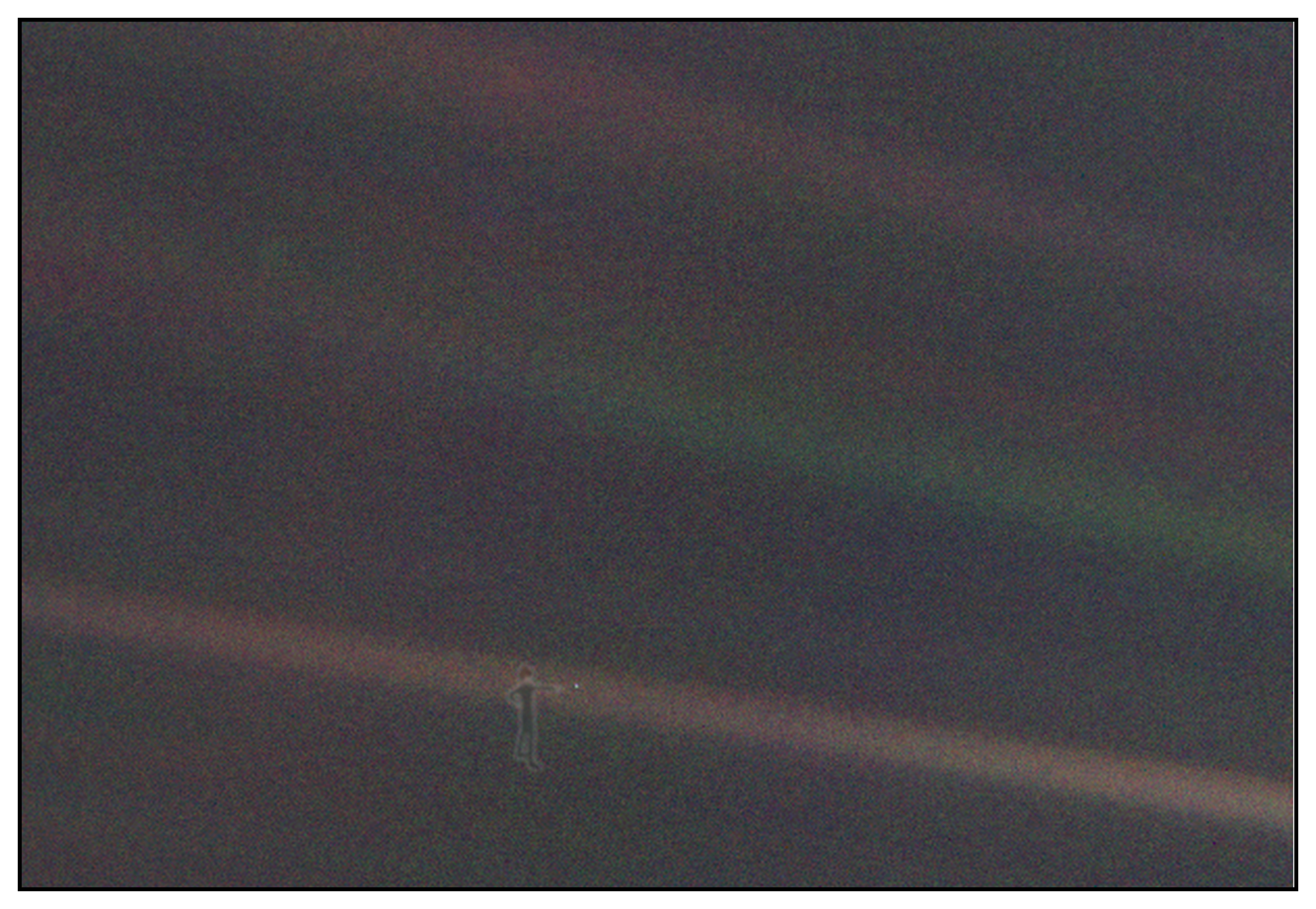
My friend Emily told me as we were going in to the lecture that she was almost hoping for a reminder of how utterly insignificant we and everyone around us actually are in the grand scheme of things; how unimportant our little blue dot is to the universe as a whole, and how little things like, say, Donald Trump being elected president of the United States really matter when you actually think about it in the context of the whole universe.

Cox delivered on this front, acknowledging that while we are a seeming anomaly — the Fermi paradox suggesting that if there were other advanced civilisations out there, we should almost certainly have seen some sort of evidence of them by now — we are ultimately insignificant to the universe as a whole. Just one pale blue dot, as Sagan put it, a "very small stage in a vast cosmic arena".

And yet both Sagan's quote and Cox's lecture continued beyond this point: apparent insignificance can also be interpreted as uniqueness that should be cherished and treasured. We may be just one pale blue dot, but it's our blue dot, a home we've made our own, for better or worse. And each of us may just be one individual taking up a tiny fraction of a tiny pale blue dot, but there is no-one in the world exactly like us, there never has been and there never will be. All of us, every single one of us, is precious and important in our own way, because there'll never be anyone quite like us ever again.

"Think of the rivers of blood spilled by all those generals and emperors so that in glory and in triumph they could become the momentary masters of a fraction of a dot," said Sagan in his famous 1994 speech. "Think of the endless cruelties visited by the inhabitants of one corner of the dot on scarcely distinguishable inhabitants of some other corner of the dot. How frequent their misunderstandings, how eager they are to kill one another, how fervent their hatreds. Our posturings, our imagined self-importance, the delusion that we have some privileged position in the universe, are challenged by this point of pale light… to my mind, there is perhaps no better demonstration of the folly of human conceits than this distant image of our tiny world. To me, it underscores our responsibility to deal more kindly and compassionately with one another and to preserve and cherish that pale blue dot, the only home we've ever known."

2486: One and Only Post About America's New President

0486_001

America elected Donald Trump, noted toupee wearer and generally unpleasant person, as their President. This is either terrifying or highly amusing — or perhaps a combination of both.

I have no love for Donald Trump. He's shown himself repeatedly in both social and popular media to be a bigoted twat who frequently speaks without thinking, promising entirely unreasonable things and making objectionable comments about all manner of groups of people. He is not, in short, who I would have voted for as President, were I an American.

I feel that it's worth contemplating exactly why so many people voted Trump, though, much as it was also worth contemplating why so many people voted Brexit, and why so many people voted for the Conservatives to govern the UK after seemingly widespread dissatisfaction with their previous work and particularly their former leader David Cameron.

This article from The Guardian offers an explanation.

Clinton’s supporters among the media didn’t help much, either. It always struck me as strange that such an unpopular candidate enjoyed such robust and unanimous endorsements from the editorial and opinion pages of the nation’s papers, but it was the quality of the media’s enthusiasm that really harmed her. With the same arguments repeated over and over, two or three times a day, with nuance and contrary views all deleted, the act of opening the newspaper started to feel like tuning in to a Cold War propaganda station. Here’s what it consisted of:

  • Hillary was virtually without flaws. She was a peerless leader clad in saintly white, a super-lawyer, a caring benefactor of women and children, a warrior for social justice.
  • Her scandals weren’t real.
  • The economy was doing well / America was already great.
  • Working-class people weren’t supporting Trump.
  • And if they were, it was only because they were botched humans. Racism was the only conceivable reason for lining up with the Republican candidate.

How did the journalists’ crusade fail? The fourth estate came together in an unprecedented professional consensus. They chose insulting the other side over trying to understand what motivated them. They transformed opinion writing into a vehicle for high moral boasting. What could possibly have gone wrong with such an approach?

In short, instead of allowing people to make their own mind up and encouraging them to think critically about both candidates — or the pros and cons of Brexit vs Remain, since a very similar situation unfolded with that vote — the mainstream media attempted to rely on its power over society by clearly marking one option as the "wrong" one. Trump is evil because x,y,z, Brexit is bad because a,b,c. It didn't stop there, though. It then repeatedly listed all the reasons why you would be a terrible person for voting for the "wrong" option along with all the reasons you would be an absolute paragon of virtue, ally to the oppressed and generally wonderful human being if you voted for the "correct" option.

It may be that if you critically analysed the positions of both options, you still thought that Hillary was the right choice, and if so, great. If it had been left at that, she could have probably won. But people need to reach that conclusion naturally rather than being shepherded away by barbed wire, locked gates and signs saying "DANGER! TRUMP AHEAD". People, particularly in the age of the Internet, are curious beasts, and if you tell them they can't or shouldn't have something, that will only make it more attractive to a particular type of individual. "Why is the media so absolutely adamant that I shouldn't choose this option?" they'll think. "What are they trying to hide?"

We are in an age of social media, where buzz and influence can be created artificially to a certain extent, but more commonly it is an organic, natural process that occurs seemingly randomly and at the bitter, twisted and above all unpredictable whims of the great Internet Gods. In this age, where everyone likes to feel like Their Opinion Matters — and where we're repeatedly told that Our Opinion Matters, even when it clearly doesn't — people really don't like to be told what to think. People really don't like to be talked down to or told that a conclusion they may or may not have reached themselves is "wrong", or that there is only one "correct" option, regardless of whether or not you personally actually think it's right for you if you take a closer look at it.

This kind of attitude — a "journalists' crusade", as Frank puts it in his Guardian piece — leads to people feeling bitterness and resentment towards the media. We're already in a place where general trust in the media is at something of a low, so it wouldn't have taken much to push people into "spiteful" mode, where they deliberately go against whatever the media is telling them to do simply to send a very clear message: we want to make up our own minds, and fuck you for trying to tell us we're awful people for doing so. There is, of course, a certain irony in doing this causing everyone who feels that way to vote the same way, but when you only really have two practical options, there are limits to how effectively you can protest.

"[Hillary Clinton]  was exactly the wrong candidate for this angry, populist moment," writes Frank. "An insider when the country was screaming for an outsider. A technocrat who offered fine-tuning when the country wanted to take a sledgehammer to the machine."

Well, I'd say that sledgehammer has well and truly been taken to that machine, and a clear message has been sent. I'm not excusing the result or saying that it was the "right one", just saying what has seemingly happened from an outsider's perspective. It is pretty much exactly the same reason there is so much resistance to perceived "political correctness" — people do not like to be told how to think or feel.

It remains to be seen whether or not this election result is ultimately "good" or "bad" for America — and the world — as a whole, but as a friend on Facebook noted, "I look forward to four years of people learning how little power the President has."