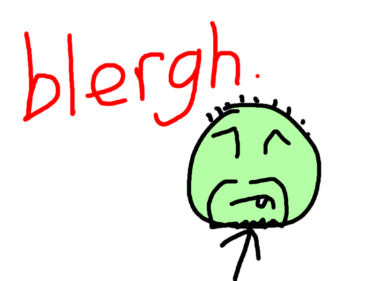
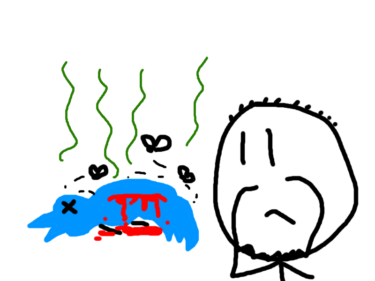
I think I'm getting a cold. I had one of those situations on the drive home from the office today (a 3+ hour trip) where I felt the "ill" hit. I got one of those annoying coughs where you cough and it doesn't shift whatever is making you cough, so then you cough more, but it doesn't move anything, and it's really annoying and ugh. I really do not want to be ill, but it is the time of year when I often get ill, so.
Also, being in contact with other human beings for once may have something to do with this, too. I don't normally get ill after a trip to the office — I'm not completely hermetically sealed in my house — but I think I recall one of my colleagues saying that they'd had a bit of a cold recently. If this is their fault then… I will have a good old grumble, but not blame them, because it's not their fault.
Anyway, with feeling like general dogshit after driving for more than three hours, I don't have a lot of energy left to write something for today, I'm afraid. So I hope you will indulge me in this particular occasion and just let me head to bed. I will try and be extra-interesting tomorrow — except we all know I'll just be my usual self. So I'm mostly just making a promise to myself to at least try and write a bit more tomorrow than I have written today.
That's it. That's the post. Good night!
Want to read my thoughts on various video games, visual novels and other popular culture things? Stop by MoeGamer.net, my site for all things fun where I am generally a lot more cheerful. And if you fancy watching some vids on classic games, drop by my YouTube channel.
If you want this nonsense in your inbox every day, please feel free to subscribe via email. Your email address won't be used for anything else.
I saw a TV ad for "Apple Intelligence" yesterday. The concept of the ad is that someone is angry someone at their workplace keeps stealing their pudding — hahaha, so hilarious and cosy and relatable — and writes them a furious email. They then click the "Friendly" button on Apple Intelligence and the email is rewritten to be the most milquetoast, handwringy, insincere thing you've ever seen. And this is supposed to be a selling point.
Elsewhere, a YouTuber I know had someone in their comments getting pissy about how they pronounced "ZX81", and, presumably in an attempt to further their argument, the commenter in question then copy-pasted a ChatGPT conversation — without editing out the "ChatGPT says:" bits — that didn't even particularly help their cause.
I keep seeing YouTube thumbnails made with AI art-stealing machines. Coca-Cola made a Christmas ad with AI. The memorial lunch for beloved broadcaster Steve Wright had an invitation that was made with AI. Entire websites are made of AI slop. And even here in fucking WordPress, I can't escape the sodding "Generate with AI" button.
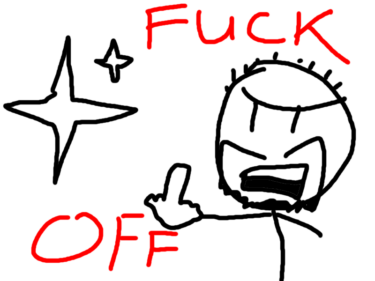
I fucking hate it. I want it to go away. I want people who say "but it's good for summarising things" to drown in the sea. I want people who say "but it's better than doctors at diagnosing problems!" to be the victims of the worst malpractice the medical industry has ever seen. I wish eternal loneliness and desolation on those who use it to write emails. And I want it out of the pieces of software I use on a daily basis.
We're even starting to get accounts on BlueSky that pretend to be real people, but simply respond with ChatGPT answers that are tuned to be deliberately argumentative. What is the fucking point of all this shit? How is it benefiting humanity and productivity in any way whatsoever?
It isn't. All it's doing is continuing to make tech worse, year on year, while keeping oblivious shareholders — who aren't interested in anything but seeing "growth" — happy that companies are providing supposed "new innovations" that actually don't provide any sort of useful functionality whatsoever.
I'm aware I'm ranting incoherently, but honestly right now it feels like it's pointless to even try and come up with a cogent argument. This shit is infesting everything, and it's becoming impossible to escape from. And I legitimately do not understand how anyone can possibly think this shit is in any way better than what we had before.
I guess the one upside is that with how much AI is being used pointlessly to provide "summaries" of Google Searches, YouTube videos and other such shite, the planet will burn down all the sooner, so eventually we won't have to worry about it at all. Then the Great Thinkers of the day — assuming anyone survives — can stroke their chins for two hundred years about "where it all went wrong".
Here. Here is where it all went wrong.
Want to read my thoughts on various video games, visual novels and other popular culture things? Stop by MoeGamer.net, my site for all things fun where I am generally a lot more cheerful. And if you fancy watching some vids on classic games, drop by my YouTube channel.
If you want this nonsense in your inbox every day, please feel free to subscribe via email. Your email address won't be used for anything else.
My Bold Proclamation of the Day is that I feel like it would probably behoove us, as a society, to be more comfortable with mediocrity than we are.
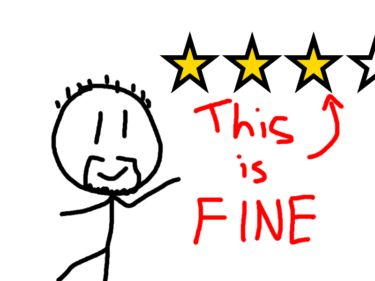
This evening, Andie and I went out for dinner, because we both just wanted to get out of the house for a bit. We went to a local chain pub that we've been to a few times before and always liked, and the food was fine. It was perfectly acceptable. If we were living in a world where star ratings were used properly, I would rate it three out of five stars. It was not the sort of meal that I will remember for the rest of my life (or indeed the rest of the week, probably) but it also wasn't so terrible that I wanted to throw it in the face of the chef who microwaved it.
Thing is, I don't feel hard done-by to have a three-out-of-five meal at a place like this. In fact, that's pretty much what I expect. But I feel like the way we live life today, a three-out-of-five meal would be seen as somehow "unacceptable", and my commentary on how it was perfectly fine and exactly what you want sometimes, would be ignored completely, with nothing but the star rating being seen as a sort of "inverse recommendation".
Back when I worked at the Apple Store in the late '00s, the company introduced a scheme called NetPromoter. Initially I thought this was an Apple initiative, but I have learned in the years that followed that it is quite a common thing in the service and retail sectors generally.
If you're not familiar with NetPromoter, it goes like this. You engage with a customer and provide them your service or sell them something. Then, after they have departed your premises/website/whatever, they get emailed a short survey in which they are asked to rate their experience out of 10. Higher scores are, of course, good, and are regarded as "Promoters" — people who are actively likely to recommend (or "promote") your store or service to family, friends and colleagues. Conversely, low scores are, naturally, bad, and are regarded as "Detractors" — people who will recommend against your services.
All sounds reasonable enough, right? What if I told you that only scores of 8 and above were regarded as "Promoters", and anything below that was considered a "Detractor"? Because that's how it fucking works. There's no option for "this was fine, I had no complaints, but it also wasn't anything particularly special that I feel like shouting about" either. If we assume someone who felt that way believed that was worth a 5 or 6 out of 10, the poor old employee responsible for that perfectly acceptable service would probably find themselves on the receiving end of some sort of disciplinary action. Because yes, of course, systems like NetPromoter are inevitably used to browbeat employees into submission, rather than to actually improve things for the customer.
The same is true of online reviews for pretty much anything. Have you ever noticed how when an app on your phone bugs you to rate it, it's never "Leave us a review!", it's always "Leave us a 5-star review!"? That's because to most folks online these days, there are only really two ratings: 5-star (good) and everything else (bad). The video game sector has, of course, also been guilty of this for as long as the games press has been a thing; "70%" is seen as a barely average passing grade, and anything below that will almost certainly be ignored or considered "bad" by a significant portion of the games-purchasing public.
I've spoken numerous times about how I've had the absolute best times with games that, on average, net scores of 65% and below, and it's often for very similar reasons that I find mediocrity in other areas of life perfectly acceptable: sometimes that's precisely what you're in the mood for. This evening, we were in the mood for some average pub food, and by golly, that's most certainly what we got. When I'm in the mood to play a Neptunia game, I also know exactly what I'm getting and am in the correct mindset to appreciate it, too.
It's time we embraced perfectly acceptable mediocrity. Perfection is the enemy of good, as the aphorism says, and I absolutely agree with that. If you spend all your time looking for something that is really worth that 5-star rating, you're never going to be satisfied with anything.
Want to read my thoughts on various video games, visual novels and other popular culture things? Stop by MoeGamer.net, my site for all things fun where I am generally a lot more cheerful. And if you fancy watching some vids on classic games, drop by my YouTube channel.
If you want this nonsense in your inbox every day, please feel free to subscribe via email. Your email address won't be used for anything else.
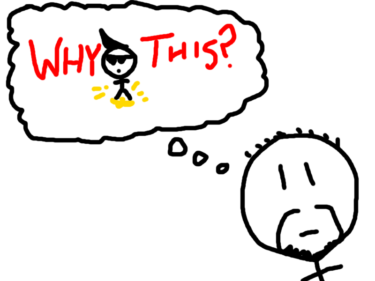
Why am I still doing this? Or, perhaps to the point, why did I start doing this again? This article from Aftermath does a good job of explaining why.
Since the rise of social media, I feel like it's significantly less likely for someone to have a "personal website", because everyone is concerned about their "reach" and "engagement", and if you want both of those things, you want to be on a well-established social media site.
But if you're more concerned with self-expression and having a space to truly call your own, having your own website is hard to beat. And I think as people become more and more disillusioned with social media — Twitter and Facebook in particular — I think personal websites are going to become more and more important to a wider range of people.
Times have changed a bit, though. The word "blog" seems to have fallen out of wide usage, to be replaced with "newsletter", this being a result of the assumption that people will sign up to get your posts delivered to them via email, rather than going out of their way to visit your site. However, most of the "newsletters" out there are actually just blogs: people having a space to call their own, writing whatever they feel like at any given moment.
The best blogs… sorry, newsletters… of course have a distinct focus. One of my favourites is Ed Zitron's Where's Your Ed At?, which is one of the few sites out there continually taking the garbage of the AI industry and other enshittified parts of the Internet to account for their making life worse for everyone.
And, of course, if you've been following me for a while, you'll know about my own MoeGamer, which is my main video game blog. MoeGamer has now outlived all of the professional, commercial sites I have ever written for, which is a nice feeling. Sure, I don't update it every day or indeed regularly, but there's a ton of stuff to read on there, and I've made sure all of it is hopefully relevant and interesting, regardless of when you come to it. No racing to get "news" out the door; no rushing games to meet embargoes; just in-depth articles about games that, for one reason or another, I have found it worthwhile to spend some time, effort and words talking about.
This site, though, this is mostly for me. This site is my virtual replacement for the personal diaries I used to write as a teenager, only at no point have I become embarrassed enough about something I've written to want to throw the whole thing in the outside bin so it would never be found by anyone, except maybe the dustmen, who I hope had a good laugh about how much I fancied Nikki Rose before flinging the book into landfill. This site is my reminder of at least part of my time on this planet which, for sure, has had some hefty ups and downs over the course of the last 15-20 years or so.
Does it have many people reading it? No. But I'm not doing it for them. I'm doing it for myself — and if anyone happens to stumble across this little corner of the Internet and gets something out of something I've written, that's just a happy bonus.
If you've never given this sort of thing a try and you find yourself frustrated at social media, I can highly recommend giving it a go. It's dead easy to get started with a platform like WordPress or its numerous imitators; in many cases, you can get up and running for free, too.
However you choose to do it, I can assure you of one thing: having a space to truly call your own, in which you can express yourself completely freely, is something that I've started to find increasingly important with each passing year. It's a good thing to have an outlet, for both the good feelings and the bad, and banging out 500-1000 words every so often just about whatever's on your mind is a healthy habit to get into.
That's why I'm still doing this. Not to be famous, not to make money, not to get engagement and followers. But because it's just something I want to do, and which I find is of great benefit to my overall wellbeing. Give it a try!
Want to read my thoughts on various video games, visual novels and other popular culture things? Stop by MoeGamer.net, my site for all things fun where I am generally a lot more cheerful. And if you fancy watching some vids on classic games, drop by my YouTube channel.
If you want this nonsense in your inbox every day, please feel free to subscribe via email. Your email address won't be used for anything else.
Christmas is coming, and that means yet another year of people who think they are absolutely hilarious for informing you of their sudden revelation that Die Hard is a Christmas movie. Societal norms dictate that you are supposed to laugh at this, pretend you've never heard it before and explain, incredulously, that "it really is, isn't it?" or something along those lines.
As an autistic person, I have the regrettable tendency to spot patterns in everyfuckingthing, particularly human interactions. And, doubly regrettably, I find predictable patterns in human interaction oddly infuriating. One would think these patterns would make communicating with one another easier, particularly for one with the social anxiety that so often goes along with autism.
But no; somehow, I have transcended these "easy wins" of polite conversation and crossed over into the territory where I can see these mindless, predictable exchanges as being utterly meaningless, devoid of any real connection between the participants, instead just relying on quoting something other people have said a million bajillion katillion times over already.
I think my distaste from this at least partly stems from someone I knew at university who, in retrospect, was probably also autistic, as his sole contribution to conversations on numerous occasions was to repeatedly and relentlessly quote Blackadder, devoid of any context whatsoever. It wore me down so much over the course of four years that I was not able to even contemplate watching Blackadder for a good long while afterwards.
It's not just that, though, as I'm sure even a non-autistic person can understand how that would become exceedingly annoying over the course of four years. I think the thing that frustrates me more than anything is how I'm sure everyone involved in the conversation about how Lisa from Accounts "can't deal with the word 'moist'" knows that, in fact, Lisa from Accounts really has no strong feelings about the word "moist" and is instead simply parroting something she heard someone else say that she found quite amusing, perhaps in the hope that someone she likes might flirtatiously start using the word "moist" around her more, giving her ample opportunity to do that thing where people go "oh, no, stop, you big silly" and push someone away while laughing, when they actually just want to shag them.
Or something. I don't know. The very prospect of behaving like that has always annoyed me sufficiently that I never attempted to carry it through to potential shag territory.
It's the insincerity of it that bugs me, I think. It's the very worst kind of small talk; supposed "communication" that is doing nothing but fill silences, but nothing of any real substance is being discussed. People aren't actually getting to know one another or improving their relationships with one another when they have the "pineapple on pizza is weird, isn't it?" discussion; they're simply reading from the hymn sheet in a vain attempt to make themselves look Funny and Cool, because as everyone really tries to drum into you while you're growing up, Having A Good Sense of Humour is the most important character trait anyone can develop, regardless of situation.
I do not, at this point, wish to imply that I am devoid of a good sense of humour. In fact, I have a fucking excellent sense of humour, thank you very much. Well, okay, I still have pretty much the same sense of humour I did when I was 15 years old, which means I still find farts hilarious, but at least when you let out a particularly salty grunt in front of friends, family or colleagues, you're taking a bit of a risk under most circumstances. You're putting yourself out there (quite literally, in terms of gaseous emissions) and, effectively, saying "this is something I find funny" without resorting to material that Michael McIntyre might find "a bit tired".
Of course, I appreciate that there are doubtless plenty of you out there who think a rancid bottom-burp is the absolute worst thing someone can do in polite company. And that's fine, too. There are plenty of people I wouldn't (voluntarily) let off a trouser-trumpet in front of because, despite the autism, I know that it's not a good idea.
But even so. A fruity guff is something you've made yourself, rather than stolen from wherever these inane non-discussions came from in the first place. And thus, if you want to be pals with me, I'd much rather you let rip with a thunderous eggy woofter than even think about telling me how funny it is that Die Hard is "technically" a Christmas movie.
Want to read my thoughts on various video games, visual novels and other popular culture things? Stop by MoeGamer.net, my site for all things fun where I am generally a lot more cheerful. And if you fancy watching some vids on classic games, drop by my YouTube channel.
If you want this nonsense in your inbox every day, please feel free to subscribe via email. Your email address won't be used for anything else.
This is a discussion I've had a few times on Discord of late, but I don't think I've mentioned it here. So, being in need of something to write for today, I thought I'd ponder it here.
I grew up being rather fond of fantasy — you know, swords, magic, elves, goblins, that sort of thing. I attribute this primarily to my brother's girlfriend of his teenage years introducing me to HeroQuest and the Elric of Melnibone role-playing game; I never played the latter but I did play a fair few sessions of the former, and even managed to convince my parents to get me Advanced Heroquest by Games Workshop for one birthday, which I think has successfully hit the table maybe two or three times in my entire life. (Lucky it has solid solo rules!)
Similarly, one (well, two, technically, I guess) of my favourite book series growing up was David Eddings' Belgariad/Malloreon cycle, which chronicles the rise of young farm boy Garion into a god-slaying hero and powerful sorcerer. Also of note was Douglas Hill's Blade of the Poisoner and its sequel Master of Fiends, both of which were really for kids, but which I enjoyed and re-read numerous times in my youth.
What do all the above have in common? They're all simple, straightforward, old-fashioned fantasy. I add those qualifiers because I feel we don't get a lot of simple, straightforward, old-fashioned fantasy any more. We get a shitload of "dark fantasy", sure, and we also get a lot of "ironic parody fantasy". But just straightforward, simple fantasy? That feels like a dying breed.
To clarify what I mean by these terms: by "dark fantasy" I mean a world where everyone is either miserable or fucking (often simultaneously), the streets are made of mud and the dwarves say "fuck" a lot. By "ironic parody fantasy" I mean "teeheehee, the heroes of this fantasy world know what a 'level' is and talk like they're in a Marvel movie!".
Both of these have their appeal — they must do, otherwise there wouldn't be so fucking many of both of them — but I feel we've reached a point where "subverting the expectations of the fantasy genre" is now more of a cliché than… the fantasy genre itself. I hunger for a good old-fashioned tale of swords and sorcery where no-one says "well, that happened" or "fuck", and which culminates in the plucky young hero, who came from humble beginnings, punching out some sort of god-like entity.
It doesn't even feel like we get this in video games much any more. Final Fantasy has very much gone down the "dark fantasy" route in more recent installments and I think that has been a positive move for the series — Final Fantasy XVI and Stranger of Paradise: Final Fantasy Origin are particular highlights from recent memory — and a lot of anime-style RPGs play up the comedic angle somewhat. There's nothing wrong with either of these things — I enjoy both when I'm in the mood for them — but sometimes you just want something a bit more… straightforward, I guess?
I'm intrigued to try out Metaphor: ReFantazio at some indefinite point in the future, though I suspect that veers towards "dark fantasy", and I have several dungeon crawlers waiting in the wings that might fit the bill.
I'm not mad about this or anything — trends and tastes change, after all — but I just think it might be nice if we could see a bit more in the way of old-school barbarians-in-loincloths-and-wizards-with-beards fantasy. It was a defining influence on me growing up, and it would be nice to revisit that.
Want to read my thoughts on various video games, visual novels and other popular culture things? Stop by MoeGamer.net, my site for all things fun where I am generally a lot more cheerful. And if you fancy watching some vids on classic games, drop by my YouTube channel.
If you want this nonsense in your inbox every day, please feel free to subscribe via email. Your email address won't be used for anything else.
Like many of us, I have become increasingly disillusioned with the role of police in today's society. I'm not an "ACAB" (look it up… actually, don't) type, but there have been too many instances in my personal experience of a clear crime being reported to the cops and them basically going ¯\_(ツ)_/¯ before spectacularly failing to do anything whatsoever. Despite this, I love a good detective drama, police procedural, anything like that. And so it was with some curiosity that I decided to start watching Ludwig from the BBC, a David Mitchell-fronted detective drama with a bit of a twist.
In Ludwig, Mitchell's character John Taylor is a renowned puzzle author who goes by the name "Ludwig", a nom de plume he adopted when first developing puzzles as a child while listening to Beethoven symphonies on vinyl records.
As the series opens, he is contacted by his identical twin brother's wife Lucy, who has booked a taxi for him to take the 150-mile drive to come and see her, but refuses to tell him anything. John, we quickly learn, is not a sociable type, and dislikes leaving the house at the best of times; Lucy, having known him (and his brother) since childhood, knows very well that presenting him with incomplete information will drive him nuts enough to actually leave his house and discover what mystery awaits his solution.
Turns out that Lucy's husband, John's brother James, has gone missing. He left behind a curious note basically telling his family to flee as quickly as possible; Lucy, being a headstrong type, refuses to do this and instead recruits John to pose as James — they are identical twins, remember — in an attempt to discover the truth of what happened to him. The only slight snag in this? James was a detective working at the local constabulary, meaning John must sneak into an environment he has no professional knowledge of and attempt to find some information from under the noses of people that, presumably, James knows quite well.
Matters are further complicated where, upon John's arrival at the police station, he is almost immediately dragged off to go and look at a crime scene. Caught in a situation where he is simply not able to refuse his partner, he ends up attending the scene of a murder and is completely out of his depth. After briefly fleeing the scene on the pretence of "getting some air", he realises that the case is nothing but a logic puzzle; putting on his "puzzling" hat, he then proceeds to solve it in the same manner he would solve one of those old logic puzzles from the books with the guy in his pyjamas on the front.
His unorthodox methods net him a suspect and a confession, though his colleagues and superiors note that had the confession not been forthcoming, the complete lack of evidence would have made the case impossible to prosecute.
What then follows is John continuing to pose as his brother, working on several cases while attempting to ascertain the truth of what happened to his brother. It gradually becomes apparent that his brother left a trail of puzzle-like "breadcrumbs" to follow, leading John to believe that his disappearance was not accidental or circumstantial; it was planned out in advance. And cracking a cipher James left behind in his notebooks is going to be key to getting to the bottom of the case.
So far I've watched two episodes of the series with Andie and we've both enjoyed it a lot. Mitchell is, of course, playing a variation on the bumbling, socially awkward character he always plays, but it works well in the context. The positioning of an obviously autistic character in a professional role he is absolutely not comfortable with (or trained for) is, at times, borderline farcical, but suspension of disbelief allows you to simply enjoy the spectacle of what unfolds. They mysteries presented are intriguing and keep you guessing, and John's tendency to follow through on his "hunches" keeps things interesting and pacy.
The music throughout each episode is absolutely excellent, too; perhaps predictably for a show called Ludwig, it's all based on themes by Beethoven. Rather than just using the themes straight, however, they are all interesting rearrangements, with variations on Für Elise making up the majority of the soundtrack and the show's main theme.
Genre critics might argue that each individual episode maybe wraps itself up a little too neat and tidily to be truly plausible — in both the episodes so far, the case being solved was dependent on one of the suspects "cracking" under the pressure of John's logical deductions — but honestly? I don't care. For the most part, I don't engage with any form of fiction, regardless of medium, to ponder its realism; I engage with it to be entertained and to get to know interesting characters. And Ludwig certainly provides both in spades. It's good, old-fashioned, entertaining television that strikes an excellent balance between drama and moments of levity, as one has surely come to expect from anything with Mitchell involved at this point.
It's a short series — just six hour-long episodes — so I'm looking forward to seeing where things go. I'm definitely glad I started watching it, and if you enjoy a good mystery, I'd recommend you give it a look, too.
Want to read my thoughts on various video games, visual novels and other popular culture things? Stop by MoeGamer.net, my site for all things fun where I am generally a lot more cheerful. And if you fancy watching some vids on classic games, drop by my YouTube channel.
If you want this nonsense in your inbox every day, please feel free to subscribe via email. Your email address won't be used for anything else.
It's peculiar exactly what memories your brain — or, well, more accurately, my brain — chooses to hold onto. One would think that your most "sticky" memories would be those that were defining influences on you; those which played a key role in shaping you into the person you are today. But I find that very difficult to believe when I contemplate some of my most vivid memories from years gone by.
For example, I vividly remember one lunchtime at primary school, my friend Matthew and I went to the rear of the school fields and did shoulderstands because we thought it would make us more likely to fart. I will freely admit that as a 43 year old man I still find farting far more amusing than I probably should, but I'm not sure that specific memory played a particularly developmental role in appreciating toilet humour. I haven't done a shoulderstand for probably more than 30 years and I doubt I could right now.
I have several other primary school memories, and unfortunately not all of them are particularly positive ones.
I remember playing one lunchtime with a girl I was friends with; we were doing some sort of "pretend play" involving swordfighting using sticks, and my mother happened to walk by the back of the field during lunchtime (it was a public right of way) and saw this play, misinterpreting it as me hitting the girl in question with a stick. I got in trouble for that, despite me knowing very well that I was perfectly innocent.
I remember one P.E. lesson at primary school — very early, infants level, class 1 or 2 — where I really needed to go to the toilet, but I wasn't allowed, and I ended up pissing myself in the playground. Rather than being embarrassed, I found it oddly fascinating how the piss would actually come out through my shorts.
Another P.E. lesson from the same "infants" period, so year 1 or 2, I somehow managed to shit myself without realising it. I didn't notice until I got home and my mother asked why there was a brown stain on my arse. Genuinely not knowing that I'd actually shat myself, I suggested that I must have fallen in some mud at some point. The contents of my pants a little later revealed this to not be the case, though to my mother's eternal credit, she simply made a comment along the lines of "it must have been some very strong mud to go all the way through your pants". To this day, I genuinely don't know how I shat myself without realising it.
Another time at school, again in the infants period, I felt sick during storytime, and yakked all over the floor. Once again, I found myself oddly contemplative about the experience rather than particularly embarrassed.
None of these experiences are what I'd necessarily call "formative". I mean, yes, I have low self-esteem and I'm sure none of those particular events helped in the development of that particular personality trait, but I don't think any of them were the root cause of it. Why do I hold on to those memories? They're not particularly "precious" or anything, though at a pinch I might suggest that I hold onto them because recounting them as an adult is at least slightly amusing.
There are others from later years, too. I've recounted the tale of "not remembering how to make friends" on my first day at secondary school numerous times.
Then there was the time I overheard someone I thought was my friend taking the piss out of me while sitting behind me in the county concert band, and when I jokingly confronted them about it, not wanting to believe that they'd actually been being mean, and them not exactly denying it.
There was the one time I did step out of my comfort zone and introduced myself to someone at university.
The time I sat, all dressed up and ready to go out, brooding in the window of my hall of residence kitchen, hoping someone would find me and I could unleash the hormonal sadness I was feeling because the girl I liked had got with a guy from downstairs.
That one Halloween I felt an incredible sense of self-confidence and liberation after completely hiding my entire body and face. Another Halloween where I dressed up as a monk and ended up not being entirely sure if I'd scored with a girl or not, since she had taken me back to her house, let me in and given me her phone number, then just sort of vanished.
That one evening in grotty student nightclub Kaos where a random bloke asked me if I'd ever done ecstasy, then almost immediately afterwards I scored with a veritable Amazon of a woman (my friend Owen called her "Xena", but her actual name was Beki) and the same bloke shook me by the hand, giving me a knowing wink and a smile, saying "yeah, mate, you'd definitely enjoy ecstasy". (I've never done ecstasy.)
I could go on. There are myriad little snippets of my life that are lodged away in my long-term storage that I don't really know why. I feel like these are the things that will flash before my eyes before I die, and I doubt I'll be any clearer on the reason why they're there at that point, either. Hopefully I won't have to think about that for a while, yet.
I don't really have a conclusion to these musings. I just think it's interesting all the useless memories our brains seem to hold on to. If there is a reason for it, I don't know what it is. Perhaps all those memories did shape me in some way and helped turn me into the gibbering wreck of a human being I am today. In which case… aren't I better off forgetting all of them?
Want to read my thoughts on various video games, visual novels and other popular culture things? Stop by MoeGamer.net, my site for all things fun where I am generally a lot more cheerful. And if you fancy watching some vids on classic games, drop by my YouTube channel.
If you want this nonsense in your inbox every day, please feel free to subscribe via email. Your email address won't be used for anything else.
It seems like Twitter's day in the sun is finally coming to an end. With the deadline looming for the site to start scraping everyone's posts to train its AI models, Elon being an absolute fucking maniac (not in a fun way) and Trump being in office, a lot of people — including some well-established figures and brands — have been jumping ship and turning to Bluesky. Hell, even the Clifton Suspension Bridge has decided to ditch Twitter. And no, I'm not making that up.
I haven't been following the progress of all the "Twitter alternatives" that sprang up a while back too closely, but it seems like a lot of people are favouring Bluesky, which I must confess is one that I've been on for a little while now. Threads sounds like an absolute dead end of a social network — tech commentator Ed Zitron describes it as "Twitter made of Instagram comments" — and the less said about shit like Gab, Truth Social and Parler (does that one even still exist?) the better.
I'm interested to see where things will go. The vibe on Bluesky right now is very positive; many folks quite rightly describe it as feeling like Twitter from 10+ years ago, and they're absolutely right in terms of atmosphere. The users have collectively decided to not allow it to fall into negativity and ragebait like Twitter has become in recent years, and there is a shared understanding that "block early and block often" is the best approach to anyone being a dickhead.
This is helped enormously by Bluesky's "nuclear block" function, which means that if someone quote-replies a post then blocks the person they quoted, the quote will appear as blocked for everyone. That helps prevent dogpiling and discourages people from going around looking for trouble. Couple this with the "detach quote" function, where if you do find yourself quote-replied and you're getting grief as a result, you can simply unclip your post from the quote and be left the fuck alone. Much better than Twitter's woefully ineffective mute and block functions — oh yeah, Twitter made block work so that anyone you blocked can still see your posts, which is… great.
At this point, anyone still on Twitter is in absolute denial. The place is infested with bots, scammers, right-wing fucknuts and Elon sycophants who want nothing more than just a crumb of billionaire dick to suck. And with the impending "AI" shit looming, I'm not surprised people have finally had enough. I'm certainly never going back, and I think my boss and I need to have a serious conversation about whether we start focusing our professional social media efforts on Bluesky instead of Twitter. There are a lot of cool retro game peeps over there, and I think Evercade would fit in well there.
Of course, there's always the thing to ponder: do people really want "brands" on a social media site? And I guess it depends what they're doing. If all they're doing is engagement bait crap, probably not. But this might be a fun opportunity to experiment with doing something a bit different, in a place with an altogether different vibe.
Something to consider next week, certainly — my boss is off this week, otherwise I'd have a chat with him about it tomorrow. In the meantime, Bluesky seems to be a pleasant enough place to hang out from a personal perspective, and a fair few people I know have showed up there. It's social media how it used to be before all those sites made us want to kill ourselves every day, and I'm sure that won't last forever. But while it does, we may as well enjoy it.
Want to read my thoughts on various video games, visual novels and other popular culture things? Stop by MoeGamer.net, my site for all things fun where I am generally a lot more cheerful. And if you fancy watching some vids on classic games, drop by my YouTube channel.
If you want this nonsense in your inbox every day, please feel free to subscribe via email. Your email address won't be used for anything else.
I'm due an upgrade on my phone, and for the first time I'm holding off because I'm not sure I want one. All the new phones are rammed with AI bullshit and I don't want to encourage that crap in any way whatsoever, so the prospect of getting one makes me a tad uneasy.
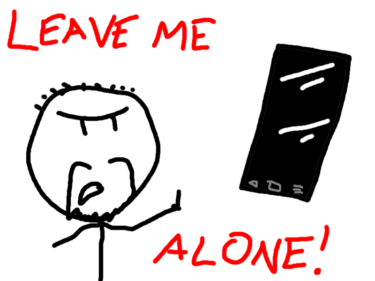
The other thing that is causing me to hold off is a growing desire to break my attachment to smartphones. I don't like being dependent on a smartphone. I don't like having that stupid black rectangle follow me everywhere I go. I don't like feeling like I compulsively "have" to fiddle with it if I don't have anything to say or anything to do.
There are a few things stopping me from immediately ditching my smartphone and "downgrading" to a modern feature phone. I thought I'd ponder each of them in turn. I probably won't come to a conclusion, but it might help me sort some things out in my mind. And maybe it'll be helpful for you, too, I don't know.
WhatsApp
I don't use WhatsApp as much as a lot of people, but I do have a few ongoing chats that are my sole means of connection with friends I haven't seen for a while. On top of that, the people from my job use WhatsApp for communication outside of work — for example, when we're having a group social trip together.
Giving up WhatsApp would mean giving up a connection to people I don't want to "disconnect" from entirely, and would also make life inconvenient for my work colleagues. That last one I'm not super concerned about, but I do like my job and my colleagues, so I don't really want to be a pain.
Beyond those maybe two group chats (both of which have declined in activity anyway) and my work colleagues, I'm not super attached to WhatsApp. I could probably live without it.
The camera
Phone cameras these days are pretty excellent. I shoot anything that isn't direct capture from gaming hardware on my phone. Upgrading my phone would mean I can get an even better camera.
However, two things: 1) I can still use the camera on my existing phone even if it doesn't have a SIM card in it (I think, anyway). And 2) I could just, y'know, buy a nice camera.
So while it's certainly convenient to be able to snap photos and take video with a device that is with me anyway, it's probably not actually a dealbreaker in this situation.
Music and podcasts
I am, I'm afraid, "part of the problem" with music, though not out of any belief that streaming is "better" than having your own collection of tunes. It's just a lot more convenient to be able to stream music (I use YouTube Music, because I have YouTube Premium and might as well use the additional benefit) and podcasts from, again, a device I have with me anyway. Plus my phone's Bluetooth connects to my car stereo with no difficulty, making it easy to queue up entertainment for long journeys, such as my monthly drive to the office.
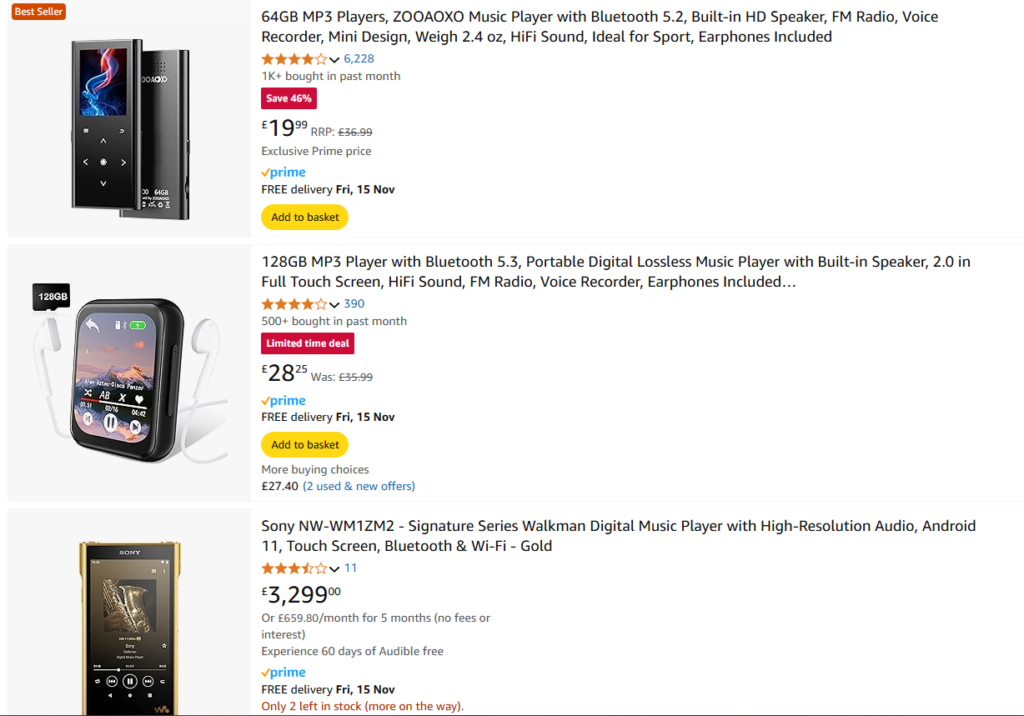
I haven't looked at standalone MP3 (or equivalent) players for probably 20+ years at this point. I'm sure they exist. In fact, hold on.
It seems I can get a cheap Chinese shitbox for £20-£30, or I can spend three thousand pounds on a gold Sony thing (just £659.80 a month!) if I'm feeling particularly insane. What the actual fuck.
Uh… anyway. MP3 players do indeed still exist, and many of them have Bluetooth. Some of them even have WiFi, and some of them take the iPod touch approach where they're basically a phone without the "phone" bit. I will steer clear of those, at least, because that would just be replacing one problem with the same problem, but mildly less convenient.
So an MP3 player with a decent capacity is not expensive. That would require me to organise my MP3 library, though, which has been in a right state since Google Music (RIP) invited me to upload it all "to access anywhere", then promptly closed down and was replaced with the considerably inferior YouTube Music… and when I downloaded it all again the organisation was all fucked.
It wouldn't be the end of the world to have to do that, but I'd rather not have to. So I think we can consider the music player side of things covered.
Navigation
In-car navigation is easily solved: buy a satnav. But I also use Google Maps when I'm on foot to see what's nearby and figure out how to get to places. That is a problem that is a little trickier to solve. GPS devices for on-foot navigation certainly exist, but they're primarily geared towards hiking and cost more than I'd be willing to spend on something that I'd only use occasionally, particularly if I had already bought a satnav for the car.
I can't see an easy solution to this one. I believe some feature phones are able to access a Web-based form of Google Maps, but I don't know how useful or effective that is.
I mean, I guess I could kick it really old school and just buy an A to Z of wherever I happened to be going. I can't check what time Sainsbury's closes with one of those, though, unless they've considerably enhanced the level of detail they go into since I last used one.
Conclusion?
I could probably find solutions to all of the above problems, except WhatsApp. I believe there are some feature phones that are capable of using a text-only version of WhatsApp, but from a cursory glance around earlier today it seems a lot of them don't work in the UK for some reason.
I will continue to mull it over. The prospect of truly breaking free from the smartphone becomes increasingly appealing day by day… I'm just not quite sure I'm truly ready to pull the plug. My main concern is suddenly running into a use case that I haven't thought of while farting this blog post out of an evening, and then being kind of fucked when I'm stuck with a modern-day Nokia and no means of fulfilling the function I suddenly, urgently require.
But really, what might that even be? It can't be that important, or I would have thought of it by now, surely.
Anyway, I haven't reached a definitive conclusion. But I have definitely convinced myself that there are at least some of the features I use on my smartphone that I absolutely can live without. Is that enough, though?
Want to read my thoughts on various video games, visual novels and other popular culture things? Stop by MoeGamer.net, my site for all things fun where I am generally a lot more cheerful. And if you fancy watching some vids on classic games, drop by my YouTube channel.
If you want this nonsense in your inbox every day, please feel free to subscribe via email. Your email address won't be used for anything else.