#oneaday Day 566: The Top Arbitrary Number of Quintessentially British Foods

This post is largely aimed at my American readers out there — you know who you are. (Largely because you live in America.) I thought you might be interested to know an arbitrary number of the things that we have over here in Britainland that are considered edible. Some of them you may have come across before, some of them you may not. So without further ado, let us jump into the list.

Bovril

You've probably heard of Marmite, the thick, brown, goopy substance that supposedly you either love or hate. Well, its bastard sibling is Bovril, which rather than being made from "yeast extract", whatever that is, is apparently made from beef. What you end up with is a thick black tar that supposedly tastes of beef but more accurately tastes "of black" and has a propensity to burn the roof of your mouth off if you have too much at once. It's good on toast. It's especially good on toast when dipped into Heinz tomato soup. You can also make it into a drink, which is inadvisable unless you like a mug full of black, salty, slightly beefy water.

Biscuits

What you know as "cookies". You may have the awesomeness that are Chips Ahoy! but we have a wide selection of biscuits that are firmly ingrained into our culture. We have the bourbon cream, for example, which is two chocolatey biscuits with a layer of chocolatey creamy stuff in between and no actual Bourbon involved. We have the custard cream, which is like a bourbon only more square and vanilla-y. We have the jammie dodger, which is another two-layer biscuit with jam in the middle. And we have Rich Teas, which are rubbish until you dunk them into a hot beverage or squish melted marshmallows between them.

Fish and Chips

Plenty of places in the States sell fish and chips, but you haven't had it the truly British way unless you follow several steps in the process. Firstly, get a portion of chips that is enough for at least three people and put it in some paper. Then smother it in enough salt to give a midget an immediate heart attack. Then drown it in vinegar. Then slap a large, greasy, wet battered fish on top of it. Then wrap it up into a neat little parcel and admire as the grease seeps through the paper. The key element of British fish and chips is the size of the portion. If you can finish a portion, the portion wasn't big enough. There is also generally an inversely-proportional relationship between the price of a portion of chips and the amount they will give you. The cheaper the chips are at the chip shop, the bigger the portions will be.

Curry Sauce

Companion to the above, the slightly-lumpy brown-green-yellow curry sauce that is on offer in most chippies is the perfect companion to your carb overload. It may look like someone has just blown chunks over your bag of chips, but it's a one-way ticket to spicy heaven.

Indian Takeaway

British takeaways are something else. You may have had a curry from your local Indian, but you haven't had it properly until you've had it from a dodgy British takeaway — the kind of place that sells dishes like the entertainingly non-specific "meat curry". Also, when a dish says it's "hot", it means it. A vindaloo will probably blow your head off. And having a drink won't help.

Proper Chocolate

You have chocolate, sure. But you don't have our chocolate, which is just better. From the immensely calorific Yorkie bars (which still somehow manage to get away with marketing themselves as "not for girls") to the legendary Cadbury's chocolate, we sure know how to do it properly.

HP Sauce

HP Sauce is the perfect condiment that goes with pretty much anything and even makes a good sandwich by itself. (On bread, obviously.) It has a taste that is impossible to describe except through the word "brown". It tastes like brown sauce. Because it is brown sauce. Try it on bacon or sausage sandwiches for the perfect breakfast, or dribbled over baked beans to give them a pleasingly spicy kick.

I hope that's educated you on British cuisine. Next time you pay us a visit, remember to give them a try.
#oneaday Day 564: Cliquety Clique

Watch any kind of American teen "coming of age" movie (or indeed play Bully) and you'll come across some combination of the same old cliques. The jocks, the nerds, the preppies, the plastics, the goths and the "normal" people.
There are many, many subcultures out there, particularly among the more youthful members of society. But I don't remember there being cliques that were quite so clearly defined back when I was at school — and yet when I talk to other people, it often becomes clear that they did exist.

I'm not sure if this is because I went to school in a relatively out-of-the-way place where, if we were playing Civ, there would not be a particularly high flow of Culture points. But the fact remains that so far as cliques went, there wasn't anything anywhere near as obvious as the typical subdivisions we're conditioned to "expect" from the media nowadays.

There were a few cliques, sure, but these were mostly friendship groups. There were the guys who were into football, the people who were into music, the people who did stuff in the school plays, the people who always went on trips. But no-one tended to let their clique define who they were — and in fact, given the amount of bleed-through between the different groups, it's questionable whether they really were "cliques" after all.

The closest I came to any kind of clique membership back at school was my involvement in music groups. That meant I often tended to hang out with the same people when doing school activities — but outside of that I had other friends, too. Those other friends didn't particularly belong to any subculture — they were just "friends". Or at least that's the way I saw them — I never looked at person X and thought "well, he's clearly a [whatever]". The only exception to this was one guy in sixth form who was very much into paganism, tarot card reading and all manner of other things and he was branded, in that inimitable high school way, as "the weird one". And, of course, the kids from the local special school who joined us in sixth form and formed their own little clique — which, being politically incorrect highschoolers, most of us were quite happy to let them do.

Technically speaking, if I was a member of a high school clique these days I'd probably be a nerd. I like Dungeons and Dragons, I like video games and I know how to use big words. Oddly enough, though, these days nerds wear their nerdiness as a badge of pride. After all, the nerds are the ones who are making all the money by building the websites that everyone takes for granted these days. So perhaps it's not such a bad clique to be a part of.

In some ways, I feel like I missed out a bit by going to a school that didn't have such clearly-defined subcultures. But then I wonder how accurate the movies really have it, anyway — is it really so obvious from looking at people and observing their attitudes what subculture they belong to?

#oneaday Day 563: A55 H013

I drive relatively normally. That is, I'm inclined to go a bit faster than you're supposed to on motorways, but I generally keep to the speed limit in built up areas. My pulse quickens when I see a policeman, and I get out of the way when there's any kind of blue flashing lights nearby. I don't drive like an old man who consistently drives 8mph below the national speed limit, but neither do I drive like a boy racer (largely due to the fact the car I drive is incapable of acting like a boy racer's car).

Tonight on a long journey, I encountered possibly the biggest asshole I've ever had the misfortune to share a piece of road with. I was driving along a stretch of dual carriageway and was in the right hand lane as I'd just overtaken a truck that was going about 40mph.

Screaming up behind me came some git with his headlamps on full beam going at least 90, probably more. He obviously wasn't going to stop so I had to get out of his way quickly. I flashed my lights at him in disapproval as he passed, which prompted him to pull over into the lane in front of me and start driving at the speed limit. I didn't have a problem with this and didn't see any need to overtake him again, as he was obviously driving like a bell-end.

He obviously wanted me to try and overtake him again, though, as he pulled out into the right-hand lane and slowed down to let me pass on the "wrong" side. I did so as I saw no sense in playing his stupid games. He promptly pulled in behind me and put his headlamps on full again. After a few minutes, he gave up and just settled in behind me.

I'm not entirely sure what he was trying to prove or achieve, but whatever it was he didn't succeed in anything other than making himself look like a complete cunt. Perhaps he thought that driving in such a "daredevil" manner made his penis sprout an extra few inches. Perhaps he had someone in the car with him that he was trying to impress. Perhaps he really thought he had more of a right to be on the road than me.

Either way, he was a complete and utter cheesy knob-end and I hope he skids off the road into a ditch somewhere. Not so he dies, but so that his precious car is wrecked and he is uninjured, so that he has to pay a ridiculous amount of money and have to deal with The Lords of All Cuntishness, insurance brokers.

Yes. That would be nice. Sadly, he probably won't end up in a ditch and right now he's probably harassing some other poor motorist having to drive out late for whatever reason.

But he's still a festering bellend.

#oneaday Day 558: Poo

Andie reckoned I wouldn't write a blog post about poo. So here I am proving her wrong.
The word "poo" is one of those ones that never fails to make me smile in a childish manner. It's not a scientific word in the slightest, and it's right up there with "wee" in the childish stakes — only, for whatever reason, talking about poo tends to be more of a taboo than talking about wee. I'm not sure why this is — but it just is.

Americans, in my experience, tend to use the word "poop" more than "poo". I recall an episode of Friends where the word "poo" came up quite a bit and it just sounded odd coming out of Matthew Perry's mouth. The word "poo", not actual poo.

The act of pooing is, of course, both unpleasant for others to witness and immensely satisfying for the person doing it. As a gross generalisation (in every sense of the word "gross") gentlemen appear to enjoy a good poo rather more than the ladies, though there are, of course, exceptions. For the most part, though, gentlemen are certainly more prone to spending a great deal more time pooing than the ladies.

There are doubtless a variety of reasons for this, possibly the fact that being alone in the bathroom with your pants around your ankles is one of the only times that you're truly alone and can sit there with your thoughts. It's probably not a coincidence that Rodin's famous statue The Thinker is sat in a distinctly pooing-like position. After all, what better time is there to get all the shit (no pun intended) together in your head than a time when you really can't be disturbed by other people? Exactly. Best to enter the bathroom with your thoughts for company.

Or, indeed, an iPhone and a copy of Bejeweled Blitz.

I sometimes wonder if iPhone game designers did their playtesting on the toilet, because the very best iPhone games are friendly to toilet-play sessions. Bejeweled Blitz, for example, takes place in one minute chunks, if you'll pardon the expression. A level of Angry Birds takes probably less than a minute to get through. And titles like 100 Rogues are easy to stop at any time when you, you know, stop.

So let's praise the act of pooing. Without it, it's entirely possible many of the great inventions of our time wouldn't have come to be. Life's great thinkers doubtless came up with their various theories of life, the universe and everything while pinching off a loaf. And surely many's the author struck with a wave of inspiration while dropping the kids off at the pool.

Pooing, then: don't be ashamed. Be proud of your poos and what you accomplish during them, even if it's just another ridiculous high score in Bejeweled Blitz. Because seriously, the alternative is just staring at a blank wall, which is just no fun at all.

Poo!

(Enough.)

#oneaday Day 556: One Direction, Unless It's That One

I have an uncanny sense of direction. I'm quite pleased that I've developed this over the years, because it's an incredibly useful thing to have. It gives me confidence when going to a new place because I know that I can 1) generally find my way around pretty quickly and 2) won't panic if I do happen to get lost. In fact, when visiting a new place, I tend to find getting lost is actually a good thing because it forces you to find your way around, spot landmarks and, occasionally, yell at your navigator. (I've never yelled at my navigator. Largely because my navigator is usually Google Maps, which doesn't respond well — or indeed at all — to constructive criticism)
I'm not entirely sure where this special ability has come from, but I have a sneaking suspicion that it's something to do with video games — particularly, in my formative years, old-school first person shooters and more recently, open-world sandbox games like Grand Theft Auto.

Modern first-person shooters wouldn't help, of course, being mostly linear in nature. If you want to get a good feeling of being lost and having to learn an environment, go play Doom or Duke Nukem 3D and marvel at how useless their 2D maps for 3D-ish environments. If you really want to get lost, have a go at Wolfenstein 3D or Catacomb Abyss, where all the textures fit on a single 1.44MB floppy disk.

The more I think about this, the more I feel it's probably where it came from. If I think of Bully, which I played through recently, I'd happily be able to navigate you around the map without having to refer to, well, the map. Want to go to the carnival? Sure. (Leave the school, turn left, go over the bridge, follow the seafront and go through the tunnel.) Looking for the town hall? Got you covered. (Leave the school, turn right, go over the bridge then keep going straight ahead until the end of the street.) Want to find your way to the mental asylum? No problem! (Leave the school, turn right, over the bridge, turn immediately right, go under the underpass, follow the road around as it bends left, then right, then right again, then around the end of the building, over the bridge, through the docks to the end and through the tunnel.)

The best thing about having a good sense of direction is not having to be a slave to satnav. When driving at night these days, pretty much every car cockpit you see seems to be lit up with some kind of satnav device. I actually very rarely use satnav, despite having a good app on my phone for it (CoPilot Live — cheap and has a sexy voice) and tend to use Google Maps if I need to see where I am.

So, then, if you need someone to guide you home after a big night out? I'm your man. You can drop me down in the middle of an unfamiliar city in the middle of the night (possibly drunk) and I'll get you home. Eventually. And there may be a stop for a kebab on the way. But I'll get you home.

#oneaday Day 555: Social Smarts

This story in the New York Times tells of a year-old startup company called Social Intelligence, whose remit consists of assembling a dossier of information on job applicants based on their online activity over the past seven years.

Now, you may argue that employers are perfectly within their rights to carry out background checks on prospective employees, and you'd be absolutely right — it's why schools and other positions which place people in positions where they will be dealing with "vulnerable" individuals require a disclosure check to make sure the applicant doesn't have a checkered criminal past. Evidence of professional honours and charitable work also helps make an employer feel that not everything listed on a CV is a fabrication.

The concerning part is what else Social Intelligence looks for — according to the NYT article, "online evidence of racist remarks; references to drugs; sexually explicit photos, text messages or videos; flagrant displays of weapons or bombs and clearly identifiable violent activity." The concerning part is not the type of content that the company is looking for — it's how it might be stumbled across in a typical Internet search. That is, completely lacking in context. I'm not for a moment condoning violent activity, racism or anything else dodgy. But, frankly, everyone makes jokes, and sometimes those jokes are off-colour. Everyone has embarrassing Facebook photos, many of which are not what they seem. And if someone's had a puff of weed of a weekend and had a good giggle about it with their friends, that doesn't make them an inherently bad person, either.

"We are not detectives," said Max Drucker, CEO of the company. "All we assemble is what is publicly available on the Internet today."

Fair enough; but where does it stop? Once employers get the message that it's okay for companies like Social Intelligence to start trawling through your online background, what's to stop them from rejecting you based simply on something you said to your friends, or who you associate with online. This is particularly relevant given the "amusing" practice of friends "facejacking" or "fraping" each other's accounts given the opportunity — perhaps they left their account logged in, perhaps they left their phone on the table to go for a piss. Regardless of how or why it happened, a good-natured facejacking with all its usual excesses could well lead to someone's job prospects being dashed on the rocks — through no fault of the candidate.

Then there's the privacy question. Not necessarily the "what you share" question — that's a different matter entirely, and one which every individual must decide upon: what are you willing to tell people online? No, the privacy question I'm concerned about here is the divide between the personal and the professional. We're all different people at work — we behave in one way when we're on the clock, expected to be that person listed in the Person Specification and deal with customers and clients in the way we're supposed to, but as soon as 5pm rolls around we're off down the pub, swearing like a sailor, giving each other light-hearted ribbings and possibly making fools of ourselves. This latter part of the day doesn't affect our capability to do the job effectively. This latter part of the day is completely irrelevant to an employer — and, given most social networks' focus on the "personal" rather than the "professional", most social networks save the interminably boring LinkedIn are also completely irrelevant to an employer.

As someone who suffered workplace bullying from management partly as a result of some extremely vague negative comments on Twitter (which didn't mention the company in question at all, I hasten to add) — and witnessed several colleagues get fired over a Facebook prank that went awry — I feel particularly strongly about this. The things I said online were vague, not directed at my employer but at my life situation in general, and designed to let my friends who cared about me know how I was feeling — which wasn't great at the time. My professional life had no place intruding on my personal life — my personal life was not affecting my job performance, which had never been better. There were facts and figures and customer satisfaction surveys to prove it. Ironically, all the poor treatment I received at the hands of this shockingly bad management did was make me more likely to badmouth them now that I've left the company. But specifics of that are for another day.

The best analogy I can think of for Social Intelligence's work would be if as part of your job interview you had someone from the company follow you to the pub in the evening, follow you home, watch you go about your daily business, watch you have a shit, shower, shave, and then go through your bins just for good measure. In the days before social networking sites employers didn't do this, so just because there is the possibility for unprecedented invasions of privacy doesn't mean that it should happen.

Sadly, however, in the modern world, a lot of people seem to think that the words can and should are, in fact, interchangeable. And as such we end up with companies such as Social Intelligence rifling through candidates' virtual dirty laundry in an attempt to come up with the one tragic flaw that means Mr Perfect is not, in fact, quite so perfect for this position after all.

To me, the concept of "watch what you say" goes against everything social media — which should, in essence, be the ultimate form of free speech — stands for. But while this sort of thing is going on, you'd better just double-check those privacy settings, and cancel that account on that swinging site you signed up for "just to take a look."

#oneaday Day 554: Telephobia

If you phone me, it's entirely possible that I won't want to talk to you. I might not even answer. I'm not being a dick, and I still like you, I just hate talking on the phone.
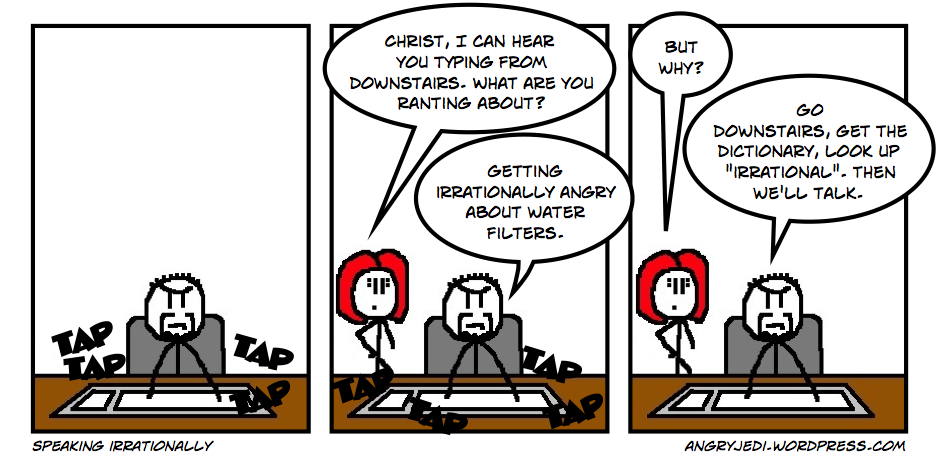
Actually, it goes deeper than that. I am fucking petrified of talking on the phone.

Here's what happens when I receive a phone call:

Phone rings.

"Shit! My phone's ringing," I think. "I wish my ringtone wasn't so loud/embarrassing."

I mute the ringtone and look at the display to see who's calling.

"I don't want to answer that if I don't know who it is," I think if I see a blocked number. "They must have bad news for me or want to yell at me; I must have done something wrong," I think if I see a number for someone I recognise.

"But wait," I then think. "Wasn't there that thing I was hoping to hear back from? Maybe it's that."

"Oh, but what the hell will I say?" the irrational side of my mind says. "You have enough trouble dealing with people in person at times, you can't fill awkward silences on the phone with hand gestures or pretending to cough or something."

"Just do it," says the rational side of my head. "What, seriously, is the worst possible thing that could happen?"

"I don't want anyone to listen to me on the phone," chimes in the irrational side of my head. "But if you must, answer it." I disappear into a room (or outside if a convenient room isn't available), close the door so no-one can listen in and take a deep breath, preparing to take the call.

Unfortunately, by this time, my voicemail has usually taken over and a whole new set of anxieties take the place of the original fears. I see a voicemail message come in and I'm hesitant to listen to it just in case it's someone, again, yelling at me. I don't generally give people reasons to yell at me, but still the natural assumption for me when I receive a voicemail is that it's someone yelling at me, particularly if I've had something important to do recently and I'm paranoid that I may have forgotten to do any or all of it.

It's no better when I have a phone call to make. Here's how that goes:

Look at phone number written down.

Look at phone.

Rehearse start of conversation in head, or at least attempt to.

Wonder what might happen if person on other end of phone deviates from script in my head.

Panic a bit.

Look at phone number again.

Rehearse alternative start of conversation in head. Wonder what the other possibilities might be.

Stare at phone for a bit.

Pick up phone. Start to dial number.

Stop.

Wait.

Think a bit more.

Swallow heavily.

Put down phone. Go and do something less stressful, like giving haircuts with a chainsaw.

(As an aside, oddly enough I seem to be just fine with "professional" phone calls. It's the more "personal" calls that I have difficulty dealing with. I worry that the person on the other end will judge me, misunderstand my long silences or call me a twat.)

I hate this part of myself. It's a genuine phobia, irrational and all, and a bit of casual Internet research suggests that I'm not the only person who feels this way, not by a long shot. It even has a proper name — telephobia (or, depending on who you talk to, the tongue-twisting telephonophobia or simply "telephone phobia") — but that doesn't really make me feel much better about it.

The solution to it is, as suggested by several people, to deliberately put myself into situations where I have to make phone calls. I've done temp work that would have involved answering the phone. I couldn't do it. I froze up, petrified, whenever the phone rang. I had to speak to my temporary boss almost in tears telling her that I just couldn't answer the phone. Deliberately put myself in that situation again? Sadly, it might work — but I just don't feel up to it, yet.

The phone is a pain in the arse. Even if I actually liked talking on it, I'd likely still think it was a pain in the arse. It's obtrusive, it interrupts things, you can't do anything else while you're talking on the phone (unless you have one of those Bluetooth headsets, and then you just look like a tit, plus people can then hear you pissing/making a sandwich/walking around outside/watching TV) and it's impossible to end a conversation effectively.

This hatred is, I know, all part of the "irrational" part of the phobia and I'm sure that if I was able to cope with it, I'd probably, in fact, actually quite like talking to people on the phone. But while a phone ringing and the prospect of having to answer it completely terrifies me and fills me with a sense of panic and dread… no thanks. I'll stick to forms of communication I'm actually comfortable with and can take my time over, thanks.

For now, anyway.

#oneaday Day 553: Classic Post

You know what annoys me? Apart from chavs; people who use too many exclamation marks; people who forget to put question marks on the end of emails and then send a whole new email saying just "??"; inappropriate use of the tongueface smiley when there's really nothing worth sticking your tongue out over; onions; Facebook; getting an itch on the part of your back you can't reach; terrorism; Michael Pachter; cameraphones at concerts; and computer hardware failing, of course?

The word "classic".

Now, there's nothing fundamentally wrong with the word "classic" when used correctly. Dracula is a classic novel. Monty Python is classic comedy. Judas Priest's Painkiller is a classic metal album. Super Mario World is a classic video game.

Brita water filter cartridges are not, in any way, nor will they ever be, "classics". Similarly, anything coated in chocolate may be tasty but likewise will not, and never will be, a "classic" flavour. Running OS 9 apps on old OS X machines using the Classic interface does not make me think "Gosh, I wish using a computer was still like this." And my bank account is never going to go down as a work of great literature or indeed an influential work of economics, despite my bank's assertion that it is a "classic" account.

I'm not sure where this stupid trend came from but it completely destroys the meaning of the word. This isn't the first word that modern society has mangled and violated, of course — see also "awesome" (which I confess I'm guilty of using, largely because I talk to a lot of Americans and partly because I used to work for Apple — the two things essentially being one and the same in terms of daily communications and what it does to your typical vocabulary), "epic", "fail" and doubtless numerous others.

But "Classic"? Seriously? I doubt in twenty years' time people are going to be looking back at the cartridges Brita water filters used and thinking "yes, that really was a classic of early 21st century water filtering design, but my, how primitive it looks now!" Or maybe they will. Perhaps early 21st century domestic engineering will become something of an art form in the near future, when we all have robot servants who will eventually and inevitably rise up against us but in the meantime get exploited by us lazy bastards.

Wait, I seem to have stretched my brain across the fourth dimension. Let me bring it back to the present.

Yeah, you think I'm taking the piss with the water filter thing, don't you? Well suck on this:

"Classic" water filter my arse. This, of course, being branded as a "classic" water filter cartridge now implies that there's some sort of edgy contemporary water filter out there which probably hangs around on street corners smoking marijuana and tagging walls with cans of spraypaint. A water filter so edgy and contemporary that it doesn't filter your water at all, it just spits it back in your face and tells you to go fuck yourself because this is 2011 and, like, dude, there are people out there who have no water at all and you're worried about sucking back a bit of limescale?

I may have overthought this somewhat and indeed deviated slightly from my original topic. I think on that note it may be time to go and lie down for a little while. Good night!

#oneaday Day 551: Feel What You Feel

It's been a couple of days of bad news, what with the horrible attacks in Norway and today's sad but unsurprising news that Amy Winehouse's somewhat tentative grip on life has finally given out.
Online and broadcast discussion of these matters has been interesting to observe. The media has been all over both of them, as you might expect. The reporting of Winehouse's death was a bit obnoxious, to be honest, with a constant live stream of the view of her street, presumably hoping to see something — anything — newsworthy. In the time I watched, there was nothing newsworthy besides the fact that she had died. The BBC strung this out with a series of quotes from a bizarre selection of people, including the ex-prime minster Gordon Brown's wife.

A lot of Twitter got all indignant earlier on at people expressing sadness over Winehouse's death while considerably more people had died in Norway. Then people got indignant about people's indignance, saying that it's OK to feel things about both pieces of news. Then people got indignant about this, saying that there are people starving in the world, etc. etc. It could have continued indefinitely — I haven't really looked since earlier, but there was severe risk of an infinite loop of indignance going on.

I kind of agree with the second group. As the version of Stalin in Command & Conquer: Red Alert said, "when one man dies, it is a tragedy; when one million die, it is a statistic" (Aside: according to Wikiquotes, this is commonly misattributed to Stalin. I did not know that. TIL.). That may be a harsh way of putting it, but there's a sort of logic to it; when we hear about the death toll in Norway, it's horrifying, but difficult to picture all the individual faces if you didn't know anyone affected personally. Contrast that with Amy Winehouse, whose face everyone knows, and it's easy to see why some people might take that a bit more "personally" despite not knowing her themselves — it's more relatable and, in some ways, easier to deal with.

However, that doesn't mean that it's a case of all or nothing, one or the other. You can feel bad about both things. You can feel bad about those things and the starving children in the world, too, if you like. Or, if you're going through a difficult time in your own life, you can feel free to say "fuck it" to all that and be selfish, too. There's no shame in your own individual feelings, particularly in this media- and Internet-saturated world where it often feels like the things we're supposed to feel about a "tragedy" are prescribed to us, and anyone who doesn't conform is not being appropriately sympathetic or empathetic.

I say feel whatever you want to feel. If you knew someone in Norway who was killed in the attacks, mourn them. If you knew Amy Winehouse, mourn her. If you didn't know anyone involved directly, feel bad for the people who were affected if you want to, but don't feel guilty if the things that are happening to you feel like they're taking priority. The relative severity of incidents gets proportionally amplified the closer they are to you — so something relatively "minor" in the grand scheme of things may seem like the most important thing in the world to you, even with all these other things going on. And that's OK.

The reason I say this is because of the way I spent a lot of last year feeling. Grief is a terrible thing and sometimes it feels like it will never end, but the worst thing I feel you can do while you're grief-stricken is feel guilty about it.

So feel what you feel without guilt. It's your business, and no-one else's.

#oneaday Day 548: Capcommotion

I'm a bit surprised by the way Capcom have been acting recently. I always used to figure them for a company that had their collective heads screwed on pretty well, and with their Capcom Unity (geddit?) site showing a much greater effort than many publishers to engage with fans, it looked like they were getting 21st century marketing right.

Then came the Mega Man Legends 3 project, where the community would be able to play an active role in the making of the game. The Capcom Dev Room page allowed users to submit ideas — many of which would end up in the final game — as well as see how the development of a game progressed from start to finish, complete with all the trials and tribulations it faced along the way.

The other day, the project got cancelled on the grounds that its transparency was proving to be "quite concerning" for the rest of the company. This, to me, is somewhat worrying, and suggests that Capcom has something to hide. It could be something as simple as the fact that they actually haven't done any real work on Mega Man Legends 3 since Keiji Inafune left last year, or it could be something altogether more sinister along the lines of the Team Bondi fiasco.

This isn't the only mis-step Capcom have made recently, either. The Resident Evil: The Mercenaries 3D save game issue stank from start to finish. To say that it's "not possible" to erase a save file on a 3DS game card is absolute nonsense — erasing a file involves writing to the card, and in order for the save to be on there in the first place the card must be written to. So there is absolutely no way that it would not be possible to reset the save data, yet Capcom persisted in perpetuating a lie to the community.

And today we learn that there's an "Ultimate" edition of Marvel vs. Capcom 3 on the way, featuring 12 new characters, 8 new stages and a spectator mode. But existing DLC characters aren't included in the package, naturally. And the "Ultimate" edition is a standalone retail product for $40, not a DLC expansion, which it really should be. I should be excited by the fact that Capcom have finally added Phoenix Wright to the game after a considerable amount of fan requesting, but instead I'm left with a bitter taste in my mouth due to them re-releasing a slightly-enhanced version of a game which only came out in February.

Sadly, this practice is becoming more and more common with this generation of consoles. And while I perhaps wouldn't go quite as far as my friend Mr Peter Skerritt in saying that this generation "sucks" — there's a lot to like, after all — I do believe that the obnoxious business practices that more and more publishers are starting to adopt are going to come back and bite both game companies and consumers in the ass at some point in the very near future.

I mentioned something along these lines on Twitter the other day in reference to Rockstar's comments that L.A. Noire still isn't finished despite having released its "final" piece of DLC. The response I got was surprising; the practice was defended on the grounds of it making good business sense. If we're at this stage already where blatant money-grabbing and the cutting of content from games in order to hold it back for subsequent DLC or new retail editions is defended by the community because it makes good business sense, it's a sad situation indeed. We gamers are supposed to be giving money to the software companies we want to support because we like their products, not bending over and asking in what ways they can violate us next. I'm quite happy to buy a game and never resort to piracy, but with more and more early adopters being punished by having to pay full whack for a product and then being stung for DLC down the line, it's understandable if people feel disillusioned by the whole thing.

That said, not all hope is lost — since picking up a gaming PC I've been using the consoles far less. And while there is DLC for PC titles, many PC gamers are a lot less patient with this sort of bullshit — largely because there's an enormous and active modding community out there more than willing to provide content of a higher quality than Activision's $15 map packs for free. And there aren't many PC games I've played recently where there's a big hole for some DLC — I intend on going back through Mass Effect 2 at some point, so I may feel differently after that, though.

The most frustrating thing I find is that people don't seem to realise or care that they are being taken advantage of. We can complain all we like about Capcom releasing the same game twice in the space of nine months, but we all know that there are enough people out there who will happily part with their cash and give Capcom the sales figures they need to justify rolling out this obnoxious business practice again and again. We can bitch all we like about paying $15 for Call of Duty map packs, but people pay it, again showing Activision that it's Okay to Do This. And we can point our fingers and say L.A. Noire's add-on cases should have been in the game in the first place, but I bet most players picked them all up just out of curiosity if anything, giving Rockstar the green light to do more in the future.

It's refreshing to see that not all of the industry is operating in this way, though. Indie developers are flourishing — and the community is taking to them. Indie RPGs Breath of Death VII and Cthulhu Saves the World along with awesome roguelike Dungeons of Dredmor topped the Steam sales charts on their day of release, and in less than a week on sale BoD/CStW has equalled its sales from a year and a half on Xbox Live Indie Games. Minecraft continues to go from strength to strength. And Frozen Synapse proves more popular than its developers could have ever dreamed.

Right now, I'm thankful that the indies exist, because with every day that passes, each new "teaser reveal", each new embargo, I'm losing more and more respect for the big publishers.