#oneaday Day 952: 伝説のブログ

I've been pretty much immersing myself in Japanese culture recently thanks to the various games I've been playing. Between Yakuza 3, School Days HQ and the Persona 4 anime that I've just started watching in preparation for Persona 4 Arena's delayed European release, it's been super-Eastern around here, to the extent that it actually felt a bit strange to boot up Guild Wars 2 earlier and hear people speaking English.

I would like to learn Japanese. I have been saying this for years, but worrying about it being difficult has stopped me on several occasions. I have, however, now found a decent iOS app (Human Japanese) that walks you through both the spoken and written forms of the language, so I will use that to give myself a good introduction and then see where I need to go after that. I am trying to devote a few sessions per week — ideally each day, but that's not always practical — to studying. So far I have learned how to write the hiragana for the vowels, which is more hiragana than I have ever learned. I would type some to prove it, but I have no idea how to type Japanese characters on a computer as yet (except by copy and pasting from Google Translate, which is how I got the title for this post), so we'll cross that bridge at a later time.

What I've found, however, is that through immersing myself in Japanese media, I've actually picked up a surprising number of words and phrases. Okay, I can't spell them, write them in Japanese script or, in many cases, even say them properly, but I recognise plenty of words and phrases. Words like "densetsu" (legend), which I first came across when I heard the Japanese name of Secret of Mana — Seiken Densetsu, literally Legend of the Holy Sword. For quite a while I didn't know that "densetsu" meant "legend" but I picked it up somehow, meaning that when someone in School Days HQ mentioned a "legendary break room" in the subtitles, I deduced that the part of the Japanese sentence that meant that bit was densetsu no kyuukeishitsu. (I know Romanji sucks, but it's all I've got right now, yo!) I knew that the "no" after "densetsu" meant that "legend" was being used to describe another word (essentially the equivalent of tweaking a noun to become an adjective in English) so therefore I figured that kyuukeishitsu means "break room". And sure enough, it does. Hurrah for apparently having the right kind of mind to work out language.

There's a few other phrases I've picked up from Japanese media, too, some of which might even be useful. I can say hello in various ways (konnichiwa, osu! (tatakae! Oueeeeeendaaaaaaaa– wait, no)), good morning (ohayou!), sorry (gomen nasai), yes (hai), no (iie, pronounced confusingly similar to someone saying "yeah" hesitantly), goodbye (sayonara — if you've never studied any Japanese before I was as surprised as you are that it's an actual word in another language rather than a made-up one) and express gratitude before a meal (itadakimasu, apparently bellowed by everyone before diving into one's bento if School Days HQ is anything to go by). Oh, and strawberry (ichigo). And laughing like a shy schoolgirl (ufufufufu!).

Now all I need to be able to do is 1) incorporate these snippets and phrases into actual Japanese conversation and 2) be able to figure out how to write them in scary squiggly script. Both of those things will probably involve a lot of practice, so if I start talking about the densetsu no bento next time I'm having lunch with you, gomen nasai.

#oneaday Day 951: First Love

She was beautiful. He could tell even back then. There was no-one he would rather look at than her. Her long, blonde hair and beautiful, sparkling eyes enraptured him so, even at that young age. He didn't really know what these feelings meant, but he knew that he loved her; he loved her dearly; he loved her more than anything or anyone else in his life.

He had no idea how she felt about him. He was too young to understand the feelings rattling around inside his head, so how could he expect to make someone else understand them? His love lived purely in his imagination, and he was happy for it to remain that way. In reality, she was his friend; in his mind, every time he closed his eyes, she was so much more.

His imagination had always been powerful, but it seemed to outdo itself every time she entered his thoughts. As he drifted off to sleep at night, he would close his eyes and picture her face; shortly afterwards he would be involved in some grand adventure either with her, or in an attempt to rescue her. He had fought his way through caves, forests, dungeons, castles and surreal landscapes made of warped shapes and bizarre colours; always, she was there waiting for him at the end, or by his side as he struggled.

One day, the bad news came. "She's moving away," they said. "And soon." He didn't know what to do with this; he didn't think he could stop it, but he desperately wanted to. He had no idea how to start, though. He was still too young; too young to understand these confused feelings in his head; too young to understand the emotions welling up inside him. He wanted to talk about it to someone but couldn't muster up the courage. His love for her was locked away in the deepest, darkest, most private part of his soul, and he couldn't let anyone in, because he feared that he wouldn't be able to get them out again afterwards. He relished his inner peace, and resented anyone who tried to defile it without an invitation; he was the one in control of his feelings; he was the one who had to deal with them, always alone.

The fateful day approached, and he began to recognize the growing knot in his stomach as a yearning to be by her side; a longing to be the one she would always come home to; a desire to give her one of the few keys to that deep, dark, secret place within his soul. He knew that he had to tell her how he felt, and he knew that he would only get one chance to do it.

The day arrived. One by one, his classmates bade her farewell, and after what seemed like an eternity, it was his turn. He looked up into those sparkling eyes and she smiled at him the way she always did. He smiled back.

Though they had both only spent a few years together out of their own respectively short times on the planet, he knew she had had a profound effect on him, and he knew that he should say something meaningful at this point.

A tense feeling wrapped around his throat, like a noose trying to choke the life out of him. He tried to speak the words he longed to say — I love you, I'll miss you, please don't go — but they wouldn't come. They stuck in his throat, lodged beneath the invisible force that choked him so.

"Bye," he said quietly.

"Bye," she said, smiling.

He wanted so badly to embrace her; to kiss her; to tell her how he felt. But he couldn't. He smiled at her one last time, turned and walked away, knowing that he would probably never see her again.

He was sad for a long time after that. It felt like a piece of his very self had been ripped out and replaced with nothing but inky blackness. There was a void in his soul where she had once been; he had wanted to let her in, not realising that she was already there. And now she was gone.

The pair exchanged letters for a while; his heart raced every time one of those distinctive coloured envelopes plopped through the letterbox — he swore she either used perfumed envelopes or sprayed them with her favourite scents — and he wrote back as soon as he got some time to himself.

As time passed, though, the letters became less frequent and eventually stopped. His own life was moving on by now; moving too fast for him to keep up with, and certain things from his past started to fall by the wayside. He saw it happening and regretted it, but he knew deep down within his heart that she probably felt the same way too. The black void in his soul started to heal, and he focused on trying to enjoy the present rather than gazing into space reflecting on what once was, and what might of been.

New loves — always unconfessed, assumed to be unrequited — came and went, giving him the familiar feeling of butterflies in the stomach for a few fleeting weeks before disappointment set in. But though the gap she had left deep inside him had mostly healed, he still held a place for her, even though he knew it was futile. She was gone, far away by now, carried away by the winds of change to distant climes, well beyond his reach. The fog of forgotten friendship descended, and he no longer knew where to find her. She was gone.

He opened his eyes slowly. The light of the morning sun was streaming into his room through the window, blasting rays of light through the panes of glass and casting a pattern on the bedspread. It looked like a nice day outside, but he knew that this was all he would see of it.

He had lived a good life. If he could do it all over again, there were some things he would have done differently, but for the most part he had no regrets.

Except when it came to her. If he had confessed his love to her when he had had the chance, how might his life have unfolded? Would it have ended the same way? Would all the other trials had endured and good times he had enjoyed have come about? Or would it have been completely different?

There's no use wondering now, he thought to himself. It's much too late for anything but one last glimpse.

He closed his eyes again, and there she was, exactly as he remembered her all those years ago. He gazed into her sparkling eyes. which were now wet with tears.

"I love you," he said. "I always loved you. And I never stopped loving you. Not for one second."

"I know," she whispered, a tear rolling down her cheek, but a cheerful smile still playing across her delicate lips. "I know."

As the flame within him flickered and dimmed, he smiled to himself. It didn't matter that it was all in his mind. That was where she had always lived for all these years; that was where she belonged. But it was time to say goodbye.

"I love you," she whispered.

Then he was gone.

#oneaday Day 948: Please Find Another Term for "Nice Guys"

I had a lengthy discussion with a couple of people on Twitter earlier regarding the term "Nice Guy" and the negative connotations it appears to have picked up recently.

For the uninitiated, the term "Nice Guy" (with caps) refers to the sort of creep who hangs around women in an attempt to get into their pants simply by trying to make himself the "default" choice. He does his best to worm his way into their life and make himself available, and doesn't take no for an answer, instead preferring to guilt-trip his targets and complain to anyone who will listen about being "friend-zoned".

Now, I won't lie; I've used the term "friend zone" before (usually jokingly) and, when single, have got depressed that certain women whom I liked and was spending a lot of time with didn't seem to reciprocate my feelings. Or, to be frank, in most cases didn't know about my feelings at all. Because I didn't tell them. Because I am a nervous wreck in even the most mundane of social situations at times, let alone a high-pressure one like confessing that you like someone. If I had been turned down, I would have left it at that. (And in fact, in one case where I did confess my feelings and got turned down, I hit the brakes immediately.)

In short, while I may have, in the past, used some of the terminology or exhibited some of the behaviours of these "Nice Guys", I am certainly not and have never been a creep. I do not and have never believed, as the wise Mitu Khandaker once said to me when describing this phenomenon, that "if I put in enough Kindness Coins then Sex will fall out".

I do consider myself a nice guy (no caps), though.

Herein lies the problem I have with this term "Nice Guy" (with caps). It carries with it such baggage that it is no longer possible to refer to yourself or someone else as a "nice guy" (no caps) because of the negative associations with "Nice Guys" (with caps).

See where the confusion is coming from, now?

The thing is, being a person who considers himself (and is often described as) a "nice guy" (no caps) makes me feel like absolute fucking shit any time the "Nice Guy" (with caps) discussion comes up. I know that it's not about me, I know that I don't exhibit those behaviours or put women in unsafe or uncomfortable situations, but it still makes me feel like crap. I already lack confidence in personal (not professional) social interactions, especially when meeting new people. I already worry about coming across as a dick, as being boring, as being a creep, and now, with this "Nice Guy" phenomenon and the widespread adoption of "Nice Guy" (with caps) as the accepted terminology, have to worry about whether or not I'm being too nice and coming across as, in the words of my fine friend Campfire Burning (a participant in the discussion from an earlier and another self-professed "nice guy" (no caps)) a "creepy misogynistic would-be or actual rapist or paedophile".

So please, for the love of all us genuine nice guys (no caps), please please please find another way to describe these creeps. There's one, in fact. What's wrong with "creep"? Or "jerk"? Or "terrifying, predatory guy who just won't leave me alone"? Or "Hello, police, please? Yeah, I'm being stalked."

I know the reason that people refer to them as "Nice Guys" (with caps) is because they refer to themselves as "Nice Guys" (with caps), but in doing so you're just reinforcing the stereotype that the words "nice" and "guy" when put together is somehow a bad thing. And it isn't. Those of us who are nice guys (no caps) are being slammed with the reputation of an unpleasant, undesirable part of society. And that is most certainly Not Okay. So cut it out. Please.

#oneaday Day 946: Things I Actually Miss About School

For the most part, I don't miss my own school days. I spent a lot of them being bullied by douchebags who hopefully haven't amounted to anything by now, one of whom I rather memorably punched in the face just as the headmaster was coming around the corner. (He sided with me after the fact, noting that my outburst of aggression was quite understandable, given bully in question's history. I got away with nothing more than a "five minute report", a piece of paper I had to get signed by teachers every five minutes during break and lunchtime.)

But there were good times too. So I thought I'd share a few.

The Rough Book

Our school library used to sell exercise books for a few pence, just in case you lost yours and wanted to replace it without having to tell your teacher that you'd lost your book. The librarian (Mrs Miller, no! We will not let you go!) asked no questions, though, other than "what colour would you like?"

And so it was that my friend Ed and I brought in the concept of the "Rough Book" — an exercise book ostensibly for quick scribblings, sketching and note-taking but which usually ended up completely covered in graffiti, drawings of cocks and an elaborate middle two pages flamboyantly depicting the name of whichever girl I had made the mistake of telling my friends I fancied that week.

A key part of the Rough Book's appeal was keeping it secret, and for the most part we managed to do so without it being confiscated or even spotted. It was immensely satisfying but also a bit sad to reach the end of one — while it was possible to look back on all the silly drawings we had done over the course of a few weeks, the book's "magic" was lost, and it usually found its way into the bin eventually — largely because we didn't want our parents and/or teachers seeing all the pictures of cocks and swear words we'd scrawled all over every available inch.

Music Concerts

Our school used to do two big concerts a year — one in the summer, one around Christmas time. The weekly rehearsals for the various groups tended to revolve around practicing pieces for these big events, which always enjoyed a strong turnout from parents and friends of the school. Going to music groups was one of my main forms of socialising at school — since I lived seven miles away, it wasn't always easy to just pop over to a friend's house for pizza and video games, and music groups gave me a chance to make some new friends and see some of my existing friends in a new context. They were fun.

There was something special about concert night, though — a strange, almost romantic atmosphere in the air. Inevitably, being a horny teenager, I'd interpret this atmosphere as "God, I'd really like to get off with someone" and spend as much of the evening as possible attempting to flirt with the girls from the clarinet section. (Ahh, Nikki. How hot you were.) Being a zitty, socially-incompetent loser with crap hair, I inevitably failed to drum up the confidence to do anything to take advantage of the romance in the air, but all of the girls were good enough to humour me and not just tell me to fuck off, which was nice.

Learning Shit

You know, I actually enjoyed the whole "learning" part of school. (This is probably why I was bullied so much.) I loved the fact that on any given day, we got to learn German, saw a plank of wood in half, spectacularly fail to compose a "reggae" piece and listen to our maths teacher make up an anecdote about the time he went windsurfing and knew he was exactly 200 metres from the shoreline. Exactly how much of that stuff has been retained over the years is perhaps questionable (my use of German nowadays can probably be filed under "racism", or "Englishman Abroad" at the very least) but I enjoyed learning it at the time.

Except maths. I hated maths with a passion. Maths homework used to make me genuinely angry. In retrospect, this was silly, because a lot of things in the real world involve maths to various degrees. Granted, I have little use for quadratic equations in my daily life (and thus can't remember what they are) but things like basic algebra and arithmetic occasionally come in handy.

The Canteen

I typically used to take a packed lunch to school, so eating in the canteen was a rare treat. They served chips and pizza and other awesome things, most of which Jamie Oliver has probably banned by now. In the upper school dining hall (which was later converted into part of the new sixth form centre that my year was the first to pass through) you could get chips and frickin' cheese.

The Teachers

Yeah, I actually miss the people who taught me. It would probably be horrifying to see how much they've aged by now, since the mental image I have of all of them is how they were between the years of 1992 and 1999, but there were some truly fine folks at the chalkface of my school. There were scary teachers, friendly teachers, knowledgeable teachers, weird teachers and, yes, hot teachers — but I can't remember any that I particularly disliked as such. (Except for the guy who taught me four-part harmony for A-Level music, but he was a peripatetic music teacher and thus didn't count.) I wonder how many of them are still there. I also occasionally wonder how many of the students I worked with during my thankfully short teaching career will remember me in years to come?

That's enough waxing nostalgic for tonight, I think. Time to sleep.

#oneaday Day 944: Uncovered: The Truth Why Gentlemen (And Some Ladies) Spend Longer in the Toilet

I can exclusively reveal to I'm Not Doctor Who a revelation: the real reasons why gentlemen (and some ladies) spend a long time in the toilet when doing a poo. This is a phenomenon that has long mystified the ladies (and some gentlemen) of the world, most of whom can be in, evacuated and back out again in the space of a couple of minutes. Your average gentleman (or some ladies), however, will regularly be in there for upwards of half an hour or so.

One question is on the lips of these gentlemen's (or some ladies') various significant others: what on Earth are they doing in there?

It is, of course, true that evacuating one's bowels continuously for 30 minutes would probably end with all of your internal organs falling out (yes, even the ones that aren't connected to the digestive system) so it's clear that not all of the time is spent doing, well, that. Likewise, the subsequent cleanup operation takes a matter of minutes at most. That leaves probably at least 25 minutes unaccounted for — so what is going on in that time period?

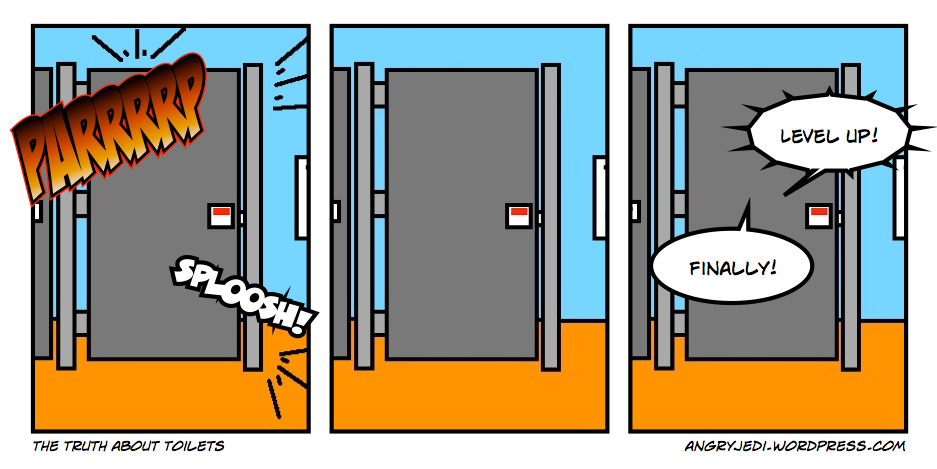
The answer is quite simple: anything which could quite easily be done in a more comfortable chair or in bed. Reading, checking emails, writing emails, checking Twitter, composing blog posts (yes, I have done in the past and no, this isn't one of them), playing video games, punching out board game components, small arts and crafts projects, installing software updates on various devices, learning a foreign language, listening to music — all of these are valid toilet activities for the dedicated "long stay" toiletgoer.

One may ask at this point why anyone would want to do any of those things on the toilet when there are many more comfortable seats in the rest of the house, many of which have an Internet connection nearby. The rather straightforward answer is "privacy, peace and quiet". For those who have trouble saying "I want to be alone," what better solution than shutting oneself behind a door which common decency prevents others from opening, even if the actual locking mechanism is broken?

You see, the bathroom is a haven of calm. Within that cramped little room lies a place for philosophers to determine their theories on life, the universe and everything; for authors to find their muse; and for committed Temple Run players to beat their previous high score while feeling one or both of their legs getting steadily more numb. It is a bastion of peace, free from the distractions of everyday life (unless the postman knocks on the door to deliver a package you've been really looking forward to) where one can go to be free, to partake in any activities they please — naked, if they so desire. There are few people on this planet who will shatter the sanctity of the the closed toilet door, and in most cases it's because they really need to go and will usually knock first.

So there you have it. A secret revealed. Should you have a partner who spends a long time in the toilet, judge them not too harshly, for they are simply setting their mental affairs in order, putting the day on "pause" for a moment before returning to tackle life's challenges once more. Allow them their moment of calm (unless you really need to go to the toilet) and marvel at their rejuvenated self once they emerge, ready to face the day.

#oneaday Day 941: Scrivenings

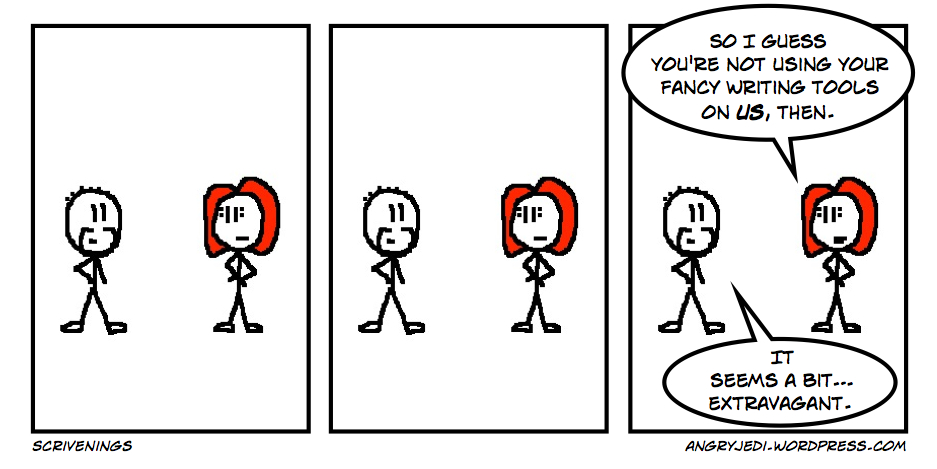
I've been spending a bit more time with Scrivener, a writing tool that I picked up a while back and then didn't do much with for a little while. Having paid actual money for it, though, I figured it was high time I delved into it and actually started using it for a project rather than it being one of those things that just gathers (virtual) dust as a symbol of past good intentions.

I decided that the project I was going to use it for was a visual novel. Regular readers will know that I find this simple but effective form of interactive storytelling to be a fascinating medium, and I have been toying with the idea of writing one for quite some time, usually falling at the first hurdle when I remember I have little-to-no graphical talent, which somewhat precludes me from incorporating the "visual" bit.

But, I figured, no sense worrying about graphics if there's nothing for them to visualise. So I decided to actually start writing it, and to use Scrivener to plan it out in advance.

Now, when I write, I must confess that I rarely go through a formal "planning" process. This is probably fairly evident in these daily blog posts, which tend to spew forth directly from my brain and out of my fingers in some sort of hideously unorganised stream of consciousness. But it's the way I've generally worked on more formal pieces over time, too. During A-Levels and university, I never "planned" an essay on a piece of paper beforehand. I never used the "outline" function of Word, I never scrawled things on Post-Its and then moved them around. I just wrote, then tweaked, fiddled and moved things around once I'd written a first draft. It worked for me.

Mostly.

That approach doesn't work so well with long-form fiction, whether you're attempting to create a linear narrative for a novel or a non-linear branching narrative for a game or visual novel. I have a number of stalled novel projects on the go simply because I'm not entirely sure where they're going. In some cases, I have an idea of what the end might be, but it's the stuff in the middle I haven't figured out. How to get from the beginning to the end, as it were.

So, as I decided to start work on this visual novel project (which, like an irritating PR agency for a company making an iOS game you don't give a shit about I'm "not ready to talk about yet") I also figured that I would give this whole "planning" thing a shot. I recalled seeing the spectacularly comprehensive flowchart for Katawa Shoujo (mild spoilers within), and knew that if I was going to put together even a relatively simple VN project, I would have to figure out some sort of way to keep it organised.

Fortunately, Scrivener has delivered just that brilliantly. In order to plan out the basic sequence of events, I've used the "corkboard" facility and its special mode where you can drag around virtual index cards as you please. I've written short synopses of each scene on each index card and laid them out in a logical fashion to depict the various routes the player might be able to take through the story. Each index card then corresponds to a separate "subdocument" in the whole Scrivener project, allowing scenes to easily be split up and composed a little bit at a time rather than simply being confronted with a daunting blank page and no idea where to start.

Then there's pleasing little touches that help with the actual writing process, too. When writing in "Script" mode (which I'm using to compose the VN), simple keyboard shortcuts allow you to easily switch from writing actions to character names to dialog and back again. You can create links to other subdocuments or your research (which you can also store within your Scrivener project). You can split the editor window so you can refer to a piece of source material as you write. And when it's all done you can "compile" your project ready for publishing as a physical product, ebook or other format.

I've barely scratched the surface of the features it offers, but already I can see it becoming an essential part of the writing process. Progress on the VN project is going well so far — I've synopsised (huh… according to spellcheck that IS a word) the whole of the first "act" of the game and am now starting on in-depth scripting for each scene. Following this, I'll work on the various diverging paths through the narrative and hopefully end up with a suitably comprehensive document ready to plug into Ren'Py and then flutter my eyelashes at someone who can draw. Following that, who knows? Perhaps I'll have a finished game one day.

#oneaday Day 937: The Olympics Are Closed

The Olympic closing ceremony finished not long ago, a little late, and now it's back to normal for Britain until the Paralympics start, at which point everyone will suddenly get interested in sport that isn't premier league football again for two weeks and then forget all about it when that is finished. (Incidentally, people, you can stop saying "don't forget about the Paralympics" any time you want. They're still quite a way off. I doubt anyone is going to forget they're happening — and more to the point, I doubt the media will let anyone forget they're happening, either.)

The closing ceremony was… well… uh… a bit poo, really. After the genuinely impressive spectacle that was Danny Boyle's opening ceremony — noteworthy for its greatest achievement, which was stopping British people from being snarky for two whole weeks — the closing ceremony just couldn't match up, and seemingly made no effort to.

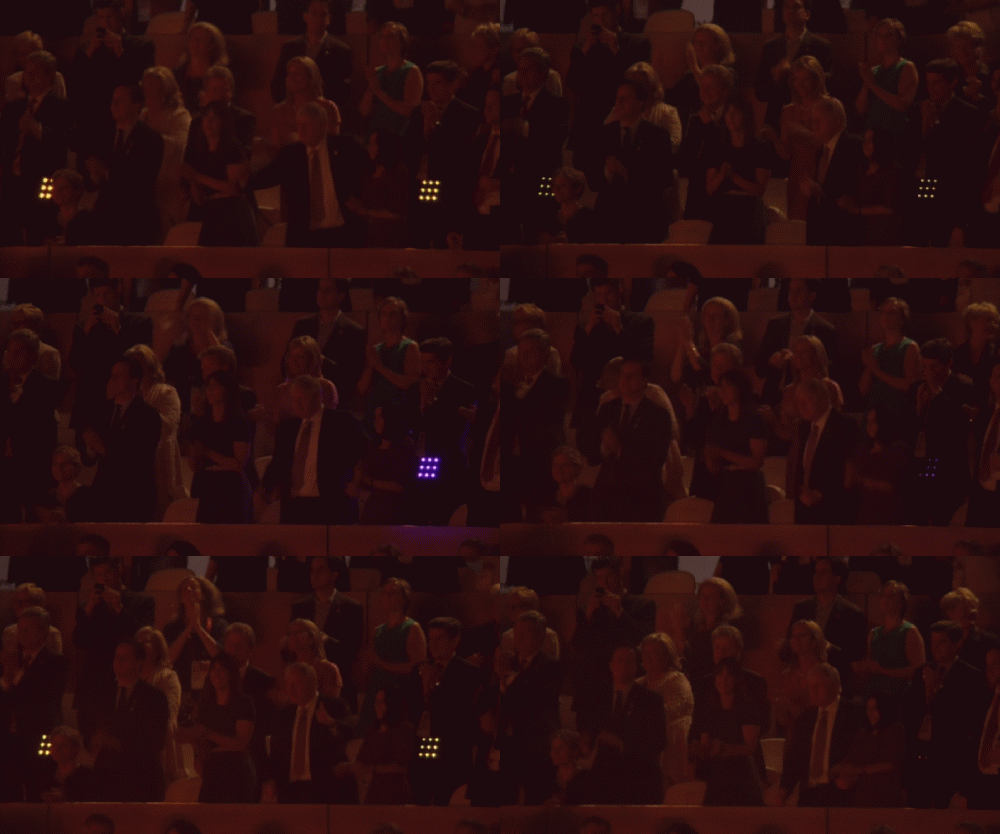
This is nothing new for Olympic closing ceremonies, of course, which always tend to be a bit poo, particularly when compared to the opening counterparts. But this was just… bizarre, really. And not especially good. There was a lot of celebration of British music that wasn't that good — Jessie J, Tinie Tempah, Taio Cruz (no, I didn't know he was British, either) were particular lowlights — and some utterly sacriligeous bollocks in the form of Jessie J butchering Queen with her characteristic out-of-tune caterwauling. Apparently the Spice Girls were involved at some point, but since I had left the room to go for a dump as soon as a video of John Lennon came on whining his way through "Imagine" showed its face, I missed them. And I'm not sorry. The Spice Girls never were good live. They were, however, responsible for this .gif of David Cameron clapping on "1" and "3" (twat!) and Boris Johnson dancing like your embarrassing uncle at a wedding:

Perhaps the most noteworthy thing about the closing ceremony was the palpable sense of relief as 60 million British people all unlocked their underpants and let rip with one of the biggest waves of snark I've ever seen. Everyone was obviously backed up from two weeks of genuine pride in the country, the achievements of our athletes and the fact that holy shit you guys, we did an Olympics and it didn't suck! It was obvious that everyone felt a lot better after ripping the shit out of the closing ceremonies, so it is, of course, entirely possible that the whole event was designed with precisely this in mind. In which case the whole thing was a wonderfully-crafted work of art that managed to get two weeks' worth of clogged-up snark well and truly ejaculated from the British public just in time for us to go back to the humdrum mundanity of everyday life tomorrow.

Or perhaps it was just a bit poo, really.

Still, regardless of how it ended, the Olympics have been an impressive spectacle and it's been nice to see people taking pride in athletes who obviously do what they do for the love rather than the money. There have been many comments over the last two weeks concerning the obvious differences in attitude between the (mostly) very sportsmanlike Olympians and the whiny, overpaid, spoiled little crybabies that are premier league footballers, and it's true. I hate football precisely for the attitudes that are typically on display from the oafs who are at the top of their game, and there was not a trace of that throughout the Olympics… well, for the most part, anyway. Winners often appeared to be genuinely humble and proud of their victories, while those who missed out on gold didn't tend to blame the referee, the other team, the other manager, the fans or anyone — they simply remained gracious in defeat and, in many cases, promised to come back fighting even harder at the next opportunity.

That's the true thing that should be celebrated from these Olympics. The opening ceremony was cool, sure, and the closing ceremony was entertainingly bad, but neither of those two things are what the whole experience is about. It's about taking pride in the sporting achievements of one's country, and if it can even crack the jaded, cynical old heart of a curmudgeon like me then it's truly something to be applauded.

#oneaday Day 936: Biggest != Best

No, I'm not talking about penises.

Let's talk about Facebook.

Facebook is massive. Facebook has taken over most people's daily existence on the Web to such a degree that there are plenty of people out there who genuinely believe that it is the Web. Like, all of it.

It's not. But then you probably knew that already.

But the fact stands that it is a massive global phenomenon, and something that has happily grown and evolved over time from its humble beginnings up to the multi-bajillion dollar business it is today.

Thing is, though, as it's grown, it's sort of lost sight of what it's for.

"Facebook is a social tool that connects you with people around you," the login screen used to say. When adding a friend, you used to have to indicate how you knew them, and the recipient of that friend request had to verify your story. It was actually quite a good idea that got around the MySpace "friend collecting" issue, whereby people would just add and add and add each other and then not talk to any of their 40,000 friends. Facebook's systems ensured that you 1) were actually friends with the people you marked as friends and 2) didn't fall into the "popularity contest" trap.

Whizz forward to today, and the Facebook of 2012 is a very different place. Now we get people promising "2,000+ friend requests" if you Like one of their pictures. I don't want two thousand friends. I want my online friends to reflect people I actually know, and occasionally give me the opportunity to meet someone new who is relevant to my interests and/or knows people that I know. Give me two thousand newcomers from all over the world, all of whom are vying for my attention simply to make some arbitrary number higher than everyone else, and you sort of lose that.

Part of the reason for this change is the different in what Facebook thinks we should use it for these days. I first joined the site quite a while after many of my friends had — at the time, I assumed it was going to be one of those passing fads like MySpace, and would quickly disappear into obscurity. But I found its value while on a trip to the States to visit my brother — while abroad, I could share the photographs I'd taken and easily stay in touch with my friends as a large group rather than emailing them individually. It was nice.

Over time, things started to shift. Facebook's big change to something a bit closer to its current layout upset a lot of people, and the addition of "applications" marked the beginning of how the social network looks now. At the time, I was of the attitude that the people complaining about it were bleating on about nothing, but in retrospect they may have had a point. As everyone's news feed started filling up with FarmVille brag posts, the signal to noise ratio started getting worse.

Then came the brands. Facebook undoubtedly thought they were doing everyone a favour when they opened up the previously "personal" social network to companies and businesses who wanted to grow their social presence. And in some cases, it worked well, with companies able to engage with their customers and post important information as and when needed.

Unfortunately, this too lost the plot somewhere. Now, pretty much every brand page uses the same obnoxious "engagement strategies" to keep people commenting, talking and Liking — the worst of which by far is the fucking awful "fill in the blank" status update that invites commenters to give their own meaningless opinion on something utterly asinine and irrelevant to the company's product. ("My favorite color is ____________!" proclaimed the Facebook Page for The Sims 3 on one memorable occasion. Over four thousand people replied.)

You see, people seem to absolutely love posting things that have absolutely no value. People love thinking their opinion is important, that they are being listened to, that the things they say are somehow valuable to someone.

The things you say are valuable to someone. The people they are important to are called your family and friends. Not the PR representative for The Sims 3. They don't care what your favourite colour is. They just want you to keep giving them page impressions and comments and Likes.

Likes. Fuck Likes. The Like button is Facebook's most enduring legacy, and one of the biggest blows to actual communication in today's connected world. Why comment any more when you can just click "Like"? It means nothing, particularly when it's connected to a sentence for which the verb "like" is completely inappropriate. ("My grandad died. So sad right now." "Insensitive Twat likes this.") It's a meaningless metric designed to measure how many people have seen something you have posted and want to interact with it, but are slightly too lazy to actually write anything.

The diminishing sense of Facebook's usefulness for actual communication is perhaps best exemplified by the current way someone's profile looks. Known as "Timeline", the theory behind it is that it is an easy to navigate history charting everything interesting that has happened in someone's life.

It's a sound plan. Unfortunately its implementation is just terrible.

The problem is that there's no consistency in how posts show up, and seemingly no understanding of how people read content. Leaving aside the fact that one's profile cover image and fairly pointless basic information takes up over 500 lines — or nearly half of a 1920×1080 display — there's seemingly no rhyme or reason as to what gets posted at the "top" of one's profile.

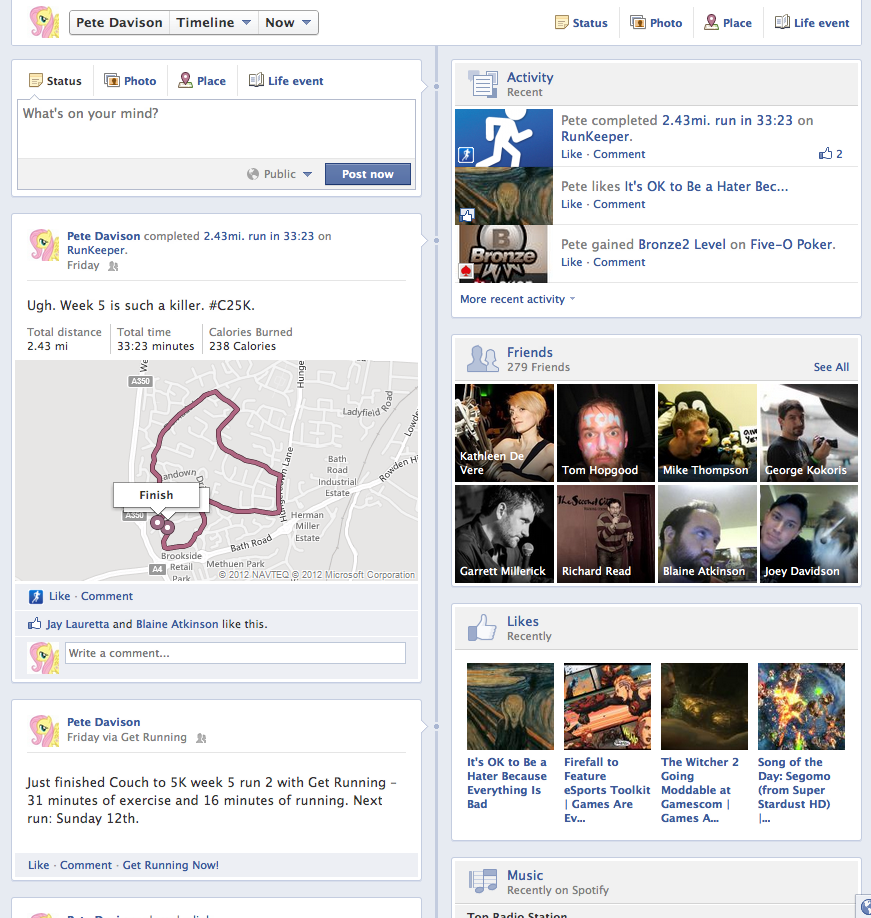
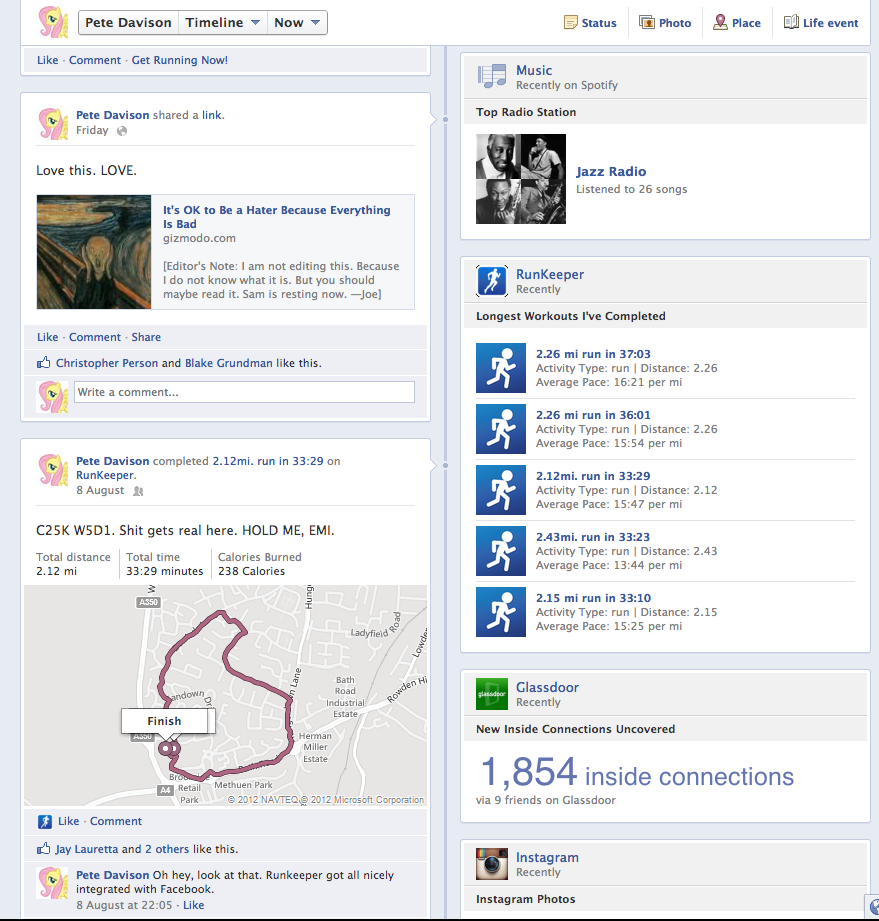
The conventions established by blogs and earlier social networks dictate that the most recent things go at the top, so anyone checking in on someone's page doesn't have to scroll around or search to find something new. Yet with all the sources from which Facebook can pull information these days — games, external sites, apps, Spotify, Netflix —  there is no consistency in what goes where. For example, at the time of writing, this is what the top of my Timeline looks like:

What a mess, and very little of it is stuff that I 1) actively shared and 2) feel people really need to know. I deliberately shared the RunKeeper stuff because I like sharing my fitness achievements because it helps keep me honest, but I have no need to show people who eight of my friends are, nor do people need to know that I achieved Bronze Level 2 in Five-O Poker, a game I reviewed earlier in the week and specifically told not to share shit on my timeline. At the other end of the spectrum, pages that I have "Liked" elsewhere on the Internet — and thus wanted to share with others, perhaps because I wrote them or just found them interesting — have been unhelpfully collected into a single box that shows just four of them. This behaviour changes seemingly daily, with Liked pages sometimes showing up as individual posts on one's Timeline (useful) and sometimes being collected into that box (not useful). At the time of writing, Facebook appears to have decided that "not useful" is the way to go on this one.

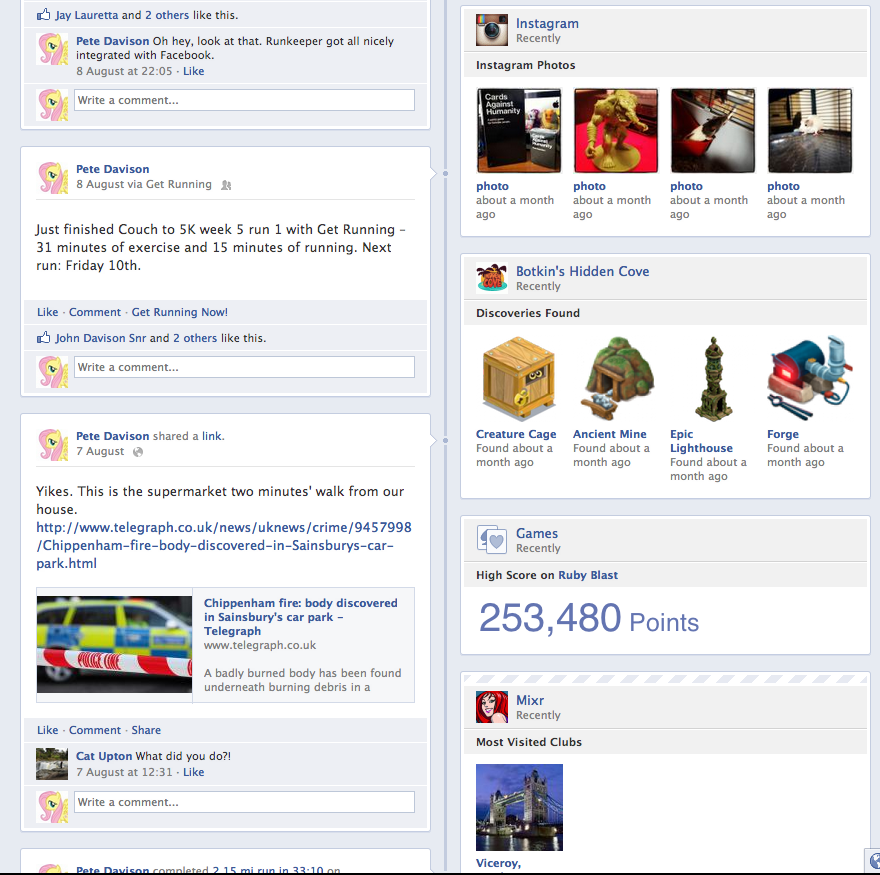
Let's scroll down a few "page heights" and see what else we have:

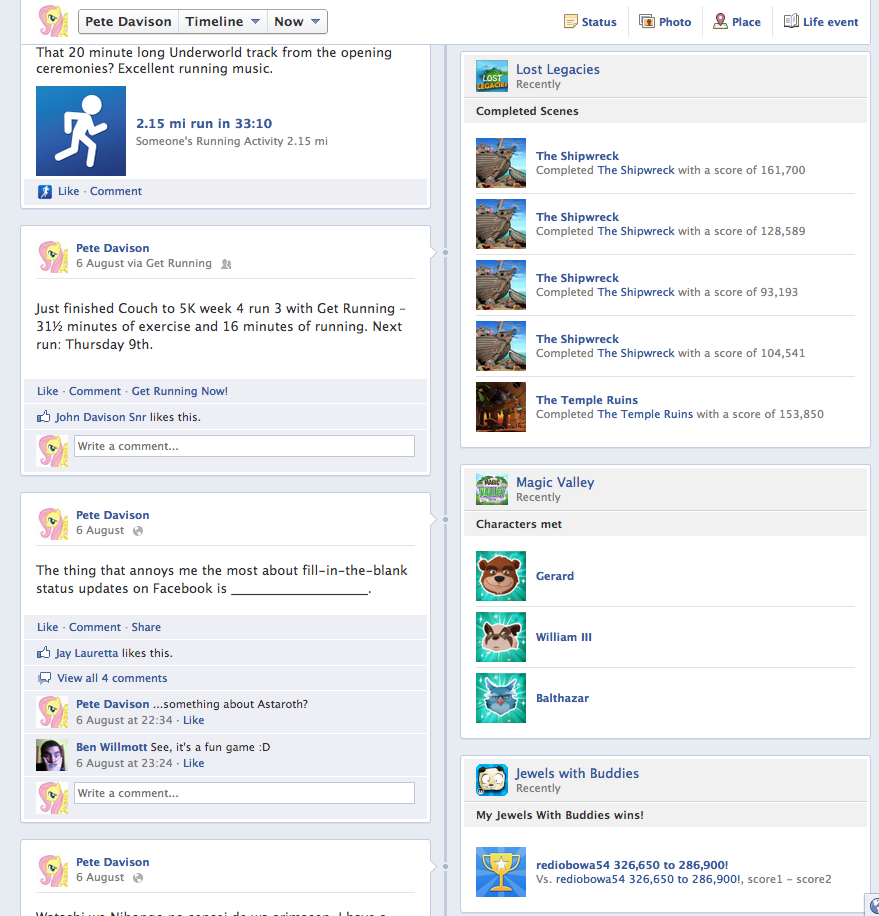
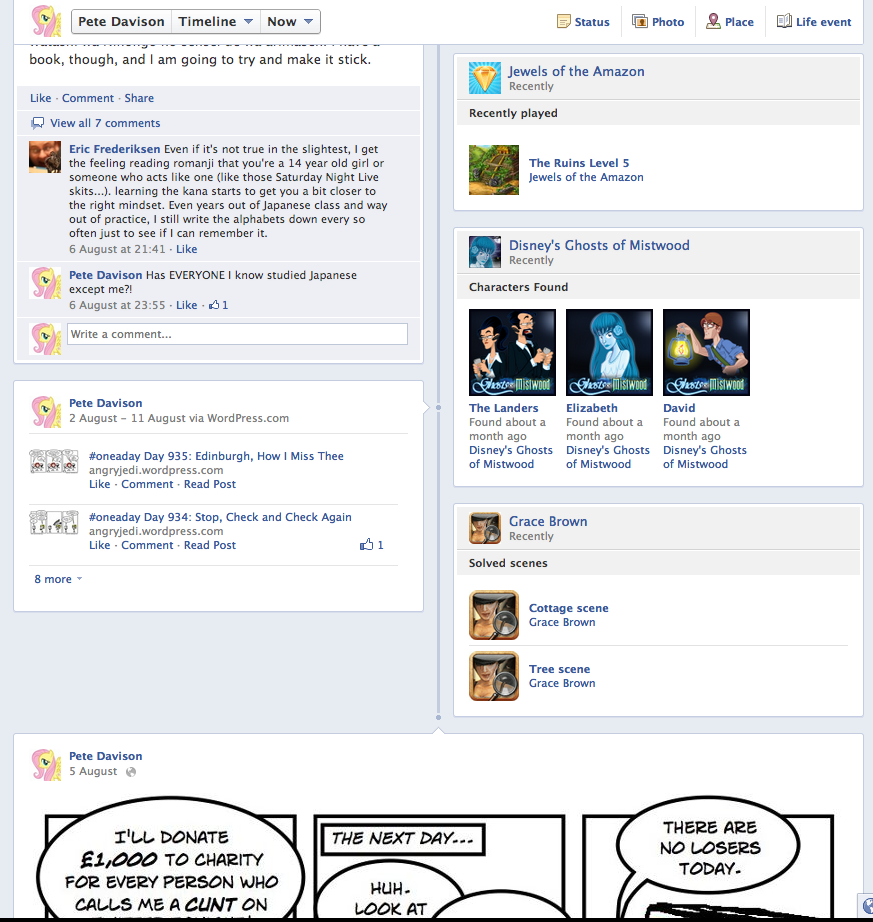
The left column? Sort of all right. The right column, though?

SO MUCH IRRELEVANT CRAP.

Including posts from games that I 1) didn't press a "Share" button in once and 2) have since removed from my Facebook account.

There. After five screen-heights worth of scrolling, I finally get to one thing that I actually want to share with people — my recent WordPress posts, aka a feed from this blog to my Facebook Timeline. Again, though, like the Likes, they have been collected together into a box that displays very little relevant information and, in this case, is put in a stupid, stupid place. Why stupid? Because the most recent post in that little WordPress.com box came considerably after the RunKeeper post at the top of my Timeline — and certainly considerably after all the spammy crap those games have plastered all over that infuriatingly useless right column.

"Facebook is a social tool that connects you with people around you" my arse. "Facebook is a digital scrapbook maintained by a five-year old with ADHD," more like.

I'll see you on Twitter.


#oneaday Day 935: Edinburgh, How I Miss Thee

A brief Twitter conversation with the always-awesome Mitu Khandaker got me all nostalgic this evening. Y'see, Mitu has just come back from the Edinburgh Interactive Festival, where she was speaking about exciting and clever things to do with love, sex, relationships and obsession in games — a topic which I find particularly fascinating, as my extensive series of posts on Katawa Shoujo will attest.

But that's not what I want to talk about today, as I'm sure video and/or slides from Mitu's presentation will be available online at some point soon, and they will probably say things rather more coherently than I can. (I LOVE YOU EMIIIIIII)

No, instead I just want to look back on why Edinburgh is awesome. Because it is awesome, and if you've never been I strongly suggest you take the opportunity to do so.

My memories of Edinburgh stem entirely from my several trips to the Fringe festival with the Southampton University theatre group, known on various different occasions as SUSU Theatre Group, "Blow Up" and "RATTLESNAKE!", for reasons that I have, sadly, since forgotten.

My first trip there came during my first year at university. I'd joined the theatre group and had already had a small part in our overly-elaborate and rather pretentious production of MacbethThe Matrix was still fashionable, you see, so it was seemingly obligatory for every student theatre company in the country to do a Matrix-inspired Shakespeare production, and we were no exception. (It actually ended up being quite good, though vastly over budget.)

Anyway, Wachowski-Shakespeare crossovers aside, my association with the theatre group eventually led to me auditioning for the Edinburgh production and successfully securing a part. The play we'd decided to take up was Ivan Turgenev's A Month In The Country, which is a good play with interesting characters (I played Afanasy Bolshintsov, a character for whom I was legitimately able to leverage my legendary Harold Bishop impersonation), but quite heavy going. Our bright idea was to perform it outdoors in the Edinburgh Botanical Gardens, which sounded like a great idea on paper.

Actually, it was a pretty great idea that added some lovely atmosphere to the play, the only flaws in the plan being 1) the amount of rain that Scotland gets and 2) the fact that the Botanical Gardens were rather off the beaten track. As a direct result of 2), we had rather disappointing viewing figures, but soldiered on regardless, despite having no more than one or two people watching most days.

Performing the play was just a relatively small part of the whole experience, though.

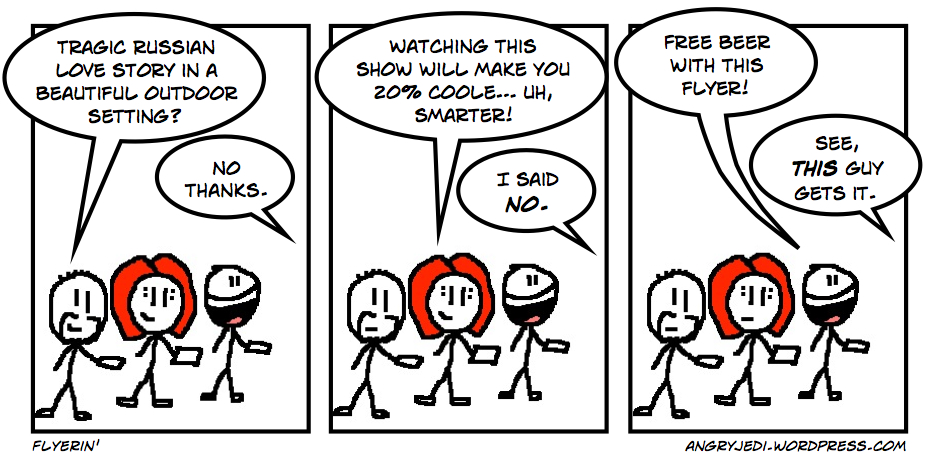
In the mornings, we'd be flyering on the Royal Mile, one of the main streets in Edinburgh that attracts entertainers and promoters come Fringe time. Flyering was always fun, even if it was rather difficult to sell the idea of a tragic Russian love story performed outdoors in a venue no-one really knew the location of to passing tourists. We managed to get a few people coming along, though — and not just all our respective parents.

In the evenings, we'd take in some shows (all right, lots of shows) and then go drinking. Lots of drinking. You see, at the time, Scotland's licensing laws were significantly different to England's — in England, you could only drink until 11pm in a pub and 2am in a club; in Scotland you could drink until… actually, I can't remember what time you could drink until in a Scottish pub (I want to say 2am) but I certainly remember that the clubs were open until 4am.

Our two regular haunts for drinking purposes were the "Frankenstein" pub, a rather tacky (but awesome) theme bar that sold overpriced (but awesome… and deadly) cocktails; and a club just around the corner called Espionage, which had five floors, each of which was themed after a far-flung locale that James Bond had visited in one of his movies. (Incidentally, I am very pleased to note that both of those venues are still there. That makes me feel warm and fuzzy.) Following drinking until some ungodly hour in the morning, we'd often decide that The Thing To Do at that point was to get a pizza from the conveniently-located all-night pizza place that was near Frankenstein — an all-night pizza place which provided you with said pizza at an astonishingly high speed.

It wasn't all roses, though. On this first trip, I was enjoying the experience but found myself suffering considerably from the social anxiety that has wracked my personal life for as long as I can remember. I found it difficult to start up conversations with the people I was living with at times — despite the fact I was acting with them every day — and I found myself worrying that people would think the things I said would be stupid. I recall one evening getting very depressed, breaking down in tears and being very embarrassed about the whole situation despite the fact I was sitting by myself in the hallway when it happened.

Two of the guys I was staying with came to my rescue: Chris and Des (no relation to Des). I was very grateful to them, because they proved to me that the things rattling around in my head were completely wrong. They took me in to their room, talked to me, got to know me and let me stay the night in there with them. (To sleep. This was not a period of "experimentation" for me.) We had some laughs, particularly at Chris' expense when he fell asleep in mid-sentence, and I got up the following morning feeling considerably more positive about myself, my situation and my ability to make friends.

That night was a real turning point for me. Remembering that night gave me the confidence to go back to Edinburgh on two other occasions with the theatre group — once without a show, once with a double-bill of The Importance of Being Earnest and Alan Ayckbourn's Round and Round the Garden. Both visits were amazing, and neither were tainted by feelings of anxiety. In fact, the experiences I had on those two visits were remarkably akin to the way I felt when I visited PAX East a couple of years ago before my life went to shit — I felt like I was "home", "among friends", and completely comfortable. I would have given anything for it to have lasted forever.

But these things don't last forever, sadly. What will stay with me forever, however, is the memories — Des getting told off for trying to dry-hump a guy dressed as a dinosaur on the Royal Mile; recording our drunken conversations on a Dictaphone in the kitchen of the hostel we were staying at; climbing Arthur's Seat after a solid night of drinking, reaching the summit in time for sunrise, drinking sake in silence as we witnessed dawn breaking, then sliding down the muddy hillside on our arses.

Thinking about it, my positive memories largely revolve around what I did while I was there than the city itself. I've never been there when it wasn't Fringe time, see — and at Fringe time it's a magical place, infused with a wonderful atmosphere all day and all night for the entire duration of the festival. But from what I saw beneath the glitz and slightly grotty glamour of Fringe time, it's a beautiful city, too, and one that you really should visit if you've never had the opportunity. One day I'll make it back there, though whether or not it'll be at Fringe time I don't yet know!

#oneaday Day 933: So What Happened Again...?

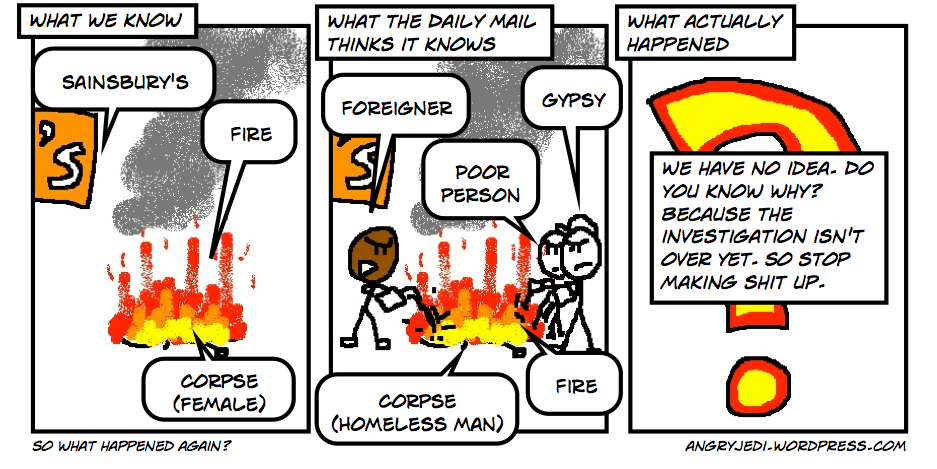
Yesterday they found a dead body in the supermarket car park approximately two minutes' walk away from my house. It was spotted around 3AM, when a dog handler on patrol saw a fire and alerted the appropriate authorities. Upon dousing the flames, a badly burned corpse was found — so badly burned that it was impossible to immediately identify it as male or female.

I am curiously unfazed by this knowledge. It's a horrible thing to happen and I can't help feeling I should be more unnerved than I am by the fact that it happened not far from my doorstep. But I'm not. And that's not what I'd particularly like to talk about in relation to this incident.

I'd instead like to talk about the reporting of the incident in the newspapers and online.

Most outlets did a decent job of reporting the known facts, which I outlined in the first paragraph. Nothing more was known, and nothing more would be known until 1) the police had completed their investigations at the scene and 2) the body had been examined.

The ever-resourceful Daily Mail, however, decided to just make some shit up to make it a better story. "CHIPPENHAM TRAMP SET ON FIRE AND KILLED BY 3 THUGS AS HE SLEPT IN SAINSBURY'S CAR PARK" proclaimed the headline. (For comparison, the Daily Telegraph went with "Chippenham fire: body discovered in Sainsbury's car park".) They then proceeded to explain that an attack was "caught on CCTV" (later changed to "thought to be caught on CCTV") and that "sources" had seen "three men" filling up jerry cans at Sainsbury's petrol station shortly before the blaze was found. (Sainsbury's petrol station isn't open at that time in the morning, which should give you a rough idea of how true the rest of it is.)

This went on for several paragraphs, explaining that the fire had been caused by this gang of three men dousing a homeless man in petrol and then setting fire to him. A horrible crime, I'm sure you'll agree, but a fictional one.

How do I know this? Because the body was confirmed as female today, not male, and the original Mail article describing these "facts" has mysteriously disappeared, to be replaced with this rather similar, but much more vague account that more accurately reports the facts. Moreover, there has been no further mention of this supposed "attack" that was caught on CCTV, just an appeal from police for people who were seen in the area to come forward and assist them with their enquiries.

Now, for all I know, the story about the victim being a homeless person could end up being true, but the fact is, the Daily Mail were guilty of some incredibly irresponsible reporting on this incident. They presented their theory as fact without providing any evidence whatsoever — who were these "sources," for example, and how did they see what  happened while apparently no-one else did? — and thought that this was somehow okay. It's another example of the Daily Mail just not giving a shit about… well, anything really. It's beyond parody. It's just pathetic. And yet somehow it still continues to exist. How? And why? How has no-one stepped in to shut this crap down yet? Does the Mail's questionable "comedy value" outstrip its obligations as a news outlet?

Apparently so. And I think it's too late to do anything about it now.