I was surprised to discover that a device exists purely for the purpose of streaming shit music into shops.
Actually, let me correct that: a device exists purely for streaming royalty-free music into shops. There's a good reason for this, of course: music in the background generally makes for a livelier, more pleasant atmosphere, but not all businesses find it practical or desirable to pay up for PRS and suchlike in order to use copyright-protected music, and as such we have the rise of the royalty-free artist and their music to fill this apparent gap in the market.
The aforementioned device isn't, shall we say, a perfect bit of kit; the available music on offer is relatively limited, and its shuffle algorithm is so unsophisticated that it's not at all unusual to hear the same song five or more times over the course of a single hour, but it does at least perform its basic function reasonably effectively. And more to the point, through a bit of the old Stockholm Syndrome, finding yourself in an environment where this nonsense is all you are able to listen to means that after a while you might actually start liking some of these songs.
Songs like Kady Z's Game Over.
Or indeed Kady Z's Beautiful Disaster — apparently Kady Z, whom I had never heard of prior to actually investigating the dreadful but catchy lyrics to Game Over, is pretty much the queen of royalty-free music.
Interestingly, of all the musical monstrosities that belch forth from the aformentioned streaming box, Kady Z's are the only ones that I seem to be able to find easily on the Internet. I'm sure the others are out there somewhere, but Game Over is the only song I've so far managed to find by Googling the one line of the lyrics I can actually remember. ("Game over, you and me, game over, finally free.")
All this is perhaps because in particular the two songs I've mentioned above I actually don't mind all that much. As I say, that may well be the Stockholm Syndrome talking, but from a bit of additional cursory research this evening, Kady Z appears to be 1) quite attractive and 2) actually not a terrible pop artist either, seemingly drawing influences from a number of other artists including Ke$ha (most apparent in Game Over), Katy Perry and numerous other "upbeat white chick" kind of affairs.
I wouldn't say she's a particular artist I'm going to rush out and buy all the albums of, but sometimes it's kind of nice to accidentally stumble across some reasonably inoffensive new music that's a bit outside the mainstream pop charts, which remain mostly dominated by bullshit these days — yes, I am getting old, and I'm not at all ashamed of it.
So there you have it. Make an hour-long playlist with Game Over in it at least five times punctuated by other stuff and you, too, can experience roughly what my day has been like.
Since I appear to be on a Final Fantasy XIV roll at the moment thanks to the excellent new patch, I thought I'd devote today to some of my favourite tunes from the game as a whole.
I respond very strongly to music that I enjoy — so much so that any time I think about hanging up my Eorzean adventurer's shoes for good, it's pretty much always the music that gets me coming back time after time. Or, if it's not the only reason, then it's certainly a leading reason as to why I keep coming back.
So let's look at some great tracks from the game.
"Patch 3.4 boss theme"
I don't know if anyone knows the actual name for this theme yet, but it's an excellent one. It seemingly became tradition with A Realm Reborn that the last couple of patches in a cycle would use different boss music from the ones we had been enjoying previously, and Heavensward is continuing — or, perhaps more accurately, confirming — this tradition.
This boss theme mixes two important themes from the game as a whole: Heroes, which we'll come to in a moment, and Penitus, which we'll also come to in a moment. To put it another way, it mashes together one of the most recognisable musical motifs from Heavensward with one of the most recognisable musical motifs from A Realm Reborn to produce a track that very much feels like a "reward" for people who have at least been playing since 2.0.
Heroes
This theme, played during vanilla Heavensward's final boss fight against King Thordan and Knights of the Round, brought the already exciting story of FFXIV's first expansion to a climactic head. While the fight was a bit easy even when it first launched, people still enjoy running it today just to enjoy this music and the spectacular graphical effects throughout the battle.
Penitus
I was already thoroughly wrapped around this game's little finger by the time I got to level 50 and was faced with the two 8-player story dungeons that wrap up vanilla A Realm Reborn's storyline, but getting into Praetorium and hearing this wonderful piece of music — snatches of which had been heard in a variety of different styles right the way through from level 1 all the way to 50 — got me absolutely hyped to see the story through to the end.
Ultima
And then the game goes and throws this incredible track on you for the Absolutely Definitely Last Boss, Yessirree (Not). I'll let this one speak for itself.
Thunderer
Ultima is followed by this little wonder featuring one of the best key changes ever. Sadly the first time you hear it, it doesn't last anywhere near long enough because everyone absolutely obliterates the Real Final Boss, Definitely Totally For Real This Time in a matter of seconds these days.
Thankfully, Square Enix clearly knew they were on to a good thing with Thunderer, as it was reused in a couple of places — most notably in the Chrysalis trial which was added in one of the content patches, and, for many people, its most iconic appearance in Turn 5 of the Binding Coil of Bahamut, in which you fought the dread dragon Twintania, and which in the game's vanilla release acted as the "true" final boss. (Of course, this later all changed with Second and Final Coil, but still.)
Footsteps in the Snow
Shiva was one of my favourite Trials to be added to the game almost entirely because of this excellent piece of music that opened the fight and ran until the phase change. This music was first heard in the trailer for patch 2.4, Dreams of Ice, and got everyone well and truly hyped.
From the Ashes
Raid dungeon The Final Coil of Bahamut was, for many players, a highlight of the game due to its fascinating story — which, unlike the narrative of A Realm Reborn itself, which span off in a different direction, followed up on how Final Fantasy XIV 1.0 ended. Turn 12, the penultimate turn, is often cited as a particular favourite by many players simply due to this unique music, which was a highly dramatic, spine-tingling take on A Realm Reborn's main theme song Answers. The whole of The Binding Coil of Bahamut had featured music based on Answers, and this track felt like it was bringing everything to a dramatic conclusion.
Answers
And, having mentioned Turn 12, it would be remiss of me not to mention the way Answers was used in Turn 13, the absolutely definitely positively totally final boss of the game, or at least of the raids. I present it here in context, including battle sound effects, to show how it is used in the fight itself. The incredible crescendo during Teraflare is made of goosebumps.
I'm yet to do the new Alexander raid — my item level isn't quite high enough yet — but I understand the grand finale is suitably spectacular. T13 is going to take some topping, though.
Let's try a little experiment, shall we? I'm going to start with a YouTube video of a piece of music I really like. Given that I've just come off a session of Ys Origin, let's make it a piece from Ys Origin. After that I'm going to see where the Related Videos take us, and we'll go on a little journey. I'll try and give a bit of useless trivia for each track.
To give things a bit of variety (though I'm not promising quite how much!) I'll pick the first Related video that isn't 1) a Recommendation for me based on past viewing and 2) from the same game, movie, whatever as the previous one.
Ready? Here we go.
This is the theme that plays in the final area of Ys Origin, and I particularly like it because it uses one of my favourite soundtrack techniques: making use of the main theme in a different way to how it sounded originally. When used in a finale sequence, as it is here, it gives the whole thing a nice feeling of "closure" — or at least of approaching the end, anyway.
To put it more simply, effective use of this technique can get you seriously pumped for the final battle. And Ys Origin certainly does it well.
Onward!
I haven't played Ys: The Oath in Felghana yet, but it's probably next up after I finish with Ys Origin. As such, this is the first time I've heard this piece, and I'm pleased to hear that it has Falcom's distinctive prog rock-inspired sound about it. While I don't really know a lot about prog rock itself, I do like the sound of music inspired by it, and it seems there are a number of Japanese groups that do it very well — Falcom's sound team being one. (Nobuo Uematsu's bands The Black Mages and The Earthbound Papas are some others, though they do arrangements of game music rather than directly soundtracking games for the most part.)
Unsurprisingly, YouTube is taking us on a distinctly Ys-ian journey. Again, I haven't played this game, so it's my first time hearing this track, and initial impressions are good. Again, it has the melodic rock sound to it, but it also makes use of some violin melodies, which I often find sound really nice in the context of instruments you might not typically associate violin with. Other examples of this being done well include its combination with electronic instruments in Final Fantasy XIII's main battle theme, and as part of a distinctly modern-sounding pop ensemble in Omega Quintet's two battle themes.
Yet another Ys I'm yet to get to, and I know I have at least a couple of friends who count this soundtrack among their favourites. The timbre of this one's soundtrack is a little "cleaner" and perhaps more artificial-sounding; there's certainly some synthesised brass going on, but the guitars and solo violins sound fairly convincing.
The slightly more artificial sound of the music is presumably down to Ys VI being an earlier release than Oath in Felghana and Origin, and Falcom's sound team still refining and developing their sound with new tech and capabilities.
We've escaped the Ys series! And we find ourselves involved with another Japanese video game company's internal sound team that is world-renowned as being Rather Good. In this case, we're with Gust, developers of the Atelier and Ar Tonelico series, both of which have simply lovely soundtracks.
This particular piece is from one of their slightly lesser known games, Mana Khemia, which is often regarded as part of the Atelier series due to its thematic and mechanical similarities.
And speaking of Atelier, here's a track from one of the more recent ones. It very much sounds like the distinctive sound Gust has put together for the Atelier series over the last few installments, featuring prominent use of traditional "folk-style" instruments such as harmonica and penny whistle.
I'm also a big fan of this track's title.
Staying with Atelier and moving forwards in time, this is from Escha and Logy, a game I don't know a lot about but know is reasonably well regarded in the Atelier canon. There's a pretty cool guitar solo in the middle of this track, too.
And we're up to the most recent Atelier game, Atelier Sophie, and a track with a pretty magnificent rhythm guitar part. There's also a hint of Nights of Azure in there with the prominent use of harpsichord/clavichord. In fact, this whole track wouldn't be out of place in Nights of Azure.
YouTube agrees. Nights of Azure was a really great game that I enjoyed a lot, and a big part of that was due to its wonderful soundtrack, also the product of Gust's sound team, but clearly heavily inspired by Michiru Yamane's work on the older Castlevania games. This sort of Gothic rock is perfectly fitting with the game's fast action and overall tone, and contrasts nicely with the more gentle music used in its story sequences.
Let's do two more, or we'll be here all night. This one's from Megadimension Neptunia V-II, a game which I'm sure you already know I liked a whole lot. This particular track was one of my favourites due to its heavy use of some distinctly retro-sounding synthesisers, which brought to mind a few things: the synthesised music of Sega Mega Drive/Genesis games, and the once-fashionable .MOD format of digital music, which effectively used short, digitised samples as "notes" on a virtual synthesiser-sequencer and allowed those who knew what they were doing to put together multi-track compositions.
Last one!
Eternal Sonata was an extremely peculiar concept for a game in that it's an RPG based around the noted Romantic composer Frederic Chopin. In keeping with that, the soundtrack has a distinctly Romantic feel to it, with authentic orchestral instruments used to give the music a very different feel to more obviously "gamey" pieces. The game also used some of Chopin's work directly in its soundtrack.
It's been quite a while since I watched Love Live! — long enough that I'm considering watching it again, particularly as what appears to be Love Live! The Next Generation of sorts is currently brewing — but ever since I watched it, it's been a pretty regular part of my life. Specifically, it's pretty rare that I go a day without listening to at least a few of the songs both from the show and which were released as singles and albums as spin-off products.
One of the reasons I really enjoyed Love Live! as much as I did when I first watched it was because of the music. Sure, the story was fun and the characters were loveable and memorable, but if a show about music doesn't have good music in it, then, well, it fails. Fortunately, Love Live! had great music that complemented the story really nicely, even if you don't understand the Japanese lyrics.
The reason I like Love Live!'s music so much is because each and every one of them is an absolutely perfectly crafted pop song. Everything about pretty much every Love Live! song is put into place so immaculately, so beautifully, that it's hard not to get swept up in the energy of it all. The choice of vocalists; the backing track; the melodies; the harmonies; the chord sequences — all these elements combine to make something naturally delightful and pleasing to listen to, and intoxicatingly addictive.
Here are a few favourites.
This song is only heard as an instrumental in the show itself, but I liked it as soon as I heard it with lyrics in the Love Live! mobile game. It's a wonderfully cheerful, upbeat piece about friendship or something; it doesn't really matter. It just sounds nice, has a catchy tune and is eminently suitable for singing along to, even if you just babble Japanese-sounding syllables to the rough melody.
Also I like the "la, laaaa, laa laa laa laaaaa" bit at the end. Andie hates it, but whatever.
I adore this song, partly because it's the first song (aside from the OP) in the show, and it's a beautiful moment: Honoka, Umi and Kotori all coming together to try and achieve something for the first time, even in the face of adversity. It's also another really catchy song with some toe-tapping rhythms that fit well with the dance moves depicted in the show. And come on, listen to it. I defy you to reach the end of that without cracking a smile.
This is a gorgeous song in many ways. I particularly like it as it highlights Umi's voice, which is one of the most understated yet pleasant to listen to voices in the cast — a fact that goes with Umi's rather straight-laced personality. This song also reflects Umi in another way: the fact that in many ways she's the most "Japanese" of the cast, without any particularly exaggerated physical or personality traits, and this song — particularly its calming opening — fits her perfectly.
This one… well. What more can you say about a heavy metal song about enjoying hamburgers after school? Just rock out to it.
This one took some tracking down and I wasn't sure why… until I realised that it's not from Love Live! itself at all, but actually from a disc of character songs for the PS3 game The Guided Fate Paradox. That said, it does feature Eli from Love Live! on vocals, and as such is worthy of inclusion. It's also a pretty awesome song in the Castlevania mould in its own right. So there. And now I think I actually need to play The Guided Fate Paradox because I had no idea how good its music was.
In response to The Daily Post's writing prompt: "Night and Day."
Have you ever had an experience that was amazing the first time, but terrible the second time around? Or vice versa? What made it different the second time?
I had to think pretty hard about this one, because by now I have a fairly firm grasp of what I do and don't like in a lot of aspects of my life, and consequently I'm inclined to seek out things I know that I'll enjoy while avoiding things that I know I'll dislike. There is value, of course, in trying something outside your usual comfort zone, but while this can sometimes pleasantly surprise you, often this ends up just confirming or reinforcing your existing perceptions.
One thing did particularly come to mind, though. I don't know that I'd describe it as "amazing" and "terrible" for the first and second times, and it's more of an abstract thing rather than a specific incident, but it otherwise fits the description.
I'm talking about playing a new piece of music for the first time, specifically — for me, anyway — on the piano.
I'm good at sight-reading. This still surprises me a bit, as it was always the part of the graded piano examinations that I hated the most (with the possible exception of aural tests, which still seem somewhat sadistic) but I think I can trace my ability to pick things up quickly back to my habitual place on the piano for the school orchestra and various other ensembles, including a local choir. Certainly in the case of my school, I was (arguably) the best pianist there, so I was often recruited to play piano parts that would otherwise go unplayed; more often than not, then, I was expected to pick up a new piece of music and be able to immediately play it.
And for the most part I can do that pretty well. However, one thing I've noticed about this is that the first time I play a piece at sight, it always feels like it sounds a whole lot better than any subsequent time I try to play it without sitting down and doing some intensive practice on it.
To be honest, I'm not entirely sure if this is actually the case or not — it may well be that my first attempts to sight-read something are a horrendous noise, with subsequent attempts only marginally better owing to the fact I at least have a vague idea of what to expect — but it certainly feels that way. Playing a new piece of music for the first time is enjoyable and exciting, assuming it's not one of those pieces that demoralises you from the get-go by being ridiculously difficult and completely unplayable without months of intensive, low-tempo practice. As such, I wonder if that "high", for want of a better word, that you get from trying out a new piece for the first time makes that first attempt "feel" better than subsequent efforts, when you know you "should" be able to do better.
I guess the above description could probably apply to a whole lot of things in life, now that I think about it. Trying something for the first time gives you that satisfying buzz of "I'm doing something new!" but after that, assuming you stick with it, you settle into more of a routine, and mistakes start to become more frustrating. At a certain point, you have to make that difficult decision as to whether you're going to continue working on the thing in question in detail, or set it aside and try something else.
It's a tough call with no right answers; no-one likes to feel like they're "wasting" their time!
Re-watching Star Trek: The Next Generation and Deep Space Nine recently has made me more conscious of something that had been on my mind for a while: the fact that TV doesn't really seem to do lengthy credits sequences any more.
This isn't necessarily a bad thing, as in the case of Star Trek you're sitting there for a good few minutes watching swirly space and Patrick Stewart as Capt. Jean-Luc Picard and Avery Brooks as Commander Sisko (still in season one at the moment) and, consequently, without a credits sequence the show itself has a few more minutes to play with. But does that few minutes really make a difference? Perhaps when the show is a short 20-minute affair, but when it's 45 minutes or more there's a strong argument for saying the writers should maybe look at where a few bits can be snipped.
But anyway. Whether or not credits sequences are a good thing isn't really what I want to talk about today, since that would be a short discussion — yes, they are — but what I did want to talk about is the ones that have stuck in my head over the years. A good credits sequence is strongly iconic and does a good job of summing up what the show's all about — either literally, by introducing characters, or sometimes in a more abstract sense by using representative imagery.
These are in no particular order. Given how I'm attempting to call them up from my living memory, they'll probably in roughly chronological order, but I am making no promises. I'm simply going to provide them for your delectation, with a few words about why I like them, why they're important to me or why I simply find them memorable.
Henry's Cat
I hadn't thought about Henry's Cat for the longest time, but a brief Twitter discussion with the fine Mr Alex Connolly the other day reminded me of both its existence and its terrible but strongly iconic credits sequence.
I honestly don't remember much about Henry's Cat beyond the title sequence and the little bit of an episode I watched out of curiosity on YouTube the other day. But I do suspect it's rather a product of its time, and not the sort of thing that kids are watching on TV these days.
Count Duckula
Whoever uploaded this gets bonus points for including the "Thames" logo at the beginning. Ahem. Anyway. Count Duckula was brilliant. And I've watched a few episodes recently and it's still genuinely quite amusing thanks to some wonderful voice work and characterisation… not to mention its baffling premise of a vegetarian vampire duck voiced by David Jason.
Unlike Henry's Cat, the Count Duckula theme and intro has stuck with me all these years. However, I did not know until two minutes ago when I looked at Wikipedia (to make sure it really was David Jason who voiced Duckula) that Count Duckula was actually a Danger Mouse spinoff series. TIL, and all that.
Star Trek: The Next Generation
You can't really get more iconic that Star Trek when it comes to title sequences, and there's really not much more that needs to be said about The Next Generation — aside, perhaps, from the fact that when you look at it, it's actually rather basic. Once the credits themselves start rolling, it's little more than text and the Enterprise occasionally hurling itself at the screen.
Star Trek: Deep Space Nine
I didn't like Deep Space Nine all that much when I was younger; its relatively "static" nature of being set on a space station rather than on an exploratory starship made it feel a bit more "boring" to the young me. Revisiting it recently has made me realise (or remember?) that it's actually really rather good — and certainly a lot more consistent than The Next Generation was in its early seasons.
I like the theme very much. It's one of those pieces of music that just sounds satisfying. What I did find interesting, though, was when they changed it very subtly starting in the fourth season:
It becomes faster, I think it's in a different key, the orchestration is different and the accompaniment is less "bare". It accurately reflects the show's noticeable change in direction from the fourth season onwards, not to mention the changes in the cast: Commander Sisko becomes Captain Sisko, The Next Generation's Worf joins the crew and Shit officially Starts Getting Real with regard to interstellar conflicts.
Friends
Friends was everywhere when I was a teenager, and I didn't mind because I enjoyed it a whole lot. The credits sequence was simple and straightforward, accurately summing up each character with a selection of season-unique snippets of their most iconic moments. It was fun to try and identify which episode each of the snippets had come from… you know, if there wasn't anything better to do.
Angel
Ah, Angel. Probably one of my favourite TV shows of all time, next to its companion piece Buffy the Vampire Slayer (which is also one of my favourite TV shows of all time, but whose credits sequence I never really rated all that much). Angel's intro was great in that it reflected the dark, brooding nature of its title character, but it also allowed the show to pull off one of its best features: the unexpected and surprising fact that while it wasn't afraid to deal with some seriously dark themes, it was very happy to poke fun at itself and show the silly side of the supernatural as well as the scary. The intro helped with this in that it set the expectation for a very "serious" and dark story, then in true Whedon fashion, it often subverted these expectations with the actual content of the episode.
Yuru Yuri
(This was the best video of the intro I could find that hadn't been snagged by YouTube's copyright laws. You'll just have to deal with the Spanish subtitles.)
I love Yuru Yuri. It's such a delightfully mundane and silly anime; very little actually happens in it, but by the end you have such a wonderful understanding of these loveable characters that it doesn't matter that they haven't done anything of note. The opening titles complement it perfectly, introducing the characters visually and setting the energetic, joyful tone for the rest of the show.
Love Live!
You'd hope a show about music would have a catchy theme tune, and Love Live! doesn't disappoint. This video (which repeats several times; you're not going mad) is from the first season and, like any good opening sequence, neatly summarises the show and its characters without them actually "saying" anything (although one could argue the lyrics of the song have a certain degree of meaning). Also it's just plain catchy.
Akiba's Trip
One thing I really like about Japanese games is that they treat them the same as anime — and that means that a big deal is made out of the opening credits, with music that is often released as a single in its own right. Akiba's Trip had a particularly strong opening with a catchy theme song, a good introduction of all the characters and, again, a summary of what to expect from the next few hours of your life.
Hyperdimension Neptunia Victory
The Neptunia series has some excellent songs throughout, but the opening theme for third game Victory is one of the stronger ones. It does a great job of capturing the games' energetic, joyful spirit and acknowledges their origins as a parody of the video games industry at large through heavy use of electronic effects and synthesised sounds. It also makes a point of demonstrating the extremely strong friendship between the core cast members — they may not see eye-to-eye about everything (or anything) but they stick together and help one another out.
Omega Quintet
Last one for now, otherwise I'll be here all night and I quite want to go to bed. I wrote a few days ago about how I like the fact Omega Quintet treats its episodic story just like an anime series, complete with opening and ending credits sequences. Here's the opening sequence, which you see not just at the beginning of the game, but at the start of every chapter. It's as delightful as the game itself.
Writing in the comments of yesterday's post, Mr Heaslip reminded me that I've been continually impressed with the quality of soundtracks in modern anime.
I tend to listen to a lot of soundtracks when I'm doing other things — particularly when I'm doing work of some description. I prefer soundtracks in this context because lyrics can be distracting — particularly if you're trying to write something — plus, given the right one, they can lend a certain air of drama to proceedings. And it doesn't have to be work, either; there's nothing that livens up a tedious motorway drive like a storming, over-the-top soundtrack.
The majority of my soundtracks come from games, unsurprisingly, but since I started really getting into anime a year or two ago, I've begun tracking down soundtracks for various anime series, too. So I thought I'd share a few favourites today.
This is Swordland from Sword Art Online, the "trapped in an MMO" show that was popular but somewhat divisive. I enjoyed it a great deal — at least partly because it reminded me of .hack, a series of games and anime that I love the idea of but am yet to actually work my way through — but I will acknowledge the arguments that it was cheesy as hell and moved way too fast for its own good. Those things didn't put me off as much as some other people, but as I think we've established over the course of the last 1947 days, I have a much higher tolerance for bullshit than many other people.
Anyway, I'm a fan of this piece because it sounds authentically "gamey" — plus, for all the series' faults, it knew exactly how to give a sense of drama to a big fight scene, and that included having a suitably epic soundtrack.
Contrasting completely with the above, this music is… well, I don't know what it's called as my Japanese reading comprehension isn't quite up to the task, but it's the music that plays during the "Previously on Love Live!" bit at the beginning of each Love Live! episode.
Not a lot to say about it really, other than the fact that it nicely captures the feeling of sheer joy that Love Live! encapsulates; it's happy, cheerful, summery, uplifting and heartwarming, just like the show as a whole.
KissXSis was pretty dumb all round — it was thinly-veiled… no, completely unveiled fanservice for the most part, but it had some entertaining moments and some fun characters. The two titular sisters were an enjoyable study in contrasts, and the supporting cast made for an enjoyable ensemble to spend some time with.
The thing that stuck with me long after finishing watching the show, though, was the ending theme — and this adorable dance animation that was shown in partial form during the closing credits, and which was rendered in its full glory for, I believe, the Blu-Ray release.
Yuru Yuri was an odd show in which pretty much nothing happened for its entire run, but it was immensely endearing purely for its characters. It was one of those shows where you feel like you're "friends" with the cast by the end of it, and for that I'll always think of it rather fondly.
I can't actually remember the context of this song in the series — or indeed if it actually appeared in the series at all, or if it's just a character song from a soundtrack album — but either way, it's a nice little song that I like a lot.
DanMachi, also known as Is It Wrong to Try to Pick Up Girls in a Dungeon? thanks to questionable transliteration, is the current hotness in anime, with many calling it this year's Sword Art Online. It seems to be overall a bit more consistently well-received than Sword Art Online, however, thanks in part to its main heroine Hestia being a much more interesting and fun character than SAO's Asuna.
Like Sword Art Online, DanMachi has a gorgeous incidental soundtrack accompanying the action. There are some awesome battle themes, but in the interest of a bit of variety, here's a lovely, more pensive piece reflecting the affection between Hestia and protagonist Bell.
To Love-Ru is another show that was pretty dumb and mostly fanservice, but I still really enjoyed my time with it. I found it particularly interesting in that it changed format significantly over the course of its three distinct seasons, with the main heroine from the first season being largely relegated to occasional background roles by the third. (I wasn't super-happy about this, as I adored Lala, but the new "main" characters made up for her relative absence somewhat.)
To Love-Ru was another of those shows that was unrelentingly cheerful throughout. It knew exactly what it was — silly, lightweight, occasionally (all right, frequently) pervy fun that had no intention of making you think too hard. This particular track, known just as "Good Morning!" reflects the show's character pretty nicely.
Welcome to the NHK was an awesome show with a wonderful streak of honesty and bitterness at its core. Contrasting starkly with the relative darkness of the protagonist's hikikomori lifestyle was the fictional anime show many of the characters were obsessed with, whose theme tune ran something like this.
Purupurupururin…
Oh, Lord, Clannad. So many feels. Anyone who's seen the show probably doesn't need any further words when they hear this piece of music. And if you haven't seen the show, rectify that right now. Bring tissues. Not for that. For all the crying. Because there will be lots of crying.
I bought a piano today. This is not something I thought I'd ever be able to do, but it turns out if you look around a bit, you can actually get a decent (albeit somewhat aged) piano for a very reasonable price.
In other words, if you eschew regular music shops and instead go for a more "direct" approach, you'll often find much better deals.
I acquired my new piano (which arrives on Wednesday) from a local business called Bryant Pianos. I stumbled across this site during my search for a place to acquire a piano the other day, and decided to pay them a visit this weekend. Bryant Pianos is, it turns out, a business run from home by the eponymous Mr Bryant, who has a workshop full of pianos that he acquires, restores, repairs and then sells on. (Sometimes he acquires, strips them for parts and then sends them off to the great piano graveyard, too.) He's also a piano tuner — a useful person to know when you have a piano.
Anyway, I made an appointment to pay him a visit, and we did so today. I took a couple of bits of sheet music with me — Chopin's Preludes and Liszt's Consolations, if you were curious — and tried a few out. I don't know an awful lot about different piano makes, to be honest, aside from the fact that the grand piano I grew up with — and which still occupies my parents' living room — was a good (and expensive!) make because it was a Steinway. I was familiar with a few other makes but not in any great depth; I'd heard of (and probably, at some point, played) Knights, Bechsteins, Rogers(es), Challens and various others, and also knew that new Yamahas were both very nice and well out of my price range for the moment. Bryant didn't offer any Yamahas, but he had the others, so I gave them a go.
The Rogers was the oldest piano there, hailing from 1906. It had a really nice, rich, full tone and, apparently, weighed an absolute ton, being a distinctly old-school upright piano. Its action was reasonably nice, though it proved a little difficult to control at times, particularly when playing more delicate phrases.
The Challen looked nice — somewhat "school piano-y" in a 70s sort of way — but had a rather clangy timbre that caused me to discount it quite quickly. The action was nice, but it wasn't the nicest piano there, nor was it the cheapest.
The Knight hailed from the late '40s and had quite a nice sound, but a slightly rickety action that, a little like the Rogers, made it difficult to control at times. It's something I could have probably learned to live with, but while there was the choice there, I didn't see any point in "settling" for something that wasn't quite right.
The Bechstein, which was the one I ended up going for, had a good sound and a pleasing action. It wasn't quite as full and rich as the Rogers, but it still sounded good, and, perhaps more importantly, it felt pleasant to play. I went back and tried the others a few times just to make sure, but felt confident that the Bechstein would be more than adequate for my needs. Bryant did say that due to its age — it's from the '20s — it probably wouldn't have a huge lifespan, hence the fact it was one of the cheaper instruments in his workshop, but that it would be fine for a while yet. That's fine with me; I need something to get started with, then if (when?) the money starts rolling in I can consider upgrading to a newer model. I'd very much like one of those shiny black Yamahas, but I can't help but feel that's a while off yet!
I'm looking forward to having a piano in the house again. I've had my electric piano for several years now, but it's just not the same; sitting and playing it on a wobbly keyboard stand with an amplifier of questionable quality spitting and popping at me is all very well and good, but even the small amount of "setup time" required to get that going was enough to make me not play nearly as often as I should. Having a piano at which I can just sit down and play should hopefully change that; I should play more, and, all being well, it'll form at least part of my 375th career change in my lifetime. So that's nice.
I have a playlist on my phone called "Dad Rock". The title will be fairly self-explanatory to most of you, I'm sure, but for those wondering why I would call it that when I'm not a father (and have no intention of being one, either), the explanation is actually relatively simple. It's a playlist full of stuff that I secretly quite enjoyed listening to when I was young and impressionable, but which during my teenage years I steered well clear of owing to the fact that it's not at all cool to be into records from your Dad's collection. Not that I was cool at all during my teenage years anyway, but that's beside the point.
Anyway, the point is, my Dad Rock playlist contains a selection of stuff from artists like Pink Floyd; Yes; Emerson, Lake and Palmer; and the Electric Light Orchestra. It's a playlist I intend to build on over time as I recall things from the past that I actually quite enjoyed, and ultimately will become a pleasing collection of somewhat retro music (largely erring on the prog rock side of things) that I can listen to at my leisure.
One of the first albums that I added to the mix was Time by ELO. I'm not entirely sure why this album has stuck in my mind all these years, but downloading a copy and listening to it on the way to and from work recently has confirmed to me that yes, it really is a cracking album and one that I'm very happy to have rediscovered.
Time, if you're unfamiliar, is a concept album based around the theme of a man from 1981 (the year of the album's original release, and the year of my birth) who somehow finds himself in 2095. The theme is rather flimsy, to be honest, but it's a good excuse for a selection of vaguely sci-fi-themed tracks about The Future — or at least The Future as imagined in 1981.
What I love about Time is how unabashedly earnest and unironic it is about everything. It features lyrics that would be used in a cynical, sarcastic or parody manner today, but it takes them seriously. Take this wonderful little bit from Yours Truly, 2095, referring to an apparently emotionless robotic woman that reminds the narrator of someone he left behind back in 1981:
She is the latest in technology,
Almost mythology, but she has a heart of stone
She has an IQ of 1,001,
She has a jumpsuit on,
And she's also a telephone.
Wonderful stuff. And it doesn't stop there, but I won't bore you with too many quotes.
What's interesting about Time is how its vision of the future actually isn't too far off the mark in a few situations. The above example from Yours Truly, 2095 is extreme, of course, but the prospect of the latest technology having "being a telephone" thrown in almost as an afterthought is already a reality thanks to smartphone technology and software like Skype. Similarly, these lines from Here is the News accurately predicted the launch of round-the-clock rolling news coverage and the subsequent banality that comes with it when there's not all that much going on.
Here is the news,
Coming to you every hour on the hour,
Here is the news,
The weather's fine but there may be a meteor shower.
Here is the news,
A cure's been found for good old rocket lag,
Here is the news,
Someone left their life behind in a plastic bag.
More than anything else, though, Time is an evocative work that uses a variety of different musical styles, some well-crafted (if occasionally cheesy when viewed through a 21st-century lens) lyrics and some genuinely catchy themes. Despite the fact that the "narrative" of the album is somewhat shaky and unclear, it certainly does manage to evoke an uncommonly vivid image of the future — not quite dystopian in nature, but certainly a rather alien existence to that which we know even now in 2014.
Early in the morning,
The sun was up and the sky was very blue,
Without a warning,
As I looked out, my thoughts returned to you,
A noise in the city made the children run,
And hide themselves away,
And thunder boomed and lightning filled the sky.
Since I've always known Time as a complete experience — and there's very much a feeling of a "journey" throughout the tracks, even if the narrative itself is a little muddy — it's one of those albums that I absolutely can't listen to on random play, even though I like most of the tracks individually. It's a work designed to be experienced as a whole, and it's one that still — for me, anyway — holds up remarkably well today. So I have a feeling there's going to be at least a few more journeys to and from work with it blasting from my speakers, yet.
I made myself a music playlist the other day. Contained therein was a selection of music from my teenage years, which is when I started actually buying CD albums and singles for myself — beginning, as I believe I've said before, with Oasis' Definitely Maybe just a day before (What's the Story) Morning Glory? came out.
Like most playlists I make, I was putting full albums rather than individual tracks in there, as I like to have a full selection of music from favourite artists available. Hitting the "Next Track" button is simple enough if you happen to be served up a stinker of an album track, so it is, for me, a case of better to have too much than too little.
Now, here's where I did things a little differently. Normally, when I put music on these days, as many people do, I believe, I choose a playlist, hit Play, then hit the Shuffle button so I get a random selection of tracks from those that I've picked. I could make the time or effort to curate playlists a little more carefully and not have to rely on Shuffle, of course, but I rarely do that these days; the only exceptions have been when I need a particular amount of music, or when I want to choose some very specific tracks to, say, take to the gym or something.
When I selected this playlist and started playing it in the car the other morning, though, I decided that I wasn't going to follow my usual pattern, and was instead going to listen to the tracks contained therein a full album at a time. If it was good enough for my fifteen year-old self, I'm sure it's still good enough for me now — and I don't like to think that the 21st century has given me such an attention span deficit that I can no longer deal with more than one track by the same artist in succession.
I used to enjoy listening to albums when I was younger. True, I rarely did it as an activity by itself — I would usually put an album on while doing homework, or reading, or something like that — but I would usually listen to a whole album once I put it on. This was at least partly due to the fact that the age of music on physical media meant that you had to get up and change a disc (or even cassette, a medium which even made it difficult to listen to a specific song) if you wanted to hear something by a different artist — but it was also due to the fact that even then, I was conscious of most albums — good albums, anyway — being designed as coherent works in and of themselves. Sure, it was the individual tracks you'd tend to hear played on the radio or the television, but a well-designed album had a beginning, middle and end: it took you on a musical journey, and sometimes even told a story.
Listening to these albums this way for the first time in a very long while has reminded me what a good experience it can be to settle down and immerse yourself in just one album; just one artist's work, the tracks presented in the order they believed that was best, rather than some arbitrary random picker thingy.
Particular highlights of drives this week have included the Manic Street Preachers' Everything Must Go, a favourite of my teenage years that I primarily picked up in the first place because a girl I fancied was totally into it; Propellerheads' decksanddrumsandrockandroll, an album I never actually owned but always enjoyed listening to; and Prodigy's The Fat of the Land, which remains, to date, a wonderfully "industrial"-sounding album filled with fire, energy and not a small degree of filth. (Not in a sexy way, either; I'm talking the kind of smoky, dusty, grimy filth that belches forth from a factory chimney.)
The latter in particular has been a pleasure to rediscover, at least in part because there's really nothing quite like it getting mainstream airplay these days; it remains a product uniquely of its time, and listening to it takes me back to the first time I heard Breathe on a school bus, courtesy of my classmate Peter Miles (a noteworthy acquaintance during my school life for being someone who challenged me to a fight that neither of us showed up for, and who was good enough to lend me a long leather coat so I could dress up as a Gestapo agent for a murder-mystery party just a couple of years ago), and discovered that an artist I'd previously written off on the grounds of the fact I didn't really liketheir previous single Firestarter was actually rather thrilling to listen to.
So while I'm not sure I'm going to start just sitting down and doing nothing but listening to an album — something that I've never really done, even back when iTunes was something we could only dream of — I'm certainly going to be making an effort to use the Shuffle facility a whole lot less when I'm listening to music in the future. There's an artistry in the construction of a good album, just as there is (arguably more obvious) artistry in the composition and production of an individual track; it's something that not many people take the time to appreciate these days, so it's something that I fully intend to (re-)explore a little more in the coming days.

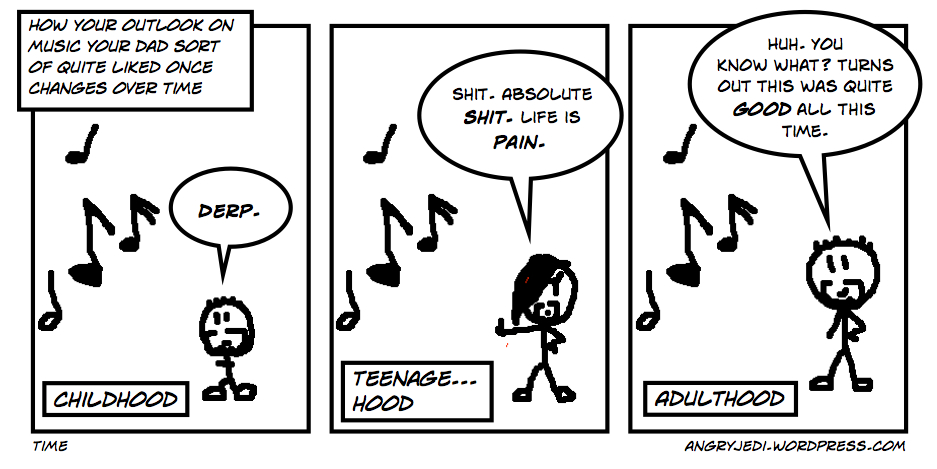 I have a playlist on my phone called "Dad Rock". The title will be fairly self-explanatory to most of you, I'm sure, but for those wondering why I would call it that when I'm not a father (and have no intention of being one, either), the explanation is actually relatively simple. It's a playlist full of stuff that I secretly quite enjoyed listening to when I was young and impressionable, but which during my teenage years I steered well clear of owing to the fact that it's not at all cool to be into records from your Dad's collection. Not that I was cool at all during my teenage years anyway, but that's beside the point.