2151: Life Line

0151_001

"You’re on a long flight, and a palm reader sitting next to you insists she reads your palm. You hesitate, but agree. What does she tell you?"

Daily Post, December 10, 2015

[This didn't post yesterday for some reason, so here it is today.]

"Hmm," she says in a long, drawn-out sort of way, clearly milking the moment for maximum drama. I look around, conscious that other passengers are surreptitiously watching to see what's going on, clearly having overheard her request. Then I look back at her. She's gazing intently at my proffered palm, running her fingertip down what I assume, as a layman, to be my "lifeline", but she's saying nothing for the moment; all I can hear is the low drone of the engines, and the somewhat subdued conversation of the other passengers in the cabin.

"Your path has been a meandering one," she says at last. "You have stumbled headlong into chaos on frequent occasions, or perhaps it is more accurate to say that chaos has sought you out; it is hard to tell at this point."

I say nothing but incline my head slightly in silent agreement. Well, she's off to a running start, at least.

"You have endured many hardships on your travels," she says. "They may not have been physical hardships, or even hardships that people could see you struggling with, but they were hardships nonetheless."

I feel my skepticism fading away a little as she offers what appears to be an accurate assessment of my life to date; that said, there's still a little voice in the back of my mind pointing out that everything she's said so far is fairly ambiguous and could probably be applied to anyone.

"Your pain has helped to forge you," she continues. "Your struggles have made you stronger, but at a cost: turbulence, uncertainty, a lack of clarity."

I glance around to see how many passengers had reacted to the mention of "turbulence" — not a word you want to utter on a plane in most instances — but most people in the immediate area appear to have returned to their own business, or at least are being subtle about their eavesdropping if they are indeed indulging their own curiosity.

She's not wrong, but again, these statements could probably apply to anyone out there. Without context and specifics, I remain not entirely convinced of her reading's veracity.

"Your future remains uncertain," she says, her finger apparently reaching its destination on my palm and ceasing its movement; she doesn't break contact, however. "You desire nothing more than to know exactly what the future holds, and how you can ensure you are on the correct path. But the truth is that there is no correct path, only the path that you choose to take. While it may feel like you are at something of a crossroads right now, be sure that you will make a decision and proceed down a road, and that road will be the correct one for you. It may not be today, it may not be tomorrow, it may not even be next year. But your route will one day be illuminated, and you shall find your way."

She releases my hand, which plops back into my lap.

"Thank you," I say simply. Ultimately I'm not sure I've learned anything particularly new from her statements, but if nothing else they gave me pause to reflect on my life, the decisions I've made, the decisions that were made for me, and what the future might hold, as uncertain as it might be.

Finding that route will be scary, no doubt, but as I look at her gently smiling at me, I feel like there's at least one person out there who has faith I'll make the right choices somewhere along the way, and that everything will work out for the best.

I hope she's right.

2112: 1984

0112_001

In response to The Daily Post's writing prompt: "1984."

"You’re locked in a room with your greatest fear. Describe what’s in the room."

My immediate reaction to this prompt was to say that the room was absolutely full of spiders. And to be fair, that would pretty much scare the shit out of me, particularly if they were of the deadly variety.

But that would be too easy. Someone who truly wanted to break me psychologically — as opposed to kill me — would go for something much more subtle, and something that wouldn't physically hurt me, but which would deal some damage regardless.

And, on reflection, I came up with an answer pretty quickly.

There is nothing in the room. Nothing at all.

The walls are plain. The floor is plain. The ceiling is plain. When the door closes, you can't even see its frame, so flush with the wall it is. There's no clear delineation between floor, wall and ceiling; no sharp corners, no right angles; everything just sort of flows into one another, making the room take on a somewhat otherworldly quality where no matter which direction you face, you see the same thing.

The nothingness extends to sound, too. There is not a single sound in the room, save for any noises I might make. I become very aware of my own breathing, and of my heartbeat pounding in my ears. But there are no other sounds; I can't hear anyone moving around outside, and my captor certainly doesn't seem to be in any sort of hurry to communicate with me. Perhaps they're just watching somehow — though it's impossible to distinguish even a tiny spy camera anywhere in the room, because that would be a distinguishing feature by which I would be able to orient myself, and clearly that would go against the intention of this place.

The light level in the room would remain constant; not so bright as to be dazzling, but just slightly darker than comfortable. The kind of light you're bathed in when in an environment lit by a bare bulb; a cold light that seems devoid of home comforts and humanity. A light that is threatening, rather than welcoming. A light that beckons with a smirk on its face, rather than inviting you in with open arms.

And of course, there are no other people in the room. No-one communicating with me. No means for me to get a message to the outside, and seemingly no means for the outside to get a message to me, either.

It's lonely. And the combination of the ever-constant light level, the total lack of sound and the lack of people or even things with which to communicate makes it impossible to tell how much time is passing. There's nothing to do, nothing to see, nothing to focus my attention on. The room is completely devoid of meaning; it's devoid of joy, but it's also devoid of other emotions, too. It doesn't even inherently inspire "fear"; it just is, and that's the scary thing about it. It's impassive, cold, unyielding. No way out. No way in. No-one to help me. No way to distract myself. I just have to wait. And wait. And wait. Alone.

That's a room that would break me. I don't know how long it would take, but it would get me eventually. So kindly don't put me in anywhere like that any time soon, please. Thank you.

2072: Storybook Day

0072_001

In response to The Daily Post's writing prompt: "A Storybook Day."

You have to spend one day as or with your favorite fictional character. Which one would it be and what would you do?

[NB: I am aware this is dangerously close to fanfiction territory, but whatever. Deal with it.]

Sometimes, you know before anything has happened that it's going to be a peculiar day.

As odd circumstances go, suddenly waking up face-down on a hard floor, the sounds of civilisation and industry mingling somewhere in the distance, is probably near the top of the "most peculiar" list. And this is how my day began.

I open my eyes and groggily get to my knees. I seem to be in an alleyway, and there's no-one else around. That would explain why no-one had come to my aid, then; I would have thought that a grown man lying face-down in the street would attract at least a little attention, but this makes a certain degree of sense. Not much, but a little, anyway.

My muscles expressing their displeasure at being disturbed from their slumber, I unsteadily brace myself against one of the alley's walls and get to my feet. I seem to be facing a dead end of some sort; the alley doesn't have much in the way of distinguishing features, aside from a couple of doors that look like fire escapes, and a dumpster or two towards the end. The alley itself abruptly ends at a strangely metallic wall.

"Stop right there!"

A feminine, assertive voice comes from somewhere behind me. I jerk upright, suddenly feeling a lot more awake than I was just seconds ago.

"Don't move!"

I want to look over my shoulder. There's something familiar about that voice.

"Um," is all I can say. Somehow words seem to be failing me.

"Oooh!" comes another feminine voice, this one energetic and somewhat childish, from somewhere behind me. "Wassat?"

"My, my," comes yet another woman's voice, this one sounding somewhat more… regal, distinguished? "Isn't this peculiar?"

I clear my throat and try, once again, to speak.

"I'm, uh," I begin. "I'm not going to hurt anyone. I don't think I'm really in a position to do so, from the sound of things."

"Turn around," says the first voice. It seems to be quavering slightly, but it's only barely perceptible. "Slowly!"

I comply with the order and turn to face the ones who discovered me. I give a start as I see who I'm confronted with.

One young woman, clad in a short blue skirt, cropped top and stockings, is pointing at me with an aggressive look on her face. Her twin black ponytails are flapping in the slight breeze. Behind her is a tall, older-looking blonde woman with a calm, gentle expression on her face. And standing at her side, fists clenched and knees slightly bent in a stereotypical expression of excitement and curiosity, is a young-looking purple-haired girl who appears to be wearing a hoodie as a dress, paired with striped thigh-high socks and sneakers. I know without looking closely that her hoodie is tied up with HDMI cables.

I instinctively bow my head, because it feels like the right thing to do.

"Goddesses," I say, trying to sound humble. "It's an honour to meet you."

"Nice to meet you too, buddy boy!" pipes up the purple-haired young girl before the twintailed girl has a chance to respond. "Whatcha doin'?"

"I wish I knew," I say. "I just sort of woke up here."

The twintailed girl is still pointing at me and looks like she's about to speak, but this time she's interrupted by the blonde woman's gentle tones.

"Hmm, we did wonder what had happened," she says. "Histoire mentioned some sort of strange energy from this region, and here you are."

I couldn't even begin to guess why I would be the source of a "strange energy", but given that I'm standing face-to-face with three women I've only previously seen through a computer screen, I feel something very odd may have happened.

This time I'm the one to interrupt the twintailed girl just before she gets something out of her mouth.

"Lady Noire," I say. "Lady Black Heart," I correct myself. "I'm not sure what I'm doing here, but I'm kind of at your mercy here."

Noire seems to shiver and then falter slightly, still pointing at me. I swear her cheeks blush slightly. Neptune, the purple-haired girl, gives a slight snicker and digs the blonde woman Vert in the ribs with her elbow.

"Here it comes," she says in a stage whisper just loud enough for everyone to hear. Noire apparently ignores her.

"W-well," she says. "Perhaps you'd better come back to the Basilicom and we can figure this out. But don't misunderstand! I-it's not like I'm doing this for you or anything! I just want to find out why a stranger suddenly appeared in my city!"

Giving Neptune a knowing smile and a nod, Vert moves aside to make room for me to pass, and I step out onto the streets of Lastation.


"So that is the long and short of it," says the tiny girl perched precariously on a floating book. "It will take about three days to make the preparations." Her facial expression doesn't change, but for some reason I find myself thinking of an exaggerated emote as she speaks.

"Three days?" says Noire.

"Yes," says Histoire, the tiny girl, whom I already know is a "tome". "Although this individual has brought a substantial quantity of Shares into this dimension, it will still take time for the–"

"Yada, yada, yada," says Neptune. "We got three days to go out and play!" She grabs me forcefully by the hand and starts to drag me out of the Basilicom, a large church-like structure that acts as Noire's home, office and base of operations.

"W-wait!" says Noire, her voice oddly high-pitched. "We still don't know anything about him! You shouldn't just go off with him by yourself!"

"Who said anything about going on my lonesome?" says Neptune. "You're coming out to play, too, Lonely Heart. It's about time you had a break! I swear, you'd be working through the night if your body didn't shut itself down every so often!"

"I concur," replies Vert. "After all the strange happenings recently, I feel we could all do with some rest and relaxation."

Noire puts her hands on her hips and looks like she's about to object, but thinks better of it at the last moment.

"F-fine," she says. "I can take a little time off, I guess. You are all visiting, after all."


An hour later, I'm sitting at the head of a table with an array of colourful women. Noire is sitting to my left, Neptune to my right. Then, moving around the table, there's Neptune's little sister Nepgear; the sullen face — currently buried in a book, ignoring the situation — of Blanc; Blanc's twin sisters Rom and Ram, the former of whom is looking very uncomfortable indeed; then Vert, who is wearing a borderline-indecent dress that shows off her considerable cleavage to great effect; and finally Noire's sister Uni, who keeps giving her older sibling and Neptune furtive glances.

"I don't understand what's going on really," bellows Neptune in what she clearly thinks is an authoritative tone, before indicating me with a wave of her hand, "but Mr. Dude here is our guest! So let's show him how we have a good time! And you know what that means — pudding!"

On cue, several waiters — whose faces I, strangely, seem to forget the moment I look away from them — put a selection of large dishes on the table, each full of a colourful pudding of some description.

"I-is this all pudding…?" says Noire slightly uneasily.

"Yes!" cries Neptune, throwing her hands in the air and accidentally tossing the spoon she'd picked up so hard into the air that it embeds into the ceiling. "We've got strawberry, vanilla, chocolate, dogoo and lamb with rosemary!"

Noire doesn't look convinced of the nutritional value of our dinner, but chooses to say nothing further. Neptune, meanwhile is clearly excited about it, and it's hard not to go along with the sheer amount of energy she seems to exude at all times.

"Dig in!" she cries.


The three days pass far too quickly for my liking; a blur of pudding meals, trips to the local chocolate cake shop, multiplayer tournaments on slightly twisted versions of video games I recognise from my own dimension and some truly baffling conversations with the goddesses.

"I wish I could stay here," I say to Noire as we both look out over Lastation from the balcony of her Basilicom. We'd both stepped out for a little air — and to get away from Neptune's vacillations over what we should all do next, to be honest.

"Hm," she says quietly, not turning in my direction. Her attitude towards me seems to have softened somewhat in the last few days; gone is the prickly, defensive young woman who confronted me in the alleyway, and taking her place is someone who seems to be strong, but carrying around a faint air of melancholy.

It's silent for a moment; all I can hear is the faint throb of industrial machinery off in the distance. Then Noire turns to me.

"I think you'd like it here," she says to me with a gentle smile, a slight flush in her cheeks. "And believe me, we're all truly grateful for your faith in all of us. We get really competitive over the Shares, but it's rare to find someone who has such value for all of us."

I smile wryly.

"Is that all I am to you, Lady Noire?" I ask. "A fountain of Shares?"

"N-no!" she says hastily, her cheeks blushing even redder. "Y-yes! No! I…"

Her shoulders slump slightly and she closes her eyes for a moment. After a moment's quiet, she begins to speak, her eyes still closed.

"You don't belong here," she says. "I… kind of wish you did, but you don't. There are people waiting for you, aren't there…?"

"Yes," I admit.

"Then you should go back to them," she says, opening her eyes and smiling softly. "We'll always be here for you, even if we're not standing right in front of you."

I smile back at Noire.

"And I'll be here for you," I say. "You'll always have my Shares." Hesitantly, I reach out my hand and pat Noire on the head, ruffling her hair slightly. She doesn't object, thankfully.

I turn around from the balcony to go back indoors and am unsurprised to see Vert, Neptune and Blanc crowding around the doorframe, clearly watching what has been unfolding with great interest. Neptune gives me a thumbs-up and an enthusiastic nod of the head. Noire doesn't appear to have noticed her observers yet, and I feel I probably shouldn't point it out to them.

I turn back to Noire.

"Lady Noire?" I say.

"Hm?" she says absently.

"I'll miss you," I reply. In an uncharacteristically assertive display of affection, I take her in my arms and hug her.

"Wh-what are you…" she objects initially, but after a moment I feel her shoulders relax and her own arms reach around my back. We stay like that for a moment. I glance over to the doorframe and see Neptune giving Vert a silent high-five. I can't help but smile.

"Thank you," says Noire. "Don't forget us,"

"I don't think you have to worry about that," I say. And I mean it.


The journey back was surprisingly simple. Histoire gave a technical explanation that Nepgear did her best to expand upon, but it frankly went in one ear and out the other. All I really had to do was stand before the Sharicite crystal and wait for Histoire to do her thing; she was waiting for "dimensional alignment" or something.

I faced my friends, who had assembled in the doorway to see me off. It was strange; these people had been "friends" to me long before I'd ever met them face-to-face, and so parting from them now, while sad, didn't hurt as much as it could have done. I knew that when I got home I could see them again any time I wanted; it wouldn't quite be the same as the experience I'd just been through, of course, but it was good enough for me. And I had a strange feeling that even if dimensions of time and space separated us, they'd all be able to make good use of the Shares I contributed.

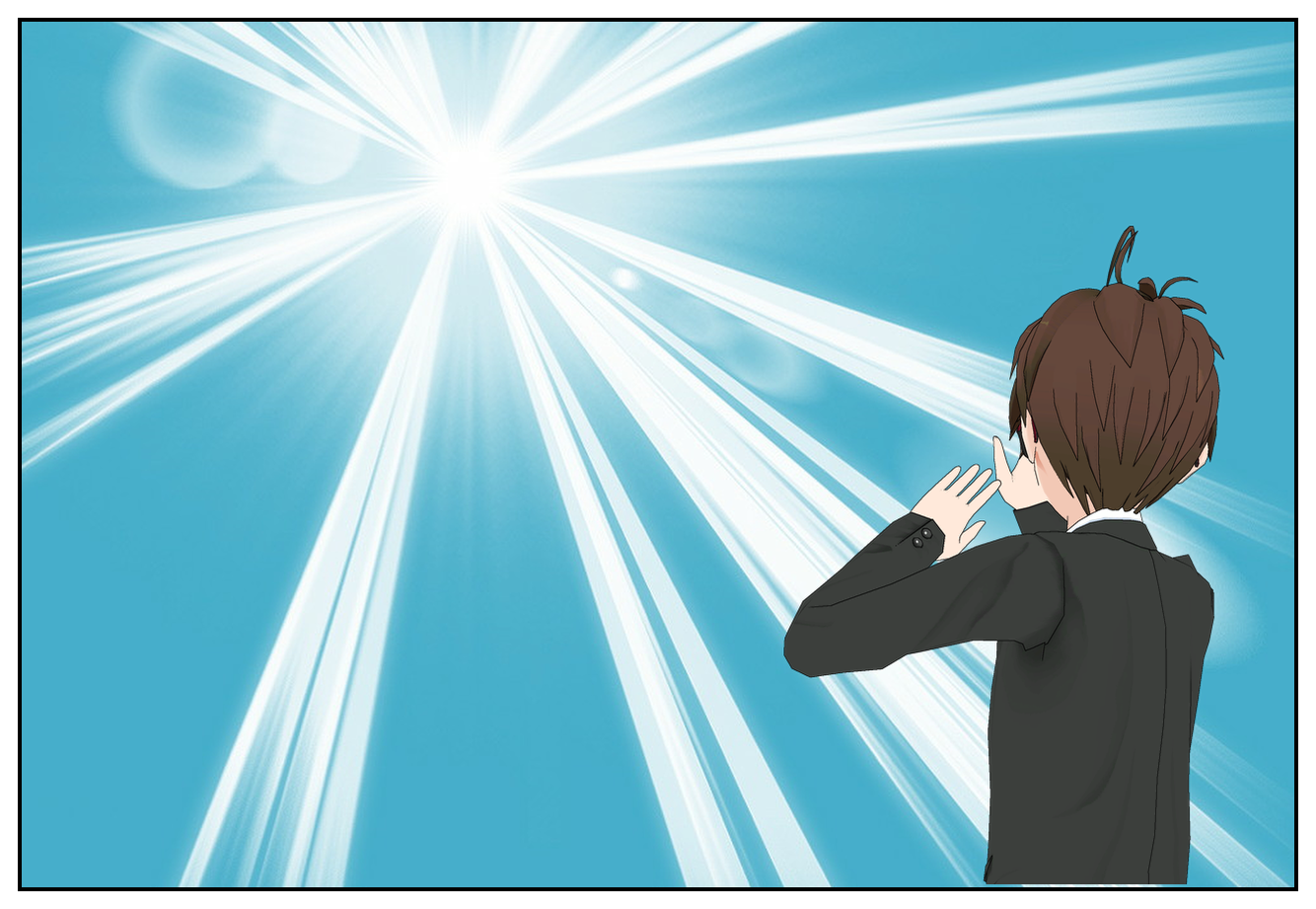
As the Sharicite chamber fills with a brilliant white light, I raise my hand in farewell.

"Bye," I say. It doesn't feel quite like enough, but it also doesn't really feel like goodbye.

"Bye-bye!" cries Neptune, followed by a slightly subdued chorus of farewells from the other goddesses and Candidates.

The light intensifies until I can't see anything any more. I close my eyes. Then, I feel the light replaced by blackness.

There's a strange chiming noise. I open my eyes again. I'm sitting up. Wherever I am, it's dark, save for a small sign up in the upper-right field of my vision.

"You have earned a trophy!" it says.
2027: Questions, Questions, Questions

0027_001I like questions. They're a good starting point for conversations, and they're a great writing prompt. For this reason, I'm very fond of social sites like Retrospring and Ask.FM, though it can sometimes be a challenge to get people to actually ask interesting questions.

Today, then, inspired by the fact I've been playing with Retrospring a bit recently — ask me anything here (caution: Umaru boobs) — I thought I'd work through a few questions as writing prompts. Rather than just being lazy and using my Retrospring answers, though — which is tempting, believe me — I thought I'd make use of the dearly-departed Plinky.com, and use some of its writing prompts that it still has available. I'm not going to spend more than a paragraph on each, mind.

All right! Let's begin.

Was there a toy or thing you always wanted as a child, during the holidays or on your birthday, but never received? Tell us about it.

Lots of things, I'm sure! Every child wants absolutely everything because they have no concept whatsoever of what money is or how it works. (I remember when I was young and my mother remarked that they were a bit low on money that month, and in my primary school wisdom I suggested they just "go to the bank and get some more") Specifics, though? Hmm. I quite wanted Red Venom, the evil counterpart to the awesome Manta Force toy that I had, but never got one. I also wanted a Mega Drive to go along with my Super NES, but never got one. I'll probably live.

Write about a noise — or even a silence — that won’t go away. (We’ll let you interpret this in different ways…)

Thanks, mysterious question master. Well, there are indeed lots of ways this can be interpreted. It could be interpreted as something simple like tinnitus — I like to listen to music loud in the car and on headphones, so occasionally give myself mild bouts of this — or it could be used to describe an "earworm" of a piece of music that just won't go away. In the latter case, I think the opening theme to Monster Musume definitely counts as this, particularly the bit where Centorea is doing her "whooshwhooshwhooshwhooshwhoosh" bit with her sword.

What’s your learning style? Do you prefer learning in a group and in an interactive setting? Or one-on-one? Do you retain information best through lectures, or visuals, or simply by reading books?

Whoa whoa whoa there, sparky, one question at a time. My learning style… uh… I'm not really sure, actually. Depends somewhat on my mood, but I'm quite good at learning by myself using books. I like to have practical examples of the things that I'm learning and ways I can practice those skills. If I'm learning under someone, I generally prefer one-on-one as there's less scope for embarrassment if you can't do something while everyone else can. I loathe passive lectures, though; they put me to sleep, particularly if the subject matter isn't something I'm particularly interested in in the first place.

You have 15 minutes to address the whole world live (on television or radio — choose your format). What would you say?

Given my self-imposed "one paragraph" rule, I'll paraphrase: I'd tell people that they need to be better to one another, and that they need to stop judging each other on stupid things, be it skin colour, race, gender, sexuality or even tastes in entertainment. Everyone is different, and that's something that should be celebrated, but we should also enjoy it when we manage to find people on the same wavelength as us. Worry less about what's "problematic" and "troubling", and focus more on the positives. Stop listening to blowhards like Anita Sarkeesian, Jonathan McIntosh and Michael Pachter. (One of these things is not like the others.) Make up your own mind about how you feel, and don't berate other people if they feel differently. (Unless, of course, they're actually hurting someone, in which case you can give them a swift kick in the genitals.) Above all, don't be a massive cunt.

Do you play in your daily life? What says “playtime” to you?

I'm not in full-time work at the moment, so all day is technically "playtime". That's not true at all, of course; I spend a considerable proportion of the days when I'm not working worrying about the fact I'm not working and that I'm not earning any money, then attempting to be proactive about getting some work to do. Playtime, though, is extremely important, as it helps you to unwind and switch off from the stresses of the day. Everyone should play. Exactly what "play" means is different for everyone, but you should find something that (preferably) has nothing to do with your job, and indulge in it until you feel happy and content.

Are you good at what you do? What would you like to be better at?

It's difficult to say "what I do" these days. I've been through so many jobs and things that I'm really not sure what my "identity" in this regard is any more. The one real constant has been writing, though, and I think I'm quite good at that. I'd like to be better at music and computery things on the technical side (both hardware and software); these are both things I was really good at when I was a youngster, but my knowledge hasn't really "moved with the times" over the years, unfortunately. I'll happily throw myself into attempting to learn things, but some stuff just doesn't stick; I can still program complicated things in Atari BASIC, for example, but I can never remember how fucking JavaScript works.

Share the story of a time you felt unsafe.

I'm not good with any situation where I worry I might hurt myself, so I try and avoid them whenever possible. One example that springs to mind is a time some university friends and I went up to Sheffield to visit a friend who had moved there. During our stay, we went walking in the impressive hills nearby, and several of our number decided they wanted to climb a rock face, and did so without too much difficulty. I got a few inches off the ground, became utterly terrified and refused to go any further. I'm not proud of that, really, but I'm also glad I didn't go through with it, as the shoes I was wearing really weren't suitable for that sort of thing, and I probably would have hurt myself.

Think about something that drives you crazy. Now, think about something that makes you happy. Does it change your perspective on the former?

Nope, unfortunately, because the thing that drives me crazy is the way people act towards the thing that makes me happy. Get out of that little paradox, if you will.

(Last one for now.)

What’s the thing you’re most scared to do? What would it take to get you to do it?

I'm scared of all sorts of things — many of which would appear to be stupid to the average observer, but such is the nature of anxiety-related issues. I think the thing I'm most scared to do is simply the mundaneness that is finding a job that is worth my time and effort, sticking with it and accepting that that is who I am: nothing special, nothing remarkable, nothing out of the ordinary. Or perhaps I'm just too proud to do that. Either way, it's something that isn't happening at the moment, and it probably should; ultimately, it's going to be that ol' faithful motivator money that makes me do something about it, I guess.

1849: The Factory Floor

Lily loved Trundlebot.

She knew she was very lucky to be allowed on the factory floor, because usually the children of the colony weren't allowed anywhere near it. The fact that her father was the manager of the complex, overseeing the various automatons' duties and making sure everything continued to run smoothly on a daily basis, meant that she enjoyed certain privileges, though: privileges that she didn't take for granted.

The other children in her class sometimes teased her for spending so much time in the factory, but she knew that secretly they were jealous; she overheard them sometimes talking about the robots, and how interesting they were, and how they'd love to get up close to see how they really worked. But no-one but Lily was allowed to do that. She'd have let them come with her if they'd only ask — her father often said that she could bring her friends — but no-one ever did, and she wasn't sure she wanted to.

That's because Lily didn't really have many friends. She'd always been somewhat distant, generally preferring the company of a book from Old Earth or a headset filled with classical music. But her father had seen how much she'd come to life the first time he'd brought her to the factory, and so he'd made special arrangements for her to be able to come and go as she pleased, so long as she was careful.

Trundlebot was particularly special to her, because Trundlebot was the first robot she'd encountered up close. Trundlebot wasn't its real name, of course, but Lily had quickly christened the mechanical giant that after seeing it trundling leisurely around the factory floor, carrying things from one place to another as if it had all the time in the world.

Trundlebot wasn't the most efficient or advanced model in the factory, but Lily's father had kept it around for as long as it remained functional, since he knew how much the ageing robot meant to his daughter. Even as the rest of the factory was staffed by shiny white plastic automatons with more convincing humanoid forms, Lily still found herself fascinated by the browning metal of Trundlebot; the stereoscopic cameras that formed its eyes; its spindly, awkward yet vaguely humanoid arms; the caterpillar tracks upon which it made its way around the factory.

Lily wasn't so naïve as to believe that Trundlebot knew who she was — she was nearly ten years old, after all; far too old for such childish fancies — but that didn't stop her thinking of it fondly and always spending most of her factory floor visits following the automaton around. Trundlebot was the closest thing she felt she had to a true friend; often, when she knew no-one was watching her, she'd talk to it, spilling forth her deepest, darkest secrets that she didn't even tell her father. She found the experience therapeutic; Trundlebot never judged her for the things she said, and she found sweet release from offloading her emotional baggage in this way.

One day, as spring was just starting to show itself in the colony, Lily headed to the factory after school as she always did, and immediately sought out Trundlebot. It didn't take her long to find it, but something didn't seem quite right: it didn't seem to be "trundling" so much as rolling around the factory floor in a somewhat determined, almost aggressive manner, with a clear purpose. It had always had that sense of purpose about it — it always got the job done, after all — but there was also the distinct impression that it would do things at its own pace and wouldn't be rushed. It reminded Lily in many ways of an elderly man pottering around his garden; plenty of things to do, and all the time in the world to do them one at a time.

Today, though, Trundlebot seemed to be moving with unusual efficiency and speed. It didn't look at all right, and it concerned Lily somewhat.

"What do you think?" said her father, walking up behind her and placing his hand gently on her shoulder.

"What did you do to him?" asked Lily. "He's… different." Lily always personified Trundlebot as a "he", despite the robot technically being completely genderless.

"We upgraded its drive components," said her father. "They were getting a little worn, so we took the opportunity to put some more efficient parts in there." Here he lowered his voice. "Plus between you and me, the bosses have been getting on my back to get it sorted out for a while. It's the weak link in the process."

Lily did not like this at all, but she just pouted and said nothing. Despite the new-found spring in its step, it was still Trundlebot, after all. She spent her usual few hours following it around the factory floor, this time having to jog to keep up with her mechanical companion. After a few short minutes, she found herself enjoying the exercise, and it wasn't until she was on her way home that she started to think about the old Trundlebot and how the new one differed from it.

Lily continued to visit the factory every day, and eventually became accustomed to her robotic friend's new-found burst of almost youthful vigour. But then something else changed, and she found herself once again feeling a little strange.

This time around, Trundlebot's spindly arms had been replaced with what appeared to be more heavy-duty lifting apparatus: large metal claws on the end of thick, almost muscular-looking arms wrapped in flexible plastic tubing, like that seen on a vacuum hose but about five times the diameter. Lily watched it from a distance for a little while; its new arms allowed it to lift much heavier, more cumbersome objects, and when combined with its new drive parts, it was doing so with remarkable efficiency.

"What did you do now?" she said, sensing her father walking up behind her.

"Well, I think you can see," said her father. "It's been working out." He chuckled.

Lily pouted again, and said nothing. Her father, sensing something amiss, continued.

"We've been starting to deal with much heavier materials now that the Arcology project is underway," he said. "It made sense to upgrade its lifting apparatus, as it just wouldn't have been able to cope otherwise."

Reluctantly, Lily found herself forced to agree; better that Trundlebot could continue doing its job than be consigned to the scrap-heap simply because it wasn't able to do the work any more. As it passed by, its stereoscopic vision cameras looked right at her, and she felt like she had made "eye contact" with the machine; it was still her friend in there.

Once again, the weeks passed by, and Lily gradually became accustomed to Trundlebot's new, more physically imposing form. On one occasion, her father took manual control of Trundlebot with the override device — essentially a remote control for any of the robots on the factory floor — and made it pick her up in its big, powerful arms. She was delighted, and found herself with an uncontrollable desire to fling her young, skinny arms around the cold, metallic neck of the automaton; it wasn't quite a hug, but it was near enough.

Summer came, and the colony enjoyed a heatwave. It was delightful weather; the sun shone in clear skies, and it was pleasantly warm without being uncomfortable. Even Lily, who generally preferred to stay indoors if at all possible, spent some time out in the sun, though she quickly found that her pale skin was more inclined to burn than tan.

One particularly hot afternoon, Lily went to the factory in the hopes of cooling off. The air conditioning inside the building usually kept things pleasantly temperate all year round, but today she was surprised to discover that it was almost as hot inside the factory as it was outside. Still, the shade inside the building afforded some respite from the rays of the sun, at least; the skin on her arms was still a little tender and was peeling in a few places, so she had no particular desire to remain outside.

She looked around for Trundlebot as usual, but was surprised to discover that it appeared to be nowhere to be seen. She walked around, calling out its "name" a few times before realising how foolish that was and continuing her search in silence. All she saw were the more modern humanoid-form robots going about their business; they ignored her for the most part, only acknowledging her presence by stepping around her when she was directly in their path as they proceeded to their next task.

Eventually, eyes widening, she saw a figure that was simultaneously familiar and strange to her. There was the base with the caterpillar tracks; there was the body of browning metal; there were the big, powerful arms that she had grown used to, but atop the body was not the familiar cuboid "head" sporting the stereoscopic vision cameras she knew as Trundlebot's "face"; instead, there was a white plastic ellipsoid atop the body.

With a mechanical whir, the robot turned around and revealed the front of its new "head"; a black screen sporting glowing green symbols clearly designed to resemble a face. As it turned to face Lily, the symbols changed to an approximation of a smiling, cheerful face, and then something very surprising happened.

"Hello. Lily," said the robot in an awkward synthesised voice. Lily didn't respond. She was frozen to the spot, but the robot was starting to advance on her; slowly this time, somewhat more akin to Trundlebot's old pace.

As the robot got close enough to have grabbed Lily with its arms, she blinked away sudden tears, shook her head and took a step back. The robot advanced again, the smiling face still glowing on its screen.

"Li. Ly," it said again.

"What do you think?" said her father, who had seen her come in earlier but had only just caught up to where she had ended up. He had a smile on his face. "Not strictly by the book, but I thought you'd like it."

The robot stopped in front of her. She looked at its still-smiling face, then her lip started to quiver, tears started to fall from her eyes and an uncontrollable sob escaped her.

Then she ran; past the big factory machines, past the oblivious humanoid robots, out into the heat of the summer's day. She kept running until she was no longer anywhere near the factory; she had come to the main recreational area of the colony, an area of lush greenery that sported a large tree she had spent many a time sitting under contemplating the meaning of life in as much depth as an almost-ten-year-old can muster.

She headed straight for the tree and sat down in the shade, her back resting against the trunk. She hugged her knees close to herself, then buried her head in them and began to cry in earnest.

She wasn't stupid. She knew why all this had happened. She knew that Trundlebot had been on borrowed time for a long while now, and that her father had kept it around to appease her for as long as possible. She knew that this last modification was done entirely with her in mind, as a way to give her a true friend rather than an unthinking, unfeeling automaton who saw the world through primitive stereoscopic cameras.

But she found herself resenting her father for that. He had tried to make Trundlebot better: a better worker; a better robot; a better friend for Lily. But in doing so he had gradually eroded the things that made Trundlebot Trundlebot in Lily's mind, until now there was all but nothing left of the robot she had loved.

She wept for her lost mechanical friend with an intense sadness she hadn't felt since the loss of her mother a year ago. The feelings were all too familiar: a sense of abandonment, of things being beyond her control, of the universe being just so damned unfair all the time. She wept until there were no more tears to cry, then she watched the sun set, the clear blue skies giving way to pinks and golds, and eventually fading away completely to reveal the starry sky. She had never felt more alone and insignificant.

Lily never went back to the factory after that, and she never quite forgave her father; but Trundlebot as he once was lived on in her memory, and would remain there for as long as she lived.

1823: Pondering Free Time

I think I'm bowing out of the creative writing project for the moment. I may revisit it at some point in the future, but for now I need to stop. It's stressing me out a bit — not because of the subject matter which, as regular commenter Jud pointed out, is, to an extent, drawn from my personal experience (albeit not the more fantastic stuff), but rather because… well, look at the clock.

I got home from work about ten minutes ago. I am exhausted. I spend up to three hours of my day travelling to and from work thanks to an absolutely hellish commute that I can't see a way around (aside from just quitting, which isn't a practical or desirable option), which means that on weekdays up to 12 hours of my time is taken up with Stuff I Have To Do rather than Stuff I Want To Do. This makes the few hours I have in the evenings to actually do Stuff I Want To Do extremely precious to me, and churning out 1,500-2,000 words a day in a story where I'm not entirely sure where it's heading eats into that time and is starting to feel a bit like an obligation rather than something fun to do.

I like writing. I really like writing. I wouldn't have been posting this bullshit for 1,823 days if I didn't. But there are days when I need a break, and to relax, and to post something that just vents a bit of steam, or gives thanks to a higher power for an entertaining dog I saw on the street or something like that. I've always said with regard to this blog that the moment it starts feeling like work rather than something I actually want to do, I need to stop. So far that hasn't happened — it's come close a few times, but I've always managed to find something to write about day after day, even if the post ends up being little more than a glorified diary entry. (Still, those posts can often be the ones that spark the most conversations or give you, dear readers, the best insights into what goes on inside the messed-up mind I call my own.)

The stuff I've been writing, though, I need a break. That is feeling like work, and given how tired I am when I get in of an evening, more "work" is the last thing I want to think about. I want to sit down, have some dinner, watch some TV, play some games, go to bed and then repeat the whole hideous process over and over again until it's time for a weekend. (I really like my weekends now, which is one arguably positive thing about life having a proper job with the rest of the normal people.)

So, then, I'm sorry to anyone reading that this disappoints, but I've learned throughout my life that if you keep doing something when you don't really want to, you start to resent it, and any joy it once held for you is lost. I don't want that to happen with writing — creative fiction writing or otherwise — so it's time to take a step back, chill out, relax, and perhaps return to it at some point in the future. Or perhaps do something else entirely! Who knows. That's the joy of being freeform.

Anyway. I need to go and sit on the sofa, lean my head back and groan about how tired I am for a bit. Then eat dinner. Then play some games. Then… well, I went through the routine above.

Thanks for continuing to read!

1822: Untitled, Chapter 13

Wilkins walked down the street, the same street he had walked down many times before.

But this time things were different. This time, he was not in full control of what he was doing: this time, he was being pushed on to a destination he did not yet know against his will. This time, he was being controlled.

And he was aware of it, too. But there was nothing he could do about it. He remembered the suspect from the Stacey Barman case showing up, with something terribly wrong about his appearance, and shortly after that he'd become this… husk, this shell, this automaton, albeit an automaton that had consciousness and life behind its eyes, even if it wasn't in control of its own destiny.

The day was just beginning, but Wilkins knew it would be busy in the city. It was the first day of the big sales, and he was supposed to be part of the team ensuring that the crowds didn't get too out of hand. He hadn't expected them to, not in a peaceful city like this, but the force had considered it prudent to have a certain amount of presence in the area just in case anyone did feel like starting something.

He was dressed in his police uniform. He didn't feel like he deserved to wear it in his current state, but that was out of his control. He was being led ever onwards towards the centre of the city, and realised that whatever had him under its control — that Thompson character, he assumed — was sending him towards where the crowds would be.

But why? That was the question that kept rattling around inside his head, and he had no good answer — no good way of finding out, either, save for just letting this experience run its course. He didn't even have sufficient control over himself to speak, so he was unable to ask Thompson before he left, and now there was no-one to ask, no-one to plead with, no way of crying out for help.

He rounded the corner onto the main street, and saw the shopping area ahead of him. Although it was early in the morning, people were already gathering, waiting for the shopping centre to open, milling around, laughing and talking with one another. They had no idea of the Darkness that crept among them.

Wilkins walked into the thick of the crowd, most people moving out of the way respectfully as they saw his uniform. When he was right in the middle of the throng of people, he stopped and did nothing. He just waited: one minute, two minutes, three minutes.

What was he waiting for? The conscious part of his mind found how still his body was standing to be somewhat eerie; he imagined the people milling around him probably felt somewhat similar. In his experience, the average member of the public was somewhat awkward around police officers; under normal circumstances, he'd have found it quite amusing, but today, he felt that their unease with him was more than a little justified.

The doors to the centre opened and people started piling in. There was some good-natured bumping and joshing, but things didn't feel like they were out of control. Wilkins felt himself swept along in the tide of people, moving as part of the group as if it was a single living mass and he was just a cell that made up the organism as a whole.

As he entered the centre, he started to feel a change within his body. He felt an energy rising within him; it was warm, but unsettling. His head began to throb, and, blinking, he saw the world twist and shift before his eyes: what he knew as the "real" world shifting back and forth to the strange, dark world he'd caught a glimpse of before.

The energy continued to rise in him until he felt like he was going to explode. Then he did.

At least, it felt like it.

The energy was released from him in all directions in an explosive rush. Tangible darkness seemed to seep from every part of his body; black clouds billowing out all around him.

Some people gasped; others screamed; others still didn't seem to notice at all. The dark miasma swirled around them and seemed to be absorbed right in to some of the people; as this happened, they stopped what they were doing, became quiet and glassy-eyed, and just waited.

The noise was terrible and indescribable. Then the pain came, and Wilkins found himself suddenly in control of his body again as the dark energy continued to emanate from him. He sank to his knees, letting out a scream — the first noise he'd been able to make of his own free will for what felt like years — and collapsed to the floor, unconscious.

The dark miasma gradually stopped swirling and faded from sight. Those who had been touched by it and rooted to the spot found themselves able to move again, with no memory of what had happened before. Those who had witnessed the curious happenings suddenly found themselves unconvinced that they had really seen what they thought they had seen, and then they shrugged, went about their business and left Wilkins just lying on the ground, forgotten.

"Well, that went better than I expected," said the shadowy figure to Magnus. They had been standing nearby, watching the whole thing. Magnus didn't understand what was happening, but he felt that it probably wasn't a good thing. Given the frightening power on display, however, he thought better of acting immediately; he felt he needed to understand the situation a little better first. So he took the direct approach.

"What just happened?" he asked. The shadowy figure laughed.

"Well," she said. "You could maybe think of it as a… recruitment drive."

"Recruitment?" he asked. She did not elaborate. He felt he would probably find out soon — and that it probably related to the strange feeling of something being amiss that he had felt a short while ago.

1820: Untitled, Chapter 12

[Back to the start.]


Dora was miserable. She didn't think she'd ever been so miserable, and the last person she would have expected to cause such misery would be someone claiming to represent the "Light" and the "greater good" in the world.

But here she was. She wasn't bound and she wasn't a prisoner but she might as well have been: the golden figure had made it abundantly clear that he had a lot of plans for her, and that to go against his will would be a very bad idea indeed.

And so here she was, still holed up in the abandoned church, which appeared to be her companion's main base of operations, although he didn't appear to have any "staff" as such. It appeared to be a solitary operation, or at least it had been until she had come along.

She was still unsure of his endgame. He kept mentioning the "greater good" and "saving" people from the "Darkness", but she still didn't really know what that meant outside of what she had already seen from Magnus. Was she the only other representative of "Light"? Was Magnus, for that matter, the only other representative of "Dark"? Why, for that matter, were they fighting? It all seemed so neat, tidy and utterly clichéd that were the evidence not all around her, she wouldn't have believed any of this were possible for a moment.

She wasn't sure how many days had passed since she had been brought here, but she felt like it had been several. Oddly, she didn't feel at all tired or hungry despite not having slept or eaten; the light within her seemed to sustain and feed her at all times.

What a boring existence, she thought, pondering a life sustained only by the light. Imagine a world without cake, or chocolate, or pie. How awful that must be.

Over the course of her captivity, she had come to learn a little more about the powers she seemingly had. She could fly, much like her companion, and she could move at superhuman speed — the latter she already knew, of course, following her strange experience shortly after all this had begun. But she also had more subtle powers: powers to break and to mend; powers to manipulate both matter and the mind. She hadn't had the opportunity to try the latter as yet, but she could feel the capability within herself; she wasn't in any hurry to find out, however, particularly as she vividly recalled how the golden figure — clearly magnitudes of power stronger than her — had forced her to do things as a demonstration of both his power and what she might be capable of. She hadn't enjoyed the demonstrations.

Under less oppressive circumstances, she might have enjoyed learning about and discovering her new powers, but she knew that she'd never have the freedom to explore them fully, as the golden figure was never far away, and as he'd said to her, she would not be able to just use the Light as she saw fit. She had to think of the greater good, whatever that was, and whoever defined it.

"Soon," said the golden figure suddenly after a long period of silence. Dora hated those long periods of silence, as they made her feel more lonely than ever. The golden figure wasn't someone she could just talk to, after all; he seemed to have no interest whatsoever in her as a person, caring only for whatever his eventual goal was.

"Soon," he said again, turning to her. "The time is almost right. Then you'll see. The world will see. The world will understand. The world will come to know the Light."

"How?" she cried, throwing up her hands in frustration. It wasn't the first time she had asked this question, because it wasn't the first time the golden figure had given a similar speech. Today felt a little different, however: there was more… she wasn't sure if she wanted to say emotion in the speech, but there was certainly a noticeably greater intensity about it.

"The world shall be bathed in a cleansing Light," he said, sounding like an increasingly excited preacher. "All who are touched by it shall be judged. And the righteous shall rule at our side, and the corrupted shall bow down to us and serve us. The world will be a better place, for the greater good."

He turned away from her and faced the sanctuary of the church.

"It begins… now."

The figure clenched its fists, and Dora became dimly aware of what appeared to be a low rumbling sound. She couldn't tell what it was initially, but then she felt the ground begin to shake beneath her feet; a slight vibration at first, a sensation that brought unprompted to her mind the memory of her student flat where the washing machine that belonged to the people downstairs used to make her floor vibrate.

But then it grew, and it was no longer the odd, unexpected source of a memory: it was frightening. The intensity of the tremors grew and grew and grew, and Dora was sure she could feel the very earth shifting beneath her feet. The floor of the church remained intact, though, even as the shaking caused empty candlesticks to fall over and roll down the aisle, vases of long-dead plants to fall from their pedestals and shatter on the floor, and the long-dormant, powerless light fittings in the ceiling to swing violently from side to side.

Oddly, the many candles which had flared to life at the golden figure's command when they had first arrived remained solidly and stubbornly where they had always been, defying the laws of physics — though by now, Dora thought with grim amusement, this was nothing new to her.

"Come," said the golden figure, apparently unperturbed by the violent shaking of the earth and extending his hand to Dora in an uncharacteristic symbol of cooperation. She pointedly refused to take his hand, but did follow him as he started to walk down the aisle towards the large front doors of the church.

"Behold," he said dramatically as he opened the doors. She walked up to the opening, feeling the cool breeze coming in and stirring up the air for what felt like the first time in years.

She had expected to see something peculiar when she peered out of the doors, but she hadn't been quite ready for this.

The church was no longer where it had been, sat in the depths of forgotten countryside. Instead, it now sat atop a huge golden spire that glowed with the same radiance as the golden figure and, indeed, at times, herself. It illuminated the surrounding area for what looked like miles, making the night almost as bright as day.

She stepped out of the door and onto the surface of the golden spire; there was a good few feet between the church doorway and the unprotected edge, so she got as close as she dared and looked down.

The spire was a long way up; she didn't feel she could accurately judge the altitude, but she knew that a fall from here for a normal person would be immediately fatal and probably extremely messy. She started to feel dizzy as she gazed down at the ground far below the spire, so she quickly stepped back from the edge and back into the church doorway.

"It begins," the golden figure said again. "And now we have work to do."


*       *       *       *        *

Magnus felt something amiss the moment it happened, even though he was preoccupied.

A terrified Wilkins gazed up at him, saying nothing. Or, perhaps it would be more accurate to say that he was incapable of saying anything.

Magnus had not seen himself in a mirror for a while now, and he indeed cut an imposing, intimidating, even terrifying figure. His features were twisted by the darkness that flowed through him, and as his powers had grown he had begun to emanate what appeared to be a dark miasma. And, as he had grown in strength, he had become less able to shut his powers off and appear "normal". The shadowy figure had described this phenomenon as the Embrace: allowing the Darkness into his body and mind so completely that he was becoming one with it.

Magnus found himself surprised at how unafraid he was with this situation. He welcomed the Darkness; it had been a friend to him when he had no-one else, and now it was rewarding him with these powers.

But how was he supposed to use them? Why was he here, really? The shadowy figure had told him to protect Wilkins, but there had been no sign of any threats to his wellbeing — although Wilkins clearly interpreted Magnus' presence as a threat to his wellbeing.

That is, there had been no sign of any threats until now. He couldn't tell what was different — what was wrong — but he knew as soon as it had happened. And he knew that bad times were coming.

He looked Wilkins in the eyes and frowned. The world seemed to bend and shift around the two of them, and Wilkins gave a low groan, slumping back in his chair as he did so. His head lolled back limply as he groaned and moaned again, then it rolled forwards again. Then Wilkins looked up at Magnus, this time with a blank, glassy stare, all trace of the previous terror gone.

"Master," he said.

Now it was Magnus' turn to be terrified. Had he done this? He hadn't meant to. What did it mean? How did he undo it? Should he undo it?

"Shit," he said to himself. "Did I mess this up?"

"No," said the shadowy figure, stepping out of a nearby wall. "No, you're doing just fine."

She clapped her hands once, twice, three times; a slow, sarcastic clap. Magnus had the feeling that he was being played, but he couldn't tell how. He had trusted the shadowy figure up until this point, but he was starting to have second thoughts. Who was she? What did she want with him? And why had he, of all the people in the world, been chosen for… whatever task she had in mind for him?

1819: Untitled, Chapter 11

[Back to the start.]


Several days passed. Wilkins had not gone back into work the day after his strange encounter; he had not gone back to work at all since, in fact. So concerned was he for his own mental wellbeing — seeing things that clearly could not be true was probably, after all, a sign that something was very wrong indeed — that he'd taken himself straight to his doctor and demanded to be signed off work with stress.

As he sat in his bed, staring at the wall, he wasn't sure that taking himself out of situations involving other human beings had been quite the right thing to do. He found himself alone with his thoughts, and his thoughts, it turned out, weren't overly friendly. They seemingly wanted him to suffer, to recall bad things that had happened in the past — and to worry about bad things happening in the present. He knew that even as he sat there, motionless, the enquiry into the disappearance of Thompson would be doing its best to trawl up any evidence of negligence on the part of Wilkins, and Wilkins knew full well that there was plenty of it, given his general feeling of detachment and disillusionment that he'd been feeling recently.

He'd lost count of the days since he'd last been in to work; he reckoned maybe a week or more. His house had been well-stocked with food and other supplies, though, so he hadn't needed to leave once, and so he hadn't. Now, though, he was starting to get down to the food at the back of the cupboard — things that had been bought and forgotten about months, even years ago, but which were designed to see people through an apocalypse with at least a bare minimum of nutrition.

He got up and walked to his kitchen, boiled the kettle and prepared a cup full of noodles for himself. The smell that emanated from the mug was less than appetising, but at least it was something to eat, and Wilkins had found, ever since delving into the food at the back of the cupboard, that the artificial flavourings in these instant "meal in a pouch" things were surprisingly tasty and satisfying, at least in the short term; he felt hungry less than an hour later, in most cases, but at least they provided something to do, if nothing else.

He hadn't had a repeat of the encounter in his bedroom since it had happened, and he struggled to understand its implications. Who was the strange, shadowy figure? What happened to his room? What did it all mean? Was it real, or was it just a manifestation of the pressure his brain was feeling at the moment?

It wouldn't be long before he'd get an answer.


*       *       *       *       *

Magnus deftly hopped from rooftop to rooftop noiselessly, breaking his fall each time with wings of darkness. He'd been surprised and delighted at how quickly he'd come to understand the peculiar changes that had come across him, and he was starting to enjoy using them. The shadowy figure, which occasionally showed up and suggested that he maybe try doing things a little bit differently, had helped him on his path, but for the most part he had explored his capabilities for himself and come to realise that he was, in human terms, virtually indestructible and capable of numerous physics-defying feats.

The strange black tendrils that could now erupt from his hands to order proved to be his most versatile assets. In just the last few days, he'd used them to climb up a seemingly unscalable wall, to give a mugger — and, for that matter, his victim — the fright of his life, and as a somewhat self-satisfied demonstration to the shadowy figure one evening, to retrieve a coffee cup from the kitchen without leaving his seat.

One thing had bothered Magnus initially. Although his new powers were exciting — not to mention a little bit frightening — they did have one impact on his life that he wasn't sure what to make of: they served to distance himself further from normal existence. There was no way around this, of course, and he knew this: there is no way that one can become capable of superhuman leaps between buildings, physics-defying stunts and the ability to summon dark tendrils to do one's bidding and in any way hope that one's life would remain in any way "normal". But still it bothered him a little, at least to begin with: as time passed and he grew more confident with each of his strange powers, however, it started to bother him less and less; he started to realise that his "normal" existence was nothing but a dark and miserable place where very few people cared about him — Dora being the obvious exception — whereas now, now he had the ability to make a difference, both for good and for ill: his powers gave him the ability to both help and hurt, and, in an attempt to understand the situation better — and at the urging of the shadowy figure — he had done both of these things.

Both the "helping" and the "hurting" had come in the aforementioned case of the mugger. Magnus had been out practising his ability to leap and float between rooftops when he had spotted the unfolding situation in a darkened alley he was familiar with from a few years back: although unlit and rather frightening to walk through late at night, it was a popular thoroughfare for student revellers returning from an evening's debauchery at a local nightclub: it was a quick, direct route between the street which housed both the nightclub and a fine selection of questionable kebab shops, and the main student residential area in the city. Because of its popularity and usual level of activity, it remained surprisingly free of crime; certainly during Magnus' time as a student, he'd never known of anyone getting attacked there. The girl had just been in the wrong place at the wrong time.

She'd been walking home slightly unsteadily; she was tipsy, but not falling-down drunk. She was, however, alone; a disagreement with her friends earlier in the evening had seen her storm off in anger, desiring nothing more than to get back home to her nice warm bed and forget about the silly things alcohol makes people do. A lone, vulnerable girl had proven too tempting a target to resist for her assailant, who had been casually walking back and forth around the area, up and down the alleyway, for the past hour or two. So unremarkable a figure he cut that no-one had paid him any mind; most people passing through the area were on their way somewhere, so had no way of knowing that he had been loitering with intent. But he had.

He'd followed the girl in the alleyway and struck quickly, grabbing her from behind and covering her mouth, threatening her not to scream. Then he shoved her violently against a wall and drew a pocket knife. She couldn't have screamed even if she did think it was a good idea; she was too terrified to even move, let alone make a sound.

Magnus saw all of this, as did the shadowy figure, who had been accompanying him. She urged him on to intervene, to test out his powers and the way in which he should respond to a situation. She encouraged him not to think, just to feel, and to do what felt most natural, to do what his instincts told him to.

Magnus had leapt down into the alleyway, floating noiselessly to the ground a short distance from the confrontation. The lack of lighting in the alleyway meant that his entrance had gone unnoticed; the pair were still far too preoccupied with their own situation.

Before he could let himself think about what was the "right" thing to do, Magnus caused the black tendrils to erupt from his hands, and they charged through the night air until they ensnared the girl's assailant. They wrapped around his legs and around his body, binding him like a constrictor snake traps its prey, and slowly started to squeeze the life out of the mugger. Gasping for breath, his face going pale, the mugger attempted in vain to remove the tendrils from around his body, but they were far too tight, and touching them gave him an indescribable sensation of terror that he had no desire to repeat ever again.

He knew that he was going to die; he resigned himself to it. Magnus felt it, and he knew he had to make a choice, quickly. Without hesitation, he retracted the tendrils, which reversed their course and coiled back into his hands — rather like a vacuum cleaner cord retracting, Magnus thought with detached amusement — to leave the breathless mugger collapsing to his knees, gasping for sweet, sweet air.

The girl, meanwhile, who had been frozen to the spot during this otherworldly display, came to her senses enough to realise that this would be a good opportunity to run far, far away and, perhaps, to never, ever come out from under the covers again.

Tonight, Magnus had come across no such incidents that required his intervention, but he knew now that if he did, he would not hesitate to step in. He had, in his lifetime, read enough superhero comics to know that he needed to use his power responsibly, but he figured that no-one would really object to a few more muggers being taken out of commission.

He wasn't on the hunt for crime tonight, though; he had a greater purpose in mind. The shadowy figure had earlier explained to him the situation of Officer Wilkins, who appeared to be teetering on the cusp of the Darkness. It was Magnus' job to keep him safe and ensure the Light didn't get to him first; it was Magnus' job to ensure that Wilkins didn't end up as another Stacey Barman.

When he thought of the Light, he couldn't help but think of Dora. He hadn't seen her for several days; hadn't even heard from her. Simple, normal things like text messages and phone calls seemed to mundane in the context of his new existence, but he still found himself missing her and worrying about the plans the golden figure had for her; he found himself worrying that they'd end up in a confrontation with one another, and that one would end up having to hurt the other — something that he knew neither of them wanted to do, despite the opposing sides on which they'd found themselves in this otherworldly conflict.

He couldn't get hung up on that now, though; he had more important things to do. He was approaching Wilkins' home — the shadowy figure had known right away where to send Magnus, much to his surprise — and he had a job to do. He hoped that it would be a boring and uneventful job, but he had the sneaking suspicion that, going by the pattern of recent happenings, things were probably not going to be that simple at all.

And he would, it transpired, be right about that.

1818: Untitled, Chapter 10

[Back to the start.]


Officer James Wilkins slumped back into his sofa and flicked the television on. He hopped through the channels, but as usual, there was nothing interesting to watch; he just wanted some background noise. He eventually settled on some sort of cookery challenge show; it seemed to run with the theme that "celebrities" were not, on average, particularly good at cooking, with some of them even struggling to throw together a convincing omelette.

It had not been a good day. The escape of the suspect Magnus Thompson had raised more than a few eyebrows, particularly as Wilkins had already submitted his report stating that he intended to release him. Thompson apparently still feeling the need to escape despite the fact that he had seemingly been telling the truth in his interviews suggested to Wilkins, Jensen and their superiors that there was perhaps something more to the situation than there had initially appeared; it certainly looked suspicious, anyway.

A big question hung over the case: how on Earth had he done it? The next morning, his cell was empty, but it was locked up just as tight as it had been the previous evening, and there was no evidence that anyone had forced entry — or, indeed, exit. It was simply as if he had never been in there at all, though the paper trail said otherwise, of course. Thompson had been processed just like any other suspect, and there was both written and recorded evidence of his time in the police station; there was just no sign of him whatsoever.

Wilkins sighed and closed his eyes, the dull murmuring of the TV show proving a relaxing backdrop.

He was roused from his almost-slumber by the "ding!" of the bell on the microwave, indicating that his meal for one was ready. He sighed again, pushed himself up out of the soft sofa, which had been threatening to swallow him, and walked through to the kitchen. He emptied the unappetising-looking pasta bake into his last remaining clean bowl, quickly wiped off a fork that was in the sink and took it back into the living room to eat in front of the TV, as was his custom these days.

His heart wasn't really in anything these days. He had once enjoyed his work as a police officer, but nowadays it felt hollow and empty, more like he was enforcing rules for the sake of enforcing them rather than to help make society in any way better. He had actually been excited — and slightly sickened at this admission to himself — to find himself investigating something more interesting than yet another crowd of youths standing on a street corner saying "fuck" a little too loudly for the taste of an old lady who lived close by, or a shoplifting incident whose value added up to less than the price of a packet of cigarettes.

Now, though, this case was proving to be just as troublesome as everything else in his life. The escape of Thompson had, of course, been blamed on him, since he was the last officer to deal with him. There was to be "an enquiry" — the station seemed to launch a thousand of these daily — and he had, for the moment, been temporarily removed from the case pending its findings. He knew that by the time the "enquiry" had finished chewing through the reams of red tape that sustained it, Thompson would be long gone, Barman's body would be in the ground and there would be little hope of ever finding out what the truth really was.

He finished his pasta as the cookery show finished. He put the bowl on the floor and leaned his head back on the sofa, closing his eyes once again. It didn't take him long to drift off to sleep.


*       *       *       *       *

When he awoke, the sun had gone down. The TV was still on; now it seemed to be showing some sort of outdoor survival program, and as Wilkins' eyes came back into focus he was treated to the sight of the presenter gobbling down some sort of beetle-like creature. Wishing he hadn't woken up at that exact moment and wincing, he fumbled around for the remote and flicked the screen off. The room filled with darkness, and he just lay there for a moment, contemplating the silence.

Then he started to think, and he didn't want to do that right now, so he forced himself to stand up, letting out a grunting moan as he did so — he'd been on his feet all day, and his legs were feeling very stiff — and shuffling towards the stairs, intending to head upstairs to bed.

The house was all too quiet now, and far too big for him to live in by himself. This was why he spent the majority of his time when he wasn't working in the living room watching television; it distracted him and kept his mind busy, and prevented him from thinking about why the house was so quiet.

He trudged up the stairs one at a time, pulled off his clothes and got into bed, closing his eyes right away.

"You want to talk about it?" came a voice he'd heard once or twice before. It was soft, feminine, soothing. He knew it wasn't really there, but it brought him comfort nonetheless. He said nothing.

"Uh-huh," said the female voice. "It's been a bad day, I know. And I bet you're thinking that things probably can't get much worse right now, can they?"

His continued his silence.

"Well," said the voice. "What if I told you that the man you're looking for can help you out?"

He opened his eyes and sat up groggily. He blinked a few times, then gave a start. A shadowy female figure seemed to be straddling him, but he felt no weight whatsoever from the figure; she seemed to be completely incorporeal, as if she was made from dark mist. But she was most definitely there; he could see her moving and hear her talking.

As he looked at her, the walls of his room seemed to bend and shift around him; must be my eyes adjusting to the dark, he thought.

Then he considered the strangeness of the situation. There was no way there could be a black, shadowy figure made of mist straddling him, but there seemingly was, so perhaps his walls really were bending and shifting, too?

He reached over to the bedside lamp and tried to switch it on. Nothing happened. The figure did not move, but as his eyes continued to adjust to the darkness — he was at least partly right about what he was experiencing — he started to feel like he could make out things that had not been there before; his walls seemed to be covered in black, scrawled writing: words, phrases, short poems and indecipherable symbols. Everywhere he looked, he saw the strange designs; he didn't know what they were, and they were frightening. But he could not scream; he found himself strangely fascinated, despite the adrenaline of terror rattling around his body.

"What's going on?" he asked in a cracked voice.

"Oh, this?" said the figure, moving off him and gesturing flamboyantly around the room. "It's probably a little early to start getting into the details of it all, but rest assured, all will become very clear very soon indeed. I'm glad that you've seen it, though; that tells me something important that I needed to know. See you soon."

The figure vanished, the room seemed to distort again and suddenly Wilkins was dazzled by the light from his lamp, which apparently he had managed to turn on at some point.

He looked around, his heart racing. His walls were clean, albeit shabby, with the wallpaper peeling here and there, but there was no sign of the strange black scrawl that had been there moments earlier. This was, he was sure, the room he knew very well, but he didn't feel quite so safe and cut off from the rest of the world here any more. Something seemed to be intruding on his sanctuary, and he didn't like it.

Oh how pathetic they'd think I look if they could see me now, he said to himself as he pulled the covers up over his head and hid beneath them, leaving the light on. He closed his eyes and tried to get to sleep, but his mind kept whirling around a cycle of images like a hyperactive slideshow screensaver: first there was his darkened room as he'd seen it a moment ago, then there was Jensen, then Thompson's empty cell, and then there was her face, just for a split second. Then the cycle repeated again, and again, and again.

Wilkins screwed up his face as if this would protect him from the mental assault his own imagination and memories were inflicting on him, but it was to no avail; still the images came, cycling around their sequence faster and faster and faster until, eventually, his exhausted body succumbed to sleep.

The assault continued in his dreams, but this time instead of still images he was reliving those moments. In each instance, he tried as hard as he could to escape, to run away from the things he was seeing, but everywhere he turned, the world seemed to turn with him; he could not get away.

He could just about deal with the simpler images. But then he came to the last situation again, and it was painfully vivid in its detail; he walked up to the gurney with that cold, grey, still body on it, looked up at the medical examiner, nodded his mute agreement that the body was indeed who it was thought she was, and then he found himself just staring down at her face, beautiful even in death, even battered and broken and bloodied as it was. She was still beautiful.

His eyes snapped open and he realised he was covered in sweat and breathing rapidly.

There would be no more sleep tonight.