1620: Community Matters

The Squadron of Shame, the "gaming book club" that was born on the 1up Radio message boards and has subsequently lived in several places across the Internet, has moved house again. We now have our own forum here — though if Squad co-founder "Beige" gets things sorted, we'll have either that forum or a variation thereof on our own domain before long, which will be nice.

Forums aren't all that fashionable these days, though they are still used somewhat, particularly for communities relating to specific software companies or even individual games. I can't say I've used one for a very long time indeed now, but having gotten back into the swing of posting on one thanks to the new Squadron of Shame boards, I can honestly say I've missed them.

The reason? They're completely different to the way modern social media works. While you may think that social media would be the ideal place to begin discussions and have in-depth conversations, in actuality modern social media is not at all well-suited for this task. Whereas many forums have long-life conversational threads that stick around for months or even years, the very nature of social media means that posts are transient — they're there one moment, gone the next, replaced by a cat picture, some vapid meme or One Of Those Clickbait Headlines That Makes Poor Use Of Headline Case And You Just Won't Believe. And while certain social media posts can attract a long string of comments and stick around for a while due to consistent interest — the reason why Facebook steadfastly refuses to organise posts in chronological order is because of this, if you were wondering — they'll still fall away far quicker than an equivalent topic on a forum.

This is fine for the sort of vapid nonsense that people post on Facebook and Twitter on a daily basis, but less ideal for more long-form discussion on more specific topics — such as the sort of thing we like to stroke our collective chins over at the Squadron of Shame. Now I know that many existing, well-established forums in 2014 — long-standing gaming forum NeoGAF is a good example — have proportions of the community that do not like seeing "walls of text" (even when they use paragraphs and punctuation and everything), but the fact is that forums are ideally suited to long-form discussion and thoughtful discourse. They're not instant messages, they're not time-sensitive, they're not places to post "fire and forget" comments that you never look at the responses to — they're places for asynchronous communication between people of similar interests, and an excellent means of having far more detailed discussions than is possible on social media in its current form.

Social media is crowded. Social media is noisy. Social media is like stumbling into the middle of a party, slightly drunk, and shouting whatever you feel like and hoping someone hears it. And, sometimes, that's fine, and can lead to beautiful interactions, friendships and even relationships. (I'm sitting in this house with the person I own it with because of Twitter.)

But a forum is like getting together a group of people with common interests — depending on the number of participants, it can be like a book club, a seminar or a large-scale gathering — and having a civilised, peaceful, thoughtful discussion on a particular topic. (Usually, anyway. This isn't to say forums are drama-free, but there's a lot less of the attention-seeking passive-aggression that's often seen on social media for the most part in my experience.)

As I said above, I'm not sure whether the Squadron of Shame will be staying on that free forum software for now or whether we'll be moving to our own site. But either way, the shift — or should I say shift back, since that's where the group was born — to a forum-based means of discussion has so far proven popular, and I think it will be good for the group in the long term.

If you're interested in joining us to talk about underappreciated and overlooked games, both new and old, drop by our new home and say hello.
1602: Search Terms

It's been a long time since I pored over my blog's stats — largely because I don't particularly care about them, since I'm writing more for myself than anyone else — but it's occasionally interesting to take a peek at the search terms that show how people have arrived at this 'ere site.

For the longest time, my blog's most popular post was this one, which features animated GIFs of stickmen doing various offensive things to one another. People would show up at my blog through search terms like "stickman sex gif" and the like — why on Earth were so many people searching for this sort of thing when there is far better porn available on the Internet? — and this, consequently, led to that post being consistently popular. Alongside that, some things I wrote ages ago about classic PC games Divine Divinity and No-One Lives Forever proved consistently popular, as did my guide on how to play Kairosoft's mobile game Pocket Academy.

It's only been fairly recently that those consistently popular posts have finally fallen off my top search terms — although, looking today, Pocket Academy is still there. Instead, we have a few newcomers.

First up was this post, in which I bemoaned the repetitiveness and utter stupidity of "[brand] sponsors [programme] on [channel]" bumpers on commercial TV channels — specifically, the infuriatingly asinine "Alpen Sponsors Characters on Dave" campaign, which features a middle-aged, bearded man speaking with a funny accent and saying painfully unfunny lines clearly written by a bored advertising executive who was apparently once told by someone that they were "really funny" more to shut them up than anything else. Since said advertising campaign is still running on Dave, it seems there's a certain degree of interest in this campaign — search terms include people asking who the guy is (I have no idea) and, so far as I can make out, why the fuck it exists.

It seems I've become a source of information on certain types of games and types of entertainment, too. Someone arrived today looking for a map of the Endless Road dungeon in Demon Gaze (while I am playing Demon Gaze right now, you won't find any maps here, sorry), while another person wanted to find out which of the in-game races had the most HP. (I have no idea there either.)

Alongside that, there are just plain bizarre pairings of search terms, the oddest of which is kiss x sis and doctor who, an unholy fusion of a somewhat ecchi anime and the classic, resurrected BBC sci-fi series from which this blog takes its name, but which I do not.

Then there's the person asking "is bovril good for you" — I have no idea, sorry, though with how salty it tastes, I doubt it — and "waiting for the phone to ring" which, I assume, led them to this post, or possibly this one.

It paints an interesting picture of the people I am somehow attracting to this site — or at least, the type of people that Google feels is appropriate to send over here. Everyone is welcome, one and all; I can't promise you'll find what you're looking for, but hopefully you'll stumble across something fun in the meantime.

1548: Sell-Out

This is probably going to sound like a terribly "inside baseball" post, but I feel the need to vent a little, so apologies in advance.

I am absolutely sick of the lack of respect given to my profession — games critic, games journalist, person who writes about games, whatever you want to call it — and I am likewise sick of the daily drama that accompanies it, particularly on the UK/European side of things. It's getting extremely tiresome to put up with the daily snark, outrage and condemnation of this, that or the other, and I really can't help feeling that ultimately all it does is distract from the reasons most of us got into this business in the first place: loving games.

Whether it's someone using the infuriating scare quotes around the job title "journalist" (as in "so-called games 'journalists'"), the regular (and, to my knowledge, usually unjustified) accusations of bribery, corruption and otherwise unethical behaviour or the current favourite of the social justice crowd, complaining whenever a white man writes something, you sometimes have to wonder why people put up with this shit. And indeed some don't. And I can't say I blame them.

I've been quite fortunate throughout my career in that there's only been one real occasion where I became a little uncomfortable as a result of the behaviour of a reader or community member. That was back on GamePro, when the GamePro Facebook page was frequented by a rather strange individual who didn't believe in debit cards and had some peculiar political ideas. He was harmless for the most part, until I posted a piece about an interesting-sounding game developed by a university that promised to explore matters of sexuality and gender. He exploded in a fit of rage; forced to confront things that clearly didn't fit in with his rather narrow-minded view of the world, he became extremely aggressive and unpleasant, and for the first time I felt a little afraid of the Internet. (The second time I was afraid of the Internet has been well-documented on these pages, but that was nothing to do with work.)

The latest incident in Games Industry Drama involved a recent press event for Ubisoft's upcoming game Watch Dogs in which attendees were reportedly given a free Nexus 7 — a decent Android tablet. Predictably, this quickly descended into people condemning the people who had accepted them and people arguing about "ethics", while at the same time NeoGAF was doing its usual thing of whingeing about how game journalists are all paid off and how no-one writes "objective" reviews. (Hahaha.)

It is exhausting to have to process all this sort of thing on a daily basis. I write about games for one reason and one reason only. (Well, two if you count the paycheque.) I write about games because I love writing about games. No other reason. I'm not trying to change the world. I'm not trying to make people rise up and fight against oppressive powers. I'm not trying to make people confront things they're uncomfortable with. And perhaps I should be doing those things. But I'm not. The reason I write about games is because I love writing about games, and because I love games.

When I come across a brilliant game I love that few people are talking about, the first thing I think about is how I might be able to write about it in a way that gets my passion and enthusiasm across. These are experiences I want to share with people; experiences I want other people to be able to have. And if just one person reads something I've written and thinks "hmm, that sounds interesting; maybe I'll check it out!" then I'm happy.

But if just one person rolls up and calls me a sellout or calls my integrity into question, that sucks. Fortunately I haven't had to deal with that particular issue in my career, but seeing it constantly going on all around me on a seemingly daily basis is just exhausting. Sometimes I wish everyone would just shut the fuck up and just enjoy themselves for once.

And I realise that by writing this I'm simply contributing to the noise. But it needed to get out of my brain and on to the page. And now I'm done. I'm off to go and play either Final Fantasy XIV or Demon Gaze and not look at social media for the rest of the day.

1545: Changing Communication

I'm trying to make a conscious effort to tone down the effect the Internet has had on the way I communicate over time. This may sound like a peculiar thing to say, given that the majority of the communication I engage in on a daily basis is via the Internet, but just recently a number of things have really started to bug me about the way people talk to one another online, and I simply want to make sure that I'm not a part of it and thus, perhaps, inadvertently annoying someone else.

I think the chief thing I want to make sure I avoid is excessive hyperbole. Most people who use social media have been guilty of this at some point — posting a link to a mildly amusing cat video and declaring "Shut the Internet down. We're done." or "This is the best thing ever!" or "There are no words." or… I could go on, but I won't. You get the idea.

Declaring things "the best thing ever" or along those lines is excessive hyperbole. It devalues that phrase "the best thing ever" if everything is the best thing ever, and the other examples are just putting undue pressure on something that was probably designed to be a throwaway joke to perform and be somehow amazing.

Particularly gross examples of excessive hyperbole come in the form of headlines from sites like Buzzfeed, Upworthy and their numerous imitators. Inevitably conversational in tone but capitalised excessively So They Look Like This And You Won't Believe What Happened Next, these headlines, on an almost hourly basis, promise laughter until you evacuate your bowels, crying until your eyes shrivel up and stories so heartwarming you'll cook yourself from the inside. And they're rarely anything special; at best, they're sob stories deliberately designed to emotionally manipulate the reader; at worst, they're pointless nonsense deliberately designed in an attempt to make them "go viral".

Excessive hyperbole can spill over into discourse, too, and it frequently does. I've lost count of the number of times things have been described as "toxic" over the last year or two, when in fact this is, in many cases, an exaggeration. (Well, of course it is; if it was literally toxic then it would kill anyone involved.) And once you jump onto your high horse and brand something as "toxic" there's really nowhere to go from there; the people who disagree will disagree forcefully because you were forceful in the first place, while the people who agree will look like wet lettuces if they decide to come in with a "Well, I wouldn't say toxic, but…". Thus online discourse frequently descends into who can be the most hyperbolic the loudest or the most often, and the quality of discussion suffers enormously as a result.

Last time I wrote about this sort of thing I attracted commenters accusing me of something called "tone policing", which is where you distract attention away from the core argument that someone is trying to make by focusing on the way they are making it rather than the content. And that, perhaps, is something that people including myself do do, but if it's becoming an issue then perhaps the people who are getting "tone policed" should consider the way they are making those arguments in the first place. With less hyperbole, less use of strong, emotive language such as "toxic" and more in the way of constructive, descriptive comments, we can all get to know the way we feel about things a lot more easily, and we can move forward in debates and discussions.

As it stands, however, the second someone jumps onto their high horse with a disproportionately passionate reaction to something that is, in many cases, very simple, I simply cannot take them seriously. And I doubt that's the effect they want to have with their arguments.

I certainly don't. Which is why I'm making an effort to tone down my own hyperbole and try to speak like a normal human being when communicating on the Internet as much as possible. With a text-based medium of communication like the Internet, you have a moment to pause before you respond to or broadcast something to look back on what you've written, reflect and decide whether that's really what you wanted to say. Things said in the heat of the moment are often regretted with hindsight; those regrets can be easily avoided with a little less hastiness and a little more consideration, both for yourself and for others.

This was a Public Service Announcement on behalf of the National Hyperbole Authority, the best thing to happen to language in three thousand years.

1541: Reclaiming the Inbox

Oh my goodness, email. What a massive pain in the arse you are. And yet you shouldn't be; you should be a convenient, quick means of asynchronous communication, and instead you're a cluttered, nigh-useless mess.

At least my personal account is. So I'm trying to do something about it. When unnecessary mailing list entries that I never read show up, I unsubscribe with due haste. When my inbox starts to fill up with useless crap, I highlight it all and archive it — if I haven't read it immediately, it almost certainly isn't important to go back to in a few days' time.

With a little coercion, I'm confident that I can start getting my inbox back under control. The trouble I'm having is largely due to the period of time where my personal email was also my professional email — while I was working on GamePro I didn't have my own address — and consequently got signed up to about a bajillion PR lists. Subsequently, when I worked for Inside Network, I then got signed up for a bajillion more PR lists for mobile games and apps — and there are a fuckload more mobile games and apps released every week than there are on computers and consoles. (And approximately 2 or 3 at most worth caring about, if that.)

The reason I'm doing this is because I actually want to start using email again. When I think back to the early days of having an email address, receiving new messages was exciting. Spam was rare, and it always felt like an "event" to see Outlook Express pop up its progress bar and indicate that yes, messages were incoming via the magic of dial-up Internet. (Random, no-longer-existent free ISPs for the win. I was a "Hot Toast" man, myself.) This was because it was an event to receive a message — someone had taken the time to actually write to you.

These days, the former function of email is largely covered by social media — to a point, anyway. But it's not quite the same, particularly with how much both Facebook and Twitter have wandered off from their original incarnations when they were first introduced. Facebook these days — even with my recently pruned feed — is nothing but links with people going "OMG SO AMAZING" or some other such hyperbole, while Twitter is inherently limited thanks to its character counts, and is becoming increasingly intolerable anyway thanks to the increasing regularity with which the social justice crowd continue to peddle their opinions and refuse to listen to anyone else.

Then there's longer-form writing such as this blog, but that's a broadcast rather than a personal message. Sure, I could write private password-protected posts and send them to individuals or small groups of people, but if I'm going to do that, I may as well just send them an email in the first place. It feels impersonal.

Which leaves email, as one of the most long-standing means of digital communication out there, as arguably the most practical means of actually getting in touch with other people — so long as you take control of it, that is. Going forward, my "good intention" is to try and use email a lot more than I have done in the past, perhaps to keep in touch with people I don't speak to enough on a daily basis or even to get to know people I want to know a bit better… a bit better.

This is a bold plan, I know, and I wonder if it will prove to be a fruitless endeavour if everyone else has the same saturated inbox problem as me, but it's worth a try. Email is a brilliantly simple but amazing technology that brings people closer together, and it's wasted by most of us on a daily basis as we take it for granted. So I'm going to try and stop doing that. Maybe. We'll see.

No you can't have my email address. Unless you ask really nicely.

1511: Read This Post and I'll Give You £1,000

No I won't. Because… come on, fucking seriously? Do you really need me to explain why that is never, ever going to happen?

Apparently so, because last night's #AskHannaForCash travesty on Twitter proved beyond the shadow of a doubt that social media is turning people into dribbling idiots.

For those not on Twitter, or who somehow missed this debacle while it was unfolding, here's the gist.

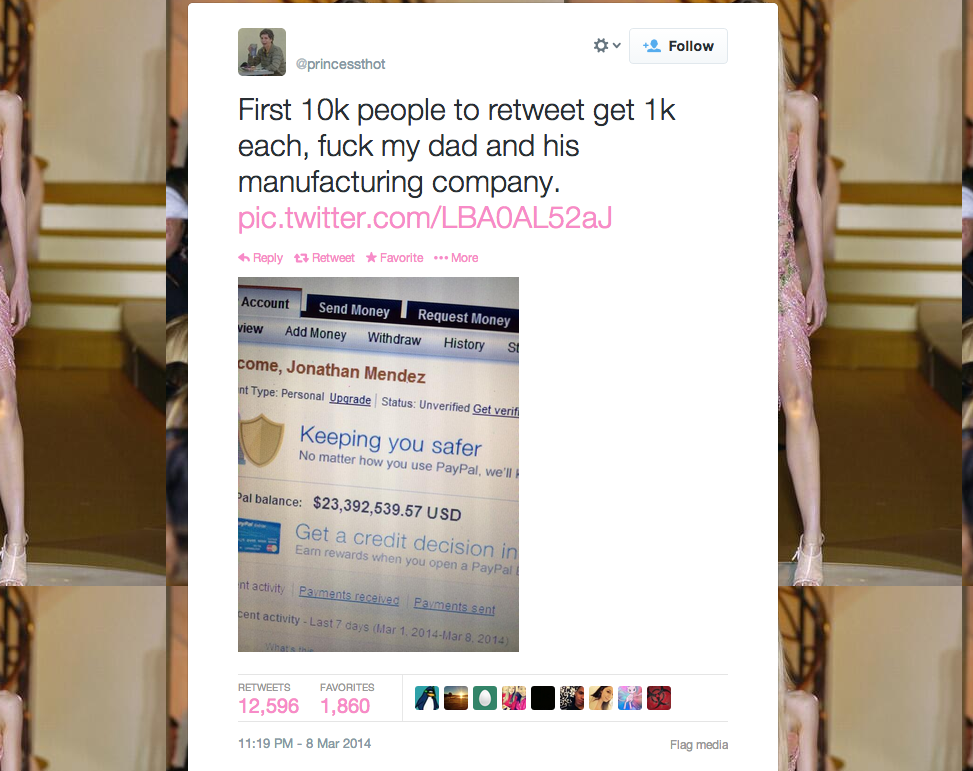
Twitter user @princessthot posted that she was, for some reason, pissed off with her father, and promptly posted a screenshot that she claimed was his his PayPal account, which supposedly contained in excess of $23 million. She then offered to send money to anyone who retweeted her message or helped spread the word — an offer which would appear to be backed up by a number of people (who, it later transpired, were her followers) who offered messages of varying amounts of exuberance claiming that yes, she "really was" sending out money to anyone who asked for it.

Uh-huh. Sure.
Uh-huh. Sure.

The moment I saw this, I knew it stank. For one of just so many things wrong with this whole situation, who the hell keeps $23 million in a PayPal account — an unverified one, no less?

And yet, very few people — including, I was disappointed to see, some people I follow — seemed to think this was worth questioning, instead engaging with the situation on the grounds that it "couldn't do any harm" or that it was "worth a try". One person I follow said that they were "pretending it was real but staying out of it, because [they] want to think humans are awesome instead of terrible."

Via the Daily Dot, here's just how easy it is to fake a PayPal balance, incidentally:

Uh-huh. Okay. Still believe it? Still want to believe humans are awesome?

Humans are awesome, is the thing — just this week, two separate crowdfunding efforts paid for a little girl's headstone and an indie game critic's cancer treatment. But humans are also terrible, and social media is, regrettably, the natural habitat for some of the worst examples of everyday (i.e. not psychotic dictators or outright psychopaths) scumbags on the planet.

Anyone who's used Facebook at all in the last few years will know that there's an epidemic of blindly resharing things without checking to see whether they stand up to scrutiny. If something uses enough exclamation marks and capital letters, many more gullible users are convinced of its urgency and authenticity, and go on to spread it to their social network — and from there, the more gullible users from among their group of friends then spread it further and further and further.

#AskHannaForCash wasn't as obviously harmful as claiming that Red Bull gives you brain tumours or that a non-existent breed of snake is going to freeze your blood (and, aside: please direct anyone who shares shit like that on your Facebook news feed to those two links and indeed the rest of Snopes at every opportunity). But it's still harmful in its own way; the person behind the Twitter account, whoever he or she is, was purely seeking attention and validation through retweets and favourites — attach a number to anything and it is seen as social currency by some people, particularly those in their teens — and now, unsurprisingly, having revealed that the whole thing was a hoax (sorry, "social experiment" — the usual getout clause) they have come in for a torrent of abuse. That can't be good for their mental wellbeing — something which I'd assume is already in something of a fragile state if they felt the need to pull such an elaborate ruse on the less discerning members of the social media sphere.

You my call it cynicism, but the attitude that "if it looks too good to be true, it probably is" will serve you well in the long term. Would you respond to an anonymous email claiming that you could come into possession of a huge amount of money just by providing some simple details? No — at least I hope not. Would you respond to a suspicious-looking Craigslist ad offering you a vast amount of cash for something simple? I imagine not. Would you let a random stranger into your house just because they promised to give you something amazing? I really hope you wouldn't. So don't do it on social media.

And come on. Do you really think an obviously bitter and twisted teenager "getting back" at their father by doling out their cash to random strangers is an example of humanity at its finest? Would you really trust that cash? Would you really trust that the details you'd have to hand over to obtain that cash wouldn't find themselves into inappropriate hands?

If you would, then your Internet license is hereby revoked. Go and read a fucking book instead; it'll be safer for everyone involved, including yourself.

1507: Why I Went Back, and The Fear

I was going to write about something else today, but after Mr Russ Pitts kindly linked to a piece I wrote this time last year in an excellent article regarding online abuse and trolling, I felt I should probably elaborate on some things that have happened since then.

Firstly, despite what I said in that piece, it transpires that I did eventually go back to Twitter. Why? Because, to be frank, I was lonely; I have a lot of friends on that social network, and it was difficult to stay in touch with them via other means. It's also a particularly convenient means of reaching out to people for my current profession.

So I went back. However, I did so under a new username and a new email address — and being much more mindful of what I shared in my 140-character bio.

This is in itself kind of silly, really; I have to effectively "silence" an aspect of my personality based on my previous experience, and cannot be fully open about the things I enjoy or love, because it might attract organised bile and vitriol not just towards me, but towards people close to me, too. Thankfully, on the few occasions I have happened to mention ponies recently, things have passed without incident — I suspect the charmers at the "GNAA" have moved on to new victims by now.

Thinking of all this brings up an important consideration that I don't believe a lot of Internet commenters stop to think about before spraying vitriol over an article they disagree with: the fact that the words you read on the Internet are, for the most part, written by an actual person with a brain, a heart, a soul and, you know, feelings. People disagreeing over various things is a fact of life — the world would be a boring place if everyone felt the same way about everything, as The Lego Movie suggested in a somewhat hamfisted way — but it's the way you go about those disagreements that is important to consider, because arguing your case in the wrong way — or wilfully misreading or misunderstanding something someone has said — can have a severe impact on their mental health.

I've been fairly open on this blog about my own self-esteem issues and occasional feelings of "imposter syndrome" — the feeling that one day, you might be "found out" and have everything taken away from you. I consider myself hugely lucky to have the job I have, working alongside people I have respected enormously for many years — since childhood in at least one case. There are days when I feel like I'm even quite good at what I do — but there are also days when I seriously consider throwing in the towel and going to do something "invisible" with the rest of the drones in the daily workforce.

The difference between those two types of day can often be just a single comment. Just one, regardless of how many otherwise positive or supportive comments you might have that day — one single, unpleasant, negative or abusive comment can completely ruin the day of someone like me.

I'm not saying all games journalists are like me — though from some conversation during the establishment of TakeThis.org, which Russ mentioned in his post, mental health issues of various descriptions are alarmingly widespread in our profession — but it's surely just basic human decency to not, in effect, walk up to someone and start hurling abuse at them. And yet it happens. And not just from inconsiderate gamers angry about the score you gave Titanfall, either; sometimes even people who claim to be fighting for worthy causes can be needlessly aggressive, confrontational or even abusive, too. It's a plague across the whole Internet.

This leads to what I call The Fear, which in turn leads to what Russ talks about in his post: the assumption that "do not engage" is the only way to deal with bullying, abuse or even just plain unreasonable comments. There are days when I write things and I'm genuinely afraid to look at the comment section — it's an irrational fear, I know, but it's what this age of anonymous abuse has wrought.

And what a ridiculous situation that is, when you think about it. People who write for a living — many of whom are considerably more talented than I am — are subject to The Fear on a daily basis. You never can tell what it is that's going to attract the next batch of abuse, or death threats, or defamation, or simple spitefulness. It's a horrible feeling.

And yet we still stick around, for the most part. Why? Because even amid all this, we love what we do, and we love engaging with those people who like to have a reasonable discussion about things without necessarily agreeing on everything — those people who, if we're honest, make up the majority of our feedback. Sometimes we even become friends with those people.

But as I say, it only takes one nasty comment to undo all the good those people do for us. Just one.

Wouldn't it be nice if we could live in a world where we could just love what we do without having to worry about The Fear ever again?

One day, perhaps. But there's a long road ahead before we get there.

1494: Another Pledge for Positivity

Earlier today, my friend (and former copy editor) Keri posted this Pledge for Positivity. And it's something I applaud; there is too much negativity around right now, for a variety of reasons. Things being taken out of context and branded as offensive; groups of fans berating each other for the most ridiculous of reasons; those who enjoy niche interest entertainment branded with less than complimentary names; those who enjoy mainstream entertainment branded with less than complimentary names.

I'm not going to say "this has to stop" because that causes people with a stick up their arse to start bleating about "tone policing". Instead, I'm going to try and follow Keri's example and remain focused on the positive things in life: the things I enjoy, the things I feel passionately about, the things I want to share with people. Things I don't like? Fuck 'em; I've got better things to do with my time than waste on discussing things I have no interest in or attempting to have rational debates with people who have no interest whatsoever in being rational. Such is the way of the Internet.

As it happens, making such a pledge for positivity isn't all that far removed from what I generally try and do day in, day out on the Internet anyway. I steer well clear of whatever issue-du-jour people are angry about on Twitter today, and instead focus on talking with the people who share similar interests, but not necessarily identical tastes. Enjoyable discussions inevitably result; just the other day I had a lengthy discussion with someone who didn't like Final Fantasy XIII as much as I did, in which we remained rational, civil and articulate throughout. Neither of us changed the other's mind, but that's not what it was about — we both came away from the interaction feeling like we'd learned a little about the other's position. And that is a far more valuable result of communication than coming away understanding that, say, someone is angry but not really knowing what they want you to do about it.

As such, you can expect the things I talk about to continue much in the same mould as they have been previously — positively. On here, I'll continue to talk about things I am enjoying and having fun with, or things that I am excited about. In my professional capacity, I tend to concentrate on things that are interesting or noteworthy rather than deliberately controversial — the most controversial thing I wrote recently was a positive piece noting that Final Fantasy XIII perhaps wasn't all that bad and people should maybe give it another chance (note: NOT "anyone who doesn't like Final Fantasy XIII is a douchebag who should probably be killed" or something similar) — and I'd much rather write something praising the interesting things that have been done well than tearing something a new arsehole for one reason or another.

Of course, the latter part sometimes comes with the territory — some stuff is genuinely simply unmitigated crap, though it's significantly less likely to come across something with absolutely no redeeming features whatsoever today than it once way — but even then I tend to try and look for the positive where I can. Take my review of Time and Eternity, a game that was reviled by most of the games press, but which I had a good time with despite its flaws. Rather than focusing on its flawed aspects, I chose instead to concentrate on what I did like about it, and as a result produced a review that I'm still pretty pleased with today.

Why am I talking about this? Well, aside from Keri's post, I was also pointed in the direction of this excellent article about the upcoming Senran Kagura Burst for 3DS — a game branded "damaging to the industry" by people who haven't played it. The Tiny Cartridge post was something I found particularly admirable and all too rare in the modern business — it was someone returning to an issue and proving willing to educate themselves, and being pleasantly surprised in the process. In this case, it was taking another look at Senran Kagura Burst and discovering that no, it's not just about boobs and fanservice; it's actually about some well-defined characters with realistic, human flaws — something which I've argued in the past in relation to similarly misunderstood games, too — titles such as Ar Tonelico that people are all too willing to dismiss for nothing more than their art style.

Looking for the positive is a much more pleasant way to approach life. I can't imagine how utterly miserable the lives of these people who seem to spend all their time being angry must be. In some cases, they may well have valid reasons for their ire, and that's fine; others are angry for the sake of bandwagon-jumping. Both groups would benefit from a step back and some time alone with the things or people they genuinely do love. Works for me. Chill the fuck out and enjoy yourself for a change.

1493: Making the Tools Work for You, Not the Other Way Around

As an experiment, I've un-suspended my Facebook account. This blog post is the first I've mentioned of doing so, and I haven't really got back into "using" the site as such just yet, because there are a few things I wanted to do first.

Specifically, I wanted to take a bit more control of my experience there. The reason I shut down my account in the first place was because the amount of nonsense being posted was reaching intolerable levels — social media experts call this a poor signal-to-noise ration. In other words, little in the way of actual communication was going on, and instead it was becoming little more than Upworthy reshares (and, thankfully, Upworthy seems to have been all but forgotten now) and "OMG! I CAN'T BELIEVE THIS THING!" posts that people haven't fact-checked before posting. It was becoming infuriating and, as I believe I said around the time I closed my account, it was stopping Facebook from being actually useful — its original stated purpose was to be a "social tool that connects you with the people around you", after all, and for a while it did an admirable job of that.

Anyway. In order to take control of my experience, I'm doing a few things that can largely be classified as "cleaning up my profile". I've "unliked" as many pages as it's possible to "unlike" — aside from ones that I actually do either want to show support for or get information from — and I've had a ruthless cutback on my friends list. There are still nearly 200 people on there, but when I compare it to some of the people I removed — many of whom had over a thousand "friends" — it seems a little more manageable. I've cut people whom I haven't spoken to for a while, or whom I didn't feel I'd had worthwhile interactions with online, or whom I simply didn't really actually like all that much. (Harsh but fair!) I've also cut a lot of people whom I mainly speak to on Twitter, and anyone that I wouldn't classify as a particularly close friend. (In other words, if I've removed you on Facebook, it doesn't necessarily mean I don't like you; it just means that I don't count you in my closest circle of friends, since the way Facebook is built has always felt like something that you should share with people you actually know, rather than people who are just Internet acquaintances at best.)

I am attempting to make Facebook work for me, then, and hopefully it will provide a better experience for me. I'm still no fan of the site itself — the interface for unliking pages and removing friends was one of the most cumbersome, badly-designed pieces of UI I've seen for a long time, the current layout seems designed to make certain pieces of information as difficult to find as possible, and I'm really not a fan of how the company does business — but I am keen to use it to stay in touch with those people for whom Facebook is the best (or indeed, in some cases, only) means of reaching them.

We'll see how long it lasts this time around. I'd like to keep an open mind, but we'll see. And if you dare post any shit from Upworthy at me, you're on my list. And not my friends list.

1489: Championing the Underdogs

If you've ever wondered why I talk so much about lesser-known games and visual novels I come across that I end up loving, Twitter today is the reason why. Specifically, this is the reason why.

For those unfamiliar with the way Twitter works, that's a search page giving a snapshot of the number of people using the words "Titanfall beta" at any given moment — at the time of writing, there are approximately 30 tweets every minute on the subject.

Titanfall, the new game from Respawn Entertainment, the studio set up by the guys who created the astronomically popular Call of Duty series, one of the biggest names in gaming for the past few years, is going to be a big hit, it seems. And this is lucky not only for Respawn, but also for Microsoft, who are counting on Titanfall being a system-seller for its so far disappointing Xbox One console. We'll have to wait and see whether Titanfall shifts Xbox One systems, but if interest in the beta is any indication, chances are good.

But I don't want to talk about Titanfall. I haven't played it and thus can't comment on it in any great detail. I have registered for a beta key because I'm interested to see if it can change the mind of someone who finds Call of Duty utterly mind-numbing, but I'm not going out of my way to get one, and frankly I'm sick of hearing about it.

It's this latter point that ties in with what I said in the first paragraph. Any time something "big" like Titanfall comes along, any smaller developers attempting to promote their work may as well just pack up and go home, because the big game is all anyone's talking about. This is how marketing works, of course; EA and Respawn want Titanfall to be as big a seller as possible, so it's in their interests to ensure as many people are talking about it as possible, and what better way to stir the pot than a steady flow of beta keys being released into the wild?

But what of the poor souls who, like me, have pretty much zero interest in Titanfall? There's nothing stopping us continuing to go about our gaming business, of course, but it's frustrating if it just happens to be this week that we find something really cool that we want to share with people. It's also frustrating if otherwise great games come out, but news of them actually being great is drowned out by everyone stampeding to play the beta for the latest manshoot. I fear for Bravely Default and Danganronpa, both of which are fantastic games that deserve a far greater audience than they will almost certainly get — Michael Pachter would probably brand them "failures" if he had any idea either of them existed — and titles that are competing against Titanfall's beta test for the attention of gamers worldwide.

I certainly don't begrudge anyone who's enjoying the experience of the Titanfall beta; by all accounts, it sounds like something that someone who enjoys competitive team-based multiplayer shooters will have a lot of fun with, and that's great. But at times like this, it's easy to feel a little cynical about the games biz's apparent inability to acknowledge the existence of more than one Good Thing at a time. As ever, the game that's likely to make the most money gets the majority of the spotlight attention, leading to swathes of articles from diverse sites all writing very similar things to one another, providing validation to those who were probably going to buy the game anyway and continuing to alienate those who are more interested in more niche, specialised titles.

At times like this — and I've said this before — I feel as if the games press needs more specialised publications. We're starting to get this to a certain extent with indie-focused websites, but we need to go further. There needs to be an acknowledgement — or more of an acknowledgement, at least — that gaming isn't just about the latest, biggest-budget game out there, and that games don't cease to be relevant after their "opening week". The latter point in particular is something that infuriates me no end; if a game doesn't sell a zillion copies in its first week, it's instantly branded a failure by analysts and press alike — meanwhile, it's extremely rare that people like, say, me buy something the moment it's released.

What have I been playing today, for example? Atelier Rorona, a PlayStation 3 game that came out in 2010. Are the experiences I've had with that game today irrelevant due to the fact it came out four years ago? No, of course not, but you might be forgiven for thinking that if you took a look at Twitter today.

Sigh. I'm pissing in the wind with this, of course, and it's far easier to just get on with what I'm doing, talk about the things I'm enjoying and hope people who feel the same way might gather together with me. I just felt the need to express some frustration, and I'll start taking my own advice tomorrow, I think.