2436: Default Tone

0436_001

Earlier today, I was browsing through the digital editions of the old magazines I downloaded from AtariMania and came across a short series of articles written by my Dad about "going online".

This was pre-Internet "going online", however, involving a 64K Atari 800XL, a 300 baud modem and an external interface for plugging in such devices, and as such involved dialling up bulletin board services (BBSes) directly to access their information and files.

What struck me when reading my Dad's wide-eyed wonderment at being able to phone up a computer in Birmingham, read messages and download programs (a much more cumbersome process than we take for granted today, involving downloading the program into a "buffer" and then saving it to floppy disk or cassette afterwards) was the fact that any time he mentioned interacting with other people — usually through the BBSes' approximation of a "forum", which allowed people to post and reply to short, simple text-based messages — he was struck with how pleasant, polite and enthusiastic people were. These BBSes were generally run by enthusiasts rather than professional, commercial organisations and consequently tended to attract people in a similar vein.

Fast forward to today and I witness this somewhat sad, plaintive monologue from PR superhero Tom Ohle of Evolve PR:

I'm with Tom here, but I'm at a loss as to how we got from the enjoyably enthusiastic experience my Dad described in these articles to a situation where the default tone on the Internet is aggressive, confrontational, cynical and negative.

This isn't universal, of course — there are still plenty of community groups that are made up of genuine enthusiasts, and interestingly enough many of them are still centred around the Atari community — but even among such community groups you find trolls, naysayers and people who are always keen to see the negative in everything.

This is particularly apparent in the gamer community, who are seemingly never satisfied by anything — blockbuster triple-A games are too formulaic, indie games are too weird, imported games are too "censored" — but it happens right across the Internet, make no mistake.

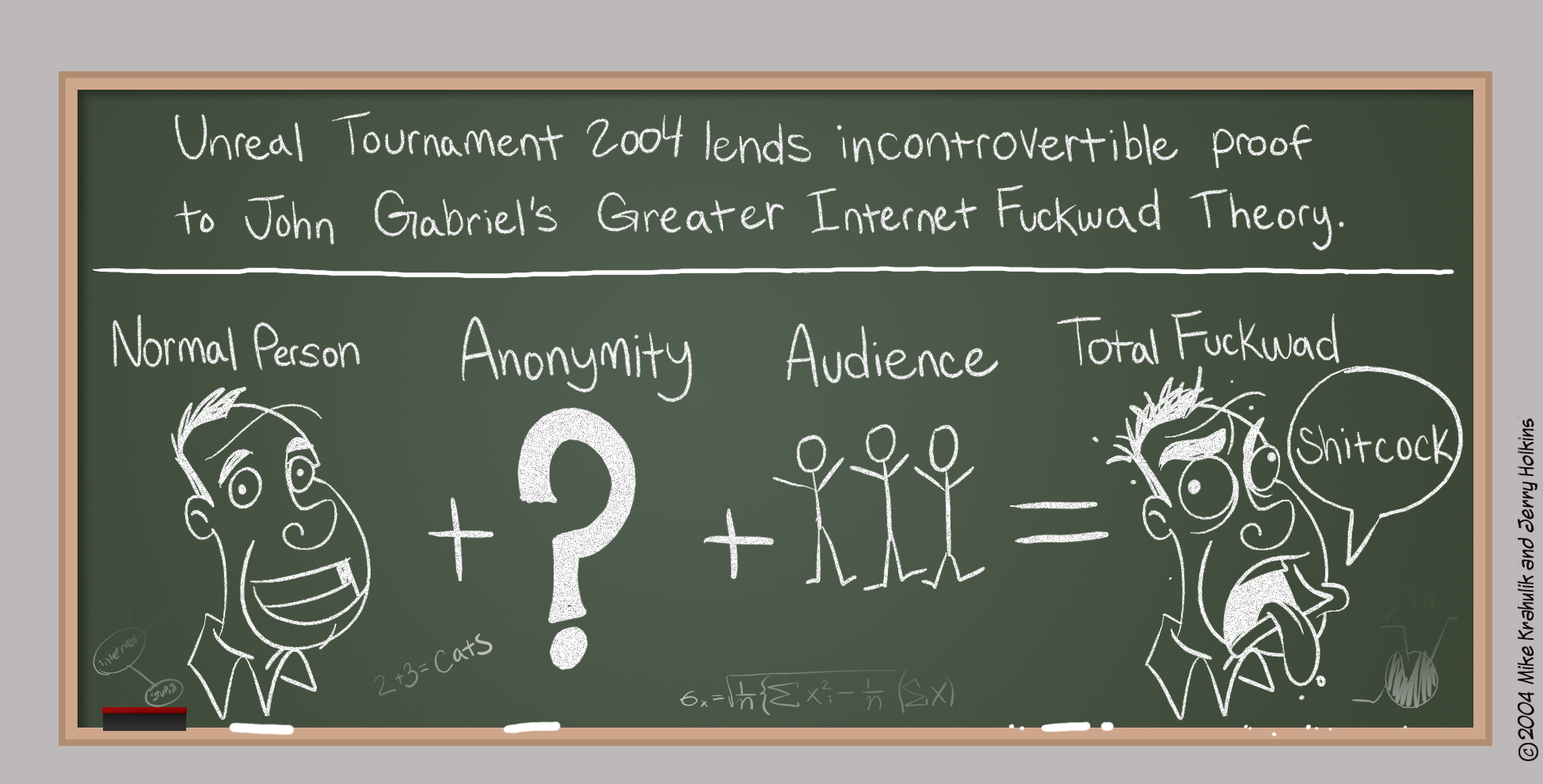
It's usually explained away by the John Gabriel Greater Internet Fuckwad Theory:

215499488_8pszr-2100x20000

And for a while that was plausible. But it's not as simple as that any more: the rise in services such as Facebook means that people are quite comfortable being total fuckwads even with their real name attached to the nonsense they're spouting. And it seems to be the default tone these days, which is disheartening; it's actually unusual when you find a community that isn't full of complainers.

Perhaps it's a consequence of throwing everyone from all different backgrounds all together into a melting pot, resulting in inevitable culture clash. Or perhaps the world of today really does engender negativity rather than positivity — I know that I certainly don't feel particularly happy about the way the world is these days, though my way of attempting to counter it is instead to focus on the things that I do love.

Whatever the explanation, I feel it's sad how things have developed since those innocent days of dialling up that BBS in Birmingham and having to explain to my mother why we were on the phone for so long. I feel we've gone backwards rather than forwards, and that it's probably too late to do anything about it now.

All an individual can do, I guess, is try their best not to be part of it.


2429: Ads Ruin Everything

0429_001

(This was supposed to post last night but didn't for some reason.)

If anyone here is in advertising or marketing…kill yourself. It’s just a little thought; I’m just trying to plant seeds. Maybe one day they’ll take root – I don’t know. You try, you do what you can.

Kill yourself.

Seriously though, if you are, do.

Aaah, no, really. There’s no rationalisation for what you do and you are Satan’s little helpers. Okay – kill yourself.

Seriously. You are the ruiner of all things good.

Seriously.

No this is not a joke. You’re going, “There’s going to be a joke coming.” There’s no fucking joke coming. You are Satan’s spawn filling the world with bile and garbage. You are fucked and you are fucking us. Kill yourself. It’s the only way to save your fucking soul. Kill yourself

Planting seeds.

I know all the marketing people are going, “He’s doing a joke…” There’s no joke here whatsoever. Suck a tail-pipe, fucking hang yourself, borrow a gun from a Yank friend – I don’t care how you do it. Rid the world of your evil fucking machinations. Whatever, you know what I mean.

I know what all the marketing people are thinking right now too: “Oh, you know what Bill’s doing? He’s going for that anti-marketing dollar. That’s a good market. He’s very smart.”

Oh man, I am not doing that, you fucking, evil scumbags!

“Ooh, you know what Bill’s doing now? He’s going for the righteous indignation dollar. That’s a big dollar. A lot of people are feeling that indignation. We’ve done research – huge market. He’s doing a good thing.”

Godammit, I’m not doing that, you scumbags! Quit putting a goddamn dollar sign on every fucking thing on this planet.

– Bill Hicks

It makes me feel a little bit sick inside to recall that when I was a child, I used to actually enjoy the advert breaks on commercial TV. There were ads I used to look forward to seeing, and ads that I still remember today that, to my knowledge, I only ever saw broadcast once.

The reason this memory makes me feel a bit sick is because I look around today and look at all the damage advertising has done to so many aspects of modern life, and I'm disgusted and ashamed.

Mobile phone games, once thought to be a true competitor to home computers and consoles, have been ruined by advertising. Creative work has been devalued to such a degree that it's now a significant risk for a developer to release anything at a price point above "free" (with in-app purchases of up to £80 a time, mind you), with ads punctuating every aspect of the game experience — or, in the worst-designed cases, actively getting in the way of what you want to do.

Games journalism has been ruined by advertising. Earlier today I saw a link to a "review in progress" of a soccer game. The "review in progress" format is usually reserved for games that it is impossible to review based on a launch-day experience — things like MMOs or multiplayer-centric titles. But it's increasingly being used by publishers to stake a claim on all-important search engine optimisation terms and ad revenue by posting an article that includes both the game name and the word "review" in its URL — thereby attracting anyone casually Googling "[game name] review" — without having to actually do a full job of reviewing a game in the traditional sense, and lapping up the ad revenue in the process. Not only that, we have sites spamming articles about the latest, most popular games — even if the sites' verdict on said game was that it wasn't very good, as has happened with Rock, Paper, Shotgun and divisive space sim No Man's Sky — and pulling in those precious ad revenue clicks by anyone Googling the game in question.

Online video streaming has been ruined by advertising. Earlier I was attempting to watch an episode of 8 out of 10 Cats Does Countdown — hardly the most thrilling or cerebral viewing, but I was enjoying it at the time as an accompaniment to dinner — and the ad break halfway through the programme crashed. When this happens, there is no way to skip the "broken" ad because oh no, you have to watch five minutes of adverts before you can see the rest of the programme, and if you can't watch those five minutes of ads, well then, you're not seeing the rest of the programme.

The Internet in general has been ruined by advertising. I can't think of many sites I've been to recently that haven't had some sort of obtrusive background, auto-playing video trailer or worse, complete page takeover making the browsing experience actively unpleasant. One of the worst offenders is one of the most useful sites on the Web: Wikia, which allows users to create wikis for any topic under the sun, but which makes the site practically unusable on mobile by first loading the page in, then loading a full-page pop-over ad a couple of seconds later which you inevitably click on when you're trying to simply follow a link in the text.

Computer software has been ruined by advertising. Whether it's Windows bugging you to upgrade or anti-virus software promising you a "free gift" that is actually just the ability to subscribe to its premium service for the same price it always is, not even in the world of productivity can you escape someone, somewhere trying to extract money from you.

I hate, loathe and despise it, particularly when I see how demoralised it makes people who want so desperately to do things ethically, but who inevitably find themselves trampled underfoot by people with fewer scruples.

I think I hate it most of all for what it's done to something I love, though: writing about games. There's little to no room for passion in the commercial games press today; instead, it's all "you must have [x] articles about [insert popular game name here] up by the end of the week". It does the wonderful diversity of the medium an incredible disservice, and I feel sorry for those people who, like me, are genuinely passionate about the things they enjoy, but who struggle to get heard and can't even think about making a living from what they love.

Unfortunately, it's the world we live in now. I'm kinda with Mr. Hicks on this one.

2360: A Life Without Social Media is a Life Without Pointless Outrage and Guilt

0360_001

I poked my head on to Twitter earlier — not to participate or engage, because I think I've well and truly broken my former addiction to it, but instead simply to share the article on Ys that I spent all day writing.

Literally immediately — and yes, I do mean literally — I saw someone indulging in one of the reasons I stopped wanting to use Twitter in the first place: pointless, unnecessary handwringing and guilt over things that were nothing to do with them.

The person in question, whom I had previously thought to be a fairly level-headed, rational sort of individual, went on an 8-tweet tirade about how awful the 4th of July was and how Americans enjoying and celebrating what has become nothing more than a holiday — regardless of its history — was somehow racist.

I closed the tab straight after I shared the link to my work, because frankly I don't have time for that shit.

One might argue that it's a good thing the Internet has supposedly made us all more socially responsible and aware of all the terrible things in the world — and perhaps it is. However, one thing the Internet very rarely does is actually do anything about these terrible things in the world. Whether it's people changing their Facebook avatars to "raise awareness" for a charity (I think they'd rather have your bank details, thanks), someone painting their nails in protest against the amorphous concept of "toxic masculinity" or flaccid "protests" against whatever the issue du jour is, Internet activism achieves absolutely nothing whatsoever.

Actually, no, that's not true — it does achieve something. But it's not anything good.

The only thing Internet activism achieves is to drive wedges between people — alienating people from one another, and drawing very, very clear battle lines that you can only ever be on one side or the other of. Us and them. The "right side of history" and its respective "wrong side". If you're not with us, you're against us. That sort of thing.

The inherently divisive nature of self-proclaimed activists' behaviour online has had an overall enormously negative impact on online discourse as a whole. As I noted in my post where I decided to set Twitter aside, people who believe strongly in things (or at least consider themselves to believe strongly in things) have a tendency to take an "I'm right, you're wrong" approach with no middle ground. And this is true for everyone who holds strong opinions on one thing or another, whether it's "censorship" in games, the supposed epidemic of "misogyny" that the Internet is suffering, or who they think should win the Presidential election.

The general unwillingness to take other people's perspectives into account has ruined all sense of rational discourse on social media. Okay, that might be a slight exaggeration, but it's certainly soured the experience for me; social media of all types (with the exception of this blog, if that counts, which I don't really feel it does) had just stopped being fun, and seeing that string of tweets today the moment I opened the Twitter page drove it home for me. There was a stark contrast between this and the private conversation I was having with my friend Chris at the time, whereby we disagreed on our opinions regarding the video game Limbo — he liked it, I hated it — and somehow, magically, managed to do so without feeling the need to convince the other person that they were wrong. We simply enjoy different things, and talking about those things you don't have in common as much as the things you do makes for some of the most interesting conversations.

You can enjoy your life, or you can spend your time getting pointlessly angry about things and people on the Internet. I've got games to play and things to write, so I know which one I choose.

2344: Life without Social

0344_001

Well, it's been a few days since I stepped away from Twitter, Facebook and social media in general (that includes my very, very occasional visits to Reddit) and I'm actually feeling pretty good about it. I'm not feeling especially isolated, since I 1) have other outlets through which I can talk about the things I want to talk about, and 2) have other means of talking to the people I actually want to talk to.

One experiment that I'm pleased with the progress of so far is my new Pile of Shame website. Here I'm using WordPress' P2 theme to basically fulfil one of the things I did still enjoy using Twitter for: sharing my thoughts and reactions on games that I'm playing, perhaps in the hope of convincing other people to check out said games after having seen a screenshot that piqued their interest or a description they found intriguing.

I guess what I'm essentially doing is microblogging a "Let's Play" of the games I'm playing, though I still far, far prefer the written/blog format for such things, even though video or streaming is probably a much more practical solution for doing it. When I think about what I'd be interested in seeing, though, should I ever find myself wanting to see what someone else's thoughts on a game are, video is very low down the list, particularly when it comes to looking at things on mobile. I'd much rather read something — even if it's bite-sized nuggets at irregular intervals — than watch a video and suffer through some idiot YouTuber's attempts to be a comedy god. (This is unfair, of course; I know plenty of people who make YouTube videos and stream who aren't immensely irritating, but sadly the ones who tend to get really popular are the ones who are immensely irritating. It's just like TV or other forms of popular media in that regard, I guess.)

But anyway. Check out the Pile of Shame site if you're interested in following what I've been playing — currently Ys Seven and VA-11 HALL-A — and feel free to leave comments.

Speaking more broadly, I'm not missing social media because it means no opportunity for me to get annoyed at all the things that are annoying on social media. These things differ from platform to platform: on Facebook it's the sheer amount of links I don't want to read that are shared by people I don't want to talk to — along with people thinking that they're suddenly God's gift to politics/economics/racism — while on Twitter it's the seemingly daily occurrence of one group or another getting upset, offended and/or angry about something or other. I don't care about any of it any more. I just want to exist in my own world, surrounded by people I actually care about and enjoy the things I enjoy without people crying about, by turns, censorship, misogyny, sexism, racism, People of Colour, Nintendo, Activision, EA, Japanese games, Western games, Gamergate, Call of Duty and whatever else has got people's respective goats this week.

The other positive feeling I have when not checking Twitter and/or Facebook every five minutes is the time and inclination to check out other sites on the Web. As any social addict will tell you, it's very easy to fall into the trap of feeling like Twitter and Facebook (and perhaps Reddit and its ilk) are the only sites on the Internet. Cut them out of your life, and there's a rich vein of interesting stuff you suddenly have time to explore; most notably, recently, I've finally been exploring the wonderful Hardcore Gaming 101, an admirably comprehensive site that covers hundreds of games in a delightful level of detail, including games from my youth that I don't think I've seen written about anywhere else on the Internet. Just last night I was reading a detailed rundown of the Dunjonquest series, for example, which I knew during the Atari 8-bit era through the games Gateway to Apshai and Temple of Apshai Trilogy. Tonight I'm reading about all the Asterix games that have been released over the years, and the site has also made for some interesting reading as I have been going through the Ys series for the first time.

There's a pleasantly wide world out there, and ditching the various virtual rooms full of people screaming at you for one reason or another makes it all the easier to see it. I'm very much enjoying the quiet.

(Note: My Twitter account is still live, sharing articles from both here and the Pile of Shame site, but it is not monitored. Please don't try and send me messages on Twitter because I won't see them! Instead, see this post for other ways to get hold of me. Or just leave a comment here.)

2341: Taking a Break from Social Media; Here's Where to Find Me

0341_001

I've reached this situation before, as longtime readers will doubtless remember, but I think I've lost patience with public social media (specifically Twitter and Facebook), and as such I think for the benefit of my mental health and overall enjoyment of life, I'm going to step away. I'll talk more about the reasons in a moment for those of you who are interested, but before I do that I'd like to share the important stuff: how you can get in touch with me if you so desire.


Email: pjedavison at gmail dot com, or you can use the Contact page on this site, which comes through to the same address.

Google Chat: My only real form of private IM; same email address as above. I have a few other IM services but don't use them much, so please don't try and chat to me on Skype because I probably won't know you're trying to reach me!

Discord: You can drop in on my server at https://discord.gg/0PVr1hioSgchWQAs and/or add me as a friend under ID Amarysse#2465.

Pete's Pile of Shame: I'm going to post some "live" thoughts and media relating to the games I'm playing over at this new site. Feel free to leave comments.

Note that I will be leaving my various Twitter accounts open, but not monitoring them. They will simply reshare my articles and posts from my sites. Likewise for Facebook. Please do not try to contact me using either Twitter or Facebook, because I won't reply or even see your message!

If you want to play games with me, here are my various game IDs you might want:

PSN: Angry_Jedi
Xbox Live: sonicfunkstars
Steam: http://steamcommunity.com/id/angryjedi
Battle.net: AngryJedi#2260
Final Fantasy XIV: Amarysse Jerhynsson, Ultros server (VinCo Free Company)


Okay. Onto the reasoning for me stepping away, if you care.

To put it bluntly, I'm tired of negativity, because that's what social media seems to have become a magnet for. If people aren't sharing the latest in Awful News from Around the World, they're trying their damnedest to be contrary at every opportunity. No-one agrees with anything any more; everyone seems to perpetually feel the need to "correct" everyone else or have a differing viewpoint.

It's the problem with everyone being able to express their opinions, in other words: everyone feels the need to have their own opinion, and heaven forbid it be the same as someone else's. Arguments erupt over the most stupid things, and people snark about things that don't matter with sufficient aggressiveness and determination to make considering talking about almost anything an unpleasant prospect. As someone who already feels a great amount of social anxiety during in-person interactions, to start feeling this way about online interactions, too — a manner of interacting which I had previously found much more comfortable and pleasant, but which I am starting to recoil away from — this is not the way I want to be feeling.

I'll give you a simple example from today: earlier, I learned that Microsoft sells hilariously awful-looking soft porn movies on its marketplace — a storefront which is accessible on its Xbox One console — and yet we still can't have Adults Only-rated games on consoles due to outdated concerns about Wal*Mart and Gamestop not stocking their shelves with anything controversial. I made a glib observation to this effect, and rather than a simple response of "Oh, interesting" or "huh, that is weird", the first response I got felt the need to correct me on my use of the word "porn". Apparently "topless" is not the same as "porn".

This interaction in itself wasn't anything unusual or particularly hurtful, but it was the proverbial straw that… you know. It exemplified everything that's come to frustrate me about social media in the last few years; coupled with the fact that no-one ever seems to be happy about anything any more — between people whining about misogyny, sexism, racism, homophobia, censorship, Donald Trump, black people, white people, Asian people, Nazis, neo-Nazis, Germans, Belgians, gamers, games journalists, Anita Sarkeesian, feminists, men's rights activists, Facebook, Twitter, Simon Cowell, Nigel Farage, gun enthusiasts, people who drink Mountain Dew, people who do fanart "wrong" and any number of other things, it's no wonder I'm feeling particularly miserable and negative about life in general, really, is it?

So the most sensible thing to do from a mental health perspective when something starts making you miserable is to cut that thing out of your life altogether. Preferably cold turkey. But the thing that always makes me hesitate is the fact that amid all the negativity and bullshit, I have struck up some genuine friendships, and I'd hate to lose those. I'd hate to lose contact with people like Mike Cunningham from RPGamer; Steve Baltimore, Joe "Eritach" Sigadel and several others from Operation Rainfall; the glorious perverts of Anitwitter such as Vyers, Ashley, Luka, Firion, Bubbel, Xiaomu, Rin, Radkatsu, TheHatPerson and doubtless hundreds of others I've forgotten to mention. (If I didn't call you out by name here, it's to save time and space, not because I don't want to stay in touch! Unless you're a shithead. In which case I probably wasn't following you anyway.)

As such, then, the details above are there in an attempt to stay in contact with people I want to stay in contact with, despite intending to leave what has previously been our primary means of communication behind. Please do feel free to use them and to say hi to me using any of the means listed; they're there to be used, so don't feel like you're "intruding" in any way by sending me a friend request or a private message via some other non social media means.

In order to continue one thing I did enjoy about Twitter — posting "live" thoughts and reactions to games I'm playing — I've set up this site to continue doing so. It'll probably be primarily PC games on there, as sharing console or handheld screenshots and other media is a bit more of a faff, but if you want to see what I'm up to and share your own thoughts on games I'm playing, feel free to drop by and leave a comment.

I'll be leaving my various Twitter accounts and my Facebook page active in order to share things like these blog posts and my other content from around the Web, but I won't be actively checking them, so please don't use them to try and get in touch with me. No, really; I've turned off notifications on my phone and everything, so if you try and say something via one of those means, I won't see it.

I'll be continuing to post here each and every day, sporadically on my new site and (hopefully) weekly on MoeGamer. Those are the best ways of keeping up to date with what I'm doing and having a chat with me, so feel free to follow and comment on any of them.

Hopefully stepping away will allow me to regain a little perspective and a lot of wasted time on a daily basis. If nothing else, it's probably healthy to get away from relentless negativity, particularly when I'm already depressed and anxious.

Thanks for reading if you came this far; hopefully I'll hear from some of you elsewhere on the Internet sometime soon.
2308: An Open Letter to @wilw About Games as a Lifeline, "Male Tears" and Inexplicable Blocks

0308_001

Hi Wil,

You don't know me, and I don't know you. Apparently I've done something to offend you in the past, though, because you have me blocked on Twitter. I don't know why and I don't know when this happened because as far as I know, we've had no direct interaction on any occasion ever, but I will apologise for whatever it was anyway. I will also express my sincere disappointment that someone I used to look up to as a bastion of what modern nerd culture should aspire to feels somehow threatened or upset with something I've done in the past — threatened or upset enough to simply cut me off from the prospect of ever interacting with him.

I was an avid viewer of many of the Geek and Sundry videos when it first launched — particularly Tabletop, which introduced my friends and I to a number of board games that are still in our regular rotation. Tabletop was an excellent show that gave a good flavour of how the various games played — even if there were occasional bits of fuzzing over the rules in the name of keeping things snappy! — as well as providing a great opportunity for some of the most entertaining, fun people in geek culture to come together and have a good time. A good time that was infectious — so enjoyable was the atmosphere on Tabletop that it felt like the audience was right there with you all, sitting around the game table, rooting for your favourite player to win and commiserating with you when you inevitably came lost. (As the resident person in our tabletop gaming group who perpetually comes last in pretty much everything, I could relate to your position quite a bit.)

On a more serious note, nerd culture in general is something that I've talked a lot in the past about giving me a lifeline when I needed it. In the case of video games, they've provided a constant and much-needed centre of stability in a life that has often been chaotic and beyond my control and understanding; in the case of tabletop gaming, they provide one of the few means of face-to-face social interaction in which I feel completely comfortable, whether it's with close friends or, as it was for me this Friday evening just gone, complete strangers. I think it's the fact that interactions over a tabletop game are, for the most part, clearly structured: it's why I gravitate towards games with clear rules, turn structures and player roles as well as those with strong themes that include flavour text I can read out dramatically to our group. Conversely, those games that require a certain degree of negotiation or freeform interaction are those I feel less comfortable with, since I'm sometimes not quite sure what I'm "supposed" to say.

But all that's by the by; it's just a bit of context of who I am. Needless to say, games of both the video and tabletop variety are extremely important to me; as you said in your keynote speech at PAX East in 2010, "some of the happiest days of our lives would not exist without games and gaming. Games are important. Games matter." I agree entirely, and when I took a risk, flying from the UK to Boston, MA for that PAX East — my first time attending such an event, and only, I think, the second time I'd taken a solo trans-Atlantic flight — I found somewhere that I really felt like I belonged. My life was, at that point, a bit of a mess: my marriage was falling apart — my wife at the time would go on to leave me shortly after I returned from Boston — and I didn't have a reliable source of income. Games gave me a sense of being grounded; somewhere to retreat to when I couldn't face the terror that everyday life at the time confronted me with. Games gave me common ground with which I could interact with other people; games gave me something to talk about, something that I could call "mine".

That time in my life was turbulent. I've had ups and downs since then, and as I type this I'm very much in a "down". Over the years since 2010, I've come to recognise the importance of acknowledging one's emotions, the causes of these emotions and the ways to deal with them. I'm not afraid to cry as I once was back in high school; as someone who sometimes has difficulty expressing exactly what he wants to say verbally, there are times when bursting into tears says more than words ever can; there are others when the act of opening those floodgates allows the repressed emotions to be released in a more controlled manner once you've calmed down a bit, letting you communicate what's really bothering you after the storm has subsided. Crying is important. Crying matters.

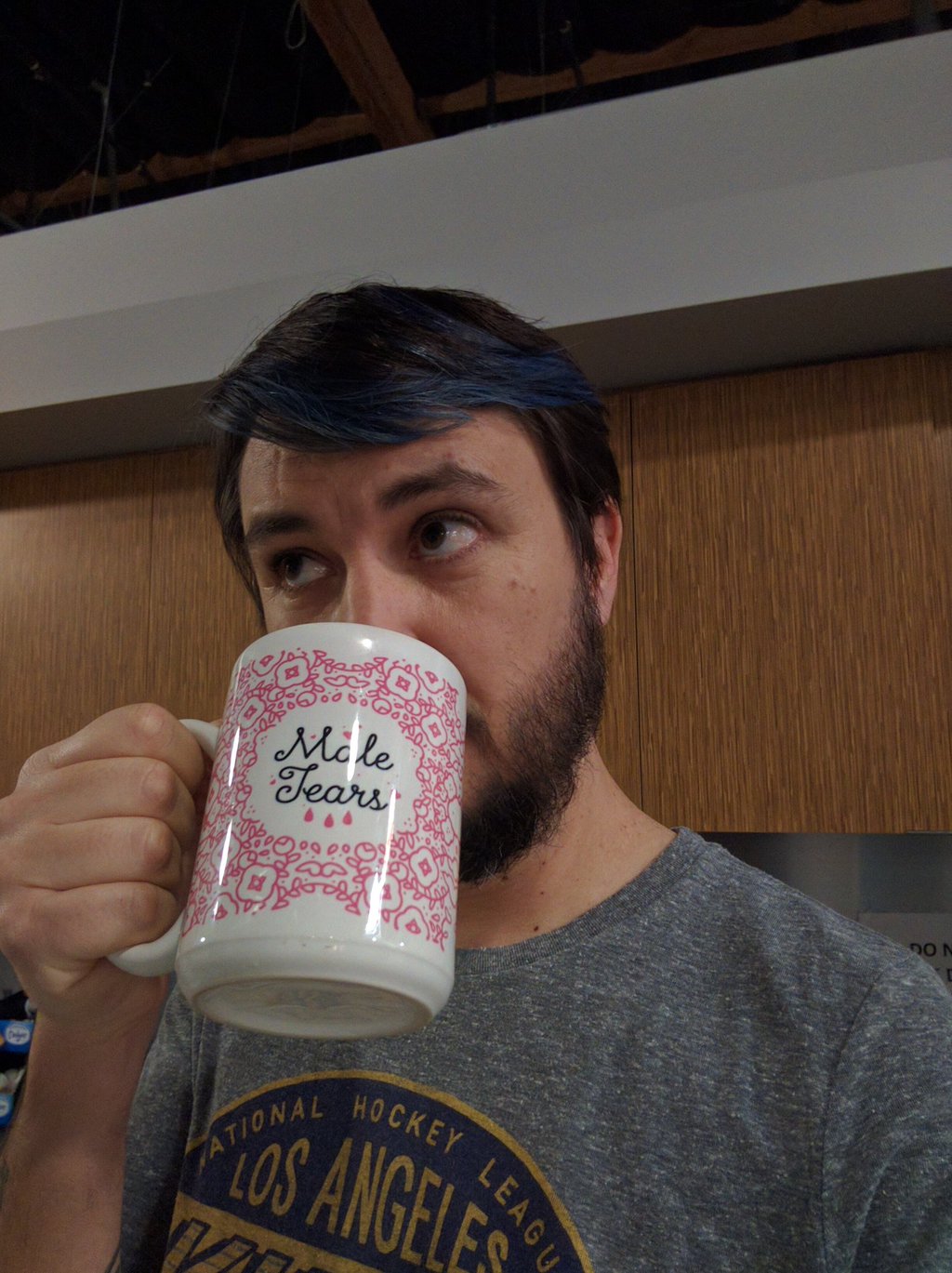
Which is why this image you posted on Twitter bothers me so much:

CiWuwtnUoAEcRkF

For anyone reading this letter who doesn't already know, the expression "male tears" is usually used by the more toxic side of online activism as a means of demonising men — usually straight, white men — when they wish to express themselves. It's largely brought out during arguments between the more militant side of feminism and those — usually, but not exclusively, men — who are tired of all the sociopolitically charged fighting that takes place every day on the Internet, particularly those who fight back somewhat aggressively with foul language, threats and exhortations for people to kill themselves. The "joke", such as it is, is that all this unpleasantness just bounces off the noble "progressive" types — referred to disparagingly by their critics as "Social Justice Warriors" or "SJWs" for short, an epithet which these people flip-flop between absolutely hating and trying desperately to reclaim in the same way black culture has largely reappropriated "nigga" for itself — and is just interpreted as straight, white men crying about something not going their way for once; the fact that "male tears" is written on a mug allows the "progressive" activist the opportunity to drink from it, suggesting that they relish the opportunity to feed on the tears of their enemies.

Pretty unpleasant however you look at it, and while the original intention may not have been to reinforce traditional ideals of what these same people call "toxic masculinity" — stereotypes such as "big boys don't cry" and "be a man for once" — I can't help but look at it that way. Speaking as a (straight, white) man who does cry, isn't ashamed of the fact that he cries and, in fact, has cried quite a bit over the last few months due to his own life situation and the suffering of the person he loves most dearly in the world: to see the idea of "male tears" used so gleefully and indiscriminately as a means of oneupmanship, of proving one's "progressiveness" feels grossly distasteful and insensitive. To have it proudly promoted by someone I once looked up to as almost an idol; someone I thought I could aspire to follow in the footsteps of; someone who proved that a person with my interests could find success and a place for themselves in the world? That just feels like a stab in the back, with a few good twists for good measure.

I don't deserve to feel like that, and I'm pretty certain I'm not the only person who feels this way. Some may express their disappointment and upset with this more eloquently or more aggressively than others, but however they choose to register their discontent and however much or little I agree with their methods of expressing it, I understand it completely. As someone who, now 35 years of age, was often ostracised and ridiculed for his interests and hobbies in his youth, was subsequently delighted when geek culture started to become fashionable over the course of the last decade and most recently has noted with a growing sense of discomfort that the things he finds most relatable, most important to him are those that are getting relentlessly torn down in the name of being "progressive"? It hurts. A lot.

I haven't done anything wrong. I haven't hurt anyone. I just want to be left alone to enjoy the things I enjoy with friends who also enjoy those things, and likewise to leave those who are interested in different things to do what they enjoy. I don't care about this perpetually raging culture war that has all but destroyed meaningful online discourse around video games in particular over the last five or six years, and put a serious strain on a number of friendships. I don't believe in a "one size fits all" approach to inclusivity and diversity, which is what many "progressive" types seem to argue for; I instead subscribe to a "many sizes fit many" ethos, which makes for a more vibrant, interesting and cross-pollinating culture in the long-term. And yet somehow, at some point, I've been branded with a scarlet letter, thrown in the pit with all the other social rejects. I've also been called a paedophile, a pervert, a misogynist and plenty of other things besides. My crime? I like Japanese video games with pretty girls in, and frequently argue against the misrepresentation of these games as soft porn in the mainstream press by those who won't take the time to engage with them.

Frankly, the whole situation makes me want to cry, but now I feel I shouldn't, because it will just, apparently, give you some sort of satisfaction. And that, to be honest, seems like the very inverse of your own credo, your own Wheaton's Law, of "Don't be a dick!"

You almost certainly won't read this, Wil, because having blocked me on Twitter I'm not sure there's any way you'll see it outside of someone you haven't blocked directly sharing it with you, and I don't see that happening. But I wanted to post it anyway; even if you don't read it, hopefully it will bring some sense of comfort to those who feel the same way I do about all this; put some feelings into words; provide a sense of solidarity.

As you argued in your speech, this feeling of solidarity, of belonging, is extremely important. We should all strive to help each other feel like we belong doing the things we love with the people we love in the places we love. With photos like the one posted above, you deliberately block off people from feeling like they can engage with this part of culture they adore, and people they might well otherwise get on with. And whether or not you believe that "male tears" only applies to men who don't know how to behave themselves politely and appropriately, know that it can — and will, and has — been interpreted in a way that just comes across as exclusive, combative and gatekeeping: the exact opposite of what you yourself argue we should aim for.

This whole situation needs to stop, as soon as possible. I hate it. Everyone else I know hates it. Can't we all just get around a gaming table and settle this the old-fashioned way: with dice, cards and chits — maybe even some fancy miniatures?

Thank you for your time, and thanks for reading, whether you're Wil Wheaton (unlikely) or some random passer-by who just wanted to see what I had to say.

Love & Peace
Pete

2306: Happy Birthday, Discord

0306_001

Back in the early days of "going online" — after the days of Bulletin Board Systems but before the widespread Internet we know today — our family used CompuServe to get at information online.

For a teenager like I was at the time, it was very exciting. For the first time, I was able to "meet" and communicate with people from all over the world, discuss common interests and even exchange files.

One of my favourite features of CompuServe was an area it rather grandiosely referred to as the "CB Simulator", after the units used by ham radio operators to communicate with other enthusiasts over the radio waves. In reality, it was simply what we now know today as a chatroom, but it was a revelation to the young me, who had always had a bit of difficulty finding new people to talk to, particularly those who were into the same things.

In the CB Simulator, I could talk to people without fear of them, say, judging me for my appearance, or my mannerisms that clearly indicated I was uncomfortable with talking to strangers, or how I tended to go the colour of beetroot when talking to girls I liked. No; in the CB Simulator, I was able to communicate in the way I had always felt most comfortable: through the written word.

A few years later, when "the Internet" started to become more of a thing and self-contained, fenced-off communities like CompuServe and AOL were starting to become less of a thing, I looked into Internet Relay Chat, or IRC. There, I found a similar experience to that which I'd had in CompuServe's CB Simulator: the ability to communicate and express myself through text to people from all over the world. And now, I could "emote" too, which in turn led to my first experiences with online roleplaying through a group that "simulated" Star Trek missions through text chat.

I was kind of sad when chatrooms fell out of favour with the rise of what we now know as social media, but for those of you, like me, who always used to enjoy the real-time nature of talking in chatrooms, may I introduce you to the wonderful service that is Discord, which is now celebrating its first birthday.

Originally designed as a free, lightweight alternative to Skype and Teamspeak, Discord has been actively developed over the last year to become one of the best — arguably the best — real-time chat application out there, particularly if you're a gamer.

For the unfamiliar, it works in a slightly different way to instant messaging services such as Skype and its earlier counterparts AIM, MSN and Yahoo Messenger. Instead of focusing on private chats with individuals on your friends list, Discord is instead server-based, much like IRC was. Within that server — again like IRC — there are channels for whatever purposes the server admins desire. Anyone who is a member of that server — and servers can be public or private — can hop in to a channel and text chat. There's voice chat facilities, too, which have very good, reliable, clear voice quality and connections, making it an ideal solution for "party chat" on PC, or even using alongside games that don't normally offer voice communication: the Splatoon community, for example, use it quite a bit, since that game has no means of direct communication whatsoever.

Mostly the thing that excites me about Discord is how much it feels like those old IRC servers, only with a more modern coat of paint. Inline image posts, markdown formatting, animated GIFs and link previews are all a natural evolution of the purely text-based chat that IRC offered, and Discord's cross-platform nature — it works via the Web, on PC or Mac desktop clients or even on mobile — makes it an ideal means for keeping in touch with groups of friends or specialised communities.

I'm very happy that Discord has been such a success since it originally launched, and hope it continues to be A Thing for many years to come yet. It's been a great way for me to interact with friends from elsewhere on the Internet in new, more immediate ways than services like Twitter offer, and, depending on the server, it can be a nice quiet safe haven away from the noise of more public social media channels.

I'm a member of several different Discord servers, but the one on which I'm most active is probably the one I'm an admin of. If you'd like to stop by and say hi — the server is largely focused on video games, anime, lewds and general shitposting, but everyone there is just happy to have a good chinwag — then you can do so by following this link.

Happy birthday, Discord, and happy chatting to those of you who choose to come and join us!

2302: By the Power of the Virtues

0302_001

There's a new-ish trend on social media. And like most new-ish trends on social media, it's not a particularly pleasant one.

Known as "virtue signalling", it essentially involves people making public statements that make it abundantly clear that they hold what is widely regarded to be the "correct" viewpoint on something, be this feminism, homosexuality, Donald Trump, immigration, unisex bathrooms, whether or not we should leave Europe, gun control and whether or not Uncharted 4 deserved more than an 8.8 out of 10.

It's an offshoot of a couple of other social media behaviours that have been happening for a while, most notably Twitter's "dot-reply" practice, which gets around Twitter's usual behaviour of not showing people you follow replying to people you don't follow (because why would you want to "listen in" on a conversation involving someone you don't know?), and the related practice of people complaining at companies on Twitter without putting the company in question's user ID in an @mention at the start of the tweet. "Hey, @amazon, your customer service today was shocking!" — you know, that sort of thing.

Both of these practices — and virtue signalling too, for that matter — are a means of amplifying one's own voice and trying to get noticed. Typically, social media consists of lots of people on a reasonably equal footing all shouting into the void and occasionally having conversations with one another. When you bring in dot-replies, public replies and virtue signalling, however, it becomes less about your actual message and more about public perception of you. When you engage in any of these behaviours, you're trying your very best to get your message heard and, crucially, reshared by as many people as possible. In that way, the word can spread about What A Fine Example of Humanity you are, and you can subsequently reap the social capital rewards from successfully Saying the Right Thing in Front of the Right People.

Taking a public stand on things isn't necessarily a bad thing. But unfortunately, the very nature of social media has a habit of distorting messages beyond recognition, and when combined with such transparent attempts to spread your message as far and wide as possible as what we've just described, the global game of Chinese Whispers kicks into overdrive and your message — which may well have been flawed in the first place, or perhaps just misinterpreted somewhere along the line — gets taken at face value, for better or worse.

And people these days simply do not question the things that are presented to them. This is particularly bad on Facebook, where many people — particularly those less Web-literate — will happily share completely untrue stories without bothering to check the validity of them, and their friends, equally Web-illiterate, will share them further, until they've been around the world and back, with a significant number of people believing the load of old bollocks that some troll from 4chan probably dreamed up in an attempt to see how many idiots he could net.

It happens on Twitter, too, though, and through the media as well. A recent example came via the subreddit for Ubisoft's multiplayer shooter The Division, where a user made up a completely false glitch-based strategy for one of the bosses, and said "cheat" was picked up by numerous high-profile gaming websites without bothering to check whether or not it was legitimate for themselves. (It would have been easy enough to do so, given that the user in question actually posted another thread on Reddit at the same time with a legitimate strategy for the same encounter, admitting that his "glitch" was a complete fabrication.)

And this lack of questioning or critical thinking is poisonous when it's combined with virtue signalling. Opinions that someone made up become accepted as irrefutable fact simply because someone "important" shared them, or lots of people shared them. Take the Ghostbusters reboot trailer, for example — now famous for being the most disliked YouTube video in the site's history. The story runs now that it is the most hated video in existence "because of misogyny" — and there's simply no arguing with that, because so many people  have made loud, proud statements about how they're going to give Ghostbusters a chance because they're not misogynist at all, no sirree, and that means that anyone who simply thinks the trailer is shit (it kinda is) gets thrown under the bus with the genuine misogynists and the trolls who enjoy stirring the pot for the hell of it.

Generally speaking, I tend to take the attitude that if you have to shout loudly about what a wonderful person you are, you probably aren't a particularly wonderful person in the first place. So far I'm yet to be proven wrong with this theory.

2212: The Stat Connection

0212_001

"Go to your Stats page and check your top 3-5 posts. Why do you think they’ve been successful? Find the connection between them, and write about it."

Daily Post, February 9, 2016

All right. Let's have a look, then. Since we're not that far into 2016 and WordPress doesn't appear to have an "all time" function to search top posts, I'll provide the top five posts (excluding the homepage, which makes up the majority of pageviews but doesn't tell me much) for both 2016 so far and 2015. In other words, these are posts that people saw the title of (probably on social media or via a search engine) and directly clicked through to, rather than simply checking my front page each day.

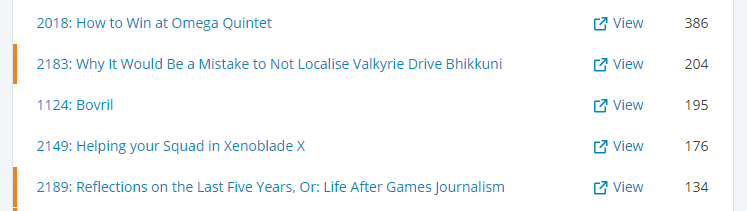
Here's 2016 so far:

blog2016.png

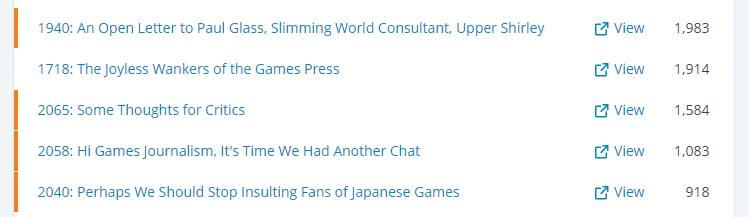
And here's 2015:

blog2015.png

All right. So let's get analysing.

Since I write about a wide variety of topics on this blog — regular readers will know that it's my personal outlet for venting about whatever is on my mind on any given day rather than any attempt to provide a coherent editorial experience — it's perhaps not surprising that not all of the entries in these two lists have something in common, but there are a few common themes along the way.

How to Do Stuff

Let's look at 2016, first. Both How to Win at Omega Quintet and Helping your Squad in Xenoblade X were written in 2015 (indicated by them not having the orange bar next to them), yet have remained consistently popular since I wrote them. The reason for this is that they are instructional content: guides for video games. Instructions or guides are consistent traffic magnets, regardless of the subject matter of your site, because one of the most common things people search the Internet for is how to do something. Video games sites often use guide content for current popular games to attract visitors to their site and guarantee a baseline of ad revenue, then cross their fingers that readers will click through to other, less "baity" content. It doesn't always work like that, of course, which is why we've seen a rise in deliberately provocative "clickbait" content across the board, not just in games journalism.

Anyway. The reason that my guide content for both Omega Quintet and Xenoblade X proved popular is that these were both games that had a specific audience, but neither of them were "big" enough for a commercial site to want to devote time and column inches to them. In other words, those searching for help when playing Omega Quintet and/or Xenoblade X would be out of luck when searching the big video games sites, but a cursory Google search would doubtless throw up my posts here fairly early on — indeed, at the time of writing, my post on Omega Quintet appears sixth in my (admittedly personalised) Google search results, embarrassingly with a typo in the preview text which I have now corrected:

omegaguidegoogle.png

It's for this reason that a couple of my other previous posts have proven popular over time: my post on How to Play Pocket Academyfor example, detailing the baffling and frankly illogical mechanics of Kairosoft's mobile-based school sim, rode high in my rankings for quite some time. I tell you: if you want traffic, write posts that tell people how to do stuff, and preferably how to do stuff that mainstream sites haven't covered.

The Power of Sharing

My most popular posts are always several orders of magnitude more popular than their nearest rivals, with perhaps the most impressive example being 2015's An Open Letter to Paul Glass, Slimming World Consultant, Upper Shirley. This post was pretty far from my more regular subject matter on popular media, particularly video games, and yet it was my most popular individual post for 2015. Why? Because it had the absolute shit shared out of it.

Paul Glass was the consultant at our local Slimming World group when I first joined, and his enthusiasm and belief in the programme was and is a big part of why I've stuck with it and had so much success over the course of the last year — I've lost six stone in a year, hopefully with more still to come off. When he revealed that he would be leaving the group to spend more time with his family in far-off climes, I felt it important to express my feelings about what he had helped me accomplish in such a way that I could be clearly understood. I'm shy and socially anxious by nature, and at the time I wrote this I'm not sure how confident I would have felt saying all those words in person, but writing them down on paper is no big deal: I can "fire and forget" that way.

Something told me that I should probably share this post a little wider than just my Twitter followers, though, and so I decided to make one of my extremely irregular visits to Facebook to post a link to the letter on the Facebook group for the Slimming World group in question. That one simple action caused that one single post to absolutely explode in popularity, as it was shared by group members, Paul himself, and subsequently by other people I'd never met involved with Slimming World in various capacities, either as group members or staff.

You never can quite tell what the next big viral sensation is going to be, but there is one thing that all my popular posts do tend to have in common:

The Passion of the Post

It is, I feel, no coincidence that my most widely shared, most popular posts are those in which I feel most passionate about the things that I am writing about. I am a person who, I feel, can express their passion for something pretty clearly through my writing. And indeed, due to the aforementioned shyness and social anxiety mentioned above, I find writing to be the easiest means through which I can express that passion to an audience that can — hopefully — appreciate what I'm saying, or at least respect it.

2015's most popular posts were all about passion, from my letter to Paul to Perhaps We Should Stop Insulting Fans of Japanese Games. Four out of the five posts above were about video games — four out of the five posts were pretty much about the same thing, in fact, which was critics' regular dismissive and unfair treatment of both Japanese game developers and the fans of the games they make — but these posts all resonated deeply both with myself and with the circle of friends I've cultivated on social media, most of whom share the same interests as me.

Consequently, much as my letter to Paul got shared far and wide, so too did The Joyless Wankers of the Games Press (actually written the year before in response to an absolutely atrocious review of Fairy Fencer F on my former stomping grounds of USgamer), Some Thoughts for Critics (a response to Jim Sterling's dreadful and ill-informed review of Senran Kagura 2), Hi Games Journalism, It's Time We Had Another Chat (a response to Mike Diver's equally dreadful and ill-informed review of Senran Kagura 2, a game which is a ton of fun but which proved to be a whipping boy for self-described "progressive" types on the grounds of the female characters' big jiggly breasts) and the aforementioned Perhaps We Should Stop Insulting Fans of Japanese Games (a response to an extraordinarily narrow-minded editorial on USgamer by a former editor, and almost certainly the reason he has me blocked on Twitter). I saw these posts get shared and reshared, not only on Twitter, but also on Facebook and Reddit, the latter of which I don't really use myself.

The things I had written had clearly got the strength of my feelings across, and other people felt like they could relate to them in some way — either agreeing or disagreeing — and this caused them to explode in popularity, at least in terms of numbers. The same, too, can be said for 2016's Why It Would Be A Mistake to Not Localise Valkyrie Drive Bhikkunian impassioned plea for the progressive loudmouths not to stop Senran Kagura creator Kenichiro Takaki's new game making it over to Western shores.

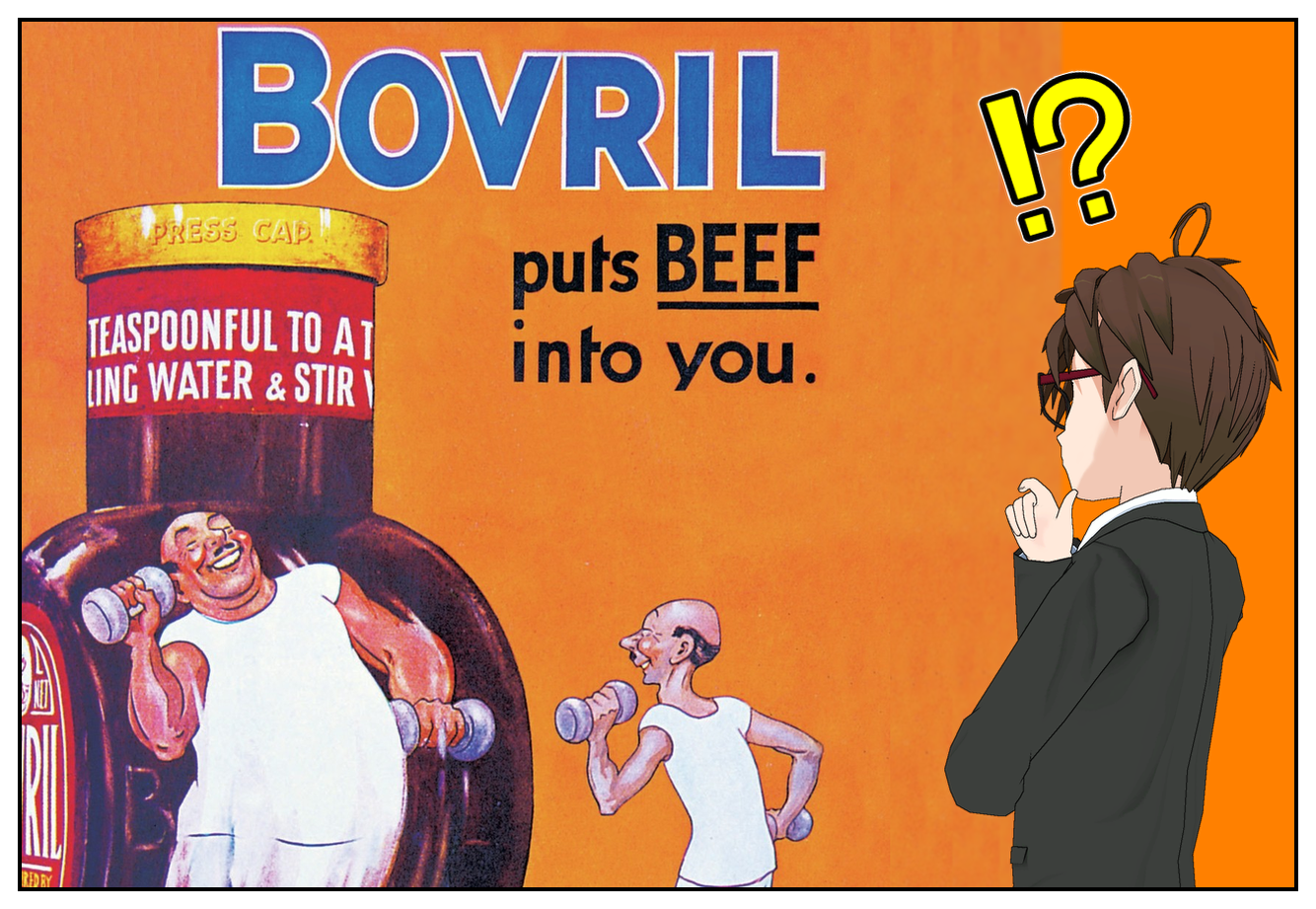
Bovril?

I'll be honest, I have no idea why a post from 2013 about beef-and-yeast-extract black sticky substance Bovril is my third most popular post this year so far, but oddly enough this post has been consistently popular: it finished 2015 in sixth place, just after my various rants at the games journalism industry and also ranked sixth in 2014, but only managed 19th place in its original year of publication.

It's not even a particularly exciting post: it simply describes what Bovril is and how I feel about it. It doesn't even appear on the front page of Google results for Bovril. But I guess it meant something to someone somewhere. Perhaps not many people write about Bovril on the Internet, and my post offered a safe space for Bovril fans to convene and share in silent contemplation of salty beef drinks. Or perhaps it's just one of those things that can't quite be explained.

So what can we learn from this?

There are a few things you can probably see my most popular posts have in common. To my eye, these things are:

  • A clear, conversational title that makes it clear what the post is about — i.e. a simple subject line rather than a "title" that tries to be clever or funny
  • Passion for the subject — clear emotion, either positive or negative, is infectious and relatable
  • Scope for sharing — be it a topic that a lot of people feel strongly about, or something that is written in such a way that presents a strong argument in favour of or against something
  • Complete honesty — even at the expense of a few "bridges" if necessary
  • Instructions on how to do stuff — particularly if nowhere else has published instructions on how to do that stuff

Not all of my most popular posts have all of the above elements — although I do make a specific effort to apply the "complete honesty" element to everything I write — but these are, by far, the most common factors that all of my most popular posts have between them.

I hope that's proved as enlightening for you as it has for me: it's certainly given me some food for thought with regard to what to write about going forward from here, so I'd say both as a writing exercise and an analytical investigation, this post has been a great success.

Thanks, Daily Post!