1645: Animus

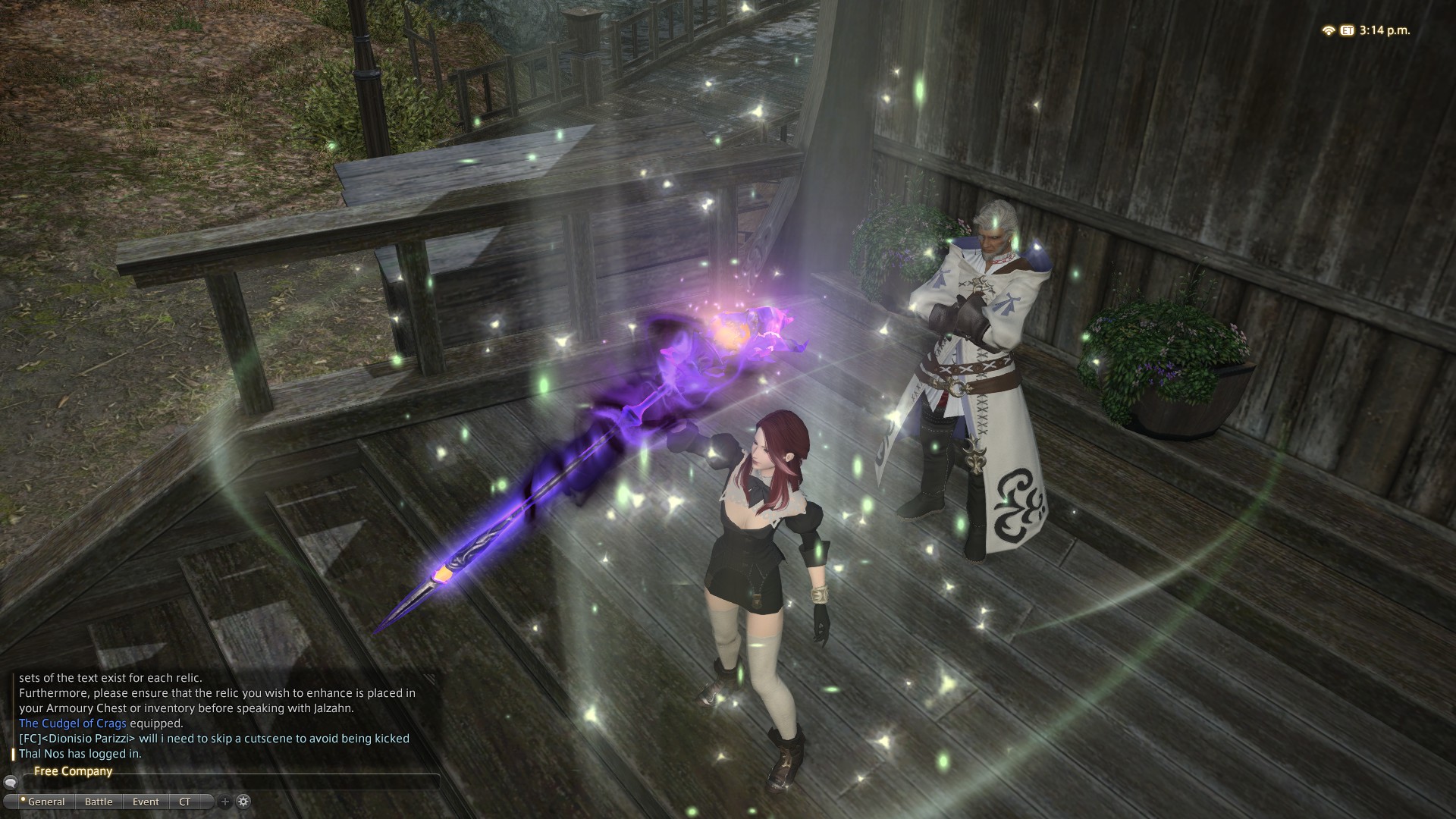
17754480252836380672_screenshots_2014-07-22_00001A long road finally came to an end today — no, nothing important, it was just a lengthy quest in Final Fantasy XIV. Specifically, it was the quest to upgrade my weapon's "Atma" incarnation into its more powerful "Animus" form, which means it's now just one step away from being its (currently) ultimate "Novus" incarnation.

The quest to acquire and upgrade your "relic" weapon in Final Fantasy XIV is a pain in the arse, extremely time-consuming and, at times, very frustrating, but it's also one of the most rewarding things to do at endgame. It gives your character a continual sense of gradual progression — particularly during the Atma-Animus phase that I've just completed — and it gives you a series of long-term goals to aim for, which is important to keep things interesting.

I really like it, in other words, partly for the fact that it's everything what is effectively a "construct your own lightsaber" quest should be. Star Wars MMO The Old Republic featured a "construct your own lightsaber" quest that was not particularly big or epic, and the lightsaber you ended up constructing would often be replaced by something better along the line anyway. Final Fantasy XIV's Relic questline, meanwhile, turns this process into a long journey, with each milestone proving to be a satisfying improvement in your weapon.

The process begins with a sidequest that sees you tracking down a once-legendary smith who now spends his days at the bottom of a bottle in the depths of the Black Shroud forest. Eventually, you track down a legendary weapon appropriate for your class, but it's in a sorry state and can't be used. Newly inspired — though he'd never admit that — the smith challenges you to find a suitable "host weapon" and infuse it with materia to act as a base for the reconstructed relic. You then need to challenge several of the toughest bosses in the realm — at least they used to be, anyway — in order to get various materials that Gerolt the smith requires to reconstruct the relic. Eventually, you're left with a weapon that you've worked hard for — but it doesn't end there.

After infusing your weapon with additional power through a strange concoction known as Thavnairian Mist, you can then begin scouring the realm for Atma crystals. These elusive little things have a very low drop rate from FATEs, the public quests that pop up around the realm, and you need to collect twelve of them: one each from a variety of different areas. This is the part that proves most frustrating for a lot of people — there's not really any way that you can make the search for Atma crystals any easier other than just doing a lot of these FATEs, but from a game design perspective it's actually quite clever: it keeps even the low-level FATEs relevant for even level-cap players, meaning that low-level players who might want to use FATEs to gain experience points will usually have at least a few people to help out, since most FATEs are designed around the assumption that multiple players will show up and participate.

Once you've gathered twelve Atmas, you upgrade your weapon into its Atma form. Initially, this offers no improvement whatsoever over its previous Zenith form, but by purchasing and then completing the various trials in a set of books chronicling the exploits of the Zodiac Braves (the ones from Final Fantasy Tactics? Who knows?) you gradually upgrade your Atma weapon, a tiny bit at a time, until it's considerably more powerful than it once was. When you've completed all the books, your Atma weapon becomes an Animus, and it's then that the road to Novus begins — the road down which I'll soon be starting.

Upgrading your Animus to Novus is a similarly time-consuming process, but rather than simply grinding through tasks again, you instead make use of the game's "materia" system to infuse a magical scroll with various stats you would like to apply to your finished weapon. In total, you have to apply 75 points of stats to the weapon, but how you distribute those is up to you — with the only restriction being the hard cap on certain stats. This means that, unlike any other weapon in the game, you can customise your Novus to be the weapon you want it to be. If you want to emphasise Accuracy — essential if you plan on venturing into the challenging endgame raids The Binding Coil of Bahamut and The Second Coil of Bahamut — then you can. If you'd rather emphasise Determination, a stat that improves your damage output, you can. If you'd rather make your spells cast just that little bit faster, you can do that too. In most cases, the combination of stat caps and the requirement to apply 75 points to the weapon means that you'll end up doing a combination of things, but it's still possible to specialise to a considerable degree.

I haven't really considered what I'm going to do with my Novus yet, but work starts on it when I next start playing. In the meantime, I have my shiny, glowy new Animus to enjoy; it helps me kill things even faster than I already could as a Black Mage. I'm looking forward to trying it out soon.

1643: Twintania Down for the Count

It's taken a lot of effort — including the effort to gather groups of people together for a common purpose — but this evening… morning… whatever it is now, I finally cleared Turn 5 of The Binding Coil of Bahamut in Final Fantasy XIV.

For those unfamiliar, The Binding Coil of Bahamut is a five-part dungeon for level-cap players. It was originally designed to be the absolute hardest challenge in the game, but has since been superseded by new content added in the three big patches there have been since launch. It's also been "nerfed" considerably, with players going in now being the recipients of the "Echo" buff — a 20% increase to maximum hit points, damage dealt and healing received. The thinking behind this gradual easing of its difficulty is so that, in theory, everyone will eventually be able to make it through — and that they might want to do so, because it offers some intriguing story content along the way.

Even with the 20% Echo buff, however, Turn 5, the fifth and final part of the dungeon, is still a stiff challenge. It's theoretically simple, consisting of nothing more than a boss fight between a party of eight people and a rather pissed-off dragon called Twintania, but it's a very demanding confrontation, requiring detailed knowledge of the mechanics, what to expect from the fight at every stage and fast reactions. As such, it's still a significant achievement to make it all the way through.

It's taken a good few hours — and several different parties — over the course of the evening to get through, but we eventually made it by the skin of our teeth. Not before we had an agonising defeat with Twintania's HP down to just 1%, of course, but we eventually made it nonetheless.

Turn 5 in particular is a good example of how high-level content in MMOs differs from more accessible challenges such as dungeons with lower player counts and open-world content. It demands either solid communication — which is why many players choose to make use of voice chat rather than the game's text-based chat — or extensive knowledge of what to expect from the fight. Or, preferably, both, because even with an experienced group, sometimes people's attention wanders, causing mistakes that can easily snowball out of control. Not only that, though, but as cheesy as it sounds, the amount of teamwork required for a successful clear is the sort of thing that really helps to build bonds between friends.

It's the kind of challenge that I don't think would be for everyone. Turn 5 in particular presents such a daunting challenge to many players that I wouldn't be at all surprised if there were plenty of dedicated endgame players who never cleared it. Which is a bit of a shame, as it's a spectacular, genuinely thrilling fight — and the perfect antidote to those people who feel that other content in the game is a little on the easy side. (It definitely is if you overgear yourself, which is quite easy to do these days.) Not only that, but my God, did it feel good when we eventually beat it. There may have been an audible "Yes!" from everyone participating when that HP bar finally dropped to 0.

Anyway. Battling that fearsome foe has led me to the doorstep of 4am, and so I'm going to go and get a few hours of sleep now. Well-earned, I'd say.

1641: Return of the Hype Train

Congratulations, Bungie; your upcoming game Destiny is the latest in a long line of high-profile, big-budget games that I'm sick of hearing about long before they're generally available to the public.

This phenomenon, which I tend to think of as "reverse hype", is a common issue with modern gaming. High-profile, big-budget games have every step of their development chronicled both internally and by the press, and this, for me, leaves me feeling saturated with information about them by the time they finally hit store shelves. (And, in the rare instances where I have tried out a triple-A game in recent memory, they have usually ended up being rather disappointing compared to what was promised.)

Destiny has been particularly bad today, though, because its "beta" launched today on PlayStation platforms, and as such social media has been filled with two things: people with "spare" codes and people begging for codes.

Let's not kid ourselves: this isn't a true beta in the development sense. It's a limited-access demo positioned as you getting the opportunity to preview an unfinished version of the game shortly before its official release. The fact that anyone who preordered the game gets not one but three "beta" codes is not generosity on Bungie's part — it's a convenient bit of free marketing. And, of course, it's working.

I'll add at this juncture that if you're playing and enjoying Destiny, great. I hope you like it, and I hope that, as an MMO, it provides enough interesting content to keep things interesting after launch. It is, however, just the latest in a long line of games that utterly dominates coverage and conversation, making attempts to talk or find out about anything else an exercise in frustration while the hype train continues clattering its way noisily along the tracks.

I'm pretty sure I'm not the only person who gets frustrated with this seeming inability for both press and public to acknowledge the existence of more than one thing at once. And now, having left behind the games press as my profession, it's doubly frustrating because I'm not really in a position to do anything about it.

Thank heavens for groups like the Squadron of Shame, is all I can say. A haven of calm amid all the noise!

1640: Not Quite Dead Yet

There was a horrible moment earlier where it looked like 1up.com had disappeared off the face of the planet.

For the uninitiated, 1up.com was a video games website that was originally born as a spinoff of Ziff Davis' multiformat magazine Electronic Gaming Monthly. It was one of the first community-driven video games sites, with as much of a focus on its community-generated content as on the professionally produced material from the site's full-time team (which, at one point, included my own brother).

For me, 1up was a site that had some good, talented writers and regularly put out interesting features, but it was that community that kept me coming back for more. It was one of my first encounters with the concept of "blogging", too — I wrote semi-regularly on the subject of what I'd been playing and it provoked some interesting conversations with others in the comments. This was in the days before social media dominated everything — and even the days before "don't read the comments" became a piece of accepted, common sense, popular wisdom.

The highlight, for me, though, was the forums. Specifically, the 1up Radio forums, which were the birthplace of the Squadron of Shame. Threads in this forum tended to follow the subjects of the 1up podcasts — 1up was also something of a pioneer in the then-fledgling podcast format — but often spun off in interesting and unexpected directions. One such example was the abortive attempt by the 1up Yours podcasters to tackle their "pile of shame" — games they'd owned for ages but had never gotten around to playing. The original intention of the segment on the show was for the hosts to play some of the same game that they had on their Pile, then discuss it the next week. Unfortunately, it didn't really take off as part of the show, but fortunately for the format — "gaming book club" seemed like a good idea — the community decided to take the idea and run with it.

The first couple of threads we did this for were simply branded "The Boardmembers' Pile of Shame" and explored games like System Shock 2 and Freespace 2. After a while, it became clear that it was the same group of people participating each time, and so the Squadron of Shame Club was born using 1up.com's Club feature — itself an interesting take on social media that I haven't quite seen the likes of since; in many ways, it pioneered microblogging long before Twitter became popular, though there was no character limitation, simply an ongoing, reverse-chronological order feed of conversation that we've tried several times to recreate with varying amounts of success.

1up has been dying for some time, though. The beginning of the end of that site for the Squadron of Shame was when the forums were merged into "Games", "Not Games" and something else that escapes me right now. Various disparate communities were pushed together; tempers flares; cultures clashed. An attempt at a Squad thread in these new digs was quickly derailed by some asshole with the attention span of a gnat yelling about "massive fucking walls of text" when, in fact, that had been our bread and butter for a long time by that point.

The Squad has kind of floated around the Internet ever since, eventually settling on our most recent digs, that will hopefully be "home" for some time to come. 1up, meanwhile, continued to tick along for a while before eventually being swallowed up by IGN and pretty much left to rot. The site was still there, though, with all its archives visible for all to see whenever they wanted.

Which is why so many people were surprised and upset today when going to 1up.com's front page simply gave what appeared to be an empty directory. Thankfully, at the time of writing, the front page at least appears to have come back, and if you can remember the not-very-friendly link, you can even get to the Squadron of Shame's original home.

How much longer will it be there, though? This is a sad and unfortunate aspect of the digital age — things that are the source of great memories are becoming increasingly impermanent. One day 1up.com will simply cease to be, and those memories will be nothing but that — memories. We've already lost a lot of things, such as our original mission threads on the old forums — it'd be a real shame to lose what's left of our community in its original form, though thankfully most of the Old Guard have followed each other around as digital nomads ever since.

So 1up.com may not be dead just yet, then, but today was a potent reminder that nothing lasts forever.

1639: Analysis Paralysis

One thing you'll almost inevitably have to deal with at some point if you play tabletop games is the matter of "analysis paralysis" — those moments where everything grinds to a standstill as one player takes ages over their turn, trying to determine what the best possible course of action will be.

It's a problem most evident in Eurogames, which tend to have the largest variety of different decisions to make each turn, as compared to more theme-focused titles where the emphasis is more on the ongoing narrative created by your play session. A typical Eurogame provides you with a wealth of options every single turn — and in many cases, those options get broader and broader as the game progresses. This means that as you get closer to the end of the game, turns slow to a crawl until, in some cases, you have to abandon the game altogether because it's getting too late — not a desirable outcome for anyone involved.

For the group I regularly play with, this is a particular issue with Uwe Rosenberg's Agricola, a worker-placement game that I don't like all that much, but which is enjoyed enthusiastically by two of our number and as such we break it out every so often according to our "different person picks each session" rota. For the uninitiated, Agricola is a game about building up a small medieval farm, and as the game progresses, more and more different action spaces become available to choose from, meaning the game gets increasingly complex as it progresses. This naturally leads to analysis paralysis, particularly as competition heats up for the more obviously useful spaces towards the end of the game.

So tonight we decided to try something different: timed turns, a la competitive chess. My friend Sam had acquired a funky little timer cube which had a different digital timer on each of its six faces, and we allocated ten minutes per player for the whole game, pausing the timer once a decision had been made so that players could move pieces and tokens around the board without being pressured by the clock.

It really, really worked! By the end of the game, the players most prone to analysis paralysis had nearly reached — but not exceeded — their ten-minute time limit, while the members of the group more inclined to take their turns quickly — usually by deciding what they were going to do during other players' turns rather than ignoring what was going on around them or getting distracted by phones, tablets or pieces of cake — had a couple of minutes left on the clock by the end of the game.

We all agreed that it made the game feel markedly different. One of the most traditionally analysis paralysis-prone players noted that he felt like he wished there was a little more time, but conceded that this was probably the point of the whole exercise. We also agreed that it wasn't necessarily desirable to play like this all the time, but that on occasions where it was necessary to get through games in a timely manner — playing on weeknights, say — it would be a good idea to implement in the future. More leisurely play sessions can still be had on those occasions where we have time for them — weekends away, holidays, that sort of thing.

I still didn't win Agricola, but I think I enjoyed the experience a little more than usual, which is saying something. And if I hadn't made a stupid mistake in the final turn, I would have probably done somewhat better than I ended up doing. Oh well! There's always next time.

1634: Pee Aitch Pee Bee Bee

Been digging around in the guts of PHPbb (or is it phpBB?) today to help get the Squadron of Shame's forum looking the way we want it to. And while there's still some work to do, things are coming together very nicely.

I haven't really explored a self-hosted forum solution before — I've set up forums for various people in the past, but have always made use of pre-made free services, since that was all we needed to fit our needs at the time. In the case of the Squadron of Shame, we're trying to make this place our permanent home on the Interwebs, since we've been flitting around from place to place every so often ever since the 1up forums imploded.

Mostly, I've been impressed with phpBB's (let's go with that spelling for the sake of argument) flexibility and customisability. There are a whole lot of options you can tweak, and in doing so you can make the forum function in plenty of different ways — you can adjust the way users can interact with it, assign various levels of permissions to users, allow or disallow various board features and extend the functionality with plugins and mods.

The only real downside to it all, so far as I can make out, is that installing the aforementioned plugins and mods looks like a bit of a pain in the arse, eschewing a handy-dandy automated install process a la off-the-peg CMS systems such as WordPress and instead in most cases demanding that you edit multiple HTML, CSS and script files, uploading new files to the server and generally doing a whole lot of things manually.

It's been relatively minor issue so far, though, since most of the things I've wanted to do with the board have so far been covered by phpBB's comprehensive administration panel — including uploading attachments such as images, which is something that appeared to be significantly more difficult to include in previous incarnations of phpBB (we're using version 3).

It's been interesting, though, since, as I said above, it's not something I've really poked around in before. I've been learning a lot about what phpBB is capable of, and how it provides a flexible solution for building an online community with relatively minimal fuss. Of course, I haven't been getting involved on the hardcore coding and styling side of things — I'm leaving that up to my friend Mark, fellow founding member of the Squad and someone who does this sort of thing for a living — but I have been doing things that I'm able to easily resolve through a bit of tinkering in the admin panel. (I'm less likely to break things that way, too; past experience with manually fiddling around with templates and CSS files has taught me that I'm good at breaking things.)

Plus there's always the possibility that this sort of knowledge might prove useful in future job hunts. You never know. And it's not as if I have anything better to do right now, is it?

1633: Newshound At Rest

Having stepped back from the games press — not entirely through choice, as previously noted — I've had the opportunity to reflect on the way I read games sites in 2014.

And the simple answer is that I, well, don't.

I had a feeling that this was the case. Being involved in the endless hype cycle for games that really don't need any more hyping up was starting to make me cynical even back in the GamePro days — hence my conscious decision to focus on unconventional, interesting and quirky stories rather than endless retreads of press releases from Activision, EA and Ubisoft. It was a decision that paid off in the short term — people started coming to GamePro to get away from the identikit coverage from other sites, and my stories contributed to a significant growth in traffic… right before the site folded, leaving us all out of a job. Bah.

On USgamer, aside from the news coverage — which I found increasingly hard to care about, particularly as we started having to refocus our efforts on covering the things that would definitely pull in traffic (i.e. the "big name" games of the moment: the aforementioned games that don't really need any more coverage and hype) rather than the interesting, unusual and underexplored areas of the business — I was fortunate enough to have a certain degree of leeway to write the sort of things that I'd want to read from a games site. Thus the JPgamer and BOARDgamer columns were born, providing specialist coverage on niche subjects — while neither of these would be likely to bring in readers by the millions, they were both the sort of things that would keep people coming back week after week, and judging by both the regular commenters and the disappointment expressed by readers when my departure was announced, they were successful in maintaining a solid, specialist audience.

Looking around at the other big sites, though, I'm seeing very little that makes me want to hang my hat on that community and call it my own. I'm seeing lots of very similar stories about how amazing No Man's Sky is supposedly going to be, or how awesome Destiny is supposedly going to be, or "everything we know" about Mass Effect 4/Dragon Age: Inquisition/Halo 5/whatever for the umpteenth time. I'm seeing very little stuff to read with any real meat on the bones, in other words — and with Polygon, the site that was supposed to reinvent games journalism, laying off the majority of its features team, it seems that interesting, long-form critiques and other, non-review, non-preview, non-news pieces are rapidly going out of the window.

And when sites do attempt to try something a bit different, it's inevitably on the increasingly tedious subject of sexism. This isn't to deny that there's plenty to talk about and criticise here, but the majority of articles on this subject are so blitheringly ill-informed with their GCSE Sociology-level critiquing of a subsection of the business as a whole — frequently completely ignoring parts that don't fit their ham-fisted, half-baked theories — that they're just painful to read, particularly when the author becomes so enormously defensive that they start insulting their readership rather than acknowledging the actually quite valid criticisms that come up in the comments section.

Or video. Fuck video. But that's a rant for another day.

Instead of professional games coverage, then, I instead tend to look to my friends. I discuss what I'm playing on Twitter, on Google Hangouts and on the new Squadron of Shame forums. Impassioned reports — positive or negative — from people I know and trust is infinitely more interesting than a carefully PR-orchestrated preview of a game that will inevitably be at least a little bit disappointing when it finally releases. I'd rather hear about something that's out now — that people have actually played, that I can track down a copy of and play should I like the sound of it — than something that, in many cases, is a year or more away. I'd rather hear about amazing discoveries that were released five or six years ago and sank without trace than something I can't install and play right now. And I'd rather share my stories and join the conversation than be preached to.

Essentially, then, I think I've come to the conclusion that I don't really give a shit about the modern games press in its current form. And I'm quite possibly not alone.

Which might explain why I'm in the situation I'm in now. Hmm.

1632: Defenders of Eorzea

Final Fantasy XIV patch day today, and I told myself that today was going to be a day off from stress, anxiety and worrying about things, and that I was just going to enjoy myself. So I did. I logged on at about 11:30 this morning — or yesterday morning, if we're being truly accurate — and now, at 2:52am, I am logging off, with only a few short breaks throughout the day for food and drink.

Suffice to say, patch 2.3 is excellent. I, along with many of my Free Company-mates, took today to work through the new episode of the main scenario quest, which included a spectacular battle against Ramuh, Lord of Levin (aka "the old man who flings lightning everywhere") as well as a ton of other story content. I also completed the new Hildibrand questline — a comedic questline that, for many, has proven a highlight of Final Fantasy XIV's ongoing updates — as well as trying out all three of the new 4-player dungeons.

And I've barely scratched the surface. I've bought a room in our Free Company's house for my character, but I'm yet to fill it with furniture — there's just a bed, a couple of chairs and a table in there for now. I haven't even touched the new 24-player Crystal Tower raid, which promises to be an enjoyable clusterfuck, just like the previous 24-player Crystal Tower raid. And there's a ton of other stuff I'm yet to fiddle around with, too — not to mention returning to the tasks I was already working on prior to the patch, which will now be somewhat easier thanks to improved rewards from a bunch of game content.

So far there have been numerous highlights. Although some disliked the amount of dialogue and cutscenes in the main scenario quest, I enjoyed what was offered, as if you stopped to read it and see what was going on, it proved to be a nice "here's what's been happening elsewhere in the realm since last you saw these people" affair. There was also some neat — if rather obvious — foreshadowing of who the next "big fight" is going to be against.

The new dungeons are great, too. Tam-Tara Hard is particularly fun — as one of the low-level dungeons that comes up most frequently in Low-Level Roulette, Tam-Tara is a dungeon that many people were growing sick of, but its Hard incarnation successfully reimagines it into one of the best — if not the best — dungeon in the game. Featuring a creepy atmosphere, some brilliant boss fights and a narrative twist that is sure to please those who were paying attention earlier in the game, Tam-Tara Hard was a real highlight of today's session.

Stone Vigil Hard has proven more divisive, but it's certainly an interesting, challenging experience. The regular enemies are more than a match for even a well-geared party, and the bosses all make use of interesting mechanics that require far more than a simple "tank and spank" approach. This is nothing unusual for Final Fantasy XIV, which features some very involved boss battles throughout, but Stone Vigil Hard features some particularly interesting mechanics.

Finally, the all-new dungeon Hullbreaker Isle was great. Unfolding mostly outdoors, the "dungeon" sees you attempting to track down the treasure of the pirate Mistbeard. Along the way, you have to contend with various groups of angry wildlife, some unpleasant traps left behind to deter unwanted visitors, and, at the end, a rather annoyed kraken who wants nothing more than to pick you up, fling you around and splatter you with ink.

Final Fantasy XIV continues to go from strength to strength. It remains, as it has done since it launched last August, one of my favourite games, and if the strength of this new content is anything to go by, it has a significant amount of life in it. I'm genuinely intrigued to see where the main story is going, and in the meantime I'm really enjoying the other tasks and challenges the game faces me with. And there's some stuff — like the super-challenging endgame raid The Binding Coil of Bahamut — that I'm still barely touching. There is so much to do, and I'm having an absolute blast doing it — not to mention making some good friends in the progress.

Now, my brain is fried, so I should probably go and get some sleep. It's back to the doldrums of hunting for work tomorrow, though I don't doubt I shall reward myself with an hour or two in Eorzea as the day progresses!

1631: GO GAMERS

The Squadron of Shame forums are coming along nicely — they're pretty much ready for the public to show up and start posting in now, so if you're at all interested in computer and video games and find that places like NeoGAF and its ilk aren't quite fitting your needs — in other words, you like to use paragraphs and write posts that include more than ten words at a time — then do feel free to come on over, sign up and start mingling with the rest of the community, who are slowly trickling over.

Forums are the spiritual home of the Squad, since it's where we, as a group, first came together. But they're also one of the most long-standing parts of the Internet — one aspect of the ever-changing digital world that has actually managed to remain reasonably constant over the course of the last 15-20 years or so.

I recall my first experience with forums fairly vividly. Our first Internet service provider was CompuServe, one of several providers that, at least initially, didn't offer "true" Internet access, instead opting to provide its users with a gated set of online services exclusively for subscribers. (Full Internet access eventually came later, initially in the form of the ability to send email messages to Internet addresses instead of just CompuServe IDs, and later full-on Web access.) As part of this "gated community", CompuServe offered a swathe of forums on a whole host of specialist subjects. Unsurprisingly, I quickly found an online home in the GAMERS forum — you clicked the "GO" button and typed "GAMERS" to get there — and had my first experience of mingling with the online community.

The term "online community" these days has a certain number of negative connotations, due in part to the perpetuation of the narrative that the majority of people who post things online are somehow "toxic", and the fact that indeed, some people who post things online are somehow "toxic". But back in its early days, it was a different matter. "Flaming" and "trolling" were established terms, but they tended to be seen fairly rarely. There were extensive glossaries of the then-new emoticons and acronyms that started to creep into everyday usage, and new terms like "netiquette" were coined to describe how you should interact with other people online.

I honestly can't remember a whole lot about the sort of things I posted and discussed on the Gamers' Forum on CompuServe, but I do remember one thing vividly: I was into Wolfenstein 3-D at the time, and had been experimenting with a variety of mod tools for it, at least partly because I'd been helping a local shareware dealer write his catalogues that included a selection of Wolfenstein add-ons and editors.

Anyway, yes; I was into Wolfenstein 3-D and had spent quite some time working on a selection of new levels — ten of them, in fact. I uploaded them to the Gamers' Forum's download area for others to have a go at, but didn't think anything more of it and certainly wasn't expecting any feedback or anything.

Imagine my surprise, then, when I was contacted by a gentleman named Carlton, who claimed to represent Apogee, the publisher of Wolfenstein, and also claimed to be interested in including my levels in an official expansion pack for the game. I'd be paid, he promised, and appropriately credited.

Frankly, I was at a loss as to what to do at this stage, but after some deliberation and discussion I took a chance and got in touch with Carlton, who took my contact details and promised to be in touch in short order.

Not a lot happened for a while, but then one day a package showed up. Inside it was a cheque for $200 and three floppy disks — one containing a full, registered version of Wolfenstein 3-D, and two containing the official expansion pack, the Super Upgrades pack. I installed the disks, browsed through the directory containing the game — and sure enough, there were my levels, credited to me. I was a professional game designer.

And all because of a forum. Pretty neat, huh?

1627: Further Enthusing on the Subject of Alchemy

Finally got around to finishing a playthrough of Atelier Rorona Plus today — thanks in part to picking up a copy of the Vita version, which allows you to transfer your save across from the PS3 version, and playing it in the coffee shop when I felt like a change of scenery during a fit of particularly bleak depression earlier in the day. My opinion of it hasn't changed, but I thought I would enthuse about it once again for those who haven't yet tasted of its joys.

Rorona Plus is an interesting game, and one with good pacing. Beginning with simple tasks for which the time limit you're given is ample — leaving you with plenty of time to take on other tasks to build up your relationships and reputation in the town — the game gradually progresses in such a way that what is the same amount of in-game time starts to feel more and more claustrophobic. The things you're tasked with making start taking longer to produce, and the journeys outside the workshop to gather ingredients and battle monsters take up longer stretches of time, too.

Fortunately, to counterbalance this, you have a number of additional systems open up as you progress — you're able to "wholesale" items to the shops around town, allowing you to simply purchase useful "intermediate step" ingredients for more complex recipes rather than having to make them every time, and Rorona gets an assistant who can either be sent out to gather ingredients or craft items independently or Rorona. I must confess I didn't make nearly enough use of these facilities in my first playthrough, but you live and learn; I now recognise that in order to get everything done to such a standard as to unlock the numerous alternative endings to the game, it's necessary to make heavy use of them.

Herein lies the interesting thing about Rorona Plus: despite having the trappings of a conventional Japanese role-playing game, the meat of the gameplay is actually more about management and strategy. In order to see the most success, you'll need to plan your time effectively, and set up systems in order to save time whenever possible. Some of these can be constructed yourself — a furnishing system added in the Plus version allows you to build various items that confer helpful benefits on Rorona and her party — while others, such as the aforementioned wholesale and assistant systems, unlock naturally as you progress in the game, though some can be unlocked sooner if you trigger certain events more quickly.

I'm looking forward to playing through the game again knowing what I know now — plus I believe some stuff can be carried over to another playthrough — and seeking out the other endings. Whether or not I'll go for all of them remains to be seen — I'm keen to play the rest of the series, after all! — but I've had a blast so far, and I'm happy that there's plenty more where that came from.