#oneaday Day 573: The Completely Subjective Guide to the Current State of G+ Games

So you're on Google+ and you've seen with some trepidation that social games have come to the platform. Firstly, fear not, because all the game posts are confined to their own stream that is separate from the day to day social interactions. Said game stream needs some work — you can't filter it in any way at the moment, for example — but at least it means your conversations aren't continually interrupted with "HEY! I NEED SOME PAINTBRUSHES! CLICK HERE AND GET FREE GIFTS!" as they are on Facebook. The lack of the "Wall" as a concept on G+ also helps with this — interactions take place in a timeline, like Twitter, but with comments, like Facebook. It's a good system.

But you want to know about these games, right? Millions of people play Facebook/social games every day and you've never dared take the plunge. So here's a brief look at each of them, gleaned from myself taking a brief look at each of them so you don't have to. I'm not pretending these are in-depth or even fair reviews, just first impressions from the amount of time an average user might take to decide whether or not to pursue playing a game further.

Angry Birds

You probably know by now whether or not you love or hate Angry Birds and its unpredictable physics model. This is no different from the norm. Well, there is one slight difference: the "teamwork" levels. Don't get too excited by the prospect of multiplayer action, though — all the "teamwork" aspect is is all your friends' stars being added together in an attempt to unlock further levels.

Bejeweled Blitz

It's Bejeweled Blitz, the one-minute twist on traditional Bejeweled play. It features a tournament system and doesn't hassle you every two minutes to share everything you've done. It does feature a completely unnecessary experience point system, however.

Bubble Island

It's Bust A Move, demonstrating ably the first refuge of an unfortunately large number of unscrupulous social game developers: ripping off someone else's game and reskinning it. It's not a bad version of Bust A Move, but the fact it's a shameless clone is a little grating.

City of Wonder

Clearly trying to be Civilization, right down to ripping off the things the advisors say when they're suggesting what to research next, this doesn't have the depth of Meier's game. If you enjoy building cities without having to worry about pesky geographical principles or simulation elements, then you might like this, otherwise it's one to give a miss. Weird art style, too.

Crime City

Absolute garbage. A game about crime should be about the thrill and the tension of potentially getting caught; here, it's about clicking on things and watching progress bars. In essence, it's Farmville, only with guns. This might sound great, but it's actually awful. A waste of a potentially rich theme; avoid.

Diamond Dash

A reasonable puzzle game with a simple premise — click groups of 3 or more gems that touch orthogonally to make them disappear. Repeat for one minute. It's sort of like Bejeweled Blitz but with a different mechanic. There's a weekly tournament option like PopCap's classic, but you have to unlock it by levelling up to level 3. Players who play this game more have an unfair advantage by getting automatic score boosts depending on their "experience" level.

Dragon Age Legends

Probably the best of the bunch in that it demands some degree of interaction on the player, and makes use of your friends in an excellent way. Dragon Age Legends is a combat-focused RPG where they player moves from battle to battle, engaging increasingly tough hordes of enemies in turn-based combat with up to two companions initially. The social twist is that these companions are your friends who are also playing the game, complete with the equipment and skills they've chosen to outfit them with — essentially a form of asynchronous cooperative multiplayer. For those with no friends, the game also provides a selection of virtual friends for you, too.

While not as deep as a "real" RPG, Dragon Age Legends goes some way to showing that traditional game mechanics don't necessarily have to be sacrificed for the sake of making the game friendly to the social network audience.

Dragons of Atlantis

This is by "hardcore social games" specialist Kabam, and is one of the most tedious games I've ever played, not helped by the fact that the tutorial (disguised as a list of "quests", as usual) goes on for approximately fifteen bajillion years and steps you through EVERY SINGLE STEP YOU MIGHT HAVE ACTUALLY WANTED TO MAKE YOURSELF ANYWAY with "rewards" along the way. The game is about building your city state and then kicking the shit out of other players, but it will take you a good few hours to get to a stage where you're able to attack another player — and you may well have been bored shitless prior to that due to the fact that some buildings take 30-60 minutes of real time to build.

Dragons of Atlantis is mildly unusual among social games in that it features a real-time chat interface, though. The community doesn't know the words "you're" and "they're" exist, and there seems to be an awful lot of people trolling for cybersex. There are probably better places to do this than in a public chat window that is two lines of text high in a tedious game about running a city that's supposedly in Atlantis (I thought Atlantis was a city?). Also there are dragons, apparently.

Edge World

Also from Kabam, this game gets going a bit quicker than Dragons of Atlantis but is fundamentally pretty much the same game, only with a sci-fi skin. It looks like StarCraft but it really isn't — you have no direct strategic control over your troops when attacking a base, for example.

Wild Ones

It's Worms, basically, though victory is determined by how much total damage you do, not by who is eliminated first. You have a significantly more limited arsenal than in Team 17's classic, though.

Unusually for a social game, it offers simultaneous online play. Most of the community appear to have never played Worms before, meaning you can assure victory for yourself by having a slight understanding of physics.

Zynga Poker

A decent implementation of online poker. Not much more to say about that really! As the reviewing cliché goes, if you like poker, you'll like this.
#oneaday Day 570: Nintendon't

So apparently Nintendo are under pressure from their investors to say sod the 3DS and start developing for smartphones. I can't help but think that this is a really good idea. The 3DS was a bold experiment for the company, but it's not going particularly well for them right now — hence the massive price cut. Said price cut still isn't enough for me to want to purchase one, however, which I think is part of the problem. Nintendo doesn't seem to know who the 3DS is for. Is it for the casual market, a la Wii? Is it for core gamers? Is it for people who played their DSes religiously?

The answer to all of those questions is a shrug of the shoulders and a non-committal "Idunno".

The trouble is, of course, iOS and to a lesser extent Android. Why should people purchase a dedicated game system featuring an initially impressive but ultimately useless gimmick when they can have equivalent gaming experiences (albeit without the 3D) on their phones? The only real advantage I see of the 3DS (and, by extension, the Vita) over the smartphone platforms is the addition of physical controls — a relatively big deal, sure, but a lot of developers are getting wise to the best ways to work controls around a touchscreen now.

iOS and Android have a bigger ace up their sleeve than physical controls, though: pricing. This occurred to me today when considering the disgruntlement people expressed over Final Fantasy Tactics releasing at £10.99/$15.99 on iOS. Final Fantasy Tactics is about 14 years old, and was a full price title on its original release. It was then a full price title on its more recent PSP release before dropping down to around the $10 mark on PSN. The iOS port is more expensive than the PSP version, sure, but it has been revamped for the touchscreen — and rather well, I might add.

Still think it's expensive? Let's take a look at the one game people consider to be an "essential purchase" for the 3DS: The Legend of Zelda: Ocarina of Time 3D. A game of an equivalent age to Final Fantasy Tactics. Given a slight makeover with some new textures, 3D graphics and an interface revamp, sure — along with the addition of the Master Quest variant that I'm pretty sure no-one ever plays — but still, in essence, the same Ocarina of Time we were playing on the N64. The price? $40.

Now hold on a minute. Suddenly Final Fantasy Tactics doesn't seem like such a bad deal after all. If Nintendo are going to charge that much more for the privilege of having the game on physical media rather than a digital download, then I say bring on the digital future. If Nintendo are so stubborn as to remain dedicated to their own proprietary hardware, then they need to think about how they can be competitive. Because at the moment, they're not — and the sales figures are showing that. Perhaps the 3DS will show a sharp upswing in popularity when the price drop comes into effect tomorrow, but said price drop still isn't going to solve the system's most critical problem — a lack of good games, and those games that are good released at a price way higher than you'd find similar experiences on the App Store — even the most expensive ones like Final Fantasy Tactics.

It'd be sad to see Nintendo crushed after they dominated the handheld market for so many years. But I have a feeling it's going to happen — and the sooner they accept it, the better. I for one would certainly be very happy to see a Virtual Console app appear on the App Store, and I'd be delighted to play titles like Super Mario Bros., Castlevania and numerous others on the go. But I'm not buying a 3DS for the privilege — if Nintendo can't accept the common knowledge that people of 2011 want fewer devices in their pocket, not more, then frankly they deserve everything they get.

#oneaday Day 568: iOS Gaming Not Proper Gaming? To That I Say "Balls!"

There's a degree of at least partly-justifiable snobbery surrounding iOS devices such as the iPhone and iPod touch — an assumption that they're not "proper" game platforms because they don't have the words "Nintendo", "Sony" or "Microsoft" emblazoned anywhere upon them, and that software for them is much cheaper than for aforementioned devices with "Nintendo", "Sony" or "Microsoft" emblazoned upon them.
This is a flawed assumption. However, as I say, it is at least partly understandable given the meteoric popularity of titles such as the ubiquitous Angry Birds and all manner of other casual-friendly games. In many ways, iOS devices are the Wii of the handheld world, featuring a lot of casual games, a lot of shovelware and a surprising number of diamonds in the rough which it's entirely possible that self-professed "hardcore" gamers will gloss over on the grounds that they're "just mobile phone games".

That in itself isn't a negative thing, though; if you're waiting for a bus/train/poo to fall out/tardy date/kettle to boil then these quick-fire, quick-play games are ideal. You can load up Bejeweled Blitz, play a game and post your score to Facebook in the amount of time it takes to make a cup of coffee. You can play a level of Angry Birds in the time it takes your toast to be toasted. If you're as bad at Flight Control as I am you'll have caused a hideous air traffic accident by the time you've finished a poo.

But here's the key thing: iOS gaming isn't just about this kind of game, but that's where the flawed perception of it comes from. Take Square's recently-released Final Fantasy Tactics: The War of the Lions, for example. This has attracted widespread bewilderment and criticism for its "unreasonable" £10.99 price point — but this is a game for which I paid £50 for an import version upon its original release 14 years ago (Christ, that makes me feel old — that game's nearly half as old as I am), and whose PSP version released at £35. Okay, sure, you can grab it for less than a tenner from PSN now, but for a couple of extra quid you can get a version with new touchscreen controls — touchscreen controls that work extremely well with the game, I might add (yes, I caved and bought it — I love me some FFT) along with a ridiculous number of hours of gameplay. Final Fantasy Tactics is not a short game — so consider its £10.99 price point in terms of "price per hour" and you'll find it a bit more reasonable.

At the other end of the pricing spectrum is the excellent (if poorly-translated) Zenonia series of action-JRPGs, the latest entry of which is completely free with a few optional microtransaction items available for those happy to pay some money or watch some ads. Zenonia is an excellent 16-bit style RPG that is simple to play yet deep and very addictive. And again, it's not a small game. The touchscreen controls are a bit fiddly — any game that attempts to incorporate a traditional control scheme usually is — but once you get used to them and customize them to your liking there's a lengthy RPG that will keep you occupied for many commutes there. The kind of lengthy RPG that you'd pay at least £20 for on DS. For free. And despite featuring microtransactions and premium items, the game never hassles you to spend money on it — it's just an option that's there if you want it, but I haven't paid a penny and it still feels like a proper game.

The list goes on: Kairosoft's series of management/sim games have provided a resurgence in popularity of a genre which has laid fairly stagnant for some time. Virtual renditions of well-established boardgames allow multiplayer action at times convenient to both players — even if that's not at the same time. And some of the finest roguelikes in existence (100 Rogues, Sword of Fargoal) are to be found on the platform.

iOS is here to stay as a gaming platform, and the sooner people wake up and stop seeing it as some sort of bastard offspring to the "mainstream" gaming industry, the better. Sure, there's a ton of amateurish shovelware out there — but that doesn't by any means diminish the significance of the some the games which are available for the platform — a platform which is growing more and more likely to give both Nintendo and Sony in particular cause for concern as the months roll by.

#oneaday Day 562: If We Haven't Announced It, It Doesn't Exist

I don't agree with everything Ars Technica's Ben Kuchera writes, but he was right on the money with this piece right here. Marketing plans are starting to rule the world, and not just in the games industry — though given my intimate familiarity with it, that's what I'll be particularly focusing on here.

I remember the early days of gaming. There were no carefully-orchestrated reveals, no countdown websites (largely because there were no websites) and no pre-order incentives. And it was good. Sometimes you'd hear through a magazine that developer X had just had a great idea for a new game, and it sounded interesting, but they didn't have anything to show yet because it was just an idea. That was cool — it gave you an insight into the creative process and didn't always come to anything. That was cool, too — cancelled games passed into the stuff of legend and became myths.

I've been trying to pin down exactly what it is that bugs me about all this, and I think it's the whole element of "you can't talk about this until we say so". Embargoes are the bane of the games journalist, particularly when, as in some cases, you find yourself seeing a game literally months before you're allowed to publish anything about it. There is absolutely no reason for this to happen in an online world of immediate information — particularly with the growing number of leaks that spring from developers presumably frustrated with the shackles that PR firms place around their necks.

The problem with the whole thing is perhaps best summed up by Gearbox's Randy Pitchford stating "if we haven't announced it, it doesn't exist." Why on Earth should that be the case? What a way to disrespect your development team, who are probably quite proud of what they're working on. What a way to insult the intelligence of the public. And what a pointless exercise — in this case it was less than a day between Eurogamer breaking the story that Borderlands 2 was "probably" on the way and Take-Two announcing that Borderlands 2 was on the way. Pitchford called this "shoddy journalism" when in fact it was the exact opposite — reporters should go off-piste from time to time, as they're not PR mouthpieces — PR mouthpieces are!

As one who reports on the news in the industry, I come face to face with this sort of thing every day. Don't get me wrong — I very much enjoy reporting on new announcements and helping drum up excitement for new products. There is always something going on in the industry, whether it's a small developer putting out an interesting-looking iPhone game or a massive publisher announcing a new means through which they're attempting to bum-burgle used game customers.

I know why it happens of course — it's so competitors don't get to find out their awesome new features and then put out a better version. But in all seriousness, there's a whole load of generic military shooters out there already — keeping the fact that New York gets attacked in one/both/all of them isn't going to change that fact. Ironically, the most original titles are often the ones who are most open and humble about their innovations.

As a consumer, the constant parade of cock-teasers is inordinately frustrating and is causing me to shy further and further away from mainstream entertainment in my own free time. In recent years, the titles I've got most excited about are the ones that weren't embargoed, the ones where developers were open about what they were up to and the ones where I could find out things about the game at my own pace by doing some research and trawling through developer websites — not by following some schedule that the marketing department had dreamed up. Recettear, Chantelise, Groove Coaster, Pocket Academy, Breath of Death VII, Cthulhu Saves the World, Dungeons of Dredmor, Minecraft — these are the games I'm excited about and it's perhaps no coincidence that most of them are independently developed and published titles. All of them either suddenly appeared out of nowhere without months of cock-teasing, or were extensively documented by their creators during development. I can only imagine how satisfying it will be for Notch and his team when Minecraft is finally released to the public and they have a complete and public record of the entire development process which they can look back on and think "Yes. We did that."

The only exception to this rule in my case is Catherine, which Atlus carefully drip-fed information out to the public about, but, notably, didn't stop people talking about the Japanese version which had come out some months earlier — including a playable demo. By the time the reviews for the game came out, I'd already made up my mind — I wanted to play that game, and a review wasn't going to change my mind. I'd played the Japanese demo and was intrigued by it. I was interested in seeing what the Persona team made of adult relationships, and I liked the idea of the story being married to something other than a typical JRPG. I felt like I was making an informed choice, not the choice that PR wanted me to make. Even then, as a European I still have to wait until Deep Silver bring the game over — by which time most of my American buddies will have played and beaten the game and will have already discussed it.

It's difficult to say whether this situation will continue — it seems that most weeks I see journalist friends suffering some sort of embargo frustration, or gamer friends fed up with the constant prick-teasing of countdown sites and "exclusive reveals" during sports events they weren't going to watch anyway. But it must at least be having an effect because it seems to be the model to follow these days.

I miss the days of bedroom programmers selling cassette tapes at car boot sales and type-in listings from magazines. Can we have those days back, please?

#oneaday, Day 561: Rusty Water

I've been playing the stupidly-named Rusty Hearts since the closed beta started at the end of last month. The game caught my eye during E3, when publisher Perfect World announced that they would be taking the free to play genre up a notch with three titles that featured the level of polish one would typically expect from a commercial title.

I was skeptical, of course — everyone was. "Free to play" does, after all, to many people, mean "not as good as a 'real' game". But still Rusty Hearts held some sort of fascination for me. I can't quite pin down what it was — perhaps it was the cel-shaded art style, perhaps it was the fact it didn't sound like another WoW clone, or perhaps I was simply just curious. Whatever it was, it meant that as soon as the opportunity to sign up for the closed beta came around, I was straight in there and sent a code almost immediately.

Now the closed beta is here and I've been playing a while, my fascination was, I believe, warranted. Because it's a good game. Not "good for a free to play game", not "good, but I'd rather play something I paid for". No; it's simply a good game that I would like to play more of — and will.

Why is it good? Well, there's a variety of factors in play. The aforementioned cel-shaded art style is one of them. It looks good, particularly the characters. The backgrounds aren't the best in the world but they're in keeping with the stylised aesthetic. Animations are decent and done with a large amount of Japanese-style visual flair to make things look more exciting. Sword impacts are accompanied by huge flashy "swoosh" effects, every scene transition is done with an effect that looks like claws ripping across the screen and the whole thing is pleasingly "arcadey" in its presentation.

Which brings us nicely onto the way it plays. World of Warcraft it ain't, unlike several of Perfect World's other titles. Sure, you have a hotbar at the bottom of the screen and health bars at the top left. But that's where the similarity ends — this is a full-on Streets of Rage/Golden Axe-style brawler given a next-gen coat of paint and put online. Couple this with a Devil May Cry-esque "style points" system, end-level rankings and skill-based techniques with the word "Just" in them and you've got a very endearingly console-style game with the depth of a PC title. This is very much a Good Thing.

Konami must be kicking themselves about now, though, because the game is essentially Castlevania Online, right down to the awesome techno-rock soundtrack. Here's the plot: there's a big castle, and somewhere within it is a Bad Dude called Vlad. He has a servant called Death. It's up to a plucky band of supernaturally-inclined heroes, some of whom may or may not be witches and vampires, to save the day by beating seven shades of shit out of everything stupid enough to cross their path. Sound familiar? It should; Rusty Hearts is pretty shameless in its inspiration. That's no bad thing, though — the game works well and if Konami aren't going to make a game like this then someone else might as well.

I haven't got that far yet — my character is just level 9, but I'm into the castle proper now after what appears to have been a series of lengthy training quests. The difficulty has ramped up noticeably and, unlike the early levels, it may become necessary to team up with other players to take on some of the subsequent challenges. I'm looking forward to trying out cooperative play — so far solo play has been satisfying and fun, but I can imagine fighting alongside teammates will be fun in a different way. It remains to be seen what the community is like.

Rusty Hearts' closed beta is active right now — I'm not sure when it finishes, but characters and progress will be wiped at that point. Any cash items players might have purchased when that happens will be refunded to their account, so players won't lose any money that they've invested into the game. If anyone's curious to try it out for themselves, somewhere in my inbox I have two spare beta codes going — not sure if you can still use them now the beta's started, but if you're interested in giving it a shot, just let me know and I'll send one over for you. First come, first served.

#oneaday, Day 560: Enchanté, Elise

I very much enjoyed EasyGameStation's Recettear: An Item Shop's Tale, mostly due to the wonderful localization job done by Carpe Fulgur. I booted it up for the first time half expecting to be done with it within less than an hour — most games involving supposed "shop management" and the like these days are in fact social games and therefore pretty much devoid of any meaningful thought whatsoever. Recettear, though, was different — by blending the loot-whoring dungeon crawler with a simple business sim and some lovable characters, EasyGameStation and Carpe Fulgur managed to create easily one of the most memorable games of last year for me.

So it was with some anticipation that I heard the team was hard at work on localizing another EasyGameStation title — Chantelise: A Tale of Two Sisters. From what I'd heard of it, it sounded like a more conventional action RPG than Recettear, but I was confident that Carpe Fulgur's translation would prove super-effective once more.

The game came out the other day so I grabbed a copy — it was cheap, and I'm happy to take a risk on something from a developer I trust, particularly for a low price. I've been playing it for a few hours now, and while it's quite a different experience from Recettear, the similarities are pleasing — you can still heal yourself by eating egg on toast, for example, and a lot of the "miscellaneous treasure" items are the same. The monsters are almost identical, too, and protagonist Elise looks somewhat like what Recette would probably look like if she were a little older. And there's a fairy involved again, too.

What's been a pleasant surprise about Chantelise, though, is how unconventional it is. Despite looking to all intents and purposes like a fairly generic action JRPG, there's some inventive ideas in there.

For starters, there's no grinding for experience points, levelling up and that sort of thing. Powering up Elise is done entirely through purchasing items and/or completing parts of the story. This negates the need for tedious grinding, as money seems reasonably easy to come by.

Then there's the magic system. Rather than simply learning an arsenal of spells and then using magic points to cast them, Elise's sister Chante (who has been turned into a fairy) handles magic. If Elise collects magic gems dropped by monsters, Chante can then use these to cast spells — each colour causes a different effect. Multiple gems can be used at once, too, with different combinations yielding different effects. The twist is that Chante will only cast a spell using the last gem you picked up, meaning that there's an element of almost puzzle game-like strategy to picking up loot from the floor as you need to ensure you have a helpful arsenal of spells on hand to use.

The game structure is peculiar but effective, too. Split into various areas which are then subdivided into stages, Chante and Elise must batter their way through all the monsters in a stage to unlock the path to the next. The final stage in an area features a boss fight. Getting KOed along the way sends the heroic duo back to town, and re-entering the area requires them to start again — only this time they can charge straight through stages that have already been completed to quickly get back to where they were. This makes getting KOed mildly inconvenient, but not inordinately frustrating.

Alongside the basic game structure, every stage also has a secret treasure chest to find, too. Requirements for revealing this range from killing special enemies to destroying parts of the scenery, and the game keeps track of which areas you've found the secrets in and which you haven't. Interestingly, you don't have to run the whole gauntlet of stages if you're just going for a treasure chest — you can play individual stages in a time attack mode if you're just treasure hunting, but you have to follow the linear "story mode" path if you want to progress through the, well, story. Obviously.

In practice, the game is more of an action game with an upgradeable character than an RPG. The first few stages are deceptively easy but by the time you're into the second dungeon you'll find yourself having to thoroughly understand what Chante and Elise are capable of if you hope to succeed. Hordes of enemies — some of whom can only be defeated in a specific manner — attack the pair and it becomes rather more important to think tactically rather than charge in mashing the Attack button.

Chantelise likely isn't going to appeal to everyone. Its animé visuals look like pretty much every budget JRPG ever. There's a lot of repetition involved, particularly if you keep dying. The tutorial is rudimentary at best, leaving you to discover the vast majority of how the game works for yourself. The music's a bit annoying. And the Zelda-style BLING! BLING! BLING! BLING! noise when you're low on health will drive you nuts (pro-tip: don't get low health). But I happen to love all these things (even the annoying music and BLING! BLING! BLING!) so I'm looking forward to what promises to be a reasonably lengthy adventure with plenty of hack and slash action and the same wonderful localization that set Recettear apart as one of my favourite games of last year.

Carpe Fulgur have great things ahead of them — they're already working on two new titles, one of which is secret. Discovery of games like Recettear and now Chantelise — both blissfully Achievement, Online Pass and DLC-free — is why I'm very glad I'm now doing most of my gaming on PC.

#oneaday Day 557: Play Some Music

I've been playing Groove Coaster on my iPhone. If you haven't already downloaded it, stop reading this right now and go and download it while it's still 99 cents/69p.
So now you've played it. So you understand.

Groove Coaster is pleasing for a number of reasons, not least of which is the fact that it's a gorgeous-looking, solidly-playing game with plenty of content for the miniscule amount of money you pay for it. The Infinity Gene-style visuals complement the gameplay well, being attractive without distracting, and they look beautifully pin-sharp on the Retina display of the iPhone 4.

That's not the best thing about Groove Coaster, though. No; the best thing about it by far is how it calls to mind the days when music games were home to a huge amount of creativity. We had virtual turntables (BeatMania), a rapping dog (Parappa the Rapper), a guitar-toting sheep that really didn't look like a sheep (UmJammer Lammy), a rabbit that liked prancing around on wiggly lines (Vib Ribbon) and weird things that liked racing down tunnels (Frequency/Amplitude).

These days, though, what do we have? Guitar Hero and Rock Band, and it's questionable whether or not we really have Guitar Hero still. Okay, we have DJ Hero too, but for the most part, it's all about the plastic instruments.

Groove Coaster casts the mind back to a time before Guitar Hero, when music games were about the music, not about the things you had in your hands while you were playing (not your penis, you filthy pervert. You know your mind was going there.) No; Groove Coaster is about losing yourself in an enormously diverse array of clearly Japanese music tracks and letting your finger do all the work. Success is down to how well you engage with the music, and how well you can equate the on-screen figures (which twist and turn rather than following the linear path of Guitar Hero and Rock Band) with the way the music is going. You can't play it passively — it's a game you need to concentrate on. It's not about "party play" — no bad thing in itself, I might add — but it's about getting inside the music and "feeling" it in a way I haven't experienced since Frequency and Amplitude.

The other great thing is the characteristically Japanese music makes me think of Namco's PS1 games — Ridge Racer Type 4 and Anna Kournikova's Smash Court Tennis specifically. These games had fantastic non-licensed music that was obviously Japanese but had enough Western-style "funk" about it to appeal to a universal audience. There are several tracks in Groove Coaster that would certainly not have been out of place in a Namco title from the late 90s. This, as they say, is a Good Thing.

I don't even mind the fact that the game gratuitously sells "boost" items and extra tracks for actual money, because 1) I paid so little for the game in the first place, 2) there's plenty of content in there without buying anything extra and 3) the "boost" items don't necessarily give you a massive advantage, they're just a bit more convenient.

So, then, if you ignored my first paragraph and still haven't downloaded Groove Coaster I say again: go get it now. (If you want to. Please don't hit me. What are you doing with that shov–)

#oneaday Day 552: My Favourite Bastard: Gary Smith

I mentioned a few days ago that I've been playing Bully again. I have now beaten it again (with 100% completion, more fool me) and have come to the conclusion that the game's primary antagonist, Gary Smith, is one of the finest villains we've seen in gaming.

(Bully spoilarz ahead.)

Gary is every teacher's worst nightmare. He's brash, outspoken, manipulative and has ADD. At the outset of the game, it's clear that he's a bully, judging by the way he treats Pete Kowalski. Pete doesn't stand up to Gary, though, as it's clear that he's afraid of him and, judging by his behaviour towards Jimmy later in the game, prefers to live for the approval of others.

Algie, one of the Nerds clique, refers to Gary as a "sociopath". This is probably an accurate description — as time goes on and Gary becomes increasingly paranoid, thanks in part to him ceasing to take his ADD meds, he manipulates the schoolkids to his own ends without a hint of remorse. He lies and cheats and takes every chance he can get to get one up on Jimmy. Jimmy, being a pretty tough "water off a duck's back" sort of kid, takes all this in his stride and eventually manages to convince the cliques of the school that Gary is, in fact, a douchebag and that Jimmy did not, in fact, do or say any of the things that Gary led them to believe. The early part of the game largely consists of dealing with the aftermath of the various messes Gary creates — messes which we never see him create, but certainly see the consequences of.

All goes well until Jimmy gets overconfident with his new-found fame and power and half-successfully pulls off his biggest prank yet: to tag Bullworth City Hall with the slogan "Bullworthless". He has an audience while he does so, but it looks like he's gotten away with it, until he gets back to school. Gary has informed the Principal of Jimmy's misdemeanour, Jimmy gets expelled and Gary becomes Head Boy of the school — a position he had coveted since well before Jimmy ever arrived.

With his new power, Gary turns all the cliques against each other — and Jimmy — with the help of the Townie school dropouts, and he sparks off a full-scale riot in the school. The teachers are powerless to do anything about this, with most of them being too embroiled in their own matters anyway — particularly Ms. Phillips and Mr. Galloway's attempts to throw off Mr. Hattrick and his crusade against Galloway's alcoholism. Taking advantage of the chaos, Gary takes Principal Crabblesnitch hostage and lures Jimmy to the roof of the school for a final showdown.

Jimmy, being Jimmy, takes down Gary, the pair of them crashing through the roof of Crabblesnitch's office just as Gary proudly proclaims that his masterplan has come to fruition. Crabblesnitch hears this — despite having been tied up by Gary, he's too under his spell to believe him capable of any wrongdoing until he hears Gary confess to his crimes. Gary ends up expelled and we never hear of him again, save for a few rumours that he's living in the school belltower, and others that he's living with the Townies.

The best thing about Gary as a villain is not his manipulative nature — though the constant frustration that Jimmy feels as clique after clique turns against him time and time again is enough to make you hate the little bastard. No; the very best thing about Gary as a villain is that he's just not there. Gary is off-screen for a good 90% of the game and all you, as Jimmy, have to go on is second-hand accounts and "he said, she said" rumours — just like real high school. Because if there's one thing a thousand crap teen coming of age movies have showed us: there's nothing worse than being misrepresented to the whole school.

It's Gary's long absence that makes kicking the snot out of the little git at the end of the game all the more satisfying. While the whole thing is perhaps a little silly, and Gary's motivations are never quite clear, it's immensely pleasing to finally get one up on him.

Perhaps the fact that Gary's motivations for "wanting to take over the school" are somewhat obscured is deliberate, though; we see frequent evidence throughout the game that Gary is at the very least a sociopath and at worst a dangerous psychopath. He's a narcissist and a megalomaniac, and he doesn't care about anyone but himself — he wants to make his way to the top by fair means or foul, and doesn't care how many toes, testicles and faces he treads on to get there. Jimmy finds himself in danger of becoming Gary when he initially manages to get all the cliques to respect him and each other and becomes overconfident and cocksure as a result — but discovers when Gary turns them all against him and each other that he's got too much respect for other people and the community, however dysfunctional, of Bullworth Academy, to continue treating people as his puppets, his playthings. It's for this reason that Jimmy eventually prevails and takes his rightful position as head of the school — this time, without becoming a dick about it, despite his propensity to solve problems through punching them in the face.

So, then, Gary Smith: I salute you. You were a worthy adversary and deserve to take your place alongside the great gaming villains of our time.

#oneaday Day 550: How to Play Pocket Academy

After posting a lengthy comment on yesterday's post, I figured that I'd share what I've discovered about playing Kairosoft's Pocket Academy with a view to potentially making the start of the game a little easier for those of you who haven't tried it yet. So here we go.
The First Few Months

You'll start your new school with a few basic facilities, one teacher and a couple of students, one of whom you design and name yourself. Don't be tempted to build facilities or level up your teacher to begin with, even if they come to you and very politely inform you that their friends get more training than they do. The reason for this is that facilities cost money each month for upkeep, and each level up for a teacher raises their salary by 20%.

Instead, your initial activities should focus around getting your students' abilities up to snuff through special classes, and performing Challenges to raise tuition.

Special classes cost one of the three types of Research Points to perform, and each will raise students' grades in one or two subjects. As you progress through the game, more classes (and more effective classes) will become available. To acquire Research Points, it's just a case of waiting — they come either from teachers using facilities (tap on a facility to see which type of points it provides), from students talking to each other (randomly determined) or special events such as those which occur in the summer and the fall (each event is tied to a particular type of Research Points).

Challenges cost money to take on, but succeeding in them increases your tuition by $20-30 per student. You can perform up to two successful Challenges per month. Failing one doesn't count as one of these two — and in fact, failing a challenge provides you with Research Points, so if you have an excess of cash, this can be a good way of quickly bumping up your stocks. Passing a Challenge is determined partly by random chance, partly by the participating student's Intelligence and Attitude stats, and partly by their grades. Raise grades with special classes and keep an eye on their Int/Att scores as they use the facilities.

At the end of each semester, there's a test. Student grades will be tallied and the school will be given a rating and a ranking. The higher the rating/ranking, the more money you get, so it's in your interests to ensure each class' grade average is as high as possible — tap on a classroom to see the whole class' average as well as students' individual grades.

Building Up

As you pass Challenges and pass other milestones, reports in the school newspaper will be published, increasing your potential catchment area. As this happens, a flow of Transfer Students will join your school. Each will bring an entrance fee with them, and some will also offer a monetary gift from their parents. The more students you have, the more tuition you get per month.

Once your classrooms are full or the flow of Transfer Students stops, that's a signal that it's time to hire a new teacher. Pick one with a reasonable salary but a good range of stats, particularly those which aren't covered by your existing staff member. Teachers' "grades" determine how much benefit students get from the classes they hold at the start of each semester as well as the special classes — each time you hold a special class, one of your teachers is picked randomly to hold it.

Levelling up a teacher requires Research Points — the exact type and amount depends on the individual teacher. Gaining a level gives the teacher a 20% pay rise and 30-90 Education Points to spend on their "grades". Try and specialise each teacher one at a time — all grades carry equal weight, so there's no need to get Eng/Ma/Sci up first, whatever the National Curriculum might tell you. Pick one and try and get it up to 100, then move on to another.

Budget carefully — at the end of each month, you'll see a brief rundown of how much you spent on facility upkeep, how much you spent on teacher salaries and how much income you got from students. Ideally the latter figure should be higher than the former two combined. If you want to check your budget in detail, go into the menu, tap School > School Info then tap on the info window that pops up.

Creating Spots

Once you're making a healthy profit each month, you can look at expanding your school. When building new facilities, the most efficient thing to do is combine groups of three facilities together into Popular Spots. These then get a bonus which they also provide to surrounding facilities, making them more effective. The more a facility is used, the better it gets, too — tap on a facility to see how many more times it has to be used before it will level up.

Known Spot combinations are listed under Lists > Spot Guide. Over time, you'll unlock more "recipes" but not all are listed. Here's a partial list:

  • Relaxing Spot: Azalea, Grass, Bench
  • Waiting Spot: Bulletin Board, Big Rock, Rest Room
  • Power Spot: Well, Woods, Grass
  • Garden Spot: Grass, Field, Water Fountain
  • Art Spot: Art Room, Music Room, Misc Room
  • Study Spot: Principal Room, Library, AV Room
  • Spooky Spot: Music Room, Lab, Incinerator
  • Friend Spot: Water Fountain, Nurse's Room, Lounge
  • Date Spot: Tennis Court, Woods, Library
  • Exercise Spot: Running track, B-Ball Court, Vending Room
  • Jealousy Spot: Incinerator, Cafeteria, Home Ec Room
  • Election Spot: Principal's Office, Teacher Room, Lounge
  • Homey Spot: Nurse's Room, Home Ec Room, Rest Room
  • Shopping Spot: Snack Store, Tiny Mart, Cafeteria
  • Meat Spot: Pig Room, Cow Room, Cafeteria
  • Water Spot: Water tile, Rest Room, Well
  • Cooking Spot: Incinerator, Home Ec Room, Water Fountain

In order to create some of these Spots, you'll need to research the relevant facilities. To do this, pop up the menu, go into Admin > Research. Each facility costs a certain amount of money and Research Points to unlock, then each will take a period of time to create. You can't research everything initially — more facilities will unlock as time passes. You'll know when you can research something new by a pop-up saying you've got a "new request". When looking at the Spot Guide, "Can Build" means that you have the capability to research all the necessary facilities, whereas "Cannot Build" means that you won't be able to research or build at least some of the facilities for a while yet.

Career Guidance and Graduation

When your students reach their third year, you need to start paying attention to their career paths, as this will determine how much money you get when they graduate in month 3 of their last year. Use Lists > Student List to view their grades, stats and success rate in their career. Anyone with a yellow success rate (80%+) is likely to succeed, so you can leave them be in most cases. For anyone else, you may want to consider giving them some career guidance.

Students with no career planned will become part-timers upon graduation. This has a 100% success rate but returns a poor amount of money, so if you have the time and resources, advise them on an appropriate career.

To give career guidance, you need to use Research Points to create a Career Change item from the Admin > Items menu. Then tap on a student either on the screen or in the Student List and choose Use Item to apply it to them. You'll see a range of careers, success rates and salaries — pick one with a good chance of success and decent salary. You'll get an award of 5% of the total salaries of all your graduating students when they leave, so it's in your interests to get them into as highly-paid jobs as possible.

Other Ways of Making Money

Certain facilities, such as the Vending Room and Snack Store, gain you money whenever students or teachers use them. This will provide a small income.

Fields will provide a slow but steady income, too. Build fields where students and teachers can reach them, next to paths. They'll plant and harvest crops automatically at regular intervals, providing money on harvest.

Animal rooms provide income in a similar manner to fields, but you can build fewer of them.

All facilities are made more effective and provide more money depending on the amount of Spirit they have — Spirit is raised by planting trees, flowers and other nice things around them.

Where Now?

It's up to you after that. From hereon you'll have a steady string of things vying for your attention — do you prioritise your third years' grades? Research? Build? Up to you — but remember you've only got until your tenth year to record a high score.

If you find your supply of transfer students drying up and your income dwindling, hire more teachers. Four teachers can handle six full classes — you'll need to build another Teachers' Room if you want to hire more.

Hope that's helped. I haven't covered everything by any means, but that sums up everything I've figured out about the game so far.

#oneaday Day 549: Kairo! Kairo! Kairo!

I've been playing a couple of Kairosoft games on iPhone recently — specifically, Game Dev Story, which most gamers with an iPhone have probably heard of, and Pocket Academy which, as a recent release, may be a little more obscure.
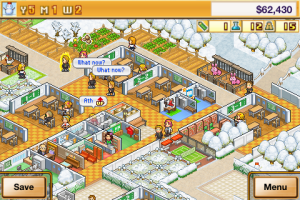
These games, while initially seemingly slightly impenetrable, are great, and bring to mind strategy games of the past, complete with super-adorable pixel art. Specifically, stuff of the SimCity ilk, where there were no set goals, no Achievements, no "win conditions", even, save the ones you set for yourself. Unlike SimCity, Game Dev Story and Pocket Academy do end after 20 years of in-game time (you can keep playing but your scores aren't recorded after that) so you do have something to strive for, but other than that, you're on your own.

I hadn't realised how long it was since we've had a game like that until I started playing them in earnest. Do you remember the start of a game of Sim City? "Here's a blank bit of land. Off you go." No tutorial. No "you should probably build this first", no initial setup. Blank canvas, palette of Stuff to Build. Begin building, build too much, lose all money, fail. Try again, pace self better, experiment with big thing, fail. Start again, pace self even better, don't build big thing until you really need it, slowly start making money. Repeat until map full.

Contrast this with one of the modern equivalents of the genre, which is the Facebook/phone-based city-building game. I tried CityVille on iPhone for a little while just to see if there was any strategy or experimentation involved whatsoever. There wasn't. It was an endless string of objectives which theoretically I could have been free to ignore were it not for the fact that you unlock things to build painfully slowly by levelling up like in an RPG — and the most efficient way to level up is to complete said objectives. This is, to misquote Aristotle, "balls".

Now we come to Kairosoft's titles. While they don't quite give you the completely empty canvas to start with, the tutorial is rudimentary at best and barely explains the basics of gameplay — the rest of it is up to you to discover. Why should you level up your staff? Why should you pump money into advertising? What effect does having couples in your school have? Why does a combination of a tennis court, a tree and a library make my students happier?

I don't know the answers to all of those questions… yet. And like in SimCity, my first attempt at Pocket Academy saw me hire too many teachers too quickly and send my school spiralling into debt that it wouldn't be able to recover from because I didn't have the capital to build the things that would make it more attractive to new students. So I had to swallow my pride and start again. Game Dev Story is a bit easier — there's always a means of getting your team out of trouble with some contract work, for example — but still challenging if you want your company to reach the upper echelons of awesomeness.

The nature of these games puts them somewhat at odds with what appeals to a stereotypical iPhone gamer, who wants something that they can pick up and play without having to take time to learn it. The beauty of Kairosoft's games is that they can be played for a few short minutes while waiting for a bus, but similarly they can be indulged in for hours at a time if you so please, too.