#oneaday Day 640: Defending the Dungeon

I find myself in vaguely familiar surroundings, though I'm not quite sure of the best way to proceed. Fortunately, one of my companions steps up to the plate. She's a young, pretty elf, and she packs a mean-looking minigun. I'm inclined to follow her suggestions.

"Put down a wall there," she says, clearly indicating the place she's referring to. I oblige, hastily battering together an impromptu blockade of wood, steel and spiky bits.

"Now one here," she adds, nimbly leaping over to another pathway towards the crystal. "And one over the other side, too." Her friend, clad in his robe and wizard hat, lollops over and drops a few mana crystals to help me pay for the defenses we're setting up. I follow her instructions, and soon enough we're ready.

"Chaaaaarge!"

We hear the cry from behind the door before they arrive. My mind wanders for a moment, thinking that it was awfully nice of the incoming hordes to wait until we were ready before attacking, but I am quickly snapped back to the present by the sight of what looks like a small army approaching.

I leap into action, swinging my sword wildly and knocking goblins left, right and centre. Green blood sprays from their lifeless corpses as they fall to the ground — they don't even reach my blockades, so weak are they against my swordsmanship. I glance to the sides and see my compatriots covering the other doorways in their own distinctive, inimitable styles. Our erstwhile leader is mucking in with her minigun just as much as the rest of us, and before long the doors slam shut, the crystal safe for a little longer.

This time, we agree that I should put some harpoon launchers behind my blockades just to make doubly sure that none of the advancing hordes get anywhere near the crystal. They prove surprisingly effective, especially when combined with the magical structures that my robe-and-hat-clad companion also summons out of thin air. Before long, we're taking another breather, but it's clear that this time, things are a little different. There's an air of tension about the group, as if it knows something terrible is about to happen.

The doors fly open again, and another swarm of enemies  troops into the chamber. I wade in, cutting through them like butter, knocking them aside, into pools of lava and down seemingly bottomless pits. These dungeons are dangerous, and surely having pools of lava beneath your castle can't be a great idea, I think.

Suddenly, the incoming enemies seem to stop, and there's a noise.

Thud.

There it is again.

Thud.

And again.

Thud.

Louder, this time.

THUD.

Something big is coming. We look frantically around the room to prepare for whatever it is that's headed our way, and our gaze falls upon the mysterious alchemical equipment left here long ago by our apprentice friend's forebears. The pretty elf nods, and we steel ourselves just before a huge demon bursts through the ceiling, roaring in fury.

I charge straight at him but am immediately knocked back by a wave of fire. The pretty elf gestures to one of the pieces of equipment down the side of the room and charges towards one herself. Following her lead, I smash the device as hard as I can with my sword, and strange, crackling, blue energy emits from it. Our two other companions do the same, and before long there's a whirling maelstrom of the crackling blue energy, converging on the demonic beast bearing down on the pretty elf.

It worked! He spasms and judders, unable to move. We immediately leap in and start attacking him — his thick skin is like stone, but from his howls of pain, it's clear we're hurting him. He breaks free of his energy prison and roars again, flames bursting forth from his body and knocking us back. He's on the ropes, though, so if we can just do it again…

He falls, the impact of his massive body hitting the floor making the whole room shake. Gigantic, valuable-looking mana crystals burst forth from his corpse and we gather them up greedily — this stuff is better than gold coins. There's an air of calm over the strange laboratory, and it's clear that this area is safe, for now. But this is just one of many of the Eternia Crystals that we've been tasked with defending. Can we live up to the bold example set by our ancestors?

Only time will tell — but we'll have a lot of fun doing it. So can you.

#oneaday Day 636: A Vote for Fitocracy is a Vote for... Wait, No

Andie and I joined the local gym yesterday, and had our induction sessions today. All is good and we're feeling suitably motivated to proceed. This will likely mean leaving EA Sports Active 2 by the wayside — boo, no PSN trophies for me, but seriously, who gives a toss? — in favour of using actual proper exercise machines. And also not having to strap on those motion sensors which occasionally disconnect for no apparent reason.

Don't get me wrong, EA Sports Active 2 is great, and it offered enough to get me motivated to start gymming it again, but there's no substitute for the "real thing".

The thing with being a member of the gym is, of course, maintaining your motivation factor. There are lots of ways you can do this — going along with a friend, keeping a log of your progress or, increasingly, using some form of website or app to both track your progress and brag about how awesome you are and how swell your guns are looking.

There are plenty of these available — Runkeeper Pro is my app of choice on my iPhone — but a lot of them are relatively simple affairs that just track what you've done without any particular form of motivation bar what you make up for yourself. Runkeeper does email you every time you break a personal record, but that's about it.

Enter Fitocracy, an up-and-coming website that's still in beta. Fitocracy takes the concept of fitness tracking and jams it firmly up the arse of social gaming. This means that every time you track some fitness, you get points. Points mean levels. Levels, as we've seen from fifteen billion social games that really don't need a levelling system, are a powerful motivational tool — and, as each level gets progressively harder to achieve, they inspire you to push yourself a little bit further, whether that's demonstrating your patience with clicking on a Facebook game, or feeling the burn a little bit more with your workouts.

There's also a Quests function, which is an awesome idea. Take on a Quest and you'll challenge yourself to do a specific exercise or combination, with points on offer as a reward upon completion. Obviously a large amount of this is down to your own honesty — but then so is fitness tracking itself, and the only person you're cheating if you lie is yourself. Levels don't get you anything per se, they simply provide a degree of motivation to the whole experience.

I will be trying out Fitocracy with some interest over the next few weeks — and possibly longer if it turns out to be awesome. It's invite-only at the minute, but if you'd like to try it out for yourself, get in touch and I can hook you up with one of my remaining ones so you can check it out.

In the meantime, I have some grinding to do.

#oneaday Day 633: Your Mine!

Been playing some more Minecraft, and I noticed something interesting. It's possible to play it in all sorts of different ways, depending on your own personal take on what it's all about.

You can play it as a survival sim — foraging for food, fending off the unpleasant beasties who would like nothing more than to fill you with holes, poison, fire or gunpowder.

You can play it as a creative canvas on which you create blocky 3D models of whatever you desire.

In multiplayer, you can play it as a crazy sort of real-time variant on Catan, staking your claim to areas of the map that are rich in a particular type of resource and collaborating with your friends to ensure everyone has access to what they need.

You can play it as a city-building sim, only instead of raising money from taxes to pay for new structures, you have to locate or create the resources you need to put together facilities yourself.

Or you can play it as a role-playing game — and by that I don't mean "battle through a storyline until facing a final boss, levelling up in the process", though a (currently useless and occasionally game-breaking) level-up system was added in the last major patch. Rather, I mean play it with a "character" in mind — or at least a concept for what you want to build. Do you want to play a hermit who lives in the woods in a tiny little cabin with an extensive and terrifying network of tunnels beneath his abode? Do you want to play the ostentatious Duke who lords it over the rest of the kingdom from his mountaintop palace? Do you want to play the adventurer, charting the world as he goes, staking his claim to various locales with some well-placed signs? Do you want to play the terrorist, building vast quantities of TNT and then setting them off in a chain reaction that lays waste to the nearby landscape?

The more I play Minecraft, despite being aware of the fact that it's still fairly pointless as there's no way to "win", the more I like it. When you're not being accosted by monsters, it's a relaxing game to play — harvesting enough stone to put together your next big structure, for example, is a repetitive task that somehow manages to be fun, as you find yourself naturally carving out shapes in the rock, creating corridors and chambers underground until you realise you've actually built a rather extensive dungeon into which you could easily lure some unsuspecting adventurers.

Mojang has hit on to a winning formula. By combining the joy of exploring uncharted, randomly-generated worlds (there's a lot of "Ooh! That looks cool, I'll run towards it" in Minecraft) with the joy of constructing things and seeing the world change according to your actions — for better or worse — they've put together something really rather special. And for those who want to take matters further, there's the frightening-sounding Nether and The End realms to explore, too — and eventually there'll be a dragon to contend with, too.

Notch and his team claim they're going to stop adding new stuff to the game on October 18, then make sure everything works properly prior to the "official" release in November. Beyond that, the game will likely continue to change and evolve — and I'm certainly very interested and excited to see what the future holds. Notch is a developer who loves his work, loves playing with interactivity and cool new "toys", then sharing them with his community — and not being too proud to take things that don't work away again. A lot of big-name professional developers and publishers could learn a lot from the way Mojang is doing things — but, despite the ludicrous amount of money Minecraft has drawn in so far, I doubt they will.

#oneaday Day 632: Safety and Peace, My Friend

So I beat Assassin's Creed. Yay! I'm glad I finally did this, as it was rather enjoyable. The game's flaws are very much apparent, but the narrative was enough to keep me wanting to play through to the end.

The game is a completionist's nightmare. It's full of progress bars and things to fill in that are completely unnecessary. Most people who have played it will, by now, know that there is absolutely no purpose whatsoever to collecting all the flags in each city, or killing all the Templars, or even doing every "Investigation" side mission when preparing for each chapter's assassinations. Fortunately, I knew this already going into the game — it didn't stop me from completely clearing the first few chapters, but then my copy of Assassin's Creed II, the game from the series that I was really interested in playing, showed up. So, naturally, I just wanted to finish it.

The ending of the game was… a little odd. (Spoilers ahead.) While the majority of the game was pretty realistic in tone and obviously based on historical events (with, I imagine, a bit of artistic license taken) the final battle was rather odd. I wasn't expecting a "fight every boss again at the same time" sort of situation, nor was I expecting a final boss with quasi-magical powers able to split himself into multiple forms.

Following the credits, the stuff you can read about on the Abstergo computers does, however, make it clear that we're dealing with sci-fi here. The material about orbital satellites for mind control, the fact Africa was wiped out by a plague and. obviously, the technology on display — it makes it clear that all is not exactly what it seems.

I dug the story though. I enjoy a good conspiracy theory tale and even if it's somewhat unsurprising to see the Templars involved in this sort of behaviour yet again, the way the story unfolded was interesting and kept me guessing up until the end, were it not for the fact that I inadvertently spoiled who the final boss was before I got to it. Oh well.

The thing I like most about it, though, is the fact that there's a ton of possibilities for the series. Desmond is a likeable enough character, and the "exploring memories" angle leaves things nicely open for travelling through lots of different time periods. In some ways, it's a bit of a shame that we've only seen Altair and Ezio so far — I'm hoping I'll see the apparent appeal of the latter once I make a start on II tomorrow. Something must have inspired Ubi to keep on with him for three games. (Money, probably — but most layers of the series I've spoken to seem to be a fan of the character.)

Ubisoft has said that Desmond's story will have to be wrapped up by the end of next year, however, but that doesn't (and likely won't) mean the series will be over. Desmond is, of course, "Subject Seventeen" — there are, then, sixteen subjects prior to him to explore, including at least one of whom that went completely mental and splattered conspiracy theories all over the walls in blood. That could be an interesting story to follow up on — or perhaps the end of Desmond's cycle will leave things open for another subject.

I can't really comment any more because I know literally nothing about what happens in II, Brotherhood and Revelations. Having beaten the first game now, however, I am very much looking forward to finding out.

Safety and peace, my friend.

#oneaday Day 629: The Hypocrisy of Isaac

I've posed this question on a couple of social networks today, but I thought I'd discuss it here, too. I'm not sure what the "right" answer is, if any, but I'd be interested to hear anyone else's thoughts on the subject.

This year, two games have come out that feature gross, puerile humour and content obviously deliberately intended to offend, shock or make people guiltily laugh. Those two games are the high-profile, legendarily-delayed Duke Nukem Forever, and independent developer Edmund McMillen's latest opus The Binding of Isaac, which I discussed a little here. Despite both featuring extreme gross-out humour, one of them was lambasted as being a smear against all that is good and pure, while the other has been praised and hailed as being daring, forthright and all manner of other superlatives expressing positivity towards its utterly shameless nature.

Those who are gamers will already know that Duke Nukem, the high-profile, well-known title, was the one which got seven shades of shit beaten out of it by the press, while McMillen's more recent The Binding of Isaac has been hailed — by the same critics who ripped Duke a new one in some cases — as something excellent.

Those readers who are not gamers may not already be familiar with the content of both of these games, so permit me a moment to summarise both titles in an attempt to compare and contrast the type of material on display therein.

Duke Nukem Forever is the fourth in a very long-running series of games which stars the titular Duke — a parody of 80s action heroes with a flat top, an arsenal of bizarre weaponry and a fine line in one-liners. The first two Duke Nukem games were very simple and featured no offensive content whatsoever. From Duke Nukem 3D, the third in the series, the developers let loose and had Duke raising hell in all manner of locations that had not previously been seen in many games — strip clubs, porn theatres, dodgy "rent by the hour" hotels and, eventually, space stations, moon bases and strangely organic alien vessels. Dotted through the bloody carnage — which was all against alien villains — were women. These ranged from strippers in the strip club, who'd flash their pasties at you if you walked up to them and pressed the "Use" key, to women imprisoned by the aliens, who were all nude and typically tied down to something with plant-like tendrils snaking around them, conveniently covering their lady-parts.

The sequel, some 13-plus years in development, featured a lot of similar content, only with the vastly improved graphics that 13-plus years of development will give you. (Some would argue that the game's visuals don't represent 13-plus years of progress, but that's not the matter we're discussing here.) The game, once again, features the grittier, seedier side of human existence, with one non-violent dream sequence taking place in a strip club. At various other intervals, numerous things happen: it's implied that Duke is getting fellated by a pair of twins dressed as schoolgirls who may or may not be incestuous lesbians; Duke has the opportunity to pick up a piece of poo and fling it around; Duke can draw whatever he likes on a whiteboard and in the book of a fan who asks him to autograph it; there's numerous groanworthy puns throughout; there's a lot of swearing; and one level, dubbed "The Hive" and representing by far the most infamous piece of offensive content in the game, features women very much like those in Duke Nukem 3D tied to things with alien tentacly things wrapped around them, evidently being raped and impregnated with alien offspring. At one point during this level, Duke comes across the twins from earlier in the game, who are caught in this inescapable situation. There's a wince-worthy joke about them losing pregnancy weight, then they explode as their alien offspring burst forth and attack Duke. (Later in the same level there's also, inexplicably, a set of tits on the wall, which Duke can wander up to and slap to watch them wobble, giggling as he does so.)

Pretty offensive — or at least of questionable taste — I'm sure you'll agree. Now, what about The Binding of Isaac?

McMillen's game is a parody of the '80s Nintendo Entertainment System game The Legend of Zelda. It features a top-down view of a randomly-generated dungeon which players have to explore, kill monsters, retrieve special items and make their way to the level's boss and, subsequently, exit.

So far so good. Nothing to worry about here, right?

Wrong.

The Binding of Isaac's protagonist is the titular Isaac who, as in the Biblical story, was about to be offered up to God as a sacrifice from his apparently insane and abusive mother. Isaac decided not to stick around to find out if God would stay his mother's hand so instead escapes, naked and crying, into the basement of the house. Said basement is inexplicably filled with monsters, most of which resemble Isaac to one degree or another, all of which bleed copiously when attacked. Most of these monsters have a degree of "body horror" about them, with swollen heads, growths, body parts such as eyes missing, blood dribbling from places that it shouldn't dribble from, and all manner of other things. One boss monster attacks you by pissing on you, while others bleed, vomit, bite and shit on you. Isaac attacks his enemies by firing his tears at them.

Isaac can upgrade his abilities by picking up special items which randomly appear on each level. Each one of these has an effect on Isaac's appearance as well as his abilities. For example, taking growth hormones causes his head to swell up with tumorous growths, while finding a wire coat hanger (a possible reference to abortion) sees Isaac jam it through his head to make him cry more. He gains health by eating dog food, as he is obviously used to it from his abusive mother, and special weaponry on offer include a suicide bomber vest, a sanitary towel, the Anarchist's Cookbook, a glass of lemonade which immediately causes him to piss himself and numerous other items.

The eventual aim of The Binding of Isaac is to kill Isaac's mother. By the end of the game, the crying infant of the outset is usually unrecognisable, clad in the random combination of special items he has picked up on his quest — on one occasion he might be wearing his mother's pants, have horns growing out of his head, be crying blood from his bleeding eye sockets and have a beating heart strapped to his chest. On another, he might have made a pact with the Devil and turned completely black. On yet another, he might have cybernetic implants and vampiric teeth.

The main point is, though, The Binding of Isaac is pretty consistently horrifying and amusing at the same time. Like Duke Nukem Forever, the offensive, horrifying content is in there quite deliberately to provoke a reaction — to attempt to provoke a guilty laugh, or if not, to offend and repulse. If anything, I'd argue that Isaac's content is more repulsive than that of Duke Nukem Forever, but this fact seems to have been totally skimmed over in many critics' appraisals of the game.

Note that I'm not arguing in favour of censorship of either game here. I have played and enjoyed both, and found both amusing in a very dark sort of way. Duke's humour was mostly lowbrow and silly, with the exception of the Hive level, while The Binding of Isaac consistently mixes the lowbrow poo and fart jokes with sadistic body horror elements.

So, then, given that these two games are arguably on a par with each other in terms of "offensive" content, why did Duke get his ass handed to him by critics? It can't surely be because of the quality of the game, can it?

Well, perhaps it can. Duke's gameplay was regarded as too little, too late by many critics, and roundly panned as a result. (I liked it precisely because it was like old shooters, but you know me, ever contrary.) Smelling blood, said critics decided to denounce it as The Worst Thing Ever, drawing particular attention to the Hive level and declaring it morally bankrupt, seemingly losing their black senses of humour in the process.

Along comes The Binding of Isaac, meanwhile, and it can do no wrong. It's a potent allegory, say the critics. It's refreshingly brave. It's up-front and honest. That's as maybe, but those things you're laughing at — poo, wee, farts and some gross bloody violence — are pretty similar to those you denounced Duke Nukem for. But The Binding of Isaac is a good game, they argue, meaning that the questionable content can be taken in your stride.

To that, I say simply this: one of the most common reasons Duke Nukem was panned was because it felt dated. However, as I said earlier, The Binding of Isaac takes inspiration from The Legend of Zelda, a game from 1986. It couples this inspiration with material from roguelikes (Rogue itself also appearing in the mid-80s) and Gauntlet (1985). Hmmmm.

As I said at the start, I'm not sure there's a right answer to this, as your take on both games' content will be largely subjective — and, like it or not, will seemingly depend on how much you like the game as well — but to me, it certainly smells like there's more than a whiff of hypocrisy about the whole thing. Do indie developers get a free pass to be more gross and offensive/"daring" simply for being indie developers who aren't tied to a big publisher?

Oh well. I shan't worry too much. I have played and enjoyed both games and, for me, that's the important thing. 
#oneaday Day 627: Hashashin

Finally started playing Assassin's Creed again tonight — yes, the first one, and yes, I know the later ones are much better, but I want to know the story from the beginning.

Assassin's Creed is a story whose premise intrigued me immensely as soon as the details of its now well known "meta plot" leaked out. I mean, sure, simply leaping around various cities and stabbing people in the neck is fun, but having a context for your actions that went beyond just Altaïr's story was a cool idea — and I'm looking forward to seeing what they do with the upcoming Revelations.

Assassin's Creed the first has its problems, sure, mostly relating to the "investigation" segment of the game, which tends to get a bit repetitive. (Also, the sheer pointlessness of the flag-collecting, which needless to say I shan't be bothering with.) But it does so many things right. It has a wonderful sense of scale and height. Freerunning across rooftops and nimbly hopping from beam to beam never gets old. And the combat system, though relatively simple, is cinematic and satisfying.

I'm not sure why I didn't finish it first time around — I think something "higher priority" came around and I never got around to returning to it — but I'm looking forward to seeing how the series pans out. I know Assassin's Creed II and Brotherhood are better, for example, but I don't know how. Since I've managed to find super-cheap copies, I will shortly be finding out.

The thing that's struck me the most from playing this first game though is how much you can forget that top-tier games can feel truly "alive". When you spend all day reading the marketingspeak that publishers of said top-tier games spout in press releases (coupled with utterly meaningless quotes from their VP of Talking Nonsense In As Many Words As Possible) it's easy to forget that these games are exciting creative works, and the teams who work on them treat them as such.

Assassin's Creed, for example, is awash with gorgeous details in its graphics and sound. Its cities are satisfying to explore and climb all over, even if there's not really any incentive to beyond "woo, look at that view!" But if all the information you had on the game came from Ubi press releases, you wouldn't know it, because they describe it as a product to be sold, not a creative endeavour to be enjoyed. And that's kind of sad — though somewhat inevitable given the times we live in.

I shall be romping through the Assassin's Creed series alongside Xenoblade at present. Maybe I'll finish all of them before Revelations comes out. Or perhaps if I take my time a bit I can finish them all by the time Revelations gets a bit cheaper!

Oh, and if you spoil anything about any of the series, I will kill you dead.

#oneaday Day 624: Genre-Bending Hogs

These days, there's a whole lot more game genres than there once were. Whereas in the "olden days" we had shoot 'em ups (which no-one would dream of shortening to "shmup"), platform games, beat 'em ups (which no-one would dream of referring to as "fighting games", and which had not yet begat the distinction between "fighting game" and "brawler"), adventure games and, occasionally, RPGs. Nowadays, the growth in gaming amongst people who aren't white spotty nerds with malodorous armpits has meant a corresponding growth in genres which aren't quite so rooted in gaming convention.

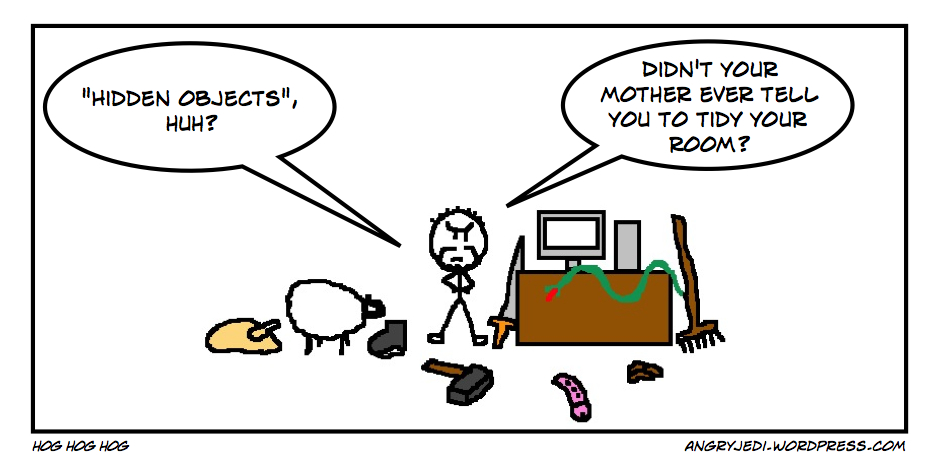
We've had the "match 3" puzzle genre — itself an evolution of earlier puzzle titles such as Klax. We've had the "time management" game — itself a super-super-super lite version of the real time strategy genre. And we have the "hidden object game", also known as the "HOG". (For some reason this annoys me. I'm not sure why. Call me irrational. [You're irrational. — The Audience.] Thanks.)

I hadn't tried a hidden object game prior to tonight, but since my BT Broadband account comes with three free months of OnLive's PlayPack I figured I'd try some of the obscure titles on offer. A game called Elizabeth somethingorother M.D. caught my attention, so I jumped in, not knowing quite what to expect thanks to OnLive's not-particularly-good job of describing what games are in its catalogue. I was hoping for something more like Trauma Center (itself an example of a new genre) but instead I was confronted with a rather bizarre experience.

If you've never tried a hidden object game, here's how they work: Plot Happens, like in a point and click adventure game (or, more accurately, like in a visual novel, since your interactions in the story are typically fairly limited.) Then, suddenly, for no discernible reason whatsoever, you are tasked with finding the aforementioned hidden objects in a scene, sometimes against a time limit, in order to advance the story.

Now, this sort of "puzzle book" gameplay would be absolutely fine if it made any sort of sense whatsoever. If I was looking for items to use in an adventure game style I would have no problem with suspending my disbelief while Doctor Elizabeth thingummybob faffed around trying to work out why she'd left her forceps on the bookcase. But instead you're tasked with finding completely incongruous objects that have no bearing on the scene whatsoever.

I'll give you an example: in the first interactive scene of Doctor Elizabeth Investigates or whatever it was called (I'd look it up, but I can't be bothered — there's your journalistic integrity for you right there) I was tasked with taking the patient's heartbeat using my stethoscope (fair enough, good start) and testing his reflexes with a hammer (similarly doctor-y). However, I was then challenged to find — in a hospital ER, I might add — three beetles, two statues, a club symbol, a gift-wrapped box, a plunger, a dinosaur and several other bizarre items which, oddly enough, vanished as soon as more Plot needed to Happen.

Now, I wouldn't call the experience "bad" as such, since hunting for the objects on the screen had a certain addictive quality to it similar to that which kept you fumbling around in puzzle books before anyone knew what handhelds or iPhones were. But it's the sheer bizarreness of interspersing a fairly serious-sounding plot with the complete flippancy of hunting down bizarre objects against a time limit — and that's not even beginning to consider the hospital's cleanliness record if it's letting that many giant beetles into its emergency room. That said, I guess the combination of elements is no more bizarre than Puzzle Quest.

I'm not sorry I tried it, but the genre's apparent popularity is somewhat bewildering. Hidden object games are seemingly only slightly less prolific than match-3 puzzle games with the casual market — which suggests that people are buying them. This means that they either don't notice the incongruity of the gameplay and the narrative — or they don't care. Which is fair enough, I guess — it all depends on what you want to get out of your gaming experience.

#oneaday Day 619: Bound by Isaac

Edmund "Super Meat Boy" McMillen and Florian "I Work With Edmund 'Super Meat Boy' McMillen Quite A Bit" Himsl have a new game out — you may have heard of it. It's called The Binding of Isaac and it costs just £3.59, or $5 to you American types. It's also a prime example of a project that would never have got greenlit by a large publisher, for many reasons.

These reasons start with the very premise of the game — you play a nude, crying child attempting to escape from his mother who has been hearing messages from God and believes that she must rid her child of corruption by, as in the Biblical story, killing him. Little Isaac isn't willing to stick around and wait and see if God stays his psychotic mother's hand, however, so he escapes into the basement, only to be confronted with numerous manifestations of his own fears and nightmares. What follows is a genuinely horrifying yet darkly amusing quest through a series of Zelda-inspired randomly generated dungeons where Isaac dispatches his enemies by crying on them and powers up through a series of items, most of which affect his appearance in some sort of particularly grotesque and inappropriate manner. Sound fun? Or just plain weird? It's both.

The exact items you'll encounter are different on each playthrough, making each run through the game's short dungeons a genuinely unpredictable experience. On one run you might come across a syringe full of steroids first of all, which beefs up Isaac and makes his head swell in an unpleasantly tumorous manner. On another run you might come across a wire coat hanger which, revoltingly, he impales through his own head and increases his capacity for crying. On yet another run you may find something else — there's about 100 different items to find and discover the uses of, and every one of them affects little Isaac's appearance in one way or another.

This being a game from McMillen, it's got a distinctive art style that is entertaining, amusing and horrifying all at once. Cute little worms slither around, only to come flying at you with fang-filled maws agape as soon as they become aware of your presence. Nightmarish clones of Isaac with no eyes in their sockets stagger around — and continue to do so even after Isaac has blown their heads off. And flies buzz around destructible lumps of shit before turning on Isaac in anger.

It's an utterly bewildering game, but strangely compelling and addictive. The fact that a single death forces you to go back to the start of a new dungeon and try again means potentially limitless replay value, and a huge number of unlockable items — including extra characters — only add to this. The game parodies the NES original Zelda dungeons perfectly, right down to the mostly mute shopkeepers with just three wares lined up before them — only in the case of Isaac's adventure, the shopkeepers are effigies of him that have been strung up by their necks and hang from the ceiling.

At $3.50, it's certainly worth giving a shot, even if you play it once and are too horrified and disgusted to play it ever again. If nothing else, it's refreshing to see fairly traditional play mechanics married to an aesthetic and setting which is utterly shameless and doesn't hold back from showing things that are either darkly hilarious or stomach-churningly revolting — I haven't quite made my mind up yet.

One thing's certain — for more reasons than one, you're never going to see this one on Xbox Live Arcade.

#oneaday Day 618: Glitch in the System

Glitch, brainchild of Flickr cofounder Stewart Butterfield, launched to the public today following an extremely lengthy and well organised testing period. I played the game briefly during testing while writing an article about it and found the experience utterly bewildering. I've had another go, and I still find it utterly bewildering.

The thing that is most bewildering is arguably its most defining feature — its non-violent nature. There is no hacking up wolves to collect 300 pelts for someone in the village. There is no dungeon delving to defeat some terrible great evil. There is no "take on this army of identical enemies singlehandedly, unless you're in a party." No, there's just a world, filled with trees, pigs, butterflies and bureaucracy, and it's pretty much up to you what you choose to do with your time there.

Your pet rock, who introduces the game to you in a tutorial which doesn't really tell you much beyond the basic controls, offers you a few quests to show you what you can do over the course of your first few hours. But beyond that, it's up to you what you choose to get on with and what skills you choose to focus on. Are you going to become a miner? A chef? Someone who talks to animals? There's a wide range of things for you to do — but none of them involve killing things.

The saying goes "you don't know what you've got until it's gone" (or something along those lines) and it's true — it's easy to take for granted that the fundamental play mechanic of the vast amount of games out there is killing things, whether it's dudes, monsters, aliens, zombies or anything else threatening the status quo. As gamers, we're comfortable with that. It's been the core mechanic of gaming since many of the earliest titles. Conflict is inherently competitive, and thus lends itself nicely to being a "game". Non-violence, however, is a more tricky prospect. What's the point of a game if there's no world to save, no princess to rescue and no Big Bad to kick the bottom of?

I'm yet to discover exactly what makes Glitch tick, but there's a lot of people playing who seem to enjoy it, so I'm willing to give it a chance. If nothing else, its non-violent nature should hopefully mean it's free of the sort of people who use words like "noobfags" and "stfu". And the whole "freeform" thing has been working pretty well for Minecraft, so why shouldn't it work for a 2D browser-based MMO platformer where there's nothing to kill? Granted, Glitch is not quite as freeform as Minecraft, though its RPG-like elements (such as learning skills) are stronger. It's not really a good comparison at all, thinking about it, save for the fact that both games are fundamentally pointless but compelling wastes of time that are inexplicably popular with hundreds, thousands, millions of people.

I shall be giving Glitch a bit more of a go over the next few days and weeks. I shall be sure to report back if I do happen to find anything interesting.

#oneaday Day 610: Gears of Bore (No-One's Ever Made That Joke Before)

I suppose with the world gripped by Gears frenzy I should probably explain why I'm not a fan of the series.

I have nothing in particular against shooters. I have nothing in particular against space marines, either — I have a copy of Space Crusade sitting proudly on my shelf as proof. But something about the first Gears of War really rubbed me up the wrong way after the "my GOD these graphics are nice even on a standard-def TV" shock wore off. I played it for a while and got a reasonable way into it before realising that I wasn't really having any fun. The series' oppressive brownness was getting to me, and what few attempts at humour there were in there just came off as silly action-movie posturing — I guess that's kind of the point, but still.

Consequently, Gears of War 2 and now Gears of War 3 hold little to no interest to me. The first game didn't make me want to get to know these characters any more, so why should I spend any more time in their universe? It wasn't just due to the risible dialogue, of course — the infuriating bullet-sponge nature of most of the regular enemies in the game put me off somewhat, too, along with numerous sequences in which snipers could insta-kill you if you didn't work out where the best cover spot was. Constant repetition of a short sequence in shooters is something of a bugbear for me, and Gears hit me right in the fury spot with one particular section.

Alongside all that, I'm not a huge fan of competitive multiplayer games (largely because I'm typcially crap at them) and it all adds up to a package that I'm not interested in in the slightest. I don't begrudge people their excitement for the new game, but it seems that the days in which every triple-A title was an essential purchase for everyone are long gone — at least so far as I'm concerned, anyway.

I'm not sure exactly when this happened. I know it was definitely this generation, as I vividly recall throughout the PS1 and PS2 eras picking up the "essential purchase" titles almost as soon as they were released. Perhaps now there are simply too many high-profile, high-quality games being released to make this practical, perhaps I'm no longer interested in the "blockbuster" genre, or perhaps I'm increasingly disillusioned with ever-more underhanded tactics to get players to part with even more of their money beyond purchasing the game itself.

Whatever the reasons, as I say, I certainly don't begrudge the Gears fans their upcoming fun-fest, but I'm more than happy with what I'm playing right now: Xenoblade Chronicles (awesome), Minecraft 1.8 (buggy but awesome), TrackMania 2 Canyon (aweso– you get the idea) and Wing Commander III (surprisingly still great). The fact that I'd rather play a Wii game, an indie game, a niche racing game and a space sim from 1994 is perhaps a sad indictment on the mainstream gaming industry, however.

Ah well. Horses for courses and other such clichés. If you're playing Gears this weekend, have a blast. I will not be joining you!