#oneaday Day 738: Diversifying

20120126-220014.jpg

In a recent blog post, one Ben Goldacre described Spotify's auto-sharing behaviour as "creepy" and called for greater transparency in opt-out procedures. While I don't disagree that users should have the option of whether or not to share what it is that they're doing, I do disagree with the good Doctor's assertion that showing off your tastes to others is somehow "creepy" or "wrong".

The reason I don't find it either of those things is because of discovery. Spotify is built in such a manner that it's easy to check out an artist or album you're unfamiliar with in a risk-free environment. You don't drop any money on the album directly, so if you wind up hating it, you haven't lost out. And if you end up loving it, you can whack it in a playlist or star it for future reference.

Combine this ease of trying things outside of your usual comfort zone with social features and you get a powerful tool to expand your own tastes. Because music is an ever-present part of society these days — silence, it seems, is frowned upon by most people, particularly those of more tender years — conversations about what artists are awesome are less common than they once were in the age of buying CDs (and, heaven forbid, cassettes). Music is just there for many people — a disposable thing that people may well have a strong connection to but perhaps don't always think to actually discuss,

What Spotify's sharing feature does is allow you to see what friends have been listening to and, if it takes your fancy, jump right in there and have a listen yourself. I've discovered more than a few new favourites this way, and I'm certain other people will have been curious about some of my tastes too. I don't have any objection to people seeing what I've been listening to and I'm certainly not ashamed of it. The same is true for Netflix, newly launched in the UK and nicely integrated with Facebook to allow you to share what you're watching. On the whole, I'm much more inclined to pay attention to new releases if my friends are enjoying them rather than if they're simply "critically acclaimed". See: The Squadron of Shame

Goldacre suggests that people will make judgements based on what you have been listening to, and your playlists which, if you weren't already aware, are made public by default. And perhaps people will — but the attitude I have always taken with personal taste is that it is just that: personal. If you're the sort of person who ridicules someone else just because of what music they listen to, how they dress, or their appearance… I probably don't really want to know you. Everyone is free to make their own choices with regard to what entertains them (unless, you know, if you're into something fucked up and illegal) and so people should not feel ashamed or embarrassed to share what it is that they have been enjoying.

In fairness, it's entirely possible that there is the scope for cyber-bullying among schoolkids based on what they might have been listening to with Spotify, or the content of their playlists. But there's the scope for cyber-bullying based on their photos, their status updates, all the other stuff that's on Facebook, too. This isn't excusing it. However, it does mean that Spotify itself isn't some sort of creepy bully-magnet. As with all forms of social media and teens interacting with others on the Web, it's important for parents to be involved and aware of what their offspring are up to. If it looks like causing a problem, they should be familiar with the options that are there to protect people — and Spotify has those options if, for whatever reason, sharing things does become a problem. But someone's listening habits are public by default — and why shouldn't they be? There's nothing to be ashamed of there.

Perhaps I have a naïve view of social media and sharing information on the Web. But I just don't see how sharing your entertainment consumption is particularly harmful. Sharing deeply personal information, yes. But the fact that you listened to the Lazy Town soundtrack today? For me, that's the start of an interesting conversation, not something creepy.

#oneaday Day 737: Attack of the Clones

20120125-220706.jpg

So it seems that Zynga, lords of the social gaming space, are cloning Nimblebit's Tiny Tower. This isn't the first time Zynga has ripped off someone else's game and removed all trace of personality from its visuals, and it certainly won't be the last. The different this time is that people are actually taking notice, because Tiny Tower, for all its faults — and it has many, that not even its glorious retro pixel art aesthetic can counter — was extremely popular, made Nimblebit a fair amount of money and was even chosen by Apple as its iPhone game of the year.

Zynga's new game is called Dream Heights and one of the guys from Nimblebit conveniently compared it to his game here. As you can see, it has pretty much all the gameplay of Tiny Tower with none of the visual appeal.

Now, in the mainstream games market, this sort of thing is generally frowned upon quite a bit. For all of the complaining that the big shooter franchises all look very similar, they at least try to differentiate themselves with how they play, the modes they offer and the like. Battlefield 3 offers a very different experience to Call of Duty. I don't care for either of them, but I can appreciate that each appeals to a different subsection of the audience,

In mobile and social gaming, however, developers and publishers seem to have no such scruples. In my current position writing game reviews for Inside Social Games and Inside Mobile Apps, I regularly see games that are almost identical to each other. Most of them follow the FarmVille model to one degree or another — you click on things, there's a countdown timer before you can click on them again to get a reward, there's a list of insultingly simple "quests" on the left side of the screen, you get experience points every time you exhale and, generally speaking, the game is designed to be a series of not very well disguised Skinner boxes.

Other popular genres include the growing hidden object genre, where you're sent into a cluttered room/street/train carriage and tasked with locating lists of completely arbitrary items, with scenes tied together by an often flimsy excuse for a plot. Just in the last couple of weeks, Zynga released Hidden Chronicles on Facebook, only to be followed this week by the almost identical World Mysteries from Brazilian developer Vostu. See, it's not just Zynga doing it — it goes both ways, too.

Fans of Spry Fox's fun puzzle game Triple Town on Facebook and Google+ may also want to check out Yeti Town on iOS by the obnoxiously-named 6waves Lolapps. This game has drawn criticism for ripping off Triple Town completely and releasing on iOS before Spry Fox were ready to release their own iOS version of their game. You may argue that Spry Fox should have been quicker off the mark in getting their iOS version to market, but it's hard to believe that 6waves Lolapps came up with an identical concept (not almost-identical, identical) completely independently of Triple Town.

Independent developer Vlambeer ran into this issue last year when, like Spry Fox, they were beaten to the punch on an iOS game. Gamenauts' Ninja Fishing hit the App Store shortly before Vlambeer was ready to release its own title Ridiculous Fishing, itself a reimagining-cum-sequel of its earlier Web-based title Radical Fishing. I'm very pleased to see that Vlambeer will be speaking publicly about this debacle at GDC this year.

Where does it end, though? Games are a creative art form and for all these clones to hit the market is to do the medium a disservice. You don't get books hitting store shelves where an author has simply done a Find and Replace on all the characters' names from someone else's work, nor do you get movies which are simply shot-by-shot reconstructions of another movie. We get remakes, sure, but at least those are usually reimagined for a contemporary audience — and they're being honest about their source material rather than attempting to pass themselves off as a completely new product.

This practice needs to stop. Unfortunately, cloning, it seems, is already an established part of mobile and social game development. In the long term it will only hurt everyone's business.

So devs? Be bold. Come up with an original idea. Don't call your game "innovative" if it's the same as something someone released last week, and the week before, and the week before. Try something new. Break out of established conventions. The most memorable games in the mainstream are the ones which tried something new. The moment we see a successful social game break out of the market's conventions is the same moment we'll see people willing to be a bit less cynical and a bit more enthusiastic to see what this burgeoning industry has to offer.

#oneaday Day 734: Pay Attention

20120123-000024.jpg

Since getting an iPad a few short days ago it's become more clear to me than ever that if you are ignoring the iOS platform on the grounds that it's "just mobile games", then you are Doing It Very Wrong.

Let's face some home truths first of all, however. Traditional control schemes suck on touchscreens. The lack of tactile feedback is the main thing — you can't feel those buttons under your fingers, so it's all too easy to drift away from them, particularly if they're of the breed that are fixed in place. Alongside that, your thumbs blocking part of the play area isn't a great look, particularly on the small screen of the iPhone and iPod touch.

That is the main issue with iOS gaming, but also a blessing in disguise.

The fact that traditional control schemes sucking is such a well-established fact by now means that iOS developers are forced into making some important decisions when creating their games. Do they remain steadfast and shoehorn in a virtual joypad control method? Do they support external controllers such as the iCade and make the assumption that anyone serious about playing that kind of game on iOS will already own one? Or do they throw conventional thinking about what makes a good portable game out of the window?

It's the latter option that leads to the most interesting experiences, and it tends to lead in one of two directions. The first direction leads to the explosion in new styles of gameplay we've had since gaming really started to take off on the platform. Granted, some of these existed in the form of independent and Flash games prior to iOS' emergence, but Apple's platforms have very much brought them to the masses. Physics-based puzzlers. Line-drawing games. Match-3 puzzlers. "One-touch" games. All of these provide simple mechanics that are surprisingly versatile. In the case of the line-drawing genre, for example, go play Flight Control, DrawRace 2 and Heroes vs Monsters and tell me that isn't an incredibly versatile control scheme.

The second direction is in the resurgence of genres which have lain all but dormant everywhere except the independent PC game development community for many years. Turn based strategy titles. Board game adaptations. First person flick-scrolling dungeon crawlers. Deep, hardcore roleplaying games. Roguelikes. All have made something of a comeback on iOS, and it's no coincidence that these games provide some of the most satisfying experiences on the platform. It's also these titles which provide the strongest, most compelling evidence that yes, you do get "proper" games on iOS, and there's no reason to believe that you're getting a "lesser" experience than what you would get from a console, except perhaps from some diminished graphical quality — and even then, that gap is rapidly closing.

iOS does also bring with it its share of controversial topics. The monetization of games in particular. It's not unusual these days for games to have the option to purchase in-game currency or even skip out parts of the game altogether. I'm not a big fan of this practice, but if done correctly, it can actually have several benefits for both consumer and developer alike.

Firstly, it allows the game itself to be released at a far cheaper price point than you'd ever see it on 3DS or Vita. I bought a racing game today for 69p. It has impressive graphics, fun gameplay and is certainly on a par with the PSP version of Burnout in terms of depth. 69p. You can't even buy a cup of coffee for that anywhere, yet here I am paying it for a game that would have been at least thirty quid a few years back. And how can it afford to do that? Because of the few people out there who value their time more than their money and would rather unlock content in the game quickly through dropping a few pounds on it rather than playing through it normally — which, I hasten to add, is very much still an option.

The downside to above is that it has affected the perceived value of these games. If you paid 69p for a game — or even got it for free in some cases — are you more or less likely to play it through to completion? I'm guessing "less", because if you're anything like me, that feeling of "I just spent forty quid on this, I'd better bloody play it" just isn't there. This factor is actually mitigated somewhat by the titles that are considered "expensive" on the platform — look at Square Enix's £10 RPGs, for example, or £5 titles like Infinity Blade and Galaxy On Fire. £5-10 is considered "expensive" for an iOS title so people are more likely to think before they buy, and by extension take a bit more time to play through these less "disposable" titles.

I think by far the greatest thing about the platform, however, is how there's something to appeal to pretty much everyone. In my circles of family and friends, there are kids and grandparents who like playing Angry Birds; hardcore strategy gamers who like deep, complex mechanics; commuters who appreciate having something quick and low-maintenance to play on said commute; hardcore gamers who crave the depth of a console or PC title in a format they can carry around with them; people who don't have time to immerse themselves in the sprawling experiences that are today's interactive entertainment titles but appreciate the opportunity to play a quick game of Words, Scramble or Hero Academy with friends. All of them are catered to, and there's a bunch of crossover between the groups too. That's amazingly awesome, and it's probably done more to help the image of gaming in the mainstream audience than any other technological innovation we've had over the years.

So in summary, then, if you arestill of the belief that iOS as a platform isn't important to the games industry and games culture at large, I say again: you are Doing It Wrong.

#oneaday Day 733: The Greatest iOS Game You've Never Played

20120121-201751.jpg

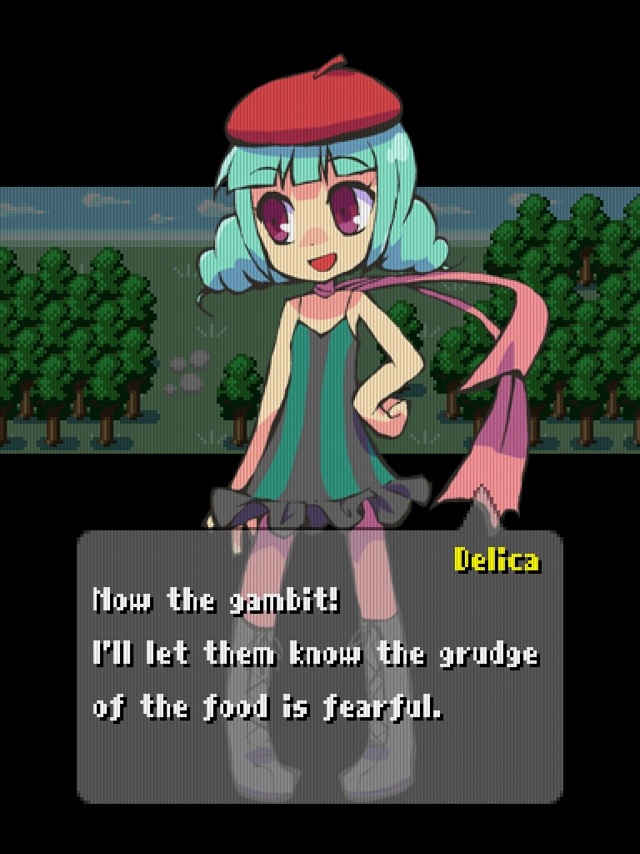
Oh boy do I have a treat for you iOS owners out there. A free game that is brilliant, doesn't try to con you out of any money and doesn't have a single ad in it anywhere. Not only that, but it also features the most spectacular Engrish you will ever see, as evidenced by the screenshot which accompanies this post.

The game in question is HungryMaster by xionchannel. I found it completely by chance while browsing titles related to Square Enix's catalogue on iPad, and downloaded it out of sheer curiosity. I was expecting it to be a five minute novelty, to be deleted immediately afterward.

What I instead found was a wonderfully silly, addictive little game whose use of touch controls puts big-name developers to shame.

The premise is simple and insane. Delica is hungry and walking in the woods one day when she comes across a talking white cat called Saten [sic]. Saten offers to give Delica magical powers for some reason I feel is somewhat lost in translation. Said magical powers allow Delica to defeat monsters by turning them into food, which kills two birds with one stone.

In gameplay terms, the player controls Delica by touching on the screen anywhere, and she follows. In order to use her new-found magical girl powers, the player must draw a line starting from her and running through enemies. The player can lock on to as many enemies as they can draw a line through while a brief timer is running, then they explode and turn into food when the player releases their finger. Delica can then collect the food by running over it. Collecting more food in rapid succession gives a combo bonus, and the main objective of most levels is to collect enough food to deliver to houses scattered around the map. There are occasional boss fights, too, where twenty pieces of food can inexplicably be used to set off a bomb.

It's as gloriously ridiculous as it sounds, but the gameplay is very solid thanks to the excellent touch controls. The whole thing is presented on the iPad or iPhone screen in portraitwise orientation, features 80s-style pixel art and scanlines. It's like holding a forgotten 80s arcade machine in your hand — the sort you only ever found at that one arcade at that one seaside resort, but would always insist on going to whenever possible because that hidden gem of a game was just so good.

I'm very happy that I've found such a hidden gem on iOS. Check it out for yourself here.

#oneaday Day 727: Together Apart

You know what it's like. You want to play with friends but they all live on the other side of the world to you, so you can never find a convenient time to play together, and as such, you never get the chance to take each other on.

Not so if you happen to have a smartphone or tablet. There's a bunch of asynchronous multiplayer games out there for you to play, meaning that you can take it in turns to play together when it's convenient for each of you. While it's not quite the same as playing live, it's the next best thing.

But what are these games? Well, focusing on iOS, here's a few:

…With Friends

Whatever you may think of Zynga the company, it publishes some of the most popular multiplayer titles in the iOS library: Chess, Words, Hanging and Scramble With Friends.

Of these four games, Scramble is my favourite because it's quick and easy to play, and impossible to cheat at. Words is far too open to abuse (there are tons of "cheat" apps on the App Store), Hanging is a bit boring and, well, I suck at Chess.

The fact that, at the time of writing, I am unbeaten at Scramble certainly helps!

Disc Drivin'

If you've ever flicked a coin around a makeshift course or played that racing game where you flick wooden discs around a racetrack, Disc Drivin' is for you. Offering a bunch of courses, some powerups and the ability to play with up to three friends, this is a fun one for a while, though lacks depth.

Carcassonne

Carcassonne is a brilliant entry-level board game, and its iOS version, while relatively expensive, is an excellent port. Offering not only a great port of the base game but also a fun solitaire puzzle mode, this is a personal favourite.

Ascension: Wrath of the Godslayer

A great card game, as discussed the other night. Ascension lends itself well to the asynchronous format because players compete with one another for points, but turns are pretty self-contained. What little direct interaction there is between players is easily resolved at the start of the next player's turn. The only thing this one is missing is a chat facility — you just play.

Starbase Orion

I admit I haven't spent a huge amount of time with this yet, but it's probably the deepest game on this list. Playing out like Master of Orion (or sort of Civ in space, if you like), this is a lengthy, complex game that strategy buffs will have a blast with in either single or multiplayer.

Hero Academy

The newest title on this list, Hero Academy from Orcs Must Die! developer Robot Entertainment is a turn-based combat strategy game that combines elements of DOTA, tower defense, Final Fantasy Tactics and, err, Scrabble. (Yes, really.) Providing players with a "rack" of units and abilities to use each turn, then allowing five actions per turn, this is a simple to understand but tough to master game with a lot of potential for awesome development in the future — new teams, maps and other possibilities are all in the works.

—

So there we go. If you have an iOS device and you're looking for some multiplayer action you can fit around your life rather than having to set aside hours at a time, the above are a great place to start.

Do you have any recommendations to add? Let me know in the comments!

#oneaday Day 723: The Escapist

Escapism is cool, and an important and valid method of keeping yourself sane.

There are, of course, many means of escapism, and different ones are more or less effective for different people.

There's the escapism of a child giving life to the inanimate lumps of plastic they own. Without a child, they're just potential, models, things to be looked at, without life. Add a child (or, more specifically, someone still in possession of their childish imagination) and something magical happens — those objects come alive, engaging in battles to save the galaxy; heroic adventures; or even just a normal day in a normal street.

Then there's the escapism of a good book. Good readers also have one of the most important qualities of a good creative writer: that active imagination again. But it's partly also down to the writer to create a convincing world, compelling characters and a reason for the reader to commit part of their life to staring at tiny print on paper, e-ink or an LCD display. You know a writer's done their job properly if you can hear the characters' voices, see the places they're in, picture the things they're doing. And as a reader, your interpretation and mental imagery might not be the same as the writer (or indeed the person who designed the book's cover) — but that doesn't make it any less valid.

There's the escapism of interactive entertainment. Instead of passively observing an unfolding story, you become a part of it. It doesn't have to be an explicit narrative as such — a long game of Civilization tells a story just as much as a chapter of Heavy Rain. The meaning the player chooses to assign to the experience is what makes interactive entertainment special.

There's the escapism of film. Increasingly designed as memorable spectacles these days, a good movie plunges its audience into darkness before casting them into a whole new world. It could be a world of giant robots; of CIA agents; of lads on a pulling holiday. For those couple of hours, though, the outside world ceases to matter.

There's the escapism of a good TV show. When you find a show that resonates with you, you want to stick with those characters, to find out what makes them tick, what they want, what they find challenging. You cheer for their successes, feel bad when they encounter adversity. And given the amount of time you spend with the cast of a TV show over an average run of a moderately successful show these days, it's not beyond the realm of possibility that the cast might feel like "friends" by the time you're through.

And there's the escapism of music. Music is a powerful imaginative stimulus, but again it means different things to different people. For one person it might stir up dormant memories. For another it might encourage them to close their eyes and picture themselves in a whole new situation. For yet another it might have an emotional impact that reflects the things that are weighing on their mind at that moment in time. And for others still it might inspire them to push forward, to do their best, to power on through and do that extra set at the gym, or put in that extra bit of effort at homework.

All this isn't even getting into what it means to be a creator as opposed to a consumer of all the above media, either.

The fact is, the world can be, at times, a bit of a sucky place. Having something comforting to escape into, whatever form that escapism might take, is important. No-one likes to feel trapped, so even if it's only for a short while, escape into something awesome and return to the real world refreshed, invigorated and ready to tackle any challenges it might want to throw at you.

And if you don't have anything like that? Then you need to have more fun.

#oneaday Day 717: Just One More Turn

I've been playing Civilization V. It's now 3AM. The two facts may be somewhat related.

I've only been playing the Civ series since its fourth instalment, and while I've found it entertaining and fun, like many heavily strategic board games, I find it difficult to actually succeed at it. It's a challenging series of games, for sure, and there are lots of things for you to focus on all at once — thankfully with the infinite time offered by turn-based games.

Civilization Revolution on consoles provided a different experience which I liked a whole lot. What we had in that game was a simplified (but not dumbed-down) Civ experience which could be played in relatively short sessions, and which was set up to encourage players to be at each others' throats almost constantly.

And now we have Civ V. I know we've had Civ V for a while now, but I've only just started playing it thanks to a generous Christmas gift. (Thanks, Paul!) Civ V, for me, is resonating nicely, offering a pleasing middle ground somewhere between the simplicity of CivRev and the depth of Civ IV. It's certainly a different beast from Civ IV, and those who have grown accustomed to the functions of the various buildings in IV will have to relearn everything for V. Thankfully, the game does a pretty good job of explaining what each building does, and offering enough suggestions to help you out without feeling like you're being shunted down a specific path or letting the game "play itself".

There seems to be a nice balance between number of players and game time, too. In Civ IV, I often found that playing a game with any more than two or three players total often meant it would stretch on into the "days long" territory, making it all the more disheartening when something went disastrously wrong in 850BC and you then spent the rest of the game playing catch-up, with no hope of winning. The game of Civ V I played tonight, however, went on for about three and a half hours. That's not short by any means, but it's certainly doable. A tabletop game of Arkham Horror takes three hours. And, of course, with Civ you can always save and come back to it later.

Except you can't. Because there's something in that game that means you can't just leave it alone. Something deep within the coding that taps into the pleasure centres of your brain and wants you to keep playing — yes, for "just one more turn". It's difficult to pin down what it is — certainly it doesn't resort to Skinner Box tricks like social games, but there's definitely something in there giving it a particularly addictive quality. Perhaps it's the fact that you have to come up with a long-term strategy and aim for a specific type of victory. (Cultural in the case of the game I just played, meaning my empire focused almost entirely on developing culture, and I spent the entire game hoping my neighbour to the North wouldn't feel the need to attack me. Fortunately, he was more interested in subjugating the city-state of Singapore to pay too much attention to me.) Perhaps it's the little countdowns showing how many turns until you complete that piece of research or build that cool building. Perhaps it's the little mini-rewards — famous quotes when you research a tech, short movies when you build a Wonder. Or perhaps it's just the satisfaction of seeing your empire grow and grow and grow and thinking "I made that."

Whatever it is, I say simply DAMN YOU, SID MEIER.

#oneaday Day 716: Games Media Shakeup

Interesting news out of the game journalism industry today, as luminaries from Joystiq, Kotaku, The Escapist and MTV news come together to form the Voltron of writing about games, Vox Games (final name TBD).

The "dream team" assembled for the new venture has the potential to provide a serious shakeup to video game news and journalism if handled correctly. All hail from some of the most popular, well-known sites in the oversaturated field of games writing, and all will have their own take on how to push the medium forward. Hopefully Vox Games, or whatever it ends up being called, will prove to be a site that dares to be different.

But what does that mean? What could a "different" games site look like? Let's brainstorm.

For starters, the idea of "consensus" among the media needs to go out of the window. Jeff Rivera wrote a good piece on this subject over at Gamer Theory recently, and he's on the money. All too often we see outlets appearing to predetermine which games are going to be the hotness of the season, sometimes offering review scores which don't necessarily match up with the words being written. Battlefield 3, for example, was almost universally lambasted for its (apparently — I haven't played it) woeful single player campaign, but that didn't stop it picking up a ton of perfect scores and awards. In some cases, this is likely something of a hangover from Gerstmanngate, as outlets don't want to piss off their advertisers by rating the game that is on the background of every single page of the site less than a 9 out of 10.

Alongside this, the audience needs to be re-educated away from thinking that anything under a 9 isn't worth bothering with. Eurogamer ran afoul of commenters on several occasions last year by daring to rate big releases with an 8. They weren't wrong to do so, but commenters were wrong to assume that 8 meant "bad". This is a hole we've dug for ourselves over the years, and it's going to be very difficult to get away from. It's tied in to the "consensus" thinking, though — it's entirely possible that those reviewing a game for a particular outlet might feel the desire to see what other places have rated it, and, whether consciously or subconsciously, seeing these other scores can colour the writer's judgement.

Which is ridiculous, of course, because scores are completely arbitrary and borderline meaningless. There's no way to quantify "how good" a game is. There's no universal measure of "quality" because everyone's tastes are so different. Some people might think Modern Warfare 3 is game of the year, while I might think it's the most insulting game I've ever played. (I do, incidentally.)

But the review scores debate is well-worn, so I'll step away from it at this point and consider some other ways in which game journalism can evolve and develop.

Chief among one of the things which needs to adapt is the relationship between developer, publisher, PR and press. At present, publishers and PR hold all the power. Developers are muzzled from talking about their game if it doesn't fit into the publisher and PR teams' tightly-controlled marketing plan. We get press releases announcing when trailers will be released. We get countdowns to countdowns to exclusive reveals of some stupid thing on YouTube which they hope will go viral but won't because it's trying too hard. Many newshounds in the industry get reduced to little more than PR mouthpieces, frantically rewriting the press releases that flood their inboxes on a daily basis rather than going in search of the "real story". And why? Because uncovering a "real story" might compromise a relationship between an outlet and a publisher/PR team.

This isn't an anti-PR rant, of course. Many PR types do a fantastic job of facilitating communication between different branches of the industry, acting as a "gobetween" or "messenger" rather than an impenetrable wall through which information cannot pass. Aubrey "Chupacaubrey" Norris (Deep Silver), Tom "Evolve PR" Ohle (CD Projekt, Larian Studios and numerous others) and Jeff Green (PopCap) spring immediately to mind here, and are certainly a far cry from the PR teams from certain large publishers who take days to reply — and don't even bother at all sometimes. For the industry as a whole to evolve, we need more people like this who are willing to work with the press rather than, as sometimes seems, against them.

And what can the writers in this brave new world do, besides not feeling obliged to fit in with the consensus of the rest of the industry? Branch out. Explore. Raise the profile of small-scale projects and the underdogs of the industry. Review the crap games as well as the awesome ones. Provide something unique — truly unique, rather than the press release meaning of "unique" — as opposed to what many other sites offer, which is an interchangeable retread of the exact same story also posted on all of the other outlets. Different sites should have their own "voice" — and this doesn't necessarily mean being snarky, which is a somewhat overused form of humor in the industry today. What I mean, rather, is that different outlets should have their own take on events that are transpiring — editorials, comments, analysis, rather than the same dry old press release facts and improbable quotes from CEOs and VPs of Five Different Capitalised Titles.

Will Vox Games be the outlet to give the industry a good shakeup? I certainly hope so, and should the opportunity ever arise to become a part of it, I'll be sure to do my bit, too.

#oneaday Day 711: The Ancient Craft of Mining

Andie and I may have inadvertently spent pretty much the whole day playing Minecraft. I've spoken at length on the virtues of this game on several occasions on this blog, but every time I play it I find something new to appreciate, a new way to play or a new way to look at the game.

This, of course, is the central beauty of Minecraft as a game. No-one is telling you how to play it. The Achievements which were added a few updates ago give you a nudge in several possible directions — enough to get you started, anyway — but beyond that, it's entirely up to you what to do.

On the Squadron of Shame SquadCast, we've had a number of discussions on the subject of games that plonk you down into the game world and simply invite you to "get on with it". Traditional RPGs followed this format, though often had a questline to follow. Bethesda RPGs, too, follow this approach after a linear introductory sequence. But none do it quite like Minecraft, which is refreshingly old-school in its approach.

Minecraft doesn't have a story. At least, not an explicit one. Nowhere is it made clear exactly why you've been thrown into this blocky landscape with nothing to your name but your wits. Nowhere is there an introduction describing how and why the monsters that plague the landscape after dark came to be. And not once are you told what your "goal" is.

In some senses, this is a return to gaming's roots, when all the information you needed to know about the game's plot and setting could be fit on the back of the box. Minecraft's retro aesthetic would certainly seem to fit with that theory, but the complexity, depth and freedom that the game offers is something that simply wouldn't have been possible with older systems.

I do most of my playing on a small private multiplayer server which is in "survival" mode. This is fundamentally identical to the single player mode, where you're tasked with surviving against the elements (or, indeed, monsters) with only your wits and what you can scavenge. You start playing in a very small area, gathering resources and building materials near where you started in an attempt to create a convincing shelter before the sun sets and the monsters come out to play. As time goes on, however, you spread your wings and start to explore the randomly-generated landscape. In single player, you'll find yourself discovering a variety of different natural biomes — forests, swamps, mountains — but it's in multiplayer that the world of Minecraft truly comes alive.

Round a corner of a mountain, you might find a mysterious door set into the hillside. Entering, you might find some chests containing tools, food and building materials — along with a sternly-worded sign informing you that this stuff is not yours.

The beauty of it, though, is that if you want to be a complete git about it, you could just take all that stuff and run. The facility to leave signs with your own custom wording on them, too, means that it's not beyond the realm of possibility to, say, nick someone's hoard of diamonds, bury them in a chest somewhere in the depths of the desert and leave them a trail of clues to reclaim them. I hasten to add that I haven't done this, but it is enormously tempting to do so.

A multiplayer Minecraft server becomes something of a community. How active that community is depends largely on how many other players there are and how often they play. On a big, busy server, you'll find impressive structures all over the place as players attempt to outdo each other with outlandish construction projects. On a small, private server such as ours, the world will change gradually, evolving piece by piece as each player stakes out their claim to their own piece of territory. It's fascinating to watch — the fact that the world is persistent so can be changed by other players when you're not online means that there's often something new and player-made to take a look at when you next log in. It also means that eventually you'll have to start either competing for the finite resources that there are, or travelling further afield to locate the items you'll need to survive and/or complete your latest building project.

There are so many ways to play Minecraft, and the situations I've described here barely scratch the surface. It's whatever you want it to be, and it's for that reason that I believe that outlets "reviewing" the game when it finally reached Version 1.0 is an utterly futile gesture. For one, everyone's experience with the game is somewhat different — some are switched off by the lack of direction and give up in frustration; some "powergame" by building the bare minimum they need to survive and progress, attempting to reach the newly-added endgame; some take their time to build impressive structures; some roleplay in their mind, casting themselves in the role of a town planner, laying out buildings and imagining what each might be used for; some do everything they can to make life hell for other players. Not one of those ways to play is "wrong" — even the griefer — and that's why the game is such a work of genius, despite its glitches and flaws, of which there are still many.

Minecraft will continue to develop over time, though now it's emerged from beta and its creators are working on other projects, new versions will be released at a slower rate. There's still an enormous amount of potential there, though, and it's exciting to imagine what might come next. By putting the creation of the game world and its character in the players' hands, the team at Mojang have created one (or indeed many) of the most compelling game worlds ever seen in interactive entertainment. There really is nothing like strolling down a street you've built yourself, defending it from monsters who want nothing more to 1) kill you and 2) blast big holes in your hard work.

If you're yet to try Minecraft, then get yourself over here and join the 4.3 million people — yes, wow — that have bought the game to date.

#oneaday Day 707: Holy Balls, How Did It Get to 3AM?

Okay. I think we can say with some certainty that The Old Republic is A Bit Good, judging by the fact that I uttered that very statement above while playing with my good buddy Jeff "Feenwager" Parsons tonight. This morning. Whatever.

As I said the other day, while the game does suffer from a few of the genre's perpetual annoyances (having to traipse all the way back to a trainer to learn new skills is something MMOs should really move beyond, for one thing) it does a lot of things right. It's balanced nicely for those players who want to play solo and just happen to "live" in the same world as other players. There are specifically-designed areas known as "Heroic Areas" which are light on story and heavy on fighting, ideal for pick-up groups. There are more lengthy multiplayer story-heavy missions known as Flashpoints. There is PvP. And pretty much everything can be played cooperatively if you so desire.

Some have argued that the writing perhaps isn't up to BioWare's usual tip-top standards, but when you consider the amount of content in this game even at launch, it's perhaps not surprising. That said, the "dark side" options in dialogue (which can usually be interpreted as "snarky") are often amusing. I'll be interested to see if playing a dark-inclined Jedi will have any significant effect on the plot. It's provoked some NPC comments so far, but I'm very early into my playthrough with said dark-inclined Jedi, so a lot remains to be seen.

Perhaps the most notable thing about the game is the fact that it's encouraging people who aren't huge fans of MMOs to give it a shot. Jeff, whom I mentioned above, is one. My buddy Edd, aka Roth, whom I used to play Final Fantasy XI with for a short period, is another. A good indicator of The Old Republic getting things "right" for me will be if these two stick around beyond the free month — and if other friends who typically shy away from the genre sign up, too. I hope they do, as these games are always more fun with friends.

The community I've encountered so far has been very friendly. With my "main" character on the European servers, I plumped for an RP (Roleplaying) server as this generally is populated with more pleasant types. I haven't been disappointed so far — when asking for advice, people are usually happy to give it rather than inviting you to "Google it". This is nice. Quite how long it will last, I don't know — the game is still new, after all — but for now I'll enjoy it.

The only thing I can see putting people off trying The Old Republic is the price. With so many free MMOs out there now, it's hard to justify spending "full price" on a new one, plus a monthly subscription after the first month. But it's effectively several BioWare games in one, along with a potential WoW-beater. And if that isn't value for money, I'm not sure what is.